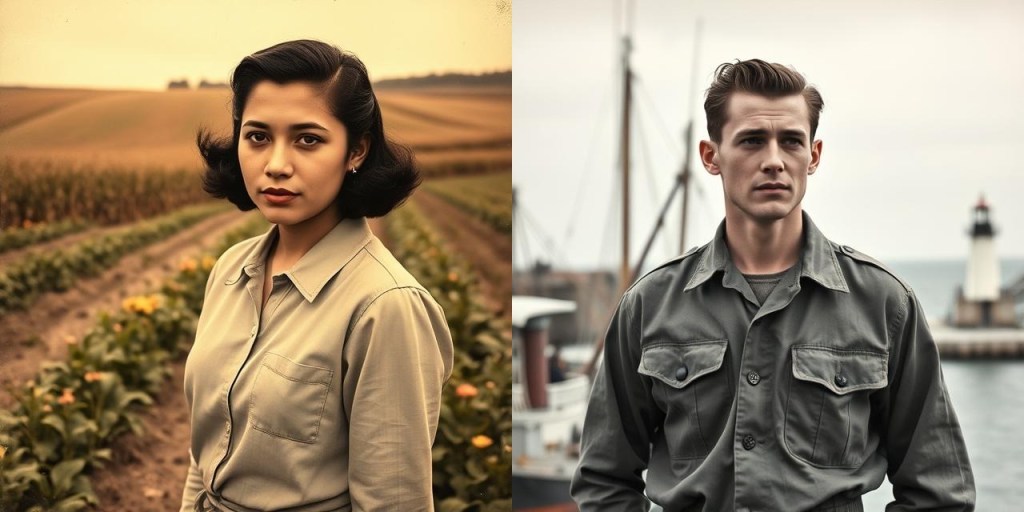
Miss Florence Marie Hernandez
1247 County Road K
Verona, Wisconsin
15th October, 1943
My Dearest Henry,
Your latest letter arrived yesterday morning, nestled amongst the usual collection of agricultural reports and government circulars that cross my desk. I confess I nearly tore it open right there in the office, propriety be damned, but Mrs. Schroeder was hovering nearby with her eagle eyes, and I couldn’t bear the thought of her witnessing whatever emotions might play across my face whilst reading your words. So I waited, Henry—waited through the longest afternoon of my life, that letter burning like a small fire in my coat pocket.
Now, in the amber light of my bedroom lamp, with Mother’s roses releasing their final autumn fragrance through my open window, I find myself both thoroughly content and rather cross with you, which I suspect is precisely the state you intended to provoke with your last correspondence.
How dare you assume, Henry James Cook, that my curiosity about the world stems from some provincial restlessness—some small-town girl’s romantic notion that life begins only beyond Wisconsin’s borders? Your letter fairly dripped with gentle condescension when you wrote of “showing me the ocean” and “introducing me to the wider world,” as though I were some sheltered creature who had never ventured beyond Father’s cornfields or questioned the limitations of my circumstances.
I’ll grant you this: I have not sailed across the Atlantic or walked the bomb-scarred streets of London. I have not debated philosophy in the hallowed halls of Brown University or worked alongside learned men in your family’s shipyard. But do not mistake the geography of my experience for the boundaries of my understanding. Each morning when I tend Mother’s victory garden, I am nurturing life in defiance of a world bent on destruction. When I catalogue the correspondence that flows through our agricultural office, I am tracing the intricate web of sustenance that keeps our nation fed whilst her sons fight overseas. These may seem humble endeavours to your worldly perspective, but they require their own form of courage and wisdom.
Yet even as I chide you for your presumptions, I find myself smiling at the very qualities that inspire such gentle arrogance. Your bold confidence, that intellectual swagger that allows you to question everything from military protocol to the fundamental nature of human connection—these are the same traits that drew you to write to a secretary from Madison rather than some sophisticated East Coast debutante who might better complement your university education and family connections.
You see, darling Henry, I know exactly what you are, perhaps better than you know yourself. You are a man who thinks deeply but sometimes forgets to feel completely. Your letters arrive filled with philosophical musings about duty and honour, with observations about the English countryside and reflections on the books you’ve been reading. They are beautifully crafted, intellectually stimulating, and occasionally maddening in their emotional restraint.
But then, tucked between your grand thoughts about the nature of love and partnership, I discover small revelations that make my heart quicken. The way you described the lighthouse near your childhood home, how its beam reminded you of the steady glow of understanding you’ve found in our correspondence. Your confession that you carry my last letter in your breast pocket during missions, not for luck but for the comfort of knowing that somewhere, someone sees beyond the uniform to the man questioning everything he once accepted without thought.
These moments of vulnerability, these glimpses of the heart beneath your careful intellect, are what I treasure most. They remind me why I began looking forward to your letters with such shameless anticipation, why I find myself composing responses in my head whilst cataloguing seed orders or walking home through the gathering dusk.
I am content, Henry—deeply, surprisingly content—with this strange courtship we’ve constructed from words and imagination. Our correspondence has become something I never expected: a collaboration of minds and hearts that transcends the physical distance between us. Through your letters, I have indeed travelled beyond Wisconsin’s borders, but not as some wide-eyed tourist seeking entertainment. Instead, I have journeyed as an equal, contributing my own observations and insights to conversations that matter.
You write of building something beautiful together once this war ends, and I find myself believing in that possibility with a faith that sometimes frightens me. But know this: when we finally meet, you will not be rescuing some provincial maiden from her limited circumstances. You will be joining your life to someone who has been preparing for such partnership not through grand adventures but through the patient cultivation of understanding, both of herself and of the complex man whose letters have become the most important part of her days.
Write soon, my darling philosopher. And next time, remember that wisdom grows as readily in Wisconsin soil as in any ivy-covered campus.
With all my love and gentle reproach,
Florence
P.S. The roses you mentioned in your letter? Mother’s garden produced the most magnificent blooms this season. Perhaps some mysteries are best experienced together rather than explained in advance.
Bob Lynn | © 2025 Vox Meditantis. All rights reserved.


 Vox Meditantis
Leave a reply to veerites Cancel reply