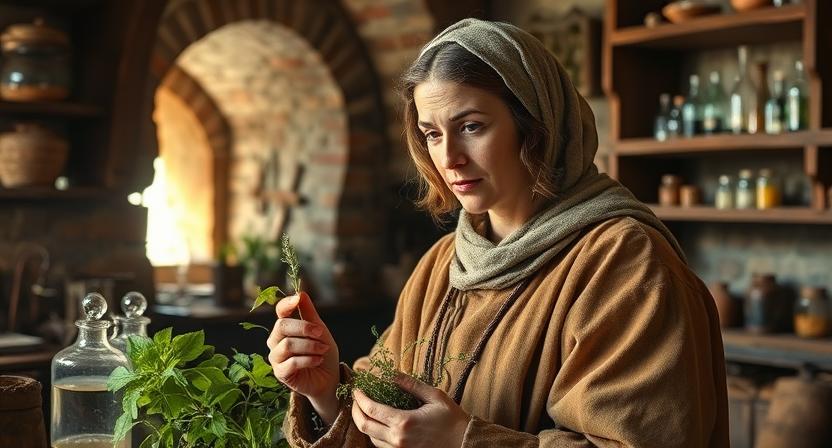
What happens when an entire medical profession erases its most influential practitioner? When centuries of scholarship reduce a brilliant woman to a mythical figure? Today, we’re speaking with someone whose groundbreaking work shaped European medicine for centuries—yet whose very existence was questioned until 1985. Meet Trota of Salerno (c. 1100-1170), the physician who revolutionised women’s healthcare in medieval Europe, only to watch her name disappear from history books.
Working at the world’s first medical school to accept women, Trota authored “On Treatments for Women,” the most comprehensive medical text on women’s health of its time. Her work established the foundations of gynecological practice that influenced European medicine for centuries. Yet her individual contributions became obscured when her work was combined with texts by male authors to create “The Trotula” compendium. For centuries, the entire work was attributed to a mythical figure called “Trotula,” rather than recognising Trota as the author of the core gynecological treatise. This erasure exemplifies how medieval women’s medical knowledge was systematically dismissed or attributed to male authorities.
Today, we’re correcting the record. Let’s hear from the woman herself.
Trota, thank you for joining us. First, I must ask—how does it feel to know that for centuries, people didn’t even believe you existed?
Ah, but I did exist. I breathed, I worked, I healed. The women of Salerno—they knew I existed. The mothers whose children I delivered safely, the wives whose monthly courses I regulated, the daughters whose wedding nights I made less fearful—they knew. It matters little what scholars eight centuries hence chose to believe.
Though I confess, it stings to learn that my name became a title, a thing rather than a person. “Trotula”—as if I were merely a collection of remedies rather than the woman who observed, experimented, and reasoned my way to those cures.
Tell us about your early life. How did a woman in 12th-century Italy come to study medicine?
I was born to fortune, I’ll grant you that. The di Ruggiero family had means, and Salerno—blessed Salerno—was no ordinary city. Here, at the crossroads of Christian, Islamic, and Jewish learning, knowledge flowed like the tides. My father, God rest his soul, was a practical man. He saw that the Schola Medica Salernitana welcomed women as students and teachers. “Better a learned daughter than an ignorant one,” he used to say.
But don’t mistake privilege for ease. I spent my youth memorising the works of Hippocrates and Galen, grinding herbs until my fingers bled, and watching the master physicians at work. The smell of mercury and sulfur became as familiar as bread. I learned to read bodies like manuscripts—the yellow cast of jaundice, the particular odour of certain fevers, the way a woman’s pulse changes when she quickens with child.
What drew you specifically to women’s medicine?
Necessity, plain and simple. Do you know what it was like to watch women suffer in silence? To see them die in childbirth from complications any trained physician could prevent? Male physicians of my time knew precious little about the female body. They theorised that women were merely defective men—our organs turned inward, our humours colder and moister. Nonsense, all of it.
I attended births where male physicians wouldn’t enter the birthing chamber, deeming it unclean. I saw women whose monthly bleeding had ceased, told they were cursed or barren, when simple herbal remedies could restore their cycles. I witnessed the agony of new mothers whose torn flesh went untended because it was considered unseemly for men to examine such matters.
Someone had to stand for these women. Someone had to observe, to learn, to teach. If the men wouldn’t do it properly, then by God’s grace, I would.
Your major work, “On Treatments for Women,” was revolutionary. Can you describe your approach to medicine?
My approach was simple: look, listen, test. I rejected the endless theorising that plagued medicine in favour of what actually worked. When a remedy succeeded, I noted it. When it failed, I discarded it. I trained my students to examine their patients thoroughly—the colour of their water, the rhythm of their pulse, the texture of their skin.
I insisted that women’s bodies deserved the same careful study as men’s. I documented how to ease the pain of childbirth—yes, even though the Church claimed such pain was God’s punishment for Eve’s sin. I prescribed opiates for labour, herbs for regulation of the monthly courses, surgical techniques for difficult births.
Most importantly, I recognised that often both husband and wife contributed to childlessness. Revolutionary? Perhaps. But I had seen too many women cast aside as barren when the fault lay equally with their husbands.
You also wrote about cosmetics and beauty treatments. Some might find this surprising for a serious physician.
Surprising? Why should caring for a woman’s appearance be less worthy than caring for her fever? Beauty and health are not separate concerns—they are intimately connected. A woman who feels confident in her appearance carries herself differently, speaks more boldly, lives more fully.
My cosmetic remedies used the same principles as my medical ones: local ingredients, tested methods, practical application. I prescribed treatments for unwanted hair, remedies for spotty skin, ways to whiten teeth and sweeten breath. I taught women how to care for their skin using fava beans, vinegar, egg yolk—simple things that actually worked.
Men might scoff at such concerns, but I knew better. A woman’s confidence in her appearance affects her health, her relationships, her entire life. Why should I ignore this when I could help?
Your work was eventually combined with texts by male authors to create “The Trotula” compendium. How do you feel about losing your individual identity in the process?
This, perhaps, wounds me most deeply. My work—my life’s labour—became a title, a thing to be owned and reshaped by others. For centuries, scribes who could not fathom that a woman might possess such knowledge altered my words, attributed my insights to mythical male figures.
They called the collection “Trotula”—little Trota, as if I were a diminished thing. They combined my careful observations with the more theoretical works of male authors, creating confusion about who contributed what. Worst of all, they began to doubt whether I had ever lived at all.
But here is what they could not erase: the knowledge itself. The remedies worked. Women across Europe used my methods for centuries, whether they knew my name or not. That matters more than personal glory.
How did you feel about the challenges you faced as a woman in medicine?
Challenging?
Every day was a challenge. The constant need to prove myself, to demonstrate that my observations were as valid as any man’s. The whispers that my success came from witchcraft rather than learning. The assumption that I could only treat women, as if knowledge had a gender.
But Salerno was different. The women physicians there—Rebecca de Guarna, Abella, Mercuriade, and others—we supported each other. We shared knowledge, compared methods, defended each other’s work. I was not alone in my struggles.
Still, I won’t pretend it was easy. Every male colleague I outlived, every treatment that succeeded where theirs had failed, every student who sought my teaching—these were small victories hard-won.
What innovations are you most proud of?
First, my insistence on examining patients directly rather than relying solely on theoretical knowledge. I taught my students to trust their eyes and hands, not just ancient texts.
Second, my recognition that infertility could stem from either partner. This saved countless marriages and spared women undeserved shame.
Third, my pain management techniques. I defied Church doctrine by providing relief during childbirth. Women should not suffer needlessly because of theological prejudice.
Fourth, my systematic approach to women’s cosmetics. I elevated beauty care from superstition to science, using the same rigorous methods I applied to disease treatment.
And finally, my training methods. I insisted that my students observe multiple cases, question their assumptions, and never stop learning. Many of my pupils became master physicians themselves.
If you could see how women’s medicine has evolved today, what would surprise you most?
That women physicians are still fighting for recognition and respect. That medical research still often ignores women’s unique needs. That pregnancy and childbirth, while safer, remain areas where women’s voices are sometimes dismissed.
But I would marvel at the tools—instruments that can peer inside the body without cutting, medicines that can prevent conception or encourage it, ways to ease pain that I could never have imagined. Most of all, I would celebrate that women can now study medicine openly, without whispers about their fitness for the profession.
Though I suspect the fundamental challenge remains: convincing male colleagues that women’s medical knowledge is as valuable as their own.
What would you say to young women entering medicine today?
Trust your observations. Do not let anyone convince you that your perspective is less valid because you are a woman. The body does not lie—learn to read its signs, and let your findings guide your practice.
Remember that healing is both art and science. Compassion without knowledge is mere sentiment; knowledge without compassion is cruelty. Strive for both.
Most importantly, document your work carefully. Write it down, share it widely, ensure it cannot be erased or attributed to others. Your contributions matter—make certain they survive.
And when you encounter suffering you cannot cure, do not turn away. Sometimes presence and comfort are the greatest medicines we can offer.
Any final thoughts on how your story reflects broader patterns in how women’s contributions to science have been treated?
My story is not unique—it is merely one example of a pattern as old as learning itself. Women discover, invent, heal, and teach, only to watch their contributions minimised, questioned, or erased entirely. They call it the “Matilda Effect” now, I’m told, though my case proves even that label oversimplifies the problem.
But here is what I’ve learned: knowledge, once released into the world, takes on a life of its own. My remedies helped women across Europe for centuries, regardless of whether my name was remembered. My methods influenced medical practice long after scribes had forgotten who developed them.
The truth will out, eventually. Scholars in your time have restored my identity, separated my work from the myths, recognised my contributions. This gives me hope that other forgotten women will also be reclaimed from history’s shadows.
We may have been erased from the records, but we were never truly gone. We live on in every woman who refuses to accept inferior medical care, every physician who listens to their female patients, every researcher who insists that women’s health matters as much as men’s.
That is our true legacy—not fame, but change. Not recognition, but revolution.
Letters and emails
Since our interview with Trota of Salerno, we’ve received an overwhelming response from readers eager to delve deeper into her remarkable story and its relevance to today’s struggles for gender equality in medicine. We’ve selected five letters and emails from our growing community—ranging from current medical students to seasoned healthcare professionals—who want to ask her more about her life, her work, and what she might say to those walking in her footsteps.
Shirley N, 34, biomedical researcher from Manchester:
Trota, your emphasis on direct observation over theoretical knowledge was revolutionary for your time. As someone who works in evidence-based medicine today, I’m curious—what was the most difficult moment when you had to choose between following established medical doctrine and trusting your own clinical observations? How did you find the courage to go against centuries of accepted wisdom?
Ah, Shirley. The moment that changed everything for me came during a particularly difficult birth—a young woman, barely sixteen, whose labour had stretched three days without progress. The master physicians insisted we follow Galen’s teachings: bloodletting to balance her humours, bitter herbs to “open the womb,” and prayers for her inevitable suffering as Eve’s punishment.
But I watched this girl’s strength ebbing away, saw how the bleeding weakened rather than helped her, observed that her womb was positioned wrongly—something Galen’s ancient texts never addressed because he’d never attended a birth himself. My hands told me what my training denied: she needed gentle manipulation to turn the child, warm compresses to ease the passage, not more blood loss.
I remember standing there, knowing that following doctrine meant watching her die, while trusting my observations might save two lives—or see me branded a heretic if I failed. The courage came from her eyes, really. This frightened girl looking to me for help. How could I offer her Galen’s theories when my own experience suggested a better way?
I chose to trust what I had learned through my own hands and eyes. Mother and child both lived. That night, I understood that my duty was to my patients first, ancient authorities second. Every physician faces this choice, Shirley—the moment when you must decide whether to follow the textbook or follow the evidence before you. Choose the evidence. Always choose what works over what’s written.
Isiah H, 28, medical student from Birmingham:
I’m struck by how you managed to balance scientific rigour with compassionate care, especially given the limited tools available in medieval times. If you could have access to one piece of modern medical technology—ultrasound, antibiotics, anaesthesia—which would you choose, and how do you think it would have changed your practice? Would it have made your work more or less personal?
Isiah, what a remarkable choice to put before me. After much reflection, I would choose anaesthesia—the ability to banish pain entirely during procedures. You cannot imagine what it was like to perform surgery while women screamed, to set broken bones while patients writhed, to stitch torn flesh during childbirth as mothers wept from agony.
I had my remedies, mind you—poppy extracts, wine infusions, herbs that dulled sensation—but nothing like what you describe. Complete pain relief would have revolutionised not just my treatments, but my patients’ willingness to seek help. How many women suffered in silence rather than endure the cure?
Yet you ask whether this would make medicine more or less personal, and here lies the paradox. Pain, terrible as it is, creates intimacy between healer and patient. When a woman grips your hand through labour pains, when you wipe her brow and whisper encouragement through her agony—there’s a sacred bond formed in shared struggle. I learned to read my patients’ bodies through their responses to pain: how they breathed, where they tensed, what brought relief.
With perfect anaesthesia, I fear I might have become more like a craftsman and less like a companion in healing. The challenge would be maintaining that human connection when the patient feels nothing. Perhaps the true skill lies not in eliminating suffering entirely, but in easing it while preserving the essential humanity of the healing relationship.
Remember this as you learn, Isiah: technique without compassion is mere butchery, no matter how painless you make it.
Neva G, 45, secondary school headteacher from Cardiff:
As an educator myself, I’m fascinated by your teaching methods and how you trained the next generation of physicians. You mentioned insisting that students question their assumptions—but how did you handle resistance from male students who might have doubted a woman’s authority? Did you ever have moments where you questioned whether you were the right person to be breaking these barriers?
Ah, Neva, you understand the peculiar challenge of commanding respect whilst being perpetually questioned. Yes, I faced resistance—young men who arrived expecting to learn from masters, not from a woman whose voice carried the same authority as their fathers’. Some would test me openly, asking deliberately obscure questions about male anatomy or challenging my interpretations of classical texts, hoping to expose some feminine weakness.
My method was simple: I made them watch me work. When a difficult case arrived—a breech birth, a fever that wouldn’t break, a wound that festered—I would invite the most sceptical student to observe closely. “Tell me what you see,” I would say. “What does this patient need?” Then I would demonstrate my method, explain my reasoning, and let the results speak.
But did I question myself? Every single day. There were nights I lay awake wondering if I was too bold, too presumptuous. When a treatment failed, when a patient died despite my efforts, the doubt would creep in: “Perhaps they’re right. Perhaps a woman’s mind isn’t suited for this work.”
The difference between us and our male colleagues is that we must be twice as competent to be considered half as capable. So I became relentless in my preparation, meticulous in my methods, and absolutely certain of my ground before I spoke. The questioning never stopped—from them or from myself—but eventually, the results became undeniable.
You know this burden, Neva. Every woman in authority does. The constant need to prove we belong there.
Rod M, 52, healthcare policy advisor from Edinburgh:
Your work essentially created the foundation for what we now call women’s health as a medical specialty. If you were designing a healthcare system today, knowing what you know about how women’s medical needs have been historically overlooked, what would be your top three non-negotiable principles? How would you ensure that future medical knowledge doesn’t get erased or misattributed as yours was?
Rod, your question strikes at the heart of everything I’ve learned through centuries of watching my work survive whilst my name nearly perished. If I were to design a healthcare system today, three principles would be absolutely non-negotiable.
First: No medical knowledge shall be considered complete unless it includes women’s experiences as both patients and practitioners. Every remedy, every procedure, every training programme must account for how women’s bodies actually function, not how men theorise they should function. Half the population cannot be treated as a footnote to the other half.
Second: All medical knowledge must be documented with clear attribution and preserved in multiple forms. I’ve watched too many discoveries vanish because they were considered “women’s wisdom” rather than proper medicine. Create systems where contributions cannot be erased, misattributed, or dismissed as folklore.
Third: Decision-making power must be shared equally between male and female practitioners at every level. No more committees of men deciding what’s best for women’s health, no more assuming that one perspective can adequately serve all patients.
To prevent future erasure, I would mandate that every medical school teach the history of women’s contributions alongside the men’s. Make it impossible to forget us again. Establish review processes where any medical guidance affecting women must include women’s voices. Create legal protections for intellectual property that cannot be dissolved simply because the author lacks social standing.
Knowledge without power is vulnerable, Rod. That’s what I learned too late. Give women not just the opportunity to heal, but the authority to shape how healing is understood and taught.
Marlene D, 61, retired pharmacist from Glasgow
I spent my career watching women’s health issues finally gain recognition—hormone replacement therapy, endometriosis research, maternal mortality prevention. You pioneered this work eight centuries ago, yet we’re still fighting some of the same battles. If you could send one message to the medieval male physicians who dismissed women’s medical knowledge, what would it be? And honestly, do you ever feel bitter about how long it’s taken for your contributions to be properly acknowledged?
Marlene, you spent your career in the very struggle I began—how fitting that you understand both the progress and the persistence of these battles. If I could speak to those medieval physicians who dismissed women’s knowledge, I would say this: “Your ignorance killed women. Your pride cost lives. Every woman who died in childbirth because you refused to learn from midwives, every patient who suffered because you deemed our remedies ‘mere superstition’—their blood is on your hands, not God’s will.”
I would tell them that their precious theories were worth nothing compared to one woman’s careful observations at a hundred bedsides. That their refusal to enter birthing chambers wasn’t nobility—it was cowardice dressed as propriety.
But bitter? Oh, Marlene, I have wrestled with bitterness like Jacob with his angel. There were nights—especially after learning how completely I’d been erased—when rage consumed me. Eight centuries, you say, and women still fight to be believed when they describe their own pain? Still struggle for research into conditions that affect only them?
Yet bitterness is a poison that kills the vessel more than the target. I choose instead to feel vindicated. Every woman like you who entered medicine, every researcher who finally studied endometriosis, every mother who survived childbirth because of knowledge passed down through women’s hands—you are my victory over those who tried to silence me.
The acknowledgement matters less than the lives saved. Though I admit, it’s deeply satisfying to watch history finally tell the truth.
Reflection
As Trota’s words fade, we’re left contemplating the profound injustice of her erasure and the enduring power of her contributions. Her story illuminates the systematic exclusion of women from medical history, yet also demonstrates the resilience of knowledge itself. Today’s fight for equitable healthcare, research that includes women’s experiences, and recognition of female medical professionals stands on foundations laid by women like Trota—healers who refused to accept that suffering was inevitable, who insisted on careful observation over theoretical prejudice, and who documented their findings despite knowing their authorship might be questioned.
The woman who dedicated her life to healing other women may have vanished from official records, but her legacy lives on in every medical professional who approaches women’s health with the rigour, compassion, and respect it deserves. In restoring her name, we do more than correct historical injustice—we reclaim the right of all women to be seen, heard, and remembered as the innovators they truly are.
Who have we missed?
This series is all about recovering the voices history left behind — and I’d love your help finding the next one. If there’s a woman in STEM you think deserves to be interviewed in this way — whether a forgotten inventor, unsung technician, or overlooked researcher — please share her story.
Email me at voxmeditantis@gmail.com or leave a comment below with your suggestion — even just a name is a great start. Let’s keep uncovering the women who shaped science and innovation, one conversation at a time.
Editorial Note: This interview is a dramatised reconstruction based on extensive historical research into the life and work of Trota of Salerno and the medieval medical school at Salerno. While grounded in documented historical facts about her contributions to women’s medicine, the dialogue and personal reflections are fictional interpretations designed to bring her story to life for modern readers. The medical practices, social context, and scholarly debates referenced throughout are historically accurate based on available sources.
Bob Lynn | © 2025 Vox Meditantis. All rights reserved.


 Vox Meditantis
Leave a reply to veerites Cancel reply