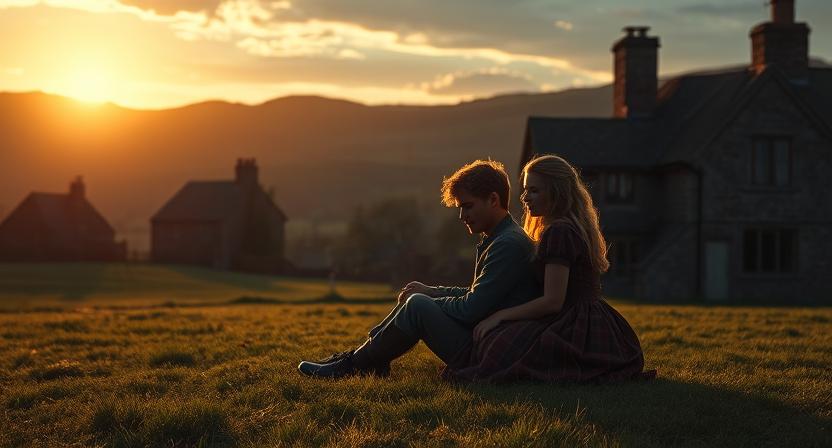
Grassington, West Riding of Yorkshire, England – 4th August 1914
I finish my work at the forge as the summer sun begins its slow descent behind the limestone crags of the Yorkshire Dales. The familiar ache in my shoulders feels good—honest work, Father always says, and I’ve spent the afternoon hammering out horseshoes for Mr Weatherby’s mare. The metal sang under my hammer, each strike ringing clear across the village green, and now the silence feels almost sacred.
I wipe my hands on the leather apron and hang it on its peg beside Father’s. His tools are arranged just so—hammers by weight, tongs by size, everything in its proper place. Three generations of Rigg men have worked this forge, and I reckon I’ll be the fourth to take up the trade proper when Father thinks I’m ready. The thought brings a smile to my lips as I bank the coals for tomorrow.
“Joseph!” Nell’s voice carries across the green, sweet as church bells on a Sunday morning. She’s standing by the old oak tree, the one that’s older than the church itself, her dress catching the evening light like water. I feel my heart do that peculiar thing it’s done since we were children—a sort of stumbling skip that makes me wonder if I’ll ever grow used to the sight of her.
I lock the forge door and cross the green, my boots scuffing through the grass where Mrs Broome’s chickens have been pecking. The air smells of hay and honeysuckle, with just a hint of smoke from the chimneys beginning to curl against the sky. This is my world—small, perhaps, but complete in ways that matter.
“You’re late.” Nell says, but she’s smiling as she says it. Her hair catches the light, brown as autumn leaves with threads of gold that make my fingers itch to touch them.
“Mr Weatherby’s mare needed new shoes.” I tell her, settling beside her on the worn wooden bench that some long-dead villager carved from a fallen branch. “She’s a right terror when it comes to standing still.”
Nell laughs, and the sound makes something warm unfurl in my chest. “Rather like her owner, then. I saw him chasing rabbits away from his prize roses this morning, waving his walking stick about like a medieval knight.”
We sit in comfortable silence for a moment, watching the swallows dart and dive above the green. The village is settling into evening—lamps beginning to glow in cottage windows, the distant lowing of cattle being brought in from the high pastures. It’s peaceful in a way that makes me think of home, though I suppose that’s exactly what this is.
“I’ve been thinking about Gran today,” I say suddenly, surprising myself with the words. Nell turns to look at me, her grey eyes serious now.
“Missing her?”
“Aye, but not sad missing. More like… remembering missing, if that makes sense.” I pick up a fallen leaf and turn it over in my hands. “She had this way of finding joy in the smallest things. Do you remember what she used to say when times were hard?”
Nell nods slowly. “Write down thirty things that make you happy. No more, no less.”
“That’s right.” The memory comes back clear as yesterday—Gran sitting in her kitchen with the fire crackling, her worn hands holding mine as she explained. “She said when the world spins faster than your feet can follow, you stop and remember who you are. What makes you smile. What makes life worth the living.”
“Did you ever make one? A list, I mean?”
I shake my head. “Never had cause to. Life’s been good to me, hasn’t it? Work I love, family that cares for me, and…” I glance at her sideways, feeling heat creep up my neck. “Well, and you.”
Nell’s cheeks flush pink, pretty as roses. We’ve been stepping around each other like this for months now, both of us knowing what’s between us but neither quite brave enough to name it plain. Perhaps it’s the evening light, or the way she looks with her hair loose about her shoulders, but I feel bold tonight.
“Perhaps I should make one anyway,” I continue. “Not because times are hard, but because they’re good. Because I want to remember this feeling—this moment when everything feels possible.”
“That’s a lovely idea.” Nell says softly. “What would you put first?”
I consider this, watching a thrush hop across the grass. “The way the metal sings when you strike it just right. That moment when you know the iron will bend to your will, when you can feel the shape it wants to become.”
“That’s very philosophical for a blacksmith’s apprentice.”
“I’ll have you know we’re a thoughtful lot,” I reply with mock dignity, which makes her laugh again. “What about you? What would be first on your list?”
She tilts her head, considering. “The way you look when you’re concentrating on your work. All fierce and determined, like you’re wrestling with dragons instead of horseshoes.”
The words hit me square in the chest, and I feel my breath catch. “Nell…”
But before I can find the words to follow that thought, the evening air is split by the deep, sonorous toll of the church bell. Not the usual call to evening service, but something different—urgent and insistent, calling the village to gather.
We both turn towards the church spire, watching as other villagers begin to emerge from their cottages, drawn by the same summons. Mrs Ackroyd wipes flour-dusted hands on her apron. Old Mr Davies hobbles out with his walking stick. Even the children stop their games to stare.
“That’s not the usual bell,” Nell says quietly, and I hear the first note of unease creep into her voice.
“No,” I agree, standing and offering her my hand. “I think we’d better see what news has come to Grassington.”
As we walk towards the church, I feel something shift in the air—a tension that wasn’t there moments before. But Gran’s words echo in my mind, and I find myself already composing that list in my head, starting with the feeling of Nell’s hand warm and trusting in mine.
Whatever news awaits us, I want to remember this moment when the world still felt small enough to hold in my two hands.
***
The church bells continue their urgent summons as Nell and I make our way across the green, joining the stream of villagers converging on the ancient stone building. The evening air thrums with nervous energy, and I can hear fragments of conversation drifting on the breeze—words like “Germany” and “mobilisation” and “King’s Army” that make my stomach tighten in ways I don’t quite understand.
Mr Davies, the village postmaster, stands on the church steps with a telegram clutched in his weathered hands. His face is grave beneath his bowler hat, and when he raises his voice to address the growing crowd, I hear the tremor that age and emotion have put there.
“Friends,” he begins, and the murmur of voices dies away. “Friends, I’ve received word from London. As of eleven o’clock this evening, His Majesty’s Government has declared that a state of war exists between Great Britain and Germany.”
The words hang in the air like smoke from a snuffed candle. For a moment, nobody speaks. Then Mrs Broome lets out a sharp gasp, and young Tommy Fairburn whoops like he’s heard the best news of his life.
“We’ll show those Hun what for!” Tommy shouts, and several of the younger lads cheer their agreement. But I notice how the older men—those who remember stories from their fathers about the Crimea—remain silent, their faces set in grim lines.
“When do we go?” calls out Billy Hepworth, the baker’s eldest son. “When do we enlist?”
Mr Davies holds up his hand for quiet. “There’ll be recruitment officers in Skipton tomorrow, I’m told. Lord Kitchener is calling for volunteers—100,000 men to join the regulars.”
One hundred thousand. The number feels impossibly large, like trying to count the stars. But as I look around at the faces surrounding me—faces I’ve known since childhood—I begin to understand what it might mean. How many of us will answer that call? How many will leave Grassington behind?
“It’ll be over by Christmas,” says Jim Weatherby, Mr Weatherby’s youngest. “That’s what they’re saying in the papers. We’ll march to Berlin and be home in time for plum pudding.”
The crowd begins to break apart into smaller groups, voices rising in excited discussion. Some talk of glory and adventure, of showing the Kaiser what British steel can do. Others speak in quieter tones of worry and uncertainty, of harvests left ungathered and businesses left unmanned.
I find myself backing away from the noise and bustle, pulling Nell with me towards the stone wall that bounds the churchyard. My head feels full of cotton wool, and I need to think. To understand what this all means.
“Joseph?” Nell’s voice seems to come from very far away. “You’ve gone pale as milk.”
I sit down heavily on the low wall, the rough stones cool beneath my hands. “I keep thinking of Gran,” I say quietly. “How she always said that when the ground shifts beneath your feet, you hold onto what matters most.”
“You want to make your list now.” It’s not a question—Nell knows me well enough to read the thoughts written on my face.
I nod, pulling my pocket diary and pencil from my jacket. The little leather book is where I keep track of orders for the forge, but tonight it feels like it might serve a holier purpose. “Will you help me? I don’t think I can do this alone.”
She settles beside me on the wall, her shoulder warm against mine. “Tell me the first one.”
I close my eyes for a moment, trying to shut out the voices from the churchyard, the talk of war and duty and king. What makes me happy? What makes life worth living?
“The sound of Father’s hammer on the anvil,” I say finally, pencil moving across the page. “Not when he’s angry or frustrated, but when he’s working with the metal like it’s music. When everything’s right between his hands and the iron.”
“That’s lovely,” Nell murmurs. “What else?”
“The way Widow Ackroyd always pretends not to notice when I filch a biscuit from her kitchen windowsill.” I smile despite the heavy feeling in my chest. “She bakes extras on purpose, I think. Leaves them where the village lads can reach them.”
The pencil scratches against the paper as I write, and somehow the simple act of recording these small joys feels like an anchor in the storm of confusion swirling around us.
“The smell of fresh hay when we bring it in from the top meadows,” I continue. “That green smell that means summer and safety and home.”
“The way you look when you’re concentrating,” Nell says softly, and I glance up to find her watching me write. “Like nothing else in the world exists except what you’re doing.”
My cheeks flush warm. “That’s not for my list—that’s for yours.”
“Then put down the way I beat you at checkers every Sunday after church,” she replies with a grin. “Even when you think you’ve got me cornered.”
I laugh, and the sound surprises me with its lightness. “Right, then. Your laugh when you’ve bested me at something. The way it sounds like church bells, but warmer.”
Behind us, the crowd is beginning to thin as families drift back to their cottages and evening routines. But here in our little bubble of gathering dusk, the world feels manageable again. Each item I add to the list is like building a wall against the uncertainty—small stones of joy that might hold back whatever’s coming.
“The way the light looks on the fells just before sunset,” I write. “All gold and purple, like God’s painting the world new every day.”
“Mother’s voice singing hymns while she kneads bread,” Nell suggests. “Even when she doesn’t know anyone’s listening.”
I nod and add it to the list. Number seven. Twenty-three more to go.
As I write, I become aware of how the evening is changing around us. Gas lamps are being lit in cottage windows. The talk of war continues, but softer now, as if people are beginning to understand the weight of what’s been set in motion. And somewhere in the distance, I swear I can hear the sound of horses and wheels on the road—messengers, perhaps, carrying word to other villages, other lives that will be changed by tonight’s news.
But for now, there’s just the scratch of pencil on paper, Nell’s quiet breathing beside me, and the growing list of small miracles that make up a life. It doesn’t feel like much against the enormity of what’s coming, but Gran always said that happiness lives in the details, not the grand gestures.
I pray she was right.
***
The sun has nearly touched the horizon now, painting the limestone crags in shades of amber and rose. Most of the villagers have drifted away from the churchyard, returning to their cottages with the weight of the evening’s news settling on their shoulders like a heavy cloak. But Nell and I remain on our stone wall, my pencil still moving across the pages of my little diary.
“Number fifteen,” I murmur, reading back over what I’ve written. “The way snow looks on the fells in winter—pure and clean, like the world’s been forgiven.”
Nell leans against my shoulder to read along. Her hair smells of lavender soap and summer air, and I add that to my mental list even though I’ve already written down “the scent of Nell’s hair when she sits close enough to touch.”
“You’re being awfully serious about this,” she says quietly. “Some of these sound like you’re… like you’re saying goodbye.”
The observation hits closer to truth than I’d care to admit. Since the bells rang and Mr Davies read that telegram, something has shifted inside me. Not fear, exactly, but a growing understanding that the world I’ve known—this small, safe world of forge and village green and Sunday walks with Nell—might be about to change in ways I can’t imagine.
“Maybe I am,” I say, surprised by my own honesty. “Maybe we all are, in a way.”
I continue writing, my pencil scratching steadily in the gathering dusk:
16. The way baby Mary Fletcher grabs at anything shiny with her tiny fists.
17. Sunday sermons when Reverend Cox forgets his notes and speaks from the heart instead.
18. The taste of fresh milk still warm from the cow.
19. Cricket matches on the green when everyone argues about whether it’s really out or not.
“What will you do?” Nell asks suddenly. “About the war, I mean. About…” She doesn’t finish the sentence, but I know what she’s asking.
I pause in my writing, watching the last light catch the weathervane on the church spire. “Billy Hepworth and Tommy Fairburn are going to Skipton tomorrow. Jim Weatherby too. They’re all talking about joining up.”
“And you?”
The question hangs between us like a challenge. Part of me—the part that’s nineteen and full of dreams of adventure—wants to march to Skipton with the lads, to sign my name on whatever papers they put in front of me. King and Country, they’ll say. Duty and honour. Glory for England.
But another part of me, a quieter part, looks at Nell’s face in the fading light and thinks of other things. Of the forge waiting for me tomorrow morning. Of the life we might build together if I stay.
“I don’t know,” I say finally. “I keep thinking about what Father would say. What Gran would have said.”
“What do you think they’d say?”
I consider this, turning the pencil over in my hands. “Father would say a man does his duty, whatever form it takes. Gran would say…” I smile despite the heaviness in my chest. “Gran would say to finish my list first. That everything else can wait until I remember who I am.”
So I write:
20. The weight of Father’s hand on my shoulder when he’s proud of something I’ve done.
21. The way time seems to stop when Nell looks at me the way she’s looking at me now.
22. Knowing that no matter what happens, I’ve had this day, this moment, this feeling of being exactly where I belong.
The pencil feels heavier in my hands as I continue, and I realise I’m no longer just listing things that make me happy. I’m creating a catalogue of everything I love about this life, this place, this moment before everything changes.
23. The sound of children playing in the street outside the forge.
24. The way the whole village turns out for harvest festival, even those who haven’t set foot in church all year.
25. Knowing that Billy Hepworth will burn the bread tomorrow because he’s too excited about joining up to pay proper attention.
Nell’s breath catches at that one, and I know she’s thinking the same thing I am. How many of the lads won’t be here for next year’s harvest festival? How many empty spaces will there be at the village tables?
26. The feeling that comes over me when I look at the fells and think about all the generations who’ve looked at the same view.
27. Sunday afternoon walks when Nell lets me hold her hand and doesn’t care who sees.
28. The way Mother hums whilst she mends our clothes, as if torn fabric is just another problem to be solved with patience and care.
Two more. Thirty was what Gran always said—no more, no less. But these last ones feel like they should carry the weight of everything I can’t quite put into words.
29. The certainty that whatever comes, we’ll face it together—not just Nell and me, but all of us. The village, the country, everyone who believes in something worth protecting.
My hand trembles slightly as I write the final entry:
30. This moment right now, when everything is still possible and nothing is decided, when I’m nineteen and whole and the girl I love is sitting beside me in the dying light of what might be the last peaceful day of our lives.
I close the diary and sit back, feeling oddly empty and full at the same time. Thirty things. It doesn’t seem like nearly enough to capture a lifetime’s worth of joy, but it’s what Gran prescribed, and somehow it feels complete.
“Read me the last one again,” Nell says softly.
I do, and when I finish, she takes my free hand in both of hers.
“Whatever you decide tomorrow,” she says, “about the war, about going or staying—I want you to know that this moment, this evening, this list—it’s the most beautiful thing anyone’s ever given me.”
The church clock chimes nine as we sit in the gathering darkness. Somewhere in London, politicians and generals are making decisions that will reshape the world. Somewhere across the Channel, other young men are probably writing letters to their sweethearts or sharpening bayonets or saying prayers.
But here in Grassington, on this stone wall beside the ancient church, I fold my list carefully and tuck it into my jacket pocket, right over my heart. Tomorrow I’ll likely join the queue in Skipton with the other lads. Tomorrow I’ll put my name to whatever papers they give me and begin the adventure that everyone says will be over by Christmas.
Tonight, though, I’m still just Joseph Rigg, blacksmith’s apprentice, and the girl I love is warm beside me in the darkness, and I know exactly who I am and what makes life worth living.
Whatever comes next, I’ll carry that knowledge with me like a talisman against the dark.
The End
On 4th August 1914 Britain’s declaration of war on Germany drew the United Kingdom and its global empire—spanning five continents—into what became the First World War, a conflict that by 1918 mobilised 8.9 million British and Dominion troops and cost the nation about £7 billion. Within three weeks of the declaration, the British Expeditionary Force of 120,000 men was fighting in Belgium; by December 1914 voluntary enlistment averaged 33,000 recruits each day. The struggle soon widened to include 30 nations, leading to an estimated 17 million military and civilian deaths worldwide. The 1919 Treaty of Versailles redrew European borders and imposed heavy reparations on Germany, sowing economic instability that contributed to the rise of extremist politics and, ultimately, the Second World War. Today, commemorations such as Remembrance Sunday and the red poppy symbol remind modern societies of the colossal human and financial costs of global conflict and the continuing need for international cooperation to maintain peace.
Bob Lynn | © 2025 Vox Meditantis. All rights reserved.


 Vox Meditantis
Leave a comment