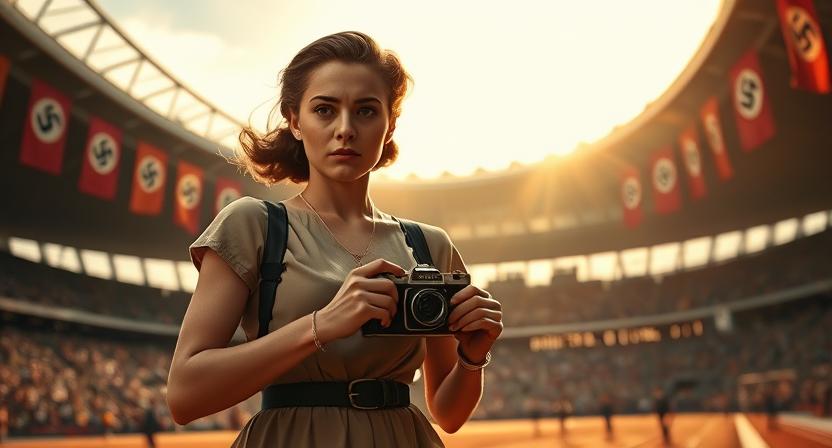
The Olympic Stadium, Berlin, Germany – 3rd August 1936
The camera’s shutter clicked with mechanical precision, capturing another image of the pristine Olympic Stadium as the morning light painted the stone façade in brilliant gold. Marlene Fischer adjusted the heavy equipment case on her shoulder, her fingers already stained with developer from the pre-dawn printing session. Around her, the official documentation team moved with rehearsed efficiency, their conversations a careful symphony of approved phrases and sanctioned enthusiasm.
“Fräulein Fischer,” called Herr Brenner, the chief photographer, his voice cutting through the morning bustle. “The Führer’s box requires additional coverage today. American participation must be… contextualised properly.”
Marlene nodded, understanding the subtext. Jesse Owens was running today. The Negro athlete whose very presence challenged everything the Reich proclaimed about racial superiority. Her official photographs would need to diminish his achievements, focus instead on German victories, on the perfect organisation of the Games, on the magnificent stadium that proclaimed Nazi supremacy to the watching world.
“Of course, Herr Brenner,” she replied, her voice steady despite the familiar knot forming in her stomach.
As the team dispersed to their assigned positions, Marlene caught sight of something glinting in the early morning sun near the tunnel entrance—a discarded programme from yesterday’s events, its pages fluttering in the gentle breeze. Without thinking, she glanced around and quickly palmed it, slipping it into her jacket pocket where it joined a growing collection of small treasures.
The habit had begun innocently enough, three days into the Games. She’d found a ticket stub trampled underfoot after the opening ceremony, its edges torn but the eagle and swastika still clearly visible. Something about its abandoned state had struck her—here was evidence of a moment, a person’s experience, reduced to litter. That evening, alone in her cramped boarding house room, she’d smoothed the stub carefully and placed it between the pages of an old album her grandmother had given her for pressed flowers.
Now, as she positioned herself in the photographers’ section overlooking the track, Marlene’s pocket seemed to burn with its contraband. Around her, cameras clicked and whirred as the morning’s preliminary events began, but her attention kept drifting to the small pile of debris accumulating near the spectator sections—programmes dropped in excitement, ticket stubs forgotten in pockets, small pennants abandoned by departing crowds.
The 100-metre final was scheduled for mid-afternoon. Until then, Marlene documented shot put competitions and early qualifying rounds, her official photographs capturing strong Aryan physiques and German dominance whilst her private eye noted the diversity of the competing athletes, the genuine camaraderie between nations that the propaganda cameras carefully avoided.
During the lunch break, she found herself near the groundskeeper’s shed, a weathered building tucked behind the main stadium structure. The elderly man she’d noticed earlier was there, methodically sorting through rubbish collected from the morning events.
“Quite a collection they leave behind,” she ventured, nodding toward the pile of discarded programmes and tickets.
He looked up, his lined face creasing into a knowing smile. “Herr Heinrich Müller,” he introduced himself, wiping his hands on a rag. “Forty-three years I’ve been tending grounds—first the old stadium, now this monument to modern German engineering.” His tone held a subtle irony that made Marlene study his face more carefully.
“Such waste,” she murmured, gesturing toward the paper debris.
“Waste?” Heinrich straightened, his pale blue eyes sharp despite his age. “Or perhaps evidence? Every ticket tells a story, Fräulein. Every programme records what really happened, not what the official reports will claim.”
The words hung between them, heavy with implication. Marlene felt her cheeks warm. “I… I collect pressed flowers,” she said finally, the half-truth easier than admitting her growing obsession with preserving these Olympic fragments.
Heinrich’s expression softened. “Flowers fade, but they leave impressions. Sometimes that’s enough to remember what was beautiful.”
When she returned to her station for the afternoon’s events, Marlene’s pocket held three more items: a child’s small Olympic flag with teeth marks along one edge, a programme with something sticky spilled across Jesse Owens’ photograph, and a torn piece of paper with what appeared to be an autograph in English.
The stadium filled with an electric tension as the 100-metre finalists took their marks. Through her camera’s viewfinder, Marlene watched Jesse Owens settle into his starting blocks, his dark skin glistening with perspiration under the German sun. The irony was not lost on her—here, in this temple to Aryan supremacy, a black American athlete was about to challenge every fundamental belief the regime promoted.
“Get the German runners,” Brenner hissed from beside her. “Focus on their form, their determination.”
But as the starting gun fired and the runners exploded forward, Marlene found herself tracking Owens through her lens. His stride was poetry, each movement economical and powerful, his face a mask of fierce concentration. She clicked the shutter repeatedly, knowing these images would never see official use but unable to stop herself from capturing this moment of pure athletic excellence.
Owens crossed the line first, and the stadium erupted. Even the German crowd, trained in their responses, could not suppress their appreciation for such a magnificent performance. Through her viewfinder, Marlene watched Hitler’s box, noting how the Führer’s expression tightened, how he leaned back as if physically recoiling from what he’d witnessed.
“Did you get the German finishing positions?” Brenner demanded, but his voice sounded distant to Marlene’s ears.
She had witnessed something transcendent, something that made a mockery of every racial theory the Reich promoted. And tonight, in the quiet of her room, she would try to capture that truth in her secret collection.
The evening ritual had evolved into something approaching ceremony. After the official photographs were developed and filed, after the day’s reports were written with their careful omissions and calculated emphases, Marlene would return to her boarding house and spread her treasures across the narrow bed.
Tonight’s collection was particularly rich. The sticky programme had dried enough to handle, revealing that the stain covered Jesse Owens’ portrait but left his name and nationality clearly visible—a small act of preservation by accident or design. The torn autograph paper, she realised under closer examination, bore Owens’ signature along with what appeared to be a child’s attempt to write “fastest man alive” in uncertain English letters.
She arranged each piece carefully in her grandmother’s album, no longer between pressed flower pages but in sections she’d mentally designated by date and event. With each placement, she wrote brief observations in pencil on small slips of paper: “Jesse Owens, 100m final, 3rd August 1936. Time: 10.3 seconds (Olympic record). Crowd reaction: genuine appreciation despite official disapproval. Hitler left before medal ceremony.”
The joy she found in this ritual was complex and dangerous. Each evening brought the satisfaction of preserving truth, of creating an honest record that countered the sanitised version being prepared for posterity. But it was more than simple documentation—it was an act of resistance conducted in the safety of solitude, a small rebellion that harmed no one yet affirmed everything she believed about truth and human dignity.
As she worked, Marlene reflected on Heinrich’s words about flowers leaving impressions. These scraps of paper, these discarded remnants of spectator enthusiasm, were perhaps more honest than any official photograph. They carried the authentic reactions of ordinary people witnessing extraordinary events, unfiltered by political necessity or racial ideology.
The album was growing thick now, its pages heavy with the accumulated weight of small truths. Tomorrow would bring new events, new opportunities to document both the official narrative and the reality it attempted to obscure. The men’s long jump was scheduled, and rumours suggested Owens would compete again. There would be more discarded programmes, more forgotten ticket stubs, more evidence of moments when athletic excellence transcended the artificial boundaries of political doctrine.
Marlene closed the album and placed it carefully beneath her mattress, next to her grandmother’s Bible and her father’s letters from the Great War. Three generations of hidden truths, she mused, each preserved against the possibility that someday, someone would want to know what really happened.
Outside her window, Berlin slept under the Olympic flags that flew beside the swastikas, a city caught between celebration and propaganda. In a few hours, she would return to her official duties, would photograph German achievements and Aryan excellence whilst carefully avoiding images that contradicted the approved narrative.
But for now, in the quiet of her small room, surrounded by the evidence of human complexity and athletic transcendence, Marlene Fischer allowed herself a moment of pure joy. Not the manufactured enthusiasm of the rallies or the forced celebration of the propaganda films, but the quiet satisfaction of preserving truth, one discarded ticket stub at a time.
In years to come, when the Olympics were memory and the Reich had crumbled into history, her collection would remain—a testament to moments when human excellence proved stronger than ideology, when joy could be found in the simple act of bearing witness to truth.
On 3rd August 1936, Jesse Owens won the 100-metre dash at the Berlin Olympics in 10.3 seconds, the first of four gold medals that week. Hitler had intended the Games to showcase Aryan superiority to 49 participating nations and millions of global radio listeners. Instead, Owens’ victories in the 100m, 200m, long jump, and 4x100m relay directly contradicted Nazi racial ideology before the world. The African American athlete’s success, alongside 17 other black American team members who won 14 medals total, provided powerful ammunition for the emerging civil rights movement. These Olympics marked a pivotal moment when athletic excellence challenged political propaganda, establishing sports as a platform for racial equality that continues influencing social justice movements today.
Bob Lynn | © 2025 Vox Meditantis. All rights reserved.


 Vox Meditantis
Leave a reply to veerites Cancel reply