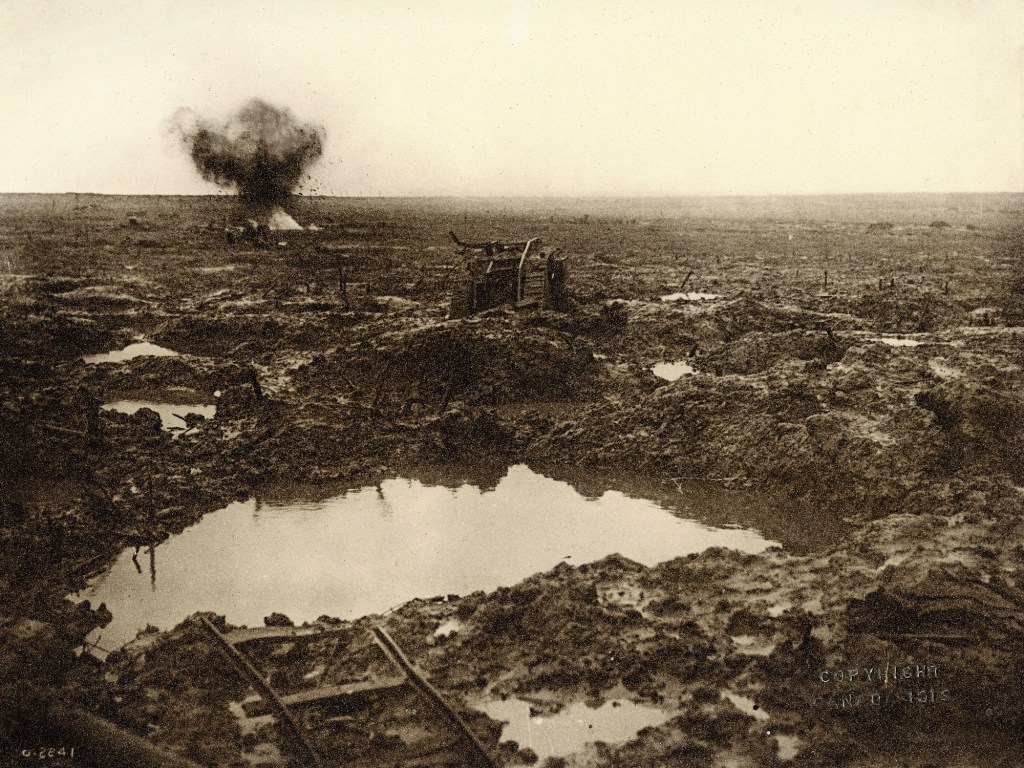
Boezinge, Ypres, West Flanders, Belgium – 31st July 1917
The shell that dropped us both into this godforsaken hole still rings in my ears like church bells on a Sunday morning, only these bells herald nothing but death and mud. I can taste the cordite on my tongue, feel the sting of it in my nostrils as I pull myself up against the crater’s slumping wall. My left leg throbs something fierce—shrapnel, most likely, though I’ve not dared look at it proper yet.
That’s when I see him.
He’s curled against the opposite wall like a child seeking comfort, his head wrapped in field dressings that’ve gone pink with seepage. The red cross on his arm marks him as one of the stretcher lads, barely old enough to shave by the looks of him. His uniform bears the mud and gore of No Man’s Land, but it’s the way his hands shake that tells me he’s been at this longer than his years suggest.
“Is someone there?” His voice carries a Yorkshire accent, soft and uncertain. “I can hear breathing.”
“Aye, lad. Corporal McKenna, 16th Irish Division.” I shift closer, mindful of my wounded leg. “You’re safe as houses, considering we’re sitting in a shell hole with Fritz trying to blow us to kingdom come.”
He turns his bandaged face towards my voice, and something in that gesture—so trusting, so vulnerable—strikes me somewhere deep in my chest. “McKenna? Irish, then?”
“Dublin born and bred, though I’ve been fighting alongside you English lads long enough to nearly forget the difference.” I pull out my cigarettes, noting how my own hands tremble as I strike a match. The flame illuminates our little tomb of mud and twisted metal. “What’s your name, son?”
“Private Eddie Thurlow. From Leeds.” He pauses, tilting his head as another shell screams overhead. “Stretcher bearer with the Yorkshire Light Infantry.”
I light my cigarette and draw deep, letting the smoke settle my nerves. “How long since…?” I gesture towards his bandages, though of course he cannot see it.
“This morning. I was bringing in wounded from the first wave when Jerry’s artillery found our position.” His voice grows smaller. “One of the medical officers checked me—said the blindness might be temporary. Concussion, they think. But before they could move me, another shell hit. Everything went black after that. Next thing I knew, I was here.”
Might be. The words linger between us, fragile and uncertain, like breath in the cold. They carry more hope than truth, and I’ve lived through enough of this war to know that might be often means never again. But I won’t be the one to snatch hope from a lad barely out of short trousers.
“Well then,” I say, settling back against the crater wall, “we’ll wait it out together. Fritz is giving us both barrels today, but this crater’s solid enough.”
We sit in companionable silence for a time, listening to the symphony of destruction above us. The opening barrage of this new offensive makes everything we’ve endured at the Somme seem like a Sunday picnic. The ground shakes with each impact, and somewhere in the distance, I can hear men screaming.
Then Eddie asks the question that changes everything.
“Corporal McKenna?” His voice is quiet, almost lost beneath the artillery’s roar. “How would you describe yourself to someone who can’t see you?”
The question hits me harder than any shell blast. I take another drag of my cigarette, buying time whilst my mind scrambles for an answer. How do you distill a man’s entire being into words for someone lost in darkness?
“Well,” I begin, then stop. The easy answer would be the physical—tall, dark-haired, thirty-two years old, scar on my left cheek from a pub fight in Dun Laoghaire when I was twenty. But something in his voice suggests he’s asking for more than that.
“I’m not sure I understand what you’re getting at, lad.”
Eddie shifts against the crater wall, and I can see him worrying at something in his breast pocket. “I’ve been thinking, lying here in the dark. About what makes a person… themselves. Not just what they look like, but who they are. If you can’t see someone’s face, how do you know them?”
The shelling intensifies, and I instinctively duck lower. When I look back at Eddie, he hasn’t moved—his world is already one of sound and sensation. His courage shames me.
“That’s a deep question for a shell hole, Eddie Thurlow.”
“Maybe that’s the only place for deep questions.” He pulls something from his pocket—a photograph, creased and worn. “I carry a picture of my girl, Mary. But I’ve been wondering… if she couldn’t see me, how would I tell her who I am? How would I make her understand that I’m still me, even after…” He gestures vaguely at the wasteland around us.
I study his young face, seeing past the bandages to the man beneath. There’s something ancient in his question, something that cuts through all the noise of war to the heart of what it means to be human.
“Right then,” I say, stubbing out my cigarette. “James Patrick McKenna, aged thirty-two, son of Patrick McKenna, dock worker, and Bridget McKenna, seamstress. Both dead of the consumption when I was sixteen.”
“That’s facts, not who you are.”
The lad’s persistent, I’ll give him that. I lean back, feeling the mud seep through my tunic, and try to see myself through his unseeing eyes.
“I’m the sort of man who writes letters to his mother’s grave every Sunday, even though she’s been dead fifteen years. I tell her about the weather, about the lads in my section, about the books I’m reading—when I can get hold of any. She always said education was the one thing no man could take from you.”
Eddie nods encouragingly, so I continue.
“I’m afraid of rats. Sounds daft, considering where we are, but there it is. Big ones, little ones, doesn’t matter. Had a cellar flat in Dublin that was overrun with them, and I’ve never gotten over it.” I pause as a shell lands closer, showering us with dirt. “I’m the sort who’ll share his last cigarette with a stranger, but I’ll fight you tooth and nail if you touch my letters from home.”
“Do you have letters? From home, I mean?”
I pat my breast pocket. “Three. One from my sister Molly, who married a baker in Cork. One from Father O’Brien at St. Bartholomew’s, who taught me to read. And one from…” I hesitate.
“From a girl?”
“Katherine. Kate.” Her name tastes like honey and heartbreak. “We were to be married before I enlisted. She writes every month, regular as clockwork, but her letters… they’re getting shorter.”
Eddie tilts his head slightly, as if trying to gauge the shape of my silence. “Is she forgetting you?”
“No. I think she’s trying not to remember me too well, in case I don’t come back.” The admission surprises me with its honesty. “She’s protecting herself, and I can’t blame her for it.”
A rat scurries across the crater floor, and I flinch involuntarily. Eddie hears the movement and smiles—the first genuine expression I’ve seen from him.
“The rats?”
“Aye. Daft, isn’t it? I’ve charged German machine guns, but put me in a room with a rat and I’m like a schoolgirl.”
“I’m afraid of water,” Eddie offers. “Deep water. Can’t swim a stroke. Used to have nightmares about drowning in the canal back home.”
We’re both quiet for a moment, two grown men admitting our fears to each other in a hole in the ground whilst the world tries to kill us. There’s something sacred about it, this exchange of vulnerabilities.
“What else?” Eddie asks. “What would help me know you if I met you in the dark?”
I think about his question, really think about it. What defines James McKenna beyond the uniform and the war and the mud?
“I sing,” I say finally. “Not well, mind you, but I sing. Irish songs my mother taught me, hymns from church, music hall numbers I picked up in the pubs. The lads in my section say I’ve got a voice like a rusty gate, but they still ask for songs when we’re in the trenches.”
“Sing something now.”
I glance at him—he’s leaning forward slightly, as if listening with more than just ears.
“Here? With Fritz trying to shell us into next week?”
He nods once, barely a movement. “Especially here.”
So I do. Soft and low, barely audible above the artillery, I sing “The Parting Glass,” my mother’s favourite. My voice cracks on the high notes, and I forget half the words, but Eddie listens with the concentration of a man trying to memorise every note.
When I finish, he’s smiling again. “Now I know you. The man who sings Irish songs in shell holes.”
“And what about you, Eddie Thurlow? How would you describe yourself?”
He’s quiet for so long I think he’s fallen asleep. Then: “I’m the lad who joined up to prove he was brave enough, only to discover he was always brave enough—he just didn’t know it. I’m the one who cries when he reads letters from home, but never in front of the other lads. I collect things—buttons, interesting stones, pressed flowers—and I send them to my little sister with my letters.”
His voice grows stronger as he speaks. “I’m afraid of being forgotten. Not just by Mary or my family, but… forgotten completely. Like I never existed at all. That’s why I became a stretcher bearer, I think. To help people remember that someone cared enough to carry them to safety.”
The honesty of it takes my breath away. Here’s a boy—for he is barely more than that—who’s found the very heart of what it means to be human in the midst of mechanised slaughter.
“And I believe,” he continues, “that every man I’ve carried off that field carries a piece of me with him. So even if I don’t make it home, parts of me will. In their memories, in the stories they tell their children.”
The shelling has lessened somewhat, though the rattle of machine guns continues in the distance. I check my watch—nearly four o’clock. We’ve been in this crater for hours, two strangers becoming something more through the simple act of truly seeing each other.
“Eddie,” I say quietly, “when your sight comes back—and it will, lad, I can feel it—you’ll look at people differently, won’t you?”
“How do you mean?”
“You’ll see past their faces to who they really are. Most folk go through life looking but never seeing. You’ve learned to see with more than your eyes.”
He nods slowly. “Maybe that’s what this was for, then. This darkness. To teach me to see properly.”
The wisdom of it humbles me. Here I am, fifteen years older and supposedly wiser, and this Yorkshire lad has taught me more about being human in a few hours than I’ve learned in thirty-two years of living.
“The shelling’s stopped,” Eddie observes.
He’s right. The sudden quiet is almost deafening after hours of bombardment. In the distance, I can hear voices—stretcher bearers calling for wounded, officers shouting orders, the general chaos of war trying to organise itself.
“They’ll be looking for us soon,” I say, though I’m oddly reluctant to leave our little sanctuary.
“McKenna?” Eddie’s voice is uncertain again. “When they find us, when we go back to the war… will we still know each other? Really know each other, I mean?”
It’s another profound question from this remarkable young man. Will the intimacy we’ve shared in this crater survive the return to military hierarchy, to the demands of duty and survival?
“Aye, lad. We will.” And I mean it. “Because we’ve seen each other properly. That’s not something you can unsee.”
I hear voices approaching our crater—English accents, medical corps by the sound of them. Our time in this strange confessional is ending.
“McKenna?” Eddie reaches towards my voice, and he finds my hand, cold and slick with mud. He squeezes once—steady, certain—and I squeeze back.. “Thank you. For helping me understand that I’m still myself, even in the dark.”
“Thank you, Eddie Thurlow, for showing me who I really am.”
The voices are closer now. Soon we’ll be pulled from this hole, patched up, and sent back to the business of war. But something has changed in both of us, something fundamental and irreversible.
“McKenna! Thurlow! Anyone alive down there?”
“Here!” I call back. “Two wounded, one blinded!”
As the stretcher bearers rope down into our crater, Eddie grips my hand tighter. “I can see light,” he whispers. “Just shapes, but it’s something.”
And I realise that we’re both seeing more clearly than we ever have before.
The End
31st July 1917 marked the launch of the Third Battle of Ypres, better known as Passchendaele; by the time the offensive ground to a halt on 10th November, British and Dominion forces had advanced barely 8km at a cost of roughly 275,000 casualties, while German losses approached 220,000. Fought in Flanders’ low-lying polders, relentless rain turned the battlefield into a quagmire where men, horses and equipment were swallowed by mud so deep that rescue was often impossible. The operation followed Somme (1916) and preceded the 1918 Spring Offensives, illustrating the grim attrition strategy then dominating the Western Front. Although Passchendaele delivered no strategic breakthrough, the staggering human and material toll fuelled public disillusionment with high-command tactics and influenced inter-war military reforms; today it serves as a cautionary example of the limits of industrial-era warfare and the urgent need for humanitarian protection of combatants.
Photo credit: Seaforth Highlanders
Bob Lynn | © 2025 Vox Meditantis. All rights reserved.


 Vox Meditantis
Leave a reply to Bob Lynn Cancel reply