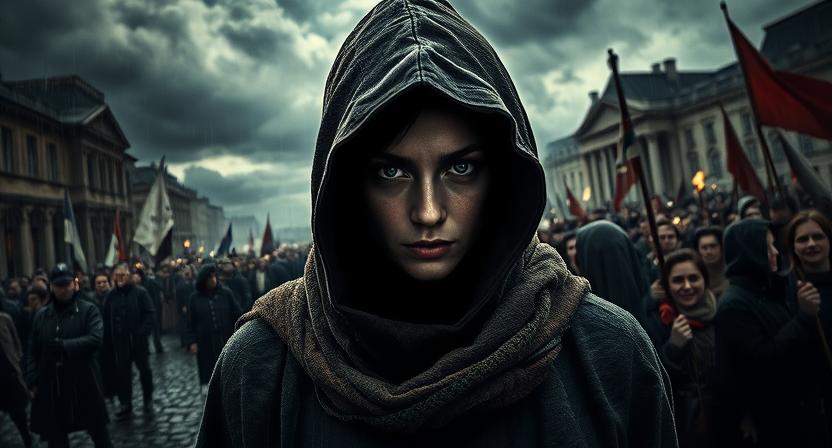
Paris, France – 28th July 1794
The stench of unwashed bodies and rotting vegetables filled my nostrils as I pressed deeper into the seething crowd at Place de la Révolution. Above the cacophony of jeers and revolutionary songs, I could hear the steady thock-thock of wooden wheels against cobblestones—Robespierre’s tumbrel drawing ever closer to the scaffold that had claimed so many of my kind.
I adjusted my rough woollen cap and forced my shoulders into the hunched posture I had practised these many months. Keep your head down, Marie-Claire, I reminded myself, though that name belonged to a world now buried beneath the rubble of châteaux and the screams of the guillotined. Here, in this press of humanity baying for blood, I was merely Citizeness Dubois, a seamstress from the Faubourg Saint-Antoine.
The irony was not lost on me that I stood amongst those who would gladly see me dead, watching the architect of their Terror meet his own demise. How many times had I imagined this moment during those sleepless nights in my cramped lodgings, listening to the death cries echoing from the square? Yet now, witnessing the end of Maximilien Robespierre, I felt no triumph—only the familiar, gnawing anxiety that had become my constant companion.
“Mort au tyran!” shrieked the fishwife beside me, spittle flying from her toothless mouth. “Death to the tyrant!“
I raised my fist in solidarity, careful to match her coarse accent. “Oui, citizeness!” The words tasted like ash, but they were my armour against suspicion.
For eighteen months, I had walked this tightrope between survival and discovery. Eighteen months since I had shed my silk gowns for homespun, traded my manor house for a single room above a bakery, learned to callous my hands with needle and thread rather than dance and embroidery. The Comtesse de Montclair was dead—officially executed in absentia, her estates seized, her name struck from every record. In her place lived this shadow, this carefully constructed lie.
The crowd surged forward as the death cart finally arrived, and I caught my first glimpse of the man who had sent thousands to their graves. Robespierre sat rigid in the tumbrel, his jaw bound with bloodied cloth from his failed suicide attempt. Even in defeat, he maintained that peculiar dignity that had made him so terrifying—and so effective.
“Look at him,” muttered a voice behind me. “Still thinks he’s above us common folk.”
I turned slightly, enough to glimpse the speaker from the corner of my eye. A man in the blue jacket and red cap of a true sans-culotte, but something in his bearing made me pause. His hands were too clean, his speech too measured despite the roughened accent. Recognition flickered—not of his face, but of his type. Another player in this deadly masquerade.
Our eyes met for an instant, and I saw my own fear reflected there. We were both ghosts haunting our former lives.
The executioner was preparing his blade now, testing the mechanism that had become the revolution’s most reliable servant. The crowd’s bloodlust reached fever pitch, a tide of hatred and celebration that threatened to sweep away reason itself.
“You’re very quiet, citizeness,” the man said, moving closer through the press of bodies. His tone was conversational, but I heard the probe beneath it. “Not celebrating our liberation from tyranny?”
My throat constricted. This was how it began—a simple question, a casual observation that could unravel everything. “I am overwhelmed by the moment, citizen,” I replied, keeping my voice steady in its assumed roughness. “To see justice finally served…”
“Indeed.” He studied my face with unsettling intensity. “You speak well for a seamstress. Have you always lived in the Faubourg?”
The trap was closing. Each question would lead to another, each answer demanding more elaborate deceptions. I had rehearsed my story countless times, but under this scrutiny, the carefully constructed details felt fragile as spun glass.
“My father was… educated,” I said carefully. “Before the revolution opened our eyes to equality.”
“Ah, a convert to the cause.” His smile didn’t reach his eyes. “And what opened your father’s eyes, if I may ask?”
The crowd roared as Robespierre was dragged from the cart, his legs failing beneath him. In that moment of distraction, I felt the weight of eighteen months’ deception threatening to crush me. How many more questions could I deflect? How many more lies could I weave before the thread snapped?
“He saw his betters’ true nature,” I said, gesturing toward the scaffold. “Saw how they cared nothing for France, only for their own power.”
“And yet you carry yourself like nobility still runs in your blood.”
The accusation hit like a physical blow. Around us, the crowd pressed closer to witness Robespierre’s final moments, but I felt utterly exposed, as if this stranger could see through skin and bone to the truth beneath.
“I don’t understand, citizen.” But my voice wavered, betraying me.
“The way you hold your head. The way you pronounce your vowels. Small things, but…” He leaned closer, and I smelled wine on his breath. “Tell me, citizeness—who are you, really?”
The question I had dreaded above all others. The question that could mean death or salvation, depending on my answer. Around us, the crowd’s roar intensified as Robespierre was forced to his knees, but their bloodthirsty cries faded to a distant hum. In this moment, there was only this man’s piercing gaze and the choice that would define the rest of my life—however long or short it might be.
I could maintain the lie, double down on my constructed identity as Marie Dubois the seamstress. But what if he truly suspected? What if others were listening? What if someone here knew the real Marie Dubois, knew she had died of fever months ago in the Salpêtrière?
Or I could tell some version of the truth—admit to education, to a past different from what I claimed, but stop short of revealing the full extent of my deception. It was dangerous, but perhaps less so than a lie that was already crumbling.
The third option terrified me most: complete honesty. Confession not just of my aristocratic birth, but of my hatred for everything this revolution represented. Of my contempt for the unwashed masses baying for blood. Of my desperate wish that France might return to the natural order these rebels had destroyed.
“I…” I began, then stopped. Robespierre’s head was on the block now, the executioner raising his blade. The crowd held its collective breath.
In that suspension between heartbeats, I made my choice.
“You’re right,” I said quietly, leaning closer so only he could hear. “I was not born to the needle and thread. My father was… he was a clerk in a lawyer’s office. Before the revolution, I was educated alongside my betters’ children. I learned to read, to write, to speak properly.” The lie came easier now, a middle path between truth and fiction. “But when the revolution came, I saw the wisdom in it. I saw how education could serve the people rather than oppress them.”
He nodded slowly, but I sensed he wasn’t entirely convinced. “A clerk’s daughter. And what became of your father?”
“Dead,” I said, and this at least was truth—though not in the way he would assume. “Caught between the old world and the new. He couldn’t adapt as I have.”
The blade fell. Robespierre’s head tumbled into the basket, and the crowd exploded in savage celebration. Blood—real or imagined—seemed to spray across my vision as the Incorruptible One joined his victims in death.
In the chaos of cheering and singing, the man moved even closer. “Do you know what I think, citizeness?” he said, his mouth almost touching my ear. “I think we are both survivors in a world that would see us dead for our past.”
My blood turned to ice. “I don’t know what you—”
“I was a law clerk myself, before all this began. I recognised the signs because I live with them daily—the careful pronunciation, the studied gestures, the constant fear of discovery.” He smiled, and for the first time it seemed genuine. “We are neither of us what we claim to be.”
The revelation should have terrified me, but instead I felt an unexpected surge of relief. To be seen, truly seen, after so many months of performance—it was almost worth the risk.
“What do you want?” I asked.
“Nothing. Everything. To know that I am not alone in this masquerade.” He paused as the crowd began to disperse, their bloodlust temporarily sated. “Do you know what I told them when they questioned me? I said I was a new man, reborn through revolutionary ideals. That the old world had died in me as surely as it died in France.”
“And was it true?”
He considered this as we watched the executioner’s assistants clean blood from the scaffold. “Perhaps. We are all different people than we were before the Terror began. The question is whether we’re better or worse for it.”
I thought of the Comtesse de Montclair—her certainties, her privileges, her comfortable assumptions about the natural order of things. That woman truly was dead now, not merely in the records but in my heart. What stood in her place was neither aristocrat nor seamstress, but something new. Something shaped by necessity and hardened by survival.
“How would I describe myself?” I said, more to myself than to him. “I am a woman who has learned that identity is more fluid than I ever imagined. That we are what circumstances make us, not what blood flows in our veins.”
He nodded approvingly. “And I am a man who has discovered that survival sometimes requires becoming someone else entirely—until you can no longer tell where the performance ends and the person begins.”
We began walking away from the square together, two strangers bound by shared deception and mutual need. Behind us, the crowd was already beginning to scatter, their revolutionary fervour temporarily spent. The cobblestones, slick with more than just summer rain, reflected the dying light of the July evening.
“What happens now?” I asked as we paused at the edge of the square.
“Now we continue the masquerade. But perhaps…” He hesitated, then continued more firmly. “Perhaps we need not perform it entirely alone.”
I understood. In a world where trust could mean death, we had found something precious—recognition. Not love, not even friendship in any conventional sense, but the acknowledgement that we were both walking the same treacherous path.
“Tomorrow I return to my needle and thread,” I said. “Marie Dubois, seamstress of the Faubourg Saint-Antoine.”
“And I to my carpentry shop. Jean-Baptiste Moreau, loyal son of the revolution.”
We parted ways at the next corner, melting back into the anonymous crowd of citizens returning to their evening meals and their small, carefully guarded lives. But as I walked through the darkening streets towards my lodgings, I no longer felt the crushing weight of solitude that had been my constant companion.
How would I describe myself to someone? I was a woman who had died and been reborn, who had learned that survival was its own form of heroism. I was neither the aristocrat I had been nor the commoner I pretended to be, but something uniquely my own—a creature of revolution, shaped by its violence and forged in its crucible.
The Reign of Terror was ending, but I suspected that France’s great transformation was far from over. And I, in whatever form I chose to take, would be part of it. Not as Marie-Claire de Montclair or even as Marie Dubois the seamstress, but as someone entirely new—a woman who had looked into the abyss of revolutionary justice and emerged not broken, but changed.
In the distance, church bells tolled the hour, their bronze voices echoing across a city that had seen too much blood and would doubtless see more before peace returned. But for tonight, walking through streets slick with summer rain and the metaphorical blood of yet another execution, I felt something I had not experienced in eighteen months of careful performance and constant fear.
I felt, for the first time since the revolution began, genuinely alive.
The End
On 28th July 1794, Maximilien Robespierre’s execution at Place de la Révolution effectively ended the Reign of Terror, a ten-month period during which approximately 16,000 people were guillotined across France. Robespierre, leader of the radical Jacobins, had orchestrated mass executions in the name of revolutionary purity since September 1793, targeting aristocrats, clergy, and eventually fellow revolutionaries deemed insufficiently committed to the cause. His death triggered the Thermidorian Reaction, leading to more moderate governance and eventually Napoleon Bonaparte’s rise to power. The Terror’s systematic use of state violence as a political tool profoundly influenced modern concepts of totalitarianism and remains a cautionary example of how revolutionary idealism can descend into murderous extremism, shaping contemporary debates about the balance between security and liberty in democratic societies.
Bob Lynn | © 2025 Vox Meditantis. All rights reserved.


 Vox Meditantis
Leave a reply to Bob Lynn Cancel reply