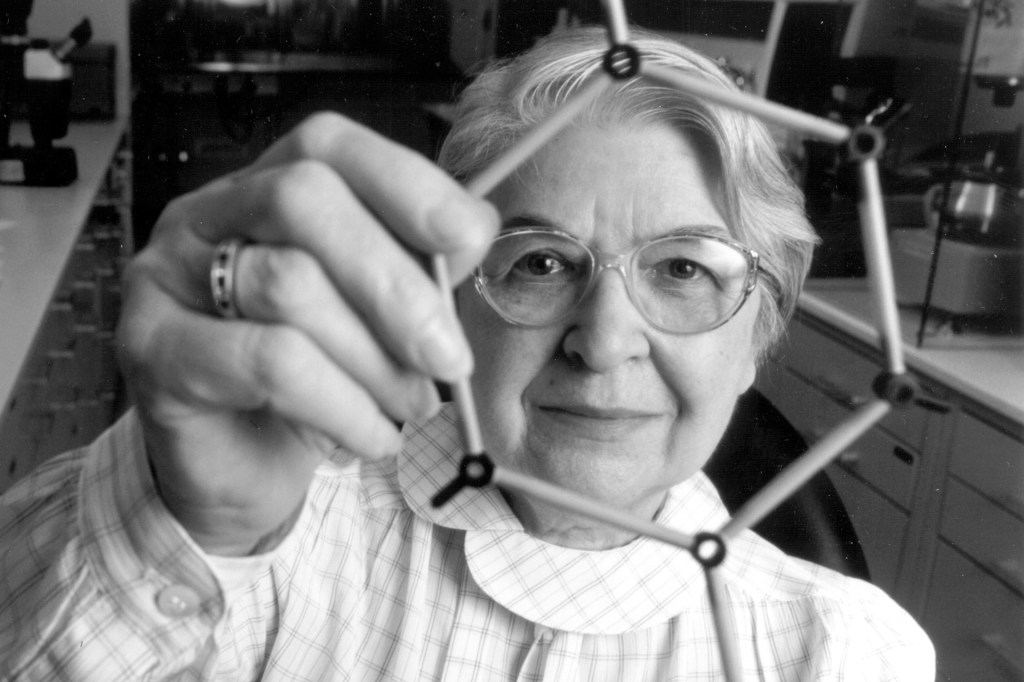
Stephanie Louise Kwolek should be a household name. Her discovery of Kevlar—a fibre five times stronger than steel—has stopped bullets, kept planes the air, and held up bridges. Yet outside chemistry circles, you rarely hear her mentioned. That silence is no accident. It speaks volumes about how we reward, and overlook, women whose brilliance sits inside laboratories rather than lecture halls. Kwolek’s story is a rebuke to that neglect—and a rallying cry for public investment in the people who keep the rest of us safe.
Early Curiosity Amid Hardship
Born in 1923 to Polish-American parents in industrial Pennsylvania, Kwolek grew up collecting plants with her naturalist father and sewing dresses beside her perfectionist mother. Money was scarce; war clouds gathered. Science, she realised, offered both escape and purpose. A chemistry degree from Carnegie Mellon followed in 1946—rare for a woman in that era. Medical school beckoned, but tuition was beyond reach. So she joined DuPont for “just a few years” to save the fees. She stayed four decades, not because she gave up on medicine, but because research offered an even bigger way to save lives.
Fighting Prejudice, Inch by Inch
DuPont’s labs were no egalitarian utopia. Women were expected to pipette, not pioneer. Pay gaps gaped; promotion ladders had missing rungs. Yet Kwolek pushed on, mastering low-temperature polymer chemistry and earning a coveted spot in the firm’s Pioneering Research Laboratory by 1950. Colleagues dismissed her as “applied” rather than “pure”, code for work that makes money instead of theory. She disagreed. “I’m not ashamed of applied science,” she later quipped. “It’s what puts food on tables.” The truth? Her “applied” insight would soon redraw the textbook.
The Cloudy Solution Everyone Else Binned
By 1964 DuPont wanted a lighter fibre to reinforce tyres and cut fuel bills. Kwolek dissolved stiff aromatic polyamides in an icy solvent; the result looked cloudy, thin, wrong. Most chemists would have tossed it. She insisted it be spun into filament. The fibre that emerged astonished the technicians—rigid, translucent, extraordinarily tough. Microscopes revealed a liquid-crystalline polymer in which rod-like chains lined up like soldiers, each hydrogen-bonded to the next. She had created poly-p-phenylene terephthalamide—Kevlar—without meaning to. Serendipity? Only partly. It takes nerve to chase an ugly solution when everyone else calls it waste.
Five Times Stronger than Steel—and Far Lighter
Kevlar’s tensile strength can exceed that of steel by a factor of five on equal weight. It refuses to melt, shrugs off flames to 450 °C, resists chemicals, and conducts neither heat nor electricity. Crucially, it keeps its strength while staying light, making it perfect for body armour, aircraft fuselages, suspension bridges and fibre-optic cables. That breadth of use was no accident. Kwolek understood that real-world problems rarely fit neat academic categories. She tested the fibre relentlessly, filing or co-filing 17 patents over her career.
Saving Lives in the Line of Duty
Since the late 1970s Kevlar vests have been credited with saving more than 3,000 police officers in the United States alone. Officers wearing body armour are over three times more likely to survive a torso gunshot than unarmoured colleagues, the statistical flip-side of a simple human truth: families kept whole because one chemist refused to settle for ordinary nylon. A peer-reviewed study of 637 shootings confirms the point—armour cuts the risk of death by 76%. Those are public-health wins by any measure, delivered not by a ministerial press release but by quiet, painstaking lab work.
Awards—Then Back to Obscurity
The industry clapped politely. Kwolek entered the National Inventors Hall of Fame in 1995, received America’s National Medal of Technology in 1996, and became only the second woman to collect the Perkin Medal in its 91-year history the following year. DuPont handed her its Lavoisier Medal—still the firm’s sole female recipient. Applause faded; school textbooks stayed silent. Why? Because the company, not the individual, owned the patent profits; because male colleagues grabbed the conference slots; because “applied” was still a snub disguised as praise. The commercial triumph of Kevlar became a corporate legend, the woman behind it footnoted as loyal staff.
The Cost of Looking Away
Ignoring Kwolek is more than historical oversight; it is policy failure. When society under-rewards women in applied science, we lose talent to better-paying, less impactful fields. We shorten the lifespans of future breakthroughs—clean batteries, safe medical implants—that rely on stubborn, detail-driven experimentation. Ask yourself: how many current schoolgirls even know a woman invented the fibre in every modern stab vest? How many might choose chemistry if they did?
Dismantling the Alibis
Some argue true innovators always rise. The record says otherwise. Kwolek dodged layoffs thanks to a sympathetic director; others were not so lucky. Some claim corporate R&D makes individual credit tricky. Yet male inventors from the same era—think Carothers of nylon—enjoy textbook fame. The inconsistency reeks of bias. And let’s bury the myth that “pure” science alone deserves the limelight. What is purer than a material that stands between a firefighter and a flash-over? What is nobler than chemistry that keeps a soldier breathing?
Lessons for a Fairer Research Culture
Kwolek’s career shows what sustained, publicly minded research funding can do. It underscores the need for strong civil-service grant bodies that back long-horizon projects, not quarterly returns. It demands that universities teach the names of women who turned polymers into life-saving kit. And it calls for procurement rules that recognise social value, steering contracts towards innovators who put lives ahead of dividends. Public services—NHS trusts, police forces, even local councils—owe her a debt. The best repayment is to champion the next Kwolek in their midst.
The final thread Stephanie Kwolek died in 2014, her invention woven into more than 200 products and countless stories that end with someone walking away from what should have been fatal. She never sought headlines, only the freedom to follow evidence wherever it led. Bullet-stopping fibre, barrier-breaking woman, quietly brilliant scientist. Repeat the phrase. Let it echo in classrooms, cabinet rooms, boardrooms. Because celebrating Kwolek is not mere nostalgia. It is a statement of justice—justice for the overlooked, and justice for every life her stubborn curiosity has saved.
Bob Lynn | © 2025 Vox Meditantis. All rights reserved.

 Vox Meditantis
Leave a comment