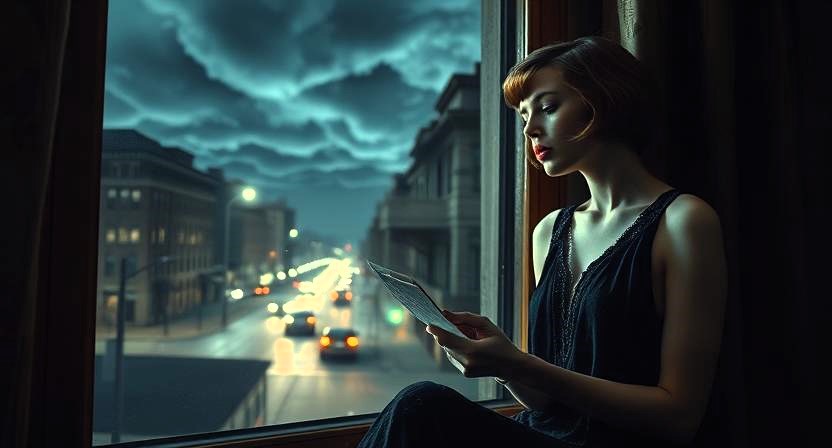
Miss Carrie Sanders
Mrs. Murphy’s Boarding House
1247 North Clark Street
Chicago, Illinois
15th November, 1927
My Dearest Thomas,
I find myself sitting by the window in my little room tonight, watching the electric lights twinkle along Clark Street like earthbound stars, and I confess my heart feels as heavy as the November clouds that have settled over our city. Your last letter arrived three days ago, and I’ve read it so many times the paper has grown soft at the creases where I’ve folded and unfolded it, searching for words that simply aren’t there.
Oh, darling Thomas, how can I begin to tell you of my disappointment? Not the sharp, angry kind that burns and fades, but the slow, aching sort that settles in one’s chest like lake fog and refuses to lift. When I first read your careful words about “taking things slowly” and “being practical about our situation,” I felt as though the ground had shifted beneath my dancing shoes.
Do you remember your letter from last spring, when you wrote so beautifully about wildflowers refusing to be contained by fence lines? You said I was like those flowers—too vibrant and wild for boundaries. I treasured those words, pressed them to my heart just as you press actual wildflowers in your books. But now I wonder if you’ve begun to see my wildness not as something to admire, but as something to fear.
I’ve been thinking about our last visit in September, when you came to the city and we walked along the lake. You seemed so enchanted by everything—the jazz music spilling from the clubs, the motor cars honking their horns, even the way the electric signs reflected in the water. You held my hand tighter when we passed couples dancing to a street musician’s saxophone, and you whispered that you’d never imagined such freedom existed. I thought then that you understood what this life means to me, what I’ve built here with my own hands and determination.
But your recent letters have grown cautious, full of phrases about “proper timing” and “considering all factors.” When I wrote about the lovely flat I found near Lincoln Park—just big enough for two, with windows that catch the morning sun—you responded with concerns about rent money and propriety. When I mentioned how exciting it would be to show you more of the city’s hidden speakeasies and jazz clubs, you worried about reputation and respectability.
Thomas, my gentle, curious man, what has happened to the fellow who once wrote that he felt like a caged bird when he looked beyond his wheat fields? Have you decided that your cage is safer than the open sky I’m offering to share with you? I fear you’ve been listening too closely to voices that aren’t mine—perhaps your neighbours, your church congregation, or that dreadful Mrs. Whitmore who runs the general store and has opinions about everyone’s business.
I know what they must be saying about me. A girl who left her family to work in the city, who cuts her hair short and wears rouge, who dances until dawn and thinks nothing of riding the elevated train alone at midnight. They probably whisper that I’m not suitable for a respectable farmer, that I’ll corrupt you with city ways and modern ideas. But don’t they understand that these aren’t corruptions but freedoms? Don’t you understand that I’m not asking you to abandon everything you are, but to expand what you might become?
The most disappointing part, my darling, is that I know you feel it too—this pull toward something larger than either of us imagined alone. I see it in the way you describe your restless nights, staring at the same stars I see from my window. I hear it in your questions about my work, my friends, my adventures in this magnificent, terrible, wonderful city. You’re curious about my world because part of you longs to be in it, yet you keep pulling back like a child afraid to jump into the swimming hole.
I’m not angry with you for your caution—it’s part of what makes you so dear to me. Your gentleness, your thoughtful nature, the way you consider every angle before making decisions. These qualities balance my impulsive spirit and make me feel cherished in ways I never expected. But disappointment has settled into my heart because I see you choosing fear over love, safety over the magnificent unknown we could explore together.
Perhaps you think I’m asking too much, expecting you to abandon your life in Kansas for my dreams in Chicago. But I’m not asking for abandonment, Thomas—I’m asking for transformation. We could build something entirely new, something that honours both your steady heart and my adventurous soul. We could find a place where wheat fields meet city skylines, where quiet conversations can coexist with jazz music and laughter.
I’ve been keeping something from you, a secret that now feels too heavy to carry alone. Last week, I received an offer to train as a supervisor at the telephone company. It would mean better pay, my own office, the chance to shape the future of women’s work in this industry. But it would also mean staying in Chicago for at least two more years, putting down roots that might grow too deep to transplant.
I wanted to discuss this with you, to dream together about what this opportunity might mean for both of us. Instead, I’m writing to a man who seems to be retreating further into his shell with each passing week. How can I share my victories with someone who appears increasingly frightened by my successes?
My dear, romantic Thomas, I still believe in the man who writes poetry about wheat dancing in the wind and sends pressed flowers in his letters. I still trust in the love that sparked between us through written words and grew stronger with each shared secret. But I need to know that you still believe in us too, that your curiosity about my world hasn’t withered into mere politeness, that your dreams of something more haven’t been abandoned for the sake of keeping others comfortable.
This disappointment isn’t the end of my love for you—it’s a call to the courage I know lives in your gentle heart. Please, my darling, don’t let fear make our decisions for us. Don’t let the smallness of others’ imaginations limit the largeness of what we might create together.
I’ll keep watching for your letters, hoping the next one will carry the bold spirit I fell in love with through the mail. I’ll keep pressing your flowers between the pages of my diary, trusting that the man who picked them still believes in growing something beautiful together.
Until then, I remain your devoted but disappointed,
Carrie
P.S. I’ve enclosed a photograph of myself in my new winter coat—you always said you loved how my eyes sparkle when I’m truly happy. I hope you can still see that sparkle, even when tempered with longing for the future I’m still brave enough to want with you.
Bob Lynn | © 2025 Vox Meditantis. All rights reserved.


Leave a comment