Cairo, Egypt – 21st July 1798
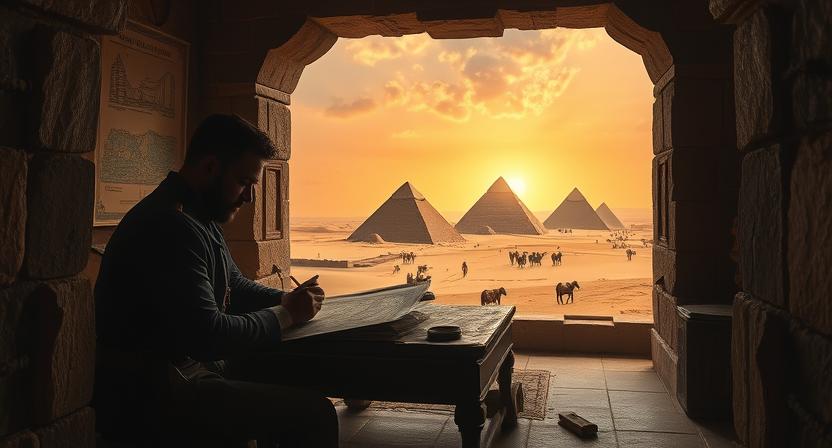
The scratch of my quill against parchment has become a metronome for this madness. Each stroke marks another coordinate plotted, another battery position calculated, another small victory against the chaos thundering beyond these ancient walls. But as I lean over my maps in this commandeered Mamluk palace, I find myself listening—truly listening—to the symphony of empire that plays around me on this scorching July morning.
Boom. The cannons speak first, their voices carrying across the desert like the pronouncements of iron gods. I count the intervals automatically—one, two, three seconds—calculating distance and trajectory even as my hand continues its precise work. The artillery placement here must account for the wind patterns, the way sound travels differently through this dry air that tastes of sand and smoke and something indefinably ancient.
Scratch, scratch. My quill finds its rhythm again. The sound is so small, so intimate against the grandeur of battle, yet it carries the weight of Napoleon’s ambitions. Each mark I make could determine where men live or die, where the Army of the Orient advances or retreats. Strange, how such momentous decisions emerge from something as quiet as ink meeting paper.
Between the cannon reports, I hear them—the war cries drifting on the desert wind. “Allahu Akbar!” echo from the Mamluk cavalry, their voices fierce and desperate. Our own soldiers answer with “Vive la République!” and “Vive Bonaparte!” The languages crash against each other like rival tide pools, Arabic consonants sharp as scimitars, French vowels rolling like artillery wheels across cobblestones.
Scritch. The quill catches on rough parchment, and I realise I’ve been timing my strokes to the distant clash of sabres. Metal rings against metal in a percussion that speaks of individual duels within the larger battle. Each clash represents a moment of absolute focus, life balanced on a blade’s edge. How different my own blade—this simple quill—yet how similar the concentration required.
The calls to prayer begin just as a particularly violent exchange erupts to the southeast. “Allahu Akbar, Allahu Akbar“—the muezzin’s voice cuts through the cannon smoke with serene authority. I pause, my calculations half-finished, struck by the surreal persistence of faith in the face of conquest. The minarets continue their ancient duty as if Napoleon’s ambitions were merely weather to be endured.
I find myself holding my breath during the prayer calls, not from reverence but from professional respect. There is something about their measured cadence that helps me think more clearly. The mathematical precision of Islamic art extends to their religious observances, I realise. Five times daily, at calculated intervals, regardless of the temporal chaos surrounding them. It is almost… scientific.
Whisper. Sand shifts through a crack in the wall beside me, each grain a tiny messenger from the Sahara itself. The sound is barely perceptible, yet it contains multitudes—the erosion of monuments, the patience of deserts, the way time moves differently in this place where pharaohs once calculated their own eternal campaigns.
My maps show elevations, distances, strategic positions. But they cannot capture what I truly hear: the weight of accumulated centuries pressing against these stones. These walls witnessed Saladin’s victories, the Mamluk dynasties, perhaps even Roman legions. Now they shelter a French cartographer plotting Napoleon’s Egyptian dream while listening to the soundtrack of collision between civilisations.
Splash. The Nile runs eternal beyond the palace gardens, its voice unchanged since Moses parted different waters entirely. I can hear it even over the battle din—that liquid constancy that gave birth to surveying, to mathematics, to the precise agricultural calculations that made this land the breadbasket of empires. The river speaks in measurements: flood seasons, irrigation schedules, the geometric perfection of field divisions that inspired Pythagoras himself.
The scratch of my quill grows more urgent as a messenger arrives with updated troop positions. I must incorporate new intelligence quickly, accurately. But as I work, I become aware of another sound layer—my own breathing, shallow and focused, punctuated by the small satisfied grunts I make when a calculation resolves correctly. These are the sounds of concentration, the auditory signature of mind wrestling with precision under pressure.
Boom, boom. A battery closer now, perhaps the twelve-pounders we positioned at dawn. The sound arrives with mathematical predictability, and I find myself plotting trajectories not just on paper but in my head, using the acoustic timing to verify distances. Napoleon values men who can think in multiple dimensions simultaneously. Here, in this ancient place, even sound becomes geometry.
Between explosions, I hear something else: silence. Not the absence of sound, but a positive presence of quiet that seems to emanate from the pyramids themselves. Those monuments have absorbed twenty centuries of human ambition and remain essentially unmoved. Their silence is not empty but full—pregnant with the accumulated breath of pharaohs, priests, pilgrims, and now soldiers.
What does a man of the Enlightenment hear when working in shadow of mysteries far older than his civilisation? I hear the humility that comes with recognition of scale. My measurements matter intensely in this moment, but they are grains of sand compared to the calculations required to build those eternal triangles on the horizon.
Scritch, scritch. The quill continues its work, and I realise I have begun to hear my own heartbeat in the pauses between cannon fire. The pulse of blood through arteries somehow synchronises with the scratch of quill on parchment, creating a personal rhythm within the larger symphony. Life asserting itself against the geometry of death.
A new sound intrudes: hoofbeats, rapid and approaching. Another dispatch rider with intelligence requiring immediate incorporation into my calculations. The horse’s breathing is laboured—they have ridden hard through this heat, through this chaos, to bring me numbers that will influence the next phase of battle.
As I adjust my maps, I become conscious of the layered nature of my auditory experience. Immediate foreground: quill scratch, paper rustle, my own breathing. Middle distance: the approaching hoofbeats, prayers from the minaret, clash of combat. Far background: the eternal whisper of desert wind, the Nile’s ancient murmur, and beneath it all, that profound silence radiating from stones that remember dynasties.
Boom. This explosion closer still, and through the window I glimpse the smoke rising where Desaix’s division engages the Mamluk cavalry. The sound reaches me moments after seeing the distant flash—another reminder that even here, in this momentous historical collision, the laws of physics maintain their quiet authority. Sound travels through this scorching desert air at speeds determined by temperature and atmospheric conditions, yet it follows predictable natural laws that care nothing for human ambition.
I hear my own voice now, muttering calculations aloud: “If the angle of elevation increases by three degrees… if wind speed holds constant… if the enemy cavalry maintains current heading…” The verbal mathematics help me think, transform abstract numbers into spoken reality that my ears can verify even as my eyes track the marks across parchment.
Scritch. The quill needs resharpening. I hear the subtle change in its voice against the paper, the way worn metal creates slightly different frequencies than a fresh point. Even my tools have their own acoustic signatures, their own ways of participating in this moment where individual precision contributes to epochal change.
Between the immediate demands of cartographic accuracy and the philosophical weight of working in shadow of eternity, I find my concentration shaped by sound itself. The rhythm of distant battle provides structure, like a complex musical composition requiring precise timing and attention to multiple simultaneous melodies.
As afternoon heat intensifies, new sounds emerge: the crack of expansion joints in ancient stone, the whisper of heated air rising through the palace’s corridors, the subtle shift in acoustic properties as temperature changes affect how sound travels across the battlefield. Even the physics of the moment reflect the larger transformation occurring here.
What do I listen to while I work? I listen to the soundtrack of empire, to the percussion of civilisational collision, to the quiet constancy of mathematical truth asserting itself against the noise of human ambition. I listen to my own small part in history’s grand symphony—the scratch of one quill in one palace on one day when France dreamed of eastern conquest and ancient stones witnessed yet another chapter in humanity’s eternal story.
Boom. The cannons continue. My quill scratches on. And in the silence between sounds, I hear the patient breathing of pyramids that know this too shall pass.
The End
On 21st July 1798, Napoleon’s forces decisively defeated the Mamluk army at the Battle of the Pyramids, with approximately 25,000 French troops overwhelming 6,000 Mamluk cavalry and supporting infantry near Cairo. French casualties numbered fewer than 30, whilst Mamluk losses exceeded 2,000, effectively ending their 500-year rule over Egypt. This victory launched France’s three-year occupation of Egypt and sparked the systematic study of ancient Egyptian civilisation, including the discovery of the Rosetta Stone in 1799. Though the campaign ultimately failed following British naval victories, it established modern Egyptology and archaeological methodology, fundamentally transforming how Western scholarship approaches ancient civilisations and inspiring the scientific expeditions that continue to shape our understanding of antiquity today.
Bob Lynn | © 2025 Vox Meditantis. All rights reserved.


Leave a comment