15th November, 1924
The Algonquin Hotel
New York City
My Dearest Clarence,
The autumn leaves are falling like scattered confetti outside my window here on West 44th Street, and I find myself thinking of that crisp October morning when we walked through the aspen groves near your ranch. Do you remember how you insisted on collecting the golden leaves, claiming they reminded you of my hair in the lamplight? Such romantic nonsense from a Wyoming cattleman—though I confess I’ve pressed one of those very leaves between the pages of my Fitzgerald, and it travels with me still.
The city pulses with a different rhythm than your wide-open spaces, old friend. The speakeasies hum with jazz until the early hours, and the theatre district buzzes with opening nights and closing scandals. I’ve been working on a series of illustrations for Harper’s Bazaar—fashion plates that capture the spirit of these modern times. The editor, a sharp-eyed woman named Mrs. Mercer, praised my “sensitivity to the masculine form.” If only she knew the true source of my inspiration! I find myself sketching men with your strong jawline and those impossibly broad shoulders that come from years of honest labour.
But here’s where my heart grows heavy, dear Clarence. In the coffee houses and artistic circles, I hear whispers of men like us—some speak with knowing glances, others with barely concealed disgust. Just last week, the police raided a private club in the Village. The newspapers were mercifully vague, but the implications hung in the air like smoke from a dying cigarette. It makes me wonder if I’m a fool for writing so candidly, even to you. Are we simply playing at being brave, or are we truly courageous? The line seems impossibly thin some days.
I’ve been corresponding with a chap named Edmund from London—a fellow artist who shares certain… sympathies. He writes of a different world across the Atlantic, where men like Oscar Wilde blazed trails we’re still afraid to follow. “The love that dare not speak its name,” he quoted in his last letter, and I thought immediately of us, of the careful way we must choose our words, even in the privacy of our correspondence.
Do you ever feel the weight of it all, my darling? The constant vigilance, the need to translate our hearts into acceptable language? When I tell the fellows at the Artist’s Club about my “dear friend in Wyoming,” they nod politely and assume you’re merely a childhood companion. If only they knew you’re the reason I wake with purpose each morning, the reason I’ve turned down three perfectly suitable young ladies whom my mother insists on parading before me.
Speaking of which, Mother has been particularly persistent lately. She’s invited the Chadwick girl to dinner again next week—a perfectly lovely creature with cornflower-blue eyes and a tinkling laugh. I find myself wondering if I could play the part convincingly, if I could build a life of pleasant deception. But then I remember the way you looked at me in the barn that September evening, with the harvest moon casting silver light across your face, and I know I could never settle for anything less than the truth of what we share.
The city offers its own temptations, I’ll admit. There’s a young man who works at the bookshop on MacDougal Street—dark hair, intelligent eyes, hands that move like poetry when he speaks of literature. He’s invited me to several gatherings, and I sense an invitation to something more substantial lingering beneath his casual words. But how can I explain that my heart is already spoken for, already belongs to a man fifteen hundred miles away who brands cattle and mends fences and writes letters that arrive like small miracles in my postbox?
I’ve been reading Whitman again—our old favourite. “For the one I love most lay sleeping by me under the same cover in the cool night…” Do you remember how we discovered that poem together, reading by lamplight in your father’s study while the wind howled across the plains? The audacity of it thrilled and terrified us both. Sometimes I wonder if we’re simply products of our reading, if poets like Whitman planted seeds in our hearts that might otherwise have remained dormant.
The season is changing here in Manhattan. The trees grow bare, and the first hints of winter nip at the edges of the wind. I find myself longing for the clarity of your Wyoming winters, where the snow falls clean and honest, where a man can see for miles in every direction. Here, everything feels obscured by shadow and suggestion, by the need to read between lines and speak in code.
I’ve enclosed a small sketch—nothing elaborate, just a quick study of two figures walking side by side through a grove of trees. To any casual observer, it’s simply a pastoral scene. But you’ll recognise the broader shoulders, the familiar gait, the way one figure leans slightly toward the other as if drawn by invisible threads. Art, I’ve discovered, can be the most honest language we possess, even when honesty comes wrapped in metaphor.
Tell me, my dearest friend, do you ever doubt the wisdom of this correspondence? Do you ever wonder if we’re being reckless, leaving evidence of our affection scattered across the postal routes between New York and Wyoming? I seal each letter with a mixture of hope and trepidation, knowing that words committed to paper become permanent, indelible proof of feelings that society would rather see buried.
Yet I cannot stop myself from writing. Your letters arrive like sustenance to a starving man, and I devour every word, every carefully chosen phrase that hints at deeper feelings. When you write of the loneliness of the winter months, when you mention how the empty bunkhouse echoes with memories of better times, I read between the lines and understand that you’re speaking of missing me, of counting the days until we might meet again.
I’ve been making inquiries about visiting Wyoming again come spring. Perhaps I could commission a series of Western illustrations—surely there’s a market for authentic depictions of ranch life. It would give me a legitimate reason to spend extended time in your territory, to walk once more through those endless grasslands where a man can breathe freely and speak his heart without fear of eavesdroppers.
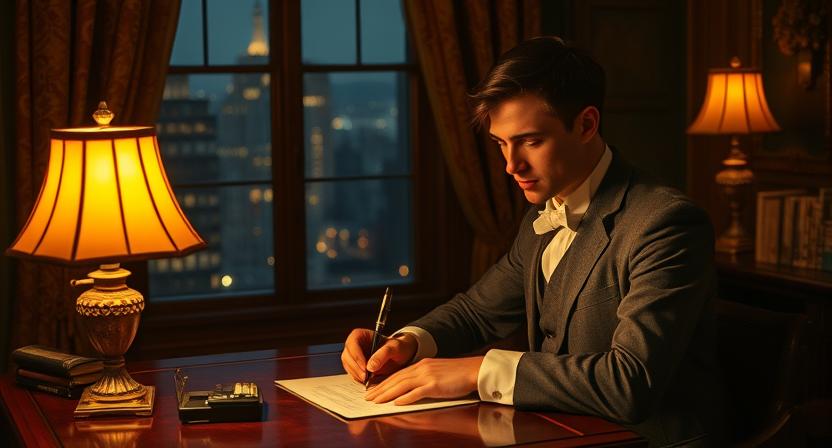
The hotel is growing quiet now. The theatrical crowd has dispersed to their various revelries, and the businessmen have retired to their rooms and their ledgers. I sit here in the amber glow of the desk lamp, surrounded by the detritus of city life—newspapers full of scandal, theatre programmes, invitations to parties I’ll probably attend but won’t truly enjoy. None of it feels quite real, quite substantial. Only these letters, only this connection to you, feels genuine in a world that seems increasingly built on pretense.
Write to me soon, my darling. Tell me about the approaching winter, about the cattle and the endless sky. Tell me that you think of me when the wind picks up at evening, when the stars emerge in that vast dome of darkness that city dwellers like myself have almost forgotten exists. Tell me that somewhere in Wyoming, a man with gentle hands and a strong heart counts the days until spring, until possibility, until we might find ourselves walking side by side through aspen groves once more.
I remain, as always, your devoted and slightly reckless friend,
Joe
P.S. Burn this letter, won’t you? Some truths are too dangerous to preserve, even as they’re too precious to leave unspoken.
Bob Lynn | © 2025 Vox Meditantis. All rights reserved.


 Vox Meditantis
Leave a reply to veerites Cancel reply