Yekaterinburg, Russia – 17th July 1918
The cellar of the Ipatiev House pressed against Alexei Trupp’s chest like a coffin lid. Seventeen months of imprisonment had transformed the modest merchant’s dwelling into a tomb for the living, its walls thick with the weight of despair and the lingering scent of carbolic acid that the guards used to mask other, more troubling odours.
Trupp’s weathered hands trembled as he descended the narrow wooden steps, each creak echoing through the suffocating darkness. Above him, the floorboards groaned under the heavy boots of the Chekists—those dreadful men with their leather coats and cold eyes who had arrived that morning with orders that chilled his very soul.
The faithful servant had served the Romanov household for thirty-seven years, through glittering court balls and devastating military defeats, through the abdication and this final, inexorable slide towards oblivion. His loyalty had never wavered, not even when the revolutionaries had stripped away every vestige of imperial dignity, reducing the once-mighty Tsar to a broken man who chopped wood in a prison courtyard.
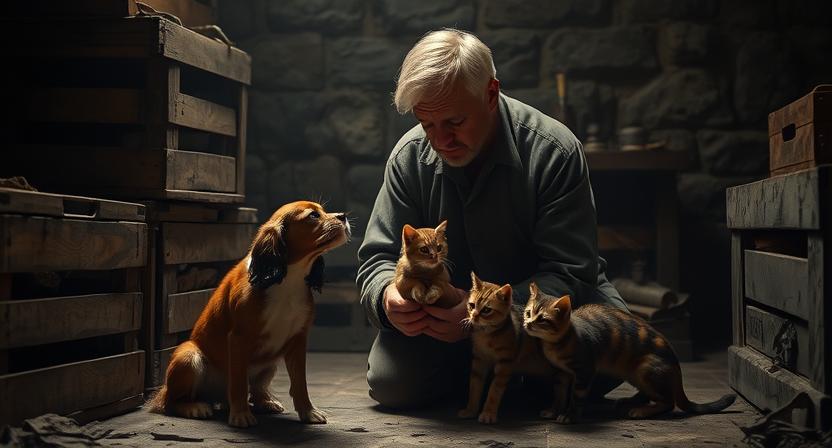
In the cellar’s furthest corner, behind a stack of mouldering crates, Joy whimpered softly. The King Charles spaniel had been the family’s constant companion throughout their captivity, her glossy coat now dull and matted, her once-bright eyes clouded with the same resignation that had settled over her masters. The little dog had slept curled beside the Grand Duchesses during the coldest nights, providing what comfort she could in their shared misery.
“There, my dear girl,” Trupp whispered, his voice barely audible above the creaking house. “Hush now.”
But it was not Joy alone who had drawn him to this dank refuge. From the opposite corner came a different sound—a low, rumbling purr that spoke of contentment despite the circumstances. The cat had appeared sometime during the winter months, a sleek tortoiseshell creature with golden eyes that seemed to hold ancient secrets. She had slipped through the cellar’s cracked foundation like smoke, establishing herself amongst the discarded furniture and forgotten belongings of the house’s former life.
The Grand Duchesses had discovered her first, of course. Despite their dire circumstances, the young women had retained their capacity for wonder, their ability to find joy in the smallest mercies. They had named her Nadezhda—Hope—and had smuggled scraps of bread and precious morsels of meat to sustain her. The cat had become their secret, their small rebellion against the grinding despair that threatened to consume them all.
Trupp knelt beside the makeshift bed where Nadezhda had made her home, her three kittens nestled against her warm flank. Born just a fortnight ago, they were perfect miniatures of their mother, their eyes newly opened to a world that held no promise of tomorrow. The servant’s heart clenched at the sight of such innocent vulnerability in this place of approaching doom.
The sound of voices drifted down from above—harsh Russian commands and the shuffle of many feet. Trupp’s blood ran cold as he recognised the voice of Yakov Yurovsky, the man who had assumed command of the house’s guard detail. There was something in the commandant’s tone tonight that spoke of finality, of orders that brooked no delay or mercy.
Time was running short. The servant could feel it in the very air, thick with the promise of violence. Soon, very soon, the family would be summoned. There would be no escape, no last-minute reprieve, no miracle to preserve the last remnants of imperial Russia.
But perhaps—just perhaps—something might be saved from the approaching catastrophe.
Trupp’s mind raced as he considered his options. The cellar had a small window, barely wide enough for a man to squeeze through, that opened onto the courtyard behind the house. During his weeks of service in this accursed place, he had discovered that the guards rarely patrolled that particular corner during the changing of the watch. It would be possible, with careful timing and considerable luck, to slip one creature through that window to freedom.
But only one.
The choice that confronted him was both simple and impossibly complex. Joy represented everything the family had once been—noble, refined, a living symbol of the grandeur that had defined the Romanov dynasty for three centuries. She was pure-bred, her lineage as carefully maintained as that of her masters, her very existence a reflection of the ordered world that was about to die alongside them.
Yet as Trupp looked upon the spaniel, he saw also the weight of the past, the burden of tradition that had perhaps contributed to the family’s downfall. Joy was beautiful, certainly, but she was also dependent, requiring constant care and attention. She had never known hardship, never learned the harsh lessons of survival that the coming years would demand of any creature fortunate enough to witness them.
Nadezhda, by contrast, embodied something entirely different. She was a survivor, a creature who had thrived in the most desperate circumstances, who had somehow found a way to bring new life into a world that seemed determined to extinguish it. Her kittens were proof of her resilience, her refusal to surrender hope even in the face of overwhelming darkness.
The tortoiseshell cat had chosen to stay with the family when she could have fled, had offered them comfort without thought of reward. She represented not the grandeur of the past, but the possibility of a future—uncertain, perhaps, but undeniably alive with potential.
Trupp’s decision crystallised as he heard the heavy tread of boots on the stairs above. The guards were coming, and with them, the end of all things familiar and cherished. His hands shook as he reached for the wooden crate that contained the family’s few remaining possessions—letters, photographs, small mementoes that would soon be discarded or destroyed.
Carefully, he lifted out Joy, the spaniel’s trusting brown eyes gazing up at him with unwavering faith. For a moment, the servant’s resolve wavered. This creature had been loyal beyond measure, had never failed in her devotion to the family. Did she not deserve salvation above all others?
But then Nadezhda approached, her three kittens mewing softly as they followed their mother across the cellar floor. The cat rubbed against Trupp’s leg, her purr a vibration of contentment that seemed to defy the horror that surrounded them. In that touch, he felt not just the warmth of a living creature, but the promise of generations yet to come—kittens who would grow to have kittens of their own, carrying forward some small flame of life beyond this night of endings.
The decision, when it came, was both agonising and inevitable.
Trupp set Joy gently back in her corner, his throat tight with unshed tears. “Forgive me, dear girl,” he whispered, his voice breaking. “You deserve so much more than this world can offer.”
With infinite care, he gathered Nadezhda and her kittens into a worn blanket, creating a makeshift sling that he could carry close to his chest. The mother cat settled immediately, seeming to understand that this was not a moment for protest or struggle. Her golden eyes met his with what appeared to be gratitude—or perhaps simply the ancient wisdom of a creature who had learned to recognise salvation when it appeared.
The window opened with a soft groan of protest, its hinges stiff with rust and neglect. The courtyard beyond was shrouded in darkness, the single guard visible in the distance, his attention focused on the main entrance where his comrades were gathering. Trupp’s heart pounded as he lifted the bundle containing the cats towards the opening, every second stretching into eternity.
“Live,” he whispered to Nadezhda as he carefully lowered her and her kittens through the window. “Live and remember that there was love in this place, even at the end.”
The tortoiseshell cat looked back at him once before disappearing into the shadows, her kittens safe against her warmth. Trupp watched until he could no longer see them, then slowly closed the window and turned back to the cellar where Joy waited, her tail wagging despite the approaching footsteps that echoed through the house above.
The servant settled beside the spaniel, his weathered hand stroking her silky ears as the sounds of preparation grew louder overhead. Soon, very soon, they would all be summoned to their fate. But somewhere in the darkness beyond these walls, three small lives carrying forward some small flame of life beyond this night of endings—a tribute to the love that had flourished even in the shadow of death..
Trupp closed his eyes and listened to the night, his choice made, his conscience clear. In saving the survivors, he had perhaps saved something more precious than memory—he had saved the future itself.
The footsteps on the stairs grew closer, and Joy pressed against his side, her loyalty undimmed even in this final hour. Together, they waited for whatever dawn might bring, knowing that somewhere in the darkness, hope walked on silent paws towards tomorrow.
The End
On 17th July 1918, Tsar Nicholas II, his family, and four loyal servants—including footman Alexei Trupp—were executed by Bolshevik revolutionaries in the basement of the Ipatiev House in Yekaterinburg, ending the 300-year Romanov dynasty. The eleven victims had been imprisoned for 78 days whilst civil war raged between Bolshevik Red forces and anti-communist White armies approaching the city. Over the following 84 days, 27 additional Romanov relatives and associates were murdered across Russia. The Bolsheviks concealed the family’s deaths for decades, with remains only discovered in 1991 and 2007. This massacre remains a defining moment in Russian history, continuing to generate pilgrimage, debate, and examination of imperial legacy versus revolutionary justice.
Bob Lynn | © 2025 Vox Meditantis. All rights reserved.


 Vox Meditantis
Leave a reply to veerites Cancel reply