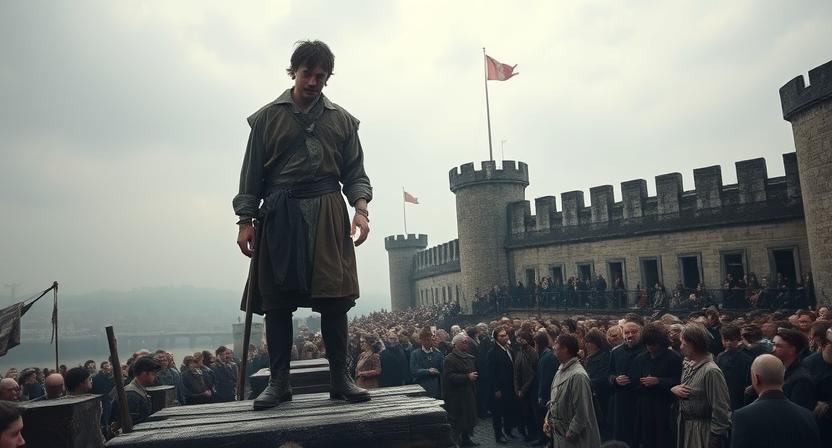
Tower Hill, London – 15th July 1685
I watched the crowd gather as I sharpened the axe for the third time that morning, the whetstone singing against steel in a rhythm that had become as familiar as my own heartbeat. Tower Hill stretched before me, a sea of unwashed bodies and hungry faces, all come to witness what they believed would be justice. The stench of their excitement mingled with the Thames’s foul breath, and I found myself wondering, not for the first time, how I had come to stand on this side of death’s door.
My name is Thom Jarrett, and I am what polite society calls an executioner’s assistant, though the tavern gossips prefer cruder terms. For three years now, I have maintained the tools of our grim trade and steadied the block when Jack Ketch’s hands shake too violently to manage alone. It is work that pays well enough to keep my wife Sarah and our two young ones fed, but it comes at a price that weighs heavier on my soul with each passing day.
Today, that weight threatens to crush me entirely.
The fifteenth of July, in the year of our Lord sixteen hundred and eighty-five, and we are to execute James Scott, Duke of Monmouth—bastard son of the late King Charles, defeated claimant to the throne, and in the eyes of many good Protestant folk like myself, a martyr to the cause of religious freedom. The irony tastes bitter as copper in my mouth: here am I, a man who has prayed nightly for deliverance from Catholic tyranny, preparing to help kill the very man who tried to provide it.
“Thom!” Jack’s voice cuts through my brooding, sharp with the nervous edge that has plagued him all week. “The blade—is it keen enough?”
I run my thumb along the axe’s edge, feeling the microscopic burr that no amount of sharpening seems able to remove. In my former life as a blacksmith, I would have reforged the entire head rather than work with such an imperfect tool. But Jack is too proud to admit his axe needs replacing, and the Crown is too miserly to provide a new one.
“Keen as I can make it,” I lie, hating myself for the deception. We both know what happened at Lord Russell’s execution two years past—five blows it took, with the poor man moving and crying out through three of them. The crowd nearly rioted, and Jack hasn’t been the same since.
The Duke arrives with less fanfare than I expected, flanked by guards whose faces show more sympathy than malice. Monmouth himself appears smaller than the portraits suggest, his dark hair dishevelled, his once-fine clothes wrinkled from his Tower imprisonment. Yet there is a dignity in his bearing that makes my stomach clench with fresh guilt.
As he mounts the scaffold, I catch sight of his eyes—dark, intelligent, filled not with fear but with a profound sadness that seems to pierce straight through me. Here is a man who has gazed upon death and found it wanting, not for himself but for what his passing will mean to the kingdom he tried to save.
“Good people,” he begins, his voice carrying clearly across the assembled throng, “I come here not to make excuses for my actions, but to commend my soul to God’s mercy and to ask your forgiveness for any who have suffered on my account.”
The words hit me like hammer blows to my chest. This is no villain we are about to dispatch, no common criminal who has earned his fate through base deeds. This is a man who believed so deeply in his cause that he wagered everything—his life, his honour, his very soul—upon it. And I, Thom Jarrett, am to help cut him down.
My hands begin to shake as I check the block one final time, ensuring its surface is level and the restraining straps are secure. Such attention to detail has always been my pride; I take no pleasure in suffering, and I have long prided myself on ensuring that those who must die do so as swiftly and cleanly as possible. But today, that very competence feels like collaboration with evil.
What bothers me most is not simply that we are killing a man—I have assisted at enough executions to become, God forgive me, somewhat inured to that particular horror. No, what gnaws at my soul like a canker is the way this execution makes me complicit in the very tyranny I have spent my life opposing.
I am a Protestant, born and raised in the faith that cost my grandfather his livelihood under Bloody Mary’s reign. I have watched Catholic courtiers grow fat on preferments while good Englishmen suffer for their beliefs. When news of Monmouth’s rebellion reached London, I confess my heart leaped with hope. Here, at last, was someone willing to fight for our faith, to restore England to its rightful Protestant path.
And yet, when the Duke’s cause failed and he was brought to the Tower, I did not resign my position. I did not speak out against his prosecution. I did not even refuse to participate in his execution. Instead, I told myself the lies that all weak men tell: that I had no choice, that my family’s welfare must come first, that one man’s protest would change nothing.
The truth is simpler and more shameful: I am a coward.
The Duke finishes his address and kneels beside the block. I move forward to help position him correctly, and as I do, our eyes meet for a brief moment. In that instant, I see not the failed rebel or the royal bastard, but simply a man—younger than myself—who is about to die for his principles while I live on, compromised and complicit.
“Forgive me, Your Grace,” I whisper, so quietly that only he can hear.
He manages a small smile. “It is not your forgiveness I require, good man, but God’s. See that you do not require mine.”
The words strike me like a physical blow. He knows. Somehow, this doomed nobleman has looked into my heart and seen the wreckage of my conscience. He knows I am a Protestant, knows I should be mourning his fate rather than facilitating it, and yet he offers not condemnation but understanding.
Jack steps forward, axe in hand, and I see the telltale tremor in his grip. My heart sinks. The blade is imperfect, the executioner is nervous, and before us lies a man whose only crime was believing too deeply in justice.
“Stand clear!” Jack calls, raising the axe.
I step back, but I cannot look away. Perhaps I owe Monmouth that much—to bear witness to what my cowardice has wrought.
The first blow lands askew, striking the base of the Duke’s neck but failing to sever it cleanly. Monmouth’s body convulses, and a low moan escapes his lips. The crowd’s cheers turn to gasps of horror.
“Again!” someone shouts from the platform, but Jack is frozen, staring in shock at his failure.
I move without thinking, grabbing his arm. “The angle,” I hiss. “You must adjust the angle.”
The second blow is better but still insufficient. Blood pools on the scaffold, and I can hear retching from the crowd. Some are calling for the proceeding to stop, but it is too late for mercy now—to leave him alive but mortally wounded would be crueller than death.
By the fourth blow, I am supporting Jack’s elbow, using my knowledge of anatomy gained from years of butchering livestock to guide his strikes. It is the most shameful thing I have ever done, and yet I tell myself it is also the most merciful—to ensure this horror ends quickly rather than prolonging the Duke’s suffering.
When it is finally finished, when the head is at last severed and held aloft for the crowd’s inspection, I find myself staring at Monmouth’s face. Even in death, there is a serenity there that I know I will never possess. He died for his beliefs, while I live on, compromised and corrupted.
The crowd disperses slowly, their bloodlust sated but their mood subdued. This was not the clean, decisive justice they had come to witness but something far uglier—a butchery that reflected poorly on all involved.
As we clean the scaffold and pack away our tools, Jack is uncharacteristically quiet. Finally, he speaks: “I cannot do this anymore, Thom. Not after today.”
I look at him—this man who has ended dozens of lives with far greater skill than he showed today—and see my own revulsion reflected in his eyes. “Nor can I,” I admit.
“But your family—”
“Will find another way to eat,” I interrupt. “My grandfather lost his shop rather than compromise his faith. I think I can manage to find honest work rather than compromise my soul.”
That night, I sit by my hearth and tell Sarah everything—about my shame, my cowardice, and my decision to leave the executioner’s service. She listens in silence, then takes my bloodstained hands in hers.
“I have been praying for months that you would find the courage to walk away,” she says simply. “We will manage, husband. We always have.”
As I write these words by candlelight, three days after Monmouth’s execution, I find myself thinking about what truly bothers me. It is not the act of killing itself—I have slaughtered animals for food and would kill in defence of my family without hesitation. It is not even the brutality of execution—quick death is often more merciful than the lingering diseases that claim so many.
What bothers me is the way I allowed fear to make me betray everything I claimed to believe. I call myself a Protestant, yet I helped kill the Protestant cause’s greatest champion. I call myself a man of conscience, yet I silenced that conscience for the sake of coin. I call myself English, yet I served a king who would drag our nation back into popish darkness.
The Duke of Monmouth died for his principles. Jack Ketch has resigned his post rather than continue in work that sickens him. And I… I have finally found the courage to choose conscience over comfort, though it comes too late to save my soul from the stain of that July morning.
Tomorrow, I return to my forge. The iron I shape will serve honest purposes—horseshoes and ploughshares, gate hinges and cooking pots. I will never again maintain the tools of death, never again stand silent while good men die for tyrants’ causes.
I cannot undo what I helped do to James Scott, Duke of Monmouth. I cannot restore life to a man who deserved far better than the bloody end we gave him. But I can ensure that his death marks not just the end of his rebellion but the beginning of my redemption.
What bothers me is that it took a man’s needless suffering to teach me the price of my own cowardice. What gives me hope is that some lessons, however dearly bought, are worth the learning.
The fire burns low in my hearth as I finish these words, but I no longer fear the darkness. Come morning, I will be a blacksmith again—nothing more, nothing less, but perhaps finally worthy of the name.
The End
15th July 1685 saw James Scott, 1st Duke of Monmouth, beheaded on Tower Hill after his rebellion collapsed nine days earlier at Sedgemoor; contemporary reports say it took five axe strokes before the head was severed as a crowd of roughly 10,000 looked on. His failed uprising cost an estimated 1,500 rebel lives in battle, and the ensuing “Bloody Assizes” led to more than 320 further executions and about 800 transportations to the Caribbean within three months. These harsh reprisals, contrasted with later leniency shown after the 1715 and 1745 Jacobite risings, fuelled resentment that helped spark the Glorious Revolution of 1688, shaping Britain’s modern constitutional monarchy and enduring principles of religious tolerance.
Bob Lynn | © 2025 Vox Meditantis. All rights reserved.


 Vox Meditantis
Leave a reply to Tansy Gunnar Cancel reply