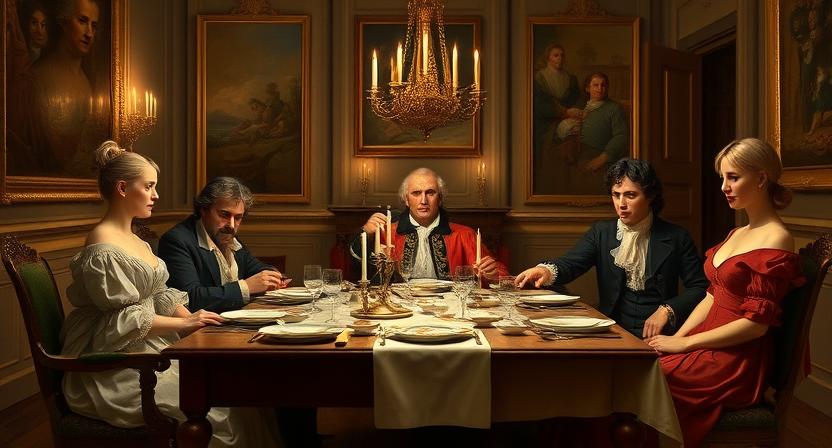
Paris, France – 12th July 1793
Part I: The Gathering Storm
The candlelight flickered against the silk-panelled walls of Madame de Staël’s salon, casting dancing shadows that seemed to mirror the turbulent spirits of revolutionary Paris beyond the heavy curtains. Charlotte Corday adjusted her simple muslin gown—a deliberate choice amongst the revolutionary rhetoric that had made silk and powder symbols of the ancien régime’s excess—and surveyed the assembled company with eyes that betrayed none of the tempest raging within her breast.
How curious, she reflected, that such a gathering could exist on this July evening in 1793, when the very air of Paris seemed thick with suspicion and the metallic scent of blood from the guillotine’s daily harvest. Yet here they sat: sworn enemies of varying revolutionary fervour, united only by their host’s mysterious invitation and an inexplicable compulsion to accept it.
“Citizeness Corday,” came the rasping voice that made her pulse quicken with recognition, “you appear contemplative this evening. Surely the beauty of our cause merits celebration rather than such melancholy?”
Jean-Paul Marat’s sunken eyes regarded her with the intensity that had made him both the darling of the sans-culottes and the terror of those who dared oppose his vision of revolutionary purity. His skin bore the pallor of his persistent ailment, yet his voice carried the same fervent conviction that had filled the pages of L’Ami du peuple with calls for ever greater measures against the enemies of France.
Charlotte inclined her head gracefully, her Norman education serving her well in this moment when every word might betray her intentions. “Indeed, Citizen Marat, I find myself quite overwhelmed by the… historical significance of our present company.”
Across the mahogany table—itself a relic of aristocratic excess that somehow survived the revolutionary zeal for destroying symbols of inequality—Georges Danton’s leonine frame shifted with barely contained energy. His voice, when it came, filled the room with the same oratorial power that had once stirred the National Convention to declare war upon all Europe.
“Historical significance,” Danton repeated, his dark eyes moving between his companions with the wariness of a man who had learned that yesterday’s allies might become tomorrow’s victims. “We are all of us writing history with every breath, every decision. The question that haunts me is whether future generations will read our choices as heroism or madness.”
“There is no distinction,” interjected Maximilien Robespierre, his precise voice cutting through the ambient murmur of conversation like a blade through silk. The Incorruptible’s pale green eyes reflected the candlelight with an almost ethereal quality, befitting one who saw himself as virtue incarnate. “What the world calls madness is often nothing more than the courage to pursue absolute justice, regardless of personal cost.”
Charlotte felt her fingers tighten imperceptibly around her wine glass—a vintage that predated the revolution, procured through means she dared not contemplate too closely. How easily these men spoke of justice and virtue whilst the streets outside echoed with the cries of the condemned. Yet she reminded herself that she had not come here to judge, but to understand—and perhaps, in understanding, to find peace with what the morning would bring.
Part II: The Dance of Ideologies
Olympe de Gouges, her intelligent eyes bright with the passion that had driven her to demand rights for women in an age when such demands were revolutionary beyond even revolution itself, leaned forward with the intensity of one accustomed to fighting for every word to be heard.
“Citizen Robespierre speaks of absolute justice,” she said, her voice carrying the cultured tones of one who had navigated both literary salons and political clubs with equal facility, “yet I wonder if such absolutes do not become their own form of tyranny. When we claim to know with certainty what justice demands, do we not risk silencing the very voices we claim to champion?”
Marat’s laugh was harsh, like parchment crumbling. “Citizeness de Gouges, your admirable passion for the rights of our sisters blinds you to the realities of revolution. In times of crisis, hesitation becomes complicity with oppression. Those who call for moderation whilst our enemies sharpen their knives are no different from the aristocrats who would see us all returned to feudal bondage.”
“And yet,” Danton interjected, his massive hands gesturing with the force of his conviction, “we must ask ourselves whether we have not already travelled so far down this path of revolutionary justice that we risk destroying the very ideals we sought to preserve. When does the medicine become more deadly than the disease?”
Charlotte observed the exchange with the detached fascination of one watching actors upon a stage, knowing that the final scene had already been written. How passionate they all were, how convinced of their own righteousness. Even now, as she sat amongst them, the weight of the letter in her reticule seemed to burn against her side—the letter that would gain her entry to Marat’s lodgings, the letter that would place her within reach of her terrible purpose.
“You speak as though we had choices,” Robespierre replied, his fingers steepled before him in a gesture that had become familiar to those who attended the Committee of Public Safety’s sessions. “The revolution is not a dance where we might choose our steps at leisure. It is a force of nature, sweeping away the corruptions of the old world whether we will it or not. Our only choice lies in whether we guide its course or become obstacles to be swept aside.”
The conversation paused as servants—their livery carefully chosen to avoid any suggestion of aristocratic pretension—refilled glasses and adjusted the elaborate dinner service. Charlotte found herself studying their faces, wondering what they made of this gathering of revolutionary luminaries discussing the fate of France over syllabub and roasted fowl.
Part III: The Weight of Conviction
“I confess,” Charlotte said, her voice carrying across the sudden quiet with startling clarity, “that I find myself curious about the personal cost of such absolute conviction. Do you never question, in the silence of your own hearts, whether the path you have chosen leads towards the light or deeper into darkness?”
The question hung in the air like incense, heavy with implication. Marat’s eyes fixed upon her with renewed interest, and she felt the familiar chill that his attention always provoked. Yet she held his gaze steadily, this Norman girl who had read Voltaire and Rousseau by candlelight in her family’s library, who had watched her world transform with the terrible swiftness of revolutionary change.
“Doubt,” Marat said slowly, “is the luxury of those who do not truly understand the stakes of our struggle. When I see the suffering of the people—truly see it, as I have done in every filthy cellar and every starving household of Paris—doubt becomes impossible. Action becomes as necessary as breathing.”
“But surely,” Olympe de Gouges pressed, “there must be gradations of action? Must every problem be solved with the same remedy? The guillotine has become our answer to every question, and I fear we are in danger of forgetting that we possess other tools.”
Danton’s face grew sombre, shadows gathering in the lines that recent months had carved around his eyes. “You speak wisdom, citizeness, yet wisdom and necessity are not always companions. I have watched friends become enemies, seen men I respected march to the scaffold singing the Marseillaise. The revolution devours its own children, and yet…” He paused, seeming to struggle with words that rarely came difficult to his eloquent tongue. “And yet I cannot bring myself to regret the forces we have unleashed, for the alternative was a slow death for millions under the old tyranny.”
Charlotte felt her heart clench with something approaching sympathy for these men who had sacrificed so much—their peace, their friendships, perhaps their very souls—in service of an ideal that seemed to recede further with each attempt to grasp it. How much simpler her own choice seemed by comparison: a single act, terrible but clean, that might halt the endless spiral of violence.
“The tragedy,” Robespierre observed, his voice taking on the tone he employed when addressing the Convention, “lies not in the necessity of our actions, but in the certainty that they will be misunderstood by posterity. History will remember the blood, but will it remember the tyranny that made such bloodshed inevitable?”
Part IV: The Moment of Truth
As the evening progressed through its elaborate courses—each dish an expression of the skills of chefs who had learned to create magnificence from ingredients that bore no taint of aristocratic excess—Charlotte found herself drawn deeper into the philosophical currents that swirled around the table. These were not the monsters of popular imagination, but men and women wrestling with questions that had no easy answers.
Yet beneath her growing understanding lay the immutable knowledge of what the dawn would bring. In mere hours, she would present herself at Marat’s lodgings, would speak words of republican sympathy to gain his trust, would… She forced the thought aside, focusing instead on Danton’s impassioned discourse on the necessity of ending the Terror whilst preserving the revolution’s gains.
“The question,” Danton was saying, his great voice subdued by the intimate setting, “is not whether we have gone too far, but whether we can find our way back without losing everything we have fought to achieve. We stand at a crossroads, and I fear that the path of moderation may already be closed to us.”
“Moderation?” Marat’s interruption was sharp as a blade. “Citizen Danton, you speak like one who has forgotten the lessons of our struggle. The enemies of the people do not moderate their hatred—why should we moderate our vigilance? Every moment of weakness invites our destruction.”
Charlotte watched the interplay between the two men—former allies whose philosophical differences had grown into an unbridgeable chasm. In Danton’s face she read the weariness of one who had begun to question the cost of victory, whilst Marat’s burning eyes spoke of a conviction that would brook no compromise.
“Perhaps,” she ventured, her voice barely above a whisper, “the question is not whether our actions are justified, but whether we can live with their consequences. Some choices, once made, transform us so completely that we become strangers to ourselves.”
The silence that followed her words seemed to expand beyond the confines of the salon, encompassing all of revolutionary France in its pregnant weight. Robespierre’s pale eyes studied her with new interest, whilst Olympe de Gouges nodded slowly, recognising perhaps a kindred spirit wrestling with the moral complexities of their turbulent age.
Epilogue: The Price of Tomorrow
As the clock in the corner chimed midnight, marking the transition from July 12th to July 13th, Charlotte felt the weight of destiny settling upon her shoulders like a cloak. The conversation had revealed so much—the genuine passion that drove these revolutionaries, their sincere belief in the righteousness of their cause, the terrible human cost of their resolute certainty.
Yet knowledge had not brought the absolution she had hoped for. If anything, understanding her intended victim’s humanity made her planned action more terrible, not less. Marat was not the bloodthirsty monster of aristocratic propaganda, but a man genuinely convinced that his harsh prescriptions offered France’s only salvation.
“I must take my leave,” she announced, rising with the grace that had been bred into her Norman bones. “The evening has been… illuminating beyond measure.”
Marat struggled to his feet, his chronic ailments making the simple gesture an effort. “Citizeness Corday, I hope our conversation has demonstrated that we revolutionaries are not the monsters our enemies would paint us. We are simply men and women who have chosen to sacrifice our comfort for the future of France.”
Charlotte met his eyes one final time, memorising the face that would haunt her dreams—assuming she survived long enough to dream. “Indeed, Citizen Marat. I understand now that we are all of us more complex than our reputations would suggest.”
As she walked through the darkened streets of Paris, her footsteps echoing against the cobblestones still damp with the evening’s rain, Charlotte Corday carried with her the terrible knowledge that good intentions could lead to evil outcomes, that men of genuine conviction could become instruments of their own destruction. Tomorrow would bring its own reckoning, but tonight belonged to the weight of understanding and the price of moral certainty in an uncertain world.
The revolution, she reflected, devoured more than its children—it consumed the very possibility of innocence, leaving only the stark choice between action and complicity. As dawn approached, she prepared herself for the role history had written for her, knowing that she would be remembered not for her intelligence or her noble intentions, but for a single, terrible act that would echo through the centuries.
In the distance, the bells of Notre-Dame began their morning call, and Charlotte Corday walked towards her destiny with the measured pace of one who had counted the cost and found it, somehow, bearable.
The End
13th July 1793, Jean-Paul Marat—whose newspaper had urged ever-harsher measures—was stabbed to death in Paris by 25-year-old Charlotte Corday. Within two months the National Convention began the Reign of Terror (September 1793–July 1794), during which about 17,000 people were guillotined and more than 300,000 were jailed across France’s 83 départements. Prominent dinner-guests later fell: Olympe de Gouges in November 1793, Georges Danton in April 1794 and Maximilien Robespierre himself on 28th July 1794, ending the Terror. Like later political assassinations—from Lincoln (1865) to Gandhi (1948)—Corday’s act fuelled debate on whether violence can reshape politics, a question that still resonates in modern discussions of extremism and free speech.
Bob Lynn | © 2025 Vox Meditantis. All rights reserved.


 Vox Meditantis
Leave a reply to 21st January 1793 – Ingliando Cancel reply