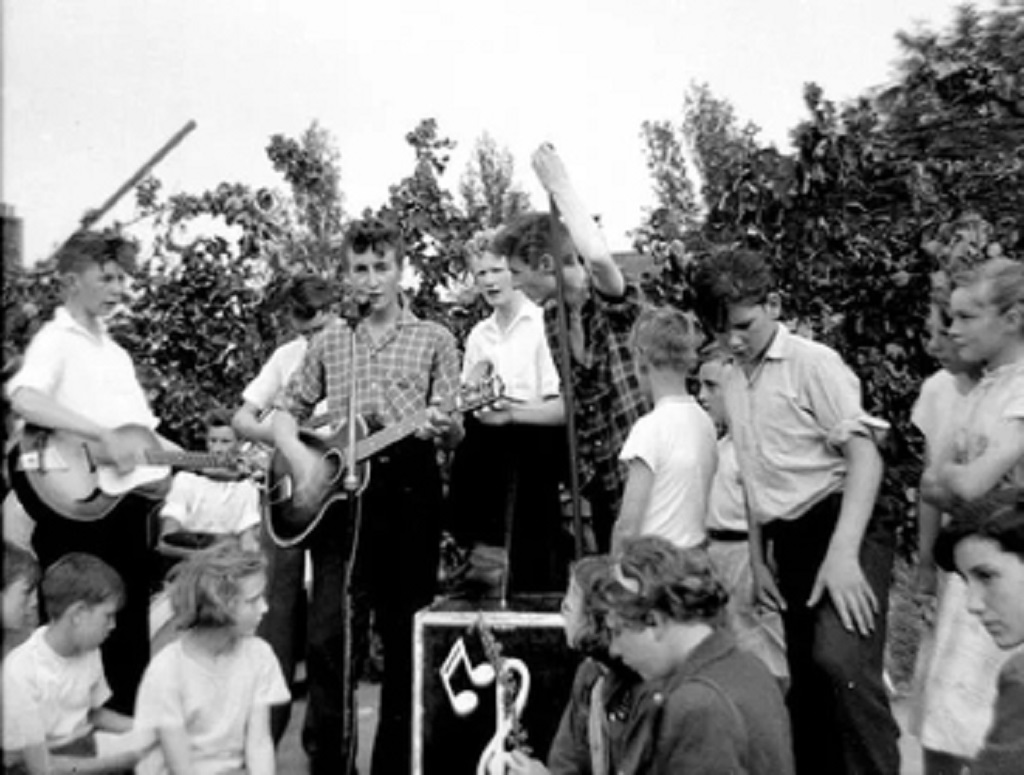
Liverpool – 6th July 1957
Part I: Afternoon Anticipation
The summer air hung thick with the scent of freshly cut grass and Mrs Whitaker’s prize-winning roses as Paul McCartney adjusted the strap of his father’s old guitar case. The weight of it pulled against his shoulder, but he didn’t mind—the instrument inside felt like a key to something he couldn’t yet name. Beside him, Ivan Vaughan whistled an off-key rendition of “Love Me Tender,” his hands stuffed deep in his trouser pockets as they made their way along Menlove Avenue towards St Peter’s Church.
“You’re certain they won’t mind an extra player?” Paul asked for the third time, his right hand unconsciously mimicking chord changes against his thigh. “I mean, they don’t know me from Adam.”
Ivan grinned, his freckled face crinkling with mischief. “John Lennon’s always looking for someone who can actually play in tune. Trust me, mate—once he hears you knock out ‘Twenty Flight Rock,’ he’ll be begging you to join up.”
The distant sound of amplified music drifted across the church grounds, a steady rhythm that made Paul’s pulse quicken. Skiffle, by the sound of it, but with something else underneath—a raw energy that seemed to cut through the genteel atmosphere of the garden fête like a knife through butter. Church ladies in floral dresses moved between stalls selling homemade jam and knitted scarves, their conversations punctuated by bursts of laughter and the occasional disapproving glance towards the makeshift stage.
Paul had been to dozens of church fêtes in his fifteen years, dragged along by his father Jim to events that celebrated community spirit and raised funds for worthy causes. But this felt different. The music—that was what made it different. Most church events featured the local brass band or perhaps a choir performing hymns. This was something altogether more dangerous.
As they approached the church hall, Paul caught sight of the group for the first time. Five lads, none much older than himself, arranged around microphones with an assortment of instruments that looked as though they’d been assembled from jumble sales and family attics. A tea-chest bass dominated one corner, its single string stretched taut between wooden frame and broomstick handle. The drummer—a stocky lad with an earnest expression—kept steady time on a kit that had seen better days.
But it was the singer who commanded attention.
John Lennon stood centre stage with his back slightly arched, cradling a Gallotone Champion acoustic guitar as though it were an extension of his own body. His dark hair fell across his forehead in a carefully cultivated quiff, and when he opened his mouth to sing, his voice carried a confidence that seemed to expand beyond his sixteen years. He was performing “Maggie Mae,” the traditional Liverpool song, but something in his delivery transformed it into something entirely modern—dangerous, even.
“That’s him,” Ivan murmured unnecessarily. “John. And that’s Pete Shotton on the washboard, Colin on drums. The one with the tea-chest bass is Bill Smith, and Len Garry’s on the banjo.”
Paul nodded, but his attention remained fixed on John. There was something magnetic about the way he commanded the small crowd—not through technical perfection, for Paul could hear the occasional bum note and missed chord change—but through sheer force of personality. When John sang, he seemed to inhabit the songs completely, whether they were traditional numbers his mother might have known or the American rock and roll that had been filtering across the Atlantic in recent months.
The song ended to enthusiastic applause, and John stepped closer to the microphone. “Right then,” he announced, his Liverpool accent thick with working-class pride, “this next one’s for anyone who thinks music should stay locked up in church on Sundays.” He struck the opening chords of “Rock Island Line,” and Paul felt something shift in his chest—a recognition, perhaps, or simply the thrill of hearing someone his own age treat music as though it were a living thing rather than mere entertainment.
Part II: The Question
When The Quarrymen finished their set forty minutes later, Paul felt as though he’d witnessed something significant, though he couldn’t quite articulate what. The crowd began to disperse, some heading towards the tea tent, others browsing the various stalls that dotted the church grounds. But a small group of admirers had gathered around the band, offering congratulations and requesting particular songs for their next performance.
Ivan nudged Paul forward. “Come on, then. Time for introductions.”
Paul’s stomach performed an uncomfortable flip as they approached the group. John was in the process of loosening his guitar strings, his attention focused on the instrument with the sort of concentration Paul recognised from his own practice sessions. Up close, John appeared both younger and older than he had on stage—younger in the softness around his eyes, older in the set of his jaw and the way he held himself.
“John,” Ivan called out. “Got someone here you might want to meet. This is Paul McCartney—the one I was telling you about. Plays guitar and piano, knows more songs than the BBC.”
John looked up, his hazel eyes taking in Paul with frank assessment. “That right?” he said, his voice carrying a note of challenge. “What sort of songs?”
“Oh, you know,” Paul replied, fighting to keep his voice steady, “bit of everything, really. Chuck Berry, Elvis, Buddy Holly. Some of the old music hall numbers my dad’s fond of. Whatever sounds good, I suppose.”
“What’s your favourite, then?” John asked, and Paul noticed how the question seemed to hang in the air between them. It wasn’t casual conversation—there was something more deliberate about it, as though John were testing him. “Genre, I mean. What gets your blood moving?”
Paul considered the question carefully. He’d been asked it before, of course, but never by someone whose answer might actually matter. His friends at school were content with whatever was popular on the wireless, and his father appreciated anything melodic enough to whistle whilst gardening. But John—John was different. Paul could sense that his answer might determine whether this conversation continued or ended with polite dismissal.
“Honestly?” Paul said, shifting his guitar case to his other hand. “I don’t think music works that way. Like asking someone their favourite colour when they’re looking at a sunset, isn’t it? Rock and roll gets you moving, no question—there’s something about Chuck Berry that makes you want to grab life by the throat. But then you’ve got something like ‘Daisy Bell’—you know that old music hall number?—and it tells a story that stays with you long after the last note fades.”
John’s expression had grown more attentive. “Go on.”
“Well, it’s like this,” Paul continued, warming to his theme. “American rock and roll—that’s the sound of rebellion, isn’t it? Freedom. But our music, the stuff that comes from here…” He gestured towards the city sprawling beyond the church grounds. “That’s got history in it. Stories. My dad plays old songs that his father knew, and there’s something in them that connects you to… to something bigger than just Saturday night at the dance hall.”
Pete Shotton, who had been listening with barely concealed impatience, snorted softly. “Sounds like you want to play tea dances, mate.”
But John held up a hand, his eyes never leaving Paul’s face. “No, I think I know what he means. Like… you can’t just copy what comes from America, can you? Has to be filtered through something, changed by the place it lands. Made ours.”
“Exactly,” Paul said, feeling a surge of recognition. “It’s not about choosing sides—traditional versus modern, British versus American. It’s about finding what’s true in each of them and…” He paused, searching for the right words. “And making something new from the combination.”
John was quiet for a moment, his fingers absently picking out a melody on the loosened guitar strings. When he spoke again, his voice had lost its earlier challenge. “You play, then? Really play, or just strum along to the wireless?”
Instead of answering directly, Paul set down his guitar case and opened it. His father’s acoustic guitar gleamed in the afternoon sunlight, its mahogany body bearing the small scratches and worn spots that spoke of years of faithful service. Paul lifted it out, checked the tuning quickly, and launched into “Twenty Flight Rock.”
The transformation was immediate. Paul’s voice, still carrying traces of boyhood, wrapped itself around Eddie Cochran’s lyrics with natural ease, but it was his guitar work that drew the small crowd closer. His fingers moved across the fretboard with practiced confidence, finding the rhythm and lead parts simultaneously, making the single acoustic guitar sound fuller than it had any right to.
When he finished, the silence stretched for several heartbeats before John spoke.
“Bloody hell,” he said quietly. “That was… how’d you make it sound like that?”
Paul grinned, his earlier nervousness evaporating. “Practice, mostly. And listening—really listening—to how the parts fit together. Want me to show you?”
Part III: The Exchange
What followed was unlike any musical conversation Paul had ever experienced. John’s guitar was slightly out of tune—a common problem with cheaper instruments—and Paul demonstrated how to use the ear rather than just the machine heads to achieve proper intonation. In return, John showed him a particularly effective way of damping the bass strings to create a percussive effect during rhythm playing.
“Where’d you learn that?” Paul asked, impressed despite himself.
“Nowhere special,” John replied, but there was pride in his voice. “Just… fooling about, really. Trying to make the guitar sound like it’s got more than six strings.”
They worked through several songs together, their voices blending with surprising harmony. John’s slightly rougher tone provided an interesting counterpoint to Paul’s melodic smoothness, and Paul found himself automatically adjusting his part to complement rather than compete. When they tackled “Maggie Mae,” Paul suggested a different chord progression that added unexpected depth to the familiar melody.
“That’s not how it goes,” Pete Shotton protested.
“No,” John said thoughtfully, “but it’s better. Makes it sound…” He paused, searching for the right word. “Bigger, somehow. Like it means more than just the words.”
Ivan, who had been watching the exchange with growing satisfaction, finally spoke up. “Told you,” he said to John. “Told you he was worth hearing.”
As the afternoon wore on, their musical conversation expanded to encompass influences and ambitions. John spoke passionately about Elvis and the way he could make a song sound dangerous and vulnerable simultaneously. Paul countered with observations about Buddy Holly’s songwriting, the way he could pack an entire story into three minutes and make it feel both intimate and universal.
“But that’s American music,” John pointed out during a lull in their playing. “What about our stuff? What’s our sound going to be?”
It was the question Paul had been circling around all afternoon without quite recognising it. “I think,” he said slowly, “it starts with not trying to be American. Not trying to be anything except… honest, I suppose. True to where we come from, but not trapped by it.”
“Meaning?”
Paul gestured towards the church around them, the fête-goers browsing stalls and chatting over cups of tea. “This is part of who we are, isn’t it? Church fêtes and Sunday dinners and knowing your neighbours. But so is the docks, and the Cavern Club, and lads our age wanting something more than what their fathers had. The music has to hold all of that somehow.”
John nodded slowly. “Rock and roll, but not just copying. Something that sounds like Liverpool, like England, but doesn’t apologise for wanting to shake things up.”
“Exactly.” Paul felt a rush of excitement at being so clearly understood. “It’s not about choosing between tradition and rebellion. It’s about making them work together.”
Colin Hanton, who had been quietly packing up his drum kit, looked up with interest. “That’s what you’re after, then? Some sort of musical revolution?”
John and Paul exchanged a look, and Paul felt something pass between them—an understanding that went beyond words. “Not revolution,” John said finally. “Evolution, maybe. Taking what exists and changing it into something… something new. Something ours.”
Part IV: Recognition
As the afternoon stretched towards evening, the formal structure of the fête began to dissolve. The Quarrymen had been invited to play an impromptu second set, and this time Paul found himself naturally included. No formal invitation had been extended, but when John handed him a spare guitar lead and suggested he “come along, then,” it felt like the most natural thing in the world.
Their second performance bore little resemblance to the first. With Paul’s musical knowledge complementing John’s natural stage presence, the songs took on new dimensions. Traditional numbers were given rock and roll arrangements, while American songs were filtered through distinctly British sensibilities. The audience—initially bemused by the hybrid approach—found themselves drawn in despite themselves.
During a brief break between songs, John leaned over to Paul. “This,” he said, his voice barely audible above the chatter of the crowd, “this is what music should feel like.”
Paul understood immediately. It wasn’t about technical perfection or even commercial appeal. It was about the moment when disparate elements—melody and rhythm, tradition and innovation, individual voices and collective harmony—came together to create something that was somehow greater than the sum of its parts.
When they launched into their final song, a reworked version of “That’ll Be The Day” that somehow managed to sound both utterly faithful to Buddy Holly’s original and completely their own, Paul felt a certainty settle in his chest. This was what he’d been searching for without knowing it—not just someone to make music with, but someone who understood that music could be both entertainment and art, both escape and expression.
The applause when they finished was enthusiastic but brief—it was, after all, still a church fête, and there were tombola prizes to be drawn and raffle winners to announce. But as Paul packed away his guitar and helped the others load their equipment, he felt as though something fundamental had shifted in his understanding of what was possible.
“Same time next week?” John asked as they prepared to part ways. It was a casual question, but Paul caught the underlying seriousness.
“Wouldn’t miss it,” Paul replied, and meant it completely.
As he and Ivan walked back through the gathering dusk, Paul found himself thinking about the question John had asked earlier: What’s your favourite genre of music? At the time, he’d given what he thought was a thoughtful answer about the blending of influences and the importance of authenticity. But now he realised he’d been approaching it all wrong.
The question wasn’t really about preference or style. It was about identity—about who you were and who you wanted to become. John’s music was an extension of his personality: confident, rebellious, unafraid to take risks. Paul’s own musical instincts reflected his desire to connect, to harmonise, to find common ground between seemingly incompatible elements.
But together—together they had created something that was neither John’s vision nor Paul’s, but something entirely new. A sound that was both rooted in tradition and reaching towards an unknown future. A genre that didn’t yet have a name.
“Good day, then?” Ivan asked as they reached the junction where their paths diverged.
Paul considered the question seriously. On the surface, it had been a perfectly ordinary afternoon at a perfectly ordinary church fête. But underneath, he sensed that something significant had occurred—not just a meeting between two young musicians, but a moment of recognition. A glimpse of what music could become when the right people found each other at exactly the right time.
“Yeah,” he said finally, adjusting his guitar case one last time. “I think it was.”
As he made his way home through the familiar streets of Liverpool, Paul found himself humming—not any particular song, but a melody that seemed to emerge from the combination of everything he’d heard and played that afternoon. It was his favourite genre of music, he realised: the sound of possibility itself, the music that existed in the space between what was and what could be.
Behind him, the lights of St Peter’s Church began to twinkle in the gathering darkness, marking the site of an ending that was also a beginning—though it would be years before anyone fully understood what had begun that July afternoon in 1957.
Epilogue: The Sound of the Future
Years later, when journalists would ask about that first meeting, both John and Paul would remember the music more clearly than the conversation. They would recall the way their voices had blended during “Maggie Mae,” the shared laughter when Paul showed John how to tune his guitar properly, the moment when they both realised they had found something—or someone—they hadn’t known they were looking for.
But on that evening in July 1957, as Paul McCartney walked home through the streets of Liverpool with his father’s guitar slung across his shoulder, he was thinking not about the past or the future, but about the immediate present—about the songs he would learn before next Saturday, about the harmonies he might suggest, about the sound two voices could make when they learned to work together instead of competing.
His favourite genre of music, he had discovered, was collaboration itself—the magical process by which individual talents could combine to create something entirely new. It was a lesson that would serve him well in the years to come, though he could never have imagined, walking home through the summer evening, just how far that collaboration would eventually take him.
The future, like the best songs, was something that had to be discovered one note at a time.
The End
Photo credit: Wikipedia
Bob Lynn | © 2025 Vox Meditantis. All rights reserved.


 Vox Meditantis
Leave a reply to Bob Lynn Cancel reply