Burgh by Sands, Cumberland – 7th July, 1307
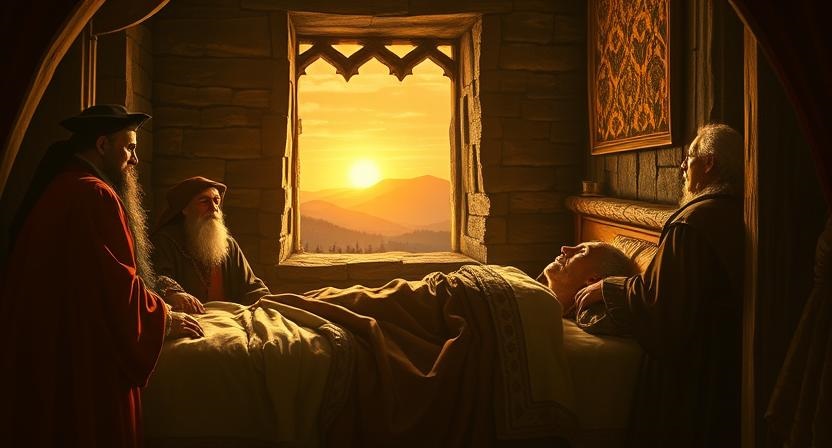
The July evening hung heavy over the marshlands of Burgh by Sands, where the last light of day painted the western sky in shades of amber and blood. Edward Plantagenet, first of that name and King of England, lay dying in a chamber that smelled of damp stone and the bitter herbs his physicians had burned to no avail. The dysentery that had plagued him for days had finally claimed victory over the man who had spent a lifetime claiming victories of his own.
Through the window, he could see the Scottish hills rising in the distance like the backs of sleeping giants. So close. After decades of warfare, countless campaigns, and rivers of blood both English and Scottish, the prize remained just beyond his grasp. The irony was not lost on him—he who had earned the name “Hammer of the Scots” would die within sight of the very land that had proved his final, unconquerable foe.
“Your Grace.” The voice belonged to Henry de Lacy, Earl of Lincoln, whose weathered face bore the marks of countless battles fought in Edward’s service. “The others await your summons.”
Edward’s eyes found the faithful earl, though the effort of focusing had become a labour in itself. His body, once towering and imposing—Longshanks they had called him, for his exceptional height—now lay diminished beneath heavy coverlets. Yet his mind remained sharp, perhaps cruelly so, for it allowed him to comprehend fully what his weakening flesh was surrendering.
“Summon them,” he whispered, his voice a mere shadow of the commanding tone that had once echoed through throne rooms and across battlefields. “All of them.”
As Henry departed, Edward turned his gaze back to the window. The Scottish hills seemed to mock him in their stillness, their eternal patience. How many men had he sent to die in their shadows? How many mothers had mourned sons lost to his ambition? The questions came unbidden, as they had increasingly in recent days, when fever and pain had stripped away the armour of justification he had worn for so long.
The chamber door opened, and his most trusted advisors filed in with the solemnity of mourners. Guy de Beauchamp, Earl of Warwick, his face grave beneath silver hair. Aymer de Valence, Earl of Pembroke, whose loyalty had never wavered despite the costs. Robert de Clifford, scarred from border warfare, his hand resting unconsciously on his sword hilt even in this sacred moment of leave-taking.
They arranged themselves around his bed like the knights of Arthur’s table, though this was no tale of chivalric glory. This was the ending of a story written in conquest and subjugation, in the screams of the dying and the tears of the conquered.
“My lords,” Edward began, each word a struggle against the weakness that threatened to claim him before he could speak what needed saying. “I have summoned you for matters of greatest import.”
They leaned closer, these men who had served him through decades of warfare, their faces expectant. They awaited, no doubt, final orders for the Scottish campaign, last instructions for the prosecution of the war that had consumed his final years.
But Edward found himself hesitating. In the flickering candlelight, he could see not just their faces but the faces of all who had fallen in his service. Welsh princes who had died defending their homeland. Scottish nobles who had chosen death over submission. His own knights, young men who had followed him into battle and never returned to their mothers’ arms.
“Tell me, Henry,” Edward said softly, “what manner of king leaves his realm perpetually at war?”
The Earl of Lincoln’s brow furrowed. “Your Grace, you leave a realm expanded, a kingdom stronger than any in Christendom. Wales bows to English rule, and Scotland—”
“Scotland bleeds,” Edward interrupted, surprising himself with the words. “As does England. As do we all.”
A silence fell over the chamber, broken only by the distant sound of wind across the marshes. Guy de Beauchamp shifted uncomfortably, whilst Aymer de Valence studied his king with new attention.
“I have spent my life hammering,” Edward continued, his voice gaining strength from some inner reserve. “Hammering Wales into submission. Hammering Scotland into compliance. Hammering my own nobles into obedience. Yet what has this hammering wrought? What harmony have I created through force?”
Robert de Clifford cleared his throat. “Your Grace, you speak of harmony, but surely the realm requires order. The Scots—”
“The Scots,” Edward said, cutting him off, “are a proud people who love their land as we love ours. Tell me, Robert, if foreign soldiers marched through Yorkshire, demanding submission, would you not resist with every breath in your body?”
The question hung in the air like incense, thick and troubling. These men had served him faithfully, had never questioned his methods or his motives. Now, in his final hours, he was asking them to see their life’s work through different eyes.
“I think often now of my father,” Edward said, his gaze distant. “Henry was no warrior king. He preferred building abbeys to besieging castles, commissioning art to commanding armies. I thought him weak, believed that strength lay only in conquest. But perhaps…” He paused, struggling with thoughts that challenged the very foundation of his reign. “Perhaps there is strength in knowing when to stay one’s hand.”
Henry de Lacy leaned forward. “Your Grace, you speak strangely. Are you not the king who gave us Wales? Who built the greatest castles in Christendom? Who brought order to—”
“Who brought fear,” Edward said quietly. “I brought fear, Henry. And where there is fear, there can be no true harmony.”
The admission seemed to drain something from him, as if speaking the words aloud had released a burden he had carried for decades. He thought of his son, Edward, weak and malleable, devoted to that cursed Gascon, Piers Gaveston. He had intended to charge these men with keeping Gaveston in exile, with forcing his son to be the king Edward believed England needed.
But what if England needed something different? What if the realm required not another hammer, but a healer?
“I have been thinking,” Edward said, his voice growing stronger with resolve, “of what I might release, for the sake of harmony. What I might let go, that England might find peace.”
Aymer de Valence spoke carefully. “Your Grace, surely you do not mean to abandon the Scottish campaign? Robert the Bruce remains—”
“Robert the Bruce,” Edward repeated, and there was something like respect in his voice. “A man fighting for his homeland, as I would fight for mine. Tell me, Aymer, what if we were to acknowledge that Scotland might be better served by Scots than by English overlords?”
The suggestion struck the chamber like a thunderbolt. Guy de Beauchamp straightened as if slapped. “Your Grace, you cannot mean—”
“I mean that I have spent my life trying to force harmony through conquest, and I have failed.” Edward’s words came with the weight of absolute conviction. “I have created not unity but endless war. Not peace but perpetual conflict. What if true harmony comes not from forcing others to submit, but from recognising their right to exist as they choose?”
Robert de Clifford’s hand tightened on his sword hilt. “Your Grace, such talk is—”
“Such talk is the truth,” Edward said firmly. “And truth, my lord, is what a dying king owes his realm.”
He turned his attention to each man in turn, studying faces that had been carved by years of warfare, eyes that had seen too much blood spilled in his name.
“I charge you now, not with continuing this war, but with ending it. Let Robert the Bruce rule Scotland. Let the Welsh princes govern their own valleys. Let England find its strength not in domination but in justice.”
The silence that followed was profound. These men had built their lives around the concept of English supremacy, had sacrificed their youth to Edward’s vision of a unified Britain under English rule. Now their dying king was asking them to abandon everything they had fought for.
“And my son?” Henry de Lacy asked quietly. “What of Prince Edward?”
Edward’s face softened at the mention of his heir. “Edward will face his own choices. I had thought to bind him with commands, to force him to be the king I believed England needed. But perhaps what England needs is not another tyrant, but a king who understands that true strength lies in knowing when to show mercy.”
He paused, thinking of Piers Gaveston, that controversial favourite who had so troubled his final years. “Let him keep his Gascon, if that brings him happiness. Let him find his own path to kingship. The realm will survive without my iron fist to guide it.”
Guy de Beauchamp looked stricken. “Your Grace, you speak of abandoning everything we have built.”
“I speak of replacing what we have built with something better,” Edward replied. “I have been a hammer, yes. But hammers destroy as often as they create. Perhaps it is time for England to learn the art of building without first tearing down.”
Through the window, the Scottish hills had faded to dark silhouettes against the star-filled sky. Edward found himself wondering what those hills had witnessed—how many battles, how many deaths, how many moments of human suffering created by his ambition.
“I have been thinking,” he said softly, “of what I might tell the Almighty when I stand before His throne. I had thought to speak of victories won, of lands conquered, of enemies defeated. But now… now I think He might rather hear of mercy shown, of peace chosen over war, of harmony achieved through understanding rather than force.”
The admission seemed to surprise even him. Edward Plantagenet, who had never retreated from a battle, who had never shown weakness to enemy or ally, was choosing in his final hours to lay down the sword that had defined his reign.
“Will you do this?” he asked them. “Will you carry this message to my son? Will you help him find a path to true harmony?”
The four men exchanged glances, their faces reflecting the magnitude of what their king was asking. To abandon the Scottish war. To grant independence to peoples they had spent their lives trying to conquer. To build a different kind of England entirely.
It was Henry de Lacy who spoke first, his voice heavy with emotion. “Your Grace, if this is truly your wish, then we shall endeavour to honour it.”
Edward smiled then, the first genuine smile that had touched his features in months. “It is my wish, Henry. My final wish. That England might find harmony not through conquest, but through compassion. Not through dominance, but through understanding.”
The effort of speaking had exhausted him, and he felt the darkness beginning to close around the edges of his vision. But for the first time in years, decades perhaps, he felt something approaching peace.
“Tell them,” he whispered, his voice fading, “tell them that Edward Longshanks, the Hammer of the Scots, learned in his final hours that the greatest victory is sometimes surrender. That true strength lies not in forcing others to bow, but in choosing to lift them up.”
As consciousness slipped away, Edward felt the weight of his crown, his sword, his conquered lands, all falling away like autumn leaves. What remained was lighter, cleaner—the possibility of harmony born not from force, but from the simple, revolutionary act of letting go.
The King of England died as the sun set over the Scottish hills, having chosen in his final moments to release his grip on everything he had spent his life trying to hold, for the sake of a harmony he would never live to see, but might yet help create.
The End
Bob Lynn | © 2025 Vox Meditantis. All rights reserved.


 Vox Meditantis
Leave a reply to Bob Lynn Cancel reply