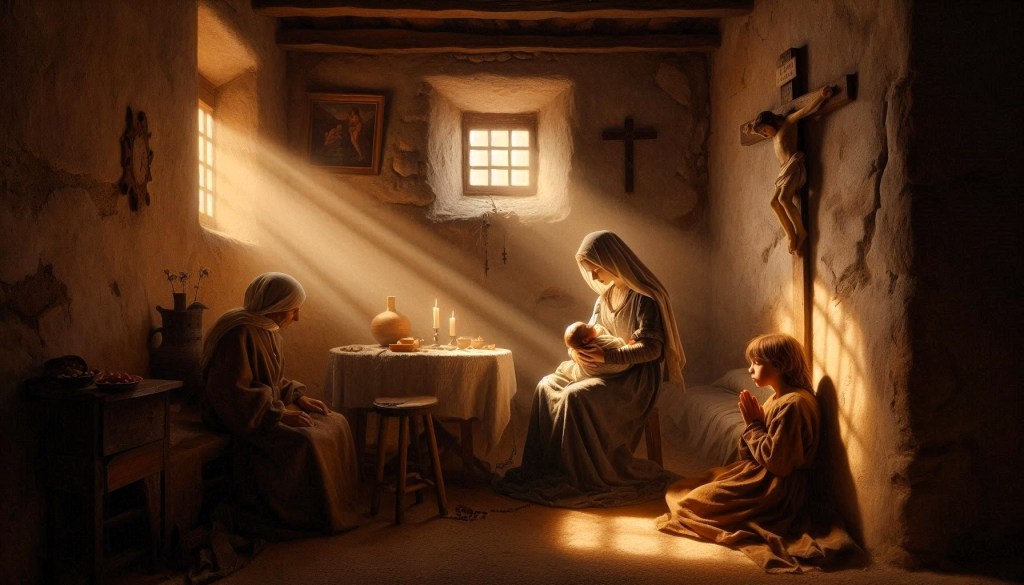
Hontiveros, Old Castile, Spain – 24th June, 1542
The pain comes in waves, like the floods that swept through our valley last spring, and I clutch my worn rosary beads until they leave marks upon my palm. “Ave Maria,” I whisper through gritted teeth, “gratia plena…” The Latin words my dear Gonzalo taught me before the fever took him flow from my lips like water from a broken cistern—precious, uncontainable, the last gift of a learned man to his unlettered wife.
Another wave crests, and I press myself against the rough stone wall of our single room. The midwife, old María Santos, moves about with practised efficiency, her weathered hands gentle despite their calluses. She has brought three of my children into this world, and buried two of them before their second summers. In Hontiveros, we know that life and death dance together like partners at harvest time.
“The child is eager to greet Saint John’s Day,” María murmurs, checking the pot of water heating over our meagre fire. “A blessed day to be born.”
Saint John’s Day. How fitting, I think, as another contraction seizes me. The Baptist, who prepared the way for our Lord in the wilderness. Perhaps this child, too, will know something of wilderness, of preparing paths through barren places. God knows we have little else to offer—no wealth, no position, only faith and the threadbare hope that love might be enough.
I close my eyes and see Gonzalo’s face as it was on our wedding day, young and earnest beneath the crown of his dark hair. How his family raged when he chose me—Catharine Alvarez, daughter of a weaver, granddaughter of nothing and no one. His brother Luis spat at my feet after the ceremony, declaring that Gonzalo had “married beneath his blood” and would receive not one maravedí from their father’s estate.
“Let them keep their coins,” Gonzalo had whispered in my ear as we walked away from the church. “I have chosen my treasure.”
Now that treasure lies cold in the cemetery behind San Miguel, taken by the same fever that has claimed so many this year. The physician from Ávila came too late and cost too much, demanding payment we scraped together by selling my mother’s silver thimble—the only thing of value I possessed. In the end, all his learning could not hold back the hand of God.
The room spins, and I find myself on my hands and knees upon the packed earth floor. María’s voice seems to come from very far away. “That’s it, mi niña. Let the child come.”
My eldest, Francisco, hovers near the door—barely thirteen but already carrying the weight of a man since his father’s death. His young face bears the same gentle intelligence that drew me to Gonzalo, but there is a wariness there now, a knowledge that innocence cannot survive poverty unscathed. He has spent these past months working the silk looms, his small fingers flying amongst threads that catch the morning light like spider webs touched by dew. The few coins he earns keep us from begging, though some weeks we survive on little more than black bread and prayers.
“Pray for your mother,” María tells him softly. “And for the little one fighting to be born.”
Fighting. Yes, that is what this is—a battle between hope and despair, between the fierce determination to bring life into this harsh world and the terrible knowledge that sometimes love is not enough to protect what we cherish most. When the fever took my Roberto last winter, barely two years old, I raged at God with such fury that I feared He might strike me down. But He did not. Instead, He let me weep until no tears remained, and then filled that empty space with something I can only call peace.
The pain intensifies, and I cry out despite myself. Through the small window, I can see the first blush of dawn touching the hills beyond Hontiveros. Somewhere in those distant mountains, pilgrims are beginning their journey to Santiago de Compostela, carrying their own burdens, seeking their own miracles. I think of them now and wonder what prayers they whisper as they walk.
My own prayer has been the same for months: Let this child live. Let me be strong enough to care for him. Let there be enough bread, enough warmth, enough love to see him through. Simple petitions, perhaps, but when you have lost so much, simplicity becomes profound.
Another memory surfaces—Gonzalo reading to me by candlelight from his precious books. He had learned to read Latin at the monastery school before his father pulled him away to work the family lands, but he never lost his hunger for knowledge. In our tiny room, he would open those worn volumes and share their treasures with me: stories of saints and martyrs, poems that made ordinary words sing, passages from Scripture that seemed to glow in the flickering light.
“Listen to this, my heart,” he would say, his finger tracing lines I could not decipher. “‘The light shineth in the darkness, and the darkness comprehended it not.’ That is us, Catharine. We are the light, small though it may be.”
The light. Yes, I think I understand now. Faith is not the absence of darkness but the presence of light within it. These past months, as I have watched Francisco’s childhood slip away beneath the weight of responsibility, as I have felt this new life growing within me whilst grieving for those already lost, I have learned that spirituality is not comfort—it is courage. It is rising each morning to face another day of uncertainty, trusting that somehow, in ways beyond our understanding, we are held.
“I can see the head!” María exclaims, and suddenly there is no time for philosophy, only the ancient, animal urgency of birth. My body knows what to do, has done this before, and I surrender to its wisdom. Between contractions, I glimpse Francisco’s face—pale but determined, clutching the wooden cross Gonzalo carved for him last Christmas.
“He prays like his father,” I gasp, and María nods approvingly.
“Good. We shall need all the prayers we can gather.”
The morning light grows stronger, painting our humble room in shades of gold and rose. Through my pain, I marvel at how beautiful even this sparse place becomes when touched by dawn. The cracked wooden table where we take our simple meals, the single iron pot that has served us faithfully through lean seasons, the small wooden santos that Gonzalo placed in the corner—Saint Joseph with his carpenter’s tools, Our Lady of Sorrows with her pierced heart—all of it transformed by light into something sacred.
Perhaps this is what Gonzalo meant. Perhaps holiness is not found in great cathedrals or learned treatises, but in the willingness to see ordinary moments as extraordinary gifts. This child fighting to be born, this boy praying by the door, this old woman attending us with skilled compassion—surely these are miracles enough for any one morning.
The final push comes with surprising gentleness, as if the child has been waiting for just this moment, when doubt gives way to trust and fear transforms into wonder. I feel him slip into María’s waiting hands, and then the room fills with the most beautiful sound in all creation—the cry of new life declaring itself to the world.
“A son,” María announces, lifting the small, perfect form for us to see. “Healthy and strong.”
Francisco creeps closer, his eyes wide with awe. “May I… may I touch him?”
“Gently,” I whisper, exhausted but filled with such joy that I fear my heart might burst. “He is your brother.”
As Francisco extends one careful finger to stroke the baby’s cheek, I see in his face the same wonder Gonzalo wore when each of our children was born. The same fierce protectiveness, the same tender amazement that something so small could carry such infinite possibility.
María places the child in my arms, and I study his tiny features—the delicate curve of his ears, the sweep of dark lashes against his cheek, the small hands that already seem to be reaching for something beyond this small room. What dreams will those hands shape? What sorrows will they comfort? What beauty will they create?
“What will you call him?” María asks, beginning to tidy the evidence of our struggle.
I look at the wooden cross hanging above our bed, at the first full rays of sunlight streaming through our window, at Francisco’s shining face. “Juan,” I say without hesitation. “Juan de Yepes, for his father’s family and for Saint John, whose feast day blesses his birth.”
Juan. The name feels right upon my lips, carries within it the weight of hope and the lightness of new beginning. This small boy may never know the wealth his father forfeited for love, may never learn letters as his father did, may never own more than the clothes upon his back—but he will know that he is cherished. He will know that faith is stronger than circumstance, that love transcends loss, that light endures even in the deepest darkness.
As I hold him close, feeling the flutter of his breath against my neck, I whisper the prayer that has sustained me through these difficult months: “Sacred Heart of Jesus, I place all my trust in You. Keep this child in Your care, guide his steps along Your paths, and let him grow to be a blessing in this broken world.”
The morning bells of San Miguel begin to ring, calling the faithful to mass on this feast day. Through our thin walls, I can hear our neighbours stirring, beginning another day of struggle and hope. Somewhere in Hontiveros, other mothers hold their children close and wonder what the future will bring. Somewhere, other widows face empty tables and full hearts, learning that love is not diminished by loss but purified by it.
I think of the pilgrims I imagined earlier, walking their ancient paths towards Santiago, and I realise that we are all pilgrims, every one of us. We carry our burdens and our hopes, we stumble and rise again, we seek signs and wonders in the ordinary moments of our days. The road may be long and the destination uncertain, but we do not walk alone.
Little Juan stirs in my arms, his dark eyes opening for a moment before drifting closed again. In that brief glance, I fancy I see something profound—not the unknowing gaze of a newborn, but the deep peace of one who comes from God and carries His light within. Perhaps I am foolish to think such things, but mothers are permitted their dreams.
“Sleep now,” I murmur, adjusting the worn blanket around his small form. “Sleep, my little saint, and may your dreams be filled with light.”
Outside, the bells continue to ring, and another day begins in Hontiveros. A day blessed by the birth of a child who will never know hunger for earthly treasure, who will discover riches in emptiness and find God in the depths of darkness. But that is a story yet to be written. For now, there is only this: a mother’s love, a brother’s prayer, and the infinite possibilities contained in one small, perfect life.
The light shineth in the darkness, and the darkness comprehended it not.
The End
Bob Lynn | © 2025 Vox Meditantis. All rights reserved.


 Vox Meditantis
Leave a reply to Tony Cancel reply