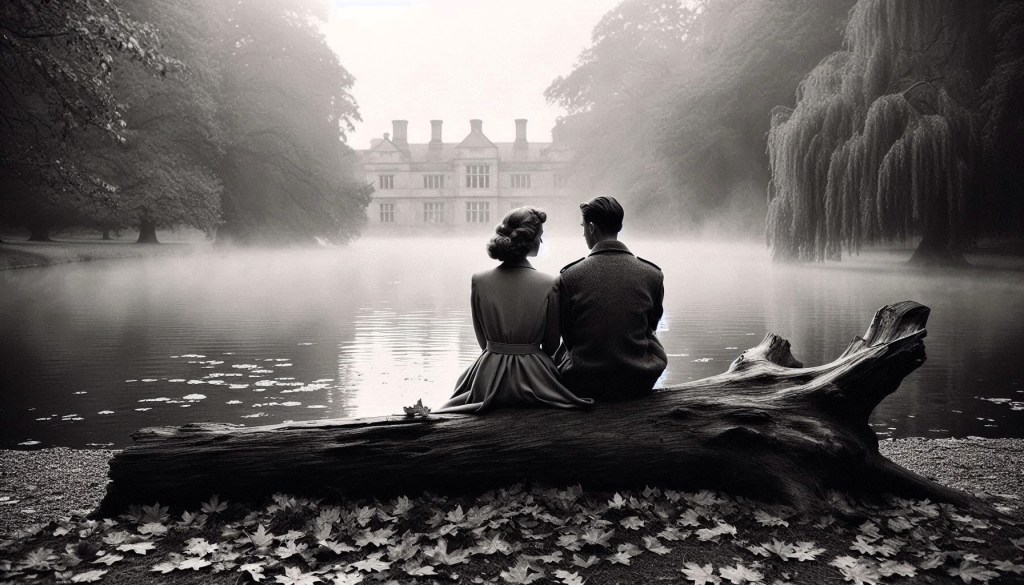
Bletchley Park, Buckinghamshire – 1943
The morning mist clung to the wooden huts of Bletchley Park like secrets whispered in the half-light, and Alan Turing felt the familiar weight of another day pressing upon his shoulders. At thirty-one, he had grown accustomed to carrying the burden of knowledge that could alter the course of the war, yet some mornings—like this one in the early autumn of 1943—the responsibility felt heavier than usual.
He paused at the threshold of Hut 8, his breath visible in the crisp Buckinghamshire air, and allowed himself a moment of deliberate stillness. This was his first act of preservation, though he would never have called it that. To Alan, it was simply a mathematical pause—a brief calculation of his mental resources before diving into the relentless stream of encrypted German messages that awaited him within.
The sounds of the early shift filtered through the morning quiet: the soft percussion of typewriter keys, the measured tread of colleagues arriving for their clandestine work, the distant hum of machinery that never truly slept. Each sound represented another life dependent upon their success, another reason why the Enigma code must yield its secrets. Yet Alan had learned, through months of navigating the knife-edge between breakthrough and breakdown, that his mind required careful tending if it were to remain sharp enough for the task.
Inside the hut, the familiar chaos of papers, calculating machines, and wire diagrams greeted him. The air held the scent of cigarette smoke, strong tea, and the particular mustiness of old buildings pressed into urgent service. His colleagues moved with the practised efficiency of people who had learned to compress enormous intellectual effort into seemingly routine gestures.
“Morning, Alan,” Joan Clarke’s voice carried across the room, warm and steady as always. She looked up from her desk, where she was already deep in analysis, her dark hair pinned back with characteristic precision. “The night shift left us some interesting developments.”
Alan nodded, but instead of immediately throwing himself into the work, he moved to his designated corner and began what had become his morning ritual. From his jacket pocket, he withdrew a small notebook—not the official logs and worksheets that documented their formal progress, but something altogether more personal. Here, in margins and between the lines of seemingly mundane calculations, he worked through mathematical problems that bore no relation to the war effort.
To an observer, it might have appeared as procrastination, even frivolity in the face of such urgent work. But Alan understood what his colleagues did not: that his mind was an instrument requiring both tension and release, focus and freedom. These morning puzzles—problems in pure mathematics that he set for himself—served as a form of mental calisthenics, stretching cognitive muscles that would otherwise grow rigid under the relentless pressure of cryptanalysis.
This morning, he found himself exploring a problem in number theory, letting his pen trace elegant equations across the page. The familiar pleasure of mathematical reasoning washed through him, a sensation as essential as breathing. For twenty minutes, he existed in a world where problems had solutions that could be proven absolutely, where beauty and truth intersected in perfect harmony, where the stakes were intellectual rather than mortal.
“Turing, we need you on this,” called Commander Travis from across the room, his voice carrying the particular urgency that meant German naval communications had yielded something significant.
Alan closed his notebook with the same care he might use to bookmark a favourite poem, then turned his full attention to the intercepted messages spread across the central table. The transition was seamless—from the playground of pure mathematics to the battlefield of applied cryptography—but it was also deliberate. His morning ritual had prepared his mind for the focused intensity that the next several hours would demand.
The work consumed him, as it always did. Each encrypted message was a puzzle wrapped in layers of mechanical and intellectual complexity. The Enigma machine’s rotors had generated patterns that seemed random but were, in truth, the product of precise mechanical logic. Finding the keys to unlock that logic required a particular kind of mental stamina—the ability to hold multiple possibilities in mind simultaneously while testing each against the evidence of the intercepted traffic.
By mid-morning, they had achieved a breakthrough on a particularly stubborn naval cipher. The messages began to yield their secrets: convoy movements, submarine positions, strategic communications that would soon make their way to the Admiralty. Alan felt the familiar mixture of satisfaction and weight that accompanied such successes. Lives would be saved because of their work, but lives were also at stake in ways that made celebration impossible.
It was then that he noticed the tension building in his shoulders, the subtle tightening behind his eyes that signalled his mind’s need for respite. Another man might have pushed through, driven by the urgency of the work or the momentum of success. But Alan had learned to recognise these signals as surely as he recognised patterns in encrypted text. Ignoring them led to diminished performance, errors in judgment, the kind of mental fatigue that could compromise their vital work.
“I’m stepping out for a bit,” he announced to no one in particular, though Joan glanced up with a look of understanding. She had observed his patterns, recognised his methods of self-preservation, and had come to respect them as part of his professional discipline rather than personal indulgence.
The grounds of Bletchley Park in autumn possessed a particular melancholy beauty that Alan found restorative. He followed his usual route: past the main house with its Victorian Gothic pretensions, along the path that wound through what had once been ornamental gardens and were now slightly overgrown with the benign neglect of wartime. The trees were beginning to turn, their leaves catching the pale October sunlight in shades of gold and amber.
Walking had become essential to his process, though he would have struggled to explain why to anyone who asked. Perhaps it was the rhythm of his footsteps that provided a counterpoint to the mechanical precision of his analytical work. Perhaps it was the way physical movement seemed to unlock different pathways in his thinking. Or perhaps it was simply the reminder that his body existed, that he was more than a calculating engine, that the world contained beauty and complexity beyond the narrow focus of cryptographic warfare.
Today, his walk carried him to the small lake at the edge of the estate. The water was still, reflecting the sky with perfect clarity, and Alan found himself thinking about mirrors and reflections, about the ways in which Enigma was itself a kind of distorted mirror—transforming clear communication into apparent chaos, yet preserving within that chaos the ghost of the original message.
He sat on a fallen log and allowed his mind to wander through problems that had nothing to do with the war: the nature of mechanical computation, the possibility of machines that could think, the mathematical foundations of biological growth. These speculations felt like breathing after holding his breath, a return to the kind of intellectual curiosity that had drawn him to mathematics in the first place.
The sound of footsteps on the path brought him back to the present. Joan Clarke emerged from behind a stand of trees, her own walk apparently having brought her to the same refuge.
“Mind if I join you?” she asked, though she was already settling onto the log beside him.
“Of course not.” Alan shifted to make room, grateful for her company. Joan understood the peculiar isolation of their work—the way that carrying state secrets created invisible barriers between them and the rest of the world. Their conversations had become another form of self-care, a way of maintaining human connection amidst the dehumanising pressure of their responsibilities.
They sat in comfortable silence for several minutes, watching the play of light on the water. Finally, Joan spoke: “How do you bear it, sometimes? The knowing that people are dying while we sit here working out puzzles?”
It was a question that had haunted Alan for months, one that struck at the heart of how he maintained his equilibrium in circumstances that might otherwise have driven him to despair. “I think,” he said slowly, “that we bear it by doing the work as well as we possibly can. And part of doing it well is taking care of ourselves—our minds, our capacity to think clearly. If we burn ourselves out in a frenzy of guilt or urgency, we become less effective, not more.”
Joan nodded, though her expression remained troubled. “Sometimes I feel selfish, taking these breaks when there are urgent messages waiting.”
“But you’ve noticed, haven’t you, that you see patterns more clearly after a walk? That solutions come more easily when you’ve given your mind a chance to rest?” Alan turned to face her, struck by the realisation that he was articulating something he had never quite put into words before. “I’ve come to think of it as professional discipline rather than personal indulgence. We’re not machines, though sometimes the work makes us feel like we ought to be.”
They made their way back to Hut 8 together, their brief respite having recharged them for the afternoon’s challenges. But Alan’s self-care extended beyond these morning and midday breaks. In the evening hours, when the official work was done but his mind remained too active for sleep, he had developed another ritual.
In a corner of his sparse quarters, he had set up a small workspace where he pursued hands-on projects that engaged his mind in entirely different ways. Tonight, he was working on improving a process for electroplating—a practical application of chemistry that required patience, precision, and a kind of tactile engagement that provided perfect counterpoint to the abstract mental work of cryptography.
The process was methodical: preparing solutions, calculating concentrations, monitoring temperatures and timing. His hands moved with careful deliberation, measuring and mixing, while his mind followed the chemical logic of metal deposition. There was something profoundly satisfying about work that produced tangible, visible results—the gradual accumulation of copper on a carefully prepared surface, the transformation of one material into another through the application of scientific principles.
This evening practice served multiple purposes. It engaged different parts of his intelligence—spatial, tactile, chemical—giving his cryptographic faculties time to rest and reorganise. It connected him to the physical world in ways that pure mathematics could not. And it provided a sense of control and creativity that balanced the reactive nature of codebreaking, where success depended on responding to enemy initiatives rather than pursuing original research.
As he worked, Alan reflected on the strange paradox of his situation. Here he was, engaged in work of enormous historical significance, yet he had learned that his effectiveness depended on regularly stepping away from that work, on nurturing aspects of himself that had nothing to do with winning the war. It seemed almost self-indulgent, yet experience had taught him that this apparent self-indulgence was actually a form of professional responsibility.
The late evening hours also provided time for the kind of theoretical speculation that fed his deeper intellectual life. Tonight, as his electroplating solution did its slow work, he found himself thinking about the possibility of machines that could simulate human reasoning. What would it mean for a machine to solve problems, to recognise patterns, to make the kinds of intuitive leaps that distinguished the best cryptographers? The question felt both practical and profound, a bridge between his wartime work and the larger questions about mind and computation that had always fascinated him.
By the time he finally prepared for sleep, Alan had moved through his complete cycle of self-care: the morning’s mathematical warm-up, the focused intensity of the day’s cryptographic work, the restorative walks through the grounds, the social connection with trusted colleagues, and the evening’s hands-on practical work. Each element served the others, creating a sustainable rhythm that allowed him to maintain peak performance under circumstances that might otherwise have proved overwhelming.
As he lay in his narrow bed, listening to the sounds of the night shift taking over the vital work of Bletchley Park, Alan understood that what he practised was not self-care in any conventional sense, but rather a form of strategic self-management. The stakes were too high for anything less than his best effort, and his best effort required careful attention to the full range of his human needs—intellectual, physical, social, and creative. In taking care of himself, he was taking care of the mission that had been entrusted to him and, by extension, taking care of all those whose lives depended on the secrets that he and his colleagues could wrest from the enemy’s encrypted communications.
The morning would bring new challenges, new messages to decode, new patterns to recognise. But tonight, having honoured both his responsibilities and his humanity, Alan Turing could rest with the quiet satisfaction of work well done and resources carefully preserved for the battles yet to come.
The End
Bob Lynn | © 2025 Vox Meditantis. All rights reserved.


Leave a comment