17 Dawson Street, Holbeck
22nd April, 1886
My Dearest William,
Your letter from February reached me three weeks past, and I confess I carried it unopened for an entire day before finding the courage to break the seal. When finally I read your words – of Edward’s death reaching you, of your illness, of your terrible guilt – I wept not just for our lost child, but for the anguish my letter must have caused you in that distant place.
You must not blame yourself for Edward’s passing, my love. The fever that claimed him struck so swiftly that even had you been beside his bed, the outcome would likely have proved the same. Dr. Halewood assured me that lung weakness such as our boy possessed makes children vulnerable regardless of their circumstances. Your presence might have comforted us both, but it could not have saved him. The fault lies not with distance, but with the cruel inequalities of this world that deny proper medicine to those who cannot afford it.
Much has changed since I wrote to you of our loss. The grief remains – it sits like a stone in my chest, particularly during those quiet evening hours when I remember Edward’s laughter filling our small rooms. Yet necessity has a way of forcing us forward when our hearts would rather remain still. I have secured employment at Caldwell’s Textiles – not the occasional weaving work I mentioned before, but a proper position in the finishing department, five days weekly from dawn until six o’clock.
The wages are modest – twelve shillings per week – but they provide a foundation upon which our reduced family might build some security. The work involves inspecting finished cloth for flaws and preparing it for shipping. My eyes have grown accustomed to spotting the minute imperfections that escape casual notice, whilst my hands have learned the precise movements required to repair minor defects without damaging the surrounding fabric. It is skilled labour, William, requiring the same attention to detail that serves you so well in your mining work.
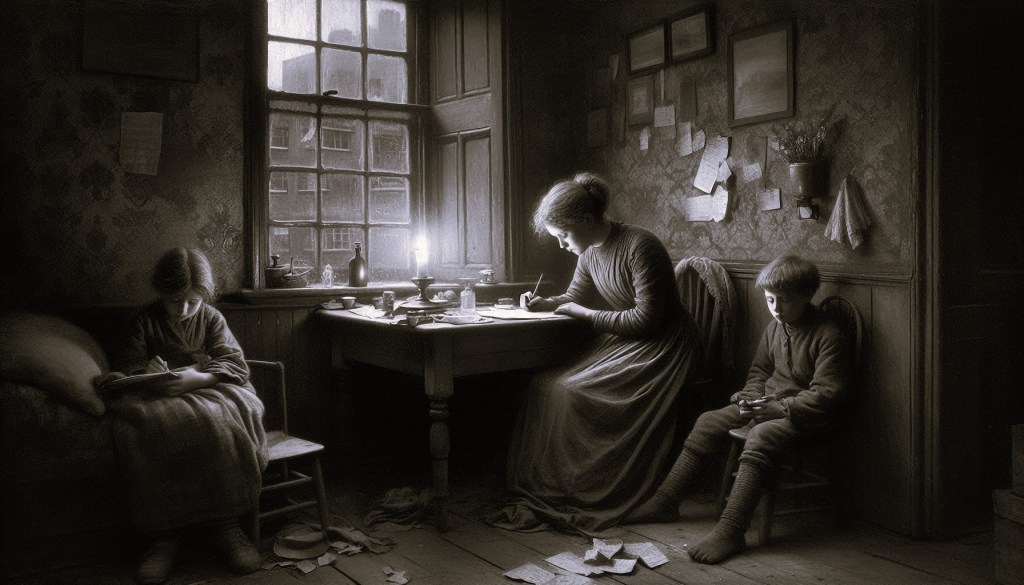
Margaret and young William have risen to the challenges that my employment has created. Our daughter, now eleven, manages the household with remarkable competence during my absence. She prepares simple meals, tends our small fire, and ensures her brother completes his lessons. The transformation in her character amazes me daily – gone is the dreamy child who once required constant supervision, replaced by a capable young woman who approaches domestic tasks with methodical determination.
Young William, now ten, has assumed responsibilities that would have seemed impossible a year ago. Each morning before school, he empties our chamber pots, fetches water from the communal pump, and checks that our coal scuttle contains sufficient fuel for evening warmth. After lessons, he collects my wages from the mill office and stops at Hawkins’ shop to purchase whatever provisions our budget allows. His arithmetic has improved tremendously through these practical applications – he can calculate change, compare prices, and budget our weekly expenses with precision that rivals any clerk.
The children speak of you constantly, weaving memories of their father into daily conversations that both comfort and sadden me. Margaret has been writing letters to you – pages filled with her careful script describing her domestic achievements and school progress. She shows them to me with such pride, though I lack the heart to explain that posting them would cost more than we can spare. Instead, I praise her efforts and promise that someday she might send them all together. Young William has taken to studying his father’s tools – the few mining implements you left behind – as though they might reveal secrets of your distant world.
Our neighbourhood continues to provide the support that sustains us through difficult times. Mrs. Braithwaite minds the children during my early morning hours at the mill, refusing any payment beyond occasional help with her own washing. Mrs. Patterson shares vegetables from her back garden, always claiming she has “far too much for one household.” When my shoes wore through entirely last month, Mrs. Henderson appeared at our door with a pair that “no longer fitted properly” but proved perfect for my feet.
Such kindness reminds me that whilst colonial ventures may promise golden treasures, the true wealth lies in communities where neighbours care for one another without expectation of reward. These women ask nothing of me save that I accept their assistance with grace, understanding that circumstances might someday reverse our positions. Their generosity has taught Margaret and William valuable lessons about mutual aid and human dignity that no textbook could provide.
The mill work has introduced me to women whose circumstances mirror our own – wives of miners, factory workers, and labourers who have learned to depend upon their own efforts rather than waiting for distant husbands to provide security. Mrs. Fletcher, who works beside me in the finishing department, supports three children whilst her husband serves with the regiment in Afghanistan. Mrs. Crowley’s husband was killed in a pit accident two years past, yet she maintains her family through wages earned in the carding room. Their stories of survival and adaptation inspire me daily.
I confess, William, that I have grown to find satisfaction in my independence. The wages I earn through my own labour feel different from money provided by others – whether husbands or charity. When I purchase bread with coins earned through my own skill and diligence, I experience a pride that surprises me. Not pride in our separation, my dear, but pride in discovering capabilities I never knew I possessed.
Yet this newfound confidence does not diminish my love for you or my hopes for your return. Each evening when I count the day’s wages, I calculate how such modest earnings might contribute to your passage home should your health improve sufficiently to make the journey. Margaret has suggested that we might all work together – herself, William, and I – to accumulate funds more rapidly than any single income could provide.
Your letter speaks of mounting debts and deteriorating health with such despair that my heart aches for your suffering. Yet I want you to know that we shall survive regardless of what befalls your colonial venture. Should circumstances prevent your return – though I pray constantly that they will not – our children will not want for basic necessities or loving care. I have learned to provide both through my own efforts, and this knowledge brings comfort even as I long for your presence.
The spring has been unusually mild this year, bringing early flowers to the small patch of earth outside our door. Yesterday, whilst tending this modest garden, I discovered the first primroses of the season – pale yellow blooms that seemed to glow with inner light. I pressed one carefully between the pages of Mother’s old prayer book, and I enclose it with this letter that you might hold a piece of Yorkshire spring in your distant tropical world. Perhaps its delicate beauty will remind you of gentler seasons and the family that awaits your recovery.
I have also enclosed a lock of my own hair, cut this morning whilst Margaret held the mirror steady. She suggested this token might provide comfort during your illness, as Edward’s hair has comforted you. My daughter possesses wisdom beyond her years, understanding intuitively that love requires tangible reminders when distance separates hearts that belong together.
William, my beloved husband, I want you to know that whatever happens in that far country, you have given our family treasures more valuable than any gold. Your courage in pursuing opportunities for our betterment, your willingness to sacrifice comfort for our security, your devotion expressed through every letter – these gifts sustain us through the darkest hours. The children carry your values within their hearts, and I see your determination reflected in their daily efforts to overcome adversity.
Should your health continue to decline, do not torment yourself with guilt over promises unfulfilled or debts unpaid. You have already provided us with strength, resilience, and love sufficient to carry us through whatever trials await. Your example teaches our children that true wealth lies not in accumulated coins, but in the character that perseveres through hardship whilst maintaining hope for better days.
Focus your energy on recovery rather than remorse, my dear. Rest when possible, follow Dr. Stewart’s instructions carefully, and remember that your family’s greatest need is not for your success in mining ventures, but for your return to us in whatever condition God’s providence allows. We shall adapt to circumstances as they develop, just as we have adapted to your absence and Edward’s loss.
Write to me when your strength permits, but do not exhaust yourself with long letters if such efforts tax your failing health. A single line confirming your survival would bring more joy than pages describing distant hardships. Know that Margaret and William join me in sending love across the ocean to their brave father, and that we count each sunrise as one day closer to reunion, whether in this world or the next.
Until we meet again – and I hold firm faith that we shall – I remain your devoted and ever-loving wife, stronger now than when you departed, yet incomplete without your presence to make our small family whole once more.
Your loving Mary
P.S. – Margaret insists I include her own message: “Dear Papa, I am helping Mama to be strong just as you taught me. When you come home, I shall show you how well I can manage our household. William and I speak of you every day and remember all your stories. Please get well soon.” Young William adds his own words, written in his improving hand: “Papa, I am learning to be the man of the house but I want you to come home and teach me properly. I miss our talks by the fire.”
◄ Go back to part 7 | Continue to part 9 ►
Bob Lynn | © 2025 Vox Meditantis. All rights reserved.


 Vox Meditantis
Leave a reply to Tony Cancel reply