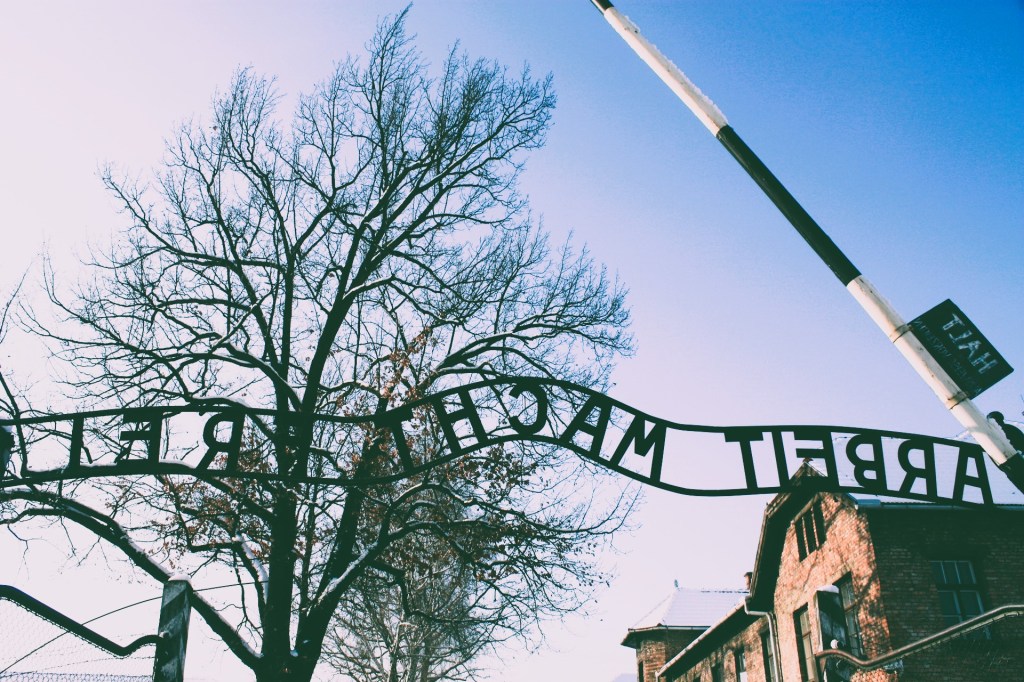
Auschwitz Concentration Camp – 20th June, 1942
The acrid smoke from the crematorium chimneys hung heavy in the June air, a perpetual reminder of the machinery of death that operated day and night beyond the electrified fences. Kazimierz Piechowski pressed his back against the rough wooden wall of Block 20, his eyes scanning the yard where prisoners shuffled past in their striped uniforms, each man reduced to a number, each soul diminished by the systematic cruelty of this place.
At twenty-five, Kazimierz had already witnessed enough horror to last several lifetimes. Three months in Auschwitz had taught him that survival required more than mere endurance—it demanded cunning, courage, and a fierce refusal to surrender one’s humanity to the beast that sought to devour it. The young Polish scout leader had been arrested for his resistance activities, branded a political prisoner, and thrust into this nightmare where hope seemed as fragile as morning mist.
But today was different. Today, hope had crystallised into something far more dangerous: a plan.
“The uniforms are ready,” whispered Stanisław Gustaw Jaster, his fellow conspirator, as he approached with calculated casualness. The older man’s weathered face betrayed nothing, but Kazimierz could see the tension in the set of his shoulders, the way his fingers trembled almost imperceptibly as he pretended to examine a loose thread on his prison garb.
Kazimierz nodded once, barely perceptible. Around them, the camp’s routine continued with its usual brutal efficiency. Guards shouted orders in harsh German, their voices cutting through the oppressive atmosphere like whip cracks. Prisoners moved with the hollow-eyed shuffle of the perpetually starved, their wooden clogs echoing against the concrete with a rhythm that had become the soundtrack of despair.
Yet beneath this veneer of submission, something else stirred. In whispered conversations conducted in shadows, in glances exchanged across the crowded barracks, in the small acts of defiance that prisoners performed at the risk of their lives, resistance lived. Kazimierz had come to understand that the greatest act of rebellion was not merely to survive, but to maintain one’s dignity, one’s sense of self, in the face of systematic dehumanisation.
The plan they had devised was audacious beyond reason. Four men—Kazimierz, Stanisław, Józef Lempart, and Eugeniusz Bendera—would don stolen SS uniforms, commandeer a staff car, and drive straight through the main gate as if they owned the place. The very simplicity of it was what made it so terrifying. No elaborate tunnels, no dramatic midnight escapes through wire fences. They would walk out in broad daylight, impersonating the very men who had turned this place into a charnel house.
“The psychology of it,” Kazimierz had explained to his companions during one of their clandestine meetings, “is that no one expects such brazen defiance. The guards see the uniform, they see the authority, and their minds fill in the rest. We become invisible by being completely visible.”
The uniforms had been procured through a network of prisoners who worked in various parts of the camp—those who cleaned the SS quarters, who handled laundry, who had access to the administrative buildings. Each piece had been acquired separately, carefully, over weeks of patient planning. A tunic here, trousers there, boots liberated from a storage room, insignia carefully removed from discarded items. The theft of each component had carried the risk of immediate execution, yet somehow, miraculously, they had assembled everything they needed.
As the afternoon wore on, Kazimierz found himself studying the guards with new eyes. He observed their mannerisms, their way of walking, the casual arrogance with which they carried themselves. These men who held the power of life and death over thousands of prisoners—how did they move? How did they gesture? What expressions did they wear? Every detail mattered, for a single false note could mean not just his own death, but the deaths of his three companions as well.
The weight of that responsibility pressed down upon him like a physical burden. Stanisław had a wife and children somewhere in Poland, assuming they were still alive. Józef spoke often of his elderly mother, though his voice always broke when he mentioned her. Eugeniusz, barely twenty, had dreams of becoming a teacher after the war—if there was an after. Each man had entrusted his life to this desperate gamble, and Kazimierz felt the full measure of that trust.
The sun began its descent towards the horizon, casting long shadows across the camp. Soon, the evening roll call would begin—that interminable process during which every prisoner was accounted for, counted and recounted like livestock. But they would not be present for that roll call. By then, if all went according to plan, they would be miles away, racing towards freedom through the Polish countryside.
At the appointed hour, the four men made their way separately to a predetermined location near the motor pool. The camp’s layout, which Kazimierz had memorised through weeks of careful observation, revealed itself to be both blessing and curse. The very familiarity of every path, every building, every guard post that might aid their escape also served as a constant reminder of how deeply trapped they had become.
The transformation was remarkable and terrifying. As they donned the stolen uniforms, Kazimierz watched his companions literally change before his eyes. Stanisław’s stooped shoulders straightened. Józef’s nervous energy consolidated into purposeful movement. Eugeniusz’s youthful uncertainty was replaced by a cold confidence that would have been admirable under different circumstances.
But it was his own transformation that proved most unsettling. As Kazimierz fastened the SS tunic and adjusted the peaked cap, he felt something shift within him—not just outwardly, but in some fundamental way. To successfully impersonate these men, he would need to understand them, to channel their mindset, their casual brutality, their absolute certainty in their superiority. The thought made his skin crawl, yet he knew it was necessary.
“Remember,” he whispered to his companions as they made their final preparations, “we are not prisoners today. We are not victims. Today, we are predators. We move with purpose, with authority. Anyone who looks at us should see exactly what they expect to see—nothing more, nothing less.”
The staff car sat where intelligence had indicated it would be—a black Mercedes with polished chrome that reflected the dying light. The keys were in the ignition, another small miracle in a chain of miracles that had brought them this far. Kazimierz slid behind the wheel, his hands steady despite the adrenaline coursing through his veins. The others arranged themselves as they had practised: Stanisław beside him in the front, Józef and Eugeniusz in the rear, all of them maintaining the bearing of men accustomed to command.
The engine turned over with a low rumble that seemed unnaturally loud in the evening air. Several genuine SS officers glanced in their direction without apparent interest—just another staff car making its way through the camp. Kazimierz engaged the clutch and pulled away from the motor pool, his movements deliberate and unhurried.
The route to the main gate stretched before them like a gauntlet. Past the administration buildings where clerks kept meticulous records of death and degradation. Past the punishment cells where prisoners were tortured for infractions both real and imagined. Past the medical facilities where Dr. Mengele conducted his obscene experiments on human beings as if they were laboratory animals.
Each landmark they passed represented another step towards either freedom or certain death. There could be no middle ground, no partial success. Either they would drive through that gate and into the uncertain safety of the outside world, or they would be discovered, shot down like dogs, and their bodies would feed the furnaces that never stopped burning.
The main gate loomed ahead, its iron letters spelling out the obscene lie: “Arbeit macht frei”—work makes free. How many thousands had passed beneath those words, never to emerge again? How many had arrived with hope and departed as smoke and ash? The irony was not lost on Kazimierz that their escape route would take them directly beneath that mocking inscription.
The guard post came into view, and Kazimierz felt his heart hammering against his ribs. This was the moment of truth, the fulcrum upon which everything balanced. A single suspicious glance, one question asked too persistently, and their audacious plan would crumble into catastrophe.
The guard, a young man with the soft face of someone who had never known real hardship before the war, approached the vehicle with the perfunctory manner of someone performing a routine duty. Kazimierz rolled down the window, his expression a carefully crafted mask of impatience and authority.
“Heil Hitler,” the guard said, offering the mandatory salute.
“Heil Hitler,” Kazimierz replied, his voice steady, betraying nothing of the terror that threatened to overwhelm him. “We’re expected in town. Official business.”
The guard’s eyes swept over the car’s occupants, taking in the uniforms, the insignia, the casual confidence that Kazimierz and his companions projected. For a moment that seemed to stretch into eternity, the young man hesitated, his hand moving towards the rifle slung across his shoulder.
Kazimierz’s muscles tensed. Behind him, he could sense his companions preparing for what might be their final moments. If shooting started, they would at least take some of their tormentors with them. It would not be the escape they had planned, but it would be a form of justice nonetheless.
Then the guard stepped back and waved them through.
The gate mechanism engaged with a grinding mechanical sound that was the most beautiful music Kazimierz had ever heard. The barrier lifted, and they rolled forward, past the electrified fences, past the watch towers, past the boundaries of hell itself.
None of them spoke as they drove through the small town of Oświęcim, past citizens who went about their evening routines as if a factory of death did not operate just beyond their doorstep. The complicity of ordinary people in extraordinary evil was perhaps the most disturbing aspect of their entire experience—the way normal life continued whilst atrocities were committed mere miles away.
Only when they had put several kilometres between themselves and the camp did Kazimierz allow himself to believe that they had actually succeeded. The realisation hit him like a physical blow, and he had to pull the car to the side of the road as his body began to shake uncontrollably.
“We did it,” Stanisław whispered, his voice filled with wonder. “Dear God, we actually did it.”
But even as they celebrated their escape, Kazimierz knew that their ordeal was far from over. They were four men in stolen uniforms, driving a stolen car, in a country occupied by an enemy that would show no mercy if they were recaptured. The road ahead was uncertain, fraught with dangers they could not yet imagine.
More troubling still was the knowledge of what they had left behind. Thousands of prisoners remained trapped within those electrified fences, subjected to horrors that defied description. Their successful escape was both triumph and tragedy—a victory that highlighted the magnitude of ongoing defeat.
Yet as they drove through the Polish countryside towards an uncertain future, Kazimierz understood that their escape represented something far more significant than four men finding freedom. It was proof that even in humanity’s darkest hour, the spirit of resistance could not be entirely extinguished. It was testimony to the power of hope, courage, and the refusal to accept that evil would have the final word.
The story of their escape would survive the war, would outlive those who participated in it, would serve as inspiration for future generations who faced their own seemingly impossible challenges. In that sense, their greatest victory was not simply walking away from Auschwitz, but demonstrating that such walking away was possible at all.
As night fell and they abandoned the stolen car for the relative safety of forest paths and hidden trails, Kazimierz reflected on the question that would haunt him for the rest of his days: what made the difference between those who escaped and those who did not? Was it luck, preparation, courage, or some combination of all three? And what responsibility did survival carry with it?
History would remember Kazimierz Piechowski as a hero, a man whose audacious escape from Auschwitz represented one of the most remarkable acts of defiance during World War II. But in that moment, stumbling through the darkness towards an uncertain dawn, he was simply a young man who had refused to allow evil to have the final word—and in that refusal, had found not just freedom, but a reason to believe that freedom was worth fighting for.
The End
Bob Lynn | © 2025 Vox Meditantis. All rights reserved.
Photo by Julia Taubitz on Unsplash


 Vox Meditantis
Leave a reply to Bob Lynn Cancel reply