Sonoma, California – 19th June 1846
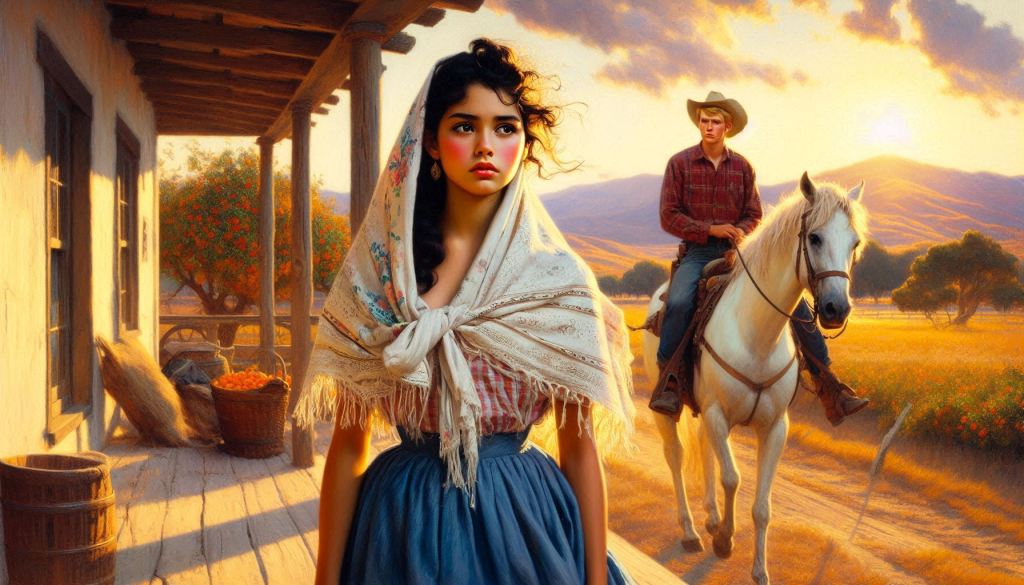
The morning air carried the scent of wild mustard and sage across our vast rancho, and I breathed it in deeply as I stepped onto the wide veranda of our adobe home. Papa always said that June mornings in Sonoma were God’s way of reminding us why He had blessed our family with this land, stretching as far as the eye could see beneath the shadow of the coastal mountains. On this particular morning—the nineteenth of June, in the year of our Lord eighteen hundred and forty-six—I had no notion that before the sun set, both my heart and my world would be forever altered.
I was sixteen that summer, no longer the child who had once raced bareback across the rolling hills with my hair streaming wild behind me, yet not quite the woman Mama insisted I was becoming. The transformation felt as uncertain as the political winds that had begun to stir throughout our beloved California, bringing whispers of change that made Papa’s brow furrow with worry during our evening meals.
“Esperanza, mija,” Mama called from within the house, her voice carrying that particular tone that meant I was dawdling when there was work to be done. “The morning grows late, and there are guests coming today.”
Guests. My pulse quickened slightly, though I told myself it was merely the prospect of company that stirred my interest. For weeks now, Papa had been conducting business with the American families who had recently established themselves in our valley. Unlike some of our neighbours, who viewed these newcomers with suspicion or outright hostility, Papa believed in the value of cooperation. “Business knows no nationality,” he would say, though I noticed how his hand rested more frequently upon his sword hilt these days.
Among these American families were the Harpers, who had established a blacksmith’s forge and carpentry workshop on the edge of Sonoma pueblo. Mr Harper was a skilled craftsman whose services had become indispensable to both Mexican rancheros and American settlers alike. More significantly—though I scarcely dared admit it even to myself—the Harpers had a son.
Samuel Harper was seventeen, with hair the colour of autumn wheat and eyes as blue as the California sky after the morning mist had lifted. He possessed hands that were strong from working alongside his father, yet gentle enough to calm the most skittish horse. I had first noticed him three months ago when Papa had commissioned new ironwork for our chapel, and since then, I found myself inventing reasons to visit the village whenever I knew the Harpers might be there.
This morning’s visit was no invention, however. Papa genuinely needed to discuss the construction of additional outbuildings for our expanding cattle operation, and Samuel—Sam, as he had shyly asked me to call him during our brief conversations—was to accompany his father to survey our needs.
I smoothed my dark blue skirt and adjusted the white rebozo around my shoulders, telling myself that my care with my appearance was simply proper courtesy for receiving guests. The lie sat uneasily with me, for I had been raised to value honesty above all virtues, yet I could not bring myself to examine too closely why my heart raced at the thought of seeing Sam again.
By mid-morning, dust clouds on the horizon announced their approach. I watched from my vantage point on the veranda as two riders crested the hill, leading a pack mule laden with tools. Even at this distance, I could distinguish Sam’s straight-backed posture from his father’s more weathered frame.
“They arrive punctually,” Papa observed, emerging from the house to stand beside me. “I appreciate this quality in the Americans, even if I question some of their other… inclinations.”
The weight in his voice made me glance at him sharply. “What inclinations, Papa?”
His dark eyes, so like my own, held shadows of concern. “There are rumours, mija. Some say the American settlers grow restless under Mexican governance. Some say they plot rebellion.”
The word sent a chill through me despite the warming sun. “Surely not the Harpers, Papa. They have shown us nothing but respect and friendship.”
“Perhaps,” he replied, but his expression remained troubled. “Yet a man may smile whilst his heart harbours darker intentions. We must be cautious, Esperanza. These are uncertain times.”
As the Harpers approached, Papa’s demeanour shifted into the role of gracious host, all traces of concern carefully masked. We greeted them in the courtyard, where the fountain tinkled softly among the orange trees Mama had planted when she first came to this rancho as Papa’s bride.
“Welcome, Señor Harper,” Papa said warmly, extending his hand. “I trust your journey was pleasant?”
“Indeed, Don Carlos,” Mr Harper replied, his Spanish careful but respectful. “Your hospitality is renowned throughout the valley.”
Sam dismounted with fluid grace, and when his eyes met mine, I felt that peculiar flutter in my chest that had become all too familiar. “Good morning, Señorita Esperanza,” he said, removing his hat with a slight bow that somehow managed to be both properly formal and endearingly earnest.
“Good morning, Señor Samuel,” I replied, proud that my voice remained steady. “I hope you will find refreshment here before your work begins.”
We settled in the main sala, where Mama had arranged refreshments with her customary attention to hospitality. As Papa and Mr Harper discussed business—the dimensions of the proposed buildings, the quality of local timber, the challenges of transporting iron fixtures across the valley—Sam and I found ourselves drawn into our own quiet conversation.
“Your family’s rancho is magnificent,” he said, his gaze wandering to the vast windows that framed views of rolling pasturelands dotted with cattle. “I’ve never seen anything quite like it.”
“Have you travelled much?” I asked, genuinely curious about the world beyond our valley.
“Some,” he replied, his expression growing distant. “My family came overland from Missouri two years ago. The journey was… difficult. There were times I wondered if we would survive to see California.”
Something in his tone made me lean forward slightly. “What was the hardest part?”
He was quiet for a moment, considering. “The uncertainty, I think. Never knowing what lay ahead, never knowing if the decisions we were making were wise or foolish. Living with the constant awareness that everything could change in an instant.”
His words resonated strangely with me, though I could not have explained why. My life had been one of comfortable predictability, bounded by the familiar rhythms of rancho life and the unchanging landscape of my childhood. Yet lately, I had begun to sense undercurrents of change, as if the very ground beneath our feet was shifting imperceptibly.
“Do you ever miss Missouri?” I asked.
“Sometimes,” he admitted. “But California feels like home now. There’s something about this land—its vastness, its promise—that captures the imagination.”
The conversation continued in this vein, weaving between observations about our respective worlds and tentative explorations of dreams and aspirations. I found myself speaking more freely than I ever had with any young man, sharing thoughts I had scarcely articulated even to myself. Sam listened with an attention that was both flattering and slightly unsettling, as if my words held weight and significance I had not recognised.
It was during this conversation that we heard the distant sound of hoofbeats—not the steady rhythm of a single rider, but the thunderous approach of multiple horses ridden hard. Papa and Mr Harper broke off their discussion, both men rising with expressions of sudden alertness.
“Riders approach with great haste,” Papa observed, moving to the window.
Through the glass, we could see a cloud of dust that suggested at least a dozen mounted men. As they drew nearer, details became visible: some wore the blue uniforms of Mexican soldiers, while others were dressed in the simple clothing of vaqueros and settlers.
“Something has happened,” Mr Harper said grimly.
Papa stepped onto the veranda, and we followed. The lead rider was Captain Martinez, a man I recognised from Papa’s occasional business in the pueblo. His usually composed features were tight with urgency.
“Don Carlos,” he called as he reined in his lathered horse. “I bring grave news. The American settlers have risen in rebellion. This morning, they seized the garrison in Sonoma and declared independence from Mexico.”
The words hit me like a physical blow. Around me, I felt the world shift and realign, as if the earth itself had suddenly tilted on its axis. I glanced at Sam, whose face had gone ashen.
“What is the extent of this rebellion?” Papa asked, his voice carefully controlled.
“They call it the Bear Flag Republic,” Captain Martinez replied with obvious disgust. “They have imprisoned our officials and raised their own flag over Sonoma. All Americans in the valley are suspected of complicity or sympathy with the rebels.”
Mr Harper stepped forward, his hands raised in a gesture of peace. “Captain, I assure you that my family has no part in any rebellion. We came here to work and live in peace under Mexican law.”
The captain’s eyes narrowed. “So you claim, gringo. Yet can you account for your son’s whereabouts this morning?”
“He has been here with me since sunrise,” Papa interjected firmly. “I will vouch for both father and son. They are my guests and under my protection.”
The tension in the courtyard was palpable. I could see the conflict playing out in the captain’s expression—his duty to suspect all Americans warring with his respect for Papa’s word and position in the community.
“Nevertheless,” the captain said finally, “all Americans must report to the pueblo for questioning. It is by order of the Mexican authorities.”
Mr Harper nodded gravely. “We will comply, of course.”
As preparations were made for their immediate departure, I found myself in a state of emotional turmoil that I could hardly comprehend. The political implications of the rebellion were certainly significant, but it was the personal dimension that left me reeling. In the span of minutes, Sam had been transformed from a welcome guest to a potential enemy. The barriers between us, which had seemed surmountable through friendship and mutual respect, now appeared as insurmountable as the mountains themselves.
Sam approached me as his father prepared their horses. “Esperanza,” he said quietly, “I want you to know that whatever happens, whatever you may hear about Americans in the coming days, my family has nothing but respect and affection for yours.”
I searched his face, looking for any sign of deception, but found only sincerity and something else—something that made my heart race despite the chaos surrounding us.
“I believe you,” I said simply.
He glanced around to ensure we were not overheard, then stepped closer. “There’s something else I need to tell you. Something I had planned to say under different circumstances.”
My breath caught in my throat.
“These past months, getting to know you, have been the happiest of my life,” he said, his voice barely above a whisper. “I know the differences between our families, our cultures, may seem insurmountable, but I hope—” He paused, struggling for words. “I hope that whatever comes, you might remember that there was an American boy who thought you were the most remarkable person he had ever met.”
Before I could respond, his father called for him. Sam pressed something into my hand—a small carving of a wild mustard flower, delicately crafted from wood—then hurried to join the departing group.
I stood in the courtyard long after the dust had settled, clutching the tiny flower and trying to make sense of the tumultuous emotions coursing through me. In the space of a single morning, I had experienced the sweet ache of first love acknowledged and the bitter recognition that the world would not bend to accommodate such tender feelings.
That evening, as news continued to arrive about the rebellion, I sat on the veranda watching the sun set over our troubled valley. The political situation remained uncertain—some said the rebellion would collapse within days, others predicted a long and bloody conflict. What seemed certain was that the comfortable world of my childhood was ending, replaced by something more complex and demanding.
Papa joined me as twilight deepened. “You care for the boy,” he said—not a question, but a gentle observation.
I nodded, not trusting my voice.
“First love is a powerful thing, mija,” he said softly. “It can inspire great beauty or great sorrow, sometimes both. But it always teaches us something about ourselves.”
“What did it teach you, Papa?”
He smiled, his eyes crinkling with memory. “That the heart recognises no boundaries that the mind has created. Your mother was the daughter of political enemies, yet love found a way.”
“But this is different,” I said. “Sam and I are from different worlds.”
“Perhaps,” Papa agreed. “Or perhaps you are both simply Californians, caught in a moment when the old world is dying and the new world is being born. Time will tell which truth proves stronger.”
That night, I lay awake holding Sam’s carving and thinking about his words. Whatever the future held—whether we would meet again as friends or as representatives of opposing sides in a larger conflict—I knew that this day had changed me fundamentally. I was no longer merely the daughter of Don Carlos Herrera, bounded by the certainties of my upbringing. I was Esperanza, a young woman who had tasted the sweetness and pain of first love against the backdrop of historical upheaval.
The Bear Flag Revolt would eventually end, California would change hands, and the world would continue its inexorable march toward the future. But in my heart, I would always carry the memory of a June morning when an American boy with wheat-coloured hair taught me that love, like freedom, recognises no flag but its own.
As dawn approached, I finally slept, the wooden flower pressed against my heart, dreaming of blue eyes and the scent of sage in the morning air.
The End
Bob Lynn | © 2025 Vox Meditantis. All rights reserved.


 Vox Meditantis
Leave a comment