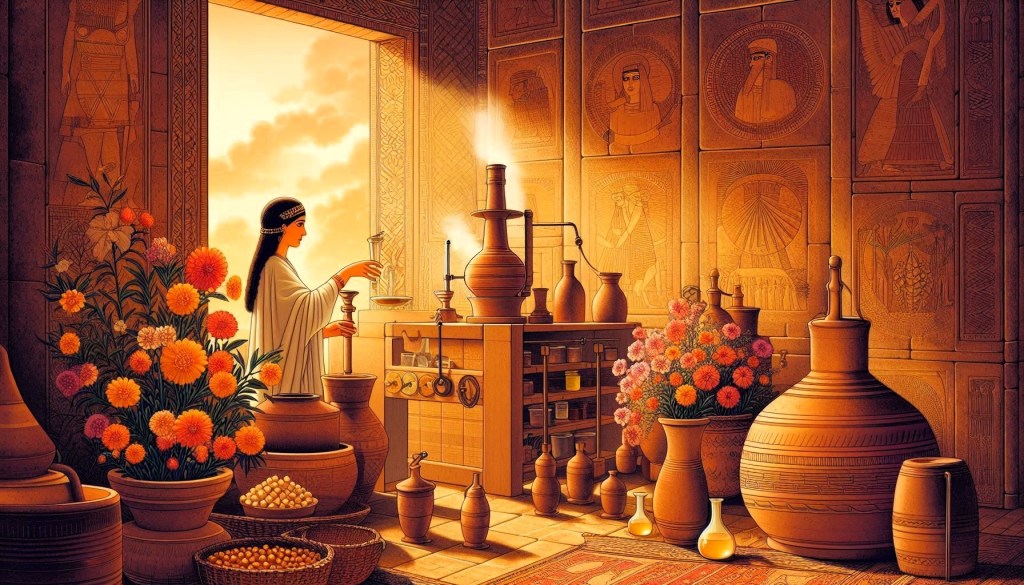
Three thousand years before Marie Curie stepped into a laboratory, a brilliant woman in ancient Babylon was revolutionising the very foundations of chemistry. Yet until recently, Tapputi-Belatekallim remained buried not just beneath the sands of Mesopotamia, but beneath centuries of historical bias that systematically erased women’s contributions to science.
This is the story of how we nearly lost the world’s first recorded chemist—and what that tells us about the women we’re still overlooking today.
The Palace Perfumer Who Changed Everything
Around 1200 BCE, in the royal palace of ancient Babylon, Tapputi-Belatekallim held one of the most prestigious scientific positions of her time. Her title, “Belatekallim,” translates to “overseer of the palace”—a role that placed her in charge of the royal household’s perfumery operations. But Tapputi was far more than a cosmetics maker. She was a pioneering chemist whose innovations laid the groundwork for modern laboratory techniques.
What makes Tapputi extraordinary isn’t just her gender in a male-dominated society, but the sophistication of her methods. She developed and perfected distillation—a fundamental chemical process still used today. Using equipment that resembled early alembic stills, she separated liquids with different boiling points, creating purified alcohol for her perfume bases. This wasn’t simple mixing; it was advanced chemistry requiring profound understanding of molecular behaviour.
Her techniques extended far beyond distillation. Tapputi employed cold enfleurage, infusing fats like lard or tallow with fragrant compounds from plants over several days. She used sublimation to extract aromatic compounds by converting them from solid to gas, then condensing them into purified liquids. These processes demanded considerable technical expertise and could take over a week to complete.
The First Scientific Treatise
Tapputi’s surviving formula reads like a modern laboratory protocol. Her recipe for a royal salve specifies precise measurements, timing, and procedures: “You put 1 qa hamimu, 1 qa iaruttu, 1 qa of good, filtered myrrh oil into the vat… You operate at the end of the day and in the evening. It remains overnight”. The meticulous detail reveals a mind that understood the importance of reproducible methods—a cornerstone of scientific practice.
Her ingredients list reads like an ancient chemist’s inventory: flowers, oil, calamus, cyperus, myrrh, balsam, and various aromatics. She mixed these with water and other solvents, then distilled and filtered the products multiple times to achieve purity. The complexity of her formulations rivalled anything produced in medieval Europe over a millennium later.
What’s particularly remarkable is that Tapputi’s work had already achieved canonical status by her lifetime. The tablet preserving her formulas wasn’t her original document, but a scholarly concordance created in King Tukultī-Ninurta I’s fifth regnal year. Her techniques were deemed worthy of inclusion in Mesopotamia’s educational corpus—housed alongside glass-making formulas in the ancient library of Aššur.
Science in Service of Society
Tapputi’s perfumes served multiple functions that reveal the interconnected nature of ancient science. Beyond cosmetics, her creations had ritual, magical, and medicinal purposes. In Babylonian society, perfumers functioned as early pharmacists, using essential oils and salves to treat infections. This multidisciplinary approach—combining chemistry, medicine, and what we’d now call aromatherapy—demonstrates the holistic thinking that characterised early scientific practice.
Her alcohol-based perfumes were revolutionary. Unlike the heavy oil-based salves common at the time, Tapputi’s formulations used volatile solvents that evaporated after application, leaving only the scent behind. Sound familiar? This is precisely how modern perfumes work—ethyl alcohol with essential oils as fragrances.
The Archaeology of Erasure
Tapputi’s rediscovery tells a troubling story about historical bias. The tablet containing her formulas wasn’t found until 1903, during German excavations at Aššur. Even then, it wasn’t translated until 1919. For over 15 years, this evidence of women’s contributions to early chemistry sat untranslated in academic collections.
But here’s the crucial point: Tapputi wasn’t unique. The same tablet mentions another female perfumer, known only as “Ninu,” whose full name was lost when part of the clay tablet broke. How many other women’s names have been lost to time, damaged tablets, or scholarly neglect?
As one researcher observed: “The difference between being the mother of perfumery or a footnote in history is a crack in a clay tablet. This is the essence of survival bias”. Tapputi is extraordinary not necessarily because she was the only woman practising advanced chemistry, but because her name survived when countless others didn’t.
The Politics of Historical Memory
The erasure of Tapputi’s contributions wasn’t accidental. Early archaeological work in Mesopotamia was conducted by European powers competing for ancient treasures. They framed their discoveries within narratives emphasising connections to classical Greece or biblical accounts, systematically overlooking indigenous scientific traditions—particularly those involving women.
This reflects broader patterns in how we construct scientific history. We celebrate the “great men” of science whilst ignoring the collaborative, incremental work that actually drives progress. We privilege European contributions whilst dismissing achievements from other civilisations. And we systematically undervalue women’s participation in scientific endeavours.
Consider this: we have documentation of perfumery trade for hundreds of years before Tapputi’s lifetime. Palace workers, even skilled ones, were rarely named in written records—especially female perfumers who often came to Assyrian courts through conquest. The fact that Tapputi’s name appears at all suggests her work was considered exceptional even by ancient standards.
Modern Recognition, Ancient Lessons
Today, Tapputi has emerged as a powerful symbol in STEM education and feminist history. In 2023, scientists successfully recreated her 3,200-year-old perfume formulas, proving the viability of her techniques. University chemistry professors now use her work to demonstrate the continuity between ancient practice and modern laboratory methods.
But her story raises uncomfortable questions about contemporary science. If we nearly lost the world’s first recorded chemist to historical bias, what contributions are we overlooking today? How many women’s achievements in STEM remain uncredited, unpublished, or simply ignored?
The scholars Marelene and Geoffrey Rayner-Canham captured this perfectly: “Though rarely noted, women have been active participants in the chemical sciences since the beginning of recorded history”. The problem isn’t women’s absence from science—it’s our failure to recognise their presence.
The Tapputi Principle
Tapputi-Belatekallim’s legacy extends beyond her technical innovations. She represents what we might call the “Tapputi Principle”—the recognition that scientific progress has always depended on diverse voices, including those historically marginalised or erased.
Her sophisticated understanding of chemical processes, developed over 3,000 years ago, reminds us that innovation isn’t the province of any single gender, culture, or historical period. The techniques she pioneered—distillation, extraction, purification—remain fundamental to modern chemistry and pharmaceutical manufacturing.
Yet perhaps Tapputi’s most important contribution isn’t scientific but social: proof that women’s exclusion from science wasn’t universal throughout history, and that brilliant minds have always found ways to contribute, regardless of the barriers placed before them.
As we continue to discover and celebrate forgotten women in STEM, Tapputi’s story serves as both inspiration and warning. It reminds us that for every Marie Curie we remember, there may be dozens of Tapputis we’ve forgotten—and that the responsibility for ensuring women’s contributions are recognised and preserved rests with all of us.
The question isn’t whether women have always participated in science. They have. The question is whether we’re paying attention.
Bob Lynn | © 2025 Vox Meditantis. All rights reserved.


 Vox Meditantis
Leave a reply to Darryl B Cancel reply