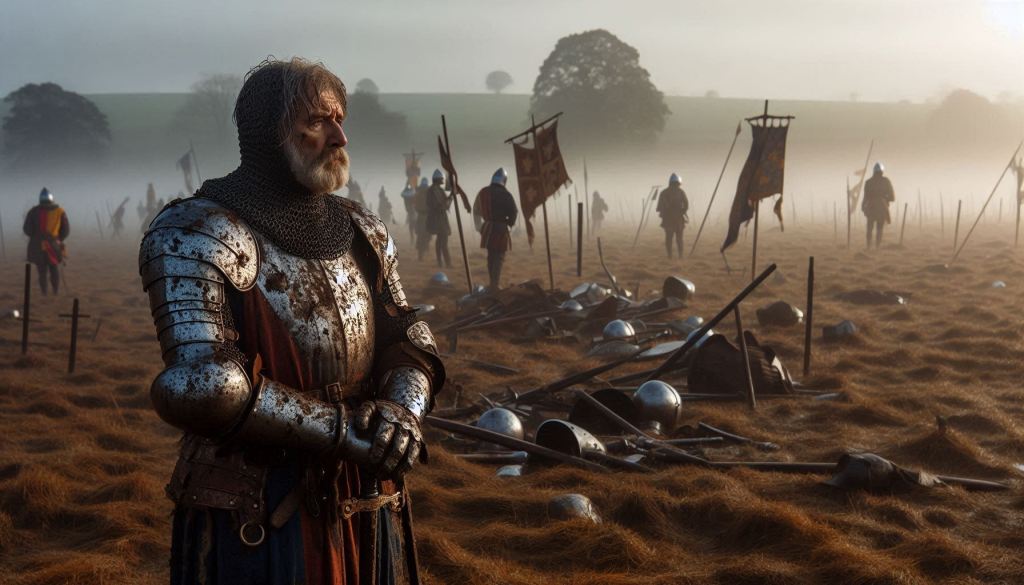
East Stoke, Nottinghamshire, England – 16th June, 1487
The morning mist clung to Stoke Field like the ghosts of all the battles I had witnessed, and as I adjusted my grip upon my sword’s pommel, I wondered if this would truly be the last time I would draw it in anger. The sixteenth day of June, in the year of our Lord fourteen hundred and eighty-seven, and here I stood once more amongst the ranks, my joints protesting against the familiar weight of mail and plate that had become as much a part of me as my own skin.
“Sir Godfrey,” called young Edmund, one of the pages who had attached himself to my retinue, “the King’s herald approaches.”
I turned to watch Henry’s messenger ride between the lines, his banner streaming in the dawn breeze. Two years since Bosworth Field, where I had stood witness to the end of the Plantagenet line and the rise of this Welsh upstart who now called himself our sovereign. Yet here we were again, steel drawn against steel, blood preparing to water English soil for what purpose? A boy pretender, this Lambert Simnel, claiming to be Edward, Earl of Warwick—as if we had not seen enough of such foolishness.
The herald’s voice carried across the field: “By order of His Most Gracious Majesty, King Henry the Seventh, all who lay down their arms and submit to royal mercy shall receive His Majesty’s pardon!”
I spat into the mud. Mercy. How many times had I heard such promises? At Towton, where the snow ran red with York and Lancaster blood alike. At Tewkesbury, where young Edward of Lancaster met his end. At Bosworth, where I watched Richard Plantagenet, crowned King though he was, charge desperately into the Tudor ranks, crying “Treason!” as the crown was struck from his head.
“Will they yield, do you think?” Edmund asked, his voice betraying the nervousness of one who had never felt a blade bite deep or heard the death-rattle in a friend’s throat.
“Some will,” I replied, watching the Yorkist lines across the field. I could see the Irish kerns amongst them, wild men from beyond the Pale who cared little for English politics but much for English gold. Beside them stood the Flemish pikemen, disciplined and deadly, and scattered throughout, the English who still believed in the old bloodlines, the old certainties. “But not all. Not the faithful ones.”
The faithful ones. Like myself, I suppose, though faith in what, I could no longer say with certainty. I had served three kings in my lifetime—Edward IV, Richard III, and now Henry VII. I had sworn oaths, broken them when necessity demanded, sworn new ones with equal solemnity. What was faith when survival demanded such flexibility?
The morning sun climbed higher, burning away the mist, and I found myself studying the faces of the men around me. Some I had fought beside for decades—grizzled veterans like myself who had weathered the storms of civil war and emerged, scarred but breathing. Others were fresh-faced lads who knew nothing of warfare save the tales their grandfathers told of Agincourt and the glory of English arms. Between us stood the truth of war: that it was neither glorious nor shameful, but merely necessary until it was not.
“Sir Godfrey,” came another voice, and I turned to see Sir Rhys ap Thomas approaching, the Welsh knight who had proved instrumental in Henry’s victory at Bosworth. “His Majesty desires to know your assessment of their formation.”
I squinted across the field, reading the dispositions as I had learned to read them through thirty years of campaigning. “They have placed too much faith in those Irish wildmen,” I said. “Fierce fighters, to be certain, but they lack discipline. When our cavalry strikes their flank, they will scatter. The Flemings will hold longer, but they are outnumbered three to one.”
“And the English contingent?”
I was quiet for a moment, watching a group of knights beneath a banner I recognised—men I had fought alongside in years past, now ranged against me because they believed in different claims, different rights. “The English will fight well and die bravely, as Englishmen always do. But they cannot win. This battle was lost before it began.”
Rhys nodded and departed, leaving me alone with my thoughts as the trumpets began to sound. Around me, men crossed themselves, muttered prayers, checked their weapons one final time. The familiar ritual of preparation for battle, performed by soldiers since time immemorial. Yet something felt different this morning—a sense of finality that went beyond the usual uncertainty of combat.
Perhaps it was my age. Fifty-three summers had I seen, and though my sword arm remained strong and my eye keen, I felt the weight of years in ways I had not when I was a young knight eager for glory and advancement. My knees ached when I knelt in prayer, my back protested against sleeping on hard ground, and increasingly, I found myself wondering what purpose my life had served.
The charge, when it came, was swift and decisive. Henry’s cavalry struck the Yorkist flanks whilst his archers sent clouds of arrows into their packed ranks. I advanced with the main body, my sword singing as it cleared the scabbard, and for a time, there was nothing but the familiar chaos of battle—the clash of steel on steel, the screams of wounded horses, the shouted commands that were often lost in the din.
I found myself engaged with a young knight, barely out of his teens, who fought with the desperate courage of one who knows he is likely to die this day. His blade was keen and his arm strong, but experience told me where he would strike before he knew it himself. When my sword found the gap beneath his arm where the plates joined, he looked at me with something like surprise before toppling backwards into the churned mud.
As I cleaned my blade on the grass, I realised that I felt no satisfaction in the kill—no triumph, no sense of justice served. Merely the weary acknowledgement that another young man had died for causes he probably understood little better than I did. How many such men had I killed over the years? I had long since stopped counting.
The battle’s end came sooner than expected. The Irish broke first, as I had predicted, streaming away across the fields in wild disorder. The Flemings held their ground longer, their pikes forming bristling hedgehogs that our cavalry could not easily break, but weight of numbers told in the end. The English knights fought to the last, some dying where they stood rather than yield, others calling for quarter that was sometimes granted, sometimes not.
As the sun reached its zenith, the field fell quiet save for the groans of the wounded and the calls of those searching for friends amongst the dead. I stood amongst the carnage, my surcoat spattered with blood—some mine, most belonging to others—and watched as Henry’s banner was raised in victory. The last Yorkist pretender’s cause was broken, his supporters dead or fled, and with it, the long agony of the Wars of the Roses had finally reached its end.
“Sir Godfrey.” Henry himself approached, still wearing his battle harness but with his visor raised, revealing a face that, whilst young, already showed the calculating intelligence that had brought him to the throne. “You fought well today.”
“As did Your Majesty’s forces,” I replied, offering the courtesy that protocol demanded whilst keeping my own thoughts private.
“Walk with me,” he said, and together we picked our way across the battlefield. Around us, men were already beginning the grim work of stripping the dead and caring for the wounded. The business of war continued even when the fighting had stopped.
“You have served faithfully through difficult times,” Henry said after we had walked in silence for several minutes. “First my predecessor, now myself. Such loyalty is… valuable.”
I heard the question in his words, though he had not spoken it directly. Where did my loyalty lie now? With him? With the old bloodlines? With England herself, or merely with my own survival?
“I have served England, Your Majesty,” I said carefully. “Through three reigns and more battles than I care to count. I have done what I believed necessary to preserve the realm, even when the realm could not decide who should rule it.”
Henry nodded slowly. “And now? Now that the realm has decided, at least for the present? What does Sir Godfrey Langton of Derwentfell desire?”
It was the question I had been asking myself for months, the question that had haunted my thoughts through the long march to Stoke Field. What did I want? What did any man want when the work that had defined his life was finally finished?
“I would speak honestly, Your Majesty?”
“I would prefer it.”
I stopped walking and turned to face him directly. “I am tired, Sire. Tired in ways that sleep cannot remedy. I have spent thirty years preparing for battles, fighting battles, recovering from battles. I have buried more friends than I can name, taken more lives than I can justify to any God worth serving. I find myself wondering what manner of man I might have been had I lived in times of peace.”
Henry listened without interruption, his dark eyes studying my face as I spoke. When I finished, he was quiet for a long moment, looking out across the field where the dead lay scattered like broken dolls.
“You wish to retire,” he said finally.
“I wish to discover what retirement might mean for a man such as myself. Whether there is purpose to be found in tending sheep instead of slaughtering men. Whether these hands, which have grown so skilled at dealing death, might learn gentler arts.”
“Your estates in Cumberland?”
“Are in need of attention, certainly. But more than that…” I paused, searching for words to express thoughts I had barely acknowledged to myself. “I find myself curious about the man I might become if I were not constantly preparing for war. Whether Sir Godfrey Langton the farmer, or the husband, or the man who builds rather than destroys, might be someone I could respect.”
Henry’s smile was slight but genuine. “You have earned such a chance, I think. And England has earned a period of peace in which good men might discover what they are capable of beyond warfare.”
As we walked back towards the Tudor camp, I felt something I had not experienced in years—hope. Not the desperate hope of survival that sustained men in battle, but the quieter hope of possibility. That there might be years ahead not measured by campaigns and sieges, but by harvests and celebrations, by the simple satisfaction of work well done without violence.
That evening, as I sat by the campfire cleaning my armour for what I hoped might be the final time, young Edmund approached with a question.
“Sir Godfrey, what will you do now? Will you remain at court?”
I looked up at him, this boy who had seen his first battle today and acquitted himself well, and realised that he was asking the same question that Henry had posed, that I had been asking myself. How do you want to retire?
“I shall return to Cumberland,” I said, running the cloth over my breastplate one last time. “I shall learn to be a farmer, I think. To plant things instead of destroying them. To build walls that keep sheep in rather than enemies out.”
“Will you not miss it? The excitement, the glory?”
I set aside my armour and looked out into the darkness beyond our fire. Somewhere out there lay the bodies of men who had sought glory this morning and found only death. Glory was a young man’s dream, and I was no longer young.
“I shall miss the camaraderie,” I said honestly. “The bonds forged between men who trust each other with their lives. But as for the rest…” I shook my head. “No, Edmund. I think I have had enough of glory to last whatever years remain to me.”
The fire crackled between us, and I could see him trying to understand how a man could willingly walk away from the profession of arms. Perhaps, if God was merciful, he would never need to learn the answer to that question for himself.
As the night deepened and the camp settled into sleep, I lay on my blanket looking up at the stars and thought about tomorrow. Not the strategic tomorrow of military campaigns, but the personal tomorrow of a man who had finally been granted permission to discover who he might be beyond his sword and shield.
For the first time in thirty years, I looked forward to finding out.
The End
Bob Lynn | © 2025 Vox Meditantis. All rights reserved.


 Vox Meditantis
Leave a reply to Tony Cancel reply