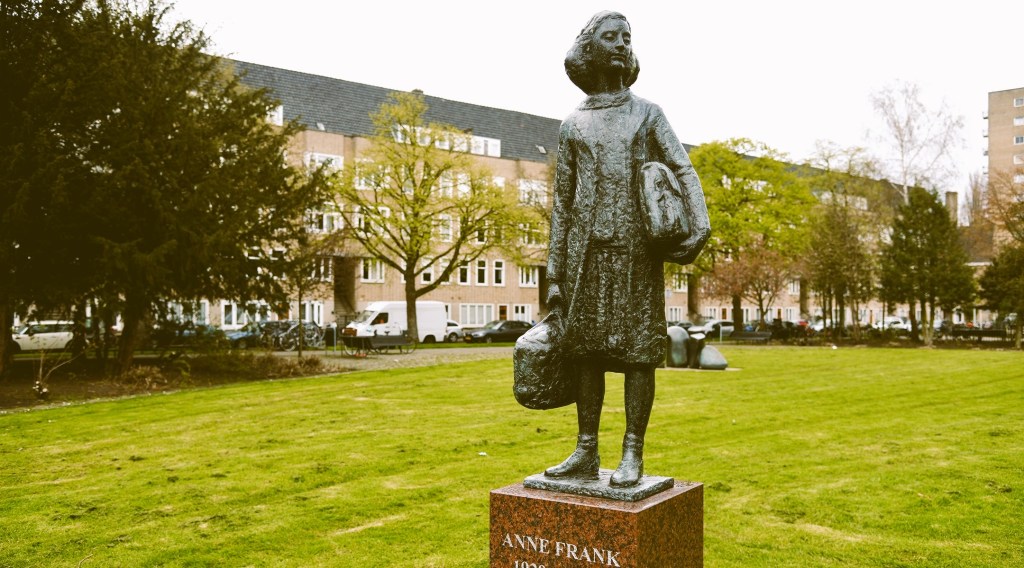
12th June 1942, Amsterdam
The morning light filtered through the lace curtains of our sitting room at Merwedeplein 37, casting delicate shadows across the wooden floor like fragments of a broken dream. I pressed my face against the cool window glass, watching the familiar street below—bicycles threading between the occasional German patrol, neighbours hurrying past with their heads down, the Jewish star sewn onto their coats catching the early sunlight like small yellow flames.
Today I am thirteen.
“Annelies!” Mummy’s voice drifted from the kitchen, carrying with it the comforting scent of ersatz coffee and the last precious scraps of real butter we’d been saving. “Come away from that window, darling.”
I turned, catching sight of myself in the mirror beside the window—dark hair falling in gentle waves to my shoulders, grey-green eyes that Pim says hold mischief and dreams in equal measure. Thirteen feels different somehow, as though I’ve crossed some invisible threshold in the night. The girl of twelve seems suddenly distant, a character from a story I’m no longer telling.
At breakfast, Margot sat primly at the table, her blonde hair perfectly arranged despite the early hour. My sister, three years my senior, possessed a composure I envied—she never seemed ruffled by the restrictions that pressed upon us like a slowly tightening vice. The yellow star on her blouse sat as naturally as a brooch, whilst mine felt heavy as a millstone upon my chest.
“The birthday girl looks contemplative this morning,” Pim observed, his kind eyes crinkling at the corners as he folded his newspaper—the censored version that told us only what the Germans wished us to know. “What thoughts occupy that busy mind of yours?”
I spooned the thin porridge into my mouth, considering his question. How could I explain the restlessness that had been growing within me like a caged bird? The need to capture something—moments, feelings, the very essence of living—before it all slipped away like sand through my fingers?
“I’ve been thinking about writing, Pim,” I said finally. “Real writing, I mean. Not just school compositions about our summer holidays or what we did last weekend.”
Mummy set down her cup with a gentle clink. “Writing about what, liebling?”
“About us. About life. About what it means to be… to be here, now, in this moment.” I gestured vaguely at the window, at the street beyond, at the whole complicated web of our existence. “Sometimes I feel as though I’m watching everything from behind glass, as though I’m not quite living it but observing it. Does that make sense?”
Pim’s expression grew thoughtful. “Perfect sense, Anne. That’s the writer’s eye—seeing the world not just as a participant but as a witness. It’s a gift, though sometimes it can feel like a burden.”
After breakfast, I retreated to the small bedroom I shared with Margot, settling at the desk beneath the window where the light was best. My schoolbooks lay scattered across its surface—mathematics, German grammar, history that stopped abruptly before the present troubles began. I pushed them aside and retrieved my composition notebook, its pages already filled with my childish attempts at capturing the world in words.
I read through some of my earlier efforts—a story about a girl who could speak to birds, a poem about raindrops racing down windowpanes, a description of Mrs. Van Daan’s peculiar laugh that sounded like a rusty gate. The words felt inadequate, like trying to catch moonbeams in a fishing net.
Outside, I could hear the sounds of Amsterdam continuing its careful existence—trams clanging along their tracks, voices calling in Dutch and German, the distinctive clip-clop of horses’ hooves on cobblestones. Each sound seemed layered with meaning, heavy with stories untold.
A knock at the front door interrupted my reverie. I heard Pim’s measured footsteps crossing the hall, the low murmur of voices. These days, every unexpected visitor brought a flutter of anxiety. But then I heard laughter—real, genuine laughter—and recognised the voice of Lies Goslar, my dearest friend from school.
“Anne!” she called up the stairs. “Come down! We have a surprise for you!”
I found her in our sitting room, fairly bouncing with excitement, her dark curls escaping from their careful arrangement. Behind her stood several of my classmates—Jacque van Maarsen with her serious dark eyes, Sanne Ledermann with her ready smile, and others from our form at the Jewish Lyceum.
“We couldn’t let your birthday pass without proper celebration,” Lies announced, producing a wrapped package from behind her back. “Even if we must celebrate quietly.”
The package was small, rectangular, bound in brown paper and tied with a piece of red ribbon that looked suspiciously like it had been carefully preserved from some previous gift. I untied it slowly, savoring the moment—such simple pleasures had become precious beyond measure.
Inside lay a diary.
It was beautiful in its simplicity—a red-and-white checkered cover, its pages crisp and unmarked, waiting. I ran my fingers across the surface, feeling the slight texture of the cloth binding, inhaling the clean scent of fresh paper.
“It’s perfect,” I whispered, and meant it. This wasn’t just a book—it was possibility made tangible, a vessel for all the thoughts and feelings that churned within me like a storm-tossed sea.
Lies beamed. “We thought you’d like it. You’re always scribbling away in those composition books, so we reckoned you needed something special. Something just for you.”
I looked around at these dear faces—friends who understood, even if they couldn’t fully comprehend the depth of longing the diary awakened in me. In their eyes, I saw reflected my own hopes and fears, the strange mixture of childhood’s end and the uncertain future that awaited us all.
“Thank you,” I managed, my voice thick with emotion. “Truly, thank you.”
We spent the afternoon together, playing the games we’d played for years—though now they seemed touched with a bittersweet quality, as though we were all unconsciously aware that such innocent pleasures might soon be memories rather than present realities. The diary lay beside me on the sofa like a trusted companion, and I found my gaze returning to it again and again.
As evening approached and my friends departed with kisses and whispered birthday wishes, I sat alone with my new treasure. The house had grown quiet—Margot studying in her methodical way, Mummy busy with household tasks, Pim reading in his chair by the wireless.
I opened the diary to its first page, my pen poised above the pristine paper. What words were worthy of this beginning? How does one commence a conversation with oneself, with the future, with history itself?
Dear Diary, I began, then stopped. No, that felt too impersonal, too distant. This book deserved something more intimate, more real.
I thought of my grandmother’s stories, of the letters she used to write that began with such warmth and affection. I needed a name, a personality to address—someone who would listen without judgment, who would hold my secrets and share my dreams.
Dear Kitty, I wrote instead, and immediately felt the rightness of it. Kitty—friendly, understanding, patient. Kitty would be my confidante, my silent companion through whatever lay ahead.
I hope I will be able to confide everything to you, as I have never been able to confide in anyone, and I hope you will be a great source of comfort and support.
The words flowed from my pen like water from a spring, each sentence carrying a piece of my soul onto the page. I wrote about my day, about my friends, about the gift itself and what it meant to me. But more than that, I wrote about the feeling of being thirteen and Jewish in occupied Amsterdam, of watching the world change around us while trying to hold onto some sense of normalcy and hope.
As I wrote, I felt something shift within me—a sense of purpose, of calling, that I’d never experienced before. These words, these thoughts preserved in ink on paper, felt significant in a way I couldn’t yet fully understand. It was as though I were not just recording my life but somehow making it more real, more meaningful.
The clock in the hall chimed nine times, and still I wrote. About Margot’s quiet strength, about Pim’s unwavering optimism, about Mummy’s carefully concealed worry. About the yellow stars we wore and the restrictions that governed our days. About my dreams of becoming a writer, of making something beautiful from the raw material of existence.
What are you passionate about? The question seemed to whisper from the pages themselves, demanding an honest answer.
Writing, I realised. This—this capturing of moments and feelings, this translation of experience into words that might outlive the experience itself. The diary wasn’t just a repository for my thoughts; it was a declaration of faith in the power of words to preserve, to illuminate, to connect across time and space.
I wrote until my hand cramped and my eyes grew heavy. When I finally closed the diary, the first entry complete, I felt as though I’d crossed another threshold—not just into my fourteenth year, but into something deeper and more permanent.
Outside, Amsterdam slept fitfully under its blanket of occupation. German soldiers patrolled the darkened streets whilst behind blacked-out windows, families like ours huddled together, hoping for better days. The future stretched ahead, uncertain and shadowed, but I held fast to this new purpose, this passion that had been awakened within me.
Tomorrow I would return to school, to the careful routine that had become our lives. But I would carry with me this red-chequered companion, this silent witness to my thoughts and dreams. Whatever lay ahead—and somehow, in the deepest part of my heart, I sensed great changes coming—I would face it with words as my weapon, hope as my shield, and truth as my guiding star.
The diary lay beside my bed as I prepared for sleep, its presence both comforting and challenging. It demanded honesty, courage, the willingness to examine life with unflinching eyes whilst never losing sight of its beauty and meaning.
I was thirteen years old, a Jewish girl in Nazi-occupied Amsterdam, and I had discovered my passion: to write, to witness, to transform the ordinary moments of existence into something lasting and true. The diary would be my laboratory, my confessional, my most trusted friend.
As sleep finally claimed me, I smiled into the darkness. Tomorrow would bring new words, new thoughts, new entries in the book that had already become the most precious thing I owned. And perhaps, someday, these words would matter to someone beyond myself—would serve as a reminder that Anne Frank had lived, had loved, had hoped, and had found her voice in the gathering darkness of the world.
Little did I know that this simple gift, this red-chequered diary given with such love by my dearest friends, would become the vessel for one of history’s most timeless voices—a passion born not despite the darkness, but because of it, transforming a young girl’s private thoughts into a beacon of hope for generations yet unborn.
The End
Bob Lynn | © 2025 Vox Meditantis. All rights reserved.


 Vox Meditantis
Leave a reply to 12th June 1942 – Ingliando Cancel reply