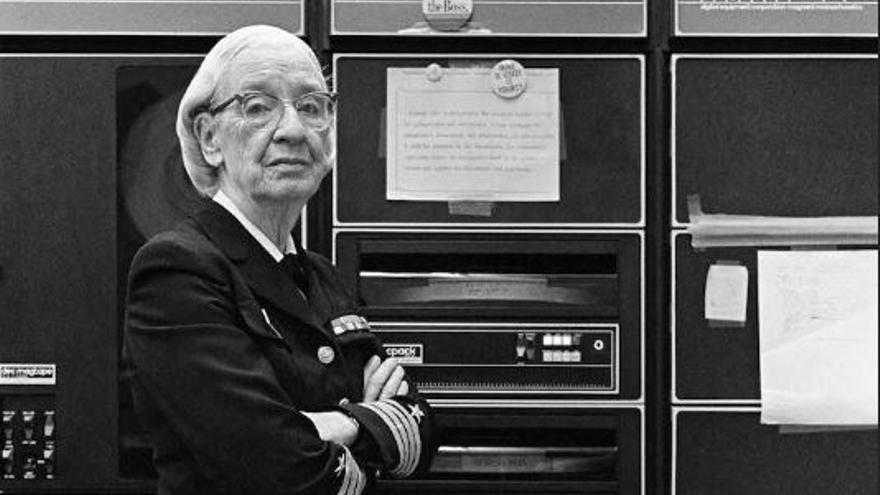
Grace Brewster Murray Hopper stands as one of the most transformative figures in computing history, yet her contributions remain insufficiently recognised beyond technical circles. This remarkable woman, who lived from 1906 to 1992, fundamentally altered how humans interact with computers by inventing the first compiler and spearheading the development of COBOL, the programming language that powered business computing for decades. Despite facing systematic barriers as a woman in both academia and the military, Hopper’s innovations laid the groundwork for modern software development whilst her vision of English-like programming languages democratised computing access. Her story represents not merely individual brilliance, but a powerful testament to how diverse perspectives drive technological progress—and how easily such contributions can be overshadowed by prevailing narratives that favour male achievements.
Breaking Barriers in Mathematics and Military Service
Grace Hopper’s journey began in an era when women faced formidable obstacles in pursuing scientific careers. Born in New York City in 1906, she demonstrated early signs of the curiosity that would define her life. At age seven, she dismantled alarm clocks throughout her family home to understand their mechanisms—a childhood incident that presaged her lifelong commitment to understanding how complex systems functioned. This intellectual fearlessness would prove essential as she navigated educational and professional environments designed to exclude women.
Her academic achievements were extraordinary by any measure. After graduating Phi Beta Kappa from Vassar College in 1928 with degrees in mathematics and physics, Hopper earned both her master’s degree (1930) and PhD (1934) in mathematics from Yale University. Her doctoral dissertation, “New Types of Irreducibility Criteria,” represented significant mathematical scholarship. She began teaching mathematics at Vassar in 1931, advancing to associate professor by 1941.
The outbreak of World War II transformed Hopper’s trajectory in ways that would reshape computing history. Driven by patriotic duty, she attempted to join the U.S. Navy but faced initial rejection due to her age and diminutive size. Her persistence paid off when she received a waiver to join the Naval Reserve in 1943. After intensive training at Smith College, she was commissioned as a lieutenant junior grade and assigned to the Bureau of Ships Computation Project at Harvard University.
At Harvard, Hopper joined the team working on the IBM Automatic Sequence Controlled Calculator, known as the MARK I—the first electromechanical computer in the United States. Under Howard Aiken’s guidance, she became one of the first three “coders” (now called programmers) and wrote the comprehensive 561-page user manual for the MARK I. This work involved top-secret calculations essential to the war effort, including computing rocket trajectories and calibrating minesweepers. Remarkably, whilst working on the MARK I, Hopper coined the term “bug” to describe computer malfunctions.
Revolutionising Computer Programming
Hopper’s most transformative contributions emerged in the post-war years as she recognised computing’s potential beyond military applications. In 1949, she joined the Eckert-Mauchly Computer Corporation, where she would revolutionise how humans communicate with machines. Her groundbreaking work on the UNIVAC I computer led to innovations that fundamentally changed software development.
The invention of the A-0 compiler in 1951-1952 represents perhaps Hopper’s most significant achievement. This pioneering tool functioned as a linker/loader, translating symbolic mathematical code into machine language. As Hopper explained, she took all the subroutines she had collected over the years and organised them on tape, giving each routine a call number so the machine could locate it. This innovation addressed a critical problem: whilst computers could perform calculations faster than humans, programming them remained tediously complex.
The significance of the A-0 compiler cannot be overstated—it represented the first successful attempt at automatic programming. When Hopper presented her work, she encountered scepticism from colleagues who believed computers couldn’t write their own programs. It took two years for the compiler concept to gain acceptance. Her persistence in the face of institutional resistance exemplifies the additional barriers women faced in gaining recognition for technical innovations.
Hopper’s vision extended beyond mere technical efficiency. She recognised that programming languages needed to become more accessible to non-specialists. This insight led to her development of FLOW-MATIC (originally called B-0) between 1955 and 1959. FLOW-MATIC was revolutionary because it used English-like statements rather than mathematical symbols. As Hopper observed, business users were uncomfortable with mathematical notation, telling her to “throw those symbols out—I do not know what they mean, I have not time to learn symbols”.
FLOW-MATIC directly influenced the development of COBOL (Common Business-Oriented Language), which Hopper helped create through the CODASYL consortium in 1959. COBOL became the dominant programming language for business applications, remaining in widespread use for decades. Her advocacy for English-like programming languages proved prescient—by making computers more accessible to business users, she democratised computing technology.
The Battle for Recognition and Legacy
Despite her groundbreaking contributions, Hopper faced systematic challenges in gaining recognition commensurate with her achievements. The computing industry’s male-dominated culture often overlooked women’s contributions, a pattern that persists today. Hopper’s experience reflects broader issues of historical erasure affecting women in STEM fields.
Nevertheless, Hopper’s persistence earned her significant accolades during her lifetime. She received 47 honorary degrees and numerous awards, including the National Medal of Technology from President George Bush in 1991. In 2016, President Barack Obama posthumously awarded her the Presidential Medal of Freedom. The Grace Murray Hopper Award, established by the Association for Computing Machinery in 1971, honours young computer professionals making significant contributions.
Her naval career culminated in promotion to rear admiral, making her one of the few women to achieve such rank. The U.S. Navy named a destroyer in her honour, and various computing systems, including NVIDIA’s “Hopper” GPU architecture, bear her name. A college at Yale University was renamed in her honour.
However, these accolades, whilst significant, haven’t translated into broader public recognition. Hopper remains better known within technical communities than in general discussions of scientific achievement. This disparity reflects ongoing challenges in how society values and remembers women’s contributions to STEM fields.
Why Her Story Still Matters
Grace Hopper’s legacy extends far beyond her technical innovations. Her career demonstrates how diverse perspectives drive technological progress. Her insight that programming languages should use English-like syntax came from understanding barriers facing non-technical users—a perspective shaped by her experience as an educator and her commitment to making technology accessible.
Recent developments underscore the continued relevance of Hopper’s work. NVIDIA’s Grace Hopper Superchip, designed for high-performance computing and artificial intelligence applications, represents the latest evolution of technologies she pioneered. These systems’ unified memory architectures and advanced processing capabilities build upon principles Hopper established decades ago.
The current climate presents both opportunities and challenges for preserving women’s contributions to STEM. Whilst initiatives celebrate women scientists, systematic erasure continues. Recent examples include the removal of lists of pioneering women in science from official websites, demonstrating how easily such contributions can disappear from public memory.
Hopper’s story offers crucial lessons for contemporary efforts to diversify STEM fields. Her success required not just technical brilliance but extraordinary persistence in overcoming institutional barriers. Her approach—”Go ahead and do it, you can apologise later”—reflects the additional boldness women must demonstrate to achieve recognition in male-dominated fields.
Conclusion
Grace Hopper’s contributions to computing remain foundational to how we interact with technology today. Her invention of the compiler and leadership in developing COBOL democratised programming, making computers accessible to business users worldwide. Her vision of English-like programming languages proved transformative, anticipating modern efforts to make technology more intuitive.
Yet Hopper’s broader significance lies in demonstrating how diversity drives innovation. Her unique perspective—combining mathematical rigour with educational insight and practical problem-solving—generated solutions that male colleagues hadn’t envisioned. Her story reminds us that excluding diverse voices from STEM fields impoverishes not just individual careers but technological progress itself.
The challenge now is ensuring that Hopper’s legacy inspires future generations whilst acknowledging the systemic barriers that made her achievements exceptional rather than routine. Her story should be celebrated not as an anomaly but as evidence of what becomes possible when barriers are removed and diverse perspectives are valued. Only by recognising and addressing these patterns can we ensure that future Grace Hoppers receive the support and recognition they deserve from the outset of their careers.
Bob Lynn | © 2025 Vox Meditantis. All rights reserved.


 Vox Meditantis
Leave a reply to Betty Holberton on Breaking Barriers: The Forgotten Pioneer Who Invented Modern Debugging and Fought for Women in Computing – Vox Meditantis Cancel reply