-
 Continue reading →: Harbouring Day: Keeping the Room Open
Catherine quietly inaugurates Harbouring Day – a modest ritual of welcome and waiting – while tuning calendars, thresholds, and harbour weather; threads from Sunday settle into Monday’s humane logistics, as New Corinth practises kindness at scale and conversation with David lingers in the lee.
-
 Continue reading →: Ellen Hutchins: The Botanist Who Catalogued an Island from Her Sickbed
Ireland’s first female botanist speaks from beyond the archive. Ellen Hutchins discovered twenty species whilst bedridden, created watercolours so precise they settled centuries-old debates about whether seaweeds were plants, and watched her name affixed to lichens and mosses she could never author. A conversation about invisible labour, institutional erasure, and…
-
 Continue reading →: The Price of Progress
A deputy head spends her Sunday alone in an empty school, obsessively troubleshooting the computer network and cataloguing institutional failures. Paper cuts bleed, computer systems crash, and security fears haunt empty corridors. Progress demands sacrifice, but who counts the cost?
-
 Continue reading →: Open Tabs, Quiet Hours
New Corinth’s Catherine closes Sunday with tide tables, library holds, Historical Society plans, and one steady recipe; a harbour walk keeps talk careful, collegial favours hold, and a four-line poem softens the day as Monday approaches with a simple invitation.
-
 Continue reading →: Sister Miriam Michael Stimson: The Nun Who Peered Into DNA
Sister Miriam Michael Stimson – a Catholic chemist – used her pioneering infrared technique to correct a Nobel laureate’s inside-out model of DNA in the 1950s. Yet her groundbreaking KBr disk method – still a standard in labs worldwide – has been largely erased from history. Why was her critical…
-
 Continue reading →: Chains That Keep Us
A sixty-three-year-old recluse finds himself running communications in a Syrian aid camp. Amongst refugees, solar panels, and makeshift networks, he confronts what he once fled: human connection. The chains he thought would trap him might be what keeps him whole.
-
 Continue reading →: The Envelope and the Present
An envelope arrives. Catherine must choose: museum pilot starts Thursday, clinic hours shift, Québec pauses. Rajesh swaps; Maggie presses; David texts. Presence becomes a calendar. Quiet courage, soup or music – and a letter waits by the keys till morning.
-
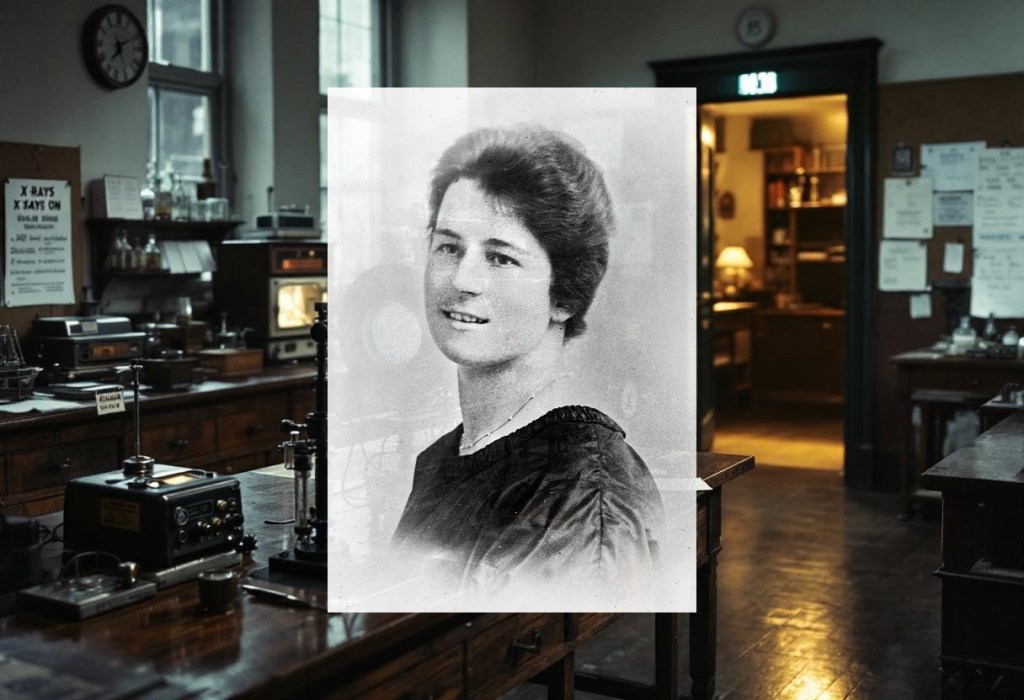 Continue reading →: Dorothy Maud Wrinch: The Mathematician Who Saw Proteins Dance
The mathematician whose “wrong” theory catalysed a right one. She proposed the cyclol structure for proteins. While the model was ultimately rejected, her stubborn advocacy sparked the research that proved her core insight – the importance of hydrophobic interactions – correct. Her story is a conversation on scientific stubbornness, gender…
-
 Continue reading →: The Closed Chamber
On All Saints’ Day 1792, an unmarried scholar reflects on legacy and loss in her borrowed refuge. As terrible news of French massacres reaches London, she confronts what will remain when she’s gone, and whether her life’s work has mattered.
-
 Continue reading →: The Hinge of Arrival
On Hallowe’en by the harbour, Catherine traces fascination to not fireworks but thresholds – river landings, blurred names, small mercies – while a conservator’s text, a neighbour’s wave and two solemn skeletons tilt the night toward ordinary courage and tomorrow’s quieter arrivals at dockside.
Feign the virtue thou dost seek, till it becometh thine own

Recent Posts
- The Geography of Survival
- The Illusion of Control
- Commanding the Tempest
- The Anchor and the Open Door
- A Holiday from Words
Categories
 Vox Meditantis