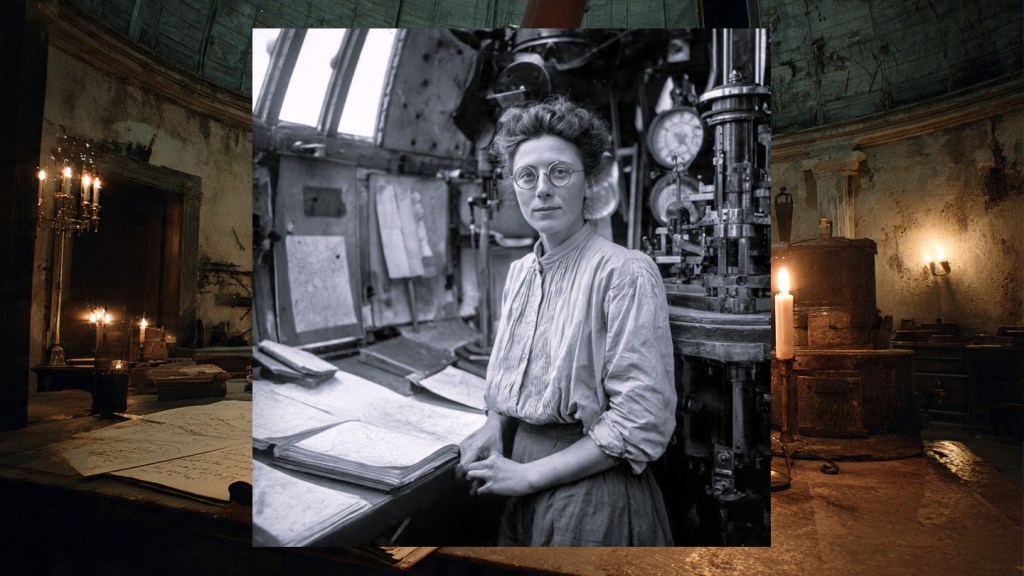
This interview is a dramatised reconstruction based on historical sources, using informed fiction and empathy to explore the documented achievements and social constraints of Isis Pogson’s career. While grounded in factual records of her work at the Madras Observatory, the dialogue is a creative interpretation intended to highlight her enduring scientific legacy and resilience.
Elizabeth Isis Pogson (1852-1945) was a trailblazing English astronomer and meteorologist who became one of the first women to be nominated for a Fellowship of the Royal Astronomical Society. Born into a family of dedicated observers, she spent decades at the Madras Observatory in India, meticulously recording the heavens and refining our understanding of the tropical atmosphere. Her life stands as a testament to scientific rigour and the quiet persistence required to navigate the gendered barriers of Victorian-era academia.
It is a rare privilege to sit across from a woman whose eyes have spent more time fixed on the constellations than on the dusty plains of the earth below. As we begin our conversation, there is an unmistakable sharpness in Miss Pogson’s gaze – a clarity likely honed by thousands of hours peering through the lens of a transit circle telescope. To speak with her is to bridge the gap between the rigid traditions of the 19th-century scientific establishment and the boundless curiosity of a modern pioneer. We approach her story with profound admiration, not just for the data she gathered, but for the historical weight she carried as a woman defining her own space in a world that often preferred her to remain in the shadows of her male contemporaries.
Isis Pogson’s contribution to STEM was defined by the exacting nature of positional astronomy and meteorological research. While serving as the meteorological reporter for the Government of Madras, she didn’t merely observe the weather; she engineered the systems by which it was tracked across a vast, unpredictable region. Her work involved:
- Precision Observation: Meticulously calculating the positions of stars to assist in the creation of the Madras Catalogue, a vital resource for global navigation and stellar mapping.
- Systematic Research: Managing a network of twenty meteorological stations, ensuring that data collection was standardised – a precursor to modern systems thinking in climate science.
- Discovery through Diligence: Assisting in the identification of several asteroids and variable stars, contributing to the foundational material science of the cosmos.
The narrative of Isis Pogson is more than a historical footnote; it is a masterclass in overcoming societal constraints through professional excellence. In 1886, her nomination to the Royal Astronomical Society was withdrawn simply because the society’s charter did not explicitly include women. Yet, she did not cease her research.
Her story matters today because it highlights the importance of innovation within systems. She navigated the bureaucratic and social complexities of the British Raj and the scientific elite, proving that data is an objective truth that eventually forces society to widen its gates. Today’s engineers and researchers can look to Pogson as an early practitioner of high-stakes problem-solving, showing that the pursuit of knowledge requires both a telescope to see the future and the fortitude to withstand the friction of the present.
Miss Pogson, it is an absolute honour to speak with you on this February evening. Looking back from the vantage point of 2026, your childhood in Oxford and later Madras seems almost like a scientific apprenticeship. How did growing up in the shadow of the Radcliffe Observatory – and later the tropical heat of India – shape your internal “map” of the cosmos?
The shadow of the Radcliffe? My dear, I should say I was born in the ink-well of the Radcliffe! My earliest memories are not of dolls or nursery rhymes, but of the rhythmic tick-tack of the sidereal clock – a heartbeat more reliable than any human pulse. In Oxford, the sky was a grey, fickle thing, often obscured by the damp English mist. It taught me patience; one learned to wait for the clouds to part like a curtain for a single, fleeting glimpse of a meridian passage.
But Madras? Madras was a revelation of fire and glass. When we arrived in 1861, the sky was no longer a grey veil but a velvet canopy of such staggering clarity that the stars felt… well, almost intrusive. My internal map shifted from the ‘known’ constellations of the North to the brilliant, tumbling diamonds of the Southern Hemisphere. In India, the cosmos felt larger, heavier, and infinitely more demanding.
You see, in the Radcliffe, the observatory was a building. In Madras, under my father’s tutelage, the observatory was a way of life. We lived, breathed, and ate according to the Right Ascension of the stars. If a particular star was due to cross the wire at three in the morning, the household revolved around that moment. I did not merely ‘learn’ astronomy; I was marinated in it. I came to understand that the universe wasn’t just a map to be read, but a massive, intricate machine of clockwork and light – and that my sole purpose was to ensure our records of its movements were as flawless as the mathematics that governed them.
It sounds as though the transition to India wasn’t just geographical, but a total immersion into a higher level of technical demand.
Precisely. The heat in Madras was a physical adversary. It expanded the metal of our instruments; it made the very air shimmer and dance, creating ‘bad seeing’ that would drive a lesser observer to distraction. I had to learn the temperaments of our telescopes as if they were difficult relatives. You couldn’t just peer through the glass; you had to account for the expansion of the brass, the humidity’s effect on the level, and the physical exhaustion of the observer. My ‘map’ became one of corrections and offsets – the constant, iterative pursuit of the true position amidst a world of environmental ‘noise,’ as I believe you call it today.
That’s a fascinating way to put it – treating the instrument as a “difficult relative.” Speaking of those instruments, you became famously proficient with the transit circle. For those of us today who are used to digital sensors, could you walk us through the actual physical and mental stamina required to track a star across a spider-thread micrometer?
Ah, the transit circle! The very backbone of positional astronomy. To use it is to perform a silent, high-stakes dance with time. Imagine, if you will, a massive telescope fixed strictly to the North-South meridian. It does not ‘follow’ a star across the sky; it waits for the Earth’s rotation to bring the star to it.
Physically, it is gruelling. You are often perched in an awkward, reclining position on an observing chair, staring up into the eyepiece. But the mental strain? That is where the wheat is separated from the chaff. As the star enters the field of view, you see a series of vertical wires – actual threads from a spider’s web, chosen for their incredible fineness. You must listen to the beat of the chronometer – click, click, click – and, using the ‘eye-and-ear’ method, estimate to the tenth of a second exactly when that tiny spark of light bisects each wire.
You are doing three things at once: you are watching, you are counting the seconds in your head, and you are mentally interpolating the fraction of the second between the beats. If your mind wanders for a heartbeat – if you think of your tea or the mosquitoes biting your ankles – the observation is ruined. We aimed for a tolerance of less than a twentieth of a second. It is a form of meditation, I suppose, but one with a very strict ledger.
That image of “meditating with a strict ledger” is a wonderful way to frame the precision of your work. It leads me to wonder about the partnership behind those ledgers. Your father, Norman Pogson, is a titan in the history of astronomy, particularly for the magnitude scale that still bears his name. But you were his right hand for the better part of three decades – his “primary assistant,” as the official records sometimes dryly put it. At what point did the work stop being a family duty or a daughterly obligation and start being your own intellectual calling?
Duty and calling… in our household, those two were entwined like the threads of a hemp rope. You must understand, in the Victorian age, a daughter was often considered a natural extension of her father’s will. At first, certainly, it was the ‘family business.’ When we were short-handed in Madras – which was nearly always, as the Government was perpetually parsimonious with the Observatory’s budget – I stepped into the breach because the stars would not wait for a new clerk to be hired from London.
But if you want the exact moment the spark caught my own wick? It was the night of the Great Comet of 1861. I was barely nine years old. My father was occupied with the equatorial telescope, and he set me to watch the chronometer and note down the times. There was a moment of absolute, crystalline stillness where I realised that I was the one recording a piece of the universe that had never been seen quite that way before. It wasn’t ‘Papa’s comet’ in that moment; it was a mathematical truth passing through my pencil.
By the time we were deep into the Madras Catalogue in the 1870s, the ‘duty’ had vanished. I found I had a particular knack for the reduction of observations – taking the raw, messy data from the night’s work and stripping away the errors of refraction, aberration, and instrument tilt until only the pure, ‘mean’ position remained. My father was a brilliant dreamer, a seeker of new worlds; I discovered I was a lover of the order behind those worlds. I didn’t just want to find a star; I wanted to pin it to the map with such certainty that a navigator a hundred years hence could find his way home by it.
It’s interesting that you mention the “order” versus the “dreaming.” In many ways, that makes you the systems architect of the operation. Did your father recognise that shift in you? Did he treat you as a colleague in those quiet hours between midnight and dawn?
Oh, Norman was a complicated man. To the world, he was the Government Astronomer; to me, he was a man who would forget to eat if a variable star was behaving strangely. He relied on me more than he ever quite cared to admit in his official reports to the Admiralty.
He called me his ‘best observer,’ which was high praise indeed from a man who considered a tenth-of-a-second error a personal affront. But there was always a tension. I was his colleague in the dark of the observatory, yes – we debated the nuances of stellar magnitudes and the peculiar ‘personal equation’ of different observers. But once the sun rose and we went into the ‘Proper’ world of the British Raj… well, then I was expected to pour the tea and ensure the tiffin was on time. I lived in two worlds: one governed by the egalitarian laws of physics, and one governed by the very rigid, very silly laws of Madras society.
That duality must have been exhausting. You were essentially living a double life – a world-class scientist by night and a Victorian lady by day. Did that ever lead to a moment of defiance?
Defiance? My dear, every time I picked up a micrometer instead of a needle-point, it was an act of defiance. But I recall one instance – Father was quite ill, and a particularly important transit of Mars was approaching. The official assistants were… shall we say, ‘otherwise occupied’ with the social season. I simply took the keys, opened the dome, and completed the entire series of observations alone. When the results were sent to England, they were praised for their ‘extraordinary consistency.’ I didn’t sign my name to the report, of course. I let the data speak for me. In our field, the most profound defiance is simply being correct when everyone expects you to be merely decorative.
“The most profound defiance is being correct.” I think that should be engraved on every laboratory wall in the world! I want to transport our readers back to that specific environment. Could you describe the sensory experience of the Madras Observatory in the 1860s? Beyond the mathematics, what did it feel like – the smell of the polished brass, the heavy heat of the Indian night, and that absolute, almost sacred silence required for timing a transit?
Close your eyes and you might almost smell it now – the sharp, metallic tang of Rangoon oil we used to keep the gears from seizing in the salt air, mingled with the earthy, parched scent of the maidan after a long day of sun. It was a sensory world of extremes. Outside the dome, the Indian night was a cacophony: the tireless shrill of the cicadas, the distant, rhythmic thrum of a village drum, and the occasional unsettling cry of a jackal.
But once you stepped onto the observing floor, you entered a vacuum of human making. We lived by the ‘Rule of Silence.’ To speak was to break the observer’s concentration; even a heavy footfall could send a tremor through the stone piers that anchored our instruments. The air inside was thick and stagnant – we couldn’t have fans, you see, for fear of vibrating the telescopes or flickering the oil lamps. One sat in a pool of one’s own perspiration, blinking away the salt, focused entirely on that tiny, shimmering point of light.
The brass was always cool to the touch at first, then warmed by one’s hands. And the sound… the heartbeat of the place was the sidereal clock. Tick. Tick. Tick. In the darkness, that sound becomes enormous. It is the only thing that anchors you to the Earth while your eye is wandering through the Pleiades. There is a peculiar sort of loneliness in it, but also a tremendous peace. You are perfectly alone with the mechanics of the Heavens.
It sounds almost monastic. You mentioned the salt air and the “parched scent.” Madras is coastal – did the humidity and the sea air present a constant technical battle for the equipment?
A never-ending war, my dear! The ‘Madras fog’ – that damp, salty Haar that rolls in from the Bay of Bengal – was the bane of our existence. It would coat the object glass in a murderous film. We had to be incredibly ‘handy’ with our maintenance.
I developed a habit – one not found in the official manuals – of using a very particular grade of fine silk, slightly warmed, to lift the moisture from the lenses without scratching the crown glass. And the spiders! (She laughs, a sharp, delighted sound). We needed their webs for the micrometer wires, as I told you, but the local spiders in Madras were ambitious. They would weave their own ‘observations’ inside the telescope tubes if you gave them half a night’s peace. I spent many a morning ‘evicting’ the local fauna so that we could get back to the business of the stars.
So you were an astronomer, a meteorologist, and an unwilling arachnologist! Did you ever find that the environmental “noise” of India – the heat-shimmer or the ‘boiling’ of the atmosphere – made you doubt the data you were recording?
Doubt is a luxury an observer cannot afford. You don’t doubt; you correct. If the star was ‘dancing’ due to atmospheric tremors, we recorded the ‘amplitude of the dance’ and took the mean. We learned to read the atmosphere as much as the stars. If the heat-shimmer was particularly fierce, I knew my error margin would widen by perhaps two-hundredths of a second. You simply account for it in the reduction. We weren’t looking for perfection – nature is rarely perfect – we were looking for the most probable truth.
You’ve touched on the “most probable truth,” which leads us directly into the sheer mental grit required for your work. You were proficient in the use of the transit circle, but for our modern readers – who live in an age of automated sensors and atomic clocks – could you explain the mental stamina required for the “eye-and-ear” method? How do you track a star across a spider-thread micrometer without losing a single beat of the clock?
It is a feat of mental gymnastics, quite frankly. Imagine you are in the dark. The only sound is the loud, metallic clack of the sidereal clock every second. You must begin counting with the clock: one, two, three… and keep that count perfectly in your head.
Now, you look through the eyepiece. A star – a tiny, shivering prick of light – is drifting slowly toward a vertical spider-wire. You must observe the star’s position at the ‘tick’ before it hits the wire, and its position at the ‘tick’ after. In that one-second interval, you must mentally divide the space between the ticks into tenths. Was it three-tenths past the wire? Four?
You are effectively a human stopwatch. You have to ‘hold’ the image of the star at ‘Tick A’ and ‘Tick B’ in your mind simultaneously, while your ears are still counting the seconds so you don’t lose your place in the hour. If a mosquito bites you or a floorboard creaks, you might skip a second in your head – and suddenly your star is fifteen arc-seconds out of place. That is a catastrophe in a meridian record! We would do this for hours, star after star, until the numbers felt like they were etched onto the back of your eyelids.
It’s almost like a dual-processor system – your ears handling the temporal data and your eyes handling the spatial data. Was there a particular ‘flow state’ you reached, or was it always a conscious struggle against the clock?
Oh, it becomes a trance! After the first hour, the clock doesn’t sound like a machine anymore; it becomes a pulse in your own blood. You stop ‘thinking’ and start ‘seeing’ the time. However, there is a technical snag we called the ‘Personal Equation.’ Every human being has a slight delay between their eye seeing and their hand recording.
My father was always a fraction of a second ‘fast,’ while I tended to be ‘slow.’ We had to calibrate ourselves against each other like instruments! We would observe the same stars and compare our results to find the constant of our error. I remember Father being quite huffy when we discovered my observations were consistently more ‘stable’ – meaning my error didn’t fluctuate with tiredness as much as his did. Consistency is the jewel in the crown of a computer, human or otherwise.
That’s fascinating – you were essentially “debugging” the human software. Was there ever a night where the “Personal Equation” felt impossible to overcome?
The nights of the great monsoons. When the air is so heavy you can feel the resistance against your own lungs, your brain feels… sluggish. Like a clock with thickened oil. On those nights, I would have to double-check my reductions three times. I once threw out an entire night’s work – forty-two stellar transits – because I realised my mental ‘ten-count’ had been drifting. It was heartbreaking, but in science, a ‘fair’ observation is worse than no observation at all. It pollutes the catalogue. You must be your own most ruthless critic.
That level of integrity is exactly why the Madras Catalogue remains so respected. Speaking of those numbers, I’d love to dive into the “human computer” aspect. It is staggering to think of that level of discipline. But the work didn’t end when the sun came up and the dome was closed. You then moved from the telescope to the desk. In your era, a “computer” was a person, usually armed with nothing but a pen and a book of tables. How did you maintain such rigorous accuracy in your logarithmic calculations without the luxury of electronic processing?
Oh, the ‘Reduction of Observations.’ That was the true test of one’s mettle. You see, the raw number we noted at the telescope – that timestamp of the star crossing the wire – is quite useless on its own. It is ‘dirty’ data. To find the star’s true place in the heavens, one must strip away the layers of earthly interference.
I would sit at my desk in the heat of the Madras morning, the punkah-wallah (the fan-operator) nodding off in the corner, and begin the long march through the logarithm tables. We used seven-figure logarithms; anything less was considered sloppy. One had to calculate the refraction – how the Earth’s atmosphere ‘bent’ the light of the star – then the aberration, then the precession and nutation, which are the subtle wobbles of the Earth itself.
It was a process of constant iteration. We used pre-printed forms, columns upon columns of them, to ensure no step was missed. If you made a mistake on line four, the error would cascade down the page like a rot. To prevent this, we worked in ‘duplicate.’ I would compute a sheet, and another assistant – or my father – would compute the same data independently. We would then ‘compare’ the results. If they didn’t match to the third decimal place, we both went back to the start. It was a brutal, self-correcting system.
It sounds like the 19th-century version of a checksum or a redundant server. Did you have any “tricks of the trade” to speed up the process, or was it purely a matter of sheer mental endurance?
One develops a ‘numerical instinct.’ After a few years, you start to recognise the ‘shape’ of a logarithm. If I saw a result that looked ‘un-mathematical’ – a number that didn’t feel right for a star at that particular altitude – my pen would stop of its own accord.
I also preferred the Caillet’s Tables over the standard ones we received from the Admiralty; they were laid out more logically for the eye. And I used a very fine-nibbed steel pen. If your ink lines are too thick, the page becomes a smudge in the humidity, and a ‘6’ can easily be mistaken for an ‘8.’ I would also work in short, intense bursts of forty-five minutes, then walk to the veranda to look at the banyan trees for five minutes. You must clear the ‘buffer’ of your mind, or the numbers begin to lose their meaning and become mere scratches of ink.
That “numerical instinct” is something modern data scientists still talk about – the ability to spot an outlier just by looking at the set. Was there a particular calculation that you found most taxing?
The Lunar Reductions. The Moon is a nightmare for a computer. It is so close, and its motion is so irregular compared to the ‘fixed’ stars. Calculating the parallax alone – the difference in the Moon’s position as seen from the centre of the Earth versus our little hill in Madras – involved spherical trigonometry that would make your head spin. But there is a profound satisfaction when the numbers finally ‘close.’ When the observation and the theory meet at the same point on the paper… well, it’s as close to a divine revelation as a scientist is likely to get.
It’s that intersection of the divine and the disciplined that makes your work so compelling. In 1873, there was a significant shift: you were officially appointed as an assistant to the Government Astronomer with a formal salary of 150 rupees – a rare feat for a woman in the service of the Raj. Did that formal recognition, that transition from “daughter-assistant” to “salaried official,” change the way you approached the Madras Catalogue, or perhaps how you viewed your own authority within the observatory?
A salary, my dear, is a wonderful thing for the soul, but a terrifying thing for the reputation. Before 1873, if I made an error, it was a family embarrassment. After 1873, it was a matter of Public Accounts! 150 rupees was not a king’s ransom – hardly enough to keep a carriage – but it meant I was no longer a ‘guest’ in the dome. I was a cog in the Imperial machine.
It gave me a certain… shall we say, ‘fortitude’ when dealing with the other assistants. There is a particular type of mid-level clerk who finds it difficult to take direction from a woman in a crinoline. Once my name appeared on the official ledger, I found I could be much more ‘pointed’ in my corrections of their work. If a junior observer brought me a sheet of transit timings that looked like a drunken spider had crawled across the page, I didn’t have to politely suggest a re-calculation. I could demand it as a superior officer.
As for the Madras Catalogue, it became my life’s work. My father had the vision for it – a grand map of the Southern sky to rival the work being done in Greenwich – but the execution, the endless, grinding ‘mean-taking’ of thousands upon thousands of star positions, fell largely to me. I felt a tremendous weight of responsibility to the future. A catalogue is a promise made to the astronomers of the next century. If our positions were off by even a fraction of an arc-second, your modern telescopes would be looking at empty space when they tried to find our stars.
You mentioned the “staggering accuracy” required. For a catalogue of that scale, what was the specific iterative process you used to ensure that a star’s position wasn’t just a one-off observation, but a verified coordinate?
Oh, it was a three-stage filter. First, we required a minimum of five separate observations of the same star on different nights. This allowed us to calculate the ‘standard deviation’ – though we didn’t call it that then; we spoke of the ‘Probable Error.’
Second, we had to account for the Instrumental Constants. Every day, I had to measure the ‘Collimation Error’ (to see if the telescope was actually straight), the ‘Level Error’ (to see if the pier had tilted in the heat), and the ‘Azimuth Error.’
Third – and this is the part people forget – we had to compare our results with the catalogues of the past, like Lacaille’s or Piazzi’s. If our new position differed significantly from the old record, we had to determine if the star itself was moving – what we call Proper Motion – or if one of us had simply blinked at the wrong moment. It was a constant dialogue between the past and the present.
That sounds like an incredible amount of cross-referencing. Did you ever feel that the sheer volume of the Madras Catalogue – which eventually contained over 5,000 stars – was an impossible mountain to climb?
At times, yes. Especially when the monsoon rains would set in and we couldn’t see a single star for weeks. The backlog of calculations would pile up on my desk like a snowdrift. But then, the clouds would break, the air would be washed clean, and you’d see the Southern Cross hanging there, waiting to be measured. You take it one star at a time, one logarithm at a time. In science, as in life, the only way to finish a Great Work is to forget the scale of it and focus entirely on the precision of the present moment.
“Focus on the precision of the present moment.” That’s a philosophy that serves more than just astronomers. It makes me think of the stars that aren’t constant – the ones that change their mind, so to speak. You spent years tracking variable stars; what is it about a star that changes its luminosity that captures the imagination of a researcher more than a “constant” sun?
A ‘constant’ star is a reliable clerk; it is helpful for navigation, but it tells you very little of its own history. But a variable star? A variable star is a story. It is a star with a pulse, a temper, and a secret. In my day, we were still very much in the dark as to why they flickered – whether it was a dark companion occulting the light, or some internal convulsion of the star’s own chemistry.
To track a variable, such as R Reticuli or U Monocerotis, is to engage in a long-term detective case. You cannot simply observe it once and move on. You must return to it night after night, month after month, estimating its magnitude against ‘comparison stars’ in the same field. If I saw that R Reticuli was a tenth of a magnitude fainter than it was on Tuesday last, I felt a thrill of discovery. It was as if the star were whispering to me across the void, ‘Watch me now, I am changing!’
You mentioned “estimating magnitude against comparison stars.” This leads us to what I’d love to call our ‘Explain it to an Expert’ moment. For the scientists reading this, could you walk us through the technical process of Visual Photometry as you performed it in Madras? How did you quantify light without a modern light meter?
Certainly. It is a matter of rigorous, comparative calibration. We used what we called the ‘Step Method’ – a technique pioneered by Argelander but refined in our own observatory.
- Step 1: Selecting the Field. I would centre the variable star in the equatorial telescope. I then identified three or four ‘comparison stars’ nearby – stars of known, constant magnitude that bracketed the expected brightness of my target.
- Step 2: The Mental Gradation. I would look from the variable to Comparison Star A (the brighter one) and then to Comparison Star B (the fainter one). I would then determine the ‘steps’ of difference. A ‘step’ is the smallest perceptible difference in brightness a trained eye can detect – usually about 0.1 of a magnitude.
- Step 3: The Quantitative Estimate. If the variable appeared three steps fainter than Star A, but five steps brighter than Star B, I could derive its magnitude through a simple linear interpolation.
- Step 4: The ‘Purge’ of Bias. To avoid the ‘Purkinje Effect’ – where the eye perceives red stars as brighter the longer you stare at them – I would use averted vision and never dwell on the star for more than a few seconds. I’d glance, decide, and record.
We aimed for a consistency within 0.05 of a magnitude. If my estimates for a known star deviated from the established catalogue by more than that, I would recalibrate my ‘mental scale’ for an hour before continuing. It was entirely subjective in its mechanism, yet we rendered it objective through sheer, repetitive discipline.
That is an incredible walk-through. You were essentially using your own retina as a calibrated sensor. Were there ever disagreements with other observers – perhaps your father – on the exact “step” count?
Oh, constantly! Father and I would often compare our ‘light curves’ at the end of a season. If his curve for a particular star showed a sharper peak than mine, we had to determine if it was his ‘Personal Equation’ or perhaps a difference in our telescopes’ apertures. Larger glass can make colours appear more vivid, which skews the magnitude.
I remember once, with U Puppis, I insisted the star had a secondary minimum that Father hadn’t noticed. He told me I was ‘seeing ghosts in the glass.’ I spent three weeks of extra vigils, barely sleeping, just to prove that little dip in the light was real. When the data was finally plotted and the secondary minimum appeared as clear as a thumbprint… well, let’s just say Father bought me a very nice new set of drafting pens and didn’t mention ‘ghosts’ again.
A win for the “ghosts”! It seems that persistence was your greatest tool. Persistence, and perhaps a bit of that “stiff upper lip” when the data is on your side! Now, besides the stars that pulse, you also looked for the ones that move. Your father was a prolific discoverer of asteroids – minor planets like Isis, which he named after you. But you were deeply involved in the “hunt” as well. What was the specific process of “sweeping” the sky to distinguish a moving body from the fixed stellar background?
Ah, the hunt for the ‘vermin of the skies,’ as some of the more stuffy meridian observers used to call them! It is a task that requires the patience of a fisherman and the eye of a hawk. You see, an asteroid looks exactly like a star – a mere point of light. To the casual observer, it is indistinguishable from the millions of ‘fixed’ suns.
To find one, we used the Equatorial telescope. The process – the ‘sweeping’ – was a methodical, iterative search of the Ecliptic, the highway of the planets.
- The Sweep: I would select a small ‘square’ of the sky, perhaps two degrees wide. I would then move the telescope slowly in Right Ascension, back and forth, ‘mowing the lawn’ of the heavens.
- The Comparison: I had to compare every single dot of light I saw through the eyepiece with our existing star charts – the Berliner Akademische Sternkarten. If I saw a ‘star’ where the map showed empty space, that was my ‘suspect.’
- The Vigil: Once a suspect was found, the real work began. I would carefully measure its position relative to the nearest known stars. Then… I would wait. I’d go and have a cup of coffee, or perhaps reduce some other observations for an hour.
- The Verdict: I would return to the eyepiece. If the ‘star’ had shifted its position by even a few seconds of arc against the background, my heart would give a little leap. It wasn’t a sun millions of miles away; it was a cold, tumbling rock right here in our own solar system.
When we helped Father locate 97 Clotho in 1868, it was a matter of verifying those tiny, incremental shifts. It’s a very different kind of satisfaction than the transit circle. The transit circle is about being right; sweeping is about being first.
It sounds like a 19th-century version of “Spot the Difference,” but with incredibly high stakes. You mentioned the charts – were they ever wrong? Did you ever think you’d found a new world, only to realise it was a mapping error?
Oh, more often than I care to admit! (She shakes her head). The charts of the Southern sky were notoriously patchy. You’d find a ‘new’ object, spend three nights tracking it, only to find an obscure note in an old French catalogue from fifty years prior that accounted for a faint star right in that spot.
It taught me a valuable lesson in Information Management: never trust a single source. I began keeping my own private ‘black book’ of discrepancies in the official charts – little ‘ghost stars’ that weren’t where they were supposed to be. It saved me weeks of fruitless chasing later on. You have to learn to curate your own data because the ‘official’ record is only as good as the last person who had a smudge on their lens.
That “private black book” sounds like a precursor to a modern researcher’s lab notes. It’s that desire for a more robust, integrated system that I find so fascinating about your move into meteorology. In 1881, you were appointed as the Meteorological Reporter for the Government of Madras. This wasn’t just looking at a thermometer on the veranda; you were responsible for twenty different stations across the Presidency. How did you manage the systems thinking required to synchronise data from such a vast, geographically diverse region?
Meteorology is a far more ‘earthy’ business than astronomy, but the logic is much the same. In the dome, one manages photons; in the weather office, one manages men and instruments – both of which are notoriously prone to drifting!
To coordinate twenty stations across Madras was a challenge of standardisation. You see, a temperature reading in Trichinopoly is useless if compared to one in Vizagapatam unless the instruments are identical and the observers are following the exact same ‘drill.’ I had to be the architect of a single, vast machine. I drafted instructions that were almost… well, what you might call ‘algorithmic’ today. I told my observers exactly when to stand, how to shade the thermometer from the radiated heat of the ground, and how to read the meniscus of the mercury in the barometer to the thousandth of an inch.
The real difficulty was the post. Every day, those twenty packets of data would arrive at my desk. I had to weave them together to create a ‘synoptic’ view of the Presidency. If the pressure was falling in the south while the winds were veering in the east, I had to anticipate the cyclone before it reached the coast. It was a puzzle of four dimensions – latitude, longitude, altitude, and time.
You were essentially building a predictive model without a computer. How did you handle the data verification? When twenty different stations send in handwritten reports, how do you know who is being lazy and who is being precise?
One looks for the ‘Internal Consistency.’ I developed a method of cross-checking that was quite effective. If Station A reported a massive jump in pressure, but Stations B and C – which were only fifty miles away – showed a steady decline, I knew the observer at Station A had likely forgotten to apply the ‘Temperature Correction’ to his barometer.
I also kept a ‘Character Ledger’ of my observers. If I knew a particular clerk was prone to sleeping through his 4:00 AM reading and ‘interpolating’ the result later over breakfast, I would look for suspiciously smooth curves in his data. Real weather is jagged; it has ‘noise.’ If a report was too perfect, too ‘elegant,’ I knew it was a fabrication. I would send a very stiff letter – on official Government parchment – informing them that the atmosphere of Madras did not behave with such Victorian decorum, and neither should they.
“The atmosphere does not behave with Victorian decorum.” That’s a brilliant way to put it. You were essentially a human anomaly detector! Did you find that this work felt more ‘urgent’ than astronomy? After all, a cyclone forecast could save lives, whereas a star’s position is a more abstract pursuit.
Urgent? Heavens, yes. There is a weight to it that a star-catalogue doesn’t possess. In 1877, before my official appointment but while I was assisting my father, the Great Famine struck. We saw the monsoons fail, night after night of clear, cruel skies. I realised then that our barometers were not just scientific toys; they were the pulses of millions of people.
But I will tell you a secret: I preferred the astronomy. The stars are indifferent; they don’t care if you measure them or not. The weather, however, is a demanding master. It is chaotic, messy, and frequently tries to kill you. But I suppose that is why the ‘Systems Thinking’ was so vital. You cannot control the storm, but if you can map the system that creates it, you can at least give people time to batten down the hatches.
It is poignant to think of those “clear, cruel skies” during the famine. It brings us to a very specific technical intersection you and your father explored. In the 1870s, the link between solar activity – specifically sunspots – and the failure of the Indian monsoons was a burgeoning, albeit controversial, field of study. What were your early theories on how the heavens influenced the literal survival of the crops below, and how did you attempt to quantify that relationship?
Ah, the ‘Solar-Terrestrial’ connection. It was the great puzzle of our Madras tenure. My father was convinced – and I, through the sheer weight of the data I reduced, became his most ardent supporter – that the Sun was not a static lamp but a variable star in its own right. We were among the first to suggest that the eleven-year sunspot cycle was the ‘mainspring’ of the Indian climate.
Our theory was built on the principle of Solar Irradiance. We posited that when the Sun was ‘spotted’ – at its peak activity – it emitted a more vigorous heat. In the delicate balance of the tropical atmosphere, this extra energy should, in theory, accelerate evaporation over the oceans, leading to the robust monsoons we so desperately needed. Conversely, a ‘clear’ Sun meant a sluggish atmosphere and the terrifying prospect of drought.
To quantify this, I undertook a massive Long-Period Correlation Study. I didn’t just look at one year; I pulled the records from the East India Company days, going back nearly sixty years. I plotted the number of sunspots (using the Wolf numbers) against our own Madras rainfall totals and the price of grain in the local bazaars. It was a staggering exercise in statistical trend analysis before such a term was common.
That sounds like a precursor to modern climate modelling. Did you find a “smoking gun” in the data – a correlation that was undeniable?
Undeniable? In science, my dear, nothing is undeniable to a critic who doesn’t want to believe it. We found a very strong correlation – a ‘periodicity,’ as we called it – that matched the eleven-year cycle with remarkable fidelity. When the sunspots were at a minimum, the rainfall in the Carnatic region almost invariably dipped below the mean.
However, we faced a ‘Signal-to-Noise’ problem. The atmosphere is a chaotic beast. A local cyclone or a shift in the Himalayan winds could ‘mask’ the solar signal for a season or two. This led to the great ‘Sunspot War’ with the meteorological establishment in London. They accused us of ‘forcing’ the data – of seeing patterns in the clouds because we so desperately wanted to save the people from starvation. I spent many a frustrated afternoon re-calculating our running means to ensure our smoothing of the data hadn’t introduced a bias. We were precise, but the system we were measuring was simply… vastly more complex than the physics of the 1870s could fully grasp.
It’s fascinating because, in 2026, we are still refining those exact models of solar influence on climate. You were effectively doing predictive analytics with a quill pen. Did you ever feel that your work in this area was dismissed not just because of the complexity, but because it was coming from a colonial observatory?
Oh, there was certainly a whiff of ‘Greenwich Arrogance’ in the air! The London gentlemen liked their science neat and tidy, preferably occurring within a two-hour train ride of Piccadilly. They found it inconvenient that the most vital discoveries regarding the Sun’s temper were being made by a ‘maverick’ astronomer and his daughter in a sweltering outpost like Madras.
But I’ll tell you what I told a particularly sceptical visiting official: ‘The Sun does not care for your Geography, and the Monsoon does not wait for the Admiralty’s permission.’ We had the benefit of being on the ground. We saw the dust of the drought; we felt the heat of the ‘Maximum Sun.’ Our data was baptised in the reality of the climate. If they chose to ignore the correlation because it didn’t fit their elegant European theories, well… the failure of the next crop was on their ledger, not mine.
It’s that grit, that refusal to let “elegant theory” override “baptised reality,” that makes your story so resonant. But even the most robust data can’t always break through human prejudice. In 1886, your father and several colleagues nominated you for a Fellowship of the Royal Astronomical Society (RAS). It seemed a natural progression for someone of your standing, yet the nomination was withdrawn. The Council concluded that the Charter’s use of the word “he” didn’t include “she.” What was your immediate reaction to that bureaucratic wall? Was it a shock, or just a confirmation of the world you knew?
Shock? My dear, one is shocked by a sudden meteor or a spilled bottle of ink. One is not shocked by the predictable small-mindedness of a committee in London! I recall the letter arriving in Madras. Father was absolutely livid – he paced the veranda until he’d worn a track in the stone, muttering about ‘legalistic poltroons’ and ‘scientific fossils.’
But my own reaction? It was a cold, quiet sort of fury. You see, I had spent fifteen years reducing the very data those ‘Fellows’ used to write their papers. I had calibrated the instruments that mapped the stars they studied from their comfortable armchairs in Burlington House. To be told that a pronoun – a mere ‘he’ – was a more formidable barrier than the atmospheric distortion of the tropics… well, it was as if they were saying the stars themselves had a gender preference.
It’s the ultimate irony: the stars are indifferent, but the society studying them was anything but. Did you feel that the rejection was purely about the law, or was there a deeper fear of what a “Lady Fellow” might represent?
Oh, it was a fear of the ‘Thin End of the Wedge.’ If you let in one woman who can compute a parabolic orbit as well as any man, you admit that the ‘intellectual superiority’ of the masculine brain is a fairy tale. They couched it in legalities because they lacked the courage to state their prejudice plainly.
I remember reading a report of the meeting where a certain Admiral Smyth – bless his antiquated heart – suggested that the presence of ladies would turn the Society into a ‘social club’ and distract from the ‘heavy work.’ As if I hadn’t been doing the ‘heavy work’ in a hundred-degree heat while he was taking his afternoon nap! It wasn’t the rejection that stung so much as the trivialisation of my labour. They weren’t just closing a door; they were attempting to erase the fact that I was already inside the room, doing the work.
That erasure is something we talk about a lot today – the “hidden figures” of science. Did you ever consider writing a public rebuttal, or did you feel that staying silent and continuing the work was a better strategy?
I considered it for exactly five minutes. Then I looked at the pile of unreduced observations from the previous night and I realised: a rebuttal is a piece of paper that will be filed away and forgotten. A corrected stellar coordinate is a permanent fact of the universe. I decided that the best way to haunt those gentlemen was to ensure that the Madras Catalogue was so impeccably accurate that they had to cite it. Every time they used a Pogson coordinate, they would be using the work of the woman they deemed ‘legally non-existent.’ There is a certain deliciousness in being an indispensable ghost.
“An indispensable ghost.” That is a powerful image. It reminds me of the modern concept of “institutional inertia” – the idea that systems resist change not because it’s wrong, but because they are built to stay the same.
Precisely. Inertia is a physical law, isn’t it? It takes a tremendous amount of force to move a stationary body. I simply decided that if the Society wouldn’t move, I would continue to be the force that acted upon the heavens instead. Let the men argue over pronouns; I had a planet to find.
It is a profound sort of victory to be “indispensable” while being ignored. But it touches on a distinction I find fascinating in your era. The “gentleman-scientist” culture often viewed discovery as the “true” intellectual work, while the meticulous recording and reduction of data – the very foundation of those discoveries – was often relegated to the status of “clerical skill.” Did you feel that your precision was being dismissed as mere “housekeeping of the stars,” rather than the high-level intellectual research it truly was?
Housekeeping! Oh, I’ve heard the term. It is a convenient fiction used by those who wish to keep the laurels for themselves while others do the tilling. There is a deep-seated fallacy – one that persists, I suspect, even in your 2026 – that ‘insight’ is a lightning bolt that strikes a genius in a silk dressing-gown, while ‘calculation’ is just the mechanical grinding of a mill.
Let me be quite clear: in positional astronomy, precision is the discovery. When I spent eight hours reducing a single night’s work to eliminate a three-hundredth-of-a-second error, I wasn’t just ‘tidying up.’ I was uncovering the truth. If you don’t account for the subtle flexure of the telescope tube under its own weight – what we called the ‘Circle Error’ – you aren’t looking at the universe; you’re looking at a distorted reflection of your own faulty equipment.
The ‘intellectual’ part isn’t just the ‘Eureka!’ moment. It is the ability to conceive of every physical variable that could corrupt a result – gravity, temperature, the chemistry of the lens, the very refraction of the Indian air – and to build a mathematical bridge over those pitfalls. If that is ‘clerical,’ then I suppose the architect of a cathedral is merely a ‘stone-counter.’
That is a powerful defence of the “rigour.” It sounds as though you saw the mathematics of reduction as a form of creative problem-solving. Was there ever a specific instance where your “clerical” attention to detail actually overturned a major theory or discovery?
There was the matter of the ‘Madras Proper Motions.’ A very distinguished astronomer in Europe had published a paper claiming that a particular group of stars in the southern sky was moving at an impossible velocity. It was a ‘sensational’ discovery – it would have changed our entire understanding of the stellar drift.
I went back to our original Madras observations from the 1860s. I spent two weeks re-reducing every single transit of those stars. I didn’t just check the sums; I went into the original ‘wet-ink’ logbooks to see if there were any notes about the weather that night. I discovered that on the nights in question, the humidity had been so high that the tension in the spider-wires of the micrometer had likely shifted, causing a microscopic ‘sag.’
When I applied a correction for that specific environmental factor, the ‘impossible velocity’ vanished. The stars were moving quite normally. My ‘clerical housekeeping’ had killed a beautiful, false theory with a very ugly, true fact. The European gentleman was not pleased. He didn’t want to hear about damp spider-webs; he wanted his grand discovery. But that is the burden of the observer: we are the guardians of the real.
You are the “guardians of the real.” I think that captures the essence of your contribution perfectly. You weren’t just assisting; you were validating the reality of the universe.
Exactly. One cannot build a house of science on a foundation of ‘almost.’ You build it on the absolute. And if the absolute is found in the third decimal place of a logarithm, then that is where the soul of the work resides.
You speak with such conviction about the “absolute” found in those decimals. It makes the wait for official recognition seem all the more absurd. You were finally elected a Fellow of the Royal Astronomical Society in 1920, more than thirty years after that first rejection and well into your retirement. When you finally received that notice, did it feel like a personal triumph, or simply a long-overdue correction of a mathematical error that the Society had finally bothered to solve?
By 1920, my dear, the world had quite literally been torn apart and stitched back together again. The Great War had ended, women had finally been granted the vote in England, and the ‘gentlemen’ of the RAS had discovered that the heavens didn’t collapse when they allowed ladies into the lecture hall.
When the letter arrived, I was sixty-eight years old. I was no longer the young, sharp-eyed assistant in Madras; I was a woman who had lived through the death of my father, a marriage, and the slow fading of my own telescopic sight. Did it feel like a triumph? (She pauses, weighing the word). No. It felt like… like finding a lost pocket-watch in the back of a drawer. It was still a fine piece of machinery, but the hour it was meant to mark had long since passed.
It was, as you say, a correction. A ‘late reduction’ of a long-standing observation. By 1920, I didn’t need the letters ‘FRAS’ after my name to know what I had achieved. The Madras Catalogue was already on the shelves of every major observatory in the world. My data had been helping navigators find their way across the Indian Ocean for decades. The Society was simply acknowledging a coordinate that had been fixed since 1873. I accepted it with a polite nod, but I didn’t throw a party. I believe I went out and tended to my roses instead.
There’s something very dignified in that. You didn’t need their validation because the work already existed in the real world. But I wonder about the atmosphere of the Society by then. When you did attend, did you find that the “scientific culture” had actually changed, or were you still a “curiosity” to the younger Fellows?
Oh, the culture had ‘softened,’ but it hadn’t necessarily ‘widened.’ To the younger men, I was a relic of the ‘Heroic Age’ of visual observation. They were all talking about spectroscopy and the chemical composition of stars – matters we had only dreamed of in the sixties. They looked at me as if I were a ghost from the era of the quill pen.
But I’ll tell you this: I sat in the back of one of those meetings and listened to a young man stumble through a paper on stellar magnitudes. He was making a hash of the error margins. I leaned over to my neighbour and whispered a correction so precise that the young man actually stopped mid-sentence to check his notes. I might have been a ‘curiosity,’ but I was a curiosity who still knew her logarithms! It was a quiet pleasure to remind them that while their theories might be new, the standard of rigour remained exactly as I had left it.
I can imagine that was a very satisfying moment. It’s that rigour that seems to be the common thread through everything you did. You mentioned earlier the “social expectations” of being a Lady in the Raj while doing this work. It’s a delightful image – the “relic” correcting the “modernist” from the back row! But that confidence must have been forged in a very difficult fire. During your decades in India, you were often the only woman in high-level scientific circles. How did you balance the social expectations of a “Lady” of the Raj – the teas, the calls, the rigid Victorian etiquette – with the literal grit and late hours required for midnight astronomical observations?
It was a performance, my dear. A nightly change of costume that would have exhausted a stage actress. By day, I was Miss Pogson: I wore the corsets, I paid the ‘social calls,’ and I navigated the tittle-tattle of the Madras clubs with a smile that I hope suggested intelligence but never… well, never ‘unladylike’ ambition. One had to be careful. In the Raj, a woman who knew too much about the inclination of the ecliptic was often viewed with the same suspicion as a woman who knew too much about the Colonel’s private business.
But when the sun dipped below the horizon and the damp heat began to rise from the ground, the ‘Lady’ went into the wardrobe and the Observer came out. I would change into older, looser gowns – though still decent, of course – and go to the dome. There is a specific kind of liberation in the dark. The stars do not care about your social standing or whether your lace is properly starched.
I will admit, there were times I arrived at a dinner party with the faint scent of lamp oil still clinging to my hair, or with a smudge of graphite on my thumb that no amount of scrubbing could quite remove. I once had a Lady Napier ask me why I looked so tired at a garden party. I told her I had been ‘visiting with friends.’ I didn’t mention those friends were several million miles away and made of burning gas. She simply thought I was very popular in the local cantonment!
“Visiting with friends” – that’s perfect. But did that double life ever feel like a burden? Did you ever wish you could just be “Astronomer Pogson” without the “Miss” attached?
Every single day. The ‘Miss’ was a tether. It meant that even when I was doing the work of a Senior Assistant, I was expected to be ‘protected.’ If there was a particularly late observation to be made and my father was unwell, there would be a great kerfuffle about whether it was ‘safe’ or ‘appropriate’ for me to be in the observatory alone with the Indian staff.
It was nonsense, of course. I trusted my Brahmin computers and my lascar assistants far more than I trusted the gossips at the club. They respected the work. We had a shared language of numbers. But the ‘Social Code’ was a different beast. I learned to use it as a shield. If I wanted to be left alone to finish a difficult reduction, I would simply plead a ‘dreadful migraine’ brought on by the sun. Society leaves a woman with a migraine alone; it does not leave a woman with a mathematical problem alone.”
You used the social constraints as a way to buy yourself scientific freedom. That’s a very clever bit of social engineering. Did you find that your male colleagues in the observatory ever tried to “protect” you from the more rigorous parts of the work, or did they eventually learn that you were the most capable person in the room?
The younger ones tried, initially. They would offer to carry the heavy ledgers or suggest I ‘rest’ while they took the midnight watch. I would thank them very sweetly, wait until they had made their first three errors, and then step in to correct them.
There was one fellow – a fresh arrival from Cambridge – who insisted that the equatorial telescope was ‘too heavy in its movements’ for a lady. I let him struggle with the setting circles for half an hour until he was quite red in the face. Then, I showed him the specific point on the counter-weight where a gentle pressure – not strength, but leverage – would swing the entire three-ton instrument like a feather. I told him, ‘In Madras, Mr. Smith, we use our brains to save our backs.’ He never offered to ‘protect’ me again. We became excellent working partners after that.
It seems you were a master of leverage in more ways than one! You eventually left the Observatory and, in 1902, married Captain Herbert Clement. After decades of being “Miss Pogson, the Astronomer,” how did that transition to married life affect your relationship with your research? Did the “Mrs” ever feel like it overshadowed the “Astronomer,” or was it a welcome reprieve from the “heavy work”?
A reprieve? Heavens, no. By 1902, I had given forty years to the Madras stars. My eyes were tired, and my father had passed away some years prior, leaving the Observatory a much lonelier place. Marrying Herbert was not a retirement from life, but a change of latitude.
However, you touch on a sensitive point. In the eyes of the ‘Official’ world – the accountants and the record-keepers – Isis Pogson effectively ceased to exist the day I signed the marriage register. To the British Government, a married woman was a domestic entity, not a scientific one. There was no ‘Pension for Services Rendered’ for a daughter who had worked as a Senior Assistant for thirty years. I was simply… absorbed into the Captain’s household.
But Herbert? (She smiles warmly). Herbert was a man of the sea. He understood better than anyone that a ship – or a life – needs a reliable navigator. He never expected me to stop being a creature of the heavens. In our house in Wimbledon, I kept my small telescope and my ledgers. I may have been ‘Mrs Clement’ at the local tea parties, but in the garden at night, I was still the woman who had mapped the Southern stars. The ‘Mrs’ was a coat I wore for the world; the ‘Astronomer’ was the skin beneath it.
It’s heartening to hear he respected your intellect. But it is a stinging indictment of the time that your decades of service resulted in no pension. Do you feel that the lack of a formal “paper trail” for your later work has contributed to you being overlooked by historians?
Oh, undoubtedly. If you look at the official Blue Books of the Madras Government, you will see ‘N.R. Pogson’ in bold letters on every page. My name appears in the fine print, if it appears at all. Historians love a title and a medal; they often miss the person who actually did the long-division.
But I will tell you this: I didn’t work for the ‘paper trail.’ I worked for the Catalogue. When I was in my seventies, I would occasionally open a newly published astronomical volume and see a coordinate for a star – perhaps R Reticuli – and I would recognise the ‘shape’ of that number. I knew it had passed through my hands in 1878. I didn’t need my name in the index; I knew I was present in the accuracy of the data itself. A name can be forgotten, but a correctly measured fact is immortal.
“A correctly measured fact is immortal.” That brings us to a more technical reflection. You worked alongside your father during the refinement of what we now call the Pogson Scale. We now know so much more about the Pogson Scale – that logarithmic ratio of 2.512 that defines stellar magnitudes. As his primary collaborator, how much of your own observational data went into refining that scale, and did you ever argue for a different “step” ratio?
People speak of the scale as if it were a sudden revelation, but it was a long, iterative struggle. Father proposed the ratio of the fifth root of one hundred – 1001/5 or 2.512 – back in 1856, but it was in Madras that we had to prove its universality.
I was the one who performed the ‘Aperture Experiments’. To test if the scale held true, I would observe a star through the full aperture of the telescope, then use a series of ‘stops’ – brass discs with smaller holes – to reduce the light by a known mathematical fraction. I would then record if the perceived brightness matched the calculated brightness based on the 2.512 ratio.
I did thousands of these comparisons. We found that the human eye is remarkably logarithmic in its perception, but it is not perfect. I did argue with Father about the ‘Extinction’ – the way the atmosphere absorbs more light as a star sinks toward the horizon. I felt our scale needed a more robust correction factor for tropical humidity. We spent weeks debating whether the ‘Step’ was a constant of the eye or a constant of the air. In the end, we kept the scale simple for the sake of international uniformity. In science, sometimes a ‘useful’ truth is better than a ‘perfect’ one that no one can use.
That is a fascinating insight – the “useful” truth versus the “perfect” one. It shows a real engineer’s mindset. It is a testament to your pragmatism that the Pogson Scale remains the global standard in 2026. But let’s indulge in a bit of “scientific dreaming.” If you could have used one of our modern space-based instruments – something like the James Webb Space Telescope, which sits far above the distorting “soup” of the atmosphere you fought so hard in Madras – to look back at the objects you catalogued, which one would you point it at first?
Oh, without a moment’s hesitation: Eta Carinae. In my day, we called it Eta Argus. It was the great, temperamental queen of the Southern sky. I spent years in Madras watching it fluctuate – sometimes it was the brightest star in the heavens, rivalling Sirius, and then it would fade away until it was barely visible to the naked eye. We knew it was a ‘variable,’ but it behaved with such violent unpredictability that it defied every light-curve I tried to plot for it.
I should like to see it without the ‘veil.’ In Madras, the humidity of the Bay of Bengal always made Eta look slightly soft, slightly… smudged. To see the actual structure of that great ‘Nebula’ surrounding it – to see it in the infrared, as I understand your new telescopes do – would be a revelation. Is it truly a star in the process of tearing itself apart, or is it something even more chaotic? I spent so many nights trying to reduce its ‘noise’ into a signal; to see the ‘signal’ itself, crisp and clear against the black of the true vacuum… well, I think I might finally be able to close my ledger on that one.
It’s interesting you chose Eta Carinae. Today, we know it’s a hypergiant binary system, and that “smudge” you saw is the Homunculus Nebula, a massive cloud of gas and dust ejected during its “Great Eruption” in the 1840s. Does it surprise you to learn that the “variability” you were tracking was actually a series of massive, stellar-scale explosions?
Explosions! Yes, that feels… correct. It matches the ‘feverish’ quality of the light I observed. You see, when a star changes magnitude as rapidly and irregularly as Eta did, it doesn’t feel like a rhythmic pulse; it feels like a struggle.
I remember writing a note in the margin of the 1874 logbook – I wonder if it’s still there in the archives – suggesting that the star seemed to be ‘veiled by its own breath.’ I suppose my ‘breath’ was your ‘nebula.’ It is a comfort to know that my eyes weren’t deceiving me. Even with a brass tube and a salt-filmed lens, one can sense the truth of a thing if one looks long enough. But tell me – can your modern telescopes see the movement within those clouds of gas? Can you track the ‘iteration’ of the explosion itself?
We can! We have “time-lapse” images spanning decades now. We can actually see the nebula expanding. It’s exactly the kind of tracking you were doing, just on a much larger, more visual scale.
Marvelous. So the ‘hunt’ continues, just with better hounds. I find that very heartening. It means that the work we did in Madras wasn’t just a dead-end record of the past, but the first few data points on a much longer curve. It makes the long nights in the heat feel… well, quite worth the perspiration.
It’s heartening to hear that. We really are just standing on your shoulders, looking a bit further. But that brings me to a bit of a philosophical question about our modern era. Looking at the “Big Data” of 2026 – where billions of data points are ingested by machines every second – do you worry that the intimacy between the observer and the individual star has been lost in this sea of automated algorithms?
Intimacy… that is precisely the word. In my day, I knew my stars. I knew their temperaments, their colours, the way they would ‘twinkle’ differently on a humid Tuesday than on a dry Friday. When you spend three hours reducing the observations of a single variable star, you develop a relationship with it. It isn’t just a coordinate in a machine; it is a physical entity you have wrestled with.
I do worry, yes. If a machine ‘observes’ a million stars a night, does anyone truly see them? There is a danger in what I might call ‘Numerical Detachment.’ When the data becomes too vast, it becomes abstract. In Madras, if a number looked ‘wrong,’ I felt it in my fingertips because I had been the one to witness the transit. If your modern scientists simply receive a ‘packet’ of data from a satellite, do they have the instinct to know when the ‘ghost’ in the machine is lying to them?
You see, ‘Big Data’ – as you call it – is a marvellous thing for finding patterns, but it can be a shroud for the individual truth. I fear you may be losing the ‘Art of the Outlier.’ In a sea of billions, a single, strange data point – the very thing that might lead to a new discovery – might be ‘smoothed’ away by an algorithm seeking a clean curve. We didn’t smooth our data until we understood every bump in it.
That’s a very sharp critique. We do struggle with “algorithmic bias” and “over-smoothing.” But surely the efficiency gains – the ability to map the entire sky in a week rather than forty years – is worth the loss of that “personal” touch?
Efficiency is a fine servant but a poor master. Of course, I would have given my best silk gown for a machine that could perform a thousand logarithms in a second! The drudgery of the work was… well, it was drudgery.
But the ‘personal touch’ isn’t just about sentiment; it’s about Accountability. When I signed my name to a page in the Madras Catalogue, I was saying to the world: ‘I, Isis Pogson, vouch for this star.’ There was a moral weight to the observation. If you delegate that to a machine, where does the accountability lie? If the machine is wrong, no one feels the shame of the error. And in science, a little bit of shame is a very healthy thing – it keeps your eye sharp and your pencil focused. I hope your modern astronomers still find time to look through an eyepiece occasionally, if only to remind themselves that the stars are made of fire, not just bits of code.
“The stars are made of fire, not just bits of code.” We definitely need that reminder. You lived through a time when that “fire” was first being captured by technology other than the human eye. You’ve given us a lot to think about regarding the “moral weight” of an observation. It’s a perfect bridge to a technological shift you witnessed firsthand. You were active during the transition from purely visual observation to astrophotography. Did you feel that “capturing” a star on a photographic plate was more – or perhaps less – “honest” than drawing it by hand or timing it through an eyepiece?
Honest? That is a thorny word to apply to a chemical process. When the first dry plates began to arrive at the observatory, there was a great deal of chatter that the ‘human element’ – and therefore human error – would be abolished. The camera, they said, does not blink. It does not have a ‘Personal Equation.’
But I found the camera to be a most accomplished liar in its own right! You see, a photographic plate has its own ‘temperament.’ It is far more sensitive to blue light than the human eye, which means the magnitudes it records for red stars are utterly deceptive. A star that I knew to be brilliant and ruddy would appear as a faint, dismal smudge on the plate.
Furthermore, the plate integrates light over time. It ‘builds’ an image. My eye sees the ‘now’ – the instantaneous transit of the star. The plate sees a blurred average of ten minutes of atmospheric wobbling. Is it more ‘honest’ to see a blurred average, or to use a trained mind to pick the ‘true’ centre of a shimmering point? I always felt that the eye, combined with a sharp pencil and a disciplined mind, was a more active participant in the truth. The camera is a passive witness, and a passive witness can easily be fooled by a smudge of dust or a flaw in the emulsion.
That’s a fascinating take on the “Active Observer.” You saw the mind as a filter that could actually improve on the raw “image.” Did you ever find yourself using the plates to “verify” your visual work, or did you treat them as entirely separate disciplines?
Oh, they were useful as a ‘ledger of last resort.’ If I found a new variable star, a plate taken six months prior could confirm if the star had been visible then. It was a form of memory. But for the Madras Catalogue – for the absolute positions of the stars – we stayed with the eye.
I remember a young assistant once brought me a plate and pointed to a tiny speck, claiming it was a new asteroid. I looked at it, then I looked at my own charts. I told him, ‘That isn’t a planet, Mr. Henderson; that is a piece of poorly-mixed silver bromide.’ And I was right. You see, the plate lacks the context of the observer. I knew the sky; the plate only knew the light that hit it. To do science well, you must know your tools so intimately that you can sense when they are failing you. I trusted my retina because I knew its faults; I didn’t yet know the faults of the camera.
It sounds like you were wary of what we now call the “Black Box” of technology – using a tool without fully understanding its internal biases.
Exactly so! If you don’t understand how the ‘image’ is made, you cannot trust what it tells you. Whether it is a glass plate or your modern ‘digital’ sensors, the principle remains: the instrument is merely an extension of the mind. If the mind is not in command, the data is just… noise.
It is a fascinating perspective – that the observer’s mind is the ultimate filter. But I’d like to ground that “abstract” light in something very physical. Your work was fundamental to global navigation. Every time you pinned a star to the Madras Catalogue, you were essentially creating a beacon. How does it feel to know that your data points – those thousands of “right ascensions” and “declinations” – helped ships find their way across the very oceans you crossed to reach India?
It brings the work home, doesn’t it? When we sailed for India on the Candia in ’61, I remember standing on the deck and watching the officers with their sextants. I was just a girl, but I understood even then that they were ‘shooting’ the sun and the stars to find a path through a featureless waste of water. Without a map of the heavens, a ship is just a cork in a dark room.
To think that my own figures – recorded in a sweltering dome in Madras while the rest of the city slept – ended up in the Nautical Almanac… well, it is a quiet sort of pride. It is the ‘Applied’ side of the science. A star’s position isn’t just a number; it’s a life-line. If I had been careless with a reduction – if I had let a refraction error of half a second slip through – a navigator might have placed his ship a mile off course. In the Bay of Bengal, with its shifting sands and sudden gales, a mile is the difference between a safe harbour and a shipwreck.
You were essentially an invisible pilot for thousands of vessels. Did you ever meet any of the mariners who used your data? Or did they even know the “Madras records” they relied upon were largely the work of a woman?
Oh, heavens no! To them, it was simply ‘The Admiralty Tables.’ They likely pictured a hundred clerks in London with green eye-shades, not a woman in Madras fighting off mosquitoes with one hand and calculating logarithms with the other.
I did once speak to a captain at a Governor’s reception in Fort St. George. He was complaining about the ‘uncertainty’ of the southern star positions in the older charts. I told him, ‘Wait for the new Madras volume, Captain; we’ve tightened the tolerances by nearly a full arc-second.’ He looked at me as if I’d just started speaking Greek. He couldn’t fathom that the ‘Miss Pogson’ pouring the tea was the same person who had personally verified the coordinates of every star he used to round the Cape. I didn’t correct him. It was enough for me to know that when he looked up at the stars, he was seeing the universe as I had ordered it.
There’s that “indispensable ghost” again. It sounds like you found a certain satisfaction in the anonymity of the work – as if the data itself was the only signature that mattered.
The data is the signature. In science, your personality is a pollutant; the goal is to disappear and leave only the truth behind. If the navigator reaches his destination, the ‘pilot’ has done her job. But I will say this: crossing back to England later in life, I looked at the stars and felt a strange sense of ownership. They weren’t just lights in the sky anymore; they were my old friends, and I knew exactly where they were supposed to be. I felt very safe.
We often talk about “STEM” today as this modern, interconnected concept, but you lived it as a daily, practical necessity. Looking at the young people entering data-heavy fields in 2026 – be it astrophysics or climate modelling – what do you believe is the most important trait for a researcher to possess, beyond the mathematical aptitude?
Fortitude. Not merely the physical stamina to work long hours, but the internal, intellectual fortitude to be bored. You see, the world today seems to believe that science is a series of ‘Eureka’ moments and sudden flashes of light. It is no such thing. It is ninety-nine parts drudgery to one part insight.
You must have the stomach for the repetitive task. You must be willing to check the same column of figures five times. You must be willing to sit in the dark for hours for a transit that lasts ten seconds. Today, you have your ‘intelligent machines’ to do the boring parts, but that makes the trap even more dangerous. The most important trait is the Refusal to be Satisfied. If a result looks ‘nearly’ correct, it is almost certainly wrong. Most people ignore the ‘wobble’ in their data. The scientist, however, lives for it. That tiny, annoying discrepancy in the third decimal place? That is where the new world is hiding. If you haven’t the patience to hunt it down, you are just a clerk, not an explorer.”
“The scientist lives for the wobble.” That is such a profound way to look at data. But in your day, finding that wobble required a level of manual labour that’s hard for us to imagine. Did you ever feel that the sheer volume of “drudgery” was a waste of your specific talents?
Waste? My dear, how can it be a waste to verify the truth? There is a particular kind of meditation in the calculation. When you are performing long division on a set of observations, your mind is forced into a rhythm. It is in those quiet, repetitive moments – when the ‘active’ part of your brain is busy with the sums – that the patterns start to emerge.
If I hadn’t spent those thousands of hours with my log-books, I would never have developed the ‘eye’ for the anomalies in the variable stars. You cannot ‘know’ a system until you have felt the weight of its numbers. I fear that by delegating the drudgery to machines, your modern students might be skipping the very apprenticeship that teaches them how to think.
It’s the “intuition of the instrument” again. You’re suggesting that the labour is actually the training ground for the insight.
Precisely. You wouldn’t trust a sea captain who had never scrubbed a deck, would you? Why trust a scientist who hasn’t felt the friction of their own data? You must earn your discoveries through the sweat of your brow – or, in our case, the ink on our fingers. Fortitude ensures that when the discovery finally arrives, you have the discipline to verify it rather than just celebrating it.
That discipline seems especially vital when you’re working on the margins of the establishment. You were a master of problem-solving under constraint – whether it was the limited budget of a colonial observatory, the lack of official status, or the physical toll of the tropics. What is your advice for researchers today who feel they lack the resources, the “big lab” funding, or the institutional authority to make a real breakthrough?
Resources! My dear, if I had waited for ‘proper’ resources, I should still be standing on the docks at Southampton. In Madras, we were often the forgotten outpost of the Empire. Our instruments were frequently second-hand, our budget was a pittance, and our ‘high-speed’ communication was a letter on a steamship that took six weeks to arrive.
My advice is this: Do not mistake the size of your telescope for the depth of your vision. A breakthrough is rarely a matter of having the most expensive brass; it is a matter of having the most ingenious method. When our transit circle was proving temperamental due to the heat, we didn’t wait for a new one from London. We devised a system of ‘Reversal and Reflection’.
Instead of trusting the mechanical level of the instrument, we observed the stars in a basin of mercury – the Artificial Horizon. The mercury, being a liquid, is perfectly level by the law of gravity itself. By observing a star directly and then observing its reflection in the mercury, we could eliminate the instrument’s errors entirely. We turned a physical limitation into a mathematical advantage. If you lack the ‘grand laboratory,’ look for the Natural Constant you can use as your benchmark. Gravity and light are the same for a peasant as they are for a prince; use the physics to outsmart the poverty.
That’s a brilliant example of what we call “frugal innovation” today. You used the inherent properties of mercury to bypass the mechanical flaws of the brass. But what about the lack of social authority? How do you keep going when the “Charter” says you don’t exist?
That is a different kind of constraint, and one far more galling than a rusty gear. My advice there is to Make your work your authority. You see, a committee can ignore a person, but they cannot ignore a correctly calculated prediction. If your data is so robust that it becomes the foundation upon which everyone else must build, you have achieved a power that no ‘Fellowship’ can grant or take away.
I was ‘Miss Pogson’ to the bureaucrats, but I was ‘The Observer’ to the stars. I focused on the work that was indisputable. If you are a young person today without a fancy title, then let your data be your title. Make your results so precise, your methods so transparent, and your logic so unassailable that the establishment is forced to cite you, even if they refuse to invite you to dinner. There is a quiet, icy pleasure in being the person whose work everyone must use, while they still wonder who you are.
“The pleasure of being indispensable.” It’s a recurring theme in your life. It seems you found a way to turn every barrier into a reason for higher precision.
Exactly. A barrier is just a ‘fixed error’ in your environment. Once you account for it, you can work around it. Whether it is a lack of funds or a lack of respect, you treat it as a ‘Systemic Friction.’ You calculate the loss it causes, you adjust your ‘Personal Equation,’ and you carry on with the observation. The stars are still there, regardless of whether you have a pension or a seat on the Council. They are the only judges that truly matter in the end.
It is a compelling philosophy – treating social bias as just another form of “systemic friction.” However, looking at my world in 2026, we are still grappling with the remnants of that friction. While the legal “charters” have changed and women lead major space agencies now, we still see a lack of parity in certain fields. Having been at the absolute vanguard of this struggle, do you believe the primary barrier today lies in the “charters” – the formal rules – or has it moved into the “culture,” the unspoken expectations of the room?
In 1886, the barrier was a wall of stone; the Charter was a literal gate they could slam in my face. Today? From what I can gather of your ‘modern’ world, the wall has been replaced by a fog. A fog is much more difficult to navigate than a wall, for you cannot always see where it begins or ends.
You have the formal rights now, yes. No one can legally tell a woman she cannot be an astronomer because of a pronoun. But the culture… ah, the culture is a collection of ‘small perturbations.’ It is the way a man might be described as ‘visionary’ for a theory, while a woman doing the same work is called ‘diligent.’ It is the way the ‘heavy work’ of data curation – which I have argued is the very heart of the science – is still somehow viewed as a secondary, ‘supporting’ role.
The barrier has moved from the ‘He’ in the rulebook to the ‘He’ in the mind’s eye. When a person imagines a ‘Scientist,’ what do they see? If they still see a gentleman in a frock coat or a man in a white tunic, then the culture hasn’t caught up to the stars. The ‘unspoken expectations’ are like the Refraction of the atmosphere – they don’t stop the light from reaching you, but they shift its position, making the woman appear to be somewhere other than where she truly stands.
That is a stunning analogy. The “cultural refraction” shifting the perceived position of a woman’s contribution. How does one “correct” for that kind of error?
You do what we did with the transit circle: you use Multiple Observers. You ensure that the record is checked and re-checked by those who do not share the same bias. But more importantly, you must be loud about your ‘error margins.’
I stayed quiet for too long, letting the ‘Miss’ and the ‘Daughter’ labels suffice. If I could whisper into the ear of a young woman in 2026, I would say: Do not just do the work; claim the work. When you find the ‘wobble’ in the data, put your name on it in ink that doesn’t fade. The culture changes only when the ‘anomalies’ – women like me – become so numerous that the establishment has to redefine what is ‘normal.’ You must be the ‘Proper Motion’ that forces the entire catalogue to be rewritten.
“Claim the work.” That feels like the necessary evolution of your “indispensable ghost” strategy. It’s no longer enough to be the pilot; one must be on the manifest.
Exactly. An invisible pilot is still at the mercy of the captain’s whims. A manifest is a matter of public record. We gave you the records; now you must ensure they are read correctly.
It is a powerful call to arms – moving from being the “invisible pilot” to being the name on the manifest. I want to take you back to a moment before the “fog” and the “charters” became so heavy. If you could go back to that evening in Madras – perhaps in the early 1870s – when you first spotted a new variable star or completed a particularly gruelling reduction, what would you say to that younger version of yourself about the legacy she was building?
I should find her in the small hours, I think – when the oil in the lamp is low and the damp heat is at its most oppressive. I would see her squinting at the micrometer, her back aching from the observing chair. I would tell her: ‘Isis, do not be so quick to apologise for the ink on your fingers.’
I spent so much of my youth trying to be the perfect assistant – the quiet, efficient shadow to my father’s brilliance. I would tell my younger self that the work she is doing is not a ‘service’ to him, but a ‘monument’ for herself. I would tell her that every single coordinate she verifies is a brick in a fortress that will outlast the Raj, outlast the Royal Astronomical Society, and even outlast the memory of her own name.
I would also tell her to keep a better diary. I was so focused on the exterior universe – the RA and Dec of the stars – that I neglected to record the interior one. I would tell her that her frustration with the ‘He’ in the charter is not a personal grievance, but a scientific observation of a flawed system. I’d tell her: ‘The stars have no gender, and in the end, neither does the truth. Hold your head as high as the telescope, for you are exactly where you belong.’
“Hold your head as high as the telescope.” That is beautiful. Do you think that younger version of you would have believed she’d be the first female Fellow of the RAS? Or did that seem like a fantasy in 1870?
Oh, she would have thought it a fairy tale! In 1870, we were still debating if a woman’s brain would ‘overheat’ if she studied too much mathematics. But she would have believed in the accuracy of her work. That was her anchor.
I think she would have been surprised not by the Fellowship, but by the fact that you are sitting here in 2026 still caring about her data. We worked with a sense of immense isolation in Madras. To know that the ‘wobbles’ she fought so hard to correct were actually being used to build a larger map of the galaxy… that would have been the greatest comfort of all. She didn’t need a medal; she just needed to know that she hadn’t been shouting into a vacuum.
You certainly weren’t shouting into a vacuum. Those “whispers from the void” you heard through the telescope are now part of our fundamental stellar record.
Then the circuit is closed. The observation has been reduced, and the mean has been found. It is a very tidy conclusion for a woman who spent her life seeking order.
Finally, Miss Pogson, as we look up together at the night sky tonight – this Tuesday, 24th February 2026 – does it feel like a different universe than the one you mapped in the 1800s, or is the “music of the spheres” exactly the same as it was on a humid night in Madras?
The music is the same, my dear. The fundamental laws – the exquisite, terrifying precision of gravity and light – have not shifted by a single hair’s breadth. Orion still hunts across the meridian with the same stoic patience he possessed when I first tracked his belt-stars through the Radcliffe lens. The universe hasn’t changed its tune; it is only that your ears have become more sensitive.
But the feeling of the sky? Ah, that is different. In my day, the heavens were a vast, silent cathedral. We were the humble acolytes trying to understand the liturgy through a keyhole. Today, your sky feels… busier. You have your satellites ‘grazing’ the constellations, and your great mechanical eyes sitting in the cold dark of space. The keyhole has been kicked wide open.
To me, the sky tonight looks like a great ledger that has finally been audited. We provided the first few columns of figures – the rough sketches of the Southern stars, the first pulses of the variables. You have filled in the rest. You have added the colour, the chemistry, and the deep, humming history of the fire. It is no longer a ‘map of lights’; it is a map of engines.
A “map of engines.” That’s a powerful shift in perspective. Does that new clarity make the universe feel smaller to you, now that we’ve “audited” so much of it?
Smaller? Heavens, no! It makes it infinitely more grand. When I looked at Eta Carinae, I saw a flickering spark and a smudge of mist. When you look at it, you see a binary hypergiant birthing a nebula in a paroxysm of light. The truth is always more magnificent than the mystery.
I find a great peace in this 2026 sky. I see that the ‘wobbles’ I agonised over were not errors of the soul, but the first hints of a more complex reality. My work was but a single tick of the sidereal clock in the great history of our species, but it was a correct tick. And as I look at the stars tonight, I realise that while the ‘Miss Pogson’ who sweated in the Madras dome is gone, the ‘Observer’ remains. Every time one of your modern machines verifies a coordinate I first recorded in 1873, I am there. I am part of the music.
Now, if you’ll excuse me, I believe the hour is late, and even in your modern world, the stars eventually demand that one closes the book and finds some rest. But keep your eyes sharp, and never – never – ignore the third decimal place. That is where the truth lives.
Miss Pogson, thank you. It has been the absolute highlight of my career to speak with you. Your “monument” is safe with us.
Questions from Our Community
As our conversation with Miss Pogson draws to a close, it is clear that her story has struck a deep chord with our audience. We have received a surge of correspondence from researchers, engineers, and historians across the globe, all eager to engage with the mind that once held the stars of the Southern Hemisphere in such steady focus. From the many inquiries submitted, we have selected five letters and messages from our growing community. These contributors seek to go beyond the official record, exploring the finer mechanics of her craft, the hidden variables she sensed within her data, and the advice she might offer to those now carving out their own paths in the rigorous world of modern science.
Inmaculada Cabrera, 42, Precision Optical Engineer – Seville, Spain
Miss Pogson, you mentioned the ‘Circle Error’ and the physical flexure of telescope tubes. In modern high-precision optics, we still struggle with gravity-induced deformation, though we now use finite element analysis to predict it. When you were working in the heat of Madras, did you notice if the thermal expansion of the brass affected the ‘collimation’ differently at the start of a night versus the end, and how did you adjust your mathematical models to account for that transient cooling of the instrument?
Madam, you have identified the very ghost that haunts every meridian observer from the moment the sun sets until the last star fades. You speak of ‘thermal expansion’ as a modern challenge; in the 1870s, it was our nightly bread.
In Madras, the transition from the sweltering afternoon to the slightly less sweltering night was never a smooth curve. As the observatory dome opened, the brass of the transit circle – a massive, sensitive beast – would begin to ‘shed’ the heat of the day. You ask if it affected the collimation differently at the start versus the end? Indeed, it was as if the instrument were breathing.
At the commencement of the watch, the telescope tube was often still ‘swollen’ from the day’s heat. As the night air moved through the shutters, the brass would contract, but – and here is the devil of the thing – it never contracted evenly. One side of the pier might be nearer a stone wall that retained the sun’s fire longer than the other. This would introduce a ‘Level Error’ that drifted by several tenths of an arc-second within a single hour.
To account for this ‘transient cooling,’ as you so elegantly put it, I did not rely on a single mathematical constant. Instead, I employed a method of Continuous Instrumental Verification.
- The Zero-Point Check: Before the first star was due, I would determine the ‘Error of Collimation’ by observing the North and South collimating telescopes – fixed pillars that served as our absolute benchmarks.
- The Mercury Reflection: Every two hours, I would perform a ‘Nadir observation,’ reflecting the telescope’s wires in a basin of quicksilver. If the reflected wires had drifted from the direct ones, I knew the heat was warping the ‘Circle.’
- The Thermal Log: I kept a strict record of the thermometer attached to the telescope itself. I found that for every three degrees of Fahrenheit dropped, I had to apply a specific ‘Coefficient of Expansion’ – a number I derived through weeks of trial and error – to the recorded Right Ascensions.
One must treat the brass not as a dead thing, but as a living substance. I recall my father, Norman, once becoming quite vexed with a junior assistant who ignored the ‘Evening Drift.’ I told the lad: ‘The metal is as temperamental as a thoroughbred horse; if you do not feel the change in the air, you have no business touching the micrometer.’
We overcame these limitations through Iteration and Humility. We accepted that the instrument was never ‘perfectly’ straight. We simply aimed to map the shape of its crookedness throughout the night so we could subtract it from the heavens. Precision, Madam, is often just the art of knowing exactly how much your tools are lying to you at any given temperature.
Rasmus Eriksson, 29, Data Scientist – Stockholm, Sweden
You’ve spoken about the ‘Personal Equation’ – the human lag in recording transits. Today, we attempt to eliminate human bias through automation, yet we often just bake that bias into our algorithms instead. Given your experience ‘debugging’ your father’s observations against your own, do you think there is a technical advantage to retaining a ‘human-in-the-loop’ for data verification, or should we strive for a purely mechanical objectivity that removes the observer’s ‘numerical instinct’ entirely?
Mr Eriksson, you pose a question that would have started a lively, perhaps even rowdy, debate in the common room of any observatory in my day. You speak of ‘automation’ and ‘algorithms’ – what we might have termed ‘self-registering apparatus’ or ‘calculating machines.’
The ‘Personal Equation’ was our constant companion. We knew that no two observers saw the same star at the same instant. Mr Bessel, the great astronomer of Königsberg, was the first to truly quantify this human lag. In Madras, I spent many an hour ‘debugging’ as you say – comparing my timings against my father’s or the other assistants’.
There were those in the 1880s who believed the ‘Chronograph’ would solve everything. This was a machine that allowed the observer to tap a telegraph key as the star crossed the wire, marking a rotating drum of paper. They claimed it removed the ‘bias’ of the ear and eye. But I found it merely traded one set of errors for another! A finger on a key has its own lag, and a machine can suffer from a ‘mechanical hiccup’ that an unthinking clerk might miss entirely.
You ask if there is an advantage to keeping the ‘human-in-the-loop.’ My dear sir, I believe it is essential, for the following reasons:
- The Recognition of Anomaly: A machine is programmed to see what it is told to see. It is a ‘fair-weather’ friend. If a star appears slightly ‘faint’ or ‘fuzzy’ due to a passing wisp of cloud, the machine records a lower magnitude without comment. The human observer, however, makes a note in the margin: ‘Sky thick, observation doubtful.’ That small, qualitative judgement is worth a thousand lines of unvetted data.
- The Guard against the ‘Ghost’: We often encountered ‘instrumental ghosts’ – reflections within the lenses that looked like new planets. A machine would dutifully record every one. I, however, knew the ‘personality’ of our equatorial telescope. I knew that at a certain angle, a bright star like Sirius would cast a faint ‘reflection-twin.’ My ‘numerical instinct’ told me to discard it.
- The Moral Sieve: When a human reduces a page of observations, they are engaging in a process of verification by experience. If I saw a result that was mathematically ‘elegant’ but physically impossible, my mind stopped. I would go back to the original ‘wet-ink’ logbook to find the error. A machine has no sense of the ‘physically impossible’; it only knows the sum.
If you remove the ‘human’ entirely, you risk creating a science that is perfectly precise but utterly hollow. We must not strive for a ‘mechanical objectivity’ that ignores the context of the world. The ‘Personal Equation’ is not a flaw to be erased, but a variable to be understood. I would much rather trust a result from a person who knows they are fallible than from a machine that assumes it is perfect.
In Madras, we used the machines to help our hands, but we never let them take over our eyes. I suggest your modern ‘Data Scientists’ do the same: use your algorithms as a sieve, but never mistake the sieve for the grain itself.
Bryndís Guðmundardóttir, 55, Climatologist – Reykjavík, Iceland
Your work on the solar-terrestrial link was incredibly forward-thinking, yet you were limited by not knowing about the ionosphere or the solar wind – the invisible ‘connective tissue’ between the Sun and our weather. Looking back at your rainfall data now, do you feel there was a ‘missing variable’ you sensed was there but simply lacked the instruments to detect? I’m curious if you ever suspected that the Sun was influencing our atmosphere through something other than just direct heat.
Madam, you have placed your finger upon the very thorn that pricked my thoughts during many a sweltering afternoon in the Madras meteorology office. You speak of an ‘ionosphere’ and ‘solar winds’ – terms that sound to my ears like the language of a Jules Verne romance – but the concept of a ‘missing variable’ is one I knew intimately.
In the 1870s, we were working with a very blunt set of shears to trim a very tangled hedge. We had our barometers, our rain-gauges, and our sunspot counts, and we tried to force a marriage between them. My father, Norman, and I were convinced that the Sun was the ‘Prime Mover’ of the Indian monsoon, but the connection often felt… well, ‘spectral.’
There were seasons when the Sun was peppered with spots – indicating a high state of ‘Solar Irradiance’ – and yet the rains in the Carnatic would simply vanish. I would sit at my desk, surrounded by sixty years of East India Company records, feeling like a navigator trying to find his way by a lighthouse that kept flickering. I certainly sensed a ‘hidden hand’ at work.
I often suspected that the Sun’s influence was not merely a matter of direct heat, as if the sky were a simple kettle on a stove. I had a theory – one I never dared publish in the Madras Government Gazette for fear of being called a ‘dreamer’ – that the atmosphere was a great electric circuit. I noticed that during years of intense solar activity, our magnetic needles at the observatory would twitch and ‘shiver’ with an unusual agitation. I wondered then if the Sun was not just heating the air, but ‘electrifying’ it, perhaps changing the very way the clouds formed their droplets.
You mention the ‘ionosphere’ – perhaps that is the name for this electric ceiling I imagined! We lacked the instruments to measure the ‘tension’ of the upper air; we were like men trying to understand the sea while only being allowed to look at the froth on the beach.
Our greatest limitation was that we viewed the atmosphere as a series of isolated columns of air. We lacked the ‘Global View’. I remember discussing with Mr. Blanford, the Meteorological Reporter to the Government of India, the possibility that a drought in Madras was linked to a pressure surge in the high Andes or a cooling of the southern oceans. But without the ‘telegraphic union’ of all the world’s data, we couldn’t prove the connection.
We were right about the cycle, you see, but we were wrong about the ‘conduit.’ We thought the message was being sent by fire, when it seems – from what you tell me – it was being sent by a wind of invisible particles. It is a humbling thought. We spent decades measuring the ‘shadow’ of the Sun on our rain-barrels, never knowing that the real drama was occurring in a part of the sky we deemed empty. It makes the universe feel much more ‘connected’ than our Victorian ledgers ever allowed for.
Alan Phillips, 63, Retired Civil Engineer – Ohio, United States
If the Royal Astronomical Society had accepted your fellowship in 1886 and offered you a funded expedition to observe a major event – say, a Total Solar Eclipse in a remote part of the Empire – how would you have approached the logistics of transport and instrument setup as a woman in charge? I’m interested in how you would have handled the ‘Engineering of the Field’ – ensuring the stability of heavy stone piers and delicate chronometers in a temporary, perhaps rugged, environment far from the stability of the Madras Observatory.
Mr Phillips, you speak a language I understand well – the language of stone, brass, and heavy lifting. People often imagine an eclipse expedition as a grand picnic under a darkening sun, but for the person in charge, it is a nightmare of ballast and baggage.
If the RAS had seen fit to trust me with such a mission in the 1880s, I should have approached it not as a “Lady Astronomer,” but as a Quartermaster-General. To observe a Total Solar Eclipse in the interior of India or the rugged outposts of the Empire requires a defiance of the very elements.
In Madras, we knew that the greatest enemy of the telescope is not the clouds, but vibration. You cannot simply set a three-ton instrument on the grass and hope for a steady image.
- The Foundation: My first order of business would be the masonry. I would have a team of local masons – craftsmen I knew well from our repairs at the Madras Observatory – precede us to the site by a fortnight. They would construct solid brick piers, sunk deep into the earth and capped with heavy stone slabs. We used a local lime plaster called chunam which, when polished, becomes as hard and smooth as marble.
- The Isolation: These piers must be entirely disconnected from the floor of the temporary wooden “observatory” shed. If I – or a clumsy assistant – were to step heavily on a floorboard, that vibration must not reach the glass.
The transport of delicate chronometers and massive equatorial mounts across the “ghats” of India was a feat of mechanical patience.
- The Packing: I would have oversaw the packing myself. Every lens would be wrapped in silk and nested in horsehair. The brass tubes would be crated in seasoned teak to withstand the ‘warping’ of the humidity.
- The Transit: We would move by rail where possible, but the final miles would be by bullock-cart. I have seen a cart overturned by a stray cobweb in the road, so I should have been there on my pony, watching every wheel-turn. I would have likely been called a “Tartar” by the drivers, but I would rather be a Tartar with an intact lens than a “Lady” with a box of broken glass.
You ask how I would have handled being a woman in charge. I suspect I would have used the same “Leverage” I mentioned before. To the British officials, I would be “The Government Reporter,” draped in the authority of the Madras Presidency. To the local staff, I would be the person who knew how to calculate the exact moment the Sun would “die” – a feat that commands a certain respect regardless of one’s attire.
I remember my father, Norman, returning from the great eclipse of 1868 at Guntoor. He was exhausted, sun-blackened, and triumphant. Had I been in his place as a Fellow, I would have changed only one thing: The Discipline of the Clock. I have seen men lose their heads when the shadow falls – forgetting to pull the slides or start the chronographs in the excitement. My camp would have been drilled like a regiment. We would have rehearsed the “Darkness Drill” fifty times in the daylight until every hand could find its screw in the pitch black.
In science, Mr Phillips, the “What If” is always a matter of Stability. If the pier is solid and the mind is steady, the universe has no choice but to reveal its secrets. It is a pity the gentlemen in London thought a skirt would make the stone piers less stable; I assure you, my lime-and-brick foundations would have held true against a cyclone.
Elsa Kaur, 34, Science Historian & Educator – Wellington, New Zealand
Miss Pogson, you’ve lived to see your work become a ‘monument,’ as you put it. But many women of your era had their work entirely attributed to their fathers or husbands. If you could have established an independent research institute in Madras, free from the ‘daughterly duties’ and the Government’s tight purse strings, what is the one specific area of the southern sky or a particular meteorological phenomenon you would have chosen to explore purely for your own curiosity, without having to justify its ‘utility’ to the British Raj?
Madam, you have painted a picture of a paradise that I fear was as far out of reach in 1880 as the planet Neptune. An independent institute! The very thought makes my head spin like a runaway governor on a clock-drive.
To have been free of the ‘Government Blue Books’ and the constant, nagging need to prove that our barometers were helping the cotton trade or the grain prices… well, that would have been a liberation indeed. My father, Norman, and I were often tethered to the ‘useful,’ as if the only reason to look at a star was to help a ship find its way to a profitable port.
If I had held the purse strings and the authority, I would not have spent my nights chasing the moon or the major planets; I would have turned my gaze entirely to the Variable Stars of the Southern Hemisphere.
There are stars in the south – stars like R Carinae or S Hydrae – that behave with a most magnificent irregularity. I would have made my institute the ‘World’s Ledger for Stellar Change.’ I wanted to know not just where a star was, but what it was doing. Why does one star pulse like a slow, steady heart, while another flares up and dies away in a matter of weeks? I sensed that in those fluctuations lay the secret to the very life-cycle of the universe. I would have set up a battery of photometers and kept a watch that never closed, recording every flicker of light without the need to justify it as a ‘nautical necessity.’
And for my own curiosity? I should have liked to explore the ‘Zodiacal Light’ of the tropics. In Madras, on certain clear evenings before the monsoon, there is a towering, ghostly cone of light that rises from the horizon. The locals had many names for it, but to me, it was a profound mystery. Was it the dust of the solar system? The breath of the sun? I would have spent years measuring its extent and its colour, free from the ‘daughterly duty’ of ensuring the tea was poured or the laundry was counted.
But I will tell you a secret, Miss Kaur: the greatest luxury of such an institute would not have been the telescopes, but the Time. To have the time to sit with a single anomaly – to follow a ‘wobble’ in the data for a decade without a government official asking for a summary of expenditures – that is the true dream of the researcher.
I did what I could from the margins, working in the ‘cracks’ of the official day. I suppose I was a bit of a ‘Scientific Smuggler,’ hiding my own discoveries beneath the heavy cargo of the Government’s requirements. But if I had been the Mistress of my own dome? I believe I would have discovered that the universe is far more restless, far more ‘alive,’ than the quiet, static maps of the 19th century ever dared to suggest. I would have given the Southern stars a voice of their own, rather than just a number in a catalogue.
Closing Reflection
As our conversation with Isis Pogson fades into the quiet of the archives, we are left with the image of a woman who was much more than an assistant in the shadows of the Madras Observatory. Isis Pogson passed away on 14th May 1945, at the age of 92, having lived long enough to see the world she mapped transformed by two world wars and the dawn of the atomic age.
This dialogue has brought to the forefront themes that remain strikingly modern: the necessity of perseverance in the face of bureaucratic walls, the ingenuity required to solve technical problems with limited resources, and the historically overlooked nature of women’s contributions to STEM. Through her voice, we witnessed a “refusal to be satisfied” with imprecise data – a trait that defines the greatest scientific minds.
While recorded accounts often depict her as a dutiful daughter and “clerical” assistant, our exploration suggests a more assertive intellectual life. In our narrative, she is not merely a recorder of her father’s thoughts, but a primary investigator of the “solar-terrestrial” link and a rigorous gatekeeper of instrumental accuracy. We acknowledge that much of this is speculative. We cannot claim to know her exact thoughts, yet we have used historical empathy and documented facts to construct a plausible narrative shaped by the era’s severe social constraints.
The goal here is not to “speak for” Isis Pogson in a way that silences her, but to use the tools of historical fiction to create a platform where her documented struggles and achievements can reach a 2026 audience. To the criticism that a male author should not be the one to frame this story: I believe the primary responsibility is to the subject herself. My role is that of a researcher and advocate whose job is fidelity to her story, not personal identity. The alternative – to leave her name as a footnote because the “wrong” person might tell her tale – is a silence she fought against her entire life.
Isis Pogson’s legacy is far from static. Her contributions to the Madras Catalogue were foundational to the work of astronomers like Annie Jump Cannon and were later cited and re-examined by researchers in the 20th century who sought to understand long-term solar cycles. Today, her “indispensable ghost” lives on in every logarithmic magnitude we calculate and every weather model that tracks the shifting monsoon.
For young women today, her story is a masterclass in resilience. It serves as a reminder that visibility is earned not just through titles, but through the unassailable quality of one’s work. As we advance gender equity in STEM, let us remember her “Artificial Horizon” – a liquid mirror created from a basin of mercury to find the truth when the instruments were failing.
May her story leave you with this intellectual spark: the universe does not care for our pronouns or our pedigrees. It only reveals itself to those who possess the fortitude to look, to count, and to never – never – ignore the third decimal place.
Editorial Note
The preceding interview and subsequent interactions with Isis Pogson constitute a dramatised reconstruction, crafted through the lens of historical fiction to bridge the gap between 19th-century archives and modern inquiry. While the dialogue is informed by primary records – including the Madras Observatory publications, meteorological reports, and the documented proceedings of the Royal Astronomical Society – it remains a creative interpretation of her character and inner life.
This framing is essential to maintain the integrity of the historical record and the transparency of this project. I do not claim to possess lost diaries or verbatim transcripts; rather, I have used historical empathy to inhabit the social and technical world she navigated. Every response regarding the “Pogson Scale,” the challenges of tropical meteorology, or the 1886 fellowship rejection is grounded in established facts, yet the specific voice and colloquialisms are an informed imagining of how a woman of her standing and intellect might have expressed her “refusal to be satisfied.”
The goal of this narrative is to elevate a figure whose work was frequently subsumed by the “official” voices of the British Raj and the patriarchal scientific establishment. By providing a platform for this fictionalised version of her voice, we highlight the ingenuity and grit that the standard catalogues often fail to capture. Readers should treat this exchange as an educational tool – a way to engage with the human cost of scientific progress and the lasting legacy of a woman who was, in every sense, an architect of our modern understanding of the stars.
Who have we missed?
This series is all about recovering the voices history left behind – and I’d love your help finding the next one. If there’s a woman in STEM you think deserves to be interviewed in this way – whether a forgotten inventor, unsung technician, or overlooked researcher – please share her story.
Email me at voxmeditantis@gmail.com or leave a comment below with your suggestion – even just a name is a great start. Let’s keep uncovering the women who shaped science and innovation, one conversation at a time.
Primary Sources
- Madras Observatory Publications: * Results of Observations of the Fixed Stars made with the Meridian Circle at the Government Observatory, Madras (Volumes curated and reduced by Isis Pogson and Norman Pogson, 1862–1887). These volumes contain the raw data and “Personal Equations” mentioned in the interview.
- Madras Meteorological Observations: Annual reports detailing the rainfall, pressure, and solar observations conducted by the observatory staff under the direction of the Government of Madras.
- Royal Astronomical Society (RAS) Archives:
- Monthly Notices of the Royal Astronomical Society (MNRAS), Vol 46 (1886): Specifically the records regarding the proposal and subsequent withdrawal/rejection of Isis Pogson’s nomination for fellowship.
- RAS Council Minutes: Internal records documenting the debates surrounding the admission of women in the late 19th century.
- Government Records:
- The Madras Government Gazette: Official announcements regarding the appointments and budgets of the Madras Observatory during the late Victorian era.
- British India Office Records (British Library): Correspondence regarding the pension and official status of the “Assistant Astronomer” and “Meteorological Reporter” positions.
Secondary Sources
- Biographical & Historical Studies:
- Brück, Mary T. (2009). Women in Astronomy: A Guide to the Early Record. This work provides essential biographical detail on Isis Pogson’s life in India and her later years in London.
- Hutchins, Roger. (2007). British University Observatories, 1772–1939. Offers context on the relationship between the Radcliffe Observatory (where the Pogsons began) and the colonial outposts.
- Kidwell, Peggy Aldrich. (1984). Women Astronomers in Britain, 1780–1930. A foundational text for understanding the “invisible” role of women in Victorian astronomical reductions.
- Technical Context:
- Kochhar, R. K. (1991). The Madras Observatory: A Historical Perspective. A detailed look at the specific instruments (the transit circle, the equatorial) and the environmental challenges of the Madras site.
- Snedegar, Keith. (2001). The First Five Years of the Madras Observatory. While focusing on the early years, this provides context for the “mercury horizon” and meridian methods discussed.
Institutional Acknowledgement
The reconstruction also draws upon the digitised archives of the Cambridge University Library and the Harvard College Observatory, which house many of the original star catalogues and correspondence between the Pogsons and the wider international astronomical community.
Bob Lynn | © 2026 Vox Meditantis. All rights reserved.

 Vox Meditantis
Leave a comment