If you had the power to change one law, what would it be and why?
Part I: The Cart and the Cobblestones
The mist off the Thames had not lifted, clinging to the rough stones of the White Tower like a shroud of damp wool. It was a cold morning, the kind that settles in the marrow and refuses to leave, a February chill that seemed less a function of the weather and more an emanation from the stone itself.
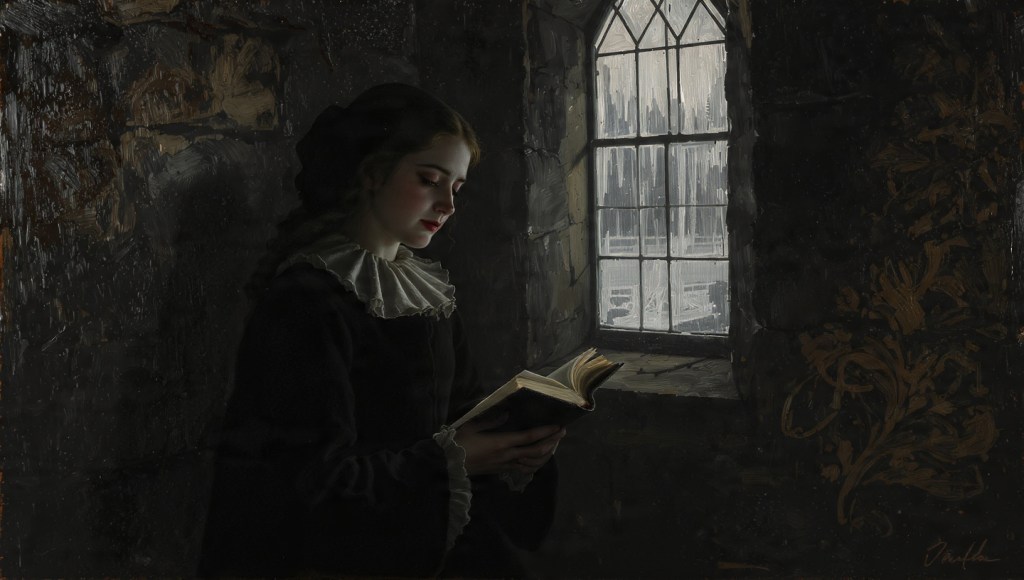
Inside the Gentleman Gaoler’s lodgings, Lady Jane Grey sat at a small oak table, her fingers tracing the velvet binding of her prayer book. She was sixteen, possessed of a scholar’s mind and a bird’s fragile bones, and in less than an hour, she would be dead.
The room was quiet, save for the crackle of a fire that gave off more smoke than heat. Across the chamber stood John Feckenham, the Benedictine abbot. He was a man of the old faith, wearing the sombre robes of his order, his face lined with a genuine, heavy sorrow. He had spent days trying to turn her soul to Rome, and she, with the fierce, terrified articulate energy of the condemned, had parried every theological thrust. They had found a strange kinship in the debate – a mutual respect amidst the wreckage of treason. He did not treat her as a monster, nor she him as a devil, though their creeds called each other such.
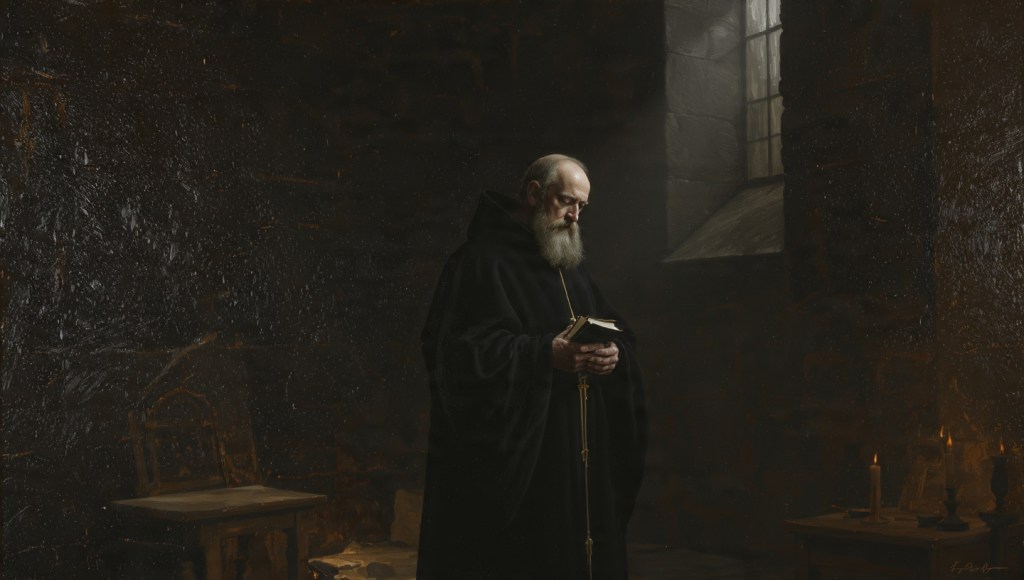
“You have not eaten, Madam,” Feckenham said softly. His voice was low, a rumble that seemed too large for the small, stifling room. “The body requires sustenance, even for… a short journey.”
Jane looked up. Her eyes were red-rimmed, the skin beneath them bruised with sleeplessness. She wore a gown of black cloth, simple and unadorned, having shed the velvet and jewels of her nine-day reign weeks ago.
“I have no stomach for bread, Master Feckenham,” she replied, her voice steady but thin. “It would only turn to ash in my mouth. My soul is fed. That must suffice.”
She turned her gaze to the window. The glass was thick and distorted, warping the world outside into grey smudges. She knew she should not look. The Partridges – the gaoler and his wife – had warned her. Do not look at the Green. Do not look at the Yard. But the compulsion was a physical thing, a hook in her chest pulling her toward the light.
A low rumble rose from the cobblestones below, a sound that vibrated through the floorboards. It was the heavy, rhythmic clatter of iron-shod wheels on uneven stone.
Jane stiffened. Her hand flew to her throat.
“Madam,” Feckenham said, stepping forward, his hand raised as if to block her view. “Do not. It is a cruelty you need not witness.”
But she was already there, pressing her forehead against the cold glass.
Below, the mist had parted just enough to reveal the yard. A cart was trundling past, pulled by a sway-backed nag with its head low. In the bed of the cart lay a heap covered in rough canvas – a long, still shape that looked too small to be a man. From the back of the cart, a slow, steady drip marked the stones with dark, wet stars.
It was Guildford.
The air left Jane’s lungs in a rush, a sound that was half-sob, half-retch. She saw a boot protruding from beneath the canvas – a fine leather boot, fashionable, the sort a young man might wear to a masque or a hunt. She remembered him putting them on. She remembered his vanity, his petulance, his fear. He had wept when they arrested him. He was eighteen.
“Oh, God,” she whispered, the prayer shattering into a whimper. “Oh, merciful Christ.”
She turned away from the window, her legs giving out, and sank onto the window seat. The world spun. The smell of the room – woodsmoke, damp wool, the faint metallic tang of fear – overwhelmed her.
Feckenham was beside her in an instant, not touching her, for that was forbidden, but close enough to offer a presence. He knelt, his robes pooling on the floor.
“He is with God now,” Feckenham said, though he knew the theology was a tangled knot between them. “His trial is ended. Yours… yours is but a shadow now, Jane. Do not let the horror of the clay distract you from the light of the spirit.”
Jane looked at him, her eyes wide and dark. The image of the boot, the dripping blood, the rough canvas – it had stripped away the intellectual armour she had worn for days. She was not the disputant who had quoted Greek at him yesterday. She was a girl whose husband had just been carted past her window like butcher’s scraps.
“He was a boy,” she said, her voice trembling, rising in pitch. “We were both just… pieces on a board. Moved by hands larger than our own. My father… his father… they played a game of crowns and we are the ones paying the wager.”
She gripped the prayer book until her knuckles were white. “Is this justice, Master Feckenham? Does your God, does my God, look down on that cart and call it justice? To crush the tool because the workman was clumsy?”
Feckenham sighed, a ragged, weary sound. He sat back on his heels, the theological rigidity leaving him. He looked tired. He looked like a man who had seen too much death in the service of too many monarchs.
“The law is a blunt instrument, Lady Jane,” he said quietly. “It sees only the Crown and the Usurper. It does not possess eyes to see the strings that pulled you. It has no heart to weigh the difference between a wolf and the lamb the wolf holds in its jaws.”
He looked at the window, then back to her. “The law of men is often a poor reflection of the law of Heaven. We build our statutes out of fear and ambition, and then we call it Justice when the axe falls.”
Jane wiped her face with her sleeve, a gesture of childish vulnerability that made Feckenham’s heart ache. She took a breath, shaky but deep, pulling herself back together. She was a Tudor. She had the blood of kings in her. She would not go to the block weeping like a scullery maid.
“If I could rewrite the statute of Treason this very moment,” Feckenham murmured, almost to himself, “I would carve an exemption for innocence misused. I would write that no child shall answer for the sins of the father.”
He looked at her then, his eyes engaging hers with a sudden, intense curiosity. It was the look of a scholar engaging an equal, not a priest comforting the damned.
“Tell me, Madam,” he asked, the question hanging heavy in the damp air. “If you, who once held the power of the Sceptre for nine fleeting days – if you could take the quill from the Clerk of the Crown this morning… if you could scratch out one line of the realm’s statutes to save this world from such grief… what would it be?”
Jane looked at him. The question was absurd. The Sheriff was coming. The straw was being laid out on the Green. And yet, her mind, trained in logic and debate, latched onto it. It was a lifeline, a final intellectual puzzle to solve before the darkness.
“To save myself?” Jane asked, a sad, wry smile touching her lips. “You think I would strike down the law of Treason? You think I would erase the Act of Succession that named me a traitor?”
“Most would,” Feckenham replied. “Life is sweet, even in a dungeon.”
“No,” Jane said, her voice finding the steel that had surprised the Privy Council when she had first refused the crown. She stood up, smoothing the front of her black gown. “Treason is a necessity of kings. Without it, there is chaos. If I cannot be Queen, I must be a subject, and subjects must obey. I do not dispute the law that kills me, John.”
She walked to the table and picked up a quill, her hand hovering over the flyleaf of her prayer book.
“Then what?” Feckenham asked. “What law is so broken that you would spend your last wish mending it?”
Jane looked at the nib of the pen, stained with dry ink. She thought of her father, Henry Grey, whose ambition had built the scaffold waiting on the Green. She thought of the whips and the pinches, the terrified obedience, the way she had been traded like cattle to the Dudleys.
“I would change the ancient, unwritten law of Patria Potestas,” she said, her voice dropping to a whisper that cut through the room. “The power of the father.”
Part II: The Statute of the Father
The Latin phrase hung in the air, heavy and archaic, seeming to suck the remaining warmth from the hearth. Patria Potestas.
Feckenham blinked, his brows knitting together. He had expected her to speak of the Act of Succession, or perhaps the heresy laws that branded her faith a crime. But this – this was a domestic grievance raised to the level of high statute.
” The law of the father?” he repeated, moving closer to the table where she stood. “You speak of Roman law, Madam. The absolute power of a patriarch over his household. But in England, the King is the father of the country. To defy the parent is to defy God. It is the Fourth Commandment written into the bone of our society.”
“And it is a law written in blood,” Jane replied, her voice gaining a sharp, brittle edge. She turned the quill in her fingers, the feather trembling slightly. “You ask me what I would change, John? I would tear down the edict that makes a daughter a chattel, a piece of coin to be spent in the marketplace of dynastic gambling.”
She looked up at him, her grey eyes burning with a sudden, fierce recollection. “Do you know Bradgate? My father’s house?”
“I know of it,” Feckenham nodded.
“It is a beautiful cage,” she said. “I remember a day when the hunt was up. The horns were blowing, the hounds baying. The whole court was galloping through the park, flushed with the joy of the kill. And I sat inside, reading Plato with Master Ascham.”
She paused, looking past Feckenham, past the stone walls, into a memory that seemed more vivid than the dungeon.
“Master Ascham asked me why I did not join them. And I told him the truth. I told him that when I am in the presence of my father or mother, whether I speak or keep silence, sit, stand, or go, eat, drink, be merry or sad, I must do it as perfectly as God made the world, or else I am so sharply taunted, so cruelly threatened…” She swallowed hard, her hand drifting unconsciously to her upper arm, remembering old bruises. “Yea, presently sometimes with pinches, nips, and bobs, and other ways which I will not name for the honour I bear them… that I think myself in hell.”
Feckenham remained silent, the pity in his eyes deepening. He knew the reputation of the Duke of Suffolk and the Duchess Frances. They were ambitious, hard people. But such discipline was common; it was the way one broke a colt to the saddle.
“That is a hard sorrow, Madam,” he said gently. “But it is the way of the world. Parents are the stewards of their children’s souls.”
“Stewards?” Jane laughed, a harsh, mirthless sound that cracked in the damp air. “No, John. Not stewards. Owners. That is the law I would strike out. The law that says a father may whip his daughter into a marriage bed she loathes, simply to add a quartering to his coat of arms.”
She began to pace the small room, the black skirts of her gown swishing over the rush matting.
“They beat me into marrying Guildford,” she whispered. “I said no. I told them I could not love him. I told them his father, the Duke of Northumberland, terrified me. And for my honesty, I was given blows. I was told that my body was not my own, that my conscience was a piece of embroidery to be unpicked and restitched to suit their design.”
She stopped and faced him, her small stature suddenly commanding. “You ask why I am here, awaiting the axe? It is not because I coveted the crown. I never wanted it! When they brought it to me at Syon House, I wept. I fell to the ground. I told them it was Mary’s right.”
“And yet,” Feckenham pointed out softly, “you took it.”
“I took it because the law of the father commanded it!” Jane cried, striking the table with her small fist. “Because I had been trained from the cradle that to disobey was a sin against God. My father, my mother, my father-in-law – they all stood over me, a trinity of ambition, and told me that my reluctance was treason. They used the Fourth Commandment as a bludgeon.”
She leaned forward, her face pale and intense. “That is the law I would change. I would draft a statute that grants a child – even a girl – the sovereignty of her own soul. The right to say ‘No’ to the ambition of her kin without it being called rebellion. If such a law existed, John, I would be at Bradgate now, reading my Greek, and Mary would be on her throne, and Guildford…” Her voice broke. “And Guildford would be alive.”
Feckenham looked at her, stunned by the clarity of her grief. He had seen her as a heretic, a dangerous intellectual, a usurper. But now he saw the terrifying truth: she was a victim of the very order he sought to uphold. The hierarchy of obedience – Child to Father, Wife to Husband, Subject to Sovereign, Church to God – was the architecture of their world. But here, in this damp room, he saw how the weight of that architecture could crush a single, fragile life.
“You speak of a world turned upside down,” Feckenham murmured, crossing himself instinctively. “A world where children rule their parents? Where the branch tells the root where to grow? That is anarchy, Madam.”
“Is it?” Jane asked, her voice dropping to a weary whisper. “Is it anarchy to believe that God places a spark of reason in every breast, regardless of age or station? Or is it simply… mercy?”
She slumped back into the chair, the fire of her argument dying down, leaving only ashes. She looked incredibly young then, the scholar vanishing, leaving only the frightened girl who missed the sunlight.
“But we do not make the laws, John,” she said, resigned. “We only suffer them. The statutes are written in iron, and we are but flesh.”
Feckenham moved to the table. He reached out and, for a moment, his hand hovered over hers, a breach of protocol that felt necessary. He withdrew it before he made contact, folding his hands into his sleeves.
“Perhaps,” he said, his voice thick with emotion, “perhaps in the eyes of God, the law of the heart outweighs the law of the father. You have defended your soul well, Lady Jane. Even if I fear for its destination, I cannot fault its courage.”
Jane picked up the prayer book again. She opened it to the back, where she had begun to write a message to her sister, Katherine.
“I leave this to Kate,” she said softly. “I shall write to her: ‘Live still to die, that you by death may purchase eternal life.’ But I should also write: ‘Trust not the hands that claim to guide you, for they may lead you to the block.’”
A heavy sound echoed from the stairwell – the tramping of boots, the clatter of a pike against stone. The heavy oak door groaned on its hinges.
Jane froze. The ink on her quill dried. The theoretical debate was over; the reality had arrived.
The Sheriff of London stood in the doorway, his chain of office gleaming dully in the gloom. He looked uncomfortable, shifting his weight. Behind him stood the Yeomen of the Guard, their faces impassive masks of duty.
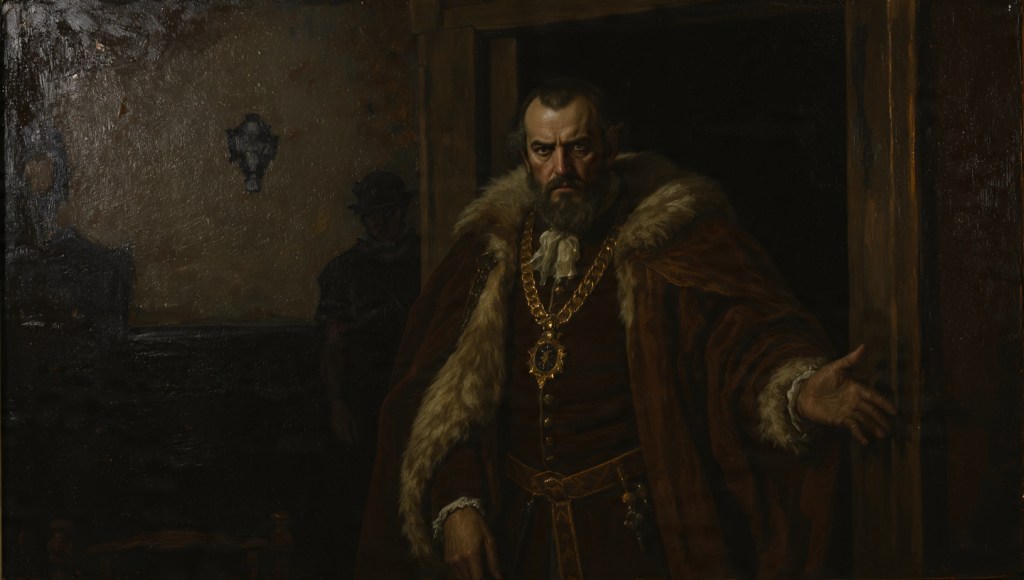
“My Lady,” the Sheriff said, his voice rough. “The hour is come.”
Jane closed the book. She did not tremble. She placed the quill down with precise, deliberate care, aligning it with the edge of the table. The conversation about changing laws vanished, replaced by the immediate, terrifying necessity of facing the one law that could not be repealed: the sentence of death.
She stood up and looked at Feckenham. The fear was there, washing over her in a cold tide, but she pushed it down, anchoring herself in the dignity of her bloodline. She was a Tudor. She would not give them the satisfaction of a spectacle.
“I am ready,” she lied.
She held out the velvet-bound book to Feckenham. “Take this, sir. For your kindness. Read it, and remember me. Not as a Queen, nor a traitor.”
She looked at the door, then back at him, a faint, sad smile gracing her lips.
“Remember me as the girl who wished to rewrite the world, but found she had only enough ink to write her own end.”
Part III: The Blindfold and the Void
The walk to the Green was shorter than she had imagined. She had always pictured a long procession, a via dolorosa through crowds of weeping subjects. But the Tower was a closed world, its geography intimate and brutal. The air bit at her face, sharp with the scent of river mud and the faint, acrid tang of sawdust.
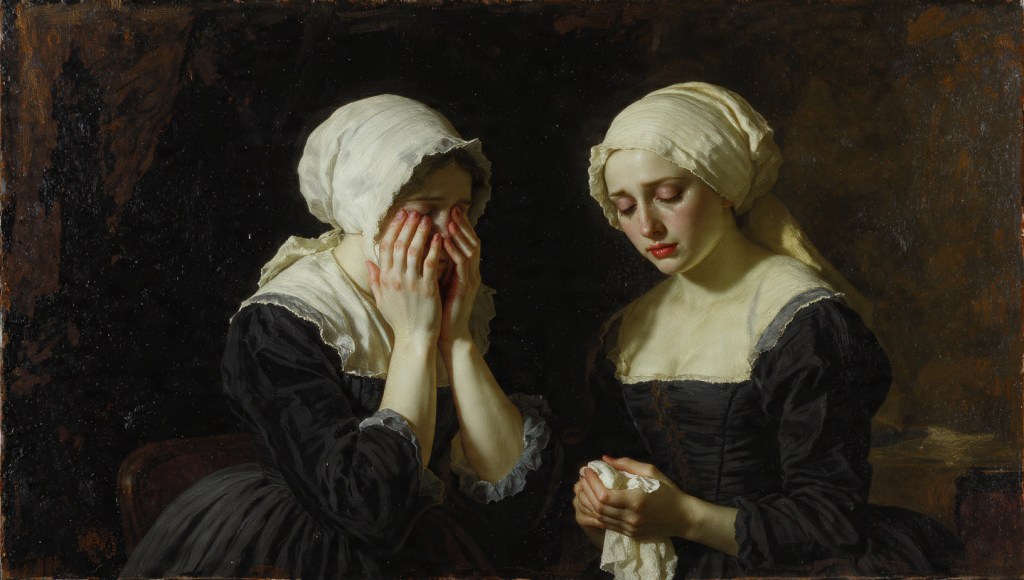
Jane walked with her head high, clutching a new prayer book – not the one she had given Feckenham, but a smaller psalter she had kept for the end. Her women, Mistress Ellen and Mistress Tylney, wept openly behind her, their sobs jagged sounds that tore at her composure. She wished they would stop. Their grief was a tether to the life she was trying to leave.
Ahead, the scaffold rose from the cobbles of the Green, draped in black serge. It looked less like a stage and more like an altar, waiting for a sacrifice. A small crowd had gathered – officials of the Tower, guards, a few citizens who had slipped in. They were silent, their breath pluming in the cold air like ghosts escaping their mouths.
Jane climbed the steps. The wood was solid beneath her feet, no creaking, no give. It was well-built. The thought was absurd, detached. It is a sturdy thing, death.
On the platform, the executioner knelt. He was a large man, his face hidden, asking her forgiveness. It was the custom.
“I forgive you most willingly,” she said, her voice carrying in the stillness. It felt thin, stripped of the resonance she had found in the debate with Feckenham. “I pray you dispatch me quickly.”
She turned to the people. She had prepared a speech, written it in her mind a hundred times. She spoke of her fault in accepting the crown, but washed her hands of procuring it. “I die a true Christian woman,” she said, her voice gaining strength, “and I look to be saved by no other mean, but only by the mercy of God, in the blood of his only son Jesus Christ.”
She felt Feckenham beside her, a dark pillar of support. He was praying in Latin. She recited the Miserere in English, their voices weaving together, two strands of faith meeting at the knot of the end.
Then came the disrobing. Her women fumbled with her gown, their hands shaking so violently they could barely undo the clasps. Jane helped them, her fingers steady, stripping away the outer layers until she stood in her petticoat. She took the handkerchief from Mistress Tylney to bind her eyes.
The world went white, then grey. The blindfold was tight, pressing against her eyelids. Suddenly, the geography of the scaffold, so clear a moment ago, vanished.
Panic, cold and absolute, seized her.
She knelt in the straw. The smell of it was overwhelming now – earthy, sweet, terrifying. She reached out for the block. It should have been right in front of her. Her hands met only empty air.
“Where is it?” she whispered.
She shuffled forward on her knees, her hands sweeping the rough wood like a blind beggar. Nothing. Just the vast, terrifying emptiness.
“What shall I do?” Her voice rose, cracking into a cry of pure, childlike terror. “Where is it?”
The silence stretched, agonising. No one moved. The executioner, the Sheriff, the guards – they stood frozen by the pathos of it. The Queen of nine days, the scholar who read Plato, reduced to a girl groping in the dark for the instrument of her own death.
Then, a hand.
It was warm, firm, smelling faintly of incense and old parchment. It took her own trembling hand and guided it forward. She felt the rough, cold wood of the block.
Feckenham. It had to be him.
“Here, Madam,” a voice whispered, too low for the crowd to hear. “It is here. Rest now.”
Jane laid her head down. The wood was hard against her cheek. She felt the curve of it against her neck, a cradle for the end.
Lord, into thy hands I commend my spirit.
The world was dark. The straw scratched her skin. She waited. The silence was a roaring in her ears. She thought of her father, of the library at Bradgate, of the law she could not change. Patria Potestas. The power of the father. The power of the King. The power of the axe.
Lord, into thy hands…
A shadow fell over her, sensed rather than seen. A shifting of weight. A sharp intake of breath.
Thwack.
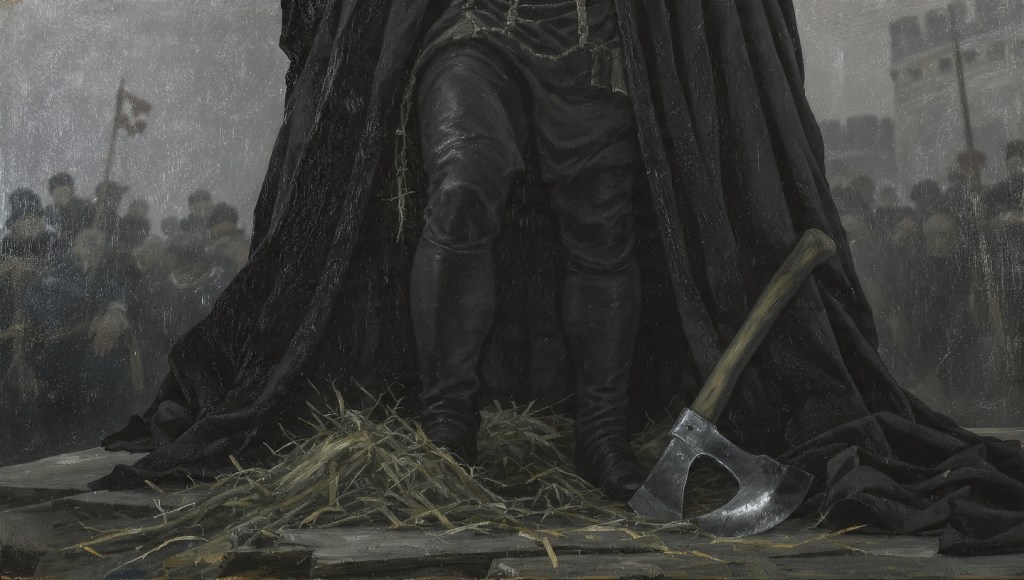
The sound was wet and heavy, a butcher’s sound that had no place in the world of men.
John Feckenham flinched. He did not look away, for that would be a cowardice she had not permitted herself. He saw the head fall, rolling onto the straw like a discarded doll. He saw the gout of blood, bright arterial red against the black serge, steaming in the cold air.
The crowd let out a collective breath, a shudder that rippled through the Green.
Feckenham stood motionless. He looked at the body, so small now, a bundle of clothes on the planks. He looked at the hand that still twitched, the fingers curled as if holding a quill.
He remembered her words in the lodging. The law of the father.
The Sheriff was shouting orders. The executioner was lifting the head, crying out, “So perish all the Queen’s enemies!”
Feckenham felt a profound, aching weariness settle into his bones. He looked up at the White Tower, its stones indifferent to the scene below. He thought of the statutes written in the Great Rolls of Westminster – the Acts of Treason, the Acts of Succession, the endless, grinding machinery of the state. They were ink on parchment, dry and brittle.
But the law she had spoken of – the law of blood and obedience, the law that allowed a parent to break a child on the wheel of ambition – that law was written in something far more durable. It was written in the very marrow of their world.
He walked to the edge of the scaffold. The mist was rolling back in from the river, grey and inexorable. It would cover the blood. It would cover the straw. By tomorrow, the Green would be clean.
But as he descended the steps, leaving the body of the girl who had been his friend, John Feckenham knew that the mist would never quite cover the memory of her question.
If you could change one law…
He touched the velvet book she had given him, tucked safely in his sleeve. It felt heavy, like a stone.
“I would change the law that makes sheep of lions,” he whispered to the damp air, his voice lost in the murmuring of the crowd. “And the law that gives the axe to the innocent.”
He walked away across the cobbles, a solitary figure in black, leaving the Sovereign of Straw to the mercy of the history books, and her soul, finally, to a jurisdiction where the only father was God.
Lady Jane Grey and her husband, Guildford Dudley, were executed for high treason on 12th February 1554. Aged sixteen, Jane had reigned as the de facto Queen of England for just nine days in July 1553 following a failed Protestant coup orchestrated by the Duke of Northumberland. While Queen Mary I initially spared her cousin, the outbreak of Wyatt’s Rebellion – joined by Jane’s father – sealed her fate as a political liability. Her death preceded the execution of approximately 280 religious dissenters during Mary’s five-year rule. Jane remains the only English monarch to be deposed and executed by the state, symbolising the lethal consequences of unfettered dynastic ambition.
Bob Lynn | © 2026 Vox Meditantis. All rights reserved.

 Vox Meditantis
Leave a comment