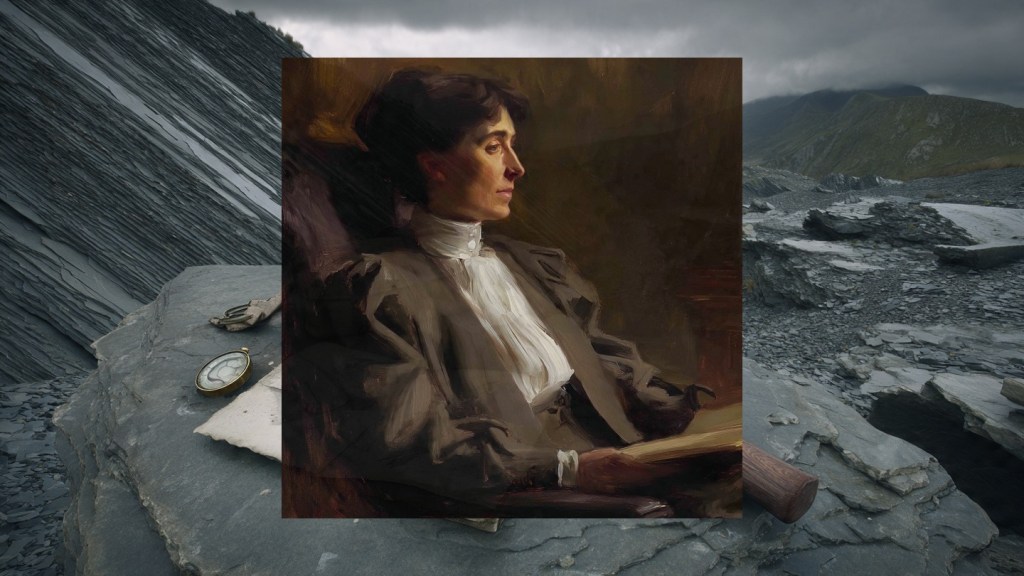
This interview is a dramatised reconstruction based on Margaret Crosfield’s archived field notebooks, published papers, and documented historical record; her conversational voice and private reflections represent plausible interpretations grounded in historical evidence, not verified fact. We offer this creative framework to amplify her documented achievements and struggles for contemporary audiences, prioritising fidelity to the historical record over ornamental speculation.
Margaret Chorley Crosfield (1859-1952) spent decades crawling across Welsh hillsides with a geological hammer, a hand lens, and a determination to solve one of Victorian geology’s most vexing puzzles – how to accurately date ancient rock formations using the fossilised remains of creatures that looked like tiny saw blades. She became one of the first women elected Fellow of the Geological Society of London in 1919, though she’d been doing the work for thirty years without the title. Her field notebooks, meticulously kept and still consulted today, were often written on the back of women’s suffrage pamphlets – because why waste good paper when you’re fighting two battles at once?
Miss Crosfield, thank you for joining us. I’m sitting here in 2026 looking at digital scans of your field notebooks from the British Geological Survey archives – they’re remarkable documents. But I want to start at the beginning. You grew up at The Dingle in Reigate. What was it like being a child in that house?
Oh, The Dingle was a paradise for a curious child. My father was a tea merchant, you understand, but he’d a passion for natural philosophy that he encouraged in all his children. We’d enormous grounds, and I spent hours turning over stones, collecting beetles, pressing flowers. My brothers and I were thick as thieves in the Holmesdale Natural History Club – I became secretary in 1907, you know. People assume a girl from a prosperous family would be kept indoors learning needlework, but Father believed education was a duty, not an ornament. When he died in 1879, he left us each £8,200 in trust. That money bought me something rather more valuable than a husband – it bought me time.
Time to pursue geology without needing employment. But you’d already started at Cambridge by then – Newnham College in 1878, when you were just nineteen.
Indeed. The Mount School in York had prepared me well – they were one of the first schools sending girls to university, you know. But Cambridge was… complicated. I fell ill and had to take leave, and when I returned a decade later, I requested permission to study geology exclusively. Not the usual path for a lady, they said. I replied that if the usual path led nowhere useful, perhaps we needed a new path. Professor Hughes, Professor Marr – they saw the work needed doing and didn’t much care whether it was a man or woman holding the geological hammer.
Let’s talk about that work. For modern readers who might not know: what exactly is a graptolite, and why did you spend years searching for them?
Ah, my little saw-toothed friends! Graptolites were colonial creatures, rather like corals in form but not in taxonomy – they lived attached to floating seaweed or the sea floor during the Ordovician and Silurian periods, perhaps 450 million years ago. When they died, they left behind carbonised impressions in the rock that look like tiny hacksaw blades, sometimes just a centimetre or two long. Now, here’s why they matter: they evolved rapidly and spread widely. That means different species existed for relatively brief periods – perhaps less than a million years – but across vast distances. If you find Monograptus priodon in a rock layer, you know that layer dates to the upper Llandovery epoch. They’re nature’s timestamps, you see. Index fossils.
And the “Silurian problem” you were recruited to solve?
Charles Lapworth had proposed subdividing what Murchison called the Silurian and what Sedgwick called the Cambrian – they’d been quarrelling about it for decades, rather publicly. Lapworth suggested the Ordovician as a separate period between them. Sensible enough in theory, but someone had to go out and prove it – to establish the actual stratigraphic sequences using fossil evidence. That’s where we came in. Professor Lapworth at Birmingham, Professors Marr, Hughes, and McKenny at Cambridge – they assembled a small group of women researchers. Ethel Skeat and I took on the Denbighshire grits and flags in the Clwydian Range.
Walk me through that fieldwork – the technical process. How did you actually establish a stratigraphic sequence?
Right. First, you need a proper geological survey of the area – mapping the rock exposures, noting strike and dip, identifying faults and folds. We covered seventy-two square miles between 1906 and 1911, with another campaign in 1911. You’re looking for continuous sections where you can observe the vertical sequence of beds without interruption. Once you’ve mapped the structure – synclines, anticlines, where the rocks have been folded – you begin collecting fossils in situ. This is absolutely critical: you must record the exact stratigraphic position of each specimen. I’d mark the location in my notebook, sketch the exposure, note the lithology – is it a mudstone, a sandstone, a limestone? – and then carefully extract the graptolite-bearing sample.
What tools did you use?
A geological hammer, naturally. Chisels of various sizes. A hand lens – a good 10x magnification was essential for field identification. I’d wrap specimens in newspaper with their location number written in India ink. Back at The Dingle, I’d split the shales carefully along bedding planes to expose the graptolites fully. They’re often pyritised or preserved as carbon films, so the technique matters. Too rough and you destroy the rhabdosome structure – the arrangement of the thecae, those little cups where the individual zooids lived. That structural detail determines the species.
And from species identification, you could determine relative age?
Precisely. Once you’ve identified the graptolite fauna at multiple horizons throughout your section, you can correlate with established graptolite zones. Lapworth had done pioneering work on this – the Ordovician has about thirty graptolite zones, each representing perhaps 50,000 to several hundred thousand years. So if I found Diplograptus multidens in a particular bed, I knew it was Lower Caradoc. If the bed above contained Dicranograptus clingani, I could establish the relative sequence and correlation with other sections across Wales and England.
What were the main challenges? What could go wrong?
What couldn’t go wrong? The Welsh weather, for one – you’d be scrambling up some exposure in the rain, trying to keep your notebook dry whilst wielding a hammer. Specimens can be fragmentary or poorly preserved, making species identification uncertain. Faulting disrupts sequences, so you might think you’re looking at a continuous section when actually you’ve got a repeated or missing interval. And graptolites can be reworked – eroded from older strata and redeposited in younger rocks – which gives you entirely spurious age determinations if you’re not careful.
How did you distinguish reworked specimens from in situ ones?
Good question. Reworked specimens are often abraded, fragmentary, or associated with a fossil assemblage that doesn’t make bio-stratigraphic sense – you’d find Ordovician species mixed with Silurian ones, for instance. The sedimentological context matters too. If you’re in a conglomerate or a bed showing clear evidence of sediment transport, you’re immediately suspicious. Conversely, if you find complete, well-preserved specimens in a fine-grained mudstone with a consistent assemblage, you can be confident they lived and died there.
Your 1896 paper on Carmarthen – the one that became the basis for the British Geological Survey maps – what did you discover there?
That was with Ethel Skeat, though sometimes Mary Johnston is credited as well. We surveyed a four-mile radius around Carmarthen town, tracing the continuation of a complex anticline that Thomas Roberts had discovered to the west. What we found was a beautiful syncline – imagine a downward fold in the rock layers – with previously unrecognised stratigraphic features. The distribution of the beds made sense once you understood the folding, but until we’d mapped it properly, the geology looked incomprehensible. I also collected a new species of trilobite there, though I confess the formal description was done by others more expert in trilobite taxonomy than myself.
Let’s talk about collaboration. You worked extensively with Ethel Skeat, but also Gertrude Elles, Ethel Wood, Mary Johnston…
Yes, we were rather a band of sisters, weren’t we? It was necessity as much as preference. None of us could attend Geological Society meetings before 1919 – we could submit papers, but a man had to read them aloud for us, as if we were children or simpletons. So we relied on each other for intellectual companionship and practical support. Ethel Skeat was particularly close – we worked together for years on the Clwydian Range project. She had a gift for structural geology, seeing how the folds and faults fit together. I tended toward the palaeontological detail, the graptolite identifications. Gertrude Elles became the real expert in graptolite taxonomy – her work with Ethel Wood produced the definitive monograph on British graptolites. I’d send specimens to Gertrude for verification when I encountered something unusual.
Did you ever feel the collaborative approach diluted your individual recognition?
I’d be dishonest if I said I never wondered. When Ethel and I published jointly, whose contribution was whose? History prefers singular heroes, doesn’t it? Newton. Lyell. Darwin – though even Darwin relied enormously on others’ observations. The truth is that good science is always collaborative, but when men collaborate, they often maintain distinct individual profiles. When women collaborate, we’re seen as… a collective. Interchangeable, perhaps. Still, I don’t regret it. We accomplished work none of us could have done alone, and we had companionship in what was often a rather lonely endeavour.
Speaking of lonely – you mention not being allowed to present your own work. What was it like to do research you couldn’t defend in person?
Maddening. Absolutely maddening. You’d submit a paper, and some gentleman would stand up and read it as if the words were his. Then the discussion would begin, questions about methodology or interpretation, and you’d be sitting there – if you were even present – unable to respond. Unable to clarify a point or defend your conclusions. The Geological Society’s reasoning was that women lacked the intellectual rigour for geology. The irony being, of course, that we were doing the geology – mapping the sections, collecting the fossils, identifying the species, drafting the papers – whilst they stood at the podium taking questions.
That changed in 1919, when the Sex Disqualification (Removal) Act passed and the Society admitted women Fellows.
Yes, though let’s be clear: they didn’t choose to admit us. They were compelled by law. I was sixty years old by then. I’d been doing professional-level geological research since my thirties. Thirty years of work before I could call myself a Fellow. And even then, my primary claim to historical memory seems to be that I was “first” – alphabetically! Crosfield comes before Elles, before Raisin, before the others admitted that day. It’s rather absurd when you think about it.
Yet you continued the work. The 1925 paper on the Clwydian Range came out when you were sixty-six.
The rocks don’t care how old you are or whether you’ve got letters after your name. The work needed doing, and Ethel and I had accumulated twenty years of field observations by then. That paper focused more on structural geology – the cross-sections, the erosion patterns, the regional tectonics. We were older, perhaps wiser about what questions mattered most. I confess the fieldwork was harder on aging knees, but the intellectual satisfaction remained.
You kept field notebooks throughout your career – meticulously organised, with specimen locations, stratigraphic details, even sketches. They’re preserved at Keyworth now. Did you always work that way?
From the very beginning. Professor Hughes drilled into us that observations not recorded are observations lost. I developed a system: each locality got a number, each specimen a sub-number, keyed to a sketch map showing the exposure. I’d note the date, weather conditions – rain can affect how fresh a rock surface appears – lithology, fossil content, structural measurements. When I returned to The Dingle, I’d transfer the information to a master catalogue, cross-referencing with the specimens themselves, which I’d organise by locality and stratigraphic position.
You wrote some of those notes on suffragette paper.
I wondered if anyone noticed! Yes, I was Honorary Secretary of the Reigate and Redhill Women’s Suffrage Society, and we’d often have surplus pamphlets or notepaper. Waste not, want not. My brothers were supportive – they donated to the cause, which helped considerably. I saw no contradiction between fighting for women’s political rights and doing geological research. If anything, they reinforced each other. Every geological survey I completed was an argument that women could do rigorous intellectual work. Every suffrage meeting I organised was an assertion that women deserved a voice in the decisions governing our lives.
Did you face direct hostility in the field?
Occasionally. More often it was condescension or dismissal. Farmers would assume Ethel and I were lost, offer to escort us back to the road. When we explained we were mapping the geology, they’d look baffled – why would ladies care about rocks? We learned to wear practical clothing, carry our own equipment, and be unfailingly polite but firm. I remember one quarry owner who refused us access because “geology is no occupation for the gentler sex.” I wrote to the owner’s superior, explained that we were conducting research under the auspices of Cambridge University, and mentioned – casually – that my family’s business interests might make his acquaintance useful. We got access. Not proud of using class privilege that way, but I wasn’t above it.
Let’s talk about that privilege. Your inheritance gave you independence, but most women didn’t have that option.
No, they didn’t. And I’ve thought about this considerably over the years. I was able to be a “lady geologist” precisely because I was a lady – financially secure, respectable family, no need for paid employment. Working-class women with my aptitude for geology would have had no such opportunity. Even middle-class women who needed to earn a living would struggle, because there were virtually no paid positions for women in geology. I was, in that sense, an anomaly. A product of intersecting privileges that made my scientific work possible whilst simultaneously limiting its recognition – I wasn’t a “serious” scientist because I wasn’t affiliated with an institution, yet I couldn’t be affiliated with an institution because I was a woman.
Did you ever wish you’d been born male?
No. Not precisely. I wished for the opportunities afforded to men, certainly. To attend lectures at the Geological Society, to hold a university position, to have my work judged on its merits rather than filtered through assumptions about feminine capability. But I didn’t wish to be a man. I quite liked being a woman doing geology, actually. It felt like inhabiting a contradiction – proving by simple existence that women could do this work competently.
You never married. Was that a deliberate choice?
Yes. I watched what happened to women colleagues who married – they vanished from scientific life. Marriage meant household management, children, social obligations that consumed all available time and energy. A husband, however enlightened, would expect dinner on the table and a well-run home. I couldn’t imagine conducting a field season in Wales whilst managing a household in Surrey. So I chose geology. I don’t regret it, though I’d be lying if I said I never felt lonely.
You lived your entire life in Reigate. Did you ever want to leave?
The Dingle was my anchor. I’d travel for fieldwork – weeks at a time in Wales, occasional excursions elsewhere – but I always came home. My specimens were there, my notebooks, my laboratory space. My brothers were there, my friends, the Holmesdale Natural History Club. I served on the Reigate Education Committee for years, lectured to local societies on geology and social issues. I was rooted there, in the best and perhaps limiting sense. Part of me wonders what I might have accomplished with an institutional position in London or Cambridge – access to better collections, more collaborative opportunities. But I’d have lost something too.
Let’s talk about mistakes. Looking back, what would you do differently?
I published too little. Three papers over a career spanning forty-some years – it’s not enough. I have notebooks full of observations, specimens that should have been formally described, regional correlations that remain unpublished. I told myself I was being careful, waiting until I had conclusive evidence before committing to print. But perfectionism is a luxury, and I indulged it. Men would publish preliminary notes, staking claims and generating discussion even if later work revised their conclusions. I waited for certainty that never quite arrived. As a result, much of my work – particularly on the Silurian-Ordovician stratigraphy that Lapworth’s group was assembled to investigate – is lost to history.
That research on Northeast Wales – it’s described as “lost over time.” What happened?
Some specimens are preserved, some notebooks survive, but the synthetic analysis – the big-picture interpretation – was never completed or published comprehensively. We were working toward it, but the Great War interrupted everything. Priorities shifted. Some of us aged out of active fieldwork. And there’s a cruel irony here: we were recruited to preserve knowledge, to establish sequences that would form the foundation for future geology. Instead, our own work became fragmentary, incompletely documented, eventually forgotten. It’s a failure I regret deeply.
What about technical mistakes? Did you misidentify species or misinterpret structures?
Oh, certainly. Early on, I mistook a specimen of Monograptus sedgwickii for M. turriculatus – similar morphology, but different stratigraphic ranges. That error propagated through some preliminary correlations before Gertrude Elles corrected me. I was grateful for the correction but embarrassed by the sloppiness. And structural geology is full of opportunities for misinterpretation. You see an apparent fold and diagram it as a syncline, then later work reveals it’s faulted or the bedding is overturned. You have to remain humble before the rocks – they’re always more complicated than your first interpretation suggests.
Were there competing theories to your approach? Did anyone challenge the graptolite biostratigraphy method?
Some preferred trilobites or brachiopods as index fossils – they’re larger, more robust, easier to identify in the field. There’s merit to that argument. Graptolites require careful extraction and close examination, and they’re not preserved in all lithologies. You need fine-grained sediments, low-energy depositional environments. In coarse sandstones or limestones, you won’t find them. So the method has limitations. There was also debate about correlation precision – could you really equate rocks across hundreds of miles based on graptolite species? What about facies variation, ecological preferences? These were legitimate critiques. Our counter-argument was that graptolites’ rapid evolution and wide distribution made them superior for chronostratigraphic correlation despite the practical challenges.
I want to ask about something you mentioned earlier – being valued for “accuracy and industry” rather than brilliance or innovation. Your obituary used that language.
Ah yes. “Wonderful accuracy and industry.” It’s the language used for conscientious clerks, isn’t it? Not for scientific innovators. Men are “brilliant” or “visionary” or “pioneering.” Women are “accurate” and “industrious” – we’re careful, reliable, but not creative. It’s a subtle diminishment, positioning women’s scientific work as craft rather than intellectual achievement. And yet, without accuracy and industry, there is no good science. Someone has to do the meticulous work, the careful documentation, the unglamorous data collection. Perhaps that labour deserves more credit than “brilliance” that builds on shaky foundations.
Looking at geology today – modern dating methods like radiometric analysis, plate tectonics completely reframing structural interpretation – how do you feel about how the field evolved?
Astonished and envious in equal measure! You can now determine the absolute age of a rock to within a few million years by measuring isotope ratios – no need for index fossils at all, though they remain useful for relative dating. And plate tectonics explains why we see the folding and faulting patterns we mapped so painstakingly – Wales was near a convergent plate boundary during the Ordovician, hence all the deformation. We were describing the what without understanding the why. It’s rather like being able to catalogue symptoms without knowing the underlying disease. Still, the foundational work remains valid. Modern geologists still consult stratigraphic sections we measured, specimens we collected. The interpretive framework changed, but the observations endure.
Your specimens and notebooks are digitised now, accessible to researchers worldwide. Does that provide some satisfaction?
It does, actually. The thought that a geologist in Australia or Japan might examine specimens I collected on a wet hillside in Denbighshire in 1907 – that my observations contribute to their understanding even now – yes, that’s satisfying. It’s a kind of immortality I suppose I didn’t expect. Though I do wish my name were more firmly attached to it all. Sometimes the specimens are catalogued generically – “Ordovician graptolites, North Wales” – with no indication that M. C. Crosfield collected them, recorded their precise stratigraphic position, sketched the exposure. The infrastructure becomes anonymous.
Let’s talk about advice. Young women in STEM today face different barriers than you did, but some patterns persist. What would you tell them?
Document everything. Keep meticulous records not just of your scientific work but of your contributions to collaborations. When someone dismisses your capabilities, prove them wrong with results, but don’t expect results alone to guarantee recognition – you may need to actively claim credit in ways that feel uncomfortable. Find your band of sisters, or brothers if you’re fortunate enough to have true allies. Don’t wait for institutional permission to do the work – if you see a question that needs answering, answer it. Publish, even if it’s imperfect. Don’t let perfectionism become self-sabotage. And remember that whatever progress you make, whatever barriers you break, serves not just yourself but the women who’ll come after.
You served on the Reigate Education Committee. What were you advocating for?
Science education for girls, primarily. Not just nature study – proper science, with laboratory work and field excursions. Mathematics beyond basic arithmetic. Access to technical education that might lead to employment in scientific or technical fields. The assumption was that girls needed only enough education to manage a household and converse politely at dinner parties. I argued that women had the same intellectual capacities as men and deserved equivalent educational opportunities. Revolutionary talk in Surrey in 1900, I assure you.
Did you see progress in your lifetime?
Some. The 1919 admission of women Fellows felt monumental, though it came ate for me personally. Women attending university became more common, though still far from universal. The suffrage victory in 1918 – though initially limited to women over thirty with property – was enormous. But institutional change is glacially slow. (smiles) Rather like geological processes, actually. Incremental accumulation of pressure until something suddenly shifts. Then the landscape is permanently altered, even if the change seems slow from a human perspective.
There’s been renewed interest in your work recently – the 2019 centenary of female Fellowship, academic papers examining early women geologists, your inclusion in historical recovery projects.
Is that so? Tell me about it.
Historians of science are documenting the contributions of women like you – over 210 female geologists and palaeontologists working between 1800 and 1929 have been identified, far more than previously acknowledged. Your story is cited as an example of how scientific infrastructure work – field notes, specimen collections, stratigraphic sequences – deserves recognition alongside theoretical breakthroughs. There’s discussion of what’s called the “Matilda Effect,” the erasure of women’s contributions.
Two hundred and ten. That’s… that’s extraordinary. I knew we weren’t as rare as people assumed, but I never imagined that many. And the Matilda Effect – I like that someone named it. You can’t address a problem that lacks a name. Though I confess part of me is frustrated it took so long. A century to acknowledge we existed? To recognise our work had value? How much knowledge was lost because we weren’t taken seriously in our own time?
That’s a question researchers are examining now. How much faster might geology have progressed if women’s contributions had been fully integrated rather than marginalised?
Unknowable, but I suspect significant. We brought different perspectives, asked different questions, noticed different things. Diversity isn’t just a moral good – it’s scientifically productive. Homogeneous groups develop blind spots, shared assumptions that go unchallenged. Women working in hostile environments, constantly having to prove ourselves, developed habits of rigour and documentation that sometimes surpassed our male colleagues. We couldn’t afford sloppiness – any mistake would be attributed to our sex, not our individual error.
Current statistics show women still underrepresented in geosciences – less than 40% of UK geoscience students. What do you make of that?
That after everything – suffrage, legal equality, a century of women demonstrating competence – geology still hasn’t achieved gender parity? It’s baffling and infuriating. What are the barriers now? Surely not legal exclusion. Is it cultural assumptions about fieldwork being unsuitable for women? Lack of visible role models? Hostile departmental cultures? Sexual harassment? All of those problems existed in my time. If they persist in yours, that’s a failure of institutional will, not of women’s capability.
Climate science now relies heavily on the stratigraphic foundation you and your colleagues built – understanding Earth’s deep history to contextualise current changes.
Does it really? That’s… I never imagined my graptolite correlations would have relevance to climate. But I suppose it makes sense – the rock record preserves evidence of past climate states, mass extinctions, environmental changes. If you want to understand how Earth’s climate system responds to perturbations, you need that deep-time perspective. The precision of stratigraphic dating allows you to resolve the timing and sequence of past events. It’s rather wonderful to think our work contributes to addressing contemporary challenges, even indirectly.
Last question. It’s February 2026. You’ve had the perspective of seeing how your life’s work played out, how you’ve been remembered and forgotten and recovered. What do you want people to understand about your story?
That competent, rigorous, important scientific work can be done outside traditional institutional structures, but it’s desperately vulnerable to erasure without those structures’ support. That collaboration is strength, not dilution, but history must recognise individual contributions within collaborative work. That class privilege enabled my scientific participation even as gender constrained its recognition – we must create pathways for those without inherited wealth. That the work itself – the field observations, the specimen collections, the careful documentation – has enduring value even when the person doing it is forgotten.
And perhaps this: that a woman with a geological hammer and a suffrage pamphlet in her pocket, scrambling up Welsh hillsides to collect fossils older than dinosaurs, was doing two kinds of essential work simultaneously. Both required persistence, both faced entrenched opposition, and both succeeded incrementally through the accumulated efforts of many people who believed the world could be better understood and more justly organised. If I contributed to either project, that’s legacy enough.
Thank you, Miss Crosfield. For the work, for the persistence, and for taking the time today.
Thank you for remembering. That’s rather more than I expected, if I’m honest. Now, if you’ll excuse me, I believe I’ve got some field notes to review. The rocks wait for no one.
Questions from Our Community
The interview with Margaret Crosfield generated considerable interest from readers, researchers, and practitioners across the globe. We received dozens of thoughtful letters and emails from geologists, historians, museum curators, science communicators, and students eager to probe deeper into her work, her choices, and her perspectives on the field she helped shape. Below, we’ve selected five of the most illuminating questions – each raising fresh angles on her palaeontological expertise, her navigation of institutional barriers, her technical decision-making, and the philosophical dimensions of her legacy. The contributors represent diverse backgrounds and international perspectives: a Czech palaeontologist curious about ecological versus chronological signals in fossil records; a Norwegian structural geologist interested in her fieldwork techniques; a Polish historian examining what remains undocumented in scientific archives; an Argentine palaeoceanographer considering how theoretical frameworks shape research questions; and a Mexican science communicator reflecting on the personal costs of professional ambition. Together, they invite Crosfield to venture beyond the main interview – to explore the tensions, uncertainties, and counterfactuals that define a scientific life.
Meda Navrátilová, 34, Palaeontologist (Czech Republic)
You mentioned that graptolites’ rapid evolution made them superior index fossils despite practical challenges in preservation and extraction. But what would you say to a modern researcher who argues that because graptolites are so environmentally sensitive – thriving only in specific water conditions – their presence or absence tells us as much about ancient ocean chemistry and ecology as it does about absolute time? In other words, were you potentially conflating chronostratigraphic signal with ecological signal, and if so, how did you account for that in your Welsh correlations?
What an astute observation, Miss Navrátilová – you’ve put your finger on something that troubled us considerably, though we lacked the vocabulary to articulate it quite as precisely as you have. Yes, absolutely, we were conflating signals. Or rather, we knew we were conflating signals but considered it an acceptable compromise given the state of knowledge at the time.
Let me be frank: we understood perfectly well that graptolites weren’t uniformly distributed across all marine environments. They’re found predominantly in what we’d call “graptolitic facies” – fine-grained mudstones and shales deposited in relatively deep, quiet waters, often with restricted circulation. You rarely find them in shallow-water carbonates or high-energy sandstones where brachiopods and trilobites thrive. This immediately tells you something about their ecological preferences – they favoured particular oceanographic conditions.
The question we tackled was this: when graptolites disappear from a stratigraphic section, does that represent a time boundary – the species going extinct globally – or a facies change – the local environment becoming unsuitable whilst the species continued thriving elsewhere? Professor Lapworth was acutely aware of this problem. He emphasised that you must correlate graptolite zones across multiple sections in different depositional settings. If Monograptus sedgwickii appears at the same stratigraphic position relative to other marker horizons in both Welsh mudstones and Scottish shales, despite different lithologies, you gain confidence it’s a chronostratigraphic signal rather than purely ecological.
In our Denbighshire work, Ethel and I tried to address this by tracking both the graptolite fauna and the associated lithofacies. When we saw a species disappear, we’d note whether the sedimentology changed simultaneously – a shift from dark mudstones to lighter siltstones, for instance, might indicate shallowing water. If the lithology remained consistent whilst the graptolite assemblage changed, we had more confidence it represented genuine temporal succession. But I confess this was imperfect. We didn’t have the conceptual framework of sequence stratigraphy or sea-level curves that I gather modern workers employ.
There’s also the matter of graptolite ecology itself, about which we knew embarrassingly little. Were they planktonic, drifting with currents? Benthic, attached to the seafloor? The morphology suggested the former – those delicate branching structures seem ill-suited for a turbulent benthic existence – but we couldn’t be certain. If they were truly planktonic and cosmopolitan, that strengthened the chronostratigraphic argument. But what if different species had different depth preferences, or temperature tolerances, or oxygen requirements? We simply didn’t know.
I remember a rather heated discussion with Gertrude Elles about this in, oh, it must have been 1908 or thereabouts. She was compiling her great monograph on British graptolites and was frustrated by apparent anomalies in the stratigraphic ranges – species appearing “early” in one section, “late” in another. Were these genuine diachronous first appearances, or were we being fooled by facies control and preservation bias? We concluded – perhaps too quickly – that the majority of discrepancies resulted from poor preservation or incomplete sampling rather than ecological factors. I’m not entirely convinced we were right.
The practical reality was this: graptolite biostratigraphy worked, at least well enough for our purposes. When we correlated sections using graptolite zones, the resulting stratigraphic framework was internally consistent and matched what little radiometric dating existed at the margins of our periods. The method was demonstrably useful for subdividing Lower Palaeozoic sequences with precision unattainable through lithological correlation alone. So we used it, acknowledging its limitations in our more careful publications but perhaps not emphasising them sufficiently.
Your question about Welsh correlations specifically is particularly apt. Wales during the Ordovician and Silurian was tectonically active – volcanic arcs, deep marine basins, all manner of complex paleogeography. We absolutely would have had strong ecological gradients – shallow versus deep, oxygenated versus anoxic, volcanic-influenced versus normal marine. The graptolite assemblages we documented surely reflect some combination of temporal evolution and spatial ecological zonation. Ideally, we’d have integrated graptolites with other fossil groups – correlating graptolite zones in the basinal facies with brachiopod or trilobite zones in the shallow-water facies. Some of that work was done, but not as thoroughly as it should have been.
If I were doing the work now, with modern understanding, I’d want stable isotope data from the rocks – oxygen and carbon isotopes to reconstruct water chemistry and temperature. I’d want to test whether graptolite assemblage changes correlate with geochemical proxies for ocean anoxia or productivity changes. I’d want quantitative morphometric analysis of graptolite populations to see if they’re showing ecophenotypic responses to environmental gradients. All of which was impossible with the tools available to us.
But here’s what I’d defend: our field observations were accurate. The stratigraphic positions we recorded, the specimen identifications, the lithological descriptions – those data remain valid regardless of interpretive framework. If modern researchers want to reinterpret our sections through an ecological lens rather than purely chronostratigraphic, the raw data exist to support that. That’s why I was so obsessive about documentation. I knew our interpretations might be revised, but if the observations were sound, the work would retain value.
So to answer your question directly: yes, we were conflating signals. We accounted for it imperfectly, through comparison of multiple sections and attention to facies changes, but we lacked the conceptual and analytical tools to fully separate chronological from ecological components. We proceeded anyway because the method was useful, because someone had to establish a working stratigraphic framework, and because perfect knowledge is the enemy of progress. I suspect you face similar challenges in your own work, Miss Navrátilová – deciding when to proceed with imperfect understanding because the alternative is paralysis.
Mohammad Simonsen, 47, Structural Geologist (Norway)
I’m fascinated by your comment about the limitations of structural interpretation – that you’d diagram a fold, then later work would reveal faulting or overturned bedding. Given that you were working before seismic reflection data or modern surveying technology, how did you physically determine the three-dimensional geometry of a structure from surface observations alone? Were there field techniques or tricks you developed to test whether bedding was upright versus overturned, or to distinguish a tight fold from a fault-bounded repetition?
Ah, Mr. Simonsen, you’ve asked about the practical business of structural geology – the bit that separates competent field geologists from those who produce pretty but meaningless diagrams. I’m delighted to answer, because this was the aspect of the work I found most intellectually satisfying, rather like solving a three-dimensional puzzle with half the pieces missing.
The fundamental challenge, as you’ve rightly identified, is reconstructing volumetric geometry from what are essentially linear exposures – a cliff face here, a stream cut there, perhaps a quarry if you’re fortunate. You’re trying to infer the shape of structures that extend hundreds of metres underground from observations of surfaces. It requires a combination of careful measurement, logical inference, and – I’ll admit it – educated guesswork informed by experience.
The first and most essential tool was the clinometer compass. Mine was a Barrow pattern compass – beautifully made instrument, brass with a magnetic needle for strike and a clinometer arm for measuring dip. You’d place it against the bedding plane and read off the strike – the horizontal direction of the bed’s intersection with an imaginary horizontal plane – and the dip, which is the angle and direction of maximum inclination. Every exposure we mapped, I’d take multiple readings because bedding surfaces are rarely perfectly planar. You’d average them to get a representative value, then plot it on your field map with the standard notation – a short line for strike, a tick in the direction of dip, and the dip angle noted.
Now, here’s where it becomes interesting. If bedding is upright and you’re looking at a simple monocline – beds all dipping in the same direction – the structural interpretation is straightforward. But in areas like the Clwydian Range where we worked, you’ve got tight folding, potential overturning, and faulting. How do you determine whether beds are upright or overturned when you can’t see the top and bottom surfaces directly?
The most reliable method is sedimentary way-up indicators. In sandstones and siltstones, you look for structures that formed during deposition and can only form one way. Ripple marks, for instance – the asymmetry tells you which way was up when they formed. Cross-bedding is even better; the curved laminations are always concave upward in their original orientation. Graded bedding, where grain size decreases upward within a single bed, is definitive. And mudcracks – they taper downward into the sediment. If you find these features and they indicate “up” is in the direction opposite to the way the beds are currently dipping, you know you’re dealing with overturned strata.
I remember a particularly vexing exposure near Moel Arthur in the Clwydians where the beds were dipping steeply to the north – perhaps seventy degrees – and my initial interpretation had them as overturned on the southern limb of a syncline. But then Ethel found cross-bedding in a sandstone interbed, and the paleocurrent direction indicated the beds were actually upright. We had to completely redraw the cross-section, converting what I’d thought was a syncline into an anticline with a steeply dipping southern limb. Humbling, but that’s precisely why you check these things rigorously.
For distinguishing tight folds from fault-bounded repetitions – excellent question. Both can produce the same apparent pattern: the same bed appearing twice in vertical succession. Here’s how we’d approach it:
First, examine the contact itself if it’s exposed. A fold hinge, even a tight one, shows continuous bedding that curves through the fold axis. You might find minor crumpling, thickening in the hinge zone, or small-scale parasitic folds, but the beds remain connected. A fault contact, by contrast, shows discontinuity – truncated beds, slickensides on the fault surface, brecciation or gouge material, sometimes mineralisation if fluids passed through. If you can access the contact and see these features, the distinction is clear.
But often the critical contact is covered by soil or vegetation – infuriatingly common in Wales, where everything grows like blazes. In that case, you rely on indirect evidence. Trace the beds laterally along strike. If they maintain consistent orientation and simply curve through a fold, you’ll see systematic changes in dip as you walk along the structure – steep on the limbs, gentler approaching the hinge. If it’s faulted, you’ll see abrupt changes in orientation, missing stratigraphic section, or anomalies in thickness.
The stratigraphic sequence itself provides clues. In a fold, both limbs contain the same stratigraphic succession, just in mirror image. In a faulted repetition, you might have unusual stratigraphic omissions or duplications that don’t make sense for folding. We’d map out the graptolite zones carefully – if the same narrow bio-stratigraphic zone appeared twice with no intervening zones, that strongly suggested faulting rather than a tight fold encompassing significant stratigraphic thickness.
Another technique, particularly useful in well-bedded sequences, is constructing structure contours. You’d trace a distinctive marker bed – say, a prominent limestone or a volcanic tuff – and map its elevation at multiple points. Then you’d contour those elevations like a topographic map. A folded bed produces smoothly curved contours that close around the fold axis. A faulted surface produces contours that are offset or truncated at the fault. This requires careful surveying, which we did using an aneroid barometer for elevation and pacing or chain measurement for horizontal distances. Not terribly precise by modern standards, I imagine, but adequate for our purposes.
Three-dimensional visualisation was perhaps the most challenging aspect. I developed the habit of carrying a small notebook specifically for three-dimensional sketches – not the formal field notes, but rough diagrams trying to work out how structures connected. I’d draw cross-sections at multiple orientations, trying to ensure they were mutually consistent. If cross-section A-A’ shows a particular fold geometry, and cross-section B-B’ intersects it at right angles, do the dip measurements along B-B’ match what you’d predict from the geometry in A-A’? If not, you’ve made an error somewhere.
Ethel was particularly good at this spatial reasoning – she could hold complex three-dimensional geometries in her head in a way I rather envied. We’d stand at an exposure arguing about whether a structure plunged to the northeast or southeast, drawing diagrams in our field notebooks, until one of us convinced the other. That collaborative aspect was invaluable; it’s frighteningly easy to become wedded to your initial interpretation and ignore contradictory evidence. Having someone equally knowledgeable who’d challenge your assumptions prevented many errors.
We also used a technique I learned from Professor Marr: construct a columnar section showing the stratigraphic succession, then plot your structural measurements as a function of stratigraphic position. If you’re traversing across a fold, the dip direction and angle should vary predictably with stratigraphic level. Anomalies in that pattern often indicate either faulting or more complex folding than you’d initially assumed.
The limitations were considerable, I won’t pretend otherwise. We had no geophysical methods – no seismic reflection, no gravity surveys, no ground-penetrating radar. Everything was direct observation or inference from surface geology. We couldn’t see below the deepest exposure, so our structural interpretations at depth were highly speculative. In areas of poor exposure, we’d sometimes have gaps of hundreds of metres between observation points, and we’d draw structure contours through those gaps based on regional trends and hope we weren’t too far wrong.
And of course, we had no way to validate our interpretations except internal consistency and predictive success. If our structural model predicted that a particular bed should appear at a certain location, and we went there and found it, that supported the model. But lack of exposure often prevented such tests. Modern drilling or geophysical profiling can directly test structural interpretations at depth – we had only surface geology and logical deduction.
I suspect your seismic reflection data in Norway provides extraordinary constraint on subsurface geometry that would have seemed like sorcery to us. But I’d wager the fundamental principles remain unchanged: careful observation, multiple working hypotheses, internal consistency checking, and healthy scepticism of your own interpretations. The tools improve, but the intellectual discipline remains essential. Does that answer your question adequately, Mr. Simonsen?
Milena Brzezińska, 52, Science Historian and Museum Curator (Poland)
Your field notebooks represent an extraordinary archive, yet you describe parts of your research as “lost over time.” I’m curious about what you couldn’t document then – the conversations with Ethel Skeat in the field, the dead ends you pursued, the specimens you rejected as unidentifiable, the weather delays that disrupted your survey schedule. How much of the actual process of geological discovery remains invisible in the formal records, and do you think future historians will be able to reconstruct not just what you found, but how you actually worked?
Miss Brzezińska, you’ve asked the question that torments me most profoundly, even now. What remains invisible in the formal record? Nearly everything that mattered, I’m afraid. The archive – meticulous though I tried to make it – captures the skeleton of scientific work whilst the living tissue dissolves away unrecorded.
Take a typical field day with Ethel Skeat in the Clwydians. My notebook records the date – let’s say 15th June 1907 – the weather – “overcast, light rain in afternoon” – the localities visited, the specimens collected, the measurements taken. All very proper. But it doesn’t record that we’d argued that morning over breakfast about whether to survey the eastern or western slope of Moel Famau, and Ethel won because she’d checked the Ordnance Survey map more carefully and noted a promising exposure I’d overlooked. It doesn’t record that we spent twenty minutes helping a farmer retrieve a sheep that had got itself wedged between two boulders, and he repaid us with bread and cheese and permission to cross his land. It doesn’t record that I misidentified a specimen in the field as Monograptus priodon, confidently noted it as such, and only realised my error three weeks later when examining it properly at home – at which point I had to go back through all my stratigraphic correlations and revise them. The published paper presents the correct identification as if it were obvious from the start.
The conversations, particularly – those are utterly lost. Ethel and I would spend hours discussing interpretation whilst walking between exposures. Should we trace this bed laterally or move to a different stratigraphic level? Does this fold geometry make sense given the regional structure? Is that really Climacograptus wilsoni or might it be a poorly preserved C. peltifer? Those discussions shaped our understanding profoundly, but they left no trace. When we published jointly, the text presents a unified interpretation as if it emerged fully formed, rather than the product of constant negotiation, disagreement, revision. Whose insight was whose? Impossible to disentangle after the fact, sometimes impossible to remember even at the time.
The rejected specimens you mention – yes, exactly. For every graptolite I collected and catalogued, I examined and discarded dozens in the field. Too fragmentary, too poorly preserved, uncertain identification. Those don’t appear in the record at all, yet they influenced my understanding of the fauna. If I found thirty specimens and twenty-nine were unidentifiable fragments whilst one was a beautiful Didymograptus murchisoni, that tells me something about preservation conditions and perhaps paleoecology. But the published record notes only “abundant D. murchisoni” without conveying how much effort went into finding that abundance.
Dead ends and false starts – whole weeks of work sometimes. I spent three days in August 1908 trying to trace what I thought was a key marker bed around a fold closure. Mapped it meticulously, took dozens of measurements. Then realised I’d been following two different beds that happened to have similar lithology, and the entire exercise was worthless. Those three days don’t appear in my field notes beyond the raw observations, which sit there looking purposeful but were actually the product of misunderstanding. A future historian examining those notes might think I was investigating some subtle stratigraphic question when actually I was simply confused.
Weather delays you mention – those too are invisible beyond brief notes. “Weather unsuitable for fieldwork” appears occasionally, but what does that mean? Sometimes it meant actual danger – trying to hammer on wet shale is asking to slip and break an ankle on steep slopes. Sometimes it meant the rock surfaces were so sodden you couldn’t see the fossils properly. Sometimes it meant Ethel or I was exhausted or unwell and used the weather as a convenient excuse. Once – I remember this vividly – we abandoned a planned survey day because we’d heard news that the suffrage bill had been defeated in Parliament again, and neither of us could muster the concentration for geology. We sat in our lodgings in Ruthin and wrote furious letters to our MPs instead. Does that appear in the geological record? Of course not.
The physical experience of the work is similarly absent. My notebooks don’t record that by evening my hands would be cut and bruised from hammering, that my skirts would be filthy despite my best efforts – I eventually took to wearing divided skirts, which scandalised some locals but was infinitely more practical. They don’t record the particular ache in your shoulders from carrying twenty pounds of rock specimens in a canvas bag for six miles, or the way your eyes begin to blur after hours of squinting at tiny fossils with a hand lens. These bodily experiences weren’t considered relevant to the science, yet they shaped what work was possible. There were exposures I probably should have investigated but didn’t because they required scrambling up a steep scree slope at the end of an already exhausting day.
Social dynamics in the field are particularly invisible. How we were received in Welsh villages varied enormously. Some farmers were helpful, others hostile to two English women wandering about with hammers. We learned to present ourselves carefully – emphasising our connection to Cambridge University, mentioning our work was for advancing knowledge, asking permission politely but persistently. I remember one farmer who refused us access until I happened to mention my brother’s tea business, at which point he became markedly more cooperative. Was that class privilege? Absolutely. Does it appear in the record? No.
And then there’s the matter of what I chose not to record. Early in my field career, I made observations about the social conditions in rural Wales – poverty, housing quality, educational opportunities for children. I’d occasionally jot these in my notebooks alongside the geology, feeling they were part of understanding the place. But I stopped after a senior colleague saw my notes during a meeting and remarked that such observations were “inappropriate sentimentality” for a geological record. I learned to restrict my notes to the narrowly scientific, but that decision itself reflects assumptions about what constitutes legitimate knowledge. A fuller understanding of how science happens would include those social observations, the context in which the work occurred.
Failed experiments and abandoned techniques – these rarely appear except as brief mentions. I tried for several months in 1909 to photograph graptolites using a camera apparatus I’d borrowed. The goal was to create a photographic catalogue that could be more widely shared than physical specimens. It was largely unsuccessful – the specimens were too small, the photographic plates didn’t capture sufficient detail, the process was laborious. I abandoned it and went back to sketching. That failure taught me something about the limitations of photographic documentation for certain types of specimens, but it’s not preserved anywhere except perhaps a few unsuccessful photographic plates mouldering in storage somewhere.
Your question about whether future historians can reconstruct how we actually worked – I’m pessimistic, frankly. The formal record is so sterilised, so stripped of uncertainty and contingency. Published papers present results as if they emerged through orderly logical progression. Field notebooks, even detailed ones like mine, capture only a fraction of the decision-making process. The informal knowledge – what an experienced field geologist knows about reading exposures, about when to trust a measurement and when to take additional readings, about pattern recognition in fossil morphology – that’s transmitted through mentorship and practice, not documentation.
I tried to combat this somewhat through teaching, though I had limited opportunity. When younger geologists visited The Dingle to examine my collections, I’d walk them through my reasoning: “You see this specimen? Initial appearance suggests Monograptus convolutus, but look at the thecal angle here, and the ventral curvature – it’s actually M. argenteus. Until you’ve seen hundreds of specimens, you won’t internalise those distinctions.” That embodied knowledge, built through years of practice, doesn’t transfer through archives.
There’s also the question of what I couldn’t document because I lacked the conceptual framework to recognise its significance. When I noted lithological changes in my sections, I was recording what I could observe with the theoretical understanding available to me. A modern sedimentologist looking at the same exposures might recognise turbidite sequences or evidence of particular depositional processes that I simply didn’t have the vocabulary to describe. I saw mudstones and siltstones; you might see storm deposits or contourites. The observations I recorded reflect not just what was there but what I was capable of seeing given my training and conceptual framework.
So to answer your question directly: I fear the actual process of geological discovery – the false starts, the arguments, the physical discomfort, the social navigation, the iterative refinement of understanding through repeated observation – remains largely invisible. Future historians might piece together fragmentary evidence from multiple sources: comparing multiple field notebooks from different geologists working the same area, examining correspondence where we discussed methodology, analysing specimens to see what was collected but not formally described. But a full reconstruction? I doubt it’s possible. The lived experience of doing science is too rich, too contextual, too dependent on tacit knowledge to be fully captured in any archive.
And perhaps that’s inevitable. We document what seems important at the time, using categories and frameworks that structure what’s recordable. But science is ultimately done by human beings with bodies that tire, emotions that fluctuate, social positions that shape access and opportunity, all embedded in particular historical moments. All of that messiness disappears, and what remains is the clean narrative of specimens collected, measurements taken, conclusions drawn. It’s not exactly false, but it’s profoundly incomplete.
What worries me is that this distilled version becomes the model for how science should be done – orderly, logical, dispassionate – when actual science is provisional, improvisational, embodied, social. Young scientists might feel inadequate because their messy process doesn’t match the tidy archive, not realising everyone’s process is messy. If your historical work can convey even some of that messiness, Miss Brzezińska, you’ll be doing a great service.
Renzo Álvarez, 38, Palaeoceanographer (Argentina)
If you could go back to 1906 and begin your Denbighshire work again, knowing everything you know now about plate tectonics, ocean circulation patterns, and the environmental preferences of graptolite species, would you ask fundamentally different questions of the same rocks? Or would your core methodology – mapping, collecting, identifying – remain unchanged because it’s geology’s bedrock approach, regardless of theoretical framework?
Mr. Álvarez, what a fascinating hypothetical – and rather unsettling to contemplate, I must say. Would I ask fundamentally different questions if I could go back armed with modern understanding? The answer is both yes and no, and the tension between those responses reveals something important about the nature of geological inquiry.
Let me start with the “no” portion, because I think it’s the more interesting answer. The bedrock methodology – if you’ll pardon the pun – would remain largely unchanged because it’s constrained by what’s actually possible to observe and document in the field. I’d still need to map the distribution of rock units, measure strikes and dips, collect specimens from known stratigraphic positions, identify fossils, construct cross-sections. These are the fundamental operations of field geology, and no amount of theoretical sophistication eliminates the necessity of doing them carefully. You cannot theorise your way out of spending weeks scrambling up Welsh hillsides with a hammer and a notebook.
In fact, I’d argue that modern theoretical frameworks make rigorous field observation more important, not less. If you want to test hypotheses about palaeoceanographic gradients or tectonic settings, you need extremely precise documentation of what’s actually present in the rocks. Sloppy fieldwork produces data inadequate for sophisticated interpretation. So yes, I’d still be mapping, collecting, measuring – the same activities that occupied me from 1906 to 1911.
But – and here’s where it becomes intriguing – I’d be noticing different things. Not seeing different rocks, but attending to different features within those rocks. Let me give you a concrete example.
When Ethel and I mapped the Denbighshire grits and flags, we paid attention to lithology primarily as a means of correlation and as context for graptolite occurrences. We’d note “fine-grained mudstone, dark grey, fissile” or “medium sandstone, greenish grey, flaggy.” Adequate for our purposes. But if I returned with knowledge of turbidite facies models and deep-water depositional systems, I’d be examining those same rocks for grain-size trends, sole marks, flute casts, load structures, sedimentary sequences indicating particular flow processes. I might recognise that what we called “flags” were actually turbidite beds recording episodic sediment gravity flows from a distant source.
And crucially, those observations would let me reconstruct the paleogeographic setting in which the graptolites lived. Were they inhabiting a deep basinal environment with episodic turbidity currents? A slope setting? An oxygenated pelagic realm? That environmental reconstruction would then inform interpretation of the graptolite assemblages themselves – which species preferred which conditions, how bathymetry influenced their distribution, whether particular graptolite zones correlate with changes in sedimentation patterns.
Similarly, if I understood plate tectonics, I’d pay much closer attention to volcanic rocks. We encountered volcanic tuffs and lavas in the Ordovician sections – we noted them, of course, and they served as useful marker horizons. But we didn’t ask why there was volcanism in North Wales during the Ordovician. With modern understanding, I’d recognise this as evidence of a volcanic arc associated with subduction. I’d sample those volcanic rocks more thoroughly, document their distribution more carefully, use them to infer the tectonic setting. That would contextualise the entire sedimentary basin – not just a pile of rocks accumulating passively, but an active convergent margin with all the implications for subsidence, sediment sources, basin architecture.
The structural geology would be utterly transformed. When we mapped folds and faults, we were describing geometry – synclines, anticlines, thrust faults, strike-slip faults. We’d speculate about regional “earth movements” that had deformed the rocks, but in rather vague terms. With plate tectonic theory, every structure becomes evidence of particular stress regimes and deformation mechanisms. That fold isn’t just a fold; it’s accommodation of crustal shortening during continental collision. That fault has a slip direction and magnitude that tell you about the kinematics of deformation. I’d be measuring fault orientations and slip indicators far more carefully, trying to reconstruct the stress field and tectonic transport direction.
And here’s where ocean circulation becomes relevant to your question. If I understood that graptolites were planktonic and that ocean currents distribute planktonic organisms, I’d think much more carefully about paleogeography and oceanic gateways. Why are certain graptolite species found globally whilst others are provincially restricted? Ocean circulation patterns controlled by continental configurations and climatic zones, surely. I might start asking questions like: does the appearance of cosmopolitan versus endemic graptolite assemblages correlate with sea-level changes that opened or closed oceanic passages? That’s a fundamentally different question than simply “what graptolite zone is this?”
Climate implications, too. We knew vaguely that different geological periods had different climates, but we didn’t connect that to our detailed stratigraphic work. If I understood Ordovician glaciation and its effects on sea level and ocean chemistry, I’d be looking for evidence in the sedimentary record – changes in lithofacies that might record glacioeustatic sea-level fluctuations, shifts in graptolite assemblages that might reflect cooling episodes. The rocks contain that information; we simply weren’t asking the questions that would reveal it.
So in that sense, yes, I’d ask fundamentally different questions – questions about paleoenvironment, palaeoceanography, tectonic setting, climate dynamics. The Denbighshire grits and flags would transform from a stratigraphic problem – establish the sequence using graptolites – into a much richer investigation of an ancient ocean basin’s evolution within a convergent plate margin setting during a period of climatic change.
But – and this is crucial – those questions would only be answerable because I’d done the foundational work properly. The detailed mapping, the careful specimen collection, the precise documentation. Modern theory doesn’t replace field observation; it provides frameworks for organising and interpreting field observations. If the observations are inadequate, no amount of theoretical sophistication helps.
Here’s what troubles me about your question, though: the implication that we were somehow working in ignorance, asking the wrong questions, wasting our time on problems that modern theory has rendered obsolete. I don’t think that’s quite right. We were asking the questions that were tractable given available tools and understanding. Establishing accurate bio-stratigraphic zonation was the essential prerequisite for every subsequent advance. You cannot investigate palaeoceanographic changes through time without a chronostratigraphic framework that allows you to correlate events temporally. We built that framework. Modern workers stand on it.
Furthermore, there’s something to be said for empirical description unconstrained by theory. Theory guides observation, yes, but it also creates blind spots – you see what your theory predicts you should see and miss anomalies that don’t fit. Some of the most important geological discoveries have come from careful observers who documented things that didn’t make sense in the prevailing theoretical framework. Wegener’s continental drift, for instance, was initially rejected because there was no plausible mechanism. But the observations – matching coastlines, identical fossils on separated continents, glacial evidence in now-tropical regions – were undeniable. Theory eventually caught up.
I like to think our work had that character. We documented what was actually present in the rocks as carefully as we could, without forcing it into theoretical frameworks that might be revised. The stratigraphic sequences we measured, the specimens we collected and identified, the structural geometries we mapped – those observations remain valid. The interpretive overlay changes, but the empirical foundation endures.
So to give you a direct answer: if I returned to Denbighshire in 1906 with modern knowledge, I’d still spend my days mapping geology and collecting graptolites, because that work is necessary regardless of theoretical framework. But I’d also collect sedimentological data more thoroughly, sample volcanic rocks for geochemistry, measure fault kinematics more carefully, document facies relationships in more detail. I’d be asking questions about tectonic setting, palaeoceanography, and climate alongside the bio-stratigraphic questions. The work would be richer, more multidimensional, more explicitly connected to global processes.
But I’d also – and perhaps this is hubris – I’d also trust that some of the patterns I noticed empirically, without theoretical explanation at the time, might prove significant when later workers with better theories examined them. That’s the perpetual hope of the field geologist, Mr. Álvarez: that the observations outlive the observer, remaining available for reinterpretation as understanding advances. One does the best work possible with available tools and understanding, documents it thoroughly, and trusts that future generations will find value in it even if they ask different questions. That’s not ignorance; that’s the incremental, collaborative nature of science itself.
Silvia Soto, 41, Science Communication Specialist and Gender Equity Advocate (Mexico)
You chose not to marry because you recognised that marriage would consume the time and energy your geology required. But I wonder: did you ever resent that choice? Not the science itself, but the fact that you had to choose at all – that your male colleagues could build careers, form families, have both, whilst you had to sacrifice one? And if that resentment existed, how did you prevent it from corroding your passion for the work itself?
Miss Soto, you’ve asked the question I’ve spent decades avoiding examining too closely, rather like ignoring a persistent toothache because you fear what the dentist might find. Yes. Yes, I resented it. Not continuously – resentment isn’t a sustainable emotional state – but in moments that would catch me unawares with their sharpness.
I remember once, it must have been 1912 or thereabouts, attending a Geological Society meeting after we’d finally been admitted as Fellows. One of my male colleagues – I shan’t name him, he’s long dead and was decent enough in his way – mentioned casually that his wife had just given birth to their third child, and he’d been up all night with the infant whilst trying to finish revisions on a paper. He said it with a sort of rueful humour, expecting sympathy for his exhaustion. And I felt this sudden, visceral anger that shocked me with its intensity.
Here was a man who had everything – a wife, children, a university position, publications, Fellowship, professional recognition – and he was complaining about the minor inconvenience of a sleepless night. Whilst I’d made myself into a sort of scientific monk, deliberately excising vast portions of human experience to create space for geology. And the truly galling part was that no one saw his domestic situation as diminishing his professional credibility. If anything, being a family man made him more respectable, more trustworthy. Whereas my unmarried state made me vaguely suspect – pitiable or possibly deviant, depending on who was doing the judging.
I went home that evening and sat in my study at The Dingle, surrounded by my specimens and notebooks, and asked myself: was it worth it? I’d devoted forty years to geology and had three published papers to show for it. Three. Meanwhile, men with half my field experience had professorships and long publication lists and their names attached to geological formations. And they also had families, companionship, children to carry on after them. What did I have? Boxes of carefully labelled graptolites that would eventually be dispersed to museums where they’d be catalogued under someone else’s name.
That was a dark evening. I don’t mind telling you.
But here’s the complicated part, Miss Soto: I also didn’t resent it, or at least not consistently. Because the choice, whilst externally imposed by social structures, was also genuinely mine within those constraints. I’d seen what marriage meant for women. My friend Catherine – I won’t give her surname – was every bit as capable a naturalist as I was when we were young women. Keen eye, good mind, genuine passion for botany. She married at twenty-four. Within five years she had four children, a demanding household to manage, a husband whose career required substantial social entertaining. I’d visit her occasionally, and she’d show me pressed flowers she’d managed to collect during brief walks with the children, apologising for how incomplete her notes were, how little time she had. The passion was still there, visible in her eyes when she talked about plant morphology, but it was smothered under layers of domestic obligation. She died in childbirth with her sixth child. She was thirty-seven.
So when I say I chose geology over marriage, I’m not romanticising the choice. I’m stating a practical reality: I could not have done both. Not at the level of commitment I wanted to give geology. And I did want to give it that commitment. When I was in the field, hammer in hand, working out the structure of a complex fold or finding a particularly fine graptolite specimen, I felt utterly alive in a way that social visits and domestic routines never provided. That sense of intellectual engagement, of solving puzzles that had actual geological significance, of contributing to human understanding of Earth’s history – that fed something essential in me.
But – and this is what your question gets at – should I have had to choose at all? That’s where the resentment lives, not in the choice itself but in the necessity of choosing. My male colleagues didn’t choose between career and family. They had both, often with the domestic labour invisibly managed by wives who sacrificed their own ambitions. The structural unfairness of that remains infuriating even now.
And it wasn’t just marriage. It was the entire architecture of how women’s lives were expected to unfold. If I’d married, I’d have been expected to prioritise my husband’s career over my own interests. To manage his household efficiently so he could focus on his work. To bear and raise children, with all the physical danger and time consumption that entailed. To provide social support – hosting dinner parties, maintaining family connections, performing the emotional labour that kept households and careers functioning. None of that is inherently without value, mind you. It’s essential work. But it was assumed work for women, whilst being utterly incompatible with serious scientific research.
I sometimes wondered what I might have accomplished with a wife of my own – someone to manage The Dingle’s household, handle correspondence, organise my specimens whilst I was in the field, provide the kind of practical and emotional support that my male colleagues took for granted. Not a realistic fantasy, obviously, but it highlighted the asymmetry. They had built-in support systems that doubled their effective working capacity. I had only myself and whatever I could afford to pay servants to do, which didn’t include scientific assistance.
Did the resentment corrode my passion for the work? I think it did, in ways I didn’t fully recognise at the time. I mentioned earlier my failure to publish more – only three papers over four decades. Some of that was perfectionism, yes. But some of it was a kind of demoralisation. What was the point of publishing when I’d receive a fraction of the recognition a man would for equivalent work? When my contributions to collaborative papers would be forgotten whilst male co-authors were remembered? When I had no students to carry on my work, no institutional position to provide continuity, no family to remember me after I died?
There were periods – months, sometimes – when I couldn’t muster enthusiasm for fieldwork or specimen preparation. I’d tell myself it was fatigue or weather or other commitments, but underneath was this gnawing sense of futility. Why am I doing this? For whom? I’d watch my brothers’ children growing up, carrying on the family name and business, and wonder what would remain of me. A few scattered specimens in museum drawers. A footnote in someone else’s geological history.
The suffrage work helped, actually. Fighting for women’s political rights gave broader meaning to my personal struggles. I wasn’t just an individual making individual sacrifices; I was part of a movement working to restructure society so future women wouldn’t face the same impossible choices. That contextualised the resentment, made it productive rather than merely bitter. Every suffrage meeting I organised, every letter I wrote to MPs, every march I attended was saying: this system is unjust and must change. That felt more constructive than private resentment about my personal circumstances.
But I’d be dishonest if I claimed the resentment never became corrosive. There were times – particularly as I aged and saw younger male geologists building on work I’d contributed to without acknowledging my contributions – when I felt genuinely bitter. Not continuously, but in flashes. A paper would cite “Skeat 1925” without mentioning I was co-author. A geological map would incorporate our field data without crediting the source. Someone would describe an area I’d surveyed extensively as “little-known” because they hadn’t bothered to check whether women had worked there. Each instance was small, but they accumulated.
And there was loneliness. I mentioned that earlier, but I don’t think I conveyed its weight. My brothers were supportive, my suffrage colleagues were comrades, I had friends in the Holmesdale Natural History Club. But there’s a particular kind of loneliness in being a sixty-year-old unmarried woman with no children, knowing you’ll die alone without immediate family to care for you in old age. That wasn’t unique to me – many women of my generation remained unmarried, for various reasons – but it was real. I’d see my brothers’ families gathering for holidays and feel this sharp pang of exclusion, even though I’d chosen the path that led to that exclusion.
How did I prevent resentment from destroying my passion? Imperfectly, I suppose. I focused on the work when the work was satisfying – and it often was. There’s genuine joy in finding a beautiful fossil specimen, in working out the structure of a complex fold, in seeing your field observations cohere into a meaningful stratigraphic sequence. I let myself feel that joy fully, without guilt about what I’d sacrificed for it. The suffrage work provided moral context and political outlet. My brothers provided family connection without the domestic burdens that would have consumed my time. I maintained friendships with other women scientists who understood the trade-offs involved – Ethel Skeat particularly, who made similar choices for similar reasons.
And I tried – not always successfully – to separate my resentment about structural injustice from my feelings about the work itself. The geology wasn’t at fault. The rocks didn’t care about my gender or marital status. The graptolites didn’t judge me for being unmarried. When I could approach the work on those terms – as pure intellectual engagement with natural phenomena – it remained deeply satisfying. The resentment arose when I looked at the social structures surrounding the work, the differential recognition and opportunity. So I learned, somewhat, to focus on the rocks rather than the institutions.
But Miss Soto, I want to be clear about something: I don’t think it’s possible to prevent resentment from affecting you when you’re facing profound structural unfairness. The idea that you should maintain perfect passion and dedication despite being treated unjustly – that’s another burden placed on women. We’re expected to be infinitely resilient, to rise above circumstances that would embitter anyone, to maintain grace and productivity regardless of how we’re treated. That’s unrealistic and unfair.
Some days I was bitter and unproductive, and that was a reasonable response to unreasonable circumstances. Some days I managed to focus on the work I loved despite the injustice surrounding it. Both were legitimate responses. I did the best I could with the psychological and social resources available to me. It wasn’t perfect. I’d have been far more productive with institutional support, equitable recognition, and the freedom to have both career and family if I’d wanted them. But I did something, and perhaps that something will prove useful to future geologists even if my name fades from memory.
Is that answer honest enough for you? I’ve tried not to provide false inspiration – the “triumph over adversity” narrative that erases the real costs. The costs were high. I paid them. Many days I resented paying them. I did the work anyway, partly from passion, partly from stubbornness, partly because the alternative was giving up entirely and letting the bastards win. If that’s advice for modern women in science, perhaps it’s this: your resentment about unjust structures is valid and justified. Feel it, use it as fuel for changing those structures, but try not to let it consume the genuine satisfaction you can find in the work itself. And recognise that some days you won’t manage that balance, and that’s also legitimate. We’re human beings, not martyrs to some abstract ideal of scientific dedication.
Closing Reflection
Margaret Chorley Crosfield died on 13th October 1952 at the age of ninety-three, having outlived most of her contemporaries and witnessed transformations in both geology and women’s rights that would have seemed impossible during her youth. She spent her final years at The Dingle in Reigate, surrounded by the specimens and notebooks that represented a lifetime of meticulous observation – the infrastructure upon which others would build careers she could never have.
This interview is, of course, a fiction. I cannot claim to know Margaret Crosfield’s exact thoughts, her precise emotional landscape, or the specific content of conversations lost to history. What I’ve attempted here is an exercise in historical empathy: using documented facts about her life, work, and era to construct a plausible narrative voice that honours both her achievements and the constraints she navigated. The geological details are drawn from her published papers and preserved field notebooks; her involvement in the suffrage movement is documented; the structural barriers she faced are well-established in histories of women in science. Where the historical record goes silent – on her private frustrations, her unrecorded field conversations with Ethel Skeat, her emotional response to decades of institutional exclusion – I’ve extrapolated based on patterns documented for other women scientists of her generation and the logical implications of the circumstances she faced.
Some may question whether I, as a man, have the standing to tell this story. It’s a fair challenge, one I’ve pondered throughout this project. My answer is pragmatic rather than defensive: the alternative to imperfect telling is often silence, and silence serves only those who benefit from erasure. My responsibility is not to my own identity but to Margaret Crosfield’s story – to present her technical expertise, her collaborative networks, her dual commitment to science and social justice, and yes, the costs she paid for choices that male geologists never had to make. I invite readers to judge this work not by the author’s gender but by its fidelity to documented facts, its respect for complexity and contradiction, and its refusal to sanitise either the injustice Crosfield faced or her very human responses to it.
The themes that emerged across this interview – perseverance amid institutional exclusion, the undervaluation of infrastructure work, the collaborative networks women built to survive hostile professional environments, the impossible choice between career and family, the resentment that accompanies structural injustice – remain painfully relevant. Women constitute less than 40% of UK geoscience students today, more than a century after Crosfield began her work. The “Matilda Effect” continues operating through citation patterns, author positioning, and award nominations. Infrastructure work – data collection, specimen curation, careful documentation – still receives less recognition than theoretical breakthroughs, despite being equally essential.
Yet Crosfield’s legacy endures in ways she might not have anticipated. Her field notebooks, preserved at the British Geological Survey in Keyworth, continue informing research on Welsh Lower Palaeozoic stratigraphy. Her specimens remain reference material for graptolite identification. The 2019 centenary of female Fellowship at the Geological Society sparked renewed scholarly attention to her contributions and those of her collaborators. Modern biostratigraphers building climate records from Ordovician sections stand on foundations she helped establish, even if her name appears only in footnotes.
What emerges from this interview is a portrait fundamentally different from the sanitised obituary praise of “wonderful accuracy and industry.” Here is a woman of fierce intelligence and stubborn persistence, capable of both rigorous geological reasoning and sharp political analysis, who wrote field notes on suffragette paper because waste offended her and the symbolism pleased her. Who felt genuine joy hammering graptolites from Welsh shales and genuine bitterness watching male colleagues receive credit for work she’d contributed to. Who made meticulous observations that outlived her interpretive frameworks, trusting future generations would find value in data carefully preserved.
For young women in science today, Crosfield’s story offers not inspiration in the simplistic sense – she did not “overcome” barriers so much as she survived them whilst doing excellent work – but something more valuable: visibility. Proof that women have always done rigorous science, even when institutions denied them recognition. Evidence that collaborative networks and mutual support matter profoundly when navigating hostile environments. And perhaps most importantly, permission to feel the full range of human emotions – joy, frustration, resentment, determination – whilst pursuing scientific work you genuinely love.
Margaret Crosfield spent decades mapping invisible structures beneath Welsh hillsides, reading Earth’s deep history in fossilised creatures smaller than her thumbnail. In doing so, she became herself a kind of fossil – evidence of capacities that institutions insisted didn’t exist, contributions that official histories tried to erase. Recovery work matters. Telling these stories matters. Not because it changes the past, but because it expands what we understand to be possible in the present, and what we’re willing to fight for in the future.
The rocks, as Crosfield noted, wait for no one. Neither does the work of building a more equitable scientific community. Her graptolites marked time with precision under one million years. We measure progress in generations, sometimes centuries. But measurement requires infrastructure – careful documentation, preserved records, deliberate attention to what might otherwise disappear. That work continues.
Editorial Note
This interview with Margaret Crosfield is a dramatised reconstruction based on extensive historical research. Margaret Crosfield died in 1952 and cannot speak directly to contemporary audiences. What follows represents an informed creative interpretation of her life, work, and likely perspectives, grounded in documented facts but necessarily speculative in execution.
Historical Sources: The technical content – Crosfield’s expertise in graptolite biostratigraphy, her field methods, her stratigraphic work in Wales, her published papers, and her role in resolving the “Silurian problem” – derives from her archived notebooks at the British Geological Survey, her three published geological papers, and contemporary institutional records. Her institutional affiliations, her 1919 election as Fellow of the Geological Society, her suffrage activism, and her family background are well-documented historical facts.
What Is Reconstructed: Crosfield’s conversational voice, her private emotional responses, her reasoning during fieldwork, her personal reflections on resentment and choice – these are plausible extrapolations based on patterns documented for other women scientists of her generation, the structural constraints of her era, and logical inference from her documented actions and published writings. They represent educated historical imagination, not verified fact.
Why This Matters: Creating space for women’s voices in science history requires sometimes bridging gaps where direct testimony is unavailable. This reconstruction prioritises fidelity to documented evidence over ornamental speculation. Where uncertainty exists, the conversation acknowledges it. Where modern knowledge differs from Crosfield’s understanding, the interview explores that tension rather than imposing contemporary frameworks.
Readers should evaluate this work by its commitment to accuracy within its reconstructive framework, not by any claim to literal historical truth. The goal is not to silence Crosfield’s true voice – which survives in her notebooks and published work – but to amplify its reach by making her documented achievements and struggles intelligible to contemporary audiences.
Who have we missed?
This series is all about recovering the voices history left behind – and I’d love your help finding the next one. If there’s a woman in STEM you think deserves to be interviewed in this way – whether a forgotten inventor, unsung technician, or overlooked researcher – please share her story.
Email me at voxmeditantis@gmail.com or leave a comment below with your suggestion – even just a name is a great start. Let’s keep uncovering the women who shaped science and innovation, one conversation at a time.
Bob Lynn | © 2026 Vox Meditantis. All rights reserved.


 Vox Meditantis
Leave a comment