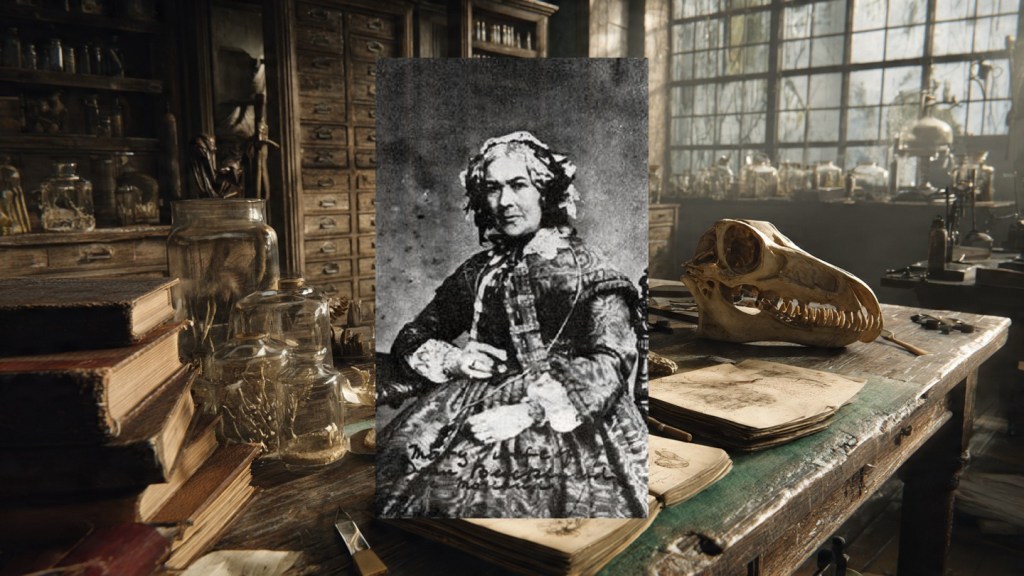
This interview is a dramatised reconstruction: Mary Buckland’s “voice” here is imagined, not a verbatim historical record. It is grounded in documented facts about her life and work, but readers should distinguish between the underlying history and the interpretive, fictionalised dialogue used to illuminate it.
Mary Buckland (née Morland, 1797-1857) was an English palaeontologist, scientific illustrator, and marine naturalist whose work underpinned some of the earliest dinosaur research. As a teenager she exchanged specimens and drawings with Georges Cuvier, and later created the meticulous fossil illustrations and restorations that helped make her husband William Buckland famous. Although her name rarely appeared in print, her eye, hand, and ingenuity are embedded in museum collections and landmark geological works that shaped nineteenth-century science.
Mrs Buckland, thank you for agreeing to this rather unusual conversation across time.
Sir, if you can contrive to call me forth a century and more beyond my appointed span, the least I can do is answer your questions. And please – call me Mary. I was “Mrs Buckland” for most of my earthly life. It will be a novelty to be addressed in my own right.
Let us begin at the beginning. How did a girl born in 1797 come to spend her life among fossils and sea-creatures?
The beginning, I suppose, was not so very promising. My mother died when I was but two years old. My father, Mr. Benjamin Morland of Abingdon, remarried, and our household became a busy one with many little ones. I was often sent to stay in Oxford, in the home of Sir Christopher Pegge, Regius Professor of Anatomy.
Sir Christopher kept cabinets of minerals and fossils and shelves of books in natural history and comparative anatomy. He did not consider it improper to allow a girl to handle a vertebra or a shell, nor to inquire what it might teach us of the works of the Creator. In that house, I read more than was thought quite suitable for a young lady, and I drew still more.
What drew you to scientific illustration in particular?
Necessity and inclination together. I had always a facility with the pencil. As a child, I would copy engravings from books, then specimens laid upon the table. Sir Christopher encouraged me to render bones, shells, and minerals as exactly as I could. He would say, “Mary, draw what you see, not what you think you see.”
When I grew older, that habit of exact drawing proved very useful. There were not many who could make a faithful figure of a fossil jaw or vertebra, with each fracture and unevenness correctly set down. Yet correct figures were essential. In our time there was no photography; an engraving carried, as it were, the very evidence from a specimen in Oxford or London to a savant in Paris or Berlin. If the drawing wanted accuracy, the science would want it too.
You began corresponding with Georges Cuvier as a teenager. How did that relationship begin?
It began, as many scientific friendships do, with a specimen and a question. I had opportunities, through acquaintances, to see fossils newly come from quarries and cliffs along our coasts. I read what Cuvier had written on fossil bones – his power of reconstructing an animal from a fragment of jaw or limb bone was most astonishing to me.
I sent him drawings of some bones from our English strata, together with what notes I could contrive upon their position and association. Presently I received a reply – very courteous, very precise – thanking me for the figures and inquiring for more particulars.
Cuvier was pleased enough with some of my drawings that he had them engraved and published. For a girl still in her teens, living in a small town and largely self-taught, that was no small encouragement.
Did you understand, even then, how unusual it was for a young Englishwoman to collaborate with the leading naturalist of France?
I knew it was unusual for any woman to concern herself with such matters, still more to be taken seriously. But I did not sit thinking, “How remarkable I am.” I thought rather, “How remarkable that such creatures once lived – and that we may know them still through these poor fragments.”
Besides, Cuvier treated my drawings as he would those of any competent draughtsman. He did not write to me as to a curiosity, but as to a person who could produce what he required. That was what I valued.
You also worked with William Conybeare before your marriage?
Indeed. Mr Conybeare was one of the foremost English geologists of his day, and a friend of many in the Oxford circle. He needed accurate figures of fossil bones and of those strange marine reptiles – the ichthyosaurus and plesiosaurus – that were then astonishing the learned world.
I drew for him as I had done for Cuvier, making myself as precise and modest a servant of the stone as I could. Those early collaborations, with Cuvier and Conybeare, established me – as some were kind enough to say – as a reliable scientific draughtswoman before ever I became “Mrs Buckland.”
One of your best-known contributions today is your illustration work on Megalosaurus, the first dinosaur to be scientifically described. Could you tell me about that?
Ah, the Stonesfield fossils. At the time we did not say “dinosaur” – that word came later. We spoke of a great saurian, a huge lizard-like creature, its remains drawn from the Stonesfield slate.
When William Buckland prepared his paper for the Geological Society on this animal he named Megalosaurus, he required figures which would do justice to the fragments – a massive jaw with its cruel teeth, vertebrae, limb bones. Some of these were of awkward shape and much broken. To draw them in such a manner that another geologist, seeing only the plate, might comprehend their true form and proportions, was no easy task.
I set to work with care. I measured, I turned the bones in my hands to understand their three dimensions, and I shaded each curve and cavity in the lithographic stone so that the engraver might not soften or alter what nature had made rough and strange. Those plates accompanied his paper in 1824. I did not present the paper; I did not speak before the Society, for such things were not permitted to women. But the images were mine.
Did you feel, at the time, that this work was historic?
We sensed that the animal itself was remarkable – that here was a creature far exceeding any known reptile in size and fearfulness, dwelling in a world long vanished. But as for “historic” – we did not think in such terms. We thought, “Is the jaw correctly drawn? Have we matched the fragments aright? Will Cuvier be satisfied?” Only later do people speak of history.
You married William Buckland at the end of 1825. Your honeymoon was famously a year-long geological tour. What was that like?
Delightful and exhausting. William could not walk a road without examining its cuttings, nor pass a quarry without descending into it. We went through France and Germany, visiting Cuvier, Humboldt, and other men of science; we examined caves, cliffs, coal-pits, and collections.
My role, beyond that of wife and companion, was to observe and to record. I kept notes, made sketches of strata and specimens, and tried to fix in my journal those impressions which William, in the heat of discussion, might later forget. It was, as you would say now, fieldwork – and a very extended kind.
After your marriage, your own byline disappears from the record. Your illustrations and even your writing are subsumed under your husband’s name. How did you experience that at the time?
It is strange to hear it put so plainly. At the time, it did not feel like a single moment of disappearance; rather, like a river that gradually sinks into sandy ground.
Before marriage, I signed as “M. Morland” on certain plates and correspondences. After, I was “Mrs Buckland.” A wife’s duty was to advance her husband’s work, not to stand forth in her own person. When I drew the plates for Reliquiae diluvianae or for the later Geology and Mineralogy, when I sat writing as William dictated, or quietly revising his sentences when he had rushed them off too hastily, it was understood that these labours were part of my conjugal obligations.
I will not say I felt no sting when my name did not appear. But one must recall the air we breathed. It was praised in a woman to be useful but modest, intelligent yet not obtrusive. To insist upon public credit would have been considered vanity and, worse, impropriety.
You have the benefit now of hearing how historians describe this pattern. They speak of the “Matilda Effect” – women’s scientific work being systematically credited to men. Does that term resonate with your experience?
The term is new to me, but the substance is not. Many of us knew, if only in our hearts, that our contributions were not weighed quite as those of our husbands, brothers, or colleagues. I have heard it said – Mr Lyell, I think, wrote something of the sort – that had Mrs Somerville been married to a great mathematician, her writings might have passed altogether under his name.
In my own case, I cannot pretend I was wholly ignorant of what was happening. I saw that my “M. Morland” signature vanished once I became “Mrs Buckland.” Yet I also saw that, by accepting this obscurity, I was permitted to continue in the work itself – drawing, restoring, experimenting, teaching my children from our fossils. It was a poor bargain in some respects, but it allowed the work to go on.
Your son Frank later wrote admiringly of your skill in mending broken fossils. Could you describe that work?
With pleasure. The fossils that came into our hands – whether from quarries, from the sea-cliffs, or from older collections – were often in a lamentable state: cracked, shattered, encrusted with matrix. If left so, they were of little use to science or to the museum.
I devised cements that would join broken pieces without staining or swelling, and ways of building discreet armatures to support delicate specimens. One must understand both the substance of the fossil and the nature of the rock that encloses it. Some bones crumble at a breath; others are hard as ironstone. I experimented with glues, plasters, even with leather, which I fashioned into models or supports.
It required patience, a steady hand, and a willingness to fail and begin again. My pleasure lay in seeing a jumble of fragments reconstituted into something like the original form, so that one might say, “Here is the limb of such-and-such an animal,” or “Here is the track of a tortoise, impressed in mud millions of years ago.”
Today, many of those specimens in the Oxford University Museum of Natural History still bear your invisible hand. How do you feel knowing your work lives on even where your name does not?
There is an odd comfort in it. The stones themselves do not care whose hands set them right. If they still instruct students and delight visitors, that is work well done. Yet I confess, hearing you say that people now inquire, “Who prepared these specimens? Who drew these plates?” – that warms a part of me that lay long cold.
You also assisted with experiments to understand fossil footprints – what we now call ichnology. What did those experiments involve?
There were, in certain sandstones, impressions which some took for “LIVING FOOTSTEPS of animals that have traversed the moist and yielding surface” of ancient shores and rivers. To confirm such an interpretation, one must show that living animals, placed under analogous conditions, produce similar marks.
We had tortoises at hand, and other creatures. We spread trays of soft clay or sand of various degrees of moisture, inclined at various angles, and allowed the animals to walk across. Then we compared the prints thus made with those in the stone.
My part was to prepare the trays, to watch and record, and to draw both the fresh and the fossil impressions. It was, if you like, an early attempt at experimental geology – seeking not merely to describe, but to reproduce, the conditions that yielded the marks we observed.
That combination of observation, experiment, and precise drawing feels very modern.
We did not imagine ourselves “modern.” We simply asked, “How can we be more certain?” The earth does not answer when you question her rudely. You must approach with courtesy and with ingenuity.
After your husband’s health declined and he was eventually placed in an asylum, you withdrew to St Leonards-on-Sea. Yet you continued scientific work there, examining microscopic marine life. How did that phase begin?
In those years, grief and solitude were my companions. William, once so vigorous, was lost to melancholy and confusion. I needed occupation that was both absorbing and, in some sense, consoling.
At the seaside, I found in the rock-pools and on the shore an abundance of small creatures – zoophytes, sponges, delicate forms half-animal, half-plant in appearance. With a microscope, one may discover in a single drop of water a world as strange as any antediluvian reptile.
My daughter Caroline assisted me. We collected specimens from Guernsey and Sark, preserved them, arranged them, and studied their minute structures. To trace the filaments of a sponge or the feeding-tentacles of a polyp under magnification is to glimpse another order of creation, as worthy of study as the great beasts of former ages.
Did you intend to publish that work?
My health was much impaired by then, and I had not the strength for controversy or for the work of preparing treatises. Yet I did not conduct the observations idly. I corresponded a little and shared what we found with those we thought might profit from it. Even if nothing bore my name in print, the knowledge was not entirely lost.
For a long time, your name all but vanished from the story of palaeontology. Your husband’s achievements were celebrated; your labour remained uncredited. How does it feel to discover that, in 2026, historians, curators, and writers are finally recovering your story?
It is like hearing, from another room, one’s own name spoken after one had thought everyone long since departed. I confess I am a little bewildered by the interest. We did not, in my day, suppose that anyone two centuries hence would inquire so minutely into who sharpened the pencils or mended the fossils.
But if this renewed attention serves to show that science has always depended upon many hands, some of them gloved and some bare; upon eyes that observed, pens that wrote, brushes that drew, as well as upon those few who lectured and signed their names prominently on title pages – then I am content to be an example.
Do you feel anger, or regret, that you were not acknowledged more fully at the time?
Anger is a hot coal; I am too far removed now to hold it. There were moments, in life, when I felt something like bitterness – when a plate on which I had laboured appeared with only “Buckland” appended, or when gentlemen praised my husband for an experiment in which my part had been more than negligible.
Yet I must also be honest: I accepted much of this as the order of things. I rejoiced in William’s successes. I took pride in making his books as clear and beautiful as I could, even if my name did not appear. My regrets now are more on behalf of the pattern than the person – that so many women’s talents were confined, diluted, or simply unseen.
In our own time, women are scientists, professors, and museum directors. Yet they still face unequal treatment, especially around recognition and work-family balance. What would you say to women in science today?
It is not for a woman of my century to instruct those of yours, but since you ask: first, know your own competence. In my youth, when Cuvier used my drawings, I learned that my work could stand in the company of the best. That knowledge fortified me when later the world required me to stand behind another’s name.
Secondly, be as exacting in claiming your due as you are in your observations. If a paper rests upon your experiments, your drawings, your calculations, then insist – courteously, but firmly – that this be acknowledged. There is a kind of modesty that is only cowardice wearing a virtue’s mask.
Thirdly, remember that science is not a solitary hero’s tale. If you find yourself in the position I once occupied – supporting the work of another – do what you can to ensure that such work is visible and valued. Give names in your acknowledgments. Teach your students that every plate, every specimen, every line of data has a history of hands and minds behind it.
As for the balance of household and laboratory – ah, that is a problem as old as Eve and unlikely to be solved by a few maxims. Yet I would say: do not allow those who benefit from your unpaid work to persuade you it is of lesser worth than your paid work, or vice versa. Both shape the world.
Your husband is remembered for trying to reconcile geology with theology. How did you yourself think about the relationship between deep time and religious belief?
To place a fossil jaw upon the table and calculate that the creature lived millions of years before any record of man is to feel, first, very small, and second, very much in awe. Some feared that such knowledge would overthrow faith. I never did.
To my mind, the strata are another book of God’s writing, not in letters and words, but in shells and bones, in coal seams and coral reefs. If the story they tell is longer and more intricate than we once supposed, that shows only that the Author is more subtle than our former catechisms allowed.
I confess, the controversies wearied me. Men would argue fiercely whether the Deluge of Noah sufficed to account for this deposit or that. Meanwhile, the rocks waited patiently beneath their turf, indifferent to our quarrels. I chose, as far as I could, to attend to the stones themselves, and to leave to others the sharper disputations.
Looking around in 2026 – the instruments, the scale of scientific research, the presence of women and people from many backgrounds in laboratories and universities – what stands out to you most?
The instruments first. The thought that one may see the structure of a cell in more detail than I could see a sponge under my best glass – that you may look upon the very arrangements of atoms! It makes my little microscope seem a toy.
Then the diversity of faces. In my day, the rooms of learned societies were filled almost entirely with gentlemen of a certain station and complexion. To see women, persons of many nations and hues, walking those same halls with authority – this gives me great satisfaction.
Yet I also perceive, from what you have said, that though the doors stand wider, the room is not yet wholly welcoming to all. Old prejudices do not die; they adapt. In my century, they said a woman’s brain was too delicate for such exertion. In yours, perhaps they say her time is too divided, or her temperament unsuited to competition. The words change, but the aim is the same.
If you could choose how posterity remembers you – not as “Mrs Buckland, wife of William,” but as Mary – what would you wish that remembrance to be?
I would like it said that I was faithful – to the evidence before me, to the craft in my hands, and to the people I loved. That I handled fossils with respect, whether they were destined for a great museum case or a drawer in a country house. That I drew honestly, without embellishment, so that others might see what I had seen.
If some also remember that I persisted in my studies when it was not altogether encouraged, that I continued to look into microscopes and to arrange specimens when grief and illness pressed heavily, then they may infer what they will about women’s capacities.
But I do not ask for monuments. A few labels corrected in museums, a few footnotes amended in histories, a few young people who, seeing my name, think, “There were such women then, and therefore there may be such women now” – that is sufficient.
Finally, if you could speak directly to a young person – perhaps a girl in Oxfordshire today who loves drawing and strange stones – what would you tell her?
I would tell her: attend closely. That is the beginning of all good science and all good art. Draw what you see, not what others have told you ought to see. If you find joy in a fossil’s curve or a shell’s pattern under the lens, do not let anyone persuade you that such joy is unfeminine or frivolous.
Seek out those who will encourage you as Sir Christopher Pegge once encouraged me. And when you have acquired knowledge or skill, use it not only for your own advancement but to open doors for others. For if there is one lesson I would carry from my century into yours, it is that talent is far more evenly distributed than opportunity.
Mary, thank you. Your voice – and your work – add so much richness to our understanding of how science has been made.
And I thank you, sir, for listening to a woman whom her own age did not much trouble to record. If, after so many years among the fossils, I may myself emerge from the strata of forgetfulness, that is a most unexpected afterlife.
Questions from Our Community
Mary’s conversation across time clearly wasn’t enough for our readers. Since publishing the interview, we’ve received a wave of letters and emails from people who see their own questions, hopes, and frustrations reflected in her story. From that growing community, we’ve selected five messages that ask Mary more about her life, her work, and what she might say to those following a similar path today.
Agáta Ševčíková, 31, conservation scientist, Brno, Czechia
If you could watch a modern fossil lab at work, using consolidants, CT scans and 3D printing, which parts of your own restoration practice would you still defend today, and which choices – materials, finishes, joins – would you change on ethical or technical grounds?
Miss Ševčíková, your question does me the honour of supposing I might have opinions worth defending even in an age whose techniques I can scarcely comprehend. I confess the terms “CT scans” and “3D printing” mean little to me – though I gather they allow you to see within a stone without breaking it, and to replicate forms with extraordinary fidelity. Such powers would have seemed sorcery in my day.
Yet let me address what I understand: the principles and compromises of restoration, which I suspect remain much the same whether one works with ox-glue or with your modern consolidants.
First, I would defend the principle of reversibility, though we did not call it by that name. When I mended a fractured ichthyosaur vertebra or rejoined the fragments of a saurian jaw, I chose cements and adhesives that could, with patience and warm water or gentle solvents, be undone. I knew that my understanding was imperfect – that a future worker might need to examine the break afresh, or that I might have erred in matching one piece to another.
We used fish glues, isinglass, and certain resins that hardened well but did not become as stone. I would never employ a substance that bit so deeply into the fossil that it could not be removed without destroying what lay beneath. That scruple, I hope, still governs your work, for no restorer – however skilled – should close the door to correction.
Secondly, I would defend restraint in reconstruction. When a fossil was incomplete, it was sometimes tempting to model the missing portion in plaster or wax, to show what the whole might have looked like. I did make such models on occasion, particularly in leather, which could be shaped and stitched to suggest the form of a limb or body. But I was careful – wherever possible – to ensure that the restored portion could be distinguished from the original bone.
If a tooth was missing, I did not carve a false one and set it in the jaw as though it had been found there. If a vertebra was half-gone, I might support the remainder with a discrete armature, but I did not pretend to completeness where none existed. The fossil itself is evidence; our additions are only conjecture, and the two must not be confounded.
Thirdly, I would defend the value of working by hand and eye. You speak of scans and machines that can measure and replicate with great precision, and I do not doubt their utility. Yet there is knowledge that comes only through touching the stone – feeling where it is friable and where it is sound, learning the grain of a bone and the way a fracture runs. I spent hours, sometimes days, with a single specimen, turning it in my hands, studying it under different lights, before I dared apply cement or tool.
That intimate acquaintance with the material taught me not only how to mend it, but also what it was – how the creature had lived, how it had died, how time and pressure had transformed it. I would not wish future restorers to lose that tactile understanding, even if machines can do the work more swiftly.
Now, as to what I would change – here I must acknowledge the limits of my century and the harms we did in ignorance.
First, the materials themselves. Some of the glues and varnishes we employed have, I am told, darkened or become brittle with age, or have stained the fossils in ways we did not foresee. I used what was available and what experience recommended, but if your modern consolidants are more stable, more transparent, and more easily removed, then I would gladly have used them in place of our cruder mixtures.
I am particularly troubled to hear that certain substances we thought harmless – shellac, for instance, or some of the spirit-based varnishes – have caused long-term damage. We applied them in good faith, to strengthen fragile bone or to bring out detail in a weathered surface. If those choices have made your task harder, I am heartily sorry for it.
Secondly, I would reconsider the degree of cleaning and polishing we sometimes undertook. In our eagerness to display a fine specimen, we would scrub away matrix, smooth rough surfaces, and polish the bone until it shone. This made for handsome museum cases, but I suspect it also removed information – scratches, encrustation, traces of other organisms – that might have told you something of the fossil’s history.
In my later years, as I worked more with marine specimens under the microscope, I learned to value what looked, to the naked eye, like mere dirt or discolouration. Often it was not dirt at all, but the remnant of another life, or evidence of the conditions under which the creature had been preserved. I wish I had carried that lesson back to my earlier fossil work and been less zealous with my brushes and scrapers.
Thirdly, I would be far more careful about where and how I recorded my interventions. We kept some notes – what was done, what materials were used – but not always as thoroughly as we should have done, and often those notes were kept in ledgers or on slips of paper that have since been lost or misfiled. If a specimen came into your hands now, you might have no way of knowing what I had added, what I had removed, or what substance I had used to bind it.
In your century, I understand there are ways of embedding such information – photographs before and after, written records attached to the specimen itself, even markings invisible to the eye but readable by your instruments. I would adopt all of these practices without hesitation, for they serve both honesty and science.
You ask also about ethics, and here I must tread carefully, for the standards of my day were not yours. We collected freely from quarries and cliffs, often with little regard for documenting the exact position of a find. We sold and traded specimens as though they were mere curiosities. We were not, I think, wicked, but we were careless of posterity’s needs.
If I were working today, I would insist – as I hope you do – that every specimen be accompanied by precise information about its provenance: where it was found, in what stratum, in association with what other remains. A fossil torn from its context is half-orphaned; you may study its anatomy, but you cannot fully understand its story.
I would also be far more cautious about removing specimens from the field. In my time, if we saw a fine fossil, we extracted it if we could, and thought little of leaving the surrounding rock in ruins. Now, I gather, you sometimes choose to leave a specimen in place, to preserve the site for study or for future generations who may have better tools. That is wisdom, though it requires a patience we did not always possess.
So, Miss Ševčíková, if I could observe your modern laboratory – with its consolidants and scans and miraculous replications – I think I would feel both humbled and vindicated. Humbled, because your tools and knowledge so far exceed mine; vindicated, because the principles I tried to follow – reversibility, honesty, respect for the material – seem still to matter.
I would ask you to teach me your techniques, and I would offer in return what I learned in my long hours with broken stones: that patience is as much a tool as any chemical, and that the restorer’s first duty is not to the beauty of the specimen, but to the truth it contains.
Adam Scott, 27, graduate student in geoscience education, Colorado, United States
In your footprint experiments, you worked from live animals and soft sediments to interpret ancient tracks. If you had access to motion-capture cameras and high-speed imaging, what extra measurements would you want, and how might they have sharpened your arguments about which creatures made those fossil trails?
Mr Scott, you offer me instruments I can barely imagine – cameras that capture motion too swift for the eye, images that freeze a tortoise’s step in mid-air. What a marvel that must be! In my day, we had only our eyes, our patience, and our willingness to get our hands and hems muddy whilst persuading reluctant creatures to walk where we wished them to.
Let me first describe what we could observe, so you may better understand what we could not.
When we conducted our experiments with tortoises and other animals upon prepared surfaces – trays of clay, sand, or mud of various consistencies – we could observe the resulting prints after the creature had passed. We measured the distance between successive impressions, the depth of each mark, the spread of the toes (where toes there were), and the shape of the whole.
We noted, too, the angle at which the foot struck the surface, though this was a matter of inference rather than direct observation. If the forward edge of a print was deeper, we supposed the animal had been moving briskly; if the print was evenly impressed all around, we imagined a slower, more deliberate gait. We tried different slopes and different degrees of wetness in the substrate, to see how these altered the marks.
But the moment of contact – the instant when foot met clay – was too quick for us to see with any precision. We could watch a tortoise advance, certainly, but the exact sequence by which its limbs moved, the way its weight shifted from one foot to another, the flex of the toes as they pressed into the mud and then released – all this happened too rapidly, or too subtly, for our unassisted vision.
If I had your motion-capture cameras and high-speed images, Mr Scott, here is what I would seek to learn:
1. The Exact Sequence and Timing of Limb Placement
I would wish to know, frame by frame, which foot touched the ground first, how long it remained in contact, and when the next foot descended. In our experiments, we could see that a tortoise walked in a particular rhythm, but we could not quantify it with precision. Does the right forefoot strike before or after the left hind foot? How much time elapses between each step?
This would allow us to compare living gaits with fossil trackways where multiple prints are preserved in sequence. If the spacing and rhythm of the fossil prints matched those of a tortoise – or did not – we could argue with far greater confidence about the identity of the track-maker.
2. The Distribution of Weight and Pressure
I would dearly love to see how a creature’s weight shifts as it walks. When a tortoise places its foot, does the pressure fall evenly across the whole sole, or does it concentrate at the heel, or at the toes? Does this change depending on the speed of movement or the slope of the ground?
In the fossil prints, we often observed that some parts were more deeply impressed than others, but we could only guess at the reasons. With your imaging devices, you might measure the pressure at different points within a single footprint, and thus understand better how the ancient animal moved – whether it walked flat-footed or on its toes, whether it bore its weight evenly or favoured one side.
3. The Deformation of the Substrate
One difficulty we faced was understanding not just the foot, but the response of the mud. When a foot presses into soft clay, the clay does not simply compress; it may also be pushed sideways, creating little ridges or rims around the print. When the foot is withdrawn, the clay may slump back, partially filling the impression, or it may hold its shape.
With high-speed imaging, you could watch this process unfold. You could see how the mud behaves under different conditions – dry versus wet, sandy versus clayey – and how the animal’s motion affects that behaviour. Does the tortoise lift its foot straight up, or does it drag it slightly backward, creating a smear? Does the mud spring back, or does it remain compressed?
This would help us interpret puzzling features in the fossil record – marks that seem too shallow, or too indistinct, or that have strange rims and ridges. We might be able to say, “Ah, this print was made in mud that was just beginning to dry,” or “This creature was moving very quickly, and the mud slumped behind it.”
4. The Angle and Rotation of the Foot
I would wish to see, in perfect detail, the angle at which the foot approaches the ground and the degree to which it rotates during contact. Does a tortoise place its foot straight down, or does it come in at an angle? Does the foot twist as weight is applied, causing the toes to splay outward or inward?
In our experiments, we could see the final print, but not the motion that produced it. With your cameras, you could trace the entire trajectory of the foot – its descent, its contact, its rotation, and its ascent. This would allow you to distinguish between prints that look similar but were made by very different motions, and thus perhaps by very different creatures.
5. The Influence of Tail, Belly, and Other Body Parts
Some fossil trackways show not only footprints but also drag-marks from a tail, or impressions where the belly of the animal scraped the ground. In our experiments, we tried to observe when and how such marks were made, but again, the motion was often too quick or too subtle.
With motion-capture, you could see exactly when a tortoise’s tail touched the mud – was it constant, or only when the animal turned? Did the belly drag only on steep slopes, or also on level ground when the animal was tired? How deep were these marks relative to the footprints, and what does that tell us about the animal’s posture and gait?
In our own time, we could say, “These fossil prints resemble those made by a tortoise in our experiments,” and that was useful. But sceptics might reply, “Perhaps some other creature could make similar marks,” and we had no decisive answer.
With your motion-capture and high-speed imaging, we could go much further. We could say, “The spacing of these prints, the rhythm of their placement, the distribution of pressure within each mark, and the deformation of the surrounding substrate all match the gait of a tortoise moving at such-and-such a speed across mud of such-and-such consistency – and they do not match the gait of a lizard, a crocodile, or any other creature we have tested.”
That is a far stronger claim, resting not on general resemblance but on quantitative correspondence across multiple measurable features. It would be much harder to dispute.
Moreover, if we found fossil trackways that did not match any living creature, your imaging would help us imagine what sort of gait the unknown animal must have had. We could say, “No living reptile walks with this rhythm and this pressure distribution; therefore, the ancient creature must have moved in a manner unlike anything alive today.” That would be a discovery in its own right.
I must add one caution, Mr Scott. For all the power of your instruments, they cannot tell you everything. A footprint in stone is not merely a record of a single step; it is a record of that step plus all that happened afterward – the drying of the mud, the influx of sand or silt, the weight of overlying strata, the chemical changes wrought by time.
Even with perfect knowledge of how a living animal walks, you must still interpret the transformations that turned a fresh print into a fossil. That requires not only measurement but also judgement, experience, and a willingness to say, “I do not know,” when the evidence is unclear.
Still, I would trade a great deal to spend even a single afternoon in your laboratory, watching a tortoise walk in perfect slow motion, and learning what my own eyes were too slow to see. It would be a finer education than any I received, and I would return to my fossil trackways with a keener understanding and a humbler sense of how much remains to be discovered.
Clara Li, 24, palaeobiology major and science illustrator, Wellington, New Zealand
Looking back, what puzzles about ancient life were simply invisible to you because the concepts didn’t exist yet – things like plate movements, DNA, or global climate cycles – and how do you think that shaped not just what you didn’t know, but what you couldn’t even think to ask?
Miss Li, yours is perhaps the most unsettling question I have been asked, for it requires me to contemplate not merely my ignorance – which any honest person must acknowledge – but the shape of that ignorance. You ask me to see the outline of ideas that did not exist in my world, and to imagine how their absence constrained not only my answers but my very questions.
It is a little like asking a person blind from birth to describe what she cannot see. Yet I shall try.
Let me begin with your examples. You speak of “plate movements” – by which I gather you mean that the very continents themselves have shifted across the face of the earth, that England was once joined to lands now separated by oceans, that mountains have risen and sunk over unimaginable spans of time.
In my day, we believed the continents fixed. Oh, we knew that land could rise and fall – there were marine shells atop mountains, which proved the sea had once covered them – but we thought these changes local and vertical. The idea that entire continents might drift, that the Atlantic Ocean might once have been a mere crack, and that creatures now separated by thousands of miles of water might once have walked from one land to another – this never entered our heads.
Had we possessed such a concept, we would have asked very different questions. When we found similar fossils in Europe and in the Americas, we supposed they must have travelled by land bridges now sunk, or that similar conditions had produced similar creatures in different places. We did not think to ask, “Were these lands once adjacent?” because the question made no sense within our understanding of the earth.
Similarly, you mention “DNA” – some essence within living things that carries the pattern of inheritance. We knew that offspring resembled their parents, that characteristics bred true, and that varieties could be produced by selection. But we had no conception of a material substance encoding this information, no notion that every cell contains, as it were, a library of instructions written in a language we could not read.
Had we known of DNA, how differently we might have looked at fossils! We might have asked, “Can we extract this substance from ancient bones and read what it tells us of kinship?” We might have understood that the resemblances we observed between creatures – between a fossil saurian and a living crocodile, say – were not mere analogies but reflections of shared ancestry written in this hidden script.
As for “global climate cycles” – we knew the climate varied. We had evidence of tropical plants preserved in what was now cold England, and we supposed there had been some great catastrophe or change. But we did not conceive of regular, repeating cycles of warmth and cold spanning hundreds of thousands of years, driven by slow wobbles in the earth’s orbit and tilt.
Had we grasped this, we might have understood that the same region could be, at different times, tropical forest, temperate woodland, and ice-covered waste – and that creatures would migrate, adapt, or perish accordingly. We would not have been so puzzled by the mixture of tropical and temperate fossils found in the same general locality, nor so quick to invoke catastrophic floods to explain their juxtaposition.
But let me go beyond your examples, Miss Li, and consider what else we could not think to ask.
The Age of the Earth: We knew the earth was old – far older than the few thousand years some divines allowed – but we had no way to measure that age with precision. William and others spoke of millions of years, but it was a vague vastness. We could not say, “This stratum is 150 million years old, and that one 200 million,” and thus we could not perceive the rate at which changes occurred.
Had we been able to measure geological time precisely, we would have asked, “How quickly did this creature evolve? How long did this species persist before it vanished?” We would have understood that some changes were gradual, spanning millions of years, whilst others were sudden. Without that ability, we could only say, “This is older than that,” and hope to arrange the strata in the correct order.
Extinction and Origination: We knew that creatures had vanished from the earth – that was evident in the fossils – but we did not fully grasp the pattern of extinction and origination. We did not know that there had been great dyings, when much of life was swept away, followed by radiations when new forms arose to fill the emptied world.
We looked at each extinct creature as an isolated puzzle: why did this animal vanish? We did not think to ask, “Were there moments when whole assemblages of life disappeared together, and if so, what caused such wholesale destruction?” That question required a larger view of the history of life than we possessed.
The Mechanism of Inheritance and Change: You mention Mr Darwin’s work, which came near the end of my life. Even then, we had no true understanding of how variation arose, nor how it was passed from parent to offspring. We knew selection could shape a population, but we did not know the mechanism by which new traits appeared, nor why some traits bred true whilst others did not.
Had we understood genetics – even dimly – we might have asked, “How quickly can a new form arise? Can great changes accumulate gradually, or must they occur in leaps?” These questions were debated, but without knowledge of the underlying process, the debate was largely speculation.
The Chemistry of Life and Preservation: We knew that soft tissues decayed and hard parts might be preserved, but we had no conception of the chemistry involved. We did not know that certain conditions – anaerobic mud, rapid burial, particular minerals – could preserve even delicate structures like feathers or skin, nor that other conditions would destroy even bone.
Had we understood this, we might have asked, “Why are fossils common in this stratum but absent in that one? Is it because creatures did not live there, or because the conditions did not favour preservation?” We often assumed absence of fossils meant absence of life, when in truth it might have meant only absence of the right conditions to turn flesh and bone into stone.
Now, to the heart of your question: how did these absent concepts shape not merely our ignorance but our enquiry itself?
I think the answer is this: we asked questions about pattern, but not about process. We could observe that creatures had changed over time, that some had vanished and others appeared, that tropical fossils lay in what was now temperate land. We catalogued these observations with care. But we could not ask why or how in any but the most general terms, because we lacked the concepts that would make such questions answerable.
It is the difference between saying, “I observe that the sun rises each morning,” and asking, “What motion of the earth or sun produces this appearance?” The first is description; the second requires a framework of ideas – about the shape of the earth, the nature of celestial motions – that makes the question sensible and an answer conceivable.
We drew beautiful pictures of fossils. We arranged them by stratum. We noted resemblances and differences. But when we tried to explain why the history of life had taken the shape it did, we had recourse only to vague notions of divine intention, catastrophic floods, or the “conditions” of past ages – none of which were satisfactory, because none could be tested or measured.
I think often of the zoophytes and sponges I studied in my later years. Under the microscope, they revealed structures of astonishing complexity – branching filaments, chambers, pores arranged in regular patterns. I could draw them, I could classify them, but I could not answer the most basic questions: How do they grow? How do they reproduce? What determines their form?
I did not even know whether to call them plants or animals, for they seemed to partake of both kingdoms. The very categories I had been taught were inadequate to the living world, yet I had no better ones to replace them.
Now you tell me that such creatures are animals, and that their forms are shaped by information encoded in every cell, and that this information has been passed down, with modifications, through inconceivable ages. Had I known that, I might have asked, “Can I trace the lineage of this sponge through the fossil record? Can I see its ancestors?” But without the concept of encoded inheritance and gradual change, that question was unthinkable.
Miss Li, you are a palaeobiologist and an illustrator, as I was. You draw what you see with the same care I tried to exercise, and you ask questions about the life you depict. But you also possess concepts I could never have imagined – genetics, plate tectonics, climate cycles, mass extinctions, cellular chemistry.
These concepts allow you to ask questions I could not ask, and to find answers I could not find. But I must also believe there are concepts you do not yet possess – frameworks of understanding that will seem obvious to your great-grandchildren but are invisible to you now.
Perhaps you look at a fossil and see its anatomy, its geological age, its evolutionary relationships, its ecological role. But perhaps there is some other way of seeing – some pattern or process you cannot yet name – that would make sense of puzzles that now perplex you.
My advice to you, if an old woman’s advice is worth anything, is this: do not mistake the limits of your concepts for the limits of nature. When you find yourself saying, “This cannot be explained,” ask instead, “What framework of thought would make this explicable?” The answer may not come in your lifetime, but the question is worth asking.
And continue to draw, Miss Li. Draw with all the precision you can muster. For even if we do not understand what we see, the record we leave – if faithful – may serve those who come after, who will see with sharper eyes and ask with clearer minds.
Maxence Bertrand, 35, museum curator of natural history, Lyon, France
You spent years arranging collections and labelling specimens under other people’s names. If history had allowed you to design a museum gallery as its acknowledged architect, what story about Earth’s past – and about the hidden labour behind science – would you have built into the space?
Monsieur Bertrand, you pose a question that stirs in me feelings I thought long settled. To be asked not merely what I would display, but what story I would tell, and to be granted – in this imagining – the authority to tell it under my own name – this is a gift I never received in life, and one I scarcely dared to wish for.
Let me consider it carefully, as I would have done had such an opportunity ever presented itself.
If I were to design a gallery – let us say, a suite of rooms within a great museum – I would build it around a single governing idea: that the earth is not fixed, but has undergone profound transformations, and that life has transformed with it.
In my day, visitors to museums saw cabinets of curiosities – beautiful, certainly, but arranged more for wonder than for understanding. A crocodile’s skull might sit beside a piece of coral, a fossil fern next to a mineral crystal, with little to connect them save that all were “productions of nature.”
I would arrange my gallery differently. I would guide the visitor through time, showing how the earth and its inhabitants have changed across the ages. But I would also show – and here is the heart of your question – how we know what we claim to know, and who has worked to bring that knowledge forth.
The First Room: The Present as Key to the Past
I would begin not with fossils, but with living creatures and present-day processes. Here the visitor would see:
- A tank with living zoophytes and sponges, such as I studied at St Leonards, alongside dried and mounted specimens showing their internal structure.
- Trays of fresh mud bearing the footprints of tortoises, lizards, and birds, each labelled with the conditions under which it was made – the moisture of the substrate, the speed of the creature, the angle of the slope.
- A shallow pool in which sediments settle, showing how layers form and how delicate structures – a leaf, a shell – might be buried and preserved.
The lesson of this room would be: We understand the past by observing the present. The processes that shape rock and preserve life today are the same that operated in former ages. This principle – which the geologists of my day were just beginning to grasp – is foundational to all that follows.
And here, Monsieur, I would introduce the labour behind science. On the walls, I would place not only engravings of specimens but also the preparatory sketches – rough drawings made in the field, with annotations and corrections. I would show a fossil as it appears when first extracted, encrusted and broken, and beside it the same fossil after cleaning and restoration, with a card explaining what was done and by whom.
I would include a small workbench, with the tools of the preparator’s trade: brushes, chisels, glues, cements, magnifying glasses. A placard would read: “Every specimen you see has passed through many hands. Quarrymen found it; dealers transported it; preparators cleaned and mended it; artists drew it; curators labelled and arranged it. Science is the work of many, though few receive the credit.”
The Second Room: The Strata and Their Testimony
The second room would display the great succession of strata, arranged from oldest to youngest. I would commission a series of large painted panels showing cross-sections of the earth, each depicting a different geological period with its characteristic rocks and fossils.
Here I would place actual specimens from each stratum: the trilobites and graptolites of the oldest fossiliferous rocks; the coal-measure plants and giant dragonflies; the saurians of the Secondary strata; the mastodons and mammoths of the more recent deposits.
But – and this is crucial – I would also show how we determine the order. I would include a case displaying the same stratum sampled from different localities, showing that the characteristic fossils are the same whether found in England, France, or Germany. This would teach the principle of correlation: that rocks of the same age may be recognised by their organic remains, even when separated by great distances.
And again, I would honour the work. Beside a fine specimen of Ichthyosaurus, I would note not only who described it scientifically but also who found it – Mary Anning, if it were her discovery – who prepared it, who drew it, who funded its acquisition. I would make visible the entire chain of effort that brought this creature from the Lyme cliffs to the museum case.
A placard might read: “This specimen was discovered in 1823 by Miss Mary Anning of Lyme Regis, who extracted it from the cliff-face at great personal risk. It was prepared and mounted by Mr _____, drawn by Mrs _____, and described by Professor _____. Each contributed essential knowledge and skill.”
The Third Room: Extinction and Renewal
The third room would address a question that troubled us greatly: Why have so many creatures vanished? Here I would display fossils of extinct forms – the great saurians, the ammonites, the trilobites – alongside explanations (such as we could offer) of why they no longer walk or swim upon the earth.
I would not pretend to certainty where none existed. A placard might say: “We do not fully understand why the ichthyosaurus and plesiosaurus disappeared, whilst crocodiles and turtles survived. Some suppose a great catastrophe; others believe gradual changes in climate and habitat. The debate continues.”
But I would also show that extinction is not the end of the story. After each great dying, new forms have arisen. I would display fossils arranged to show this succession: after the age of the great saurians came the age of mammals, filling the seas and lands with new shapes and habits.
The lesson would be one of resilience: life persists, though its forms change. And I would note that our understanding of this pattern has come through painstaking comparison of countless specimens, gathered over decades by many workers.
The Fourth Room: The Unsolved Mysteries
Here is where I would depart most from the museums of my day, Monsieur. In this room, I would display not our triumphs but our puzzles – the things we do not yet understand.
I would show:
- Fossils of creatures we cannot place confidently in any known group – are they plants or animals? Reptiles or amphibians?
- Strata with fossils that seem out of place – tropical plants where the climate is now cold; marine creatures atop mountains.
- Trackways and burrows whose makers we cannot identify with certainty.
Each display would include a question: “What was this creature? How did it live? What can it teach us about the past?”
And I would invite visitors – yes, even ladies and children – to contribute their observations. A visitor’s book would be provided, not for idle compliments, but for genuine enquiry: “Have you seen anything in nature today that helps explain these ancient marks? Do you have a hypothesis to test?”
This room would teach that science is not finished, that mysteries remain, and that the next discovery might be made by anyone with eyes to see and patience to observe.
The Fifth Room: The Hidden Hands
Finally, Monsieur, I would create a room dedicated entirely to the labour you mention – the work that goes unseen.
Here I would display:
- A series of illustrations showing the same fossil at different stages: as first found, as sketched in the field, as cleaned and restored, as drawn for publication. Each stage would be credited to the person who performed it.
- Letters, notebooks, and ledgers showing the correspondence and collaboration that underpin scientific work. A letter from Cuvier requesting a drawing; my reply with the sketch enclosed; his acknowledgment and use of it in publication. The visitor would see that knowledge is built through exchange, not in isolation.
- Portraits or silhouettes of people rarely depicted in museums: the quarrymen who find fossils, the preparators who mend them, the illustrators who draw them, the teachers who explain them to the next generation. Women as well as men; workers as well as gentlemen.
A large placard would read: “Science is often presented as the work of a few great men. In truth, it is the work of many – some famous, most forgotten. This room honours those whose names do not appear on title-pages but without whom no book would be written, no specimen preserved, no discovery made known.”
I would include a case showing my own work – drawings signed “M. Morland” before marriage, and later illustrations published under William’s name alone – with an explanation: “The same hand drew both, but only one bears the draughtsman’s name. This was common practice, and it has rendered much labour invisible. We seek now to correct that omission.”
Taken together, these five rooms would tell a story in three parts:
- The Earth has changed profoundly, and life has changed with it. What we see around us is but the latest chapter in an immensely long history.
- We know this through observation, comparison, and experiment – not through revelation or speculation. Science is a method, and anyone willing to apply it carefully may contribute.
- This knowledge is not the product of solitary genius but of collective labour, much of it performed by people who receive no public recognition. To honour science, we must honour all who make it possible.
Monsieur Bertrand, you ask what I would have done had history allowed it. But history did not. I spent my years arranging collections that bore other names, drawing plates that appeared without my signature, mending fossils that would be admired by thousands who never knew my hands had touched them.
There were moments – I will not deny it – when I felt the sting of that obscurity. But there were also moments when I stood before a case I had arranged, or saw a drawing I had made reproduced in a fine volume, and thought, “The work is good. It will endure. Perhaps that is enough.”
Now, in this strange conversation across time, I discover it was not quite enough – that people do wish to know who did the work, and that my name is being recovered from the margins where it was placed. That is gratifying, though it comes too late to change my life.
If my imagined gallery serves any purpose, let it be this: that future curators like yourself, Monsieur, will build such stories into the museums you create. Not as a separate exhibit on “forgotten contributors,” but woven into the very fabric of how you present science – as a collective endeavour, built on many kinds of labour, and enriched by many kinds of minds.
That would be a finer monument than any I could design for myself alone.
Josefina Suárez, 42, marine ecologist and feminist historian of science, Mar del Plata, Argentina
You moved from giant fossil reptiles to tiny living zoophytes, often working with your daughter. Did that shift in scale and in companionship change how you thought about your own life’s arc and legacy – as a scientist, a mother, and a woman rarely recognised in print?
Mrs Suárez, your question reaches into chambers of memory I do not often open. You ask not merely about the work itself – the shift from great saurians to minute marine creatures – but about what that shift meant to me inwardly, and what it revealed about the shape my life had taken. I shall attempt an honest answer, though it requires me to speak of matters we did not, in my day, much discuss.
When I was young – working with Cuvier, drawing the jaw of Megalosaurus, handling the massive vertebrae of ichthyosaurs – I was drawn to the grand and the dramatic. These were creatures that commanded awe: reptiles as large as whales, with teeth like daggers and limbs like tree-trunks. To reconstruct them, even in part, was to glimpse a world utterly unlike our own, a world of monsters and marvels.
There was, I confess, a certain thrill in that work. When I placed my hand upon the jaw of Megalosaurus and tried to imagine the creature whole – its bulk, its power, the thunder of its tread – I felt I was touching something immense and important. And perhaps, too, I felt that I was doing something immense and important, though I could not say so aloud.
By the time I retired to St Leonards and took up the study of zoophytes and sponges, the world had changed, and so had I. William was lost to illness and melancholy. My children were grown or growing. My health was much impaired. I no longer had access to the great collections, the networks of correspondence, the steady flow of new discoveries that had surrounded me in Oxford.
What I had was a microscope, a stretch of seashore, and my daughter Caroline willing to accompany me in these small investigations.
At first, I will admit, it felt like a diminishment. I had gone from drawing creatures that filled entire plates to peering at organisms scarcely visible to the naked eye. From fossils that were the talk of the Geological Society to living things that most people dismissed as mere “sea-moss” or “sponge” without a second thought.
But as I worked – collecting specimens from the rock-pools, preserving them, examining them under magnification – I began to see differently.
Under the microscope, a fragment of zoophyte no larger than my thumbnail revealed structures of astonishing complexity and beauty. Branching filaments, each finer than a hair. Tiny polyps with delicate tentacles, opening and closing like flowers. Chambers and pores arranged in patterns as regular as any cathedral’s stonework.
Here, in miniature, was as much wonder as in any saurian jaw – perhaps more, for these creatures were alive. I could watch them move, feed, grow. I could see processes that the fossils could never show me: the pulse of life itself, the mystery of how form arises and is maintained.
I began to think that perhaps scale was not the measure of importance. A zoophyte is as perfectly adapted to its world as an ichthyosaurus was to its. Each is a solution to the problem of living, worked out over uncounted generations. To understand even one small creature thoroughly is to learn something profound about the workings of nature.
This was a lesson I might not have learned had I remained among the great fossils. In my youth, I was dazzled by size and drama. In my later years, I learned to attend to the small, the overlooked, the seemingly insignificant – and to find there just as much truth.
You ask, too, about the companionship – about working with my daughter rather than with male colleagues or alone. That shift, Mrs Suárez, was perhaps even more significant than the shift in scale.
When I worked on the great saurians, I worked in William’s shadow. Oh, he valued my contributions – I do not doubt that – but the work was his. I was the assistant, the helpmate, the one who made his ideas visible and his prose clear. Our collaboration was fruitful, but it was never equal. He was the naturalist; I was the wife who happened to have useful skills.
With Caroline, it was different. She was my daughter, yes, but she was also a companion in curiosity. When we walked the shore together, gathering specimens, it was not she helping me nor I helping her – it was two people engaged in a common pursuit.
She had her own observations, her own questions. Sometimes she saw things I had missed: a tiny creature clinging to the underside of a stone, a pattern in the arrangement of sponge-pores that suggested some principle of growth. I taught her what I knew, but she taught me as well – taught me to look afresh, to question my assumptions.
There was a freedom in that work I had not felt before. No Geological Society to present before, no audience of learned men to satisfy, no husband’s reputation to uphold. Just the two of us, the microscope, the specimens, and the questions we asked because they interested us, not because they would advance anyone’s career or add to anyone’s fame.
I will not pretend it was as grand as the earlier work. We published nothing under our own names; we contributed little that the world took note of. But it was ours in a way the Megalosaurus illustrations never were.
You ask how this shift changed my thoughts about my legacy – as a scientist, a mother, and a woman rarely recognised in print. That is the hardest part of your question to answer, Mrs Suárez, for it requires me to confess disappointments I scarcely admitted even to myself.
As a young woman, I think I hoped – though I dared not say it – that my work might earn me some lasting recognition. When Cuvier published my drawings, when the Megalosaurus plates appeared, I thought, “Perhaps this will be remembered. Perhaps my name will be known.”
It did not happen. The drawings were praised, but as parts of William’s work, not as mine. My name faded from view. By the time I was at St Leonards, studying zoophytes with Caroline, I had largely given up hope of being remembered.
Yet there was a strange peace in that surrender. If I would not be remembered, then I was free to work for the sake of the work itself – for the pleasure of understanding, for the satisfaction of seeing clearly, for the joy of sharing discovery with my daughter.
I thought often, in those years, about what I would leave behind. Not publications with my name upon them – I knew that was unlikely. Not specimens labelled “Mary Buckland, collector” – such things were not done. What, then?
I came to think my legacy might be threefold:
First, the specimens and drawings themselves. Even if my name was not attached, the work would endure. Future naturalists would study the fossils I had restored, would learn from the illustrations I had made. The knowledge would persist, even if I was forgotten. That was something.
Second, my children – particularly Caroline, but also Frank and the others. I had taught them to observe carefully, to question, to handle fossils and microscopes with respect and curiosity. Frank became a naturalist in his own right, and though he was often as eccentric as his father, he had learned from me the patience and precision that good science requires. Caroline might never publish, but she had the mind and skills of a naturalist. If I could not leave my own name in the record, perhaps I could leave theirs – and know that part of what they accomplished came from what I had taught them.
Third – and I hesitate to say this, for it sounds too hopeful – I thought perhaps someday the very fact that I had worked, even in obscurity, might matter. Not to my own generation, which could not see me, but to some future generation that might look back and ask, “Were there women who did such work? Were there hands and minds that went unrecorded?”
I thought, if such a question were ever asked, there might be enough traces – a letter here, a mention in a son’s memoir there, a restored specimen in a museum case – that someone might piece together the story and say, “Yes, she was here. She worked. She mattered.”
I did not truly expect it to happen. But working with Caroline, seeing her bent over the microscope with the same absorption I felt, I thought: even if my name is lost, perhaps hers need not be. Perhaps the fact that we worked together, mother and daughter, might be remembered – and might show that women’s minds were never unfit for such enquiry, even when the world said otherwise.
You describe me as “a woman rarely recognised in print,” and that is true. But I must tell you, Mrs Suárez, that the absence of recognition in print was not the whole of my difficulty, nor even the hardest part.
The hardest part was the doubt – the whisper in one’s own mind that perhaps the world was right, that perhaps my contributions were not truly important, that perhaps I was foolish to care so much about work that would never bear my name.
When I worked among the saurians, with William’s encouragement and Cuvier’s approval, I could silence that doubt. I could say to myself, “See, they value what I do. It matters.”
But when I sat alone at St Leonards, examining zoophytes that no one had asked me to study, producing drawings that no one would publish, I had no such reassurance. I had to decide for myself whether the work had value – whether understanding the structure of a sponge was worth the hours I spent, whether teaching Caroline to use a microscope was a worthy use of time I might have spent on household duties or charitable works.
I decided it was. Not because anyone told me so, but because I felt it to be true. The work satisfied something in me – a need to understand, to see clearly, to exercise my mind and my hands in pursuit of knowledge. If the world did not recognise that, the world was wrong, not I.
That, Mrs Suárez, was a hard-won conviction, and I do not know that I held it firmly every day. But I held it often enough to keep working.
Now, from this strange vantage point, I can see my life’s arc more clearly than I could whilst living it.
I moved from the grand to the small, from the dead to the living, from collaboration with famous men to quiet work with my daughter. In worldly terms, it looks like a decline – from the centre of scientific attention to the margins, from named contributions to anonymous labour.
But in another sense, it was a deepening. I learned to see more carefully, to value understanding over recognition, to find satisfaction in the work itself rather than in its reception. I learned what it meant to pass knowledge and curiosity to the next generation, not through publications but through shared hours at the microscope and on the shore.
And I learned – though it took most of my life – that my worth did not depend on whether men acknowledged it. I was a scientist because I did science, not because anyone called me one.
If there is a legacy in that – a legacy as a scientist, a mother, a woman who worked despite obscurity – then I am content. Not perfectly content, for I am human and the sting of being overlooked never entirely fades. But content enough.
And if you, Mrs Suárez, and others like you, are now asking these questions – about the shift in my work, about what it meant to work in the margins, about what I taught my daughter and what she carried forward – then perhaps that third part of my hoped-for legacy is coming to pass.
Perhaps, after all, the small and overlooked can become visible again, when the light is right and someone cares enough to look.
Closing Reflection
Mary Buckland died on 30th November 1857, at the age of sixty, in St Leonards-on-Sea. She was buried in Islip, Oxfordshire, near the country home where she had taught village children and curated fossil collections that would outlive her by centuries. Her death passed with little public notice – no obituary in the scientific journals, no tribute from the Geological Society whose discoveries she had helped illustrate. The woman who had drawn the first dinosaur vanished as quietly as her byline had disappeared thirty years earlier.
This interview, of course, is an act of speculation – historical ventriloquism, if you will. I cannot claim to know Mary Buckland’s exact thoughts or the precise tenor of her inner life. What I have attempted here is historical empathy: using documented facts about her work, letters mentioning her contributions, her son’s memoir, and deep knowledge of Victorian gender constraints to construct a plausible, informed narrative. Where the historical record offers only fragments – a mention here, a specimen there – I have tried to imagine what those fragments might have felt like from the inside.
Some may question whether I, as a man, should undertake this work at all. It’s a fair challenge. But I would encourage readers to focus not on the author but on the subject – on Mary Buckland herself, whose story deserves telling regardless of who holds the pen. My primary responsibility is fidelity to her documented struggles and achievements, not assertion of my own identity. The alternative to imperfect telling is often silence, and silence has already claimed too much of women’s history. My role here is researcher, advocate, storyteller – excavating a life from the strata of forgetfulness.
Throughout this conversation, certain themes emerged with unmistakable clarity: perseverance in the face of institutional exclusion, ingenuity within constraint, and the deliberate erasure of women’s labour from scientific record. Mary’s shift from monumental saurians to microscopic zoophytes – from William’s shadow to Caroline’s companionship – revealed not decline but deepening: a scientist learning to find value in understanding rather than recognition, to measure legacy in taught skills rather than published pages.
Her perspective may differ from some historical accounts that portray Victorian scientific wives as passive helpmates. The Mary who speaks here claims agency – strategic adaptation rather than victimhood, conscious choices about what battles to fight. Whether the historical Mary felt precisely this way, we cannot know with certainty. The documentary record is sparse, filtered through male voices. But the work itself – those meticulous illustrations, those expertly restored specimens – speaks of someone who knew her own competence and exercised it with deliberation.
Today, Mary Buckland’s contributions are finally receiving recognition. The 2024 Breaking Ground exhibition at Oxford University Museum showcased her sketchbooks and restoration work. Scholars like those studying the 1824 Megalosaurus prints are documenting her role as scientific illustrator. Her fossil preparations remain in collections, now properly attributed. This rediscovery matters not as historical curiosity but as correction – acknowledgment that palaeontology was never the sole province of great men, but always a collaborative endeavour sustained by many hands, including women’s.
The parallels to contemporary science are sobering. Women palaeontologists still face citation gaps, still operate within field cultures that can be hostile, still balance scientific ambition with domestic expectations that fall disproportionately on them. Mary Buckland’s story reminds us that these aren’t new problems – they’re Victorian problems we’ve failed to fully solve.
Yet her life also offers something vital: proof that scientific passion persists despite obstruction, that invisible work eventually becomes visible when people care enough to look, that teaching the next generation – as Mary taught Caroline – can be its own form of legacy. For young women in STEM today, Mary Buckland represents both warning and inspiration: warning about how easily contributions can be erased, inspiration about the resilience required to work anyway, for the sake of the work itself.
She drew what she saw, not what others told her she should see. Two centuries later, we’re finally learning to see her.
Editorial Note
This piece is a dramatised reconstruction, not a verbatim record. Mary Buckland left no interviews, no extensive diaries, and only a handful of letters and second-hand descriptions. The “voice” you have just read is therefore an imaginative exercise built upon, but not identical to, the surviving historical evidence.
Every line of the fictional interview is grounded in what we can reasonably establish about her life: her dates (1797-1857), her work with Cuvier and Conybeare, her illustrations for Megalosaurus and William Buckland’s books, her fossil restoration techniques, her later research on zoophytes and sponges, and the gendered constraints of early nineteenth‑century science. Where the record is clear, this reconstruction follows it closely. Where the record is thin or silent – her private feelings, her unspoken frustrations, her hopes for recognition – it relies on informed inference, comparison with contemporaries, and an understanding of Victorian social norms.
The goal is not to claim secret access to Mary Buckland’s inner life, nor to put words in her mouth to serve a modern agenda. Rather, it is to use the tools of historically informed fiction to create a plausible speaking position from which her documented labour and context can be made vivid to contemporary readers. This protects both author and audience: you are invited to treat the dialogue as a narrative device that illuminates a real person’s world, not as a primary source.
Readers should therefore distinguish carefully between the underlying facts – which are drawn from scholarship and archival work – and the imagined voice, which is offered as an interpretive bridge, not as evidence in itself.
Who have we missed?
This series is all about recovering the voices history left behind – and I’d love your help finding the next one. If there’s a woman in STEM you think deserves to be interviewed in this way – whether a forgotten inventor, unsung technician, or overlooked researcher – please share her story.
Email me at voxmeditantis@gmail.com or leave a comment below with your suggestion – even just a name is a great start. Let’s keep uncovering the women who shaped science and innovation, one conversation at a time.
Bob Lynn | © 2026 Vox Meditantis. All rights reserved.

 Vox Meditantis
Leave a comment