If you could make your pet understand one thing, what would it be?
Tuesday, 22nd January, 1901
The sea-mist had long since swallowed the Solent, pressing against the glass of Osborne House like a wet grey wool, muffling the world until only the clocks remained. They were too loud. In the Lower Household corridors, where the drugget muffled the tread of the under-servants, time felt less like a measurement and more like a weight being dragged across the floorboards.
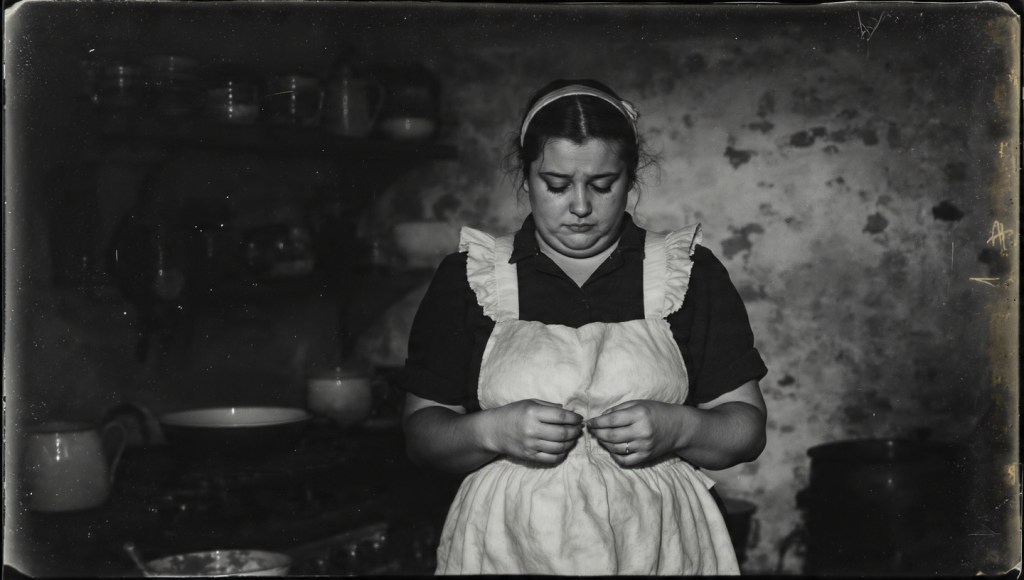
Nora Phipps smoothed her apron, her hands red from the scullery water and trembling just enough to annoy her. She was twenty-two, broad-shouldered and sharp-chinned, a girl who knew the price of coal in Cowes and the exact ache of a letter that hadn’t arrived from South Africa in three months. She did not hold with trembling.
But the house was holding its breath. Everyone knew it, from the Equerries pacing the upper carpets to the boot-boys buffing leather in the basement. The Queen was dying. The word hadn’t been spoken – it was forbidden to speak it, as if naming the thing might summon the Reaper faster – but the silence shouted it.
“Phipps.” The housekeeper’s voice was a dry rustle, like autumn leaves in a gutter. “The veterinary surgeon is at the side entrance. The Lower. See him in. And keep that dog quiet, for the love of God. If the Kaiser hears yapping, we’ll all be turned off without characters.”
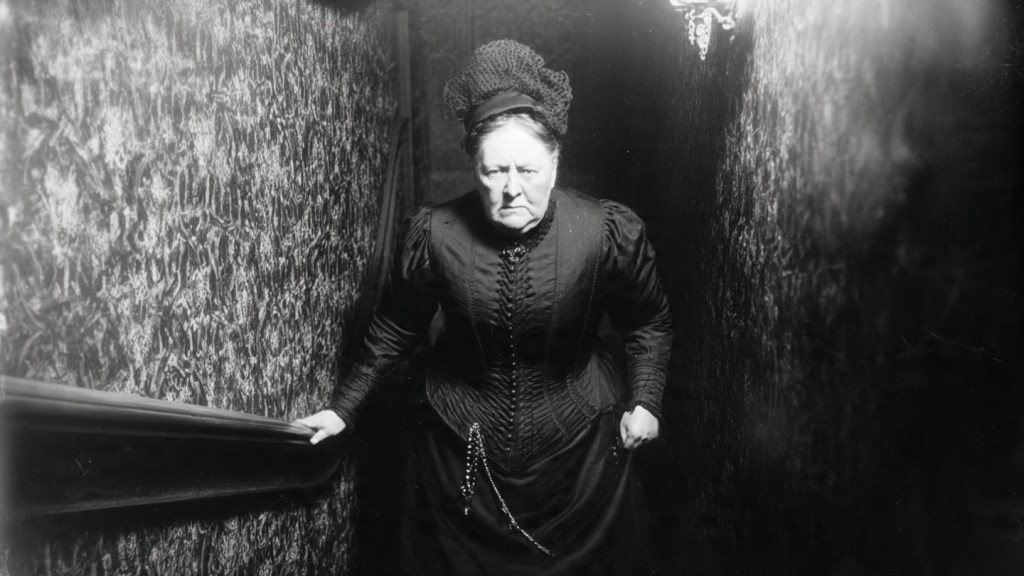
Nora bobbed a curtsy that was more muscle memory than deference. “Yes, Mrs. Tubbs.”
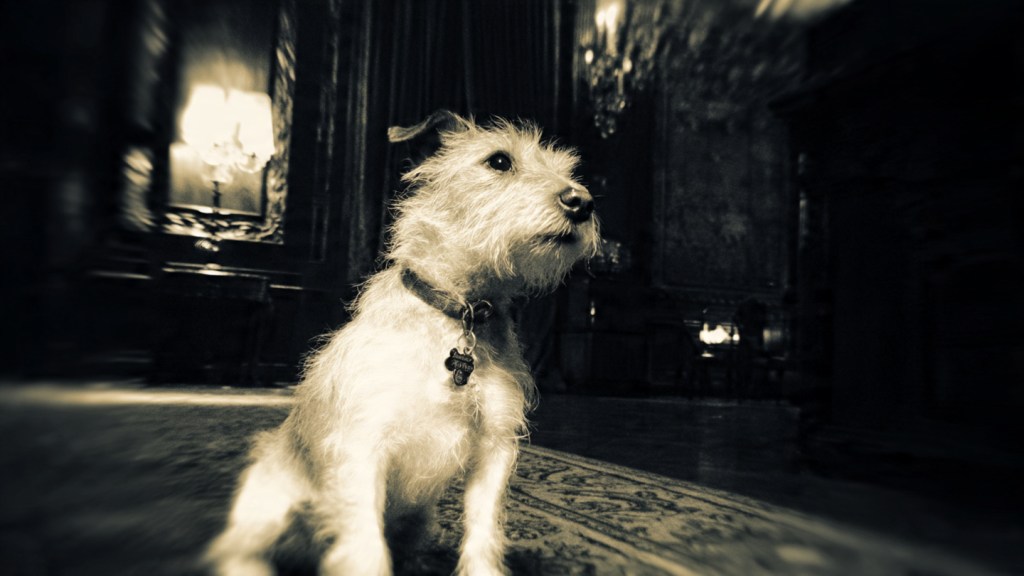
She moved towards the service door, the air in the passage cold and smelling faintly of damp stone and carbolic. At her heels, the little terrier, Sharp, made a sound that was half-whine, half-hiccup. He was a scrap of a thing, wiry hair the colour of toast, with eyes that seemed too large for his skull. He had been frantic since noon, scratching at the skirting boards, his claws tich-tich-tiching on the wood until Nora wanted to wrap him in a blanket just to stop the noise.
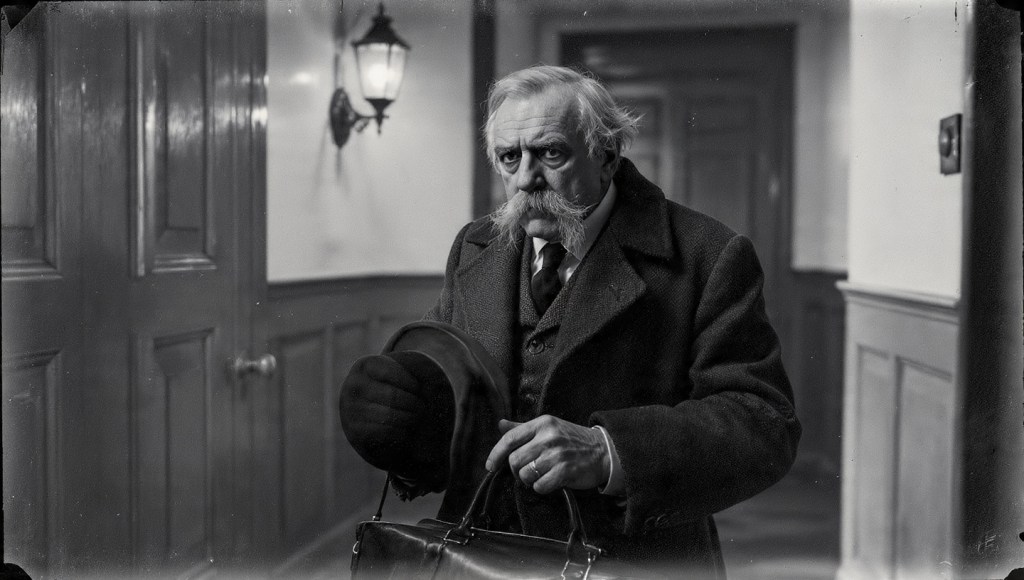
She opened the heavy oak door. The man standing in the mist was older than she expected, his coat heavy with moisture, his hat in his hands. He had a face like a worn saddle – lined, weathered, but kindly. He carried a leather bag that smelled of liniment and horse-oil.
“Dr Bloxham?” Nora asked, keeping her voice low.
“That’s me, lass. Though ‘Bertie’ does for most who know the price of a good drench.” He stepped inside, wiping his boots with a deliberation that suggested he knew exactly how much trouble dirt caused a maid. He looked down. “And this is the patient?”
Sharp didn’t bark. He simply stood, his entire body vibrating like a plucked string, staring up the dark length of the corridor towards the main staircase – the one he was absolutely forbidden to climb.
“He won’t eat, sir,” Nora said, crouching to catch the dog’s collar as he made a lurch forward. “And he won’t rest. He just… watches. It’s like he’s waiting for a train he knows is late.”
Bloxham set his bag down on a bench. He didn’t reach for the dog immediately; instead, he peeled off his gloves, his movements slow and respectful. “Animals know the weather, Miss…?”
“Phipps, sir. Nora.”
“Nora. They know the weather before the sky turns. And the weather in this house is changing, isn’t it?”
He said it quietly, but the truth of it made the skin on Nora’s arms prickle. It was the first honest thing anyone had said to her all day. The Telegram boys had been running back and forth like shuttles in a loom, carrying codes and ciphers, but down here, nobody said Death. They just said Hush.
“He keeps trying to get up the back stairs,” Nora whispered, glancing over her shoulder. “To the Queen’s rooms. We’ve locked him in the pantry twice, but he howls something awful. If he gets out and disturbs the family…”
Bloxham knelt, his knees cracking audibly. He extended a hand, palm up. Sharp ignored it, his nose twitching, his gaze fixed on the shadows beyond the lamp’s reach.
“He’s not sick, is he?” Nora asked. “Not in his belly?”
“His belly’s likely fine,” Bloxham murmured. He gently palpated the dog’s ribs, his hands sure and gentle. “His heart, though. That’s a different matter. A dog is a creature of routine, Nora. When the sun stops moving in the sky, they notice.”
Nora watched the dog. She thought of her brother, Thomas, somewhere on the veldt. She wondered if a dog howled when a soldier fell, or if the world just kept turning, indifferent and cold. The unfairness of it rose in her throat – that this little animal could demand answers with a scratch at a door, while she had to scrub floors and wait for a postman who might never come.
“If you could make him understand one thing,” Nora said suddenly, the words slipping out before she could check them. “If you could speak ‘dog’ for just a minute. What would you tell him?”
It was a foolish question. A child’s question. She braced herself for the doctor to laugh, or to give her a lecture on the distinction between beasts and Christians.
Instead, Bloxham paused. He looked at the closed door at the top of the stairs, then back at the trembling terrier. His eyes were dark, shadowed by the brim of his hat which he’d set on the bench.
“I’d tell him,” Bloxham said, his voice grave, “that doors sometimes close for mercy, not cruelty.”
Nora blinked. “Sir?”
“He thinks he’s being shut out,” Bloxham continued, scratching Sharp behind the ears, a spot that usually elicited a groan of pleasure but now garnered no reaction. “He thinks if he just tries hard enough, scratches deep enough, he can get back to the way things were. He doesn’t know that what’s behind that door isn’t something his loyalty can fix. He wants to be there because he loves, but he’s barred because… well. Because witnessing an end doesn’t stop it happening.”
Mercy, not cruelty.
The words hung in the damp air. Nora looked at the locked door of the pantry where they’d kept him, then at the service stairs that led up to the hush and the crepe and the weeping princesses.
“It feels like cruelty,” she said, her voice tight. “To be left in the dark.”
“It always does, lass,” Bloxham sighed, straightening up. “Until the light comes back, and you realise the dark was the only place you could hide your eyes.”
He reached for his bag, and as he did, his coat swung open. Nora saw it then – just a flash in the gloom of the corridor. Tucked into his waistcoat pocket wasn’t a watch, or a thermometer. It was a small, violet envelope. The paper was thick, expensive – the kind used by the Royal Household for private correspondence, not stable orders. And it was sealed with black wax.
He saw her look. He didn’t flinch, but his hand moved instinctively to cover the pocket, buttoning his coat with a swift, practised motion.
“Now,” he said, his tone brisk, shifting back to the professional. “I have a tincture of valerian. It smells like old socks, but it might settle him. Do you have a quiet corner? Somewhere away from the drafts?”
Nora looked at his face. The kindness was still there, but the openness was gone. The door had closed again. He was carrying something – a message, a secret, a final instruction from a room where the Queen was breathing her last? She nodded slowly.
“The linen room, sir. It’s warm there. And quiet.”
“Lead on, Nora,” he said.
Sharp gave a low, mournful whine and pressed his flank against Nora’s ankle. She looked down at him, then up the stairs one last time.
Mercy, she thought bitterly. Or just another way of keeping us from seeing the truth.
“Come on then, Sharp,” she said softly. “Let’s get you out of the way. That’s what we’re best at, isn’t it?”
The linen room was a kingdom of white. Sheets, starched stiff as sailcloth, were stacked in pillars that reached the ceiling, smelling of lavender and the iron-hot press. It should have been a sanctuary, but tonight it felt like a waiting room.
Dr Bloxham measured the valerian with a steady hand, counting the drops into a saucer of milk. “Three, four, five. That ought to take the edge off.”
Sharp didn’t want the milk. He paced the small square of floor between a basket of damask napkins and the copper warming-pans, his claws clicking a frantic Morse code. Dash-dot-dash. Let-me-out.
“He knows,” Nora said, sitting on a stool and watching the dog. The gas jet hissed above them, casting long, wavering shadows. “It’s not just nerves, is it, Doctor? It’s like the house is humming a note only he can hear.”
Bloxham capped the bottle. “Animals live in the ‘now’, Nora. We humans, we’re always dragging the past behind us or tripping over the future. But a dog? A dog is pure present tense. And the present tense of this house is… unsettled.”
“Unsettled,” Nora repeated, testing the word. It was a polite word for dying. “Mrs Tubbs says the Kaiser is eating roast beef in the Dining Room while his grandmother is fighting for breath upstairs. That’s more than unsettled. That’s unnatural.”
“Kings and Kaisers have stomachs, same as the rest of us,” Bloxham said, though his eyes didn’t meet hers. He was checking his pocket watch, thumbing the catch repeatedly without opening it.
Nora saw the gesture. She remembered the violet envelope.
“You’re not just here for the dog, are you?” she asked. The boldness of it surprised her. A housemaid didn’t question a gentleman, even a veterinary one. But the air in the room was thin, brittle. The normal rules felt suspended, like a clock stopped at midnight.
Bloxham looked at her then. He didn’t bluster or scold. He looked tired. “There are debts, Nora. Old promises. Sometimes a man is called to do a thing simply because he is the only one who remembers the way the path used to run.”
He didn’t explain. He didn’t need to. Nora knew about old promises. She had promised Thomas she’d keep his Sunday best suit brushed and ready for his return. She brushed it every week, even though the wool was thinning and the moth-balls made her eyes water.
“Is it… is it for Her?” Nora whispered.
“It is for a friend,” Bloxham said firmly. “And that is all a man needs to say.”
He offered the saucer to Sharp again. This time, the terrier lapped at it, half-heartedly, his tongue flicking the white liquid. But his ears remained pricked, swivelling towards the door.
Suddenly, the dog froze. His head snapped up. He didn’t growl; he simply stiffened, every muscle locking into place.
From the corridor outside came the sound of footsteps. Not the scurrying of maids or the heavy tread of footmen. These were boots. Hard, military heels striking the floorboards with authority.
Nora stood up. “That’s not household,” she hissed.
“Stay here,” Bloxham ordered, his voice suddenly sharp.
But the door wasn’t latched. As the footsteps passed, Sharp lunged. He hit the wood with his shoulder, scrabbling at the gap, squeezing his small body through before Nora could grab his tail.
“Sharp! No!”
She wrenched the door open. The corridor was dim, lit only by a single lowered sconce. A figure was walking away from them – a tall man in a dark frock coat, his posture rigid. He wasn’t a soldier, Nora realised, but he walked like one. He was carrying a leather dispatch box.
Sharp was trotting behind him, not barking, but following with a desperate, silent intensity.
“He’ll go up,” Nora gasped. “If he follows him to the Main Wing… the Kaiser’s guards are on the landing. They’ll kick him.”
“Nora, wait – ” Bloxham started, reaching for her arm.
She shook him off. “He’s my responsibility, Doctor. Mrs Tubbs said if he yaps, I’m out.”
She ran. Not a run – maids didn’t run – but a swift, silent glide, her skirts gathered in one hand. The corridor twisted, leading away from the service quarters towards the transition point – the heavy baize door that separated the servants from the silence of the Royal apartments.
The man ahead opened the baize door. He didn’t look back. Sharp slipped through the closing gap like a shadow.
Nora reached the door and hesitated. The brass handle was cold. Beyond this point lay the world of velvet and hushed voices, of princes and physicians. To enter unbidden was dismissal, instant and without character.
Mercy, not cruelty.
But leaving the dog to be kicked or thrown out into the winter night – that was cruelty.
She pushed the door.
The air on the other side was different. It smelled of hot wax, lilies, and something medicinal – ether, perhaps, or brandy. The carpet was thick, swallowing her footsteps completely.
The man had vanished. But Sharp was there, halfway down the corridor, sniffing at the base of a tall mahogany door. He wasn’t frantic anymore. He was shivering, his tail tucked low.
Nora crept forward. “Sharp,” she whispered. “Come here, you daft thing.”
She was five feet away when the mahogany door opened.
Nora froze, shrinking back against a tapestry.
A woman stepped out. She was dressed in black silk, heavy and rustling. Her face was pale, her eyes red-rimmed but dry. It was Princess Beatrice, the Queen’s youngest. The daughter who had never left.
She didn’t see Nora in the shadows. She looked down at the dog.
Sharp looked up at her. He gave a small, pitiful wuff.
The Princess didn’t shoo him. She didn’t call for a footman. She stood there, her hand on the doorknob, looking at the terrier with an expression of such naked desolation that Nora had to look away.
“He knows,” the Princess whispered. She wasn’t speaking to the dog. She was speaking to the air. “Everyone is waiting for the end, but he… he is waiting for her.”
She knelt. It was a shocking movement – a Royal Princess, sinking to her knees on the corridor carpet. She reached out a hand, her fingers trembling, and touched Sharp’s head.
“She cannot see you, little one,” she said, her voice cracking. “She cannot see anyone now.”
Nora held her breath. This was the secret heart of the house. Not the politics, not the telegrams, not the Kaiser eating beef. This. A daughter and a dog, united in the helplessness of watching a door that would not open.
Then, the Princess stiffened. She looked up, her eyes narrowing as she scanned the shadows.
“Who is there?”
Nora stepped forward. There was no point hiding. “It’s me, Your Highness. Phipps. The… the dog, ma’am. He got away.”
She expected anger. She expected to be ordered out.
Princess Beatrice stood up, smoothing her silk. The mask of royalty slid back into place, but it was thinner now.
“Take him,” she said. Her voice was flat. “Take him away. He… he distresses the doctors.”
“Yes, ma’am.” Nora scooped Sharp up. He was dead weight in her arms, all the fight gone out of him.
“Phipps,” the Princess said, as Nora turned to go.
“Ma’am?”
“Does he… does he understand? Why he cannot go in?”
Nora looked at the Princess. She thought of Dr Bloxham’s words. Mercy, not cruelty.
“I think, ma’am,” Nora said, her voice steady, “he understands that he is waiting. And that waiting is a kind of love, too.”
The Princess closed her eyes for a second. “Yes,” she whispered. “Yes. Go.”
Nora hurried back towards the baize door, clutching the dog tight. Her heart was hammering against her ribs. She burst through into the service corridor and nearly collided with Dr Bloxham.
He was standing there, pale and anxious. But he wasn’t looking at her. He was looking at the violet letter in his hand. He had broken the seal.
“Nora,” he said, and his voice was rough. “You saw?”
“I saw… nothing,” Nora said, breathless. “Just the Princess. Sending the dog away.”
Bloxham looked at her, searching her face. Then he nodded. He held out the letter.
“Burn this,” he said.
“Sir?”
“It’s not a message for the living, Nora. It was… it was a goodbye. From someone who wasn’t allowed to say it in person. I was meant to give it to the Dresser, to slip under her pillow. But it’s too late.”
He looked at the baize door.
“The Queen is dead,” he said softly. “The bell hasn’t rung yet. But she’s gone.”
Nora looked at the letter. A secret grief, from someone outside the circle, trying to reach the centre before the end. Just like Sharp.
“Who?” she asked.
“Does it matter?” Bloxham asked gently. “Love doesn’t always have a title.”
Nora took the letter. She could feel the heat of his hand on the paper. She looked at Sharp, huddled in her arms, and then at the closed door that hid a dead Queen and a weeping daughter.
“No,” she said. “I suppose it doesn’t.”
She walked towards the scullery, where the fires were always burning. She had a letter to burn, and a dog to comfort. The world had changed. The era was over. But the work – the washing, the comforting, the keeping of secrets – that went on.
The scullery fire was banked low for the night, a slumbering bed of orange coals behind the black iron grate. It was the only place in Osborne House that felt truly warm, a heat that got into the bones rather than just hovering near the velvet curtains.
Nora stood before it, the violet letter heavy in her apron pocket. Sharp sat at her feet on the flagstones. He was no longer shivering, but he held his head low, his chin resting on his front paws, his eyes fixed on the grate as if he could see pictures in the embers.
“It’s a sin to burn a letter unread,” Nora whispered. It was something her mother used to say about the Bible, but it felt true of this, too. A letter was a voice. To burn it was to silence a ghost.
She took the envelope out. The wax seal was black – mourning before the fact. The handwriting was spidery, frantic. For Her hand only.
Dr Bloxham stood by the scullery door, his hat back in his hands. He looked older than he had an hour ago. The damp air of the Solent seemed to have settled in the creases of his face.
“It’s not a sin, Nora,” he said softly. “It’s a kindness. Some words are too heavy for history to carry. They belong to the fire.”
Nora looked at the letter one last time. She thought of the Princess on her knees in the corridor, weeping for a mother who could no longer see her. She thought of her own brother in South Africa, writing letters that might end up in a muddy ditch, unread.
“Who was it from?” she asked, not really expecting an answer.
“Someone who loved the woman, not the Queen,” Bloxham said. “And there’s no room for that in the newspapers tomorrow.”
Nora nodded. She opened the grate with the tip of the poker. The heat flared against her cheeks. She dropped the letter onto the coals.
For a moment, the violet paper resisted. Then the edges curled, brown and brittle, and a blue flame licked up the side. The black wax bubbled and ran like ink. In seconds, the secret was gone, turned to grey ash that crumbled into the rest of the coal.
“There,” Nora said, the word tasting of ash. “It’s done.”
As if the fire had been a signal, a sound rippled through the house. It started high up – a door opening, a heavy footfall, a voice raised not in anger but in command. Then came the sound that stopped the heart: the great clock in the hall began to chime, but it was drowned out by the sudden, heavy tolling of a bell from the stables.
Dong.
Sharp lifted his head. He didn’t whine. He simply listened.
Dong.
“She’s gone,” Bloxham said. He put his hat on, pulling the brim low. “The King is King now.”
The air in the scullery changed. It wasn’t just the draft from the door. It was the sudden, crushing weight of the future arriving. The Victorian age had ended in the time it took to burn a piece of paper.
“I should go,” Bloxham said. “Before the gates are locked. They’ll be posting sentries.”
He looked down at the dog. “He’ll need watching, Nora. Grief makes creatures do strange things. They look for the gap in the fence.”
“I’ll watch him,” Nora said.
Bloxham paused, his hand on the latch. He looked at her with a strange expression – respect, perhaps. “You’re a good girl, Phipps. You understand the quiet work.”
“Goodnight, Doctor.”
He slipped out into the mist, leaving her alone with the dog and the dying fire.
Nora sat down on the rag rug beside Sharp. The house above them was waking up to its new reality. She could hear the muffled thud of running feet – footmen, doubtless, sent to wake the bishops and the cabinet ministers. The telegrams would be flying now. The Queen is dead. Long live the King.
But down here, it was just silence.
Sharp nudged her hand with his wet nose. He let out a long, shuddering sigh, the kind that comes after a long bout of crying.
Nora stroked his ears, the velvet soft under her rough fingers. She remembered the question she had asked in the corridor, foolish and desperate. If you could make him understand one thing…
She looked into the dog’s dark, liquid eyes. He wasn’t looking for the door anymore. He was looking at her. He was waiting for the world to make sense again.
“Listen to me, you daft scrap,” she whispered, her voice thick.
She pulled him into her lap, burying her face in his neck. He smelled of dog and damp wool and the valerian milk he hadn’t drunk.
“The door is closed,” she told him, speaking the words clearly, as if he were a Christian soul who could take comfort in them. “But it’s not because you were bad. And it’s not because she didn’t love you.”
Sharp licked her chin, a small, tentative gesture.
“It’s just that some doors… they don’t open from this side,” Nora said. “And staying outside, scratching at the wood… that doesn’t help Her. It only hurts you.”
She thought of the letter burning in the grate. That had been scratching at the door, too. Trying to reach across the divide.
“You have to wait,” she said, smoothing the fur along his spine. “That’s the hard bit, Sharp. You have to wait here, with the rest of us. And you have to eat your supper. Because if you starve yourself, you’re not loyal. You’re just another thing for the House to worry about.”
It wasn’t poetry. It wasn’t the sort of thing a Vicar would say. But it was the truth.
Sharp seemed to consider this. He rested his head on her knee, his body heavy and warm. The frantic tension that had vibrated through him all day began to unspool. He closed his eyes.
Nora sat there for a long time, while the bell tolled sixty-three times, once for every year of the reign. She counted them, automatically. At the end, the silence that followed was deafening.
She shifted her legs, which were going numb. She reached for the saucer of milk Bloxham had left on the floor. It was cold now, a skin forming on the top.
“Go on then,” she said, nudging the bowl towards the dog. “For me. Not for Her.”
Sharp opened one eye. He looked at the bowl. Then he looked at the door leading to the upper house, where the King was reigning and the Queen was cooling. Then he looked back at Nora.
Slowly, stiffly, he got to his feet. He stretched, a long bow of his spine. He lowered his head and began to lap the milk.
Slap, slap, slap.
The sound was loud in the quiet room. It was a common, messy, living sound.
Nora leaned her head back against the warm bricks of the fireplace and closed her eyes. Tears finally leaked out, hot and fast, tracking through the soot on her cheeks. She cried for the Queen, and for her brother Thomas, and for the letter that was ash, and for the fact that tomorrow she would have to get up at five and scrub the front steps because the world kept turning.
But the dog was eating. And for tonight, that was enough mercy to be getting on with.
Queen Victoria died at Osborne House on the Isle of Wight at 6:30 p.m. on 22nd January 1901, at the age of 81. Her death ended a reign of nearly 64 years, the longest in British history until surpassed by Elizabeth II in 2015. The event marked the conclusion of the Victorian era, a period of immense industrial, political, and scientific change during which the British Empire expanded to cover roughly one-quarter of the world’s land surface and population. Her son, Edward VII, succeeded her, ushering in the Edwardian period. Victoria’s funeral on 2nd February 1901 involved one of the largest gatherings of European royalty in history, signalling the twilight of a monarchical network that would largely collapse within two decades during World War I.
Bob Lynn | © 2026 Vox Meditantis. All rights reserved.

 Vox Meditantis
Leave a comment