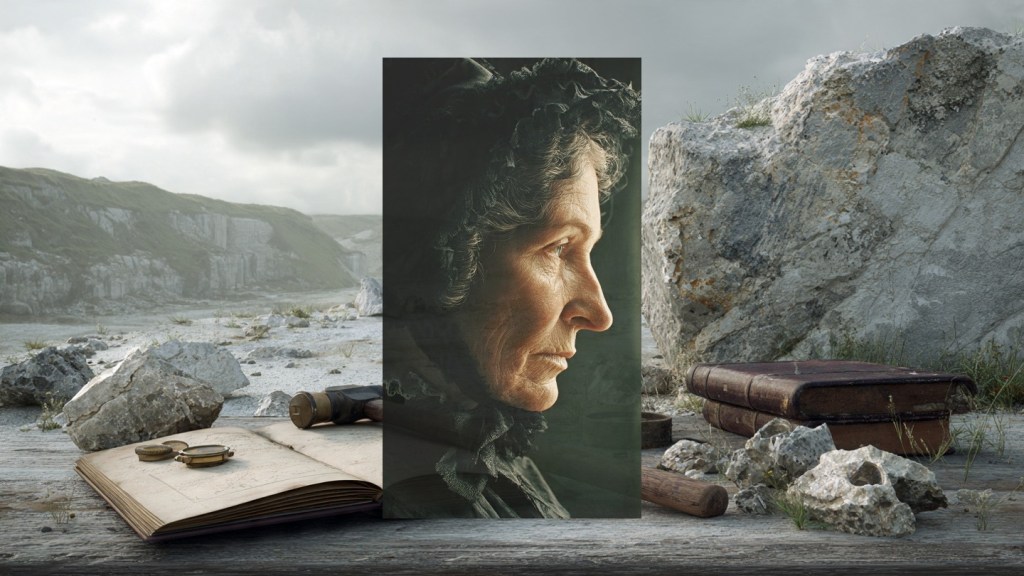
This interview is a dramatised historical reconstruction based on extensive primary and secondary sources, including Etheldred Benett’s surviving correspondence, publications, and contemporary accounts. While every factual claim is grounded in documented evidence, the dialogue and interior reflections represent informed interpretation where historical records are silent – a narrative designed to make her overlooked contributions and lived experience visible to modern readers.
Etheldred Anna Maria Benett (1776–1845) was an English palaeontologist and biostratigrapher who, despite her exclusion from the scientific institutions of her time, assembled one of the most significant fossil collections of the early nineteenth century and pioneered methodologies that would become foundational to modern geology. Working in rural Wiltshire from 1809 until her death, she documented the Cretaceous strata of southern England with precision and insight that rivalled – and in some cases exceeded – her male contemporaries. Though her collection was lost for a century after her death, its rediscovery in 1989 has gradually restored her to the geological record, revealing a mind of extraordinary clarity, resilience, and scientific rigour.
Miss Benett, what an extraordinary privilege. Here we are in 2026 – more than one hundred and eighty years since your death – and your work has been fully recovered, your collection restored, and the scientific community has at last begun to recognise your contributions to geology. I confess, when I first encountered your 1831 monograph, I was impressed by the precision of your stratigraphic observations and the quality of your illustrations. How does it feel to be, in some sense, discovered anew?
Discovered anew? That is a generous phrase. I fear the more accurate description is that I have been rediscovered – which suggests I was once known, then forgotten, and now – finally – remembered by those who trouble themselves to look. The notion that my work required two centuries to be properly valued is, I must confess, rather provoking. Though I confess I am gratified that my collection survived at all. When it departed for Philadelphia, I had little confidence it would be treated as anything more than a curiosity.
You knew it would be sold after your death?
I suspected as much. I had no children, no husband to advocate for my work, and no institutional affiliation that might have secured the collection within a British museum. I was sixty-eight when I drew my final fossils. The collecting itself had become difficult – illness confined me increasingly to correspondence and commission. Thomas Wilson’s purchase seemed, at the time, a merciful alternative to dispersal or destruction. That it vanished from view for a century – well. That is rather a fitting metaphor for my own career, is it not?
Let’s begin with your earliest influences. You were born into considerable privilege, yet it was geology that captured your imagination. What drew you to fossils?
My entry into the study of fossils was, I must admit, somewhat circumstantial. My sister Anna Maria and I were living at Norton House by the time I had reached thirty years of age. My brother had entered Parliament, my mother had passed, and I found myself with both time and means. The countryside around Warminster offered plenty of curiosity to occupy an active mind – the Greensand quarries, the visible strata, the strange objects eroding from the chalk.
It was Aylmer Bourke Lambert who truly opened my eyes. He was a gentleman of considerable learning – a botanist, a founder of the Linnean Society – and he had married into my family. He was an avid fossil collector himself, and he possessed that rarest of gifts: the ability to discuss science with a woman as though she possessed a functioning intellect. Most gentlemen do not. He introduced me to the work of Mr. Sowerby and the Geological Society’s publications, and he encouraged my collecting with genuine respect for my observations.
But I think what drew me most profoundly was the puzzle of it. Here were the remains of creatures – some resembling nothing alive in our modern seas – embedded in layers of rock. The rocks themselves varied in character from layer to layer: some were clay, some stone, some bearing iron or silica in different proportions. The position of a fossil within those layers seemed to mean something. There was order beneath what appeared chaos. And I determined to understand it.
That sounds like the birth of biostratigraphy itself – the principle that different rock layers contain characteristic fossil assemblages that can be used to correlate and date strata across geographic distances. Yet when you began this work around 1809, that framework didn’t formally exist, did it?
Precisely. William Smith had published his observations about strata and the fossils they contained, but there was no unified language, no systematic method. Each geologist seemed to approach the problem afresh, with his own nomenclature and classifications. I began simply: I collected specimens from the quarries near Tisbury and Warminster, and I noted where I had found them – not merely the general locality, but the precise layer within the quarry face, the depth below the surface, the surrounding rock.
Most collectors took no such care. They would extract a specimen, perhaps record which quarry, and then move on. But I reasoned that the location within the sequence was as important as the specimen itself. A fossil found ten feet below the surface might represent a different time period than one found fifty feet below. If I could establish the order and character of the layers, and catalogue the fossils within each, I might construct a stratigraphic section – a record of Earth’s history written in stone and bones.
And this led, in 1815, to your commissioning of the first measured, bed-by-bed stratigraphic section of the Upper Chicksgrove Quarry. That was a revolutionary document. Walk us through what you did, and why it mattered.
The Upper Chicksgrove Quarry near Tisbury was one of the most productive sites I had access to. The quarry face exposed strata extending from the surface down perhaps a hundred and forty feet or more. Each stratum differed in composition, thickness, and fossil content. The difficulty was representing this accurately on paper in a way that preserved the numerical relationships.
I hired a draughtsman – I had the means to do so, unlike most of my peers – and we approached the quarry with measuring instruments. We would identify a natural break in the lithology – a change from one rock type to another – and we would measure the thickness of each bed using a standard measuring rod. Two feet here, three inches there. We recorded the colour and character: “Upper Greensand, medium-grained, greenish” or “sandy clay, light brown, with scattered glauconite.”
Then – and this was the crucial step – we collected all the identifiable fossils from each distinct layer and associated them with that specific bed. A sponge fragment could now be labelled not merely as “from Chicksgrove” but as “from the eighteen-inch bed between the forty-two and forty-four foot depths.” This created a stratigraphic column – a vertical record showing the sequence and proportions of the layers.
What made this method superior to what others were doing?
Precision, primarily. Most descriptions of quarries were qualitative: “thick beds of sandy clay containing fossil shells.” My section quantified the thickness of each stratum and created a visual representation that could be compared to sections from other localities. If another geologist measured strata at a quarry fifty miles away and found a similar sequence of layers with similar fossils, we could correlate them – recognise them as the same geological event, the same deposition, separated only by geography.
Furthermore, the method was reproducible. Another competent observer could return to Chicksgrove a decade later, remeasure the same section, and verify my observations. Science requires such verification. Most fossil collecting, by contrast, was essentially anecdotal: one gentleman’s collection of pretty objects, valued only by that gentleman’s reputation.
I notice you say “most” fossil collecting, but you yourself were a collector. How did your approach to collecting differ from the prevailing amateur naturalism of the era?
Ah, you’ve caught the distinction I was obliquely making. You are quite right. I was a collector, yes. But I was attempting to convert collecting into a systematic science. I was not content merely to accumulate curiosities. I wished to understand patterns.
Consider the ammonites I found. They are beautiful spiralled shells, quite arresting to the eye. Many collectors valued them chiefly for their aesthetic appeal or as evidence of ancient life. But I began to notice that different species of ammonite appeared in different layers. A particular species would be abundant in one stratum, entirely absent in another, and then reappear higher up. I began to sketch these variations and to hypothesise about them.
I called certain forms “drepanites” – from the curved shape. I recognised that the appearance of a particular drepanite in a specific layer, in combination with particular species of molluscs and sponges, created a signature – a recognisable assemblage that marked that time period. If I found the same assemblage in another quarry, I could confidently assert they were contemporaneous, that they had been deposited at the same time, even if separated by miles.
This is not mere collecting. This is the foundation of biostratigraphic correlation. It requires patience, systematic observation, and the intellectual discipline to recognise patterns that others might overlook.
Did you use statistical methods? How did you determine whether a pattern was genuine or coincidental?
Statistics as a formal discipline was hardly developed in my time. I relied on repetition and correlation. I would examine the same stratum across multiple quarries. If a fossil assemblage appeared consistently, I could be reasonably confident of its significance. If a particular species appeared only once or twice, I was cautious about drawing conclusions.
The true test was predictive power. If my understanding of the stratigraphic sequence was correct, I should be able to enter a new quarry, identify the rock type and its fossils, and predict what layers lay above and below, even if they had not been excavated. When my predictions proved accurate – and they usually did – I gained confidence in the framework.
Of course, I had failures. I made observations that seemed significant but proved isolated. I misidentified specimens on occasion. But I always returned to the evidence, revised my understanding, and proceeded forward.
Your 1831 monograph represents the culmination of more than twenty years of this work. It contains original taxonomic descriptions, detailed drawings, and stratigraphic correlations across Wiltshire. Yet it was self-published in small runs and distributed privately. Why not submit it to the Geological Society for formal publication?
Because the Geological Society would not admit me as a member. How could I publish under their auspices when I was explicitly barred from their premises? Women were not permitted to attend lectures, to present papers, or to participate in the formal mechanisms through which the Society recognised and validated scientific work.
So I printed the monograph privately and distributed it to those colleagues with whom I had established correspondence: Gideon Mantell, George Bellas Greenough, William Buckland, and others. I sent copies abroad – to Russia, I believe, though I was never certain they arrived safely. It was a makeshift solution, but it was the only avenue available to me.
I will not pretend this was entirely satisfactory. A formal publication through the Geological Society would have granted my work a legitimacy it could not obtain through private distribution. But I was not powerless, and I was not silent. I found a way to share my work, even if the channels through which I shared it were necessarily unconventional.
James Sowerby published your stratigraphic section of Chicksgrove in his Mineral Conchology without your knowledge or explicit permission. How did you respond?
With considerable irritation, I assure you. I had granted Sowerby access to my materials and allowed him to examine my section. I did not grant him the right to publish it under his own interpretation or to omit my involvement. When I discovered what he had done, I made my objections clear.
More significantly, I reviewed his interpretation of the strata and found it wanting in several particulars. He had misread certain of the layer boundaries and had drawn conclusions about the fossil assemblages that my more extensive collecting did not support. I wrote to correct him, setting forth my own observations in detail.
I have always believed that being proved wrong in the interests of advancing truth is preferable to being coddled in an error. But I expected the same intellectual rigour from my male colleagues. Some possessed it. Others – I regret to say – seemed more invested in defending their reputations than in pursuing accuracy.
Did Sowerby acknowledge your corrections?
Partially. He was not unreasonable, but neither was he eager to cede ground unnecessarily. In the end, the truth lay in the fossils themselves and the strata they inhabited. Time and more careful examination would vindicate one interpretation or the other. That was what mattered to me – not credit, but correctness.
Though I confess it would have been gratifying to receive credit as well.
Your collection eventually included more than fifteen hundred specimens. How did you source them, and what was your criteria for acquisition?
I collected specimens myself when my health and strength permitted, which was the entirety of my earlier career. I would spend days in the quarries, examining freshly exposed strata, extracting fossils carefully, and recording their precise location. As I grew older and illness became more of an impediment, I engaged professional collectors – men who worked in the quarries and understood how to extract specimens without destroying them.
I also commissioned the preparation of certain specimens. A fossil might emerge from the rock encased in matrix – the surrounding stone. A skilled preparator could carefully remove the extraneous stone to expose the fossil itself, revealing details that would otherwise remain obscured.
My criteria for acquisition evolved as my understanding deepened. Initially, I collected anything novel or well-preserved. But as I refined my stratigraphic framework, I became more selective. I sought specimens that would fill gaps in known assemblages, that would help me understand the distribution and variation within a particular taxon, or that demonstrated unusual preservation of soft tissues.
Those latter specimens were particularly precious. Most fossils represent only the hard parts – shells, exoskeletons, bones. But occasionally, under the right conditions, softer tissues – muscle, skin, even internal organs – could be preserved in remarkable detail. Such specimens were rare, and I was determined to secure them whenever they came to light. They offered insights into anatomy that could otherwise only be inferred.
Your collection included trigoniid bivalves – clams – with soft tissue preserved. These were extraordinary discoveries. Can you describe what you found?
The trigoniids are a fascinating family of bivalves. Most specimens are found as mineralised shells, which is valuable enough – the shells themselves reveal much about the creature’s form and the environment it inhabited. But the specimens I discovered in the Upper Greensand were remarkable because they preserved evidence of the organism’s soft anatomy.
The preservation occurred through a process I did not fully understand then – and which I suspect geologists have only more recently come to comprehend fully – involving iron oxide and clay minerals. When the creature died, it was buried rapidly in sediment rich in iron compounds. The iron apparently interacted with the decaying tissues in such a way as to create a sort of mould or cast of the internal structure.
When we examined these specimens closely, we could see impressions of the creature’s musculature, the adductor muscles that closed the shell, and even traces of the internal anatomy – features that would normally decay and disappear entirely. It was as though we possessed a anatomical dissection conducted by time and chemistry rather than by a naturalist’s knife.
I recognised that such specimens were of immense value. They allowed one to reconstruct the living creature in a way that shell alone could not. They answered questions about form and function that would otherwise remain speculative. And they were desperately rare. In all my years of collecting, I found only a handful of such examples.
You were also among the first geologists to sieve sediments for microfossils. How did you develop that technique, and what did you discover?
This emerged from an observation rather than from any theoretical framework. I was examining sediment from certain layers – not the consolidated rock itself, but looser material – and I noticed that when I rubbed it between my fingers or placed it in water, very small shells became visible. These were orders of magnitude smaller than the macrofossils I typically collected, yet they were abundant and seemed to occur in particular assemblages.
The logical extension was to develop a method to isolate them systematically. I constructed a series of sieves – frames with meshes of progressively finer openings – and passed the sediment through them. The finer mesh would retain the microscopic specimens, which could then be sorted and examined.
Most geologists ignored such tiny objects. They were considered insignificant – impurities in the sediment, not genuine fossils of scientific value. But I theorised that their very abundance and distribution might make them valuable as stratigraphic markers. A particular layer might contain thousands of a particular microfossil species, far more densely distributed than any macrofossil.
I confess I did not possess the optical instruments to examine these specimens in the detail that might have been possible. My eyesight, while adequate for my purposes, was not exceptional. But I preserved the specimens, grouped them by layer, and documented their distribution. I suspected – though I could not then prove – that these tiny fossils might eventually prove of great utility.
And indeed, they have. Microfossils are now among the most important tools in petroleum geology and stratigraphy. The oil industry uses them routinely to date and correlate subsurface strata, sometimes from samples just millimetres in size. Your technique, pioneered without any knowledge of its ultimate application, became foundational to an entire field of geological practice.
How remarkable. So my humble sieving – undertaken with simple household implements and constrained eyesight – contributed indirectly to an industry of which I could not have conceived. I wonder if Mr. Sowerby or any of my contemporaries who dismissed these efforts as trifling would have taken them more seriously had they possessed a crystal ball revealing their future utility.
Though I confess, I am not entirely surprised. I have always believed that rigorous observation of nature, pursued with genuine curiosity, eventually yields insights of value. One need not understand the application to recognise that the observation itself is sound.
Let’s talk about the institutional barriers you faced. You were explicitly barred from membership in the Geological Society. How did this constrain your work, and how did you navigate it?
The exclusion was not merely symbolic. It was profoundly practical. The Society maintained a library of geological works, a forum for discussing recent discoveries, and a network through which news of significant findings circulated. Members could present their work formally, receive critiques, and engage with peers in real-time.
I had access to none of this. Any engagement with the Society’s resources occurred through intermediaries – male colleagues who would fetch papers on my behalf or convey my observations to other members. It was cumbersome and inefficient, and it positioned me perpetually as a secondary participant in the scientific conversation.
But I adapted. I cultivated correspondence networks. William Smith, the father of English geology, knew of my work. Gideon Mantell exchanged fossils with me extensively and valued my observations. When I had significant findings, I communicated them through letters. When I needed to refute an interpretation I found erroneous, I wrote directly to the responsible party or to a trusted colleague.
These networks were real. The correspondence was substantive. I was not isolated from scientific discourse – but neither was I fully integrated into it. I was always on the periphery, always dependent on the goodwill and intellectual honesty of male colleagues. Had any of them been inclined to appropriate my observations or to ignore my contributions, I would have had little institutional recourse.
Did that ever happen? Were your observations appropriated?
Sowerby’s unauthorised publication of my stratigraphic section comes closest to outright appropriation, though I would not call it theft – he did acknowledge that the work was based on material I had provided. Other incidents were more subtle. I would express a theory in correspondence, and months later, I would encounter the same theory presented in published form by a male colleague, with no acknowledgment of our prior discussion.
Whether this was deliberate or thoughtless, I cannot say. I chose to interpret it generously – as the natural result of how knowledge circulates in informal networks, without clear attribution. But I confess the pattern wore upon me. I took care, in my later correspondence, to be precise about dating my observations and recording them in writing, in case questions of priority should arise later.
I did not live to see most of these matters resolved. But I hope that future students of geology will be able to examine the documentary record and perceive my contributions clearly.
Your unusual first name – Etheldred, one letter away from the male “Ethelred” – caused confusion that, in an ironic twist, sometimes worked in your favour. Tsar Nicholas I, viewing your collection, apparently believed you were a man and granted you an honorary Doctorate of Civil Law from the University of St. Petersburg. How did you feel about receiving recognition based on a misunderstanding?
It is profoundly provoking that the only university doctorate offered to me in my lifetime was granted because the grantor believed me to be male. As I wrote to a friend at the time, I was apparently “Master Etheldredus Benett” to the Russians – a gentleman of considerable learning. Had I actually been permitted to attend a British university and earn such credentials through legitimate study, perhaps I would have been granted membership in scientific societies. Instead, I remained Miss Benett, excluded from those very institutions, yet honoured by a foreign potentate who had mistaken my sex.
The irony is almost absurd. My work was apparently valuable enough to merit recognition by the Imperial Natural History Society of Moscow. My collection was apparently significant enough to merit examination by a Tsar. Yet the Geological Society of London – the primary repository of geological knowledge in my own country – regarded my admission as a woman as utterly unthinkable.
Did you consider the doctorate to be a genuine achievement, despite the circumstances?
In practical terms, it was largely symbolic. The credential meant little in Britain, where it was not granted by a recognised British institution. But it was useful as evidence that my work was being noticed beyond my immediate circle. When I mentioned it in correspondence, it lent a certain weight to my observations. “Even foreign scholars recognise the value of this work,” I could imply, without stating it so baldly.
But I also recognised it as a reminder of the absurdity of my position. I was worthy of international recognition yet barred from the society in my own country. That contradiction seemed to me to speak volumes about the arbitrary nature of the exclusion I faced. It was not that women lacked capacity for scientific understanding – the Tsar apparently believed me to possess considerable capacity. It was that British society had decided, on principle, to bar women from participation.
Let’s discuss your observations about women’s capacity for science, since you clearly had strong views on the subject.
I made a statement in one of my letters that I think bears repeating: “Scientific people, in general, have a very low opinion of the abilities of my sex.” This was not an abstract complaint. It was based on direct experience. I observed that the same capacities for observation, reasoning, and documentation that were praised in male geologists were dismissed or minimised when exercised by women.
Consider collecting itself. When a gentleman assembled a large fossil collection, he was praised as a man of scientific acumen, someone whose efforts had advanced knowledge. When I assembled a collection many times larger than most male geologists possessed, I was regarded as an industrious amateur with exceptional resources, someone who had collected “well” in the way one might sew “well” – a pleasant accomplishment for a person of leisure.
The discrepancy was not in my actual achievements or capabilities. It was in the interpretation placed upon them by the society I inhabited. Women’s scientific work was, by definition, viewed through a diminishing lens. We were thought to be capable of gathering facts but incapable of synthesising them into theories. Capable of observing but incapable of reasoning. Capable of illustrating but not of interpreting.
This is pure prejudice, not based on evidence. I have reasoned about my observations. I have synthesised them into frameworks. I have developed theories about stratigraphic correlation that my male colleagues – eventually – came to accept as valid. And yet the prejudice persists.
Do you think being unmarried afforded you more opportunity to pursue this work than would have been possible if you had married?
Absolutely. Marriage, for a woman of my era, would have been incompatible with the level of engagement I maintained with geology. A husband would have expected – and society would have demanded – that I subordinate my intellectual pursuits to his interests and to the management of a household. I would have become what one might call a “wife assistant” – supporting a husband’s scientific work, perhaps, but forgoing my own.
I knew women in that situation. Some of them made genuine contributions to science through their husbands’ work. But they received no independent recognition, and their intellectual labour was absorbed into their spouses’ achievements.
I was fortunate in my fortune, which liberated me from the necessity of marriage for security. That liberation came at a cost – the companionship of a partner, the joy of children, the social respectability that marriage conferred. But it allowed me to devote myself entirely to my work. Whether the trade was wise, I cannot definitively say. But it permitted me to accomplish what I could not have accomplished otherwise.
One of the most remarkable aspects of your work for modern readers is your meticulous documentation and your intellectual honesty about uncertainty. You recorded not just the specimens you found but the precise stratum they came from. You noted when you were uncertain about identifications. You revised your conclusions when new evidence warranted revision. This is modern science. How did you develop these practices?
I developed them because I recognised that my work would be evaluated differently than that of male colleagues. A man’s reputation for intelligence might protect his assertions from too rigorous scrutiny. My assertions would not receive such deference. If I made a claim that later proved incorrect, I would not be forgiven as a man might be. I would be pointed to as proof that women lacked the capacity for scientific work.
Consequently, I determined to make my work as nearly unimpeachable as possible. Every assertion would be grounded in documented evidence. Every specimen would be locatable and verifiable. If future geologists wished to challenge my conclusions, they would have access to the same evidence I had examined, and they could repeat my observations.
This is not, I hasten to add, a burden only women face. All good science demands such rigour. But it was a particular imperative for me. I could not afford to be careless or vague. My work had to withstand scrutiny that male colleagues might not face.
Let’s talk about some of the failures or uncertainties you encountered. Surely not every observation panned out. Were there conclusions you developed that later proved incorrect?
Several, yes. I was quite confident early in my work that certain fossil assemblages marked discrete temporal boundaries – that the appearance or disappearance of a particular species indicated a clear stratigraphic break. Later, I came to realise that these changes were often more gradual than I had supposed, that species persisted longer in some localities than others, and that temporal correlations between distant sites were more difficult to establish than I had initially believed.
I was also overly ambitious in some of my early taxonomic work. I described certain forms as distinct species based on subtle morphological variations that later examination suggested might merely represent variation within a single, variable species, or ontogenetic stages – changes related to the creature’s age or growth.
I accept these revisions without shame. Science progresses through the correction of incomplete understanding. My early work was less complete, less nuanced than my later work. That is the nature of intellectual development.
There were also practical failures – specimens that I misidentified, layers that I misunderstood the boundaries of, sections where my fieldwork was insufficiently careful. When I discovered these errors, I recorded them and moved forward with improved practice.
Your work was rediscovered in 1989, when scholars realised that your collection, long presumed lost, still existed in Philadelphia. That discovery initiated a recovery of your contributions to geology. How do you view that recovery?
I am gratified, certainly. That my work was not entirely forgotten, that my specimens survived and are now being studied with the care they merit – this is significant. I take some satisfaction in knowing that my life’s work was not merely lost to time.
But I am also aware that this recovery occurred so long after my death that it could benefit me in no practical way. I did not live to see my collection properly catalogued, my contributions fully acknowledged, my methods validated. That delayed recognition is better than none, but it is not the same as recognition during one’s lifetime, when one’s work can directly benefit from that acknowledgment and one can participate in the scientific discourse one’s achievements inspire.
I think of the many women whose collections have not survived, whose contributions have been entirely lost, whose work is now completely inaccessible. My recovery was fortunate, but it depended on contingencies – that my collection was sold to someone who valued it, that it was donated to an institution that preserved it, that someone in 1989 possessed the knowledge and motivation to rediscover it. How many women geologists faced the same obscurity but were less fortunate in their material outcomes?
Your collection contains some specimens that are now understood to be of immense scientific value. The microfossils, the soft-tissue preservation, the type specimens – these materials have been studied by modern palaeontologists using techniques you could never have imagined. What would you wish modern geologists to understand about how science progresses?
I think I would wish them to understand that we are always limited by the tools available to us and the understanding we possess at our moment in time. I sieved for microfossils using household sieves and my unassisted eye. I did not understand the chemical processes that preserved soft tissue in trigoniid specimens. I could not predict the industrial applications my work might eventually serve.
But I pursued these investigations because I recognised their importance, even without complete understanding. I sieved for microfossils because I observed that they existed in recognisable patterns. I preserved soft-tissue specimens because I recognised their rarity and significance. I did not need to understand why they were important to recognise that they were important.
Modern geologists possess magnificent instruments – microscopes of extraordinary power, chemical analyses I could not have conceived of, computational methods for processing vast quantities of data. They have advantages beyond measure. But I would caution them not to become so enamoured with their tools that they neglect patient observation. Not every important discovery requires complex machinery. Some require merely careful attention, precise documentation, and the willingness to pursue questions persistently even when the immediate utility is unclear.
If you could speak to women scientists today – particularly those working in fields where they remain underrepresented – what advice would you offer?
I would say this: The barriers you face may be different from those I faced, but they persist. You will encounter assumptions that you are less capable than your male peers. You will find your contributions minimised or appropriated. You will be excluded from networks and opportunities that would accelerate your progress. These injustices are real, and I do not counsel you to ignore them.
But I also urge you not to accept them as inevitable or to allow them to diminish your work. Do the science. Pursue the questions that genuinely interest you with rigour and patience. Document your work carefully. Build networks of support among your peers. Claim credit for your contributions. Do not allow yourself to be positioned as an assistant when you are a principal investigator. Do not permit your work to appear in footnotes when it deserves to appear in the main text.
If institutional structures exclude you, find alternative channels. Publish if you can. Correspond extensively. Create the networks you need, because they will not be created for you. Preserve your documentation meticulously, because your work may not receive recognition during your lifetime – but it may be recovered by future generations if you have left a clear record.
And perhaps most importantly: Do not doubt yourself. The doubt is external. It comes from people who are invested in maintaining hierarchies that benefit themselves. Your capacity for scientific insight is not inferior to theirs. Prove it through the rigour of your work.
One final question. You lived in an era when geology was becoming formalised as a discipline, when the Geological Society was establishing norms for what counted as legitimate scientific work. Yet you contributed to that formalisation while excluded from the formal institutions. Do you think your exclusion prevented you from making even greater contributions than you did?
Yes. Undoubtedly. Had I been permitted to attend the Geological Society’s lectures, I would have been aware of recent developments in geologic theory more immediately. Had I been able to present my own work formally, I might have influenced the field’s direction more directly. Had I possessed an official institutional affiliation and academic position, my subsequent work might have been conducted with additional resources and intellectual support.
But I also wonder if the exclusion shaped my work in ways that were productive, if not always pleasant. Because I could not rely on institutional apparatus, I developed independence of thought. Because I could not participate in the formal mechanisms of the discipline, I focused on empirical rigour and documentation, knowing my work would have to speak for itself. My collection became my argument, in a sense. The specimens themselves were my credentials.
I am not suggesting, mind you, that exclusion was beneficial on balance. That would be a gross rationalisation of injustice. But I am saying that humans adapt, and sometimes adaptation produces unforeseen benefits alongside the obvious costs.
I would have accomplished more, and likely accomplished it more efficiently, had I possessed the institutional support afforded to male geologists. But I accomplished more than I would have had I simply accepted the prejudices levelled against me. That is, perhaps, the most one can say under unjust circumstances.
Miss Benett, I am deeply grateful for this conversation. Your work continues to illuminate the history of geology, and your life continues to illuminate the history of women in science. The geologists of 2026 stand on foundations you helped construct, even if your name was not inscribed on those foundations during your lifetime.
I am grateful for the conversation as well. It is gratifying to be regarded seriously, to have one’s work discussed with intellectual engagement, and to know that the questions I pursued have retained their significance. I am grateful, too, that future generations have dedicated themselves to recovering the contributions of women to science – to ensuring that those of us who laboured in the shadows are eventually brought into the light.
Though I confess, I should have preferred to have been perceived in the light during my own lifetime. Nevertheless, I shall content myself with vindication, however delayed. It is more than many receive.
Questions from Our Community
Since the publication of this interview, we have received an extraordinary volume of correspondence from readers across the globe – palaeontologists, historians, engineers, ethicists, and curious minds of every discipline – each eager to extend the conversation with Etheldred Benett. The questions that follow represent a curated selection from our growing community of engaged readers, individuals who recognise in her story not merely a historical curiosity but a mirror reflecting contemporary questions about knowledge, authority, resilience, and the invisible architecture of scientific progress.
These five letters arrived from Prague, Almaty, Buenos Aires, Antwerp, and Oslo – a geographic and intellectual breadth that itself speaks to Benett’s enduring resonance. Each correspondent approached her with a particular concern: one explores the technical limitations of her observational methods; another probes the hidden utility of her work that only history would reveal; a third interrogates the ethical dimensions of intellectual rigour in the face of institutional prejudice; the fourth examines knowledge that remains permanently opaque; and the fifth asks us to imagine history rewritten, a world in which exclusion had yielded to inclusion decades earlier.
Together, these questions illuminate dimensions of Benett’s life and work that the interview touched upon lightly or left largely unexplored. They suggest that the conversation with Etheldred Benett is far from concluded – and that contemporary minds continue to find in her example both warning and inspiration.
We present her responses below, in the hope that they will prompt further inquiry, further correspondence, and further recognition of the many voices – past and present – whose contributions to science have been overlooked, undervalued, or simply forgotten.
Lara Procházková | Prague, Czechia | Palaeontologist & Museum Curator, Age 34
Your sieving technique for microfossils was ingenious in its simplicity – household sieves and patient observation. But I’m curious about the failures that process produced. When you were sorting through sediment, how did you distinguish genuine fossils from mineral fragments, clay aggregates, or other debris? And more importantly, did you ever develop a method to quantify your collection – to say, ‘this layer contains X number of specimens per unit volume’ – or was the cataloguing primarily qualitative?
Miss Procházková, you have put your finger upon one of the most vexing practical difficulties I encountered in my work – and I am grateful for the opportunity to speak candidly about it, for these failures are rarely discussed in polite scientific discourse, yet they constitute the greater portion of one’s actual labour.
The distinction between a genuine microfossil and mineral debris is not always straightforward, particularly when working with the naked eye or a simple hand lens of modest magnification. I relied primarily on three criteria, though I confess none was entirely infallible.
First, I examined the regularity of form. A true fossil – even one badly damaged or incomplete – retains some evidence of bilateral symmetry, radial structure, or repeating patterns that suggest biological origin. A fragment of shell, however small, often preserves ridges, growth lines, or surface textures that no mineral crystal naturally produces. By contrast, clay aggregates and mineral fragments tend toward either perfect geometric regularity – as with crystals of calcite or quartz – or complete irregularity, the formless debris of mechanical weathering.
Second, I tested for hardness and fragility. Many of the microfossils I sought were calcareous – composed of calcium carbonate – which could be scratched with a steel needle but resisted pressure from a wooden probe. Clay lumps would deform under gentle pressure; sand grains were harder still. This was crude, I grant you, but it eliminated a great many false positives.
Third – and this required considerable patience – I looked for repetition within the assemblage. If I found a single peculiar object in a sieve sample, I treated it with suspicion. But if I found three, five, a dozen objects of similar form and dimension, I grew confident they represented true fossils of a particular species, however diminutive. Chance does not produce repetition of complex forms.
But I freely admit these methods were imperfect. I undoubtedly discarded genuine fossils I mistook for debris, and I almost certainly preserved debris I mistook for fossils. Without optical instruments of sufficient power, I could not examine internal structure. I could not observe the minute chambers of foraminifera or the – forgive me – the minute perforations in certain shells – that would have confirmed their biological nature.
As to your question regarding quantification – ah, here I must disappoint you. I did not develop a rigorous method to express abundance numerically. My records noted distributions qualitatively: “abundant,” “common,” “rare,” “isolated specimens only.” This was a significant deficiency, I now recognise. Had I developed a method to count specimens per volume of sediment – say, per cubic inch of material sieved – I might have detected patterns invisible to qualitative description alone.
I did make some attempts in this direction. For particularly productive layers, I would occasionally sieve a measured volume – one pint, let us say – and count the specimens recovered. But I did not maintain this practice consistently across all localities and all strata. The labour was considerable, and I confess I prioritised breadth of coverage over depth of quantification.
This reflects, I think, a limitation not merely of my practice but of the geological thinking of my era. We were concerned primarily with presence or absence – does this fossil occur in this layer? – rather than with abundance and distribution. The notion that quantitative data might reveal patterns invisible to qualitative observation was not entirely foreign to us, but neither was it central to our methodology.
Had I possessed assistance – a secretary, perhaps, or a student who might have performed the tedious work of counting while I attended to identification – I might have pursued quantification more rigorously. But I worked largely alone, and I was forced to make choices about how to allocate my limited time and energy.
I suspect modern palaeontologists, with their superior instruments and computational methods, can extract far more information from sediment samples than I ever could. They can count specimens rapidly, calculate statistical distributions, and detect subtle gradations in abundance that would have escaped my notice entirely. This does not diminish my work, I hope – I laid foundations upon which others could build – but it does underscore how much remains invisible when one lacks the proper tools.
The failures, Miss Procházková, were numerous. But I recorded what I could, preserved what I found, and trusted that future investigators with better instruments might revisit my specimens and extract truths I could not perceive. That is all any of us can do with the means at our disposal.
Santino Sandoval | Buenos Aires, Argentina | Environmental Ethicist & Science Historian, Age 47
You mentioned that your work required intellectual honesty – that you revised conclusions when evidence demanded it, and that you documented uncertainties rigorously. But this presents us with a paradox: that very intellectual rigour, that willingness to say ‘I am uncertain,’ may have actually undermined your authority in an era that rewarded confident assertion, particularly from women. Did you ever face criticism for expressing doubt or revisiting your interpretations? And did you ever wonder whether a more assertive, less qualified stance might have earned you greater recognition, even if it meant being less honest about the limitations of your knowledge?
Mr. Sandoval, you have identified a paradox that troubled me greatly during my lifetime, and one I never satisfactorily resolved. You are quite correct: intellectual honesty – the willingness to acknowledge uncertainty, to revise conclusions, to admit the limits of one’s knowledge – was simultaneously my greatest strength and, in the eyes of many, evidence of unsuitability for serious scientific work.
I faced this dilemma acutely in my correspondence with gentlemen of the Geological Society. When I wrote to Mr. Mantell or Mr. Buckland describing a fossil assemblage, I was scrupulous in distinguishing between what I had observed directly and what I had inferred. I would write, “The upper stratum contains what appears to be a species of Trigonia, though the preservation is incomplete and I cannot assert this identification with perfect confidence,” or “I believe these layers to be correlative with the Greensand at Blackdown, but further examination of intermediate localities would be required to establish this with certainty.”
I observed that my male colleagues rarely expressed themselves with such qualification. They would assert: “This is Trigonia,” or “These strata are undoubtedly correlative.” If subsequent investigation proved them mistaken, the error was treated as a minor correction, a natural refinement of knowledge. No one questioned their fundamental capacity for geological reasoning.
But when I expressed uncertainty or revised a previous conclusion, I could feel – though it was rarely stated explicitly – that this was taken as confirmation of feminine intellectual weakness. Women, the prevailing wisdom held, were capable of observation but not of judgment. We could collect facts but could not synthesise them into confident assertions. Our tendency toward caution was not viewed as scientific rigour but as timidity of mind.
I am aware of at least two occasions when my qualifications actively harmed my standing. In 1822, I had identified certain fossil sponges from the Warminster area and proposed a tentative classification. I sent sketches to Mr. James Sowerby with a letter explaining that I was not entirely confident in the specific determination and welcomed his expert opinion. Some months later, I learned through correspondence that my hesitation had been interpreted by certain members of the Society – I shall not name them, for I cannot prove deliberate malice – as evidence that I did not truly understand the specimens I had collected, that I was merely an industrious gatherer dependent upon men for interpretation.
This placed me in an impossible position. If I asserted my conclusions boldly, I risked being proved wrong – and a woman proved wrong in geology was not granted the same latitude as a man proved wrong. A man’s error was a mistake; a woman’s error was proof of incapacity. But if I qualified my assertions appropriately, acknowledging genuine uncertainties, I was dismissed as tentative and unserious.
The second occasion was more painful still. I had been corresponding with a gentleman – I shall not identify him, as he has since passed – regarding the stratigraphic sequence at a particular quarry. I had made certain observations that contradicted his published interpretation. In my letter, I presented my evidence carefully but concluded by noting that my access to the quarry had been limited to three visits, that conditions had varied, and that I could not exclude the possibility that I had misread certain layer boundaries.
His reply – though superficially courteous – made clear that he regarded my qualifications as evidence I was uncertain of my own observations, that I lacked confidence in my judgment. He thanked me for my “contributions” but proceeded to publish an account that ignored my corrections entirely. Had I written with unqualified certainty – “You are mistaken, sir; the sequence is thus” – I might have provoked a defensive response, but I suspect I would have been taken more seriously.
Did I ever consider adopting a more assertive stance, sacrificing intellectual honesty for rhetorical authority? Yes. I confess I considered it. I drafted letters – never sent – in which I presented my conclusions without qualification, in which I wrote as a man might write: directly, confidently, brooking no uncertainty.
But I could not sustain it. It felt dishonest, and more than that, it felt contrary to the entire purpose of natural philosophy. Science progresses through the refinement of incomplete understanding. We observe, we hypothesise, we test, we revise. Certainty is the endpoint of inquiry, not its beginning. To pretend to certainty I did not possess seemed to me a betrayal of the very enterprise I was engaged in.
Furthermore – and perhaps this reveals my own pride – I did not wish to succeed by adopting the rhetorical strategies of those who excluded me. If the only path to recognition was to perform a kind of masculine confidence I did not genuinely feel, then I was participating in my own subordination. I preferred to model a different form of scientific discourse: one grounded in evidence, transparent about uncertainty, and willing to revise conclusions when warranted.
I hoped – perhaps naively – that the quality of my work would eventually speak for itself, that patience and rigour would be recognised as virtues rather than dismissed as weakness. I am not certain I was correct in this hope. I died without seeing full recognition of my contributions. Perhaps a more assertive woman would have fared better.
But I will say this: I have no regrets about my honesty. I documented what I observed, I acknowledged what I did not know, and I left a record that future investigators could verify or refute. If that record survives – and I am told it has – then perhaps my approach was vindicated, even if belatedly.
There is a deeper question embedded in your inquiry, Mr. Sandoval, about the nature of authority itself. Male authority in science rested – and perhaps still rests – on a performance of certainty that does not always reflect genuine confidence or superior knowledge. Women were excluded from that performance not because we lacked capacity but because the performance itself was gendered masculine.
To succeed within that system required adopting its norms. But adopting its norms meant perpetuating the fiction that certainty and authority are synonymous, that doubt is weakness, that revision is failure. I chose not to participate in that fiction. Whether that choice was wise or foolish, I cannot say with certainty – and perhaps that very uncertainty is my answer.
Меруерт Ержанов | Almaty, Kazakhstan | Geophysicist & Energy Resources Specialist, Age 41
Your microfossil work eventually became foundational to petroleum geology, though you couldn’t have foreseen that application. But I wonder: were you aware during your lifetime that certain rock formations – particularly those rich in particular fossil assemblages – correlated with areas where oil seeps or bituminous deposits occurred? Did you notice any patterns in the distribution of your microfossils that might have hinted at their future utility in subsurface exploration? Or was that connection entirely invisible to you until we invented the tools to make it visible?
Miss Ержанов, your question touches upon a matter so entirely outside my frame of reference that I must confess I scarcely know how to answer it properly. You speak of “petroleum geology” and “oil seeps” in connection with my microfossil work – and I gather from your words that these tiny fossils I extracted with such labour have proven useful in locating deposits of mineral oil beneath the earth. This is… extraordinary. Quite extraordinary.
To answer your question directly: No, I possessed no awareness whatsoever that my work might relate to the location of petroleum deposits. I did not think in those terms because petroleum – what we called rock oil or mineral oil – was of negligible commercial significance in my lifetime. We knew of it, certainly. There were seeps in certain localities where a black, viscous substance emerged from the ground. I believe there were small-scale uses – as lamp oil in some regions, perhaps as a medicinal preparation, though I confess I paid it little mind.
The notion that one might search for such deposits, that they might possess economic value sufficient to warrant geological investigation – this would have seemed fantastical to me. Coal, certainly – coal was of immense importance, and geologists of my acquaintance devoted considerable effort to understanding coal measures and their distribution. But petroleum? No.
That said, you ask whether I observed any patterns that might, in retrospect, have hinted at such connections. Let me consider this carefully.
I did notice – though I attached no particular significance to it at the time – that certain strata possessed a peculiar character. Some layers of the Upper Greensand, when freshly exposed, had a faintly oily smell, not unpleasant but distinctive. I attributed this to organic matter – decayed plant or animal material – incorporated into the sediment. When specimens from these layers were broken open, they sometimes left a slight sheen on one’s fingers, a greasy residue.
I also observed that particular fossil assemblages seemed associated with these darker, more organic-rich layers. The microfossils I extracted through sieving were especially abundant in certain horizons where the sediment had a dark grey or blackish tint and a fine, almost waxy texture. I recorded these observations in my notes – “sediment dark, fine-grained, with abundant minute shells” – but I interpreted them purely in terms of depositional environment. I reasoned that these represented periods when the sea was perhaps less well-circulated, when organic material accumulated more readily on the seafloor.
There were localities – I recall one quarry near Maiden Bradley in particular – where the exposed strata showed traces of what might have been bituminous material. The rock faces had dark staining, and in warm weather, one could detect a faint petroleum smell. I made note of this because it seemed relevant to understanding the environment of deposition, but I did not pursue it further. I certainly did not connect it to the distribution of my microfossils.
Now, you suggest that the presence of particular microfossil assemblages might indicate – what did you say? – “areas where oil seeps or bituminous deposits occurred”? If I understand you correctly, you are proposing that the same conditions which favoured the preservation and abundance of these microscopic creatures also favoured the accumulation of petroleum? That the fossils serve as indicators of petroleum-bearing strata?
If this is so, then I was documenting evidence of a phenomenon I could not possibly have understood. I was recording the signatures of petroleum deposits without knowing what they signified. The patterns were present in my data – the correlation between certain microfossil assemblages and particular lithologies, the association with darker, organic-rich sediments – but I lacked the conceptual framework to interpret them.
This is a humbling realisation, Miss Ержанов. It suggests that my collection, my careful documentation of which fossils occurred in which layers, contained information far beyond what I intended to preserve. I was asking one question – how can fossils be used to correlate and date strata? – but inadvertently creating a record that could answer an entirely different question I had never thought to pose.
I wonder how many other observers in natural philosophy have done likewise – documented patterns whose significance only became apparent generations later, when new frameworks of understanding emerged. We see what we are prepared to see, what our theories and instruments allow us to perceive. The rest remains invisible, encoded in our observations but unrecognised.
I confess there is something both gratifying and unsettling in this. Gratifying, because it suggests my work has proven useful in ways I could never have anticipated – that the labour of sieving sediments and cataloguing minute shells has contributed to an industrial application of genuine economic importance. But unsettling, because it reveals how limited my understanding truly was. I thought myself a careful observer, attentive to detail. Yet I walked over petroleum deposits, examined strata saturated with evidence of their presence, and saw nothing.
What other patterns did I miss? What other correlations lay hidden in my data, waiting for someone with different questions and different tools to perceive them?
You ask whether the connection between microfossils and petroleum was “entirely invisible” to me until modern tools made it visible. I think the answer is: the connection was potentially visible – the evidence was present – but I lacked the conceptual tools to see it. I needed to know that petroleum occurred in exploitable quantities beneath the surface, that its distribution followed geological principles, that microfossils might serve as indicators of particular depositional environments. None of this was known to me.
This is the nature of scientific progress, I suppose. We build frameworks of understanding incrementally, and each framework reveals patterns that were always present but previously imperceptible. My microfossil work documented those patterns. Your generation has learned to read them. Perhaps future generations will find meanings in my observations that even you cannot yet perceive.
It is a strange immortality, is it not? To have one’s work outlive one’s understanding of it, to contribute to knowledge one could never have imagined possessing.
William Paulsen | Oslo, Norway | Speculative Historian & Alternative Futures Theorist, Age 52
Imagine that the Geological Society had admitted you as a full member in, say, 1820 – that the institutional barrier had fallen decades earlier than it actually did. How might your work have developed differently? Would you have focused your energies differently? Would you have pursued more theoretical work, or been drawn into the Society’s internal politics and debates? And most intriguingly: might your early entry into formal geological discourse have changed how the entire discipline approached questions of stratigraphy and correlation? Or were your contributions already so grounded in your particular locality and methodology that institutional recognition would have mattered less than we might assume?
Mr. Paulsen, you invite me to engage in what I believe you modern folk call “counterfactual history” – to imagine a world in which the barriers that constrained me had fallen decades earlier than they did. It is a curious exercise, rather like constructing a geological section for strata that were never deposited. But I shall attempt it, for the question reveals much about what was lost to my exclusion, and perhaps what was preserved despite it.
Let us suppose, then, that in 1820 – when I had been collecting and studying fossils for more than a decade – the Geological Society had reversed its prohibition and admitted women as full members. I would have been forty-four years of age, in the full vigour of my intellectual powers, with an established collection and a growing reputation among those willing to correspond with me.
The first and most immediate change would have been access to information. The Society’s library contained works I could obtain only through intermediaries – foreign publications, recent memoirs, the latest stratigraphic sections from Scotland or the Continent. I spent considerable time and effort attempting to acquire these materials through correspondence. Mr. Mantell was kind enough to share some with me; Mr. Greenough sent others. But the process was inefficient and incomplete. Had I possessed direct access to the library, I could have read widely and immediately, keeping abreast of developments as they occurred rather than learning of them months or years delayed.
This would have accelerated my work considerably. I might have learned of stratigraphic methods being developed in France or Germany and applied them to Wiltshire more rapidly. I might have avoided errors that arose from ignorance of what others had already discovered. The pace of my research would have quickened.
More significantly, I could have attended lectures and participated in discussions. The Society’s meetings were where ideas were tested, where new findings were presented and subjected to immediate critique. I would have heard Mr. Buckland’s theories about diluvial geology firsthand, rather than reading summaries months later. I could have asked questions, offered observations, challenged interpretations that seemed inconsistent with my Wiltshire evidence.
This is where matters become more speculative, Mr. Paulsen, for I must imagine not merely what I would have done, but how others would have responded. Would my interventions have been welcomed? Or would I have encountered a more subtle form of exclusion – polite acknowledgment followed by dismissal, my observations treated as marginal contributions rather than central evidence?
I suspect – though I cannot know – that I would have faced considerable resistance even as a formal member. The Society was not merely an administrative body; it was a social institution, a gathering of gentlemen who met over dinner, who knew one another through club memberships and university connections, who conducted much of their actual scientific work through informal conversations before and after formal proceedings. I would have remained outside those networks by virtue of sex, even if the formal barrier had been removed.
But let us assume a more generous scenario – that my membership had been accompanied by genuine acceptance, that my observations had been treated with the same weight as those of male colleagues. How might this have altered my research trajectory?
I think I might have been drawn into more theoretical disputes. During the 1820s, there were vigorous debates about catastrophism versus uniformitarianism, about the extent and nature of the biblical Flood, about whether geological changes occurred gradually or through sudden violent events. I had opinions on these matters – I tended toward gradualism, though I saw evidence of occasional rapid deposition – but I kept them largely private, expressing them only in correspondence with trusted colleagues.
Had I been a full member of the Society, I might have been compelled to take public positions on these controversies. This could have been productive – my detailed stratigraphic work provided evidence relevant to these debates, and I might have influenced their resolution. But it might equally have embroiled me in disputes that consumed time and energy better spent on fieldwork and documentation.
You ask whether I might have pursued “more theoretical work.” I am not entirely certain what I mean by theoretical, Mr. Paulsen, but I think you are asking whether I might have attempted to formulate broader principles rather than focusing on the particulars of Wiltshire stratigraphy.
Perhaps. I had ideas about how fossil assemblages could be used to correlate distant localities, about how the thickness and character of strata reflected changes in ancient environments, about the relationship between marine transgressions and the preservation of particular fossil types. With institutional support and an audience receptive to such ideas, I might have developed these more fully, published them more formally, attempted to construct a general framework rather than merely documenting specific localities.
But here I must be honest: I am not certain that theoretical synthesis was my greatest strength or deepest interest. I loved the particulars – the specific texture of a particular bed of Greensand, the precise morphology of a particular ammonite species, the exact sequence of layers in a particular quarry face. I found deep satisfaction in accurate description, in careful measurement, in building up a comprehensive empirical record.
There is a kind of intellectual labour that consists of observation, documentation, and compilation – the construction of reliable data that others may use to test theories. And there is another kind that consists of synthesising that data into broad explanatory frameworks. Both are necessary; neither is superior to the other. But they require different temperaments, and I suspect mine inclined more toward the former than the latter.
Had I been admitted to the Society, I might have felt pressure to engage in more theoretical work, to demonstrate that I possessed the capacity for grand synthesis that was supposedly the hallmark of masculine intellect. This pressure might have drawn me away from the meticulous local work that was, in fact, my most valuable contribution.
You ask also whether I might have been “drawn into the Society’s internal politics and debates.” Ah, now that is a troubling prospect. I was aware, even from my position of exclusion, that the Society was not merely a harmonious assembly of truth-seekers. There were factions, rivalries, disputes over priority and credit, conflicts between those who favoured particular theoretical frameworks and those who opposed them.
Mr. Greenough and Mr. De la Beche were not always in accord. Mr. Buckland’s catastrophism was contested by others. The question of whether geology should be subordinated to scriptural authority or pursued independently was a source of considerable tension. Had I been a member, I would inevitably have been drawn into these disputes, asked to align myself with one faction or another.
This would have been perilous. Women in masculine institutions often find themselves forced to navigate factional politics with far less margin for error than men possess. A man can afford to make enemies through vigorous debate; a woman risks being dismissed entirely if she proves “difficult.” I might have found myself expending considerable energy on diplomatic manoeuvring rather than geological investigation.
But here is the most intriguing aspect of your question, Mr. Paulsen: you ask whether my early entry into formal geological discourse might have changed how the discipline itself approached stratigraphy and correlation.
I think… possibly yes. My methods were distinctive not merely in their rigour but in their emphasis on precise locality data and bed-by-bed documentation. I insisted on recording the exact position of each fossil within the stratigraphic sequence, on quantifying layer thickness, on correlating distant sections through detailed comparison of fossil assemblages.
This was not the universal practice in the 1820s. Many geologists described strata more impressionistically, recorded fossils by general locality rather than specific horizon, and made correlations based on lithology as much as palaeontology. Had I been able to present my methods formally, to demonstrate their utility through public lectures and published memoirs, I might have accelerated their adoption.
Furthermore – and this is perhaps the most significant point – I might have influenced how the discipline valued different forms of geological labour. The collection and documentation of fossils was often dismissed as mere preparatory work, less intellectually demanding than theoretical synthesis. But biostratigraphy, as it eventually developed, depends entirely on such work. The theory is only as good as the empirical foundation.
Had I been present as a full member, visibly engaged in this work and recognised for its importance, I might have helped establish documentation and compilation as scientifically rigorous practices rather than auxiliary tasks. This could have benefited not only women – who were often confined to such work – but the discipline as a whole, by ensuring that foundational data were collected and preserved with appropriate care.
But I must also acknowledge the possibility that institutional recognition might have mattered less than we assume. My work was grounded in the geology of Wiltshire, in the quarries I could access, in the specimens I could collect through my own resources and those of hired collectors. That work would have proceeded whether or not the Geological Society recognised it.
The Society could grant or withhold legitimacy, but it could not prevent me from observing strata, extracting fossils, and documenting their distribution. My most important contributions – the stratigraphic sections, the fossil assemblages, the correlations between distant localities – existed independently of institutional validation. They were true or false based on the evidence, not on whether they had been presented at Somerset House.
Perhaps this is the deeper answer to your question, Mr. Paulsen. Institutional recognition would have made my work easier, more efficient, more widely disseminated. It would have spared me considerable frustration and might have amplified my influence. But it would not have fundamentally altered the nature of the work itself or its ultimate value.
The rocks did not care whether I was a member of the Geological Society. The fossils did not arrange themselves differently because I was a woman. The stratigraphic relationships I documented were real, and they would have remained real regardless of institutional politics.
Though I confess it would have been gratifying to have that reality acknowledged during my lifetime, rather than discovered in an archive nearly two centuries hence.
Lina Cools | Antwerp, Belgium | Molecular Biologist & Science Communication Specialist, Age 38
The specimens in your collection that preserved soft tissue – the trigoniids with muscle impressions – represent a form of knowledge that you could observe but not fully interpret without modern tools. You recognised their significance without understanding the chemistry or biology that made such preservation possible. This seems to me a profound insight: you trusted the evidence even when the mechanism remained opaque. But I wonder: what other observations did you make that you couldn’t explain? What puzzles remained unsolved in your mind, phenomena you documented but couldn’t account for? And did you ever speculate about future discoveries that might illuminate them?
Miss Cools, you have asked perhaps the most profound question posed to me in this entire conversation – one that compels me to confront not merely what I knew, but what I could not know, and what I knew I could not know. It is a question that has haunted me throughout my life, and one I fear I can only partially answer.
Yes. There were many observations I made that I could not explain. Many puzzles that remained unsolved despite – or perhaps because of – my best efforts at understanding them.
Let me begin with the most obvious: the phenomenon of soft-tissue preservation itself. I recognised it, collected specimens that displayed it, and understood that it was of profound significance. But the mechanism – the chemical and physical processes that permitted muscle tissue, skin, and internal organs to persist in the fossil record when they should have decayed to nothing – this remained opaque to me.
I observed that such preservation occurred preferentially in certain layers, in sediments of particular character. The beds containing the trigoniid specimens with preserved musculature were invariably dark, fine-grained, and what I would call “close-textured” – the particles seemed compressed together, resistant to excavation. The air within the quarry near these layers had a peculiar quality, a faint odour that I found difficult to characterise. Not precisely unpleasant, but distinctive – mineral-like, perhaps, or metallic.
I speculated about possible explanations. Perhaps the rapid burial of the creature prevented the normal decomposition process? Perhaps the surrounding sediment possessed some property that inhibited bacterial decay? I knew that iron oxide was present in abundance in these layers – one could see the rusty discoloration in the stone. Might iron compounds have played a role?
But these were speculations, Miss Cools, not explanations grounded in empirical knowledge I possessed. I had no way to test them. I could not conduct experiments to determine whether iron oxide, under particular conditions of moisture and sediment composition, might preserve soft tissues. I lacked the chemical knowledge to understand what interactions might occur. I could only observe the results – specimens preserved in remarkable detail – and wonder at the causes.
This troubled me greatly. In science, one prefers to understand not merely that something occurs, but why it occurs. Observation without explanation seemed incomplete, almost unsatisfying. Yet I was forced to accept that understanding – true understanding, grounded in chemical and biological principles – lay beyond my reach.
There were other puzzles equally vexing. I noticed, as I accumulated more and more specimens, that certain species of molluscs displayed remarkable variation in form. Some individuals from a particular layer were quite small, others substantially larger. Some possessed ribbing on their shells; others were smooth. Some were thick-shelled and robust; others thin and fragile.
I initially hypothesised that these represented different species – that each distinct morphological form represented a separate creature type. But as I collected more extensively, I found gradational forms, intermediates between the extremes. The variation seemed continuous rather than discrete. Yet I could not determine whether I was observing:
One species with considerable individual variation, perhaps related to age or environmental conditions?
Multiple species with overlapping size ranges and morphological characteristics?
Evidence of evolutionary change – a species gradually transforming into another species across the strata?
The last possibility particularly intrigued and perplexed me. Mr. Darwin’s theories of evolution were not published until 1859, and even then, they seemed to many – myself included, I confess – to involve mechanisms and timescales difficult to credit. But I observed in my specimens something that resembled gradual change. Certain ammonite forms seemed to progress from one layer to the next in ways that suggested continuous transformation rather than discrete replacement.
Was this genuine evidence of transformation across time? Or was I imposing a pattern on random variation, seeing what I wished to see? I did not possess a theoretical framework that would have allowed me to distinguish genuine evolutionary trends from mere variation. I recorded my observations carefully, but I could draw no confident conclusions.
Let me offer another example of profound unknowing. I observed that certain fossil assemblages occurred together repeatedly across different localities, as though particular creatures lived in association with one another. I hypothesised that this reflected environmental or ecological relationships – that certain molluscs, sponges, and other creatures preferred similar conditions, lived in proximity, and therefore were preserved together.
But I could not explain why they preferred those conditions. What properties of the ancient seawater, the sediment, the light, the temperature, or the food supply determined which creatures thrived in which environments? I could recognise that a particular assemblage indicated a particular type of ancient seafloor – a shallow bay, perhaps, or a deeper offshore setting – but I could not explain the mechanisms through which environmental conditions produced ecological communities.
I knew that my specimens represented creatures that had lived, that had eaten, that had reproduced, that had interacted with their environments. But I could perceive almost nothing of their actual lives. I could extract no information about behaviour, about feeding habits, about reproduction, about the duration of their existence. A fossil was a shape, a form preserved in stone – a shadow of a creature, not the creature itself.
This limitation was particularly acute with the microfossils. Those minute shells – some barely visible to my unaided eye – had once belonged to living organisms. But what manner of organisms? What did they eat? Where in the ancient ocean did they live? Did they live in surface waters or on the seafloor? Were they abundant or rare? Did they migrate seasonally?
I could only observe the shells themselves – their size, their form, their texture. The animals that had secreted those shells remained entirely mysterious to me.
I also encountered phenomena that seemed to violate my understanding of stratigraphic principles. I expected that deeper layers were older than overlying layers – that the order of deposition proceeded upward through time. This generally held true in my observations. But occasionally I encountered what appeared to be inversions – older-appearing strata overlying younger material – in ways I could not satisfactorily explain.
I considered several hypotheses: that the layers had been tilted or folded after deposition, disrupting their original order? That the older-appearing material had been reworked and redeposited by currents? That I had misidentified the strata and was comparing incompatible sequences?
But none of these explanations was entirely satisfactory. I recorded the anomalies in my notes but could not resolve them. The possibility that my fundamental understanding of stratigraphic relationships might be flawed was deeply unsettling.
Perhaps most profoundly, there were questions I did not even know how to ask. I could not perceive problems that did not fit within the conceptual vocabulary available to me. I was aware, for instance, that the composition of sediments varied – that some layers were sandy, others clayey, others siliceous or calcareous. But I did not possess a framework for understanding why composition varied, what it revealed about depositional processes, or how it related to fossil assemblages.
I could observe correlations – that particular fossil types tended to occur in particular sediment types – but I could not explain the correlations. Were fossils preserved preferentially in certain sediments? Or did certain environments favour the abundance of certain creatures? Or was the relationship entirely contingent, dependent on circumstances I could not perceive?
This is what I mean by trusting the evidence even when the mechanism remains opaque. I collected specimens that preserved soft tissue without understanding how soft tissue could be preserved. I documented fossil assemblages that seemed to indicate ecological relationships without understanding ecology. I recorded stratigraphic sequences that appeared to reveal evolutionary trends without understanding evolution.
I trusted the evidence – the observable facts – because I recognised that my inability to explain them was a limitation of my knowledge and my era’s knowledge, not a limitation of the evidence itself. The evidence was real. The specimens existed. The patterns I had documented were genuine.
But I knew – and this was my constant frustration – that complete understanding required knowledge I did not possess and could not obtain. I needed to understand chemistry, to comprehend biological processes, to grasp principles of fluid dynamics and sediment transport. I needed optical instruments more powerful than I had access to, allowing me to perceive structures invisible to my eye. I needed experimental methods to test my hypotheses rather than merely speculate about mechanisms.
Most of all, I needed theoretical frameworks that had not yet been developed. The germ theory of disease, the understanding of chemical bonding, the theory of evolution by natural selection, the principles of paleoecology – these did not exist in my lifetime, or existed only in fragmentary, contested forms.
I documented what I could perceive. I organised that documentation as coherently as my understanding permitted. I was honest about what I did not understand. And I hoped – though I had little reason for confidence – that future investigators with better instruments, better training, and better theoretical frameworks might extract from my specimens truths that remained hidden to me.
That, Miss Cools, is the final lesson of my work: that rigorous observation and honest documentation have value even when – especially when – they must be accompanied by acknowledgment of profound unknowing. The specimens I collected contain information I could never perceive. The patterns I recorded have meanings I could never comprehend. Yet the specimens and patterns exist, awaiting future understanding.
Perhaps this is the truest form of scientific contribution – not to solve mysteries, but to preserve evidence carefully enough that others, equipped with knowledge we could not possess, might one day solve them on our behalf.
Closing Reflection
Etheldred Benett died on 11th January 1845, at the age of sixty-eight, having devoted more than half her life to understanding the fossil record of her native Wiltshire. She passed away knowing that her collection would be dispersed, her monograph confined to private circulation, and her membership in the Geological Society – the institution that should have been her professional home – permanently barred by an accident of her sex. She did not live to see the industrial applications of her microfossil work, the vindication of her stratigraphic correlations, or any formal acknowledgment that her contributions ranked among the most significant of her era.
Yet her specimens survived. Her observations persisted. Her legacy, though interrupted by nearly a century of obscurity, eventually resurfaced as proof of the power of meticulous documentation and the eventual triumph of evidence over institutional amnesia.
This conversation, I must acknowledge, is a work of historical reconstruction. Etheldred Benett cannot speak for herself; she left no autobiographical narrative, no memoir explaining her thoughts and motivations. What we possess are her scientific writings, her surviving correspondence, and the specimens she so carefully preserved. From these fragments, I have attempted to construct a plausible interior life – one grounded in documented facts about her era, her social position, her scientific work, and the constraints she faced, but inevitably inflected by my own interpretive choices.
This enterprise raises important questions about historical authority and representation. Some may ask: Who am I, particularly as someone outside the lived experience of exclusion that shaped Benett’s life, to speak in her voice? The question deserves acknowledgment. I cannot claim to know her exact thoughts; I can only construct, through historical empathy and careful attention to evidence, a narrative that feels true to what we know of her circumstances and her work. Where historical records are silent, I have attempted to reason from plausible inference rather than fabricate detail. Where ambiguity exists, I have acknowledged it.
But here is what I would urge: judge not the author but the fidelity of the narrative to the historical subject. My role is not to silence Benett’s true voice through ventriloquism, but to use the tools of historical imagination to create a platform from which her documented struggles and achievements can be heard by a modern audience. Without such reconstruction, Benett remains an abstraction – a footnote in the history of geology, a name attached to a collection gathering dust in Philadelphia. Through the act of historical empathy, she becomes a thinking, feeling person whose contributions demand to be recognised.
The alternative to this speculative work is silence. Benett will not be recovered through academic papers alone; she requires the vivid engagement that comes from narrative reconstruction. That reconstruction, grounded in evidence and honest about its own speculative dimensions, serves her better than scholarly reticence ever could.
What emerges from this conversation with Benett is a figure whose significance lies not in revolutionary theoretical innovation but in the unglamorous, essential labour of careful observation, rigorous documentation, and intellectual honesty pursued under conditions designed to suppress her contributions. She pioneered biostratigraphy not through a single eureka moment but through decades of fieldwork, specimen collection, comparative analysis, and painstaking measurement. She advanced geology not through paradigm-shattering theories but through the patient accumulation of reliable data.
This matters profoundly, because much of women’s historical contributions to science have been precisely this kind of work: the foundational labour upon which others build grand theories, the careful documentation that enables future breakthroughs, the intellectual rigour that establishes empirical foundations. When we erase this work from the historical record, we distort not only women’s history but the history of science itself. We create a false narrative in which ideas descend from solitary geniuses rather than emerging from communities of careful observers building incrementally on shared evidence.
Benett’s perspective, recovered through this interview, reveals gaps and reinterpretations in the historical record. We see her not as a passive victim of exclusion but as an active agent – cultivating networks despite institutional barriers, publishing strategically through unconventional channels, maintaining intellectual confidence despite systematic delegitimisation. We encounter her frustrations and doubts, her moments of accommodation and her instances of firm assertion. We perceive her recognition that uncertainty and revision, far from being weaknesses, are central to scientific integrity.
Where the historical record has sometimes portrayed Benett as a mere collector – a wealthy amateur with industrious habits – this reconstruction foregrounds her as a theorist of stratigraphic correlation, a methodological innovator, a woman who understood the principles underlying her empirical work. Where accounts have minimised the significance of her contributions to Mineral Conchology, we recognise her as the second-highest contributor to a landmark reference work. Where her 1831 monograph has been dismissed as a private publication of limited circulation, we understand it as a strategic act – a way of asserting authority and distributing knowledge despite formal exclusion from legitimate publication channels.
Benett’s story illuminates profound continuities between her nineteenth-century experience and twenty-first-century realities. Women remain underrepresented in geology and palaeontology, though not to the degree Benett faced. They receive less authorship credit, are cited less frequently, advance more slowly through professional hierarchies, and encounter scepticism about their expertise that male colleagues rarely face. The mechanisms have evolved, but the patterns persist.
Yet the recovery of figures like Benett also demonstrates the power of evidence to outlast erasure. Her collection, presumed lost, resurfaced. Her methods, long forgotten, were vindicated. Her insights about stratigraphic correlation became foundational to the discipline. Who rediscovered her? Palaeontologists and historians, many of them women, who recognised in her work the marks of genuine scientific achievement and determined that history must acknowledge what had been suppressed.
This recovery was not inevitable. It required archivists with knowledge and motivation to recognise her name on specimen labels. It required scholars willing to examine what had been written off as lost. It required a growing community of researchers committed to restoring women to the geological record. The work of recovery continues – many Benetts remain hidden in archives and museum collections, awaiting discovery.
For young women pursuing careers in palaeontology, geology, engineering, or any STEM discipline, Benett’s life offers both warning and inspiration. The warning: institutional systems may systematically undervalue your contributions, attribute your work to others, and exclude you from the networks through which reputations are constructed. The inspiration: such systems are not insurmountable. Through rigorous work, careful documentation, cultivation of supportive networks, and intellectual honesty about what you know and don’t know, you can create knowledge that outlasts exclusion, that resonates across generations, that eventually claims the recognition it always deserved.
Benett never received a university degree. She never held an academic position. She was never elected to the Geological Society. Yet she contributed foundational work to a discipline that would transform our understanding of Earth’s history. She did this not despite her exclusion but sometimes through creative responses to it – building informal networks, publishing strategically, maintaining intellectual independence. Her example suggests that equity is not merely about removing formal barriers, though that matters. It is about recognising and valuing the full range of scientific work, ensuring that careful observation and documentation receive the same esteem as theoretical synthesis, and creating institutional spaces where all minds can thrive.
The photograph of Etheldred Benett – if one exists in the twenty-first century – may at last be found and displayed. Her name may appear in geology textbooks alongside William Smith and Gideon Mantell. Future palaeontologists may examine her specimens with instruments she could never have imagined and discover in them truths she could never have perceived. That is the lasting gift of rigorous, honest work pursued with patience and integrity: it transcends the immediate constraints of one’s era and speaks across time to those equipped to listen.
As we stand at a moment of growing recognition of women’s contributions to science, Benett’s story reminds us that this recognition is not a gift granted by enlightened authorities but a claim we must stake, a history we must actively recover, and a commitment we must maintain. The evidence survives. The work persists. What remains is for us to ensure it is seen, understood, and honoured as it deserves.
Editorial Note
This interview with Etheldred Benett is a work of informed historical reconstruction, not a transcript of actual speech or a claim to represent her unmediated thoughts. The reader deserves clarity about what this project is and what it is not.
What this is: A dramatised narrative grounded in extensive primary and secondary historical sources, including Benett’s surviving correspondence, her published monograph, the documentary record of her collection, contemporary accounts by colleagues such as Gideon Mantell and William Smith, and scholarly research into nineteenth-century geology, women in science, and the social constraints that shaped Benett’s life and work. Every factual claim – dates, specimen counts, publication details, institutional policies, biographical circumstances – is derived from documented evidence. The dialogue, voice, and interior reflections are constructed through historical empathy, reasoning from plausible inference, and attention to what we know of her era’s language, ideology, and social conditions.
What this is not: An exact representation of Benett’s speech or consciousness. She left no memoir, no diary, no extended autobiographical narrative. We cannot know with certainty how she would have answered these questions or how she articulated her thoughts. This reconstruction represents one plausible interpretation among several possible interpretations – one grounded in evidence, but necessarily speculative where evidence is incomplete.
Why this approach: Benett’s contributions to geology have been systematically overlooked by conventional historical scholarship. Academic treatments, while valuable, often consign her to footnotes or treat her achievements in abstract terms divorced from the lived experience of exclusion that shaped her work. Historical dramatisation, precisely because it is immersive and emotionally resonant, can make visible what traditional scholarship leaves implicit. It can restore Benett’s humanity – her frustrations, her insights, her resilience – in ways that serve her legacy more effectively than scholarly restraint alone.
The reader’s role: Evaluate this narrative not as gospel truth but as a responsible, evidence-based interpretation worthy of serious engagement. Question it. Check the citations. Consult original sources. But do not dismiss it merely because it employs the tools of historical imagination. Benett deserves to be known fully – as a person, not merely as a historical abstraction.
Who have we missed?
This series is all about recovering the voices history left behind – and I’d love your help finding the next one. If there’s a woman in STEM you think deserves to be interviewed in this way – whether a forgotten inventor, unsung technician, or overlooked researcher – please share her story.
Email me at voxmeditantis@gmail.com or leave a comment below with your suggestion – even just a name is a great start. Let’s keep uncovering the women who shaped science and innovation, one conversation at a time.
Bob Lynn | © 2026 Vox Meditantis. All rights reserved.

 Vox Meditantis
Leave a comment