Provenance:
Commissioned by Metropolitan Macarius of Moscow (1482–1563); traditionally believed held in the private treasury of the Chudov Monastery until 1612; appearing in the inventory of the Stroganov family archives, Solvychegodsk, c. 1720; acquired by Count Sergei Sheremetev in St Petersburg, 1884; thence by descent; smuggled via Finland during the Revolution of 1917; Private Collection, London.
Description:
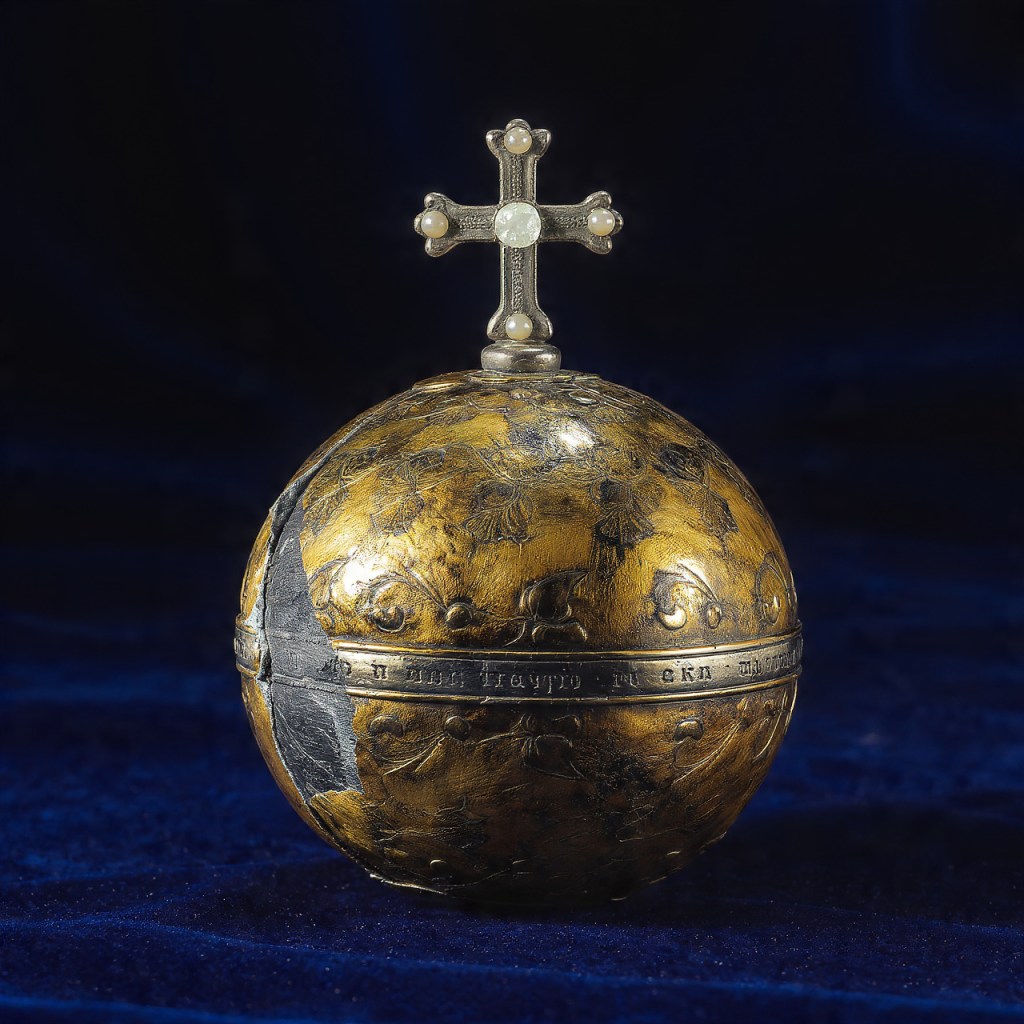
A heavy, gilt-silver liturgical hand-orb (yablocko) of exceptional Moscow workmanship, measuring 11.4 cm in diameter. The sphere is chased with a repeating pattern of intertwined vine tendrils and double-headed eagles, a motif signifying the symphonia of church and state. The orb is surmounted by a distinctively archaic cross pattée, inset with a rough-cut spinel of approximately 14 carats, surrounded by four seed pearls.
The central band bears an inscription in Old Church Slavonic: “To the First Tsar, from the Servant of God, Macarius. In the year 7055, on the sixteenth day of January.”
Catalogue Note:
This remarkable object represents a tantalising footnote to one of the most pivotal days in Russian history: 16th January 1547, the coronation of the sixteen-year-old Grand Prince Ivan IV Vasilyevich – later known to history as Ivan the Terrible – as the first Tsar of All Rus’.
Until recently, historians believed the regalia used during the ceremony at the Cathedral of the Dormition consisted solely of the legendary Cap of Monomakh and the ancient shoulder-mantle (barmy). However, the existence of this “Lesser” Orb supports the theory posited by Solovyov that Metropolitan Macarius, the intellectual architect of Ivan’s elevation, sought to introduce Byzantine imperial symbolism gradually. Unlike the great imperial orb (derzhava) later associated with the Romanovs, this piece is smaller, designed not as a symbol of secular dominion over the earth, but as a liturgical weight to be held by the Tsar during the anointing, reminding the young autocrat that his power was a burden granted by God, not a right of conquest.
The date inscribed – corresponding to the very day of the coronation – suggests it was a personal gift from Macarius to his protégé. The rough-cut spinel is characteristic of mid-16th-century Kremlin workshops, which had not yet adopted the refined facets of Western lapidaries. The object shows signs of significant handling, particularly on the sinister side, consistent with the nervous habit attributed to Ivan by foreign ambassadors of gripping objects tightly in his left hand during court audiences.
It is a chillingly intimate artefact: a physical connection to the moment a nervous teenager stood before the iconostasis, receiving the divine mandate that would eventually consume him and his nation in fire and blood.
Estimate:
£120,000 – £150,000
Bob Lynn | © 2026 Vox Meditantis. All rights reserved.

 Vox Meditantis
Leave a comment