Who are the biggest influences in your life?
Sunday, 24th December, 1671
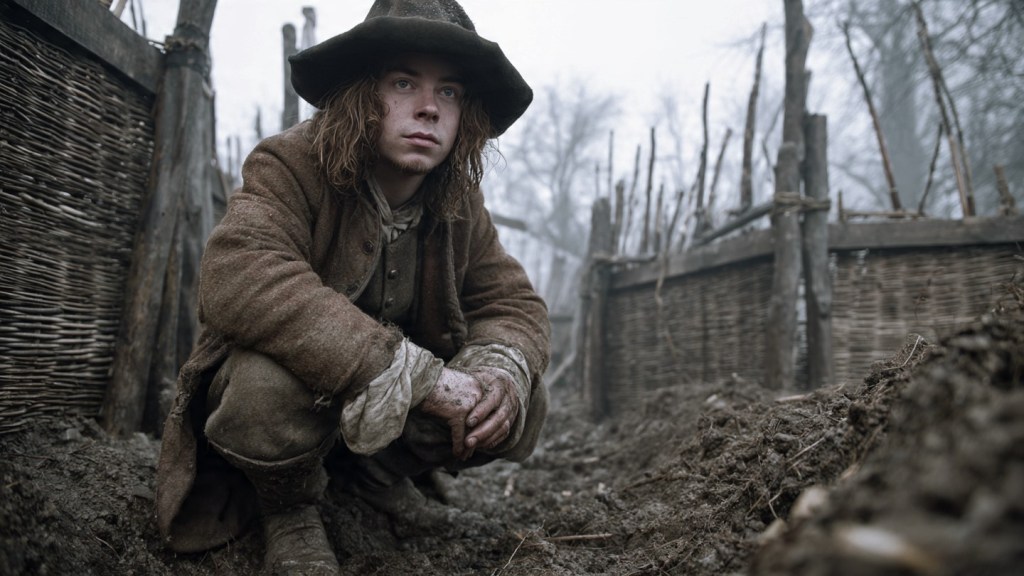
‘Tis the Lord’s Day, the four-and-twentieth of December, in this year of our redemption sixteen hundred and seventy-one, and here I crouch behind gabions stuffed with frozen earth, my hands too clumsy for the spade and my tongue too rough for gentle counsel. The siege drags on. The enemy holds the high ground; we hold the trenches, and between us lies a veil of smoke and winter mist through which neither side can see the other’s true strength. Yet we do not quit this work. Tenacity, they say, is my sole virtue – though I confess it feels more like stubbornness born of having nowhere else to go.
Silence reigns at this hour. The sentries stamp their feet; no musket cracks the cold. I have come to know silence as a companion these past weeks, a curtain drawn across the mind when speech would betray us. We whisper our plans behind revetments, lest a word carry on the wind to the enemy’s ear. But silence is also fear – the hush before the cannonade, the stillness in a man’s throat when he knows he may not see another dawn. And yet, against that silence, there must be voice. A voice that declares what we are about, why we hold fast when wiser men would flee.
Who, then, hath most sway upon me? Whose counsel rings loudest when all is still?
I think first of my father, a mason by trade, whose hands were sure and whose temper was hot. He taught me to lay stone upon stone, though I broke more than I set. He despised the king’s men – remembered the old wars, the levelling of churches, the blood that bought us a Commonwealth only to see it stolen back by painted courtiers and French whores. His voice was the first I heard speak plainly of justice denied. He is dead now, his back bent by labour and his heart stopped by fury. But his words remain: that no man should kneel save to God alone.
Then there is scripture itself, read aloud in conventicles by ministers who risk the gaol for speaking truth outside the steepled walls. “Fear not,” they say, though the Book of Common Prayer is enforced by law and dissenters are hunted like foxes. “Fear not, for behold, I bring you good tidings of great joy.” Yet how can a man not fear when the bailiffs come for his neighbours, when the assizes hang a man for printing a pamphlet? Still, those words lodge in me like shot in flesh. They speak of something mightier than tyranny, a turning-towards-us when all the world seems turned away. Not Providence – I will not use that word, for it smacks of complacency – but rather a mercy woven into the grain of creation itself, a force that resists the dominion of cruelty and despair.
And there is my own experience, clumsy though I am in both deed and discourse. I have stumbled in the trench, dropped my match at the worst moment, offended allies with ill-chosen words. Yet each time I rise again. Tenacity is not elegance; it is the grinding persistence of a man who knows he is unfit for the task but will not yield it to another. In that stubborn return, I have learned this: that the powers which enslave us – isolation, meaninglessness, the dread of our own death – are not the final truth. There is a reconciliation written into the fabric of the world, though it is hidden behind the curtain of our fear. When we are confronted by that which is utterly beyond us – by the sheer magnitude of what we oppose, by the terror of standing against crowned heads and bishops’ courts – the first word we need is not surrender, but courage. “Fear not.”
For what is this cause if not the belief that we are not alone? That the tyranny of despair can be broken, that alienation is not the end of the story? I am no scholar, no divine. I dig trenches poorly and speak worse. But I hold fast because I have glimpsed – through scripture, through my father’s rage, through the fellowship of these ragged men beside me – a movement toward connection, toward liberation, toward wholeness. It is not a negation of terror, but its transformation. Awe remains, but no longer paralysing; it becomes instead a reverence for that which meets us in our extremity.
The enemy will advance again come morning. The curtain of smoke will lift. Voices will cry out – commands, prayers, curses, the screams of the wounded. And I, clumsy and unworthy, will take up my musket once more and hold this ground. Not because I am certain of victory, but because the alternative is to betray the hope that has been given to all people: that our deepest longing for meaning is answered, that reconciliation is possible, that we need not die in chains. This is good news, and it must be shared.
Fear not. Hold fast. Let the work continue.
Bob Lynn | © 2025 Vox Meditantis. All rights reserved.

 Vox Meditantis
Leave a comment