What’s something you used to love that adulthood completely ruined?
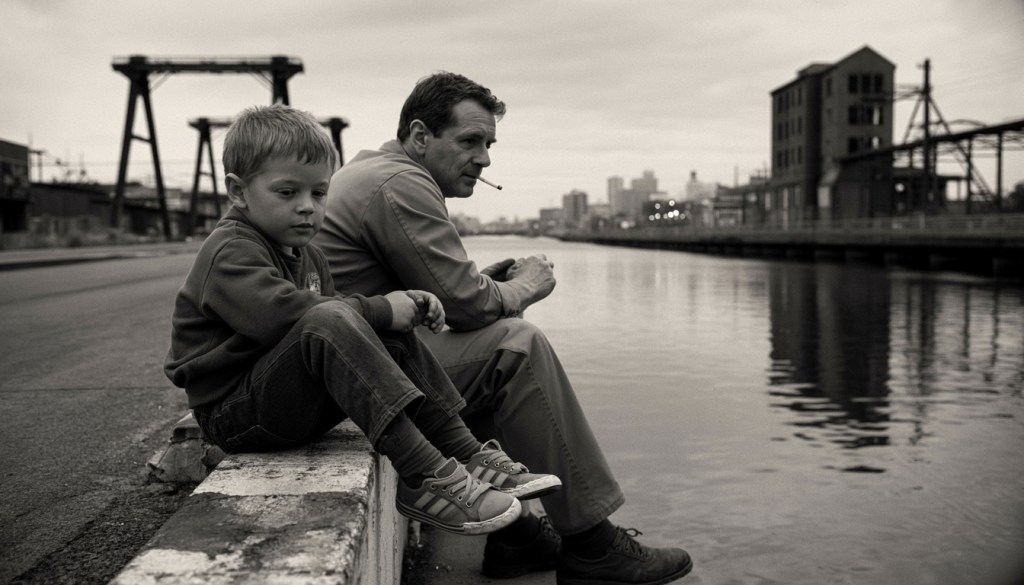
I used to love the riverfront at night. When I was a kid in the mid-nineties, my uncle Ray would sometimes take me down to the old freight yards after his shift at the warehouse – one of the few places still limping along after most of the big employers had shuttered. We’d sit on the concrete barrier where the abandoned rail spurs met the water, and he’d smoke whilst I watched the lights from Wilmington shimmer on the Delaware’s surface, twelve miles downstream. The river felt enormous then, powerful, like it was carrying secrets and possibilities from Philadelphia all the way to the bay.
What the River Meant Then
Back then, I didn’t understand what I was looking at. I saw rusted gantries and empty warehouses as mysterious structures, relics of some grand industrial age I’d just missed. The old Iron Works building – which had closed in 1978, nearly a decade before I was born – loomed like a cathedral against the sky. Uncle Ray would point out where his father had worked, where the Minerva Mills complex used to hum with textile machinery powered by the creek. To me, these weren’t monuments to loss; they were adventure. The riverfront was our secret world, especially at night when the city’s troubles – and there were many in those years – felt distant and abstract.
New Corinth hit 127 murders in 1993, the year I turned six. Market Street was mostly check-cashing shops and bars by then. But Uncle Ray made the riverfront feel safe, and in the darkness, with the water moving past and the occasional barge lights drifting by, I felt connected to something larger than our struggling city. The river was thirty-five to forty feet deep right there, navigable for ocean-going vessels. I loved imagining where those ships had been, what they carried, how our little bend in the Delaware had once mattered to the wider world.
What Adulthood Showed Me
Now I’m thirty-eight, and I can’t look at the riverfront the same way. I work in logistics for a distribution centre out near the Business Park – the sanitised name they gave to the converted Iron Works site. I drive past that same stretch of river almost every day, and what I see now isn’t mystery or possibility. It’s contamination zones awaiting environmental clean-up. It’s the Riverside neighbourhood, where my mum’s family has lived for three generations, caught between legacy industrial pollution and the slow creep of gentrification pushing people out.
I’ve learnt that the river Uncle Ray showed me was never just beautiful – it was a working artery that companies used and abandoned when it suited them. The DuPont plant expanded during the war, producing munitions and chemicals, then contracted and left behind soil and groundwater issues that the city’s still addressing with state and federal programmes. The shipyards that built destroyer escorts for the Pacific theatre are gone, replaced by a casino that opened when I was in secondary school and a riverfront park that’s lovely but feels designed for tourists and university students more than for people like me.
The Weight of Understanding
I’ve also learnt what those empty buildings really meant. They weren’t romantic ruins – they were 1,200 jobs lost when the Iron Works closed, entire families’ security evaporating overnight. When Uncle Ray stared at the old mills, he wasn’t being nostalgic for aesthetics; he was grieving a world where a bloke could work with his hands, support a family, and retire with dignity. That world ended decades before I was born, but I grew up in its aftermath, in a city where unemployment hit fifteen per cent by 1980 and never fully recovered.
The woman who wrote about becoming her neighbourhood’s unofficial healthcare advocate had it right – we survive here by showing up for each other, not because systems work but because they so often don’t. The elderly man who remembered nearly drowning in the Delaware as a child understood something essential about this city: we’re defined by who reaches out when we’re sinking. But adulthood has taught me that loving the riverfront now means reckoning with what it cost to build that industrial glory, and who’s still paying for it decades after the profits dried up.
What Remains
I still go down to the river sometimes, though not to the same spots – those freight yards are part of the Riverfront Development Authority’s mixed-use plans now, fenced off and awaiting the next phase of transformation. When I stand by Minerva Creek where it meets the Delaware, I can still feel that old pull, that sense of the water connecting us to something beyond New Corinth’s struggles. The river’s still navigable, still moving commerce, still indifferent to our human dramas just like it was when I was six.
But I can’t unknow what I know now. I can’t see the riverfront as pure possibility when I understand it as a landscape of broken promises, environmental debt, and the brutal mathematics of deindustrialisation. Adulthood didn’t just complicate my love for those nights by the water with Uncle Ray – it showed me that what I loved was already a ghost, a romanticised memory of a city that had died before I was old enough to understand what we’d lost.
I suppose that’s what adulthood does to the things we loved as children. It hands us the context we were mercifully spared, and asks us to carry on loving them anyway, scars and all. I still love this city, and I still love the river that defines it. But the love is different now – more complicated, more costly, shot through with the knowledge of what that deep, dark water has witnessed and what it’s carried away.
Bob Lynn | © 2025 Vox Meditantis. All rights reserved.

 Vox Meditantis
Leave a comment