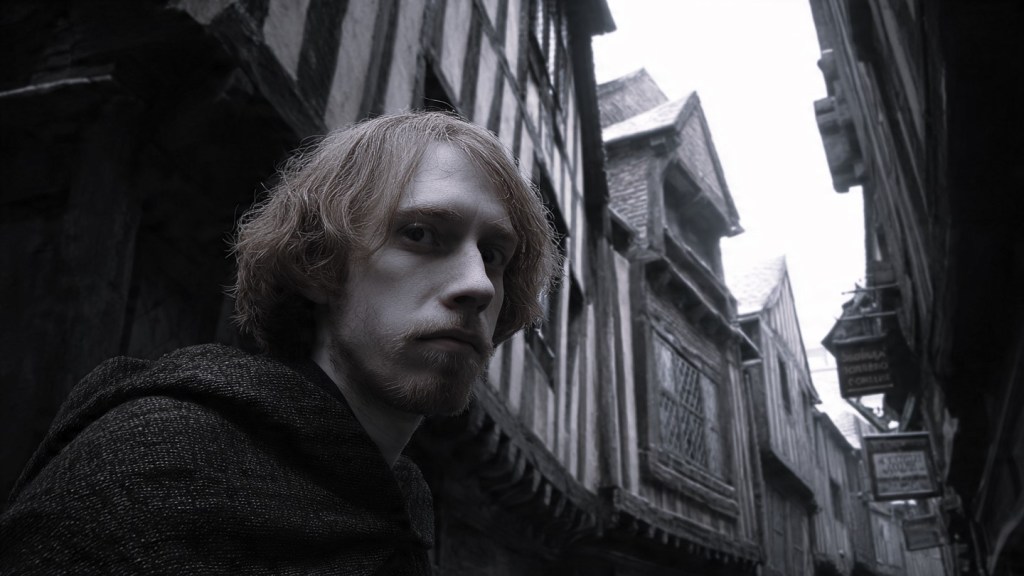
Are you a good judge of character?
Sunday, 22nd December, 1191
On this Sunday, the two and twentieth day of December, in the Year of Our Lord eleven hundred and ninety-one, I stand here in the cold of the town square and speak to you, who lend an ear. I am a stranger among you, and yet not wholly strange. Think not too much on whence I come; say only that I have walked too many days, from winters yet unborn and summers long spent, until all my years are pressed into this narrow place of stone and breath and watching eyes.
See how the houses lean inward, as though they would stoop and listen. The walls are close, the alleys cramped, each shutter a lid half‑closed upon a spying eye. When the bell rang for Prime this morn, its sound did not fly free, but struck from wall to wall, an echo beating like a caged bird. It is so with words in this square. Nothing spoken here flies to Heaven unheeded; it ricochets from stone to stone, from ear to ear, until a man’s sin returns to him as a whisper he himself once cast forth.
You ask who I am, that I should speak thus. I will answer crookedly, for straight speech has never well suited me. I am a man who has worn out many roads, yet often left his appointed path. Set me a task with quill or chisel, and I will not spare my hand; I bend close, labouring till my eyes smart, and each line I cut is true, each letter tight and fair. But give me a vow to keep, a charge to watch through the dark hours, and you will find me slinking from it like a cur that smells the whip. I am careful in small things and careless in great, and the Lord, Who sees the heart, knows how this crookedness has followed me like a shadow.
Look about you. The snow that fell yestereve lies trodden into foul slush where the beasts were driven in for market. The dung and the blood are ground together by many feet, making a mire that clings to a man’s shoes, so that he carries the filth home upon his very soles. So it is with our dealings here in the square. We step out upon clean intentions, so we say, but the trampling of many wills, the jostling for place and coin and honour, make a mire, and we do not know what uncleanness clings to us when we depart.
You would know my mind, you say. Are you a good judge of character? That question walks at my side like a thin dog that never leaves off whining. The neighbours here boast of their cunning eyes. “This man is a rogue,” they murmur; “that woman is light,” they say; “this one is pious, that one mad.” Their words creep along the walls like smoke, and lodge in every crack of stone. Have you never marked how, when one man calls another “fool” or “fiend‑touched,” the name takes root, and all who hear it water that seed with their own whispers, till the poor soul wears madness like a cloak not of his own cutting?
You look at me now, weighing me upon your inner balance. You hear that I am not of this place, that I come from afar, that my tongue trips oddly at your names for things. You see how often I slip aside when some duty seeks to lay hand on my shoulder. What judgement do you make? Would you say, “Here is an idle wanderer, a reed blown by the wind, unfit to be trusted”? Or would you say, “Here is a man who bends his whole strength to his work, when once he sets his hand to it; only he fears the yoke, as an ox fears the goad”? Tell me, then. Are you a good judge of character, or do you, like me, see through a glass darkened by your own breath?
Madness, you say. You have seen it. So have I. I have watched a man laugh in the frost with no cloak upon his shoulders, calling the crows by the names of kings. I have heard a woman mutter to the chimneys as though they were saints’ ears. The leeches will speak of black bile and choler, the priests of unclean spirits, the old wives of charms and the ill eye. Each in his tongue says, “Here is a soul out of measure, the balance of his mind untrue.” We stand and watch, and are glad it is not we.
Yet I tell you this, and you may mark it well: there is another madness abroad, and it walks in fair clothes to church, and haggles in the market, and nods gravely at the reeve. It is the folly that sits in us when we think ourselves sound in our wits, able to weigh the hearts of others as skilfully as goldsmiths weigh silver. We make our measures from crooked rods; we say, “This one is just, that one false; this man’s sorrow is feigned, that man’s joy is pure.” But who set the scales in our hands? The same Lord Who told us we shall be measured as we have measured others. When I remember this, the square itself seems to draw in close about me, and the air grows thin, as though I stood at the bottom of a great well and every voice above were an echo of my own hidden thoughts.
You speak of sanity. What is it, save to walk in such fear of losing the path that a man will not step aside to lift up one who has fallen? I have seen folk pass by a beggar groaning at the pillar where wrongdoers are bound, making the sign of the Cross as though to ward off his misfortune, not share it. “He is accursed,” they whisper. “His mind is touched. His tongue is not right within him.” So they call his sorrow madness, and their own hardness, prudence. Is that not a kind of lunacy also, that we can stand in this narrow place, all hedged about by law and hunger and the sharp tongues of neighbours, and yet imagine we are masters, judges seated high above the press?
Listen. The wind runs about these walls as if seeking a crack by which to enter. In the turning of this cold air I remember another tale, one that has haunted me these days of Advent, like a voice heard and half‑forgotten from a dream. They told it here not long ago; maybe you heard the priest speak it, maybe only the tattered folk at the back door. Two travellers, so the story goes, went south at the bidding of an emperor’s command, for a counting of souls and coin. Not for love of the road, nor for the pleasure of strange inns did they go, but because a hand that seemed far off weighed heavy upon them.
They went to a town tied to their bloodline, a place of old kings, where the stones themselves seemed to remember. The man and the woman were bound one to another by a solemn word, yet the bond was not yet fulfilled in the flesh as in the promise; there was talk, thin and sharp as needles, running before and behind them. A child’s time was nigh, and many said the reckonings did not add. Whispers followed them like stray dogs. You know these whispers; you have heard them in this very square, thrown after any maid whose belly swells too soon.
The tale tells how, in that journey pressed upon them by the high powers of the world, in that city of their fathers, in the very midst of such gossip and doubt, a great meaning was born into the world. Not in marble halls, but among beasts’ breath and common straw. Not greeted by princes, but by folk whose hands stank of sheep and cold iron. Those who love to weigh and judge stood without, guessing and condemning; those who saw only their own need came near, and found in that frailty a warmth their hearts had long lacked. So the priest said, and his words struck the walls and sent back an echo that has not yet left my ears.
I tell you that story now not as learned clerk, but as one who feels its press upon his ribs like a tight band. If such a wonder may choose to come among slander and doubt, in a place where an emperor’s decree drives folk like cattle, then perhaps this little square, with its mud and its harsh tongues and its thin‑faced children, is not so far off from that manger‑stead. Perhaps, even here, some small thing may be born that will judge us more truly than we judge one another. That thought hems me in more than any wall. It is as if all the narrow streets have bent their crooked lines toward a single point, and I stand upon it.
You look at me askance when I speak so. “He is not right in his mind,” someone will say, when I have turned my back. “He speaks like one in a fever, or one who has stared too long into the sun.” It may be so. I who have fled from my own duties would gladly call my trembling wisdom, if that name would hide my idleness. There were times – I confess it before you as before the altar – when a word of mine, honestly spoken, could have turned a neighbour from harm, and I held my tongue. I had other work, I told myself. I was bent over my parchments, my carving, my accounts. Diligence, I named it. Sloth of the heart, it was, dressed in a finer gown.
So I have taken refuge in the small labours where praise may be had and blame is little. But the great labours – the keeping of trust, the bearing of another’s burden, the standing witness when truth is trampled in this very square – those I have dodged like arrows. If there is madness in me, it lies there: that I labour hard at what will soon be dust, and flee the work whose mark is laid upon the soul.
You there – yes, you who still attend my words – tell me: when you look upon me, do you see one whose wits are whole, or do you see a man divided against himself, diligent in craft yet reckless in duty? Can you read that rift from my face, my gait, the cut of my cloak? Are you a good judge of character, or do my sins sit cunningly hid beneath the show of restless toil? And if you misjudge me, for good or for ill, whose fault is it? Yours, who weigh me hastily, or mine, who have woven my life into such a tangle that no straight thread may be seen?
I have come, you might say, from the world yet to be, where men will boast more loudly still of what they know and how finely they can discern another’s heart. I have seen what comes when every man sets himself up as a little judge, holding up his neighbour’s life to some crooked light of his own devising. It is not a sight to give peace. Believe me when I say: the more cunning the scales, the more swiftly they turn against the one who holds them.
The hour draws on. Soon the bell will sound again, and this square will empty as folk draw in to meat and fire. The words spoken here to‑day will not so easily depart. They will cling to the eaves, curl in the beams, settle in the thatch, and drop again in the dark hours as half‑remembered dreams. Of all those words, one thing only do I beg you to keep: that the One Who came in such lowly wise, under the shadow of a great empire’s counting and the sharper shadow of men’s gossip, chose to be judged by those He came to save. If He did not refuse such misjudgement, how shall we, who are but clay, refuse to look gently on one another?
I am no fit example; I stand as one convicted by his own tongue. Yet even so I say it: be slow to name another mad, or false, or worthless. You do not know what journey he walks, what decree has driven him, what birth of meaning waits unguessed in the frailty of his days. Here, in this narrow square, under these leaning walls, among these watchful windows, we are nearer to that manger than we reckon.
Hark – do you hear it? The bell’s first stroke, the children’s shouts, the murmur of prayers begun behind closed doors. All these threads of sound are drawn together and flung back at us from stone and lintel. They make an echo that is not easily stilled. So it is with our judgements and our mercies; they go out as whispers and return as voices. Remember that, when next you weigh a stranger. For even now, as my own words die upon the air, I hear them coming back to me, softer, like a whisper that is not mine alone.
Bob Lynn | © 2025 Vox Meditantis. All rights reserved.

 Vox Meditantis
Leave a comment