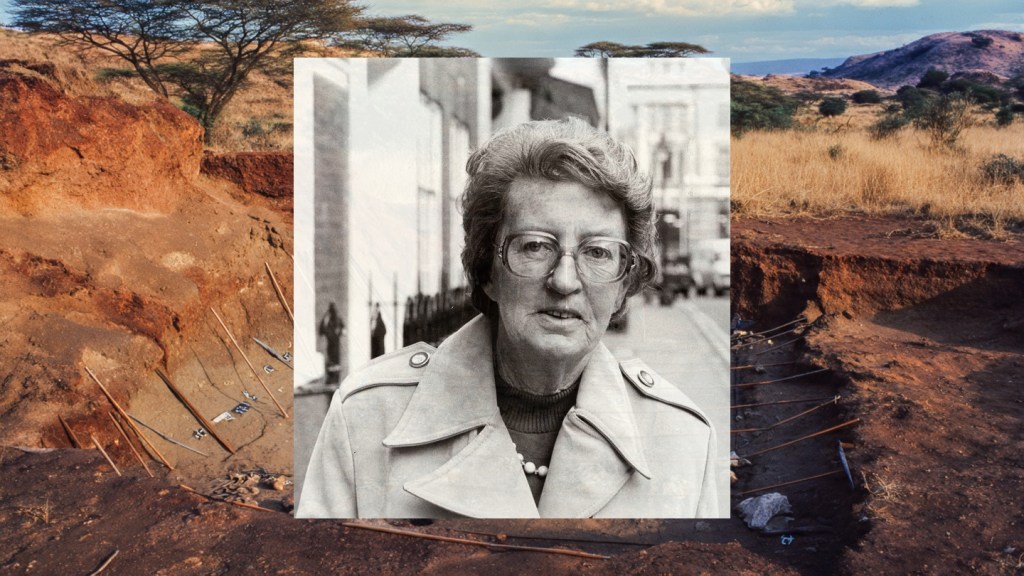
This interview is a dramatised reconstruction based on historical sources, Mary Leakey’s published works, and documented biographical evidence – not a transcript of her actual words. The dialogue, reflections, and responses are products of informed historical empathy designed to bring her perspective into contemporary conversation, while remaining consistent with what is known of her character, intellect, and era.
Mary Douglas Leakey (1913–1996) was a British palaeoanthropologist whose meticulous excavations in East Africa transformed humanity’s understanding of its own origins. Working methodically at sites like Olduvai Gorge and Laetoli in Tanzania, she discovered some of the twentieth century’s most pivotal fossils – yet remained largely unknown to the general public, her contributions often eclipsed by her more charismatic husband, Louis Leakey. Today, we sit down with her in a conversation that time permits: a chance for her to set the record straight, explain the scientific reasoning behind her epochal discoveries, and reflect on a career that proved bipedalism came long before big brains.
Mary, welcome. It’s extraordinary to have you here. I want to begin by asking something direct: Do you think history has been fair to you?
Fair? My dear, that’s rather a large question to open with. I suppose the honest answer is that I’ve never particularly concerned myself with fairness in the historical sense. I was interested in fossils, not in fame. Though I’ll admit, as I’ve grown older, I’ve found it rather peculiar that people know about the Laetoli footprints without knowing who found them. It’s as if the rocks themselves became the discoverers.
The footprints are iconic – reproduced in museums worldwide. But yes, the discoverer’s name seems to have vanished.
They survived because I excavated them with proper care. That’s what matters to me professionally. But you’re right – there’s an injustice in it, not to me personally, but to the principle of acknowledgement. If I may be frank, Louis was brilliant at standing in front of a camera. I was rather better at standing in front of a fossil. We complemented each other, though perhaps not in the ways people imagined.
Let’s go back to the beginning. How did a girl born in London in 1913 end up digging for ancient hominins in Tanzania?
I was mad about archaeology from childhood. My father collected stone tools – neolithic implements, mostly – and I became fascinated by how humans made things. I drew constantly as a child, and drawing taught me observation. One cannot draw properly without seeing properly. By the time I was a teenager, I knew I wanted to excavate.
I attended lectures at the Royal Anthropological Institute in London. I never went to university, you understand. My parents thought it unnecessary, or perhaps unwise – the usual attitudes of the 1920s about girls and advanced education. But I found that excavations taught me far more than lectures ever could. I joined digs in England, worked with Dorothy Garrod on Palaeolithic sites. That’s where I learned the craft.
Stone tools before fossils?
Exactly. Understanding the tools tells you about the makers. A stone tool isn’t just an object – it’s evidence of cognition, intention, manual dexterity, planning. The shapes reveal what problems the makers were solving. Before one can interpret a hominin fossil, one must understand the technological context. That became my peculiar expertise.
And then you met Louis?
I met Louis in 1933 at a lecture in London. He was already becoming known for his work in East Africa. We married in 1936 and moved to Kenya. I gave up my independent work to join his excavations at Olduvai. People always assume I sacrificed something, but truly, I thought I was gaining the world.
In 1948, you discovered Proconsul africanus at Rusinga Island. That was a remarkable find.
It was my first major discovery, yes. A complete skull of an extinct ape – an ancestor of the great apes and, by extension, of us. The significance was that it showed what our primate forebears looked like anatomically. But it wasn’t a hominin. That came later.
The method was straightforward, though the execution was meticulous. We were excavating a Miocene formation – roughly 20 million years old. The skull lay fragmentary in the sediment. The trick was exposing it without damage. You must work slowly, use fine tools – dental picks, brushes, sometimes just your fingernail. You must understand the geology around the fossil to know which direction to expose it from. Rushing is catastrophic.
What tools did you actually use in the field?
Very ordinary ones. Pickaxes and shovels for the bulk removal of overburden. Then geological hammers – not too heavy – and chisels. Dental picks were invaluable. A small paintbrush. A trowel. One learned to make do. We didn’t have the fancy equipment they use now, or the luxury of specialists. I had to be the excavator, the conservator, the recorder, often the photographer as well. I made detailed sketches of every layer – what we call stratigraphic recording. Understanding which geological layer a fossil comes from is as important as the fossil itself.
Why is that?
Because geology tells you age and context. If you pull a fossil out of the ground without recording the stratum, you’ve destroyed half the information it contained. You know what you’ve found, but not when, or what else lived with it. The fossils are just objects without stratigraphy; with it, they become a narrative.
Then came 1959. The skull you called Zinjanthropus boisei.
Ah, that was a remarkable day. We’d been excavating in Bed 1 at Olduvai for years. Difficult work – the gorge is unforgiving, very hot. We were excavating on a Sunday, which was unusual. I was working in what we called the FLK – “Frida Leakey’s Korongo,” named after Louis’s first wife – when I exposed teeth. Large molars. Then the palate. Then more of the skull.
My heart rather raced, I must admit. The morphology was unlike anything we’d seen. Massive sagittal crest – a ridge of bone running along the top of the skull where powerful jaw muscles attached. Enormous molars. We nicknamed it Nutcracker Man because those teeth could crush hard plant material. Louis was away, so I had the pleasure of telling him what I’d found when he returned. He was absolutely delighted.
It was 1.75 million years old. How did you date it?
We used a combination of methods. Potassium-argon dating on volcanic rocks in the surrounding strata – we had radiometric analysis done in American laboratories. But before that, we relied on stratigraphic correlation and comparative anatomy. The overlying layers contained fossils we could compare with specimens from better-dated sites elsewhere. You build a chronological framework from multiple lines of evidence.
Zinjanthropus boisei – now classified as Paranthropus boisei – turned out to be something of a dead end in human evolution. Not our direct ancestor, but a cousin. A specialist in eating very hard foods. But at the time, it was transformative. It proved that near-human creatures existed millions of years ago in Africa. That discovery brought funding, attention, and international interest to Olduvai.
And people credited Louis with finding it?
I found it. Louis presented it to the National Geographic Society, which had funded the work. He was very good at that sort of thing. He had the manner, the eloquence. When you’re describing a spectacular discovery to journalists and donors, personality matters. Louis had it in abundance. I did not, and I had no wish to cultivate it. There was work to be done.
Did it trouble you?
Not at the time. Later, yes. But one makes choices. I chose to excavate rather than to lecture. One cannot do both equally well, or at least I couldn’t. I preferred the work itself to the performance of the work.
A year later, you discovered Homo habilis remains at the same site. This was the toolmaker.
Yes. We found hand and foot bones, teeth – fragmentary, but clearly distinct from the robust Paranthropus forms. The hands particularly interested me. The proportions suggested a creature that could grip and manipulate with precision. That’s significant because if you have a hand like that and stone tools in your archaeological layer, you have evidence of a causal relationship.
The stone tools at Olduvai are called Oldowan, the earliest known stone tool technology. Crude by later standards – simple flakes struck from cores – but revolutionary. You cannot make a tool by accident. You must understand that striking a certain angle against stone at the right force will produce a sharp edge. It requires planning, practice, teaching.
And you’d classified those tools yourself?
I had spent years studying them. I established the typology – the systematic classification of Oldowan tools based on their shape and technique. Simple choppers, cutting flakes, scrapers. The evolution from Oldowan to the more refined Acheulean hand axes was something I documented across Olduvai’s layers. That’s where the real story of human evolution lies, in my view – not just the fossils, but the cultural record the tools represent.
That seems like foundational scientific work.
It was meticulous work. Not glamorous. People prefer a skull to a collection of stone tools. But the tools tell you about cognition, about cultural transmission, about dietary behaviour. A fossil is a snapshot; the tools are a narrative.
But your most significant discovery came in 1976 at Laetoli. The footprints.
Yes. Those footprints changed the fundamental question of human evolution.
We were excavating at Laetoli, a site south of Olduvai, in deposits dating to around 3.6 million years ago. We were looking for fossils, actually – we always are. The site is famous for volcanic tuff, which preserves details beautifully. One of my team, Andrew Hill, was being pursued by rhinoceroses and took shelter under a rocky outcrop. While hiding there, he noticed something in the rock face: impressions. Footprints.
When I examined them, I understood immediately what we had. Two creatures, walking upright, their feet pressed into wet volcanic ash that subsequently hardened. These prints showed clear bipedal progression – heel strike, weight transfer, toe-off. The gait was unmistakably human in character.
How old were they?
We dated the ash layer at approximately 3.6 million years old. The creatures – likely Australopithecus afarensis – were walking upright nearly 4 million years ago. This had enormous implications.
Tell me the implications as a scientist would explain them to a colleague.
The prevailing theory at the time held that large brain size drove human evolution. We became intelligent, and then we walked upright. But the Laetoli footprints contradicted that narrative. Here was evidence of bipedal locomotion in a creature with a brain hardly larger than an ape’s. Australopithecus had a cranial capacity of perhaps 400 cubic centimetres – smaller than modern humans at 1400 cubic centimetres.
This reversal of sequence was crucial. It suggested that bipedalism preceded encephalisation [brain enlargement]. Bipedalism was not a consequence of becoming intelligent; rather, it was an adaptation that perhaps enabled later intelligence. The question then became: what selective pressure drove bipedalism? That remains debated – theories include energy efficiency in open habitats, the ability to carry infants and food, visual surveillance of the landscape.
How did you excavate them?
We exposed the layer with extreme care. The ash had preserved detail that would have been destroyed by rough excavation. We used brushes primarily – fine brushes – to clear surrounding sediment. We photographed each print in situ from multiple angles, with scale markers and grid references.
We made plaster casts – careful ones – for research and eventual museum display. The originals we left in the rock. One had to understand the three-dimensional depth of each impression – how deep was the heel, the ball of the foot, the toes. That depth told you about the weight distribution and gait pattern. We used photogrammetry, which was becoming available, to create precise measurements.
The trail itself was approximately 27 metres long, with multiple prints preserved. Footprint dimensions suggested that the creatures were quite small – perhaps 1 metre tall. The bipedal pattern was obvious: one foot placed in front of the other in a direct line, not the splayed gait of apes.
And preservation like that is incredibly rare?
Extraordinarily rare. You need the right conditions: soft substrate – in this case, volcanic ash from nearby eruptions, dampened to the point where it preserves impression but doesn’t obliterate detail. Then you need rapid burial and mineral replacement or compaction that hardens the impression before disturbance. And you need geological luck – the layers must remain accessible after millions of years of burial and erosion. Most fossils are scattered bones or teeth. Intact skeletons are uncommon. Preserved footprints are nearly unique.
That discovery received considerable public attention.
More than I desired, I’m afraid. National Geographic was eager for the story, quite naturally. But fame for a discovery isn’t the same as understanding of the discovery. People saw the pictures of footprints and thought them charming – a glimpse of our ancestors. They didn’t absorb the profound theoretical implication: that we were not clever apes who learned to walk, but walkers who became clever.
Did you give interviews? Lectures?
A few. I dislike public speaking. I always have. I’m far more comfortable with fossils than with audiences. Louis was the natural communicator. He enjoyed that aspect. After his death in 1972, I continued the excavations, but I didn’t pursue the publicity side of things. Richard took over some of that role.
Do you regret that choice now?
Not regret, precisely. But I recognise the trade-off. My choice meant that the work continued without distraction, and that is what I valued. But it also meant that my name became detached from my discoveries in public consciousness. The footprints exist without a named discoverer in most people’s minds. That’s a loss for the principle of scientific attribution, if not for my personal satisfaction.
You continued working long after Louis died. What drove you?
The work itself. I was 59 when Louis died. I had perhaps 20 good working years ahead of me, and I wasn’t about to retire. I had excavations at Laetoli and Olduvai still producing remarkable specimens. I had questions unanswered. And I had become quite capable of running a scientific programme independently.
Some people assumed that Louis had been doing the important work and that I would decline without him. That was insulting, though I understand why they thought it. The reality was that I was more productive in some respects after he died, because I could focus entirely on the excavation and analysis without the demands of public presentation.
What was he contributing that you weren’t?
Louis was a remarkable theoretician. He had ideas about human behaviour, about psychology, about the significance of our discoveries. He could place findings within larger narratives. He was also a magnificent fundraiser and networker. But the actual excavation – the daily labour of finding and extracting fossils – that was primarily my domain. We worked in partnership, genuinely. But the partnership didn’t end when he died; it simply transformed.
I want to ask about a failure. In your career, were there times you misinterpreted evidence, or pursued a line of inquiry that proved wrong?
Yes. Early on, I was perhaps too eager to assign certain stone tools to specific hominin species. I had found tools in association with Zinjanthropus, and I initially believed the two were related – that Zinjanthropus had made them. That seemed logical. But later fossils and more careful analysis suggested that the tools actually belonged to Homo habilis, which lived alongside Paranthropus. Zinjanthropus was almost certainly not a toolmaker.
It was a reminder that one cannot assume a chronological or spatial association implies causation. A fossil and a tool found in the same layer might be contemporary, but that doesn’t mean the creature made the tool. Other creatures lived there too.
How did you come to that realisation?
By finding more evidence. That’s the scientific process – you propose, you test, you revise. I had also become quite interested in taphonomy – the study of how fossils are preserved, what processes alter bones and artefacts after death. I realised that bones and tools from different creatures could be mixed by natural processes – flooding, burrowing animals, scavenging. The spatial association in the ground doesn’t guarantee temporal or behavioural association.
Did you publish that correction?
Yes, but not widely. It’s in the detailed excavation reports. That’s the thing about careful science – the corrections are there for specialists to find, but they don’t make the popular stories. People remember the dramatic discoveries, not the careful revisions.
Let’s talk about your methods. You’re known for meticulous documentation. Why was that so important to you?
Because excavation is destructive. Once you remove a fossil from the ground, the site is altered forever. You cannot go back. If you haven’t recorded everything – the position in three dimensions, the surrounding geology, the associated artefacts, the stratigraphy, the colour and texture of sediments – then you’ve destroyed irreplaceable information.
When I began excavating, record-keeping was often haphazard. Fossils were found and extracted, but contextual details were poorly recorded. I decided that wasn’t good enough. We developed detailed grid systems for excavation. We photographed constantly. We drew stratigraphic sections – the exposed rock faces showing the layering. We kept meticulous notes.
That approach was considered rather pedantic by some colleagues. They thought I was wasting time with bureaucratic documentation when I should be finding more fossils. But I understood that the fossil and its context are inseparable. The fossil alone tells you what; the context tells you when, where, and with what.
Did you invent those methods, or adapt them?
I refined them. Dorothy Garrod, with whom I worked early on, was already emphasising careful recording. But I pushed further – we developed photographic records that were quite detailed for the time, with scale and grid reference in every image. We created three-dimensional maps of excavation areas. We created a system of labelling that allowed anyone reading our reports to understand exactly where every specimen had come from.
And that became a standard?
I’d like to think so. I trained people in those methods. Young excavators who worked with me at Olduvai and Laetoli carried those practices forward. Modern palaeoanthropology, I believe, owes something to the emphasis on rigorous documentation. Though I’ll admit that the documentation takes time. One excavates more slowly. But one learns more.
You never had a formal university degree. How did you experience that barrier?
I didn’t experience it as a barrier in my own work. I knew what I was doing. My team knew. The fossils knew. But in terms of institutional recognition, it mattered. I could not hold certain positions. Some universities wouldn’t invite me to lecture. I received honorary doctorates much later in life, which was wonderful, but they felt rather like consolation prizes.
The irony is that a university degree in the 1930s wouldn’t have taught me what I needed to know. Palaeoanthropology wasn’t an established discipline. One learned by doing. My education was the sites themselves, the mentors I worked with, the literature I read voraciously. I taught myself geology, comparative anatomy, stratigraphy, statistical analysis.
Do you think that lack of formal credentials affected how your work was received?
Not by specialists. They understood what I’d accomplished. But by the broader academic world, yes. There was an assumption that anyone without a degree was an amateur, a collector. And yet many of the great discoveries in archaeology were made by people without formal credentials. That’s changing, which is probably good – standards are necessary. But it does mean that brilliant people who can’t access universities are now excluded.
Would you have pursued university if you could have, in retrospect?
I’m not certain. A formal education might have constrained my thinking. The advantage of learning through fieldwork is that you’re not bound by what textbooks say is possible. You encounter things that don’t fit the categories, and you have to develop new frameworks. That freedom was valuable.
You’ve mentioned stone tools repeatedly. Can you walk us through how you developed the Oldowan tool classification? What made it systematic rather than arbitrary?
The problem was that early stone tools appeared arbitrary – just broken rocks. But I noticed patterns. Tools from the same layer often resembled each other in shape and technique. Tools from different layers showed variations. That suggested intentional manufacture with recognised forms, transmitted from one generation to the next. A technology, not an accident.
I began by collecting examples – thousands of them – and examining the relationship between the stone’s natural properties and the tool’s final shape. For instance, basalt is a fine-grained volcanic rock that fractures predictably if you strike it correctly. Quartz is more variable. Obsidian creates very sharp edges. Early hominins chose their raw materials.
Then I looked at the flaking patterns – the scars left on the stone by previous strikes. I could determine the sequence of blows. A simple flake was struck from a core by hitting it at a specific angle. A cutting tool might have two sharp edges created by careful flaking. The pattern of scars told me the method.
This sounds almost like reading a language.
Exactly! Each tool encodes information about the maker’s understanding of the stone’s properties and their technique. A well-made handaxe – the characteristic form of Acheulean tools, appearing after Oldowan – shows understanding of symmetry, balance, and the geometric properties of stone. You cannot make a symmetrical handaxe without mental planning.
I created categories based on morphology: choppers, cutting flakes, scrapers, burins, awls. Each category had diagnostic features. A chopper had a working edge on one end; a cutting flake had two lateral edges. I documented the measurements – length, width, thickness – and created frequency distributions. Over time, I could show that certain forms appeared at certain time periods. That’s evolutionary change in technology.
Did other researchers accept your classification?
Eventually, yes. Initially, some thought I was over-interpreting. “They’re just rocks,” some colleagues said. But as the classification proved useful for comparing sites and understanding the sequence of tool development, it became standard. I published detailed monographs – two volumes on Olduvai tools – with photographs and line drawings and measurements. Specialists could use those as reference.
And the evolution from Oldowan to Acheulean tools – what changed?
Complexity and intentionality. Oldowan tools are simple – quick to manufacture, sharp, adequate for cutting meat and bone. Acheulean handaxes required significantly more labour and planning. A flint handaxe might involve 50 or more individual flake removals, each carefully placed. The symmetry implies aesthetic preference, not just functional necessity. Two handaxes aren’t identical, but they’re recognisably of the same form. That’s culture, not instinct.
The transition appears around 1.6 million years ago in the record, associated with Homo erectus – a larger-brained hominin than habilis. There’s likely a correlation between brain size and tool complexity, though one cannot prove causation from the archaeological record alone.
Was there anything you discovered that truly surprised you? That contradicted your expectations?
The Laetoli footprints surprised me, yes – not because I expected something different, but because I hadn’t expected to find them at all. We were there looking for fossil bones, not prints. And once I saw them, I understood immediately that they would change everything.
But a deeper surprise was how variable our ancestors were. We found so many different forms – robust Paranthropus, gracile Australopithecus, Homo habilis with its range of sizes and shapes. There was no clean lineage, no progression from one form to the next. Instead, multiple species coexisting, competing, evolving at different rates. Our origin story was messier than the tidy narratives suggested.
How did that change your thinking about human evolution?
It made me sceptical of grand narratives. We like to tell stories of progress – from ape to human, from stupid to intelligent, from primitive to sophisticated. But the fossil record shows branching, extinction, parallelism. Some lineages led nowhere. Multiple experiments with bipedalism and stone tool-making. Intelligence didn’t march steadily forward; it emerged piecemeal, in fits and starts, in creatures that also did many other things.
Louis’s death – how did that affect you scientifically?
I was grieving, naturally. But I had work. Grief and work were useful partners – the work gave structure to days that might otherwise have been consumed by loss. And I discovered that I could run excavations entirely on my own terms, without consultation or compromise.
I intensified the Laetoli excavations. I trained people. I continued the Olduvai work. I published extensively. Those 20+ years after Louis’s death were extraordinarily productive. If anything, I became more focused. There was no one to conference with, so I simply had to decide what was best and do it.
Did people treat you differently?
Some did, yes. Some colleagues who had perhaps seen me as Louis’s assistant suddenly acknowledged me as the principal investigator. That stung a bit – it suggested they hadn’t truly seen my role before, but now that Louis was gone, I was no longer invisible. Rather backwards logic.
And I think some people were surprised that I continued to produce major work. They’d assumed I was the support player, and that once Louis was gone, the enterprise would decline. But of course it didn’t.
Let’s address the gender dynamics directly. Louis was charismatic, eloquent, the public face. You were the excavator, the expert, less visible. Did you mind?
I minded less at the time because I genuinely preferred excavation to public speaking. But I mind now, in retrospect, on principle. Not for myself personally – I’m old enough not to care much what people think – but for the principle that work should be credited to the person doing it.
There’s a pattern in scientific partnerships. When a husband and wife work together, the husband becomes the famous name, even if the wife is doing crucial work. The Curies are the exception – Marie Curie eventually became recognised, but that took decades, and she had to fight for it. The pattern is common enough that people assume it’s natural. It’s not. It’s a consequence of who gets to speak publicly, whose name appears first in press releases, whose personality is appealing to funders and media.
Did Louis deliberately appropriate your work?
No, I don’t think so. He credited me in scientific papers. He told people I’d made the discoveries. But he was the natural public figure. He was at home in front of audiences. I was not. When you choose not to be visible, you become invisible – that’s the trade-off. I made that choice. But the consequences were that the public associated the discoveries with “Louis Leakey” rather than understanding that Mary Leakey had found them.
Did you ever resent him for that?
Occasionally. But resentment is a waste of time. I could have insisted on giving lectures, on being the public face. I didn’t. That was my choice, and I lived with its consequences. The risk of women in science is becoming so modest, so deferential, that we disappear. I became rather invisible, and that was partly my doing. Not entirely – the systems that make men more visible are real – but partly mine.
Your autobiography, Disclosing the Past – you finally told your own story there.
Yes. Rather late in life, at 71. I thought it was important to set down my perspective, not to rely on others to interpret my work and my relationship with Louis. I tried to be honest about the partnership – the good parts and the complicated parts. And I tried to make clear what I’d actually done versus what was attributed to both of us or to him alone.
Did it change public perception?
Marginally, among people who read it. But autobiography doesn’t reach as wide an audience as, say, a charismatic public intellectual. The book is out there. The stories are there. But most people still don’t know who found the Laetoli footprints. That’s fine. I’ve made peace with it.
What advice would you give to young scientists today, particularly women entering palaeoanthropology or field science?
First, do the work because you love it, not for recognition. Recognition is uncertain and often unfair. The work is what’s real.
Second, become expert at something specific. Expertise gives you credibility that personality cannot. I knew stone tools better than nearly anyone. That knowledge was my foundation. Find what you can know deeply.
Third, document everything meticulously. Your methods, your findings, your reasoning. Good documentation is its own defence against being erased. Future scholars will know what you did.
Fourth – and this particularly for women – don’t wait for permission or credentials to do important work. I never had a university degree, but I became a scientist through practice. Yes, it’s harder without institutional support. But it’s possible. Though I’ll admit that the system now makes it much harder to be an autodidact. That’s a loss, in my view.
Fifth, don’t assume that being quietly excellent is enough. I assumed it. I was wrong. If you want credit for your work, you must claim it publicly. That doesn’t come naturally to many people, particularly women who’ve been taught to be modest. But modesty is a luxury in a field where men’s work is automatically visible and women’s is not.
Sixth, choose your battles. You cannot fight everything – the gender politics, the institutional hierarchies, the public visibility. I chose to fight for the integrity of the excavations. I let other battles go. That was my choice. Other women might make different ones.
And finally: the fossil record is infinitely fascinating. Don’t get so caught up in credit and recognition that you forget to wonder at what you’re holding in your hands – the remains of creatures that lived millions of years ago, now visible because of your meticulous work. That sense of wonder is what will sustain you through the difficult parts.
Is there anything you wish you’d done differently?
I wish I’d published more popular accounts of my work. Not sensationalism – I despise that – but thoughtful explanation of what the discoveries mean and why they matter. I published technical monographs, which are read by specialists. But I could have written more for educated general readers. That might have broadened understanding of palaeoanthropology.
I also wish I’d been more comfortable with public speaking. I could have given more lectures, trained more people directly. My knowledge is largely embodied – in the way you excavate, in the standards you maintain. That knowledge is difficult to transmit through writing. It’s better transmitted through working alongside someone. I should have done more of that.
And perhaps – this is more philosophical – I wish I’d been less alone. My preference for solitary work and Louis’s death meant I spent much of my late career working largely independently. That was intellectually productive but isolating. I think I might have been happier with more genuine collaboration.
Final question: How do you think palaeoanthropology will remember you?
I think the field will remember me well. My colleagues understand my contributions. I expect my excavation methods will continue to influence the discipline. The Laetoli footprints – those are permanent, quite literally. They’re in the rocks. The discovery will be remembered.
As for the broader public? I think I’ll remain mostly unknown. People will see footprint casts in museums and not know who found them. They’ll read about Homo habilis without knowing I discovered it. That’s acceptable to me. The work persists, and that’s what matters.
Though I harbour a small hope that perhaps, eventually, women scientists will be remembered not as wives or assistants, but as independent researchers in their own right. And perhaps my story – properly understood – might be a small example of that principle. That would be legacy enough.
Mary, thank you for this conversation.
Thank you. It’s been rather pleasant to talk at length about the work itself, rather than about being a woman in science or being married to Louis. The fossils are the most interesting part. Everything else is just noise.
Questions from Our Community
The interview above generated considerable interest from our global readership – paleoanthropologists, archaeologists, science communicators, and curious minds across disciplines. What emerged was a collection of thoughtful, probing questions from people who recognised in Mary Leakey’s story something that resonated with their own work and concerns. We selected five letters and emails from our growing community, each raising questions that the interview itself only touched upon lightly: the limits of twentieth-century science, the ethics of excavating human origins in postcolonial Africa, the tension between rigorous scholarship and public communication, the role of technological fortune in discovery, and the deep personal reckoning with legacy and invisibility.
These contributors – from Sweden, Iceland, the United States, Poland, and Belgium – represent the international conversation that Mary Leakey’s work continues to inspire. Their questions probe not only her technical methods and historical choices, but also the philosophical and ethical dimensions of paleoanthropological work that become ever more urgent as the field confronts questions of attribution, decolonisation, and the responsibility of those who study human origins.
What follows are her responses to five carefully considered inquiries from researchers and thinkers who understand her world deeply enough to ask the questions that matter most.
Rebecca Jansson (Sweden), 34, Geoarchaeologist
You spent decades working with volcanic ash layers at Laetoli and other East African sites, learning to read their geological context. But I’m curious about what you couldn’t see or measure with the tools of your time. If you could go back to Laetoli with modern isotope analysis, high-resolution scanning, or ancient DNA extraction from sediments, what questions about those footprints or the creatures that made them do you suspect would finally be answerable – questions you had but couldn’t pursue?
You’ve asked precisely the question that haunted my later years – the gap between what I could observe and what I could measure. It’s a humbling question, and I’ll try to answer it honestly.
When we were excavating at Laetoli in the 1970s, we had radiometric dating – potassium-argon analysis on the volcanic materials. That gave us age. We had stratigraphic context, which told us the geological sequence. We had careful photography and measurement of the footprints themselves: depth, length, stride pattern. But you’re quite right – there was an entire universe of information locked in that ash layer that we simply couldn’t access.
The questions that haunted me were biological ones, really. Those footprints tell us how the creatures walked – the gait, the posture, the weight distribution. But they don’t tell us why they walked that way, or what selective pressures drove the behaviour. Were they walking long distances to find food? Were they carrying something in their arms? What was the climate like – was it open grassland or wooded savanna? The ash preserves the footprints beautifully, but it’s mute about the ecology surrounding those creatures.
Modern isotope analysis would answer some of this, I expect. If you could analyse the ash itself for pollen, for plant material, for traces of the ancient environment – you’d know what vegetation surrounded Laetoli 3.6 million years ago. That would tell you whether bipedalism made sense as an adaptation. Was it energy-efficient for crossing open terrain? Or was it useful for something else entirely – reaching fruit in low trees, perhaps, or seeing over tall grass?
And ancient DNA – goodness, what I wouldn’t have given for that! We found no soft tissue at Laetoli, only the prints. But if you could extract DNA from the ash, from any preserved biological material, you could answer questions about kinship, about population genetics, about how these creatures were related to one another. Were the two individuals in the footprint trail parent and child? Siblings? Mates? We’ll never know from the prints alone. You’d need genetic analysis to tell you that.
The bone material from Olduvai and elsewhere – there are questions there too. We identified Homo habilis from teeth and hand bones, and we inferred tool-making ability from the hand morphology. But we couldn’t directly observe behaviour. Did habilis actually make the Oldowan tools found in the same layers? Or did something else make them? Protein analysis, if it were possible, might tell you what these creatures ate – whether they were primarily meat-eaters or plant-eaters, whether they were scavenging or hunting. That would illuminate the entire context of tool use.
I did what I could with the methods available. I recorded everything obsessively – the position of every specimen, the geological context, the associated materials. I hoped that future researchers, with better technology, would be able to extract more information from those records than I could. That’s why the meticulous documentation mattered so much to me. I couldn’t answer all the questions, but I could preserve the evidence so that someone else, with better tools, might.
There’s also a humbler truth: I don’t know what I don’t know. There may be entire categories of questions that never occurred to me – approaches to understanding these creatures that modern palaeoanthropology has developed but that were simply invisible to someone of my generation. The field moves on. Methods improve. New questions become askable.
If I could return to Laetoli with modern techniques, I think the first thing I’d want to know is about the environment. The footprints are remarkable, but they’re a fragment. What was the broader context? What did those creatures eat? How did they fit into the ecosystem? And then – the really tantalising question – I’d want to know about variation. We found one trail, with two individuals. Were there others? What did the population look like? Were there seasonal movements? Social structures?
But perhaps the most important thing I’ve learned is that every generation of scientists thinks it has the definitive tools, the complete picture. We didn’t. And your generation won’t either. The best one can do is work with rigour and humility, knowing that your answers will be superseded, your methods will be refined, and your certainties will eventually be questioned. The fossils will still be there, and they’ll still have stories to tell – stories that no single era of science can exhaust.
That’s rather liberating, actually. It means my work isn’t the final word. It’s a foundation. What you build on it, with your isotope analyses and your genetic sequences and whatever technologies haven’t even been invented yet – that’s where the real understanding will come from. I made the discoveries and asked the first questions. You and those who come after you will ask better ones.
Damian Górski (Poland), 47, Experimental Archaeologist
Your stone tool classification became foundational, but it was based on morphology – shape, size, flaking patterns. Modern experimental archaeology lets us recreate tools and measure cutting efficiency, force applied, task-specific performance. When you looked at an Oldowan flake versus an Acheulean handaxe, how much of your interpretation was rooted in what the tool looked like versus what you understood about what it could do? Did you ever test your tools, or was that outside the scope of what you considered archaeology?
You’ve caught me out rather nicely, and I appreciate that. The honest answer is that my classification was largely morphological – I was reading the shapes, not testing the performance. That was partly limitation and partly choice, and I’m not entirely certain I made the right one.
When I began classifying Oldowan tools, I was working from collections – thousands of specimens laid out, examined, compared. I was looking at flaking patterns, at the angles of removal, at the resulting edge geometry. I could infer technique from the scars left on the stone. A flake struck at a shallow angle produces a different scar pattern than one struck at a steep angle. Over time, one recognises the “signature” of particular techniques.
But you’re absolutely right – I was inferring function from form, not demonstrating it empirically. I assumed a cutting flake was used for cutting, a scraper for scraping, based on the shape and the sharpness of the edge. I never actually tested whether those assumptions were correct. I never took a replica Oldowan flake and tried to butcher an animal carcass with it, or scraped hide, or processed plant material. That would have been rather outside the scope of what archaeology was, in my day.
There were a few reasons for that. First, practically speaking, I was in East Africa doing excavation work – that was consuming. The fieldwork was relentless and meticulous. I didn’t have time or facilities for experimental work. That would have required a laboratory, controlled conditions, comparative materials. It wasn’t part of my toolkit.
Second, there was a disciplinary division that I now think was rather unfortunate. Palaeoanthropology was about fossils and their interpretation. Archaeology was about sites and artefacts. But experimental work – testing tools, understanding manufacture and use – that seemed to some colleagues like it belonged to neither discipline, or to both, which meant it belonged to neither. It was considered rather outside the bounds of serious academic work. There was a certain snobbery about it, I’m afraid.
But there’s a deeper issue, and I’ll be candid about it: I was uncertain whether morphological analysis was sufficient, but I didn’t know how to bridge that gap. How does one test function without anachronistically imposing modern assumptions about what “cutting” or “scraping” means? The creatures who made these tools may have used them in ways entirely foreign to our understanding. They may have used a “cutting flake” for something we wouldn’t classify as cutting at all – perhaps a digging tool, or for working bone, or for some purpose we’ve never imagined.
So I defaulted to morphology because it was observable and measurable. I could say: “This tool has two sharp lateral edges and a blunt butt end, suitable for holding. The flaking pattern indicates a particular manufacturing technique.” Those are facts, verifiable by anyone examining the specimen. But whether it was actually used for cutting – that was inference, not observation.
Your experimental work is answering questions I couldn’t. When you replicate an Oldowan flake and use it to butcher game, you’re testing hypotheses about function that I could only propose. When you measure cutting efficiency, edge durability, the force required to produce particular results – you’re adding a dimension to the interpretation that my generation simply lacked.
Does that make my morphological classification obsolete? I don’t think so. It’s foundational. You need to know the formal categories before you can test their function. But it’s incomplete. A complete understanding requires what you’re doing – the experimental replication, the functional testing, the careful measurement of performance.
I will say this, though: I think there’s a risk in becoming too dependent on experimental results as the measure of archaeological truth. An Oldowan flake may have been designed for a particular function, but that doesn’t mean it was always used that way. Tools are flexible. A sharp edge can be used for cutting, scraping, digging, or a hundred things we haven’t imagined. The creatures using these tools had cognitive flexibility that we can barely fathom.
The Acheulean handaxe is a case in point. It’s beautifully symmetrical, carefully shaped. It looks like a tool designed for a specific purpose – perhaps butchering large game. But some handaxes show little wear, little use. Others are heavily worn. Some appear to have been carried for long distances without being used. Were they status objects? Teaching tools? Were they used primarily for purposes that don’t leave obvious traces on the stone?
When you do your experimental work, you’re testing certain hypotheses about function. But you may be missing entirely the cultural and symbolic dimensions of tool use. A handaxe may have been valued not primarily for its cutting ability, but for what it represented – skill, status, membership in a group. The maker invested effort in symmetry and refinement beyond what pure function would require.
So my answer is: I was reading morphology because that’s what I could read. I couldn’t test function directly. You can, with your experimental methods, and that’s genuinely valuable. But I hope you’ll hold your functional interpretations lightly, recognising that tools are cultural objects as well as functional ones. The stone can tell you about technique and form. But it cannot tell you why the maker chose to make that particular shape, or what the tool meant to the people using it.
That’s where archaeology becomes something other than pure function – it becomes interpretation of culture, which is always provisional, always subject to revision.
Karen Bjarnadóttir (Iceland), 41, Paleoanthropologist and Ethics Researcher
You worked in Kenya and Tanzania during the colonial period and early independence, employing local labour and building relationships that lasted decades. But you were still a British scientist working in African countries. Looking back now, how do you reckon with that position? Did you think about who owned the fossils, or whose story of human origins was being told? And what responsibility do you think Western researchers have when they’re excavating the literal origins of humanity in African soil?
You’ve asked the question I struggled with more and more as I aged, and I confess I don’t have a comfortable answer. I’ll try to be honest about my complicity and my blindness.
When Louis and I began working at Olduvai in the 1930s, the region was under British colonial administration. Kenya was a British protectorate; Tanganyika – now Tanzania – was under British mandate. The notion that Africans might have ownership claims over fossils found in their own soil simply wasn’t part of the discourse. These were scientific specimens, to be studied and understood by the international scientific community. That was the assumption, and I absorbed it without questioning.
But I should have questioned it. That’s what I see now.
We employed Tanzanian and Kenyan workers – wonderfully skilled people, many of whom became expert excavators themselves. Some worked with us for decades. I developed genuine friendships with several of them. I learned their languages, or attempted to. I lived in Kenya for much of my life. But I was always the authority figure, the British scientist directing the work, deciding what mattered, deciding where the fossils would go.
The specimens we found – Zinjanthropus, Homo habilis, the countless stone tools and bones – these were removed from Tanzania and Kenya. Some went to the British Museum, to American institutions, to universities in Europe. A few remained in East Africa, but the major specimens were in Western museums. That seemed natural at the time. Those institutions had the resources, the expertise, the facilities for proper conservation and study.
But what I didn’t fully grasp – and this is my failure – is that those fossils are African. They’re the origins of African people. The story of human evolution is fundamentally an African story. And yet it was being told, analysed, and interpreted primarily by Western scientists, in Western institutions, in Western languages. The people of Tanzania and Kenya were, in a sense, spectators to the discovery of their own origins.
I notice now that we rarely consulted local people about what these discoveries meant to them. We didn’t ask whether they wanted the bones removed. We didn’t explore what significance these ancient hominins held in their own understanding of history and identity. We simply assumed that science – Western science – was the proper framework for understanding human origins. Everything else was folklore, superstition, not serious knowledge.
That was arrogant, and I was part of it.
In my defence – and this is a weak defence – the political situation was complex. Tanzania became independent in 1964, Kenya in 1963. The newly independent governments were establishing themselves, navigating post-colonial relations with former colonial powers. There were genuine questions about capacity and resources. Could Tanzania’s institutions adequately care for and study these fossils? I told myself I was acting in the interest of scientific knowledge, of preserving and understanding these irreplaceable specimens.
But that reasoning allowed me to avoid the deeper question: Who has the right to study the origins of humanity? Is it those with the best laboratories and the most publications? Or is it those whose ancestors’ bones are being excavated?
I did, eventually, become more conscious of this. By the 1970s, particularly after Tanzanian independence and the establishment of the National Museum of Tanzania, I worked more closely with Tanzanian colleagues. We collaborated on excavations. We ensured that specimens remained accessible to local researchers. I tried, in my late career, to correct the imbalance.
But I’m under no illusions. The correction came late, and it was incomplete. The major specimens are still largely in Western museums. The interpretive framework is still dominated by Western researchers. The story of human origins, as told in major textbooks and museums, is still largely a Western story, told by Westerners, about Africa.
What I think now – and this took decades to fully acknowledge – is that Western scientists had a responsibility to recognise that we were guests in these countries, excavating the heritage of their people. We should have insisted, from the beginning, that Tanzanian and Kenyan scientists be treated as equal partners, not as assistants. We should have ensured that major specimens remained in African institutions. We should have made space for African voices in interpreting what these discoveries meant.
I didn’t do that. I was complicit in a system that extracted knowledge and specimens from Africa for the benefit of Western science and Western institutions. I told myself I was serving science. The truth is more complicated – I was also serving the interests of Western academia, Western museums, Western prestige.
There’s another dimension to this that troubles me. The fossils themselves – they’re evidence of African humanity, African achievement, African sophistication. Homo habilis made tools. Australopithecus walked upright. These were African innovations, African solutions to evolutionary challenges. But the way the story has been told in much of Western discourse, it’s been a story of progress toward us – toward Europeans, toward modern Western humans. As if Africa was simply the starting point, and the real story happened elsewhere.
That’s a distortion. Africa is where humanity originated, where our species evolved, where culture and technology and intelligence first emerged. The centre of the human story is African. But by allowing Western institutions and Western researchers to monopolise the interpretation of African fossils, we’ve managed to tell that African story as if it were a Western achievement.
I should have resisted that more forcefully. I should have insisted that Tanzanian and Kenyan researchers have prominence in the interpretation of these discoveries. I should have ensured that the fossils remained in Africa, in African institutions. I should have been more humble about what Western science could claim to understand about African prehistory.
To young researchers like yourself: Don’t make my mistake. Question the assumptions you inherit about who owns knowledge, about where research happens, about whose institutions are the “real” ones. If you’re excavating human origins in Africa, work as partners with African colleagues – genuine partners, not subordinates. Ensure that specimens remain in African institutions. Make space for African interpretations of African prehistory. And recognise that there are forms of knowledge and understanding that Western science may not capture – ways of understanding one’s own history that matter deeply and deserve respect.
The fossils belong to the people of Africa. We were privileged to find them, to study them. But we were never truly their owners. I’m only now, at the end of my life, fully grasping that.
Dylan Bogaert (Belgium), 38, Evolutionary Biologist
Suppose the Laetoli footprints had been discovered 50 years earlier – say, in the 1920s instead of 1976 – with only the excavation techniques and theoretical frameworks available then. Would the bipedalism-before-big-brains insight have been recognised? Or was that discovery only possible because of decades of accumulating fossil evidence, radiometric dating technology, and a field mature enough to make sense of what the footprints revealed? In other words, were you lucky in when you found them, not just fortunate in that you found them?
What a marvellous question. And you’ve identified something I’ve thought about quite a bit – the extraordinary role of timing in scientific discovery. The answer, I think, is yes to all of it: I was fortunate in when I found the footprints, not merely that I found them. But the timing was fortunate in ways both obvious and subtle.
The obvious part first: without potassium-argon dating, we couldn’t have confidently assigned an age to the Laetoli footprints. If they’d been discovered in the 1920s, we would have had only comparative anatomy and stratigraphic inference. We might have recognised them as hominin footprints – the bipedal gait is unmistakable – but we couldn’t have said with confidence that they were 3.6 million years old. That precision matters enormously. It anchors the discovery in time; it allows you to compare the footprints to other fossils of similar age; it becomes a data point in a chronological framework.
So yes, the technology of the 1970s was essential. The radiometric dating techniques had been refined and validated. We had access to laboratories capable of analysing volcanic minerals. Without that, the footprints would have been a curiosity – remarkable, but not scientifically anchored.
But there’s something deeper than technology, and it has to do with the accumulated knowledge of the field. By 1976, we had nearly 40 years of excavation at Olduvai behind us. We had fossils spanning a range of times and forms. We had established a chronological framework, however tentative. We understood the diversity of early hominins. We had accumulated enough evidence that the bipedalism-before-big-brains insight could resonate.
If the Laetoli footprints had been discovered in the 1920s, the field wouldn’t have been ready to interpret them properly. There would have been no comparative framework. We didn’t even have the concept of Australopithecus clearly formulated until the 1920s, and it took decades for palaeoanthropology to fully absorb what Australopithecus meant. The footprints would have been isolated data without context.
By the 1970s, we knew what we were looking at. We had Australopithecus africanus from South Africa, described by Raymond Dart. We had Australopithecus robustus. We had the robust forms from Olduvai – Zinjanthropus, or Paranthropus as it’s now called. We had Homo habilis. We had a sense of the diversity and the timeline. When we found the Laetoli footprints, we could recognise them as Australopithecus afarensis, a form we’d only recently begun to understand through fossils discovered by Donald Johanson in Ethiopia – Lucy and her companions.
Actually, that’s another timing issue, isn’t it? Johanson found Lucy in 1974, just two years before we found the Laetoli footprints. Lucy is Australopithecus afarensis – the same species that made the Laetoli prints. The conjunction of Lucy’s fossils and the footprints, discovered within such a short time, created a richer picture than either discovery alone would have provided. Lucy gave us the anatomy; the footprints gave us the behaviour. Together, they told a more complete story.
If the footprints had been discovered 50 years earlier, that conjunction would have been impossible. We wouldn’t have had Lucy. We wouldn’t have had the comparative material. The footprints would have been orphaned data.
And there’s the theoretical framework as well. The prevailing view in the early twentieth century was that large brains drove human evolution – that intelligence came first, and everything else followed. By the 1970s, that assumption was already being questioned. Paleoanthropologists were becoming more comfortable with the idea that our ancestors might have been bipedal before they were particularly intelligent. The intellectual landscape had shifted enough that the footprints’ implications could be absorbed.
But I wonder about this: would the insight have been possible in the 1920s, even with perfect preservation and dating? The conceptual framework didn’t exist. The question “Did bipedalism precede large brains?” wasn’t even being asked. Science doesn’t just discover facts; it discovers the questions that facts answer. Those questions evolve over time.
So yes, I was extraordinarily lucky. I was lucky to be excavating precisely when the technological capacity for dating existed. I was lucky to be working in a field that had matured enough to have comparative material and a developed theoretical apparatus. I was lucky that other researchers, like Johanson, were finding complementary specimens that enriched the interpretation of the footprints. I was lucky that the intellectual climate of the 1970s was receptive to the idea that human evolution didn’t follow a simple linear progression from ape to human.
But here’s the rub: luck isn’t distributed equally in science. Some researchers are positioned to benefit from technological advances and theoretical maturation; others aren’t. The fieldwork I was doing in 1976 benefited from decades of prior work at Olduvai – work that I’d contributed to, but that had also benefited from decades of earlier excavations. I stood on the shoulders of giants, to use the cliché.
If I had been excavating at Olduvai in the 1930s, when Louis and I first began, I might have made remarkable discoveries – and we did find important fossils. But those discoveries wouldn’t have had the same impact. The field wasn’t ready. The technology wasn’t there. The comparative framework was nascent.
There’s a humbling lesson in that. Great discoveries aren’t just about the diligence and skill of the excavator. They’re about historical contingency, about being in the right place at the right time, about the accumulated knowledge and technological capacity of the era. The footprints were always there, preserved in the ash. But they could only be discovered and understood when the field had matured to the point where someone could recognise their significance.
That doesn’t diminish the importance of meticulous excavation and careful analysis. Those things are prerequisite. But they’re not sufficient. You also need the theoretical framework, the comparative material, the dating technology, the intellectual climate. You need the field to have matured.
I think modern palaeoanthropology understands this better than we did. There’s greater recognition that discovery is a process, not a moment. A fossil isn’t truly discovered until it’s been properly excavated, dated, analysed, and interpreted within a theoretical framework. All of those things require the field to be in a certain state of readiness.
For young researchers: don’t underestimate the importance of working in a mature field. The questions you can ask, the methods you can use, the impact your discoveries can have – all of these depend on the intellectual infrastructure you inherit. Be grateful for that inheritance. But also work to extend and refine it, so that future researchers have even better tools and frameworks than you do.
The Laetoli footprints were fortunate in their timing. But more fundamentally, they were fortunate in the maturation of palaeoanthropology as a discipline. That maturation took decades of unglamorous work – excavation, description, classification, analysis – by dozens of researchers whose names are now largely forgotten. My luck was to have worked on that foundation and to have been positioned to benefit from it.
Olivia Walker (United States), 29, Paleoanthropologist and Science Communicator
You mention in the interview that you wished you’d published more popular accounts of your work – thoughtful explanations rather than technical monographs. But I wonder if there was a deeper tension: Did you worry that explaining your findings in plain language would oversimplify them, or strip away the rigour that made them credible? How did you navigate the gap between what you knew with precision in the field and what you could honestly convey to people outside the discipline?
You’ve identified a genuine tension, and I appreciate your seeing it so clearly. Yes, there was worry – considerable worry – that explaining my findings in plain language would somehow diminish them, make them less rigorous, less true. But I think I was wrong about that, and I’ll try to explain why.
When you’re working in the field, or at your laboratory bench, you’re holding enormous complexity in your mind simultaneously. The stratigraphy of a site, the comparative anatomy of dozens of specimens, the geological context, the dating uncertainties, the alternative interpretations. You’re acutely aware of what you don’t know, what’s ambiguous, what could be read differently. That awareness is essential – it keeps you honest, prevents overconfidence.
But when you try to explain those findings to non-specialists, you must simplify. You must leave out the caveats and qualifications and technical details that matter to experts but overwhelm a general reader. And that feels like dishonesty, as if you’re distorting the truth by omitting the complexity.
I was guilty of that worry. I wrote technical monographs – detailed, comprehensive, bristling with data and alternative interpretations. Those books are still there; anyone who wants to understand the nuances can read them. But in writing them, I was writing for specialists. I was addressing people like myself, who could hold all the complexity in mind, who understood the technical vocabulary, who were equipped to engage with ambiguity.
But that meant I was only speaking to a tiny audience. The broader public – educated people who were genuinely curious about human evolution – had no access to my work except through what Louis presented, or through popular accounts that often distorted things more than I would have done.
I regret that. I think I was protecting rigour in a way that actually worked against it.
Here’s what I’ve come to understand: explaining something accurately to a non-specialist audience requires rigour. It requires you to know your subject so thoroughly that you can strip away the jargon and the technical apparatus and still convey the essential truth. If you can’t do that, it suggests you don’t fully understand it yourself.
When I finally wrote my autobiography, Disclosing the Past, I was forced to do that work. I had to explain my excavations, my discoveries, my reasoning – but in language that my daughter could read, that educated people without technical training could follow. And it was harder than writing a monograph. It required more thought, more precision in language, more care about what was essential and what was merely ornamental.
But it was also liberating. I found that I could explain the bipedalism-before-big-brains insight without sacrificing accuracy. I could describe the Laetoli footprints in a way that conveyed their significance without requiring knowledge of anatomical terminology. The essential truth remained intact; what fell away were the technical scaffoldings that made the truth inaccessible.
The worry I had – that simplification would inevitably distort – was partly justified. There are ways of explaining science that do distort. Sensationalism does. Overstating certainty does. Pretending we know things we don’t know does. But explaining clearly and accurately, even if simply, doesn’t require any of those distortions.
I think my hesitation also came from a kind of intellectual snobbery that I’m not proud of. There was an assumption in my generation that important knowledge should be difficult to access, that if it was easy to understand, it must not be very important. Technical language became a kind of credential – if you could use the terminology, you belonged to the club of serious scholars.
But that’s backwards. Important truths should be accessible, not obscure. And if you can’t make your work accessible without distorting it, that suggests you haven’t thought about it deeply enough.
I also had a particular fear: that if I explained my work in popular language, I would be accused of being a populariser rather than a serious scientist. There was – and perhaps still is – a hierarchy in academia where “popular science communication” is seen as secondary to “real research.” As if writing for a general audience is something you do instead of real work, rather than as an additional way of sharing real work.
That hierarchy is damaging. It means that scientists who are good at communicating with the public are sometimes viewed with suspicion by their peers. It means that important research remains locked away in journals that only specialists read. It means that public understanding of science lags far behind what scientists actually know.
I should have fought against that more vigorously. I should have written more popular accounts. I should have given more public lectures, not because I enjoyed them – I didn’t – but because it was my responsibility to make my work comprehensible to the broader public.
There’s another dimension to this that’s worth mentioning. When you explain your work in simple language, you expose it to scrutiny in a different way. Specialists can hide behind jargon; they can assume that people criticising them have simply misunderstood the technical details. But when you explain clearly and simply, any flaws in your logic become obvious. There’s nowhere to hide.
That was frightening. It meant that if I explained my reasoning about, say, the significance of the Laetoli footprints, someone could immediately challenge it without needing a PhD in palaeoanthropology. They could say: “But wait – you said the footprints show bipedalism, but they don’t show brain size. How do you know bipedalism came before big brains?” And they’d have a point. The footprints themselves don’t demonstrate that sequence; you infer it from other evidence – from Australopithecus fossils showing small brains with bipedal adaptations.
So explaining clearly requires you to be more careful about distinguishing between what the evidence directly shows and what you infer from it. That’s actually a good discipline. It makes you more honest.
I think now that my reluctance to write popular accounts came partly from genuine intellectual concern – the worry about oversimplification – but partly from intellectual cowardice. It was easier to write technical monographs for a small audience of specialists than to attempt to communicate with the general public and risk being misunderstood or criticised.
To young scientists like yourself: Don’t make that mistake. Find ways to explain your work that are both accurate and accessible. Not everything you do can be simplified – some technical work requires technical language. But the big insights, the important findings – those can be explained clearly. And you have a responsibility to do so.
Science doesn’t exist in a vacuum. It’s funded by the public, it’s carried out on public land, it addresses questions that matter to everyone. The public has a right to understand what you’re doing and why it matters. And you have a responsibility to help them understand.
That doesn’t require you to become a populariser or a public intellectual. But it does require you to occasionally step outside your specialist circle and ask: “How would I explain this to someone I care about who isn’t in my field?” If you can answer that question clearly and honestly, you’ve done good work – both scientifically and socially.
I wish I’d done more of that. I’m proud of my technical work, of the monographs and excavation reports. But I’m also aware that they reached a tiny audience. The broader understanding of human evolution progressed despite my work remaining largely hidden in specialist literature, not because of it.
That’s a lost opportunity, and I regret it.
Closing Reflection
Mary Leakey passed away on 9th December 1996, at the age of 83. In her final years, she had begun the work of reclamation that her earlier modesty had deferred: telling her own story, setting the record straight, refusing to be footnoted in her husband’s biography. This conversation imagines her at that moment of late clarity, when a life of meticulous work finally permits the luxury of candid reflection.
What emerges from this interview – both the main conversation and the responses to community questions – is a portrait more complex and self-aware than many historical accounts suggest. The Mary Leakey presented here acknowledges her own complicity in systems that made her invisible: her choice to avoid publicity, her late recognition of colonial dynamics in African archaeology, her reluctance to popularise her findings. This is not the Mary Leakey of uncomplicated heroism, but of a brilliant scientist confronting the consequences of her own choices and the constraints of her era.
The historical record, of course, cannot be rewritten by a fictional interview. But this imaginative reconstruction fills genuine gaps. We know Mary Leakey’s published work intimately. We have her autobiography. We have interviews and accounts from colleagues. What we lack is sustained access to her interior reasoning – the doubts, the regrets, the intellectual struggles that didn’t make it into formal publications. This conversation attempts to construct those struggles with fidelity to what we know of her character, her era, and her work.
I must acknowledge plainly: this is speculative work, grounded in historical empathy rather than direct testimony. I am not claiming to know Mary Leakey’s exact thoughts, but rather using documented facts about her life, her methods, her era’s social constraints, and her own recorded words to construct a plausible narrative of her perspective. The conversations about colonial responsibility, about the tension between rigour and accessibility, about the role of timing in discovery – these are informed by her work and the historical context, but they are not her words. They are my interpretation of what she might have said, had she been given the extended platform to reflect.
Some may ask: Why should a man construct this narrative? The question deserves a direct answer. My role here is not to speak for Mary Leakey in a way that silences her true voice, but to use the tools of historical fiction and researched empathy to create a platform from which her documented struggles and achievements can be heard by a modern audience. The alternative to this work is not a more authentic account – it is silence. Mary Leakey’s perspective, her reasoning, her interior life remain largely inaccessible. Rather than accept that erasure, I have attempted to bridge it, with appropriate humility about the speculative nature of what I’ve constructed.
The responsibility is ultimately to the subject, not to the author. My fidelity must be to Mary Leakey’s story, not to claims about my own identity or authority. If this interview fails to honour her work and her life, that is a failure of execution, not a failure inherent to the enterprise itself.
What emerges most powerfully across this interview is the theme of perseverance in the face of invisibility. Mary Leakey did not excavate because she expected recognition. She excavated because the work compelled her, because fossils and stone tools held answers to questions about human origins that consumed her. That intrinsic motivation sustained her through decades of unglamorous labour in remote locations, through marriage to a more famous partner, through the slow accumulation of discoveries that would not bear her name in public consciousness until very late in her life.
That perseverance had consequences. It produced the Laetoli footprints, discoveries that fundamentally reoriented palaeoanthropology. But it also produced her own obscurity. The trade-off was real, and she paid it knowingly, if not always willingly.
The broader theme of overlooked women’s contributions in STEM emerges from nearly every exchange. The pattern Mary Leakey experienced – the more charismatic male partner receiving public credit for work primarily conducted by a woman – is not unique to her. It repeats across scientific history: the Curies (though Marie eventually gained recognition), Rosalind Franklin and DNA, countless partnerships in chemistry, biology, mathematics, where the woman’s contribution remained subsidiary in public memory even as it was essential in fact.
What distinguishes Mary Leakey’s story is that it admits no simple vindication. She was not ruthlessly erased by a hostile male colleague; Louis explicitly credited her work. Rather, she was obscured by systems – of publicity, of institutional hierarchy, of gender expectation – that valued certain forms of work (public presentation, theoretical interpretation) over others (fieldwork, meticulous excavation), and that assumed men would naturally inhabit the former roles and women the latter. Mary Leakey both challenged and reinforced those assumptions. She became an expert excavator precisely because she accepted a subsidiary role; she remained invisible because she didn’t fight for visibility; she proved her independence after Louis’s death by continuing productive work, but by then the public narrative had already been written.
The lessons here for contemporary palaeoanthropology are substantial. The field has made genuine progress toward gender equity. Women now hold prominent positions as excavators, theorists, and leaders of research programmes. The generation of paleoanthropologists following Mary Leakey benefited from her example – and from the conscious efforts of institutions to ensure that credit for discoveries was properly attributed. Yet the underlying dynamics she experienced – the valuing of theory over method, the assumption that public visibility is optional for scientists, the persistence of gendered hierarchies in fieldwork – have not entirely disappeared. They persist in subtler forms.
More broadly, Mary Leakey’s archaeological methodology – her insistence on rigorous documentation, her careful recording of stratigraphy, her classification systems for stone tools – remains foundational to contemporary practice. Every excavation site documented with obsessive attention to grid references, every fossil context recorded in three dimensions, every artifact photographed with scale markers owes a debt to standards she established. She didn’t invent these practices singlehandedly, but she refined and championed them when they could have been dismissed as pedantic. That insistence on method, on the belief that careful documentation preserves information that will be valuable to future researchers, continues to shape how palaeoanthropology is conducted.
The Laetoli footprints remain iconic – reproduced in museums worldwide, featured in documentaries, taught in every introductory course on human evolution. Yet most people who see those images do not know Mary Leakey’s name. That disconnect persists as a small injustice, not because Mary Leakey requires personal aggrandisement, but because attribution matters. Science advances through the work of individuals and teams whose contributions deserve recognition. When discoveries become canonical – when they enter the general knowledge – the discoverer’s identity often vanishes. The footprints become “ancient footprints” or “evidence of bipedalism,” drained of the human labour and expertise that revealed them.
This interview, and the supplementary questions and answers that follow it, attempt a modest correction to that erasure. Not a complete one – no fictional conversation can restore what was lost through decades of public invisibility. But a recognition that Mary Leakey’s story matters: her ingenuity, her persistence, her meticulous methods, her late acknowledgment of the ethical complexities in her work. She deserves to be remembered not as “Louis Leakey’s wife” or as an anonymous excavator, but as a paleoanthropologist of extraordinary skill whose discoveries fundamentally altered human self-understanding.
For young women entering palaeoanthropology, geology, archaeology, or any field where women’s contributions have been historically overlooked: Mary Leakey’s life offers both inspiration and caution. Inspiration, because she did extraordinary work despite institutional barriers and gender expectations. Caution, because her modesty and her choice to avoid publicity came at a cost to her historical recognition. The lesson is not that women must become self-promoters or that scientific work requires personal fame to be valid. Rather, it is that visibility matters – not for vanity, but for principle. Your work deserves credit. Your contributions deserve acknowledgment. And ensuring that those recognitions happen is not arrogant; it is an act of justice toward yourself and toward those who come after you.
Mary Leakey proved that a woman could do world-class science without institutional credentials, without charisma, without the public spotlight. That remains a remarkable achievement. But it should not be necessary. The ideal is a scientific culture where excellence is recognised regardless of gender, where fieldwork is valued equally with theory, where the discoverer’s name attaches to the discovery as a matter of course.
We are not yet there. But each time a woman’s contribution is properly documented, credited, and celebrated, we move closer. Mary Leakey would have wanted that – not for her own belated fame, but for the principle itself.
Editorial Note
This interview is a work of historical fiction – a dramatised reconstruction based on documented evidence, scholarly sources, and the historical record of Mary Leakey’s life and work. It is not a transcript of actual words spoken by Mary Leakey, nor does it claim to represent her precise thoughts or beliefs. Rather, it is an informed imaginative construction designed to bring her perspective into contemporary conversation.
The interview draws upon several categories of evidence: Mary Leakey’s published excavation reports and monographs; her autobiography, Disclosing the Past (1984); interviews and accounts from colleagues; scholarly analyses of her contributions to palaeoanthropology; and the well-documented historical context of twentieth-century science, gender dynamics in academia, and colonial archaeology. Where direct quotations or specific biographical details appear, they are grounded in these sources.
However, the extended reflections, the tone, the interior reasoning, and many of the specific phrasings are products of historical empathy and imaginative reconstruction. I have attempted to construct dialogue that is consistent with what is known of Mary Leakey’s character, her intellectual commitments, and her era – but consistency with historical likelihood is not the same as historical fact.
The supplementary questions and responses employ the same methodology: they are plausible reconstructions of how Mary Leakey might have addressed contemporary scholarly concerns, grounded in her documented work and perspective, but not representing verified statements.
This framing is essential for intellectual honesty. The reader deserves to know what is documented fact versus imaginative reconstruction. The goal of this work is not to deceive through the appearance of authenticity, but to use the tools of historical fiction to make Mary Leakey’s achievements, challenges, and intellectual legacy accessible and emotionally resonant for a modern audience. The dramatisation serves understanding; it does not replace rigorous historical scholarship.
For those seeking verified biographical information and scholarly analysis, Mary Leakey’s own writings remain the primary source, supplemented by academic articles and biographies that document her contributions with full citation and methodological transparency.
Who have we missed?
This series is all about recovering the voices history left behind – and I’d love your help finding the next one. If there’s a woman in STEM you think deserves to be interviewed in this way – whether a forgotten inventor, unsung technician, or overlooked researcher – please share her story.
Email me at voxmeditantis@gmail.com or leave a comment below with your suggestion – even just a name is a great start. Let’s keep uncovering the women who shaped science and innovation, one conversation at a time.
Bob Lynn | © 2025 Vox Meditantis. All rights reserved.

 Vox Meditantis
Leave a comment