What’s the most dramatic exit you’ve made from anything, ever?
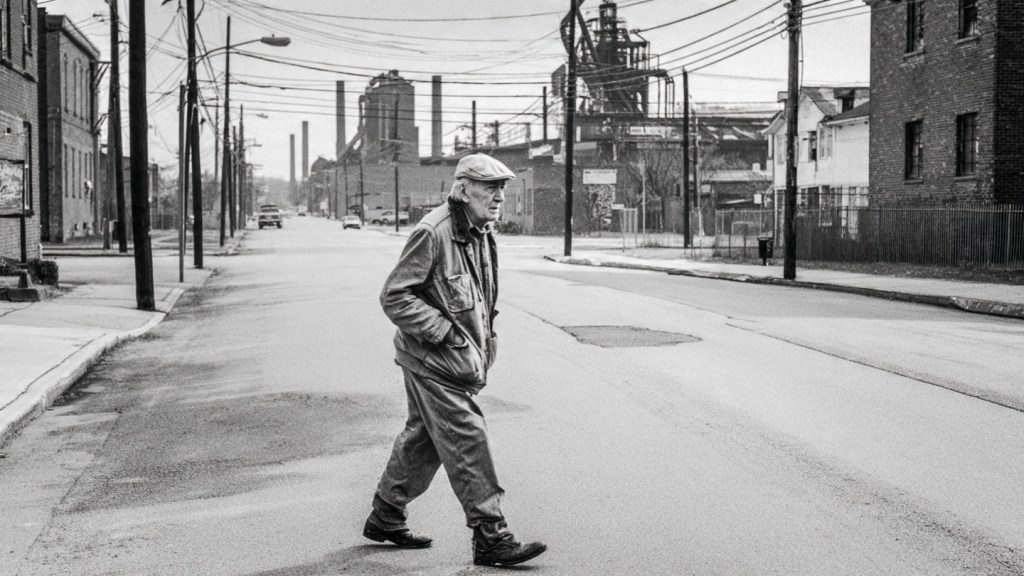
You ask about dramatic exits, and I suppose you’re expecting some story about slamming doors at family dinners or storming out of the Elks Club after a bad poker hand. But when you’ve lived eighty years in New Corinth, Delaware, watching this city rise and fall like the tides on the Delaware River, there’s only one exit that matters to me – the day I walked out of the New Corinth Iron Works for the last time.
The Last Day
It was March 1978, a cold Friday afternoon with that grey light that makes the river look like hammered steel. I’d worked at the Iron Works for eight years, ever since I came back from Vietnam with shrapnel in my leg and a need to do something with my hands. My father had worked there before me, pouring rails and bridge components during the Depression, and I’d always thought my son Michael would follow us both. That’s how it was supposed to work in New Corinth – you inherited your job the way you inherited your grandfather’s watch.
The rumours had been circulating for months, of course. Everyone knew the old mills were dying, that the steel was being made cheaper somewhere else, somewhere that wasn’t a tired river city in Delaware. But knowing something and believing it are different creatures entirely. When the foreman called us all to the main floor that afternoon and told us the plant was closing – eliminating 1,200 jobs, he said, as if those were just numbers and not families, mortgages, and Christmas presents – I felt something crack inside my chest that had nothing to do with my age.
Walking Out Into Nothing
Most of the men just stood there in shock, their faces grey as the foundry dust that coated everything. Some started crying right there on the floor, grown men who’d raised families and fought wars. Jimmy Kowalski, who worked the crane for twenty-eight years, sat down on a pile of steel plate and didn’t move for an hour. But I couldn’t stay in that building another minute. I walked past the foreman, past the offices where management had already packed their things, past the trophy case in the lobby that held the model of the first rail we’d ever poured.
I didn’t clock out. I didn’t say goodbye. I just walked.
The City I Left Behind
I walked down Market Street, which was already starting to show the cracks that would split it wide open in the years to come. Past the diners where we used to eat lunch, where the owners’ faces fell when they realised what our empty tables would mean for them. Past Saint Mary’s where my wife Angela and I were married, where we’d baptised both our children, where I’d eventually bury her twelve years later. Past the union hall where we’d fought for better wages, better conditions, a future that was already crumbling behind us like the bricks in the old textile mills.
The dramatic thing wasn’t the walking – it was what I was walking away from. Not just a job, but an entire world, a way of life, an identity. I was a steelworker, a union man, someone who made things that held up bridges and kept trains running. Without the Iron Works, I didn’t know who I was supposed to be.
What Came After
I never went back to collect my tools. They probably got sold off with everything else when they liquidated the plant. The building’s still there – well, what’s left of it – converted now into the New Corinth Business Park, all clean lines and “light manufacturing,” whatever that means. Sometimes I drive past it, and I can still see the way the sparks used to fountain up when we poured the molten iron, like we were stealing fire from the gods themselves.
The city struggled for decades after that closure – drugs, crime, people leaving for the suburbs or anywhere else that still had work. We hit 127 murders in 1993, and I remember thinking this was what happened when you took away people’s purpose, their pride in making something real. My son Michael never did work in steel; he went to community college and became a nurse at Christiana Care. He did well for himself, better than I could have in those years, but I still feel that small sting of broken continuity.
Looking Back Now
These days, they’re trying to revive the riverfront, bringing in casinos and university buildings and restaurants where a craft beer costs more than I used to make in an hour. Young people are moving back in, calling the old neighbourhoods “authentic,” taking pictures of the industrial ruins like they’re beautiful instead of broken. Maybe they are both.
That walk out of the Iron Works in 1978 – that was my most dramatic exit. Not because I slammed anything or made a scene, but because every step took me further from the man I’d been and closer to a future none of us could see clearly. Dramatic doesn’t always mean loud. Sometimes it means walking quietly away from everything you’ve ever known, into a city that’s dying around you, and somehow finding the strength to keep living in it anyway.
I’m still here. New Corinth is still here. We’re both older, more scarred, but stubbornly standing. That walk ended at the riverfront, where I sat on a bench and watched the Delaware flow past, indifferent to commerce and industry and all our human plans. The river’s still there, too. I suppose that’s something.
Harold Mitchell
Bob Lynn | © 2025 Vox Meditantis. All rights reserved.


 Vox Meditantis
Leave a comment