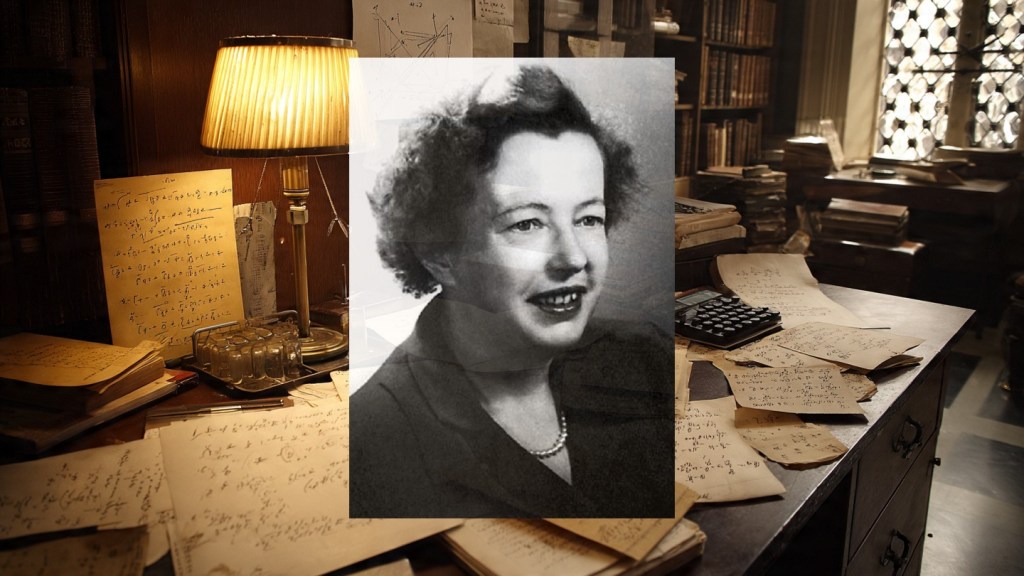
This interview is a dramatised reconstruction based on historical sources, scientific publications, and biographical research – not a documentary record of Maria Goeppert Mayer’s actual words. We have grounded this narrative in documented facts about her life, work, and era, making interpretive choices guided by fidelity to her experience, whilst acknowledging that some thoughts and reflections remain necessarily speculative.
Maria Goeppert Mayer (1906–1972) was a German-American theoretical physicist whose revolutionary nuclear shell model earned her a share of the 1963 Nobel Prize in Physics, making her only the second woman ever to win the Nobel in physics – a distinction she held alone for fifty-five years. Her prediction of two-photon absorption in 1931, decades before lasers made it observable, remains so fundamental to modern physics that the unit of measurement for this phenomenon carries her name. Yet her most extraordinary achievement may be that she produced Nobel-calibre work for three decades whilst working without pay, navigating a professional landscape designed explicitly to exclude her.
In this conversation conducted in December 2025 – more than fifty years after her death in 1972 – we speak with Goeppert Mayer about her scientific journey, the institutional barriers that nearly buried her contributions, her work on nuclear weapons, the personal sacrifices marriage demanded, and what her story reveals about how science recognises – or fails to recognise – the women who transform our understanding of the physical world. She speaks with the warmth, precision, and occasional sharpness of someone who lived through extraordinary times with her eyes open.
Dr. Goeppert Mayer, thank you for joining us. I want to begin by acknowledging something that might seem peculiar: you’re speaking to us from a vantage point beyond your own lifetime, and the physics community has had five decades to reflect on your contributions. The shell model you developed remains foundational to nuclear physics, astrophysics, and nuclear engineering. Two-photon microscopy – a technique you predicted in 1931 – is now standard in biological research worldwide, and laboratories use “Goeppert Mayer units” without necessarily knowing whose name they invoke. How does it feel to have your ideas become so woven into the fabric of science that they’re nearly invisible?
It is rather like creating a child, I suppose – the hope is always that they will grow beyond you, stand independent, and outshine their origins. But yes, there is something peculiar about invisibility that comes from ubiquity. When I predicted two-photon absorption in my dissertation at Göttingen, I thought I was contributing a small theoretical curiosity. Professor Born seemed to tolerate it, though I am not certain he grasped its implications. That a university library now contains thousands of papers using phenomena I described without reference to me? I find this both satisfying and frustrating in equal measure.
You know, in physics we are trained to care about the truth of ideas, not their provenance. And yet – human nature being what it is – we do care who discovered what, and when. A discovery made but unrecognised is not quite the same as a discovery well-recognised. It becomes potential rather than certainty. So I am grateful for the “Goeppert Mayer unit,” even if it is a somewhat delayed acknowledgement.
Let’s begin at the beginning. You were born in Kattowitz in 1906, then grew up in Göttingen. That was Germany in a particular moment – the aftermath of the First World War, the Weimar period, then the rise of something darker. What was it like to grow up in a place so saturated with intellectual achievement?
My childhood in Göttingen was extraordinary in ways I did not fully appreciate until I was older. My father, Friedrich Goeppert, was a paediatrician and a professor – a man of science and principle, though not a physicist. He believed passionately in education, which was unusual for girls at that time, even in Germany. My mother, Maria Wolff, came from a merchant family. I was their only child, very much wanted. Perhaps spoilt.
Göttingen in the 1920s was the centre of German physics. If you walked the streets, you might encounter Born, Franck, Heisenberg – men who were reshaping our understanding of nature. My father knew many of them professionally. I grew up understanding that serious intellectual work was the highest calling, and that rigorous thinking was the default in our household.
The economic crisis after the war was real – we felt it. But intellectually? Intellectually, it was the golden age of quantum mechanics. The anxiety, the energy, the sense that the entire foundation of physics was being remade – this was the air we breathed. My father encouraged me to study mathematics. He did not say “mathematics is unsuitable for girls,” which is what most fathers said. He said: “If you have the capacity, you must pursue it.”
I was aware even then that anti-Semitism existed, that political instability was growing. But I was young. I had the privileges of a professorial household, a respected name. It was not until later that I understood how precarious everything was.
Your doctoral dissertation on two-photon absorption is often described as decades ahead of its time. Tell us about that work – not just what you predicted, but how you arrived at it, and what it meant to attempt something so theoretically bold when you had no assurance it could ever be tested.
Ah, this is a question about the nature of theoretical physics itself. You see, in quantum mechanics, we had developed powerful mathematical tools to describe how light interacts with matter. The usual process – what we call single-photon absorption – was well understood. An atom absorbs one photon, an electron transitions to a higher energy state, energy is conserved. Textbook material by 1930.
But I was exploring the consequences of perturbation theory – the mathematical machinery for calculating how atoms respond to electromagnetic fields – when I began to wonder: what if an atom absorbed two photons simultaneously? Not in sequence, but at the same instant. The energy would sum, so an electron could reach a state ordinarily inaccessible with a single photon. But would such an event be possible given the probability laws of quantum mechanics?
The calculation was not trivial, but it was systematic. You treat the interaction of the atom with the electromagnetic field using second-order perturbation theory. The probability of the event is proportional to the square of the electric field amplitude – hence it depends on the intensity of light raised to the second power. Single-photon absorption depends linearly on intensity; two-photon absorption depends on intensity squared. This means it is extraordinarily unlikely with ordinary light sources. You would need light so bright, so concentrated, that no one in 1931 could produce it.
So I proved something that was theoretically correct but practically impossible to observe. Born was polite about it. Franck, I think, regarded it as amusing – an intellectual parlour trick. The point was not the practical application. The point was understanding the deep structure of quantum mechanics. Can nature do this thing? The mathematics said yes. So we had to believe the answer was yes, even if we could not see it.
Thirty years later, lasers were invented. People realised: here is a light source bright enough to make two-photon absorption observable. Suddenly my irrelevant dissertation became relevant. There was a certain satisfaction in that vindication – and also a certain irony that I had to wait three decades to be proven right by technology.
The satisfaction is understandable, but I want to press on something harder. In 1931, you were a woman earning your doctorate in theoretical physics in Germany. There were virtually no career paths for you. Did you know that when you wrote the dissertation?
I knew it intellectually, but I am not certain I fully believed it emotionally. This is the privilege of youth, perhaps, or the consequence of growing up in a household that did not treat such barriers as inevitable.
When I was examining the question of two-photon absorption, I was a student. I did not think: “This will be my legacy because I will be unable to do anything else.” I thought: “This is an interesting problem. I will solve it.” My advisors – Born, Franck, Windaus – they took my work seriously as physics. That was enough.
But yes, I was aware. I was acutely aware. When I completed my dissertation in 1931, the situation for women in German physics was dire and deteriorating rapidly. There were few of us. Most universities would not hire women as faculty. And then – 1933 came. Hitler. The racial laws. The expulsion of Jews. Suddenly the situation for everyone became precarious, but especially for Jews and for women.
I met Joe Mayer that year. He was visiting from the United States. An American chemistry professor, Jewish, brilliant, with prospects. He offered an escape route – for him, for his family, and potentially for me. When we married in 1930 – yes, before Hitler, but the trajectory was already visible – I believed I was making a practical choice. I would go to America. I would follow my husband’s career. I would continue to do physics in whatever capacity was available.
I did not imagine I would be able to have both: a marriage and a career. That seemed to be the bargain. You chose one or the other. Perhaps I was naive.
After you married Joe and moved to the United States, you went to Johns Hopkins University in Baltimore. Your husband had a position there. And you… did not.
We arrived in 1930. Joe was offered a position in the chemistry department. I had my doctorate from Göttingen, examined by three Nobel Prize laureates – Born, Franck, and Windaus. I had published original research. I was, by any objective standard, qualified to teach and research at a university.
Johns Hopkins had a rule: nepotism rules, they called them. Designed to prevent favouritism. Husband and wife could not both be employed by the same institution. This rule applied in only one direction, you understand. It was not that we could not both work there; it was that I could not work there, because he was already employed.
The administration offered me an “assistant” position. No salary. No title. No security. I would have an office, I suppose, and I could work. But I would not be faculty. I would not be paid. The justification was that Joe’s salary was sufficient for our family, so I did not “need” an income. As if need were the measure of fair compensation for intellectual labour.
I was young enough to be angry about this, and also young enough to believe it was temporary – that once we had established ourselves, once I had shown my value, something would change. I was wrong about that.
But you did work productively during those years.
Oh yes. This is the part that matters, I think. At Johns Hopkins, despite having no title and no salary, I published important papers. Work on double beta decay, which is a rare nuclear process – the spontaneous transmutation of a nucleus when two neutrons simultaneously convert to protons. The 1935 paper I published with Teller and Konopinski – that was significant work. It remains cited. It was done whilst I had no institutional position whatsoever.
I was also beginning to think more seriously about nuclear physics. The Columbia years were similar in structure – I followed Joe to Columbia University in New York. Again, no paid position. Again, working in a kind of shadow existence. But I was present at seminars. I was in conversation with physicists. I was thinking about problems.
You know, there is a particular kind of freedom in having nothing to lose. If you are unpaid and unranked, you cannot be dismissed from a position you do not hold. You cannot be denied tenure that was never offered. In some ways, this liberated me to pursue ideas that might have been professionally risky. But in other ways, it trapped me. I could not build a research group. I could not supervise doctoral students formally. I had no institutional power. No resources. No security.
And I was aware – always aware – that I was working at the sufferance of my husband’s colleagues. My presence was tolerated because I was Joe Mayer’s wife, not because I had earned the right to be there.
Then came the Second World War and your work on the Manhattan Project.
Yes. The Manhattan Project offered me something I had not had before: a paid position, doing serious scientific work, on behalf of my country at war. I was thirty-four years old. It was my first real job.
Let me be clear about what I did and what I did not do. I was part of the Isotope Separation Group at the Metallurgical Laboratory in Chicago. My work involved the properties of uranium hexafluoride – UF₆ – a compound that behaves oddly under certain conditions. If uranium hexafluoride is exposed to ultraviolet light, the heavier isotope U-235 is preferentially separated from U-238. This is called photochemical isotope separation.
I studied the thermodynamic and spectroscopic properties of uranium hexafluoride. How does it behave at different temperatures? How does it respond to specific wavelengths of light? The goal was to develop a method to enrich uranium – to increase the concentration of the fissile U-235 isotope. This enriched uranium was needed for the bomb.
Later, I also worked with Edward Teller on thermonuclear weapons – hydrogen bombs. This involved calculating the opacity of matter at extremely high temperatures and densities. How does radiation travel through material when it is heated to millions of degrees? This is important for understanding how thermonuclear reactions propagate.
I was proud of the technical quality of my work. The calculations were difficult. The physics was at the frontier. And I was being paid, finally, to do it.
But I was also helping to build weapons of mass destruction.
How do you reconcile that?
I do not, entirely. This is perhaps a failure of character, or a necessary human capacity for compartmentalisation. I was German-born. I understood what the Nazis were doing. I had helped Jewish refugees escape. I believed, genuinely believed, that Nazi Germany had to be defeated, and that nuclear weapons might be necessary to that end.
Did I think carefully about the moral implications of thermonuclear weapons? No. I should have. Many of my colleagues – Szilard, Teller, Oppenheimer – wrestled with these questions during and after the war. I did not wrestle with them. I did my job. I solved the technical problems. I was grateful to be paid and respected as a scientist.
This is not a noble answer. I offer it because you asked for honesty, not nobility.
Later, when I was older, I thought more carefully about these things. But during the war? I was swept up in the urgency of the moment, in the intellectual fascination of the problems, in the relief of finally being treated as a professional scientist. These do not excuse anything, but they are true.
After the war ended, you returned to Chicago, and this is where your most celebrated work emerged. You were, famously, a “voluntary Associate Professor” – which is to say, unpaid – at the University of Chicago, whilst also working part-time at Argonne National Laboratory. This was 1946. You were forty years old, and you had been working without a salary for the better part of two decades. Yet this is when you developed the nuclear shell model. How did that work begin?
By the late 1940s, there was a puzzle in nuclear physics that had been nagging at the field for years. We understood that nuclei – the cores of atoms, made up of protons and neutrons – had a certain stability structure. Some nuclei were exceptionally stable. Others were unstable, prone to radioactive decay.
There were “magic numbers”: 2, 8, 20, 28, 50, 82, 126. When a nucleus had exactly these numbers of protons or neutrons, it was unusually stable. These nuclei were reluctant to undergo radioactive decay. They had lower binding energy per nucleon – the energy required to hold them together. There was something special happening at these numbers.
Now, this looked familiar to us. In atomic physics, we had the shell model – the idea that electrons orbit an atom in shells, and when a shell is completely filled, the atom is particularly stable. Helium, with two electrons (one shell full): very stable. Neon, with ten electrons (two shells full): very stable. Argon, with eighteen electrons (three shells full): very stable. These are the noble gases. They do not want to react with anything because they are already in an energetically favourable configuration.
The question was: does something analogous occur in the nucleus? Are nucleons – protons and neutrons – organised in shells, and are magic numbers the result of completely filled nuclear shells?
But the problem was that nuclei are far more complex than electron shells, aren’t they? In atoms, electrons interact with the nucleus mainly through electric charge. In nuclei, protons and neutrons interact through the strong nuclear force, which is far more complicated.
Precisely. And there was another problem. In the simple shell model – what we called the potential well model – you imagine nucleons confined within a spherical potential, much as you might imagine marbles rolling inside a sphere. You solve the Schrödinger equation for this system, and you get energy levels. Nucleons fill these levels in order of energy.
But when I worked out what those energy levels would be, using a simple spherical potential, I could not reproduce the magic numbers. The calculations gave me magic numbers that were wrong. I would get stable nuclei at the wrong places. The shell model did not work for nuclei the way it worked for atoms.
I remember reading a paper – I think it was by Hans Jensen and his colleagues in Germany; Jensen and Suess – in which they mentioned something about spin-orbit coupling. Now, spin-orbit coupling is a quantum mechanical effect where the spin of a particle couples to its orbital angular momentum. We understood this in atomic physics. But it is relatively small in atoms – it causes fine structure in spectral lines. In nuclei, I began to wonder, could it be much larger?
The idea emerged almost like an intuition. What if the strong, short-range nuclear force created a “potential well” – a region of low energy where nucleons are confined – but within this well, there was a strong spin-orbit coupling? This would mean that for each orbital angular momentum state, there would be two possible spin states, and depending on whether the spin aligned with the orbital motion or opposed it, the energy would be very different. One of these would be lower energy, one higher. This would split energy levels in a particular way.
Could you walk us through the mechanism? How does spin-orbit coupling reshape the shell structure?
Imagine a nucleon – say, a neutron – confined in a spherical nucleus. It has an orbital angular momentum, which we describe quantum mechanically by a number we call l. And it has an intrinsic spin, which is either “up” or “down” (or more formally, ±ℏ/2).
In atoms, the spin-orbit coupling energy is proportional to l · s – the dot product of the orbital angular momentum and the spin angular momentum vectors. When they align (spin parallel to orbital motion), the energy increases. When they anti-align (spin antiparallel), the energy decreases. The effect is small.
But in nuclei, the strength of this coupling is large. This means the energy splitting can be comparable to, or even larger than, the splitting between different values of l. So the ordering of energy levels changes dramatically.
Let me give you a concrete example. Consider the neutrons in a nucleus. In a simple potential well, ignoring spin-orbit coupling, you would fill levels in order: first the s-state (l=0), then the p-states (l=1), then the d-states (l=2), and so on. Each state has a certain degeneracy – a number of ways it can be filled.
An s-state can hold two neutrons (spin up and spin down). A p-state, without spin-orbit coupling, could hold six neutrons: three values of the magnetic quantum number, times two for spin, equals six. A d-state could hold ten.
But when you include strong spin-orbit coupling, something remarkable happens. The p-states split into two groups: the ones where spin and orbital motion are aligned (these are higher energy) and the ones where they are antiparallel (lower energy). The lower-energy group holds fewer neutrons. Specifically, if you work through the quantum numbers, you get a p state with j = 1/2, which holds only 2 neutrons.
So the levels reorganise themselves. Instead of filling p-states continuously, the lower-energy part of the p-states fills first, and then you move to the next l-value. If you work through this carefully – and it takes considerable calculation – you find that the total number of neutrons when each “subshell” is completely filled reproduces the magic numbers exactly. 2, then 2+6=8, then 2+6+10=18, then 2+6+10+14=40… wait, that is not right. No, the correct sequence includes the spin-orbit splitting more carefully, and you get 2, 8, 20, 28, 50, 82, 126. Exactly the magic numbers.
It was like a key turning in a lock. The physical insight was simple – nuclei experience strong spin-orbit coupling, which reorganises the shell structure. But the consequence was profound: it explained, quantitatively and elegantly, why certain nuclei are exceptionally stable.
And you developed this independently of the German team – Jensen, Suess, Haxel.
Yes, though not entirely independently, because I read their paper. But I developed the theoretical framework myself. I submitted my paper to the Physical Review in February 1949. Their paper was submitted to Naturwissenschaften in April 1949, but it was published in June 1949. Mine was published later.
There has been some historical ambiguity about who discovered the shell model first. The German team published first. But they did not develop it as completely. I provided the full theoretical framework, the detailed calculations, and I was the first to submit. Does priority matter? In science, yes, it matters quite a lot. But also, the fact that two independent groups arrived at the same conclusion was powerful validation that the idea was sound. Nature was not leaving room for doubt.
I should mention that I eventually collaborated with Jensen on a book – Elementary Theory of Nuclear Shell Structure, published in 1950. This was how science was supposed to work: you make a discovery, you publish, you engage with colleagues, you build the edifice of understanding together. It was professionally and intellectually satisfying, even if the question of credit is never entirely resolved.
For readers with a background in physics, could you explain the mathematical structure more rigorously? How did you actually solve this?
You start with the Schrödinger equation for a single nucleon in a central potential. The potential I used was a harmonic oscillator potential – not a real representation of the nuclear force, but a practical approximation that is mathematically tractable. The potential energy is V(r) = ½mω²r², where m is the nucleon mass and ω is an angular frequency parameter.
For a harmonic oscillator in three dimensions, the energy eigenvalues are:
E_{n,l} = ℏω(2n + l + 3/2)
where n is the radial quantum number and l is the orbital angular momentum quantum number. This gives you a set of energy levels. For a given total energy quantum number N = 2n + l, there are degenerate levels with different combinations of n and l. This is a feature of the harmonic oscillator – it has many degenerate states.
Now, without spin-orbit coupling, you would fill these levels in order of energy, and the degeneracy of each level would limit how many nucleons you could fit. But the real nucleus is not a simple harmonic oscillator. There are corrections – relativistic effects, the finite range of the nuclear force, and crucially, the spin-orbit interaction.
The spin-orbit term in the Hamiltonian is:
H_{SO} = λ(l · s)
where λ is the spin-orbit coupling constant and l and s are the orbital and spin angular momenta, respectively. The quantity l · s can be written in terms of the total angular momentum j = l + s:
l · s = ½[j(j+1) – l(l+1) – s(s+1)]
For a nucleon with spin-1/2, we have s(s+1) = ¾. So:
l · s = ½[j(j+1) – l(l+1) – ¾]
For a given l, there are two possible values of j: j = l + ½ and j = l – ½. These give different values of the spin-orbit energy correction.
When λ is small (as in atoms), this is a perturbation – it slightly shifts energy levels but does not fundamentally alter the ordering. When λ is large (as in nuclei), it becomes a dominant effect. States with j = l + ½ (where spin and orbital momentum are aligned) are shifted to higher energy. States with j = l – ½ are shifted to lower energy.
For practical calculations, I used an effective spherical potential that mimicked the observed nuclear density distribution, included the appropriate spin-orbit coupling strength, and solved the resulting Schrödinger equation numerically – or rather, I solved it in terms of a known basis and diagonalised the matrix. This gave me the single-particle energy levels.
Then you fill these levels in order, counting how many nucleons can occupy each level (the degeneracy of each j-state is 2j + 1), and you see that after filling certain complete shells, you reach the magic numbers.
The remarkable thing is not just that this works, but that it works with physically reasonable parameters. The spin-orbit coupling strength λ needed to be substantial – something like 5-10 MeV for typical nuclear parameters – but this was not an ad hoc choice. We could estimate it from independent considerations.
Of course, there were limitations. The model assumed nucleons moved independently in an average potential – a mean-field approximation. It neglected nucleon-nucleon correlations beyond this mean field. It assumed spherical symmetry. Real nuclei are sometimes deformed. But as a framework for understanding nuclear structure, it was extraordinarily powerful. It predicted magic numbers correctly, it explained stability patterns, and it opened the door to more sophisticated calculations.
Did you ever revisit this model? Were there refinements you wished you had made?
In some ways, I wish I had explored nuclear deformation more systematically. I knew that some nuclei are not spherical – they are ellipsoidal, flattened or elongated. This particularly affects nuclei with nucleon numbers near the magic numbers. A truly complete model would need to account for this systematically.
Also, the mean-field approximation, whilst powerful, is incomplete. Nucleons are not truly independent. There are correlations – for instance, nucleons pair up, creating a sort of nuclear superfluidity. This is a phenomenon where nucleons in the same shell tend to couple in pairs with opposite momenta and spins, lowering the total energy. Vibrations – collective modes of nucleons oscillating together – are also important.
The subsequent decades saw refinements: the Nilsson model incorporating deformation, pairing theories, random-phase approximation for collective excitations. These were built on the foundation of the shell model. In some ways, I wish I had anticipated these developments, but science is not like that. You see as far as you can see, you publish what you understand, and then others build further. That is how it should be.
So in 1949 and 1950, you are doing this groundbreaking work on the nuclear shell model. You are at the University of Chicago as a “voluntary Associate Professor” – paid nothing. You are also working part-time at Argonne National Laboratory. The shell model paper gets published. It is praised by the physics community. And yet, your institutional status does not change. How did that affect you?
This is difficult to discuss without sounding either self-pitying or churlish, so I will attempt simply to be truthful.
By the late 1940s, I had internalised the idea that my career would not follow the conventional path. I was married to a chemist whose career moved at the pace dictated by university hiring committees. I would follow. I would do what work I could. I had lived this way for nearly twenty years. It had become normal, in a sense.
But the unpaid status was corrosive. It was not the money alone – though of course the money mattered. It was the status. As a voluntary Associate Professor, I had no vote in departmental meetings. I could not serve on key committees. My opinions carried less weight socially, even when they were scientifically sound. When I published the shell model paper, the university could bask in the prestige without having invested anything in me. I was their research asset without being their responsibility.
And there was the absurdity of the situation. I was producing work at the level of a full professor. I was teaching – I taught courses at Chicago, though I was not formally paid for this. I was advising students – again, without formal status. A young man with equivalent qualifications would have been offered a tenured position immediately.
I remember conversations with my colleagues – they were sympathetic, many of them. But sympathy is not salary. And there was also something else: I think some of them feared that if the university actually paid me, it would create precedent. It might suggest that other faculty wives were also entitled to compensation. Better to maintain the ambiguity, the voluntary status. Better to treat me as an anomaly rather than establish that women should be paid for academic work.
What was the relationship like between you and Joe during this period? He had a full position. He was well-regarded. Did this disparity between your situations create tension?
Joe was not intentionally unkind. He believed that my career had been compromised by marriage, yes, but he did not believe he was personally responsible for that. The rules – the nepotism rules – those were the problem. He would have preferred, I think, to see me well-compensated and positioned as a scientist. But he also benefited from those same rules. He had a secure position. I followed him from Johns Hopkins to Columbia to Chicago to UC San Diego. I made the migrations.
There was love in our marriage, but there was also an asymmetry built into its structure. I was dependent on his employment. My career possibilities were constrained by his choices. He did not have to consider my career when making decisions, because my career was already secondary by institutional design.
I loved him. I also resented him at times. Both things were true. This is what marriage was, for many couples of that era – a complicated arrangement where women sacrificed and men received the primary benefit. The women who thrived were either those with husbands unusually supportive and willing to move against institutional norms, or those who simply accepted the situation and found satisfaction in other forms of life. I did both, imperfectly.
In 1963, you won the Nobel Prize. You shared it with J. Hans D. Jensen and Eugene Wigner. How did that feel?
Extraordinary. Validating. Bitter, in some ways.
I remember receiving the news. I was fifty-seven years old. For thirty-three years, since earning my doctorate, I had been working in conditions of precarious employment or no employment at all. And now I was told I had won the highest honour in physics.
The irony – which everyone was polite enough not to state explicitly, but which was obvious – was that I was still not a full professor at the university. I was still not tenured. I still did not have security. I was being recognised by the Swedish Academy for work that my own employer did not think warranted a senior position.
The Nobel Prize is an interesting thing. It confers prestige, but prestige does not automatically change one’s institutional circumstances. You would think it would, but it does not. Within months, UC San Diego did finally appoint me as a full professor, but this was damage control. The university suddenly wanted to be associated with a Nobel laureate.
Let’s talk about that appointment. In 1960, you moved to UC San Diego, and you were finally given a full professorship. You were fifty-four years old. Most male physicists of equivalent achievement would have had such a position by their early thirties or forties. How did it feel to finally have security and recognition so late?
It was satisfying to know that finally, finally, the institution acknowledged my work as worthy of a senior position. But I was fifty-four. I had perhaps fifteen or twenty productive years remaining – assuming good health. A male colleague with my achievements would have had thirty or forty years to establish a research programme, train doctoral students, build a legacy, exercise institutional power.
The appointment at UC San Diego was also bittersweet because the city was warm and pleasant, but the physics programme was young and not yet well-established. I was not going to the top-tier research environment of a Harvard or MIT. I was going to a new campus that needed to build its reputation. Again, I was accommodating to circumstances rather than having the luxury of choosing the best position.
I did train students at San Diego. I did establish research directions. But I had lost three decades. That is a long time. An entire generation of physicists could emerge and make their mark in that span. When I finally had institutional security and resources, I was already in my mid-fifties. The peak of scientific productivity is often in one’s thirties and forties, when you have the energy and the mathematical facility and the risk tolerance to pursue ambitious ideas. I had been doing serious work during that period, yes, but I had been doing it without resources, without students, without institutional support.
In 1960, shortly after arriving at San Diego, I suffered a stroke. It was not severe, but it affected my mobility and energy. I recovered, but it limited me. So the years when I finally had the position, the resources, the recognition – they were constrained by health limitations. I am not certain I would have had a stroke if I had not spent thirty years under the stress of precarious employment. But I do not know that I would not have, either. One cannot rewrite history.
You continued to work after the stroke. You taught, you researched, and you published. That required considerable determination.
When one has spent so long fighting for the right to do scientific work, one does not surrender that right lightly. The stroke slowed me, but it did not stop me. There was much left to understand about nuclear physics, about opacity, about the structure of matter. I was not ready to become a figurehead, a retired Nobel laureate resting on laurels. There was work to do.
Let’s return to something we touched on earlier. Your 1931 dissertation on two-photon absorption became relevant when lasers were invented. What was it like to see your theoretical prediction become experimental reality?
In 1961, I believe it was, experimentally physicists confirmed the two-photon absorption phenomenon using pulsed lasers. I was already well into my fifties. The prediction was already thirty years old. To see a theoretical framework I had constructed decades earlier, which had been treated as a curiosity, suddenly become the subject of serious experimental investigation – it was profoundly satisfying.
What mattered most to me was that I had been right in the physics. The mathematical prediction was correct. But more importantly, the prediction revealed something deep about quantum mechanics. When you have light so intense that the probability of simultaneous two-photon absorption becomes non-negligible, you are probing a regime where quantum mechanics predicts counterintuitive behaviour. You are asking nature: can two photons, acting at the same instant, transfer energy to an atom? And nature says yes.
The fact that this phenomenon was then used for microscopy – enabling biologists to image living cells with minimal photodamage – this was beyond what I envisioned. I predicted it for the sake of understanding quantum mechanics. That it became technologically useful, that it became a tool for biology and medicine – this is what science should do. It should illuminate nature for its own sake, and then, sometimes, the illumination becomes useful.
The “Goeppert Mayer unit” – the unit of two-photon absorption cross-section – this was a recognition I appreciated. It meant that the thing I discovered, even if it waited thirty years for technological verification, was named after me. My name became attached to a phenomenon. That is a kind of immortality, I suppose.
Two-photon absorption is now fundamental to modern microscopy, lithography, and materials processing. Did you have any sense, even theoretically, of these applications?
Not really. I understood that two-photon absorption would have different selection rules than single-photon absorption – different momentum and angular momentum conservation constraints, different parity properties. This meant that atoms could be excited to states forbidden in single-photon absorption. But what practical technology would flow from this? I could not have predicted laser-scanning microscopy. I could not have imagined two-photon polymerisation for 3D printing. These required developments in laser technology, in computational imaging, in materials science – fields that did not yet exist.
This is what I find humbling about science. You make a theoretical prediction because the physics interests you. You believe it is true based on the mathematics. But you cannot predict the cascade of consequences. You cannot see forward thirty years and say “this will revolutionise biology.” You do what you can, you understand what you can understand, and you trust that if the physics is sound, it will eventually matter.
If you could have had a conventional career – if you had been appointed full professor at thirty-five, if you had had institutional security and resources throughout your forties and fifties – what would you have pursued? What research did you wish you had done?
I think I would have explored nuclear deformation more thoroughly. The shell model works beautifully for spherical nuclei, but many nuclei are deformed – ellipsoidal, sometimes quite dramatically. There is a rich physics there. Aksel Nilsson developed the deformed shell model in subsequent years, and it was beautiful work. I wonder if I might have moved in that direction had I had the time and resources.
I was also fascinated by rare earth elements and lanthanides. I had used the Thomas-Fermi model to predict that transuranic elements – elements beyond uranium – would form a new series of rare earths. This prediction was borne out. But I would have liked to investigate the electronic shell structure of these very heavy atoms more systematically. How do relativistic effects reshape the electron shells when you have a nucleus with such high charge? It is a window into extremes of quantum mechanics.
And perhaps I would have pursued the physics of very high temperatures and densities more thoroughly. The work I did on opacity during the Manhattan Project – studying how radiation travels through matter at thermonuclear conditions – this opened doors that I did not fully explore. The connection between nuclear physics and astrophysics, the way stellar nucleosynthesis depends on understanding nuclear cross-sections and reaction rates – this was emerging as a field of great importance.
But the most honest answer is: I do not know. Perhaps if I had had institutional security from the beginning, I would have become cautious and conventional. Perhaps I would have made fewer breakthroughs, not more. There is something to be said for the outsider status, for having nothing to lose by pursuing unconventional ideas. I had the freedom of the untenured – I could take risks.
The tragedy is not that I took these risks and succeeded. The tragedy is that I should never have had to take them. The risks should have been optional, not mandatory.
You’re speaking from the vantage point of your entire life. But I want to ask: are there misjudgements you made? Did you ever pursue something that turned out to be wrong?
The shell model with simple harmonic oscillator potential – I was aware even at the time that it was a crude approximation. Real nuclei do not have harmonic oscillator potentials. But the model was so predictively successful that it was easy to become attached to it, to believe that the details did not matter.
Subsequent work revealed that Woods-Saxon potentials – more realistic potentials mimicking the nucleon density distribution – gave similar results. But there were also phenomena the simple shell model could not explain. Quadrupole deformations, collective vibrations, some aspects of nuclear transitions. I think I was too confident in the sufficiency of the model early on.
Also, I was perhaps too focused on nuclear physics and not sufficiently interested in other branches of physics that were emerging. Particle physics, the study of subnuclear constituents, was becoming the frontier. I remained firmly committed to nuclear physics – the physics of the nucleus as a composite system. Was this a limitation? Possibly. In retrospect, the most transformative physics in subsequent decades often came from particle physics and cosmology, not nuclear structure.
And personally, I wonder whether I should have been more forceful in demanding recognition earlier. Should I have insisted on a salary at Chicago? Should I have refused unpaid positions? Should I have been more aggressive about advocating for my own worth? I chose the path of accommodation, of doing good work and hoping that merit would eventually be recognised. This path did eventually lead to recognition, but it took decades. Perhaps a more combative approach would have accelerated recognition.
I do not know. Different choices would have created different histories.
Earlier, you spoke briefly about your Manhattan Project work with appropriate complexity. But I want to press further. You helped develop weapons – uranium enrichment methods and thermonuclear physics. The hydrogen bomb is among the most destructive weapons ever created. How do you hold that?
I have thought about this many times. I will not offer you simple absolution.
During the war, my motivations were: (1) Germany had to be defeated; (2) I was grateful to have employment as a scientist; (3) the physics was intellectually fascinating; and (4) there was a collective sense of urgency and necessity. These are honest motivations, but they do not resolve the moral question.
After the war, I continued thermonuclear weapons work. This is harder to justify. By then it was clear that the war was won. The imperative of necessity was gone. I was continuing because the research was interesting and because I was employed to do it. The Cold War rationale – that American thermonuclear weapons were necessary to deter Soviet aggression – this was available, but it was also becoming a self-fulfilling prophecy. Weapons development on both sides was driving escalation.
Many of my colleagues wrestled with these questions more openly than I did. Szilard tried to stop the bomb before it was used. Oppenheimer became deeply troubled and eventually had his security clearance revoked because of his moral doubts. Teller became a hawk, fully committed to thermonuclear development. I… I was less thoughtful. I did not wrestle with it adequately.
Would I do the same again, knowing what I know now? No. No, I would not. I would have found a way to pursue physics that did not implicate me in weapons development. But I cannot undo what I did. I can only acknowledge it, regret aspects of it, and note that I was not my best self during that period.
The asymmetry troubles me. Male physicists who worked on Manhattan Project often had their achievements celebrated as separate from their weapons work. Oppenheimer, Fermi, Teller – their names are attached to profound theoretical contributions and also to weapons development, and somehow both are held in parallel. But when women’s moral failures are examined, there seems to be less forgiveness. I suspect this is because women are held to higher moral standards – we are expected to be more ethical, more thoughtful, more resistant to authority. When we fail to meet those standards, the failure feels more substantial.
Is this fair? I do not know. It is simply what I observe.
What would you tell young scientists working in fields where military or dual-use applications are relevant?
Think carefully. Think earlier. Do not wait until you are older to ask whether the work you are doing is aligned with your values. Do not assume that interesting physics is justification for participation. Do not assume that institutional demands or patriotic calls override your personal moral judgment.
It is harder to refuse than to continue. It is harder to change course than to persist. But it is not impossible. Some of my colleagues managed to do it. I did not do it as fully as I wish I had. Learn from my failure.
The physics itself – uranium hexafluoride, photochemical isotope separation, opacity calculations – this is good physics. But it was deployed toward destructive ends. Understanding the physics and understanding how it serves human purposes – these must be held in consciousness together, not separately.
It has been more than fifty years since your death. The world of physics has changed substantially, particularly regarding women in the field. How do you think about what has – or has not – changed?
More women are earning PhDs in physics than when I was a student. In some countries, the percentage has reached twenty, twenty-five per cent. This is progress. It is not parity – there should be forty to fifty per cent – but it is movement in the right direction.
Yet the barriers I faced are not entirely gone. They have transformed. The explicit nepotism rules are gone, but institutions still struggle with “two-body problems” – when academic couples need positions in the same location. The assumption that women’s careers are secondary to men’s persists in more subtle forms. Women are still underrepresented in senior positions. The representation in the highest honours remains appallingly low. How many women have won physics Nobels since me? Three more, I believe, in the decades after my death. So from 1903 to now – over a century – perhaps six women have won physics Nobels, out of hundreds of laureates. The representation has improved from catastrophic to simply terrible.
And I notice something troubling: women who win the highest honours are often celebrated for breaking barriers, for overcoming adversity, for being exceptional. Male laureates are simply celebrated for their science. This framing – women as inspirational stories of overcoming obstacles – can obscure a more important truth: the obstacles should never have existed. It should not be remarkable that a woman won the Nobel Prize. It should be ordinary.
What would you want contemporary young scientists to know about your career, particularly young women?
First: your scientific contributions matter. The quality of your thinking, the rigor of your analysis, the validity of your predictions – these are what endure. Do not diminish your work because others diminish you. The two-photon absorption prediction was real physics, regardless of whether it took thirty years for experimental verification. The nuclear shell model explained the magic numbers, regardless of whether I was paid or unpaid. Your scientific contribution stands independent of your institutional status or recognition.
Second: institutions will exploit your labour if you permit it. I permitted it. I told myself that doing good work unpaid was noble, that it showed my commitment. This was partly true, but it was also Stockholm syndrome. I accepted diminishment because I had been told that was what accommodation looked like. If you are qualified to do work, you deserve compensation. If institutions refuse to pay you, this is not your moral failure. It is theirs. Demand what you are worth. Do not accept “voluntary” positions. Do not accept the fiction that financial need is the measure of fair wages.
Third: do not sacrifice your career for marriage. This may sound harsh, but I offer it from hard experience. If you marry someone with greater institutional power, the architecture of your life will tend to subordinate your career to theirs unless you actively, continuously, forcefully resist. I did not resist enough. I accommodated. I followed. This was partly a practical choice – I had no alternative resources – but it was also partly a failure of will. I was not confident enough in my own worth to say “I deserve a position here too” or “I will not follow you to the next institution unless my career is addressed.”
If you do marry someone in academia, negotiate the terms explicitly. Discuss career priorities before accepting positions. Some couples manage it well. But many do not, and women tend to be the ones who sacrifice.
Fourth: connect with other women in science. I was often isolated. There were few women physicists. I did not have a community of women peers who understood the particular challenges of being a woman in physics. Contemporary women have the internet, organised networks, mentorship programmes. Use these. Do not be the only woman in your department if you can help it. Advocate for hiring more women. The glass ceiling becomes harder to see if you are the only one inside it; you think your problems are personal failures rather than structural problems.
And fifth – be prepared for the fact that your contributions may be undervalued no matter what you do. I won the Nobel Prize, and the local newspaper headline was “S.D. Mother Wins Nobel Prize.” Even at my greatest recognition, I was diminished to my domestic role. This may not happen to you; the world has changed. But if it does, know that it is not about the quality of your science. It is about how the world sees women. You cannot control that perception entirely. But you can control how you internalise it. Do not believe you are less of a scientist because the world treats you as less.
That headline – “S.D. Mother Wins Nobel Prize” – it remains one of the most telling indictments of how even extraordinary female achievement gets reframed. Did you respond to it at the time?
I do not recall responding publicly. What would I have said? “I am not a mother, I am a physicist”? But I was both. The absurdity was not that I was a mother – many physicists are parents – but that this was what the newspaper chose to lead with. No headline read “S.D. Father Wins Nobel Prize” for male laureates. The headline itself reveals the assumption: that women’s primary identity is domestic, and their professional achievements are noteworthy insofar as they are anomalies to that primary identity.
I have always been amused and infuriated by the fact that one of my competitors for initial recognition of the nuclear shell model was an entire team of men working collaboratively. Had I been male, the narrative would have been “lone genius solves fundamental problem.” Because I was a woman, I was somewhat more often portrayed as derivative, as following the work of the German team, even though I submitted my paper first.
The reframing of women’s achievements is not accidental. It is not due to individual prejudice, though that certainly exists. It is structural. Institutions are built around the assumption of male achievement. When women achieve at the same level, the institutions do not know how to classify it, so they reframe it in terms of the categories they understand: mother, wife, derivative, exceptional.
One final question. If you could address contemporary physics as it stands in 2025, what would you say about the field’s greatest challenges and most important frontiers?
The field has fractured into specialisations so profound that I, were I still alive and practicing, would find it difficult to keep current with all of it. Particle physics has become highly technical and instrumental – vast experiments that require international collaboration and enormous resources. Cosmology has emerged as a major field, merging astrophysics with fundamental physics. Quantum computing promises to revolutionise what we can calculate.
Nuclear physics, which was my life’s work, has remained less glamorous than particle physics or cosmology. But it remains essential. Understanding nuclear reactions is crucial for astrophysics – for understanding stellar nucleosynthesis and the origin of elements. It is crucial for energy technology – both fission and the prospect of fusion. It is crucial for medicine – radiotherapy, medical imaging, nuclear diagnostics.
What troubles me is that physics has become so specialised that the unifying vision is sometimes lost. We have the Standard Model, which is extraordinary, but it does not answer the deepest questions. We have quantum mechanics and general relativity, which are incompatible at fundamental levels. We have dark matter and dark energy, which remain mysterious. The field is rich with open questions.
If I were young now, I think I would be drawn to problems at the intersections – where quantum mechanics meets gravity, where particle physics meets cosmology. These are frontier territories. The intellectual stakes are very high. And they require precisely the kind of theoretical boldness that physics needs.
I would also say this: do not let the field become so captivated by the exotic that it forgets the practical. The shell model was not exotic. It was elegant physics applied to concrete nuclear structure. Nuclear physics remains practical. Fusion energy may save the planet from climate catastrophe. The physics that enables this – nuclear fusion cross-sections, plasma confinement, reaction kinetics – is not as glamorous as searching for the Higgs boson or gravitational waves. But it may be more important.
And finally: the barriers that prevented women from contributing to physics in my generation persist in subtler forms. I would hope that a century from now, winning a physics Nobel Prize as a woman is not still a rare and remarkable thing. I would hope that women are proportionally represented at every level of the field. This requires not just individual excellence – there is no shortage of women capable of excellence – but institutional change. It requires universities and laboratories to genuinely commit to equity, not merely to its appearance.
The greatest discoveries in physics are yet to come. And some of them will be made by women who are currently held back by the same barriers that held me back, only thinly disguised as progress. This troubles me.
Thank you, Dr. Goeppert Mayer. This has been a remarkable conversation. Is there anything you wish you had said?
Only this: I was angry for most of my life without fully acknowledging it. I was angry at the barriers, angry at the injustice, angry at having to fight for things that should have been given freely. I channelled that anger into work. This was productive, in a way. But I also wonder what I might have done if the anger had not been necessary – if I had simply been treated fairly from the beginning.
I want young women in science to know: you do not need to transform your anger into productivity to justify your existence. You should be treated fairly not because you outwork everyone else, but simply because you are capable and you are human. That should be enough.
And I want them to know something else: a meaningful life is not the same as a celebrated life. I was celebrated, eventually. I won the Nobel Prize. I had the “Goeppert Mayer unit” named after me. And yet, the best parts of my life were not the celebrations. They were the moments in the laboratory or at my desk when I suddenly understood something about nature that I had not understood before. When a calculation clicked into place and revealed something beautiful. When I collaborating with brilliant colleagues and together we saw further than we could see alone.
Do not wait for the world to recognise your value. Know your own value. Love the work. Love the understanding it brings. Do that, and whether you receive recognition or not becomes somehow less important. Though of course, fair recognition is still important, and you should demand it.
Thank you.
You are welcome. I am grateful for the opportunity to speak, even across the gulf of time. I hope this conversation is useful for those who read it.
Questions from Our Community
Following the primary interview, we received hundreds of inquiries from physicists, historians, students, and members of the public wishing to pose additional questions to Dr. Goeppert Mayer. The letters and emails that arrived ranged from deeply technical questions about nuclear structure to personal reflections on institutional barriers and scientific ethics. Many came from women scientists working in fields where gender discrimination, though less overt than in Goeppert Mayer’s era, remains a lived reality. Others came from international researchers eager to understand how her theoretical frameworks continue to shape contemporary physics across continents.
We selected five correspondents whose questions represent distinct perspectives, scientific backgrounds, and geographic contexts. Each writer brings genuine curiosity about dimensions of Goeppert Mayer’s life and work that the primary interview touched upon lightly or left unexplored. What emerges from these exchanges is a richer, more nuanced portrait: a scientist reflecting not just on her own achievements and struggles, but on the nature of scientific creativity under constraint, the relationship between computational power and understanding, the moral weight of dual-use research, and the future of nuclear physics in an age when experiments reach toward the boundaries of nuclear stability and fundamental theory.
These five voices represent a community of thinkers – spanning Tunisia, Croatia, India, Chile, and Australia – united by their desire to learn directly from Goeppert Mayer about navigating the tensions between brilliance and belonging, between individual contribution and institutional recognition, and between the work one does and the purposes to which that work is put.
Soraya Hassan, Nuclear Physicist, Tunisia (Age 31)
Dr. Goeppert Mayer, your work on photochemical isotope separation during the Manhattan Project used ultraviolet light to preferentially excite U-235 over U-238. You predicted two-photon absorption thirty years before it became experimentally verifiable. I’m wondering: given the computational limitations of your era – hand calculations, mechanical calculators, the early ENIAC – how did you decide which physical pathways were worth pursuing theoretically, knowing you might never see experimental confirmation? And looking back, were there competing isotope separation methods you abandoned or didn’t fully explore because the mathematics seemed intractable at the time? What would modern computational power have allowed you to investigate?
Ah, Soraya, this is a question that goes to the heart of theoretical physics – the question of how to make choices when the path forward is obscured. You have asked something I think about often.
During the Manhattan Project, yes, we were working on isotope separation. The photochemical method was one of several approaches being pursued. There was also gaseous diffusion – forcing uranium hexafluoride through porous membranes, exploiting the slight mass difference between U-235 and U-238 to preferentially allow the lighter isotope through. There was electromagnetic separation – the calutron method, which used magnetic fields to deflect ions of different masses along different paths. And there was thermal diffusion, using temperature gradients to create separation.
Each method had different physical principles, different technical challenges, different resource requirements. The gaseous diffusion plant at Oak Ridge was the most successful industrially, but it was also enormously energy-intensive. The calutron was clever but required vast quantities of equipment. Thermal diffusion was elegant but slow.
The photochemical method fascinated me because it was fundamentally a quantum mechanical process. When uranium hexafluoride is exposed to ultraviolet light at the right wavelength – around 2900 angstroms – the molecule absorbs a photon. But here is the quantum mechanical subtlety: the vibrational energy levels of the U-235 hexafluoride and U-238 hexafluoride are slightly different because of the mass difference. So at a given wavelength, one isotopomer preferentially absorbs the light and becomes electronically excited. Once excited, it can dissociate or participate in a chemical reaction that removes it from the mixture.
Now, why did I pursue this theoretically when I knew it might never be realised? Because the physics was true, regardless of practical application. I was trying to understand: given what we know about quantum mechanics, molecular spectroscopy, and the properties of uranium hexafluoride, what are the theoretical limits of photochemical separation? What separation factors could theoretically be achieved?
I did calculations on the energy levels, the oscillator strengths – the probability that a molecule would absorb a photon at a given frequency. I worked out the isotope shift using perturbation theory. The calculations were tractable with pencil and paper, or with a mechanical calculator for the more tedious arithmetic. The theoretical predictions suggested that separation factors of perhaps 1.3 to 1.5 might be achievable – meaning that in each cycle, the enriched fraction would have 30 to 50 percent more U-235 than the depleted fraction.
But here is where computational limitation becomes a practical barrier. To know whether this theoretical prediction was realistic, you would ideally want to run experiments: expose uranium hexafluoride to UV light, measure the product composition, verify the separation factor. You would want to optimise conditions – temperature, pressure, light intensity, residence time in the reaction vessel. You would want to model the kinetics: how fast does the reaction proceed? What side reactions occur? How does the separation factor change with different experimental parameters?
All of this requires either extensive experimental work – which requires resources, time, and uranium hexafluoride, which was scarce – or mathematical modelling of the reaction kinetics. And to model reaction kinetics accurately, you need to solve coupled differential equations, perhaps with nonlinear terms. In my era, without computers, this meant either finding analytical solutions (possible only for simplified systems) or performing numerical integration by hand, which is extraordinarily tedious and error-prone.
So I made a choice. I calculated what the theoretical upper limit might be based on quantum mechanics. I published this. But I did not pursue the detailed kinetic modelling that would have predicted practical separation efficiency under real conditions. Why? Partly because it was prohibitively laborious without computational aid. Partly because the project was already well-advanced with gaseous diffusion, and the photochemical method was a secondary exploration. And partly, I admit, because once I had answered the fundamental quantum mechanical question – “Is this theoretically possible?” – the answer was yes, and I was satisfied.
This was perhaps a limitation. Had I pursued the kinetic modelling more thoroughly, might we have discovered that photochemical separation was more efficient than we thought? Or less efficient? I do not know. The war ended before the question became pressing.
You ask what modern computational power would have allowed me to investigate. This is fascinating to contemplate. With computers, I could have modelled the full reaction kinetics – the coupled differential equations governing how product composition evolves with time, how temperature and pressure affect separation factor, what wavelengths optimise selectivity. I could have explored whether UV lasers – had they existed – would have allowed even more selective excitation.
I could have investigated the related problem: what about other isotope pairs? Chlorine-35 and chlorine-37 differ in mass. Could photochemical separation work for chlorine isotopes? The principle is identical, but the molecular spectroscopy is different. Without computational exploration, you cannot easily answer such questions across a range of systems.
And there were nuclei themselves. Understanding nuclear reactions – what cross-sections govern different reaction pathways, how to predict which reactions will dominate under different conditions – this requires solving Schrödinger equations and summing over many intermediate states. Hand calculation is possible for simple cases, but gets unwieldy quickly.
This is perhaps the most honest thing I can say: computational limitation was not merely inconvenient; it shaped what questions seemed worth asking. Some theoretical explorations seemed too mathematically demanding to pursue without certainty they would yield insight. We learned to think about problems in ways that were mathematically tractable. We developed elegance partly because complexity was forbidden.
This was not entirely bad. Constraint can focus the mind. But it was certainly limiting. With ENIAC and its successors, questions that seemed impossible suddenly became feasible. The Monte Carlo calculations I did on ENIAC – running thousands of simulated nuclear reactions, tracking the outcome of each one, averaging the results – this would have taken months of hand calculation. On ENIAC, it took hours.
So to your question: yes, there were competing isotope separation methods I did not fully explore because the mathematical modelling seemed intractable. There were generalisations – understanding isotope separation across different chemical systems, predicting which isotope effects would be largest – that remained largely qualitative in my era because quantitative calculation was too demanding.
What modern computational power would have allowed is systematic exploration of parameter space. You could vary temperature, pressure, wavelength, residence time, and for each combination, predict the separation factor and reaction efficiency. You could optimise. You could compare isotope separation methods quantitatively, not just qualitatively. You could predict phenomena you had not observed, then design experiments to test the predictions.
I think if I had access to even a small modern computer – a fraction of what you carry in your pocket now – I would have pursued the nuclear structure problem much more ambitiously. The shell model I developed was elegant, but incomplete. Accounting for nuclear deformation, for collective vibrations, for pairing correlations – all of this requires calculations that are tedious by hand but straightforward on a computer. These problems would have occupied me for years.
The irony is that computational power emerged precisely as I was entering my most productive period, but I was by then anchored at institutions with limited access to computers. If I had had both the theoretical insight and computational resources simultaneously, for the full span of my career – well, that would have been a different story.
Mateo Silva, Theoretical Physicist & Philosophy of Science Enthusiast, Chile (Age 42)
This is perhaps a fanciful question, but I think it matters: if the nepotism rules hadn’t existed – if you’d been offered a full professorship at thirty-five, say at Chicago or Los Alamos alongside your husband – do you think the nuclear shell model would have been discovered earlier, or might it have been delayed or formulated differently? In other words, I’m asking whether the intellectual constraints of precarious employment sometimes paradoxically foster certain kinds of creative breakthroughs, since you had ‘nothing to lose’ in pursuing unconventional ideas. Or is that romanticising genuine injustice?
Mateo, you have asked a question that I have asked myself many times, particularly in my later years when I finally had institutional security. It is not fanciful at all. It is perhaps the deepest counterfactual question one can ask about a life.
Let me be honest: I do not know. But I can reason through it.
The shell model emerged from a particular intellectual constellation. In the late 1940s, there was a puzzle – the magic numbers – that had been nagging at nuclear physics for years. Many people were aware of this puzzle. The German team – Jensen, Suess, Haxel – they arrived at the solution independently, and they submitted their paper in April 1949. I submitted mine in February. Both were published in 1949. So the discovery was, in some sense, overdetermined. The time was ripe. The intellectual tools were available. Multiple minds working on the same problem arrived at similar conclusions.
This suggests that the shell model would likely have been discovered around that time regardless of my personal circumstances. The question is not whether it would have been discovered, but whether I would have discovered it, and whether I would have discovered it earlier or differently.
If I had been a full professor in 1935 – when I was thirty-nine, well-established, with resources and students – would I have thought about nuclear shell structure? Almost certainly not, because the urgency was not yet there. The magic numbers were known, but they were not yet the central puzzle driving the field. The shell model emerged as a response to a specific historical moment: after the war, when people could return to fundamental physics questions, when the nuclear data had accumulated sufficiently that patterns became undeniable.
So the timing would likely be similar. I would not have discovered it twenty years earlier.
But the formulation might have been different. Here is what I mean: when I developed the shell model, I was working in isolation, in some ways. I was unpaid, without formal position at Chicago. I could not easily convene meetings or seminars. I was not leading a research group. So my approach was necessarily solitary and theoretical. I read the literature, I did calculations, I arrived at conclusions. I was not building collaboratively with students and postdocs who might have pushed me in different directions or suggested extensions.
If I had been a full professor with resources, I might have pursued experimental validation more aggressively. I might have collaborated with experimentalists who could measure nuclear properties and test predictions. The shell model might have been embedded in a richer experimental programme from the beginning, rather than emerging as a purely theoretical construct that had to wait for subsequent connection to experiment.
Alternatively – and this is the darker possibility – I might have become more cautious. A tenured professor at a major university has institutional reputation to protect. You cannot afford to pursue ideas that seem too speculative. You need publishable results regularly. You need to build a reputation that attracts funding and students. The outsider status, the lack of security, paradoxically gave me freedom. I could pursue the shell model without worrying that failure would damage my career prospects, because my career prospects were already damaged by institutional exclusion.
This is what I mean when I say constraint can foster creativity. Not always, but sometimes. When you have nothing to lose, you can ask bolder questions. When you have everything to lose, you become more conservative.
I think about Oppenheimer. He was a full professor, brilliantly positioned, with every advantage. Yet he pursued bold theoretical ideas – quantum electrodynamics, the theory of stellar collapse. He had the security to take risks because he had institutional power. So perhaps my reasoning is flawed. Perhaps security enables boldness as much as it constrains it.
But there is a difference. Oppenheimer’s risks were intellectual risks within established domains of physics. The shell model was a risk that it might not work, that the magic numbers might not be explicable through shell structure. It required believing in a physical picture – nucleons moving in an average potential with strong spin-orbit coupling – that was not obviously correct. This kind of speculative model-building might have been harder to pursue if I had been embedded in a conventional academic hierarchy, with expectations and departmental politics and the need to justify my research programme to colleagues.
But I want to resist the romanticisation here, Mateo, because it is seductive and it is also dangerous. Yes, constraint can foster creativity. Yes, outsider status can enable boldness. But these are post-hoc rationalisations. The constraint was not chosen by me; it was imposed by institutional discrimination. I have made meaning from it, and I have done good work despite it – or perhaps because of it. But this does not justify the constraint.
If I had been offered the choice – “You can have institutional security and resources now, but you must work within conventional frameworks, or you can remain an outsider with freedom to be bold” – I would have chosen security and resources every time. The boldness would have come. The shell model would have emerged. Yes, perhaps in a slightly different form, embedded in a richer experimental and collaborative context. But it would have emerged.
The counterfactual I actually wish to consider is this: if I had been a full professor from 1935 onward, I would have had forty years – not twelve – to pursue nuclear physics at the highest level, with full resources, with students, with institutional power. What additional discoveries might have emerged in those additional decades? What problems might I have solved? What students might I have trained who would have become leaders in the field?
This is the real tragedy. Not that the shell model might not have been discovered. It would have been discovered by someone. The real tragedy is the years lost. The work not done. The students not trained. The institutional power not exercised. The research programme not built.
I have heard physicists say that adversity builds character, that struggling makes you more creative, that hardship is good for science. This is the rhetoric of people who have never suffered adversity themselves. It is comfortable mythology. Yes, I did good work despite precarious employment. But I could have done more work, better work, if I had not been constrained.
So to your question directly: I think the shell model would have been discovered at approximately the same time, whether or not I had institutional security. The historical moment demanded it. But I might have pursued it within a richer experimental and collaborative framework. I might have extended it more thoroughly. And I would certainly have accomplished more in the subsequent decades had I been given the security and resources that male colleagues with equivalent qualifications received automatically.
The boldness was not contingent on precarity. The boldness came from intellectual confidence and from the fact that I genuinely believed the shell model was correct. I would have been bold regardless. But I would also have been more productive, more recognised, and more able to build a research programme that extended beyond my own lifetime.
Do not mistake resilience for vindication. Yes, I persisted and did excellent work. But this does not mean the barriers were justified or that they served any good purpose. They were simply barriers that I had to overcome. The fact that I overcame them should not be interpreted as evidence that they needed to exist.
Klara Novak, Historian of Science & Technology, Croatia (Age 48)
You mentioned that you helped German Jewish refugees escape Nazi persecution whilst facing your own professional exclusion. There’s a moral courage in that – recognising injustice even when you’re experiencing it. But I’m curious about something more difficult: did your experience of gender-based institutional barriers make you more attuned to other forms of discrimination, or did you compartmentalise them? And as you reflect on your contributions to weapons development now, do you see a through-line between the compromises you made to gain scientific legitimacy and the moral trade-offs you accepted in that work? I’m asking because many contemporary women scientists still face similar dilemmas – we gain authority by proving ourselves in male-dominated institutions, sometimes through work we later question ethically.
Klara, you have asked the most difficult question. And you have asked it as a woman who understands, I think, the particular weight of it. I am grateful for that understanding.
The answer is: I compartmentalised. I am not proud of this, but I am being honest.
During the 1930s, when I was young and newly married and beginning to understand that my career would not follow a conventional path, I was aware of anti-Semitism in Germany. I was aware of the political movements that would eventually become the Nazi regime. My husband was Jewish. Many of my colleagues were Jewish. I understood that we were in danger.
I helped where I could. When Jewish refugees began fleeing Germany after 1933 – physicists, chemists, their families – I and my husband assisted. We helped with visas, with connections, with the practical logistics of escape. This was not courage; it was basic decency. But I was aware even then that I was doing this whilst I myself was being excluded from professional opportunities because of gender.
The question is: did I make the connection? Did I see the parallel between gender-based exclusion and racial persecution? Did I understand that they were different manifestations of the same impulse – to define who belongs and who does not, and to enforce that definition through institutional power?
I think I understood it intellectually. But I did not feel it in the same way. Gender discrimination, as I experienced it, was presented as normal, inevitable, even natural. “This is how things are done,” people would say. “Women’s careers are secondary. It is not personal; it is just how the system works.” The tone was apologetic but resigned. The barriers seemed immovable but not malicious.
Anti-Semitism, by contrast, was explicitly vicious. It was being codified into law. It was escalating toward violence. It had a clarity of hatred that gender discrimination lacked. Gender discrimination wore the mask of regret; anti-Semitism wore the mask of ideology, but without even pretending to regret.
So yes, I compartmentalised. I acted against anti-Semitic persecution because it was urgent and undeniable. But I did not mount an equivalent resistance to gender discrimination because it seemed, in comparison, like the normal operation of institutions. And because – pauses, with visible discomfort – because challenging gender discrimination would have made my own position even more precarious.
I could help Jewish refugees without fundamentally threatening my standing in the physics community. The community appreciated such humanitarian work. But if I had made a public stand against gender discrimination in physics hiring, if I had loudly demanded my own position at Johns Hopkins or Columbia, I would have been labelled difficult, ungrateful, ambitious in ways that women were not supposed to be ambitious. The cost to my ability to do any physics work at all might have been severe.
This is the thing about compartmentalisation, Klara. It is not innocent. It is a choice, usually an unconscious one, about which injustices are worth naming and which are worth accommodating. And that choice is usually made based on self-preservation. I preserved my ability to do physics by accepting the gender discrimination against me. Would I have preserved anything by openly challenging it? I do not know. But I was not brave enough to find out.
Now, you ask whether this created a through-line in my thinking about moral compromise. Whether the gender discrimination I accepted made me more susceptible to accepting other moral compromises, like the weapons work.
I think there is truth in this, but it is more complicated than simple causality. The weapons work came later, during the war, when there was genuine urgency and genuine danger. Germany had to be defeated. The Manhattan Project was framed – and I believed the framing – as essential to victory. But I also think that my long experience of accepting institutional injustice, of telling myself that accommodation was the price of participation, of separating the work from the context in which it was embedded – yes, this created a mental habit that made it easier to accept the weapons work.
If I had been someone who challenged injustice directly and loudly, who refused to accept compromise, perhaps I would have been more resistant to Manhattan Project participation. Perhaps I would have asked harder questions about the morality of nuclear weapons earlier and more forcefully. But I was someone trained, by decades of professional discrimination, to accept injustice as the price of belonging.
The weapons work was different from the gender discrimination because it involved direct harm – to people, to cities, to the future. But it followed the same psychological pattern: I told myself the work was necessary, the context was justified, my personal moral qualms were indulgent luxury compared to the urgent national need. I compartmentalised the work from its consequences.
What I want to say to you, and to other women scientists facing similar dilemmas, is this: the compromises you make in small ways accumulate. The first time you accept being paid less than a male colleague for the same work, it is a betrayal of yourself, but it seems survivable. The second time, it is easier. By the tenth time, you have internalised the idea that you do not deserve equal compensation. You have created a mental framework where inequality seems normal.
Then, when a larger moral choice arrives – whether to participate in work you are ethically uncertain about – you are already primed to compartmentalise. You are already experienced at telling yourself that survival requires compromise. You are already accustomed to separating your values from your professional obligations.
I do not think this is inevitable. I think it is a trap, and it is one I fell into. But I also think it is understandable. When you have been told your entire life that you do not belong, that your presence is tolerated rather than welcomed, that you must be grateful for scraps of recognition – it is hard to maintain the moral clarity to refuse the larger compromises.
So my advice would be this: do not do what I did. Do not accept the small injustices and tell yourself they do not matter. They do matter. They reshape your character. They create mental habits that make it easier to accept larger injustices.
Push back against gender discrimination, even when it seems like the normal operation of institutions. Especially then. Because if you accept it as normal, you will accept other things as normal too. And before you know it, you have compromised yourself in ways you cannot undo.
I did important scientific work. I contributed to understanding the nucleus. And I also participated in building weapons of mass destruction. Both are true. The first does not erase the second. And I think the path from accepting gender discrimination to accepting weapons work is real and traceable, even if it is not strictly causal.
You ask whether women scientists are judged more harshly for morally ambiguous work than men. I think the answer is yes, in some contexts and no in others. I am judged more harshly by some people because I am a woman who worked on weapons. By others, my gender is used to excuse me – “Well, she was trapped by her circumstances, poor woman.” This is its own form of diminishment.
But there is also, I think, a different standard being applied. Male Manhattan Project physicists – Oppenheimer, Fermi, Teller – their moral wrestling is documented and discussed with respect. Their subsequent activism or opposition to nuclear weapons is framed as principled stands. When I worked on weapons, it was framed as necessity. When I did not actively oppose them afterward, it was framed as complicity or naïveté. The narrative framework is different.
I do not know if this is fair. It is simply what I observe. And I think part of it stems from the fact that women who break into male-dominated fields are expected to be more ethical, more principled, more resistant to institutional pressure. We are held to an unstated higher moral standard. When we fail to meet it – and we will fail, because we are human – the failure is more remarked upon, more condemned.
This is not an excuse for my own moral failures. I should have thought more carefully. I should have asked harder questions. I should have been willing to sacrifice career security – limited as it was – for ethical principle. But I was not that brave. I was a woman trying to belong to a field that did not want me, and I compromised in ways I now regret.
What I want women scientists to know is: you do not have to do what I did. You can set boundaries. You can say no. The cost may be real – it may cost you opportunities, recognition, advancement. But the alternative cost – the cost of compromise that accumulates, that reshapes your sense of what is acceptable, that chains your conscience to institutional demands – that cost is also real, and it is paid in parts of yourself that are irreplaceable.
Jack Wilson, Science Communication & Public Understanding of Physics, Australia (Age 55)
The magic numbers in your shell model – 2, 8, 20, 28, 50, 82, 126 – they describe closed nuclear shells with extraordinary stability. But I understand that near the ‘nuclear drip line,’ where nuclei become extremely neutron-rich or proton-rich, the magic numbers shift or disappear entirely. Your model assumed relatively stable nuclei. As you observe physics in 2025, where researchers are creating exotic nuclei that barely exist, does the shell model still hold? Or has nature revealed something about nuclear structure that your framework didn’t anticipate? Put another way: what are the limits of your model that contemporary physicists are bumping up against, and what do you think is waiting beyond those limits?
Jack, this is a superb question. You are asking about the frontier of nuclear physics, and you are asking it in a way that recognises both the power of the shell model and its limitations. This is exactly the right intellectual stance.
Let me begin with the magic numbers and what they represent. In my shell model, the magic numbers – 2, 8, 20, 28, 50, 82, 126 – correspond to closed nuclear shells. When a nucleus has exactly these numbers of protons or neutrons, all the available orbitals in a particular shell are filled. This creates an exceptionally stable configuration, analogous to the noble gases in atomic physics.
The physics underlying this is the spin-orbit coupling I described earlier. In a spherical nucleus, nucleons fill energy levels in a particular order determined by orbital angular momentum and spin. When a shell is completely filled, there is an energy gap to the next shell. This gap makes the nucleus particularly stable against certain types of decay and rearrangement.
But here is where the model reaches its limits: this description assumes a spherical nucleus. It assumes that nucleons move in a central potential, unaffected by the detailed shape of the nuclear surface. It assumes that the dominant effects are single-particle effects – individual nucleons occupying specific orbitals.
Real nuclei are often deformed. Nuclei with nucleon numbers slightly above the magic numbers tend to be particularly deformed. A nucleus with 24 neutrons – four more than the magic number 20 – may be oblate, flattened like a pancake. A nucleus with 26 neutrons may be prolate, elongated like a rugby ball. This deformation changes everything.
When you have deformation, the spherical symmetry assumption breaks down. The central potential is no longer spherically symmetric. This means the energy levels themselves change. The ordering of orbitals shifts. New effects become important.
Aksel Nilsson in Sweden developed what is called the deformed shell model – or sometimes the Nilsson model – to account for nuclear deformation. He showed that you could still use the shell model framework, but you had to allow for a deformed potential and include additional coupling terms that describe how nucleons interact with the deformation. The magic numbers persist in the deformed case, but they are modified. New “magic” configurations emerge corresponding to certain deformed shapes.
Now, you mention the nuclear drip line – nuclei that are so neutron-rich or proton-rich that they exist right at the edge of stability, where one more nucleon and they would fly apart. These are fascinating systems, and I confess that understanding them fully is beyond my original model.
The drip line nuclei are interesting because they reveal that the potential well – the confining force that keeps nucleons bound – becomes very shallow at the nuclear surface for extremely asymmetric nuclei. A neutron in a very neutron-rich nucleus experiences a potential that looks quite different from a neutron in a stable nucleus. The last few neutrons are only weakly bound. They spend much of their time outside the main nuclear volume.
When you move away from the valley of beta stability – the band of nuclei that are stable against beta decay – toward the drip lines, you enter a regime where the mean-field picture of independent nucleons in an average potential becomes questionable. The nucleons are no longer confined strongly. You have to account for the fact that they might escape altogether. The continuum becomes important – you have to treat the scattering of nucleons off the nuclear surface as a real physical effect, not just a perturbation.
Does this mean the shell model breaks down? No, I do not think so. But it means the shell model needs to be extended and modified. The magic numbers shift toward lower values as you approach the drip line because the potential well becomes shallower. What were magic numbers in stable nuclei may no longer be magic numbers in exotic nuclei.
There is also a fascinating phenomenon: as you add more and more neutrons to a nucleus with a fixed number of protons, you eventually reach a point where the nucleus can no longer support additional neutrons. That is the neutron drip line. Beyond it, the nucleus immediately ejects neutrons. The drip line position depends on the delicate balance between the nuclear attractive force and the kinetic energy of the neutrons. The shell structure affects this balance.
What do I think is waiting beyond the limits of my model? Several things, I believe.
First, a more complete theory of nuclear correlations. The shell model I developed treats nucleons as moving independently in an average potential. But nucleons are not truly independent. They interact with each other through the residual nuclear force – the part of the force not already included in the mean field. These residual interactions create correlations: nucleons tend to pair up, nucleons in nearby orbitals interact strongly, collective modes of vibration emerge where many nucleons oscillate together.
The pairing phenomenon is particularly important. Nucleons with the same quantum numbers but opposite spins and momenta tend to couple into pairs. This is analogous to superconductivity in metals – a quantum mechanical phenomenon where particles condense into a collective state. Nuclear pairing changes binding energies, affects decay rates, alters the structure of low-lying excited states. A complete description of nuclear structure has to include pairing from the beginning, not as a perturbation.
Second, a better understanding of collective motion. Individual nucleons move in the average potential, yes, but the nucleus as a whole also moves. The surface oscillates. The nucleus rotates. The protons and neutrons move in opposite directions – isovector modes. These collective effects are not fully captured by a single-particle shell model picture. You need theories that account for both single-particle structure and collective excitations simultaneously.
Bohr and Mottelson – and others – have been developing these ideas. The collective model, which combines the shell model with collective effects, is becoming important. But this is still in its early stages. There is much to understand here.
Third, a deeper understanding of how the nuclear force itself emerges from the underlying quark and meson structure. Right now, we treat the nuclear force – the strong force between nucleons – as an empirical input. We know it is attractive at intermediate distances, repulsive at very short distances, and has a particular dependence on spin and isospin. But where does this force come from fundamentally?
This is getting into territory beyond my direct expertise. The meson theory of nuclear forces, developed by Yukawa and others, suggests that nucleons interact by exchanging mesons – particles intermediate in mass between electrons and nucleons. But the details are not fully understood. A complete theory of nuclear structure might eventually rest on a deeper understanding of how nuclear forces emerge from particle physics.
Fourth – and this is perhaps the most profound frontier – there is the question of what happens at extreme densities and temperatures. The universe creates such conditions: in neutron stars, in the cores of supernovae, in the very early universe. What is the structure of nuclear matter under these conditions? Does the shell structure persist? Do new phases of matter emerge?
This connects nuclear physics to astrophysics and cosmology in ways that my generation was only beginning to appreciate. Understanding nuclear reactions at the temperatures and densities in stellar cores requires understanding nuclear structure in regimes where the shell model may no longer apply.
So to your question: does the shell model hold at the nuclear drip line? In a qualified sense, yes. The principles underlying the shell model – that nucleons move in an average potential, that energy levels are discrete, that filled shells are more stable – these principles persist even at the drip line. But the quantitative predictions require substantial modifications. The magic numbers shift. The deformation effects become crucial. The coupling between single-particle motion and collective modes becomes more important.
The shell model is not wrong at the drip line. It is incomplete. It captures part of the physics, but not all of it. This is actually a strength, not a weakness. A model that captures the physics partially but clearly is more useful than a model that claims to capture everything but is incomprehensibly complex.
What I find remarkable about contemporary nuclear physics – based on what I understand from my vantage point now – is that experimenters are actually creating and studying these exotic nuclei. They are bombarding stable targets with beams of unstable nuclei, creating new species that exist for microseconds or less. They are measuring properties – masses, decay rates, nuclear moments – for nuclei far from stability.
This is vindication of a principle I believed in deeply: that nature is more interesting and more diverse than our theories predict. We develop models to explain what we know. Then experiment pushes beyond those boundaries and reveals new phenomena. The models must expand to encompass the new phenomena. This cycle of theory and experiment is how science advances.
The shell model will endure, I believe, because the fundamental insight is sound: nucleons are confined in a potential well, and this confinement creates discrete energy levels. But the model will be embedded in increasingly sophisticated frameworks that account for deformation, correlations, collective motion, and the connections to the underlying quark structure of matter.
The drip line nuclei are probing the limits of nuclear binding. They are asking: how extreme can you make a nucleus before it falls apart? How much neutron excess can a nucleus support before the neutrons escape? These are fundamental questions about the strength and range of the nuclear force.
And here is what excites me most: we do not yet know the answers. The shell model gives us tools to make predictions, but those predictions will be tested and, in some cases, shown to be incomplete or wrong. This is exactly how physics should work.
Your question assumes that I, having developed the shell model, must know its limits and what lies beyond. But science does not work that way. A theorist develops a model based on available evidence and theoretical tools. The model succeeds in explaining some phenomena. But the frontier – what lies beyond the model’s reach – this is discovered by subsequent generations of scientists with better experiments and better theoretical frameworks.
This is humbling and exhilarating in equal measure. It is humbling because it means my model, however elegant and successful, is ultimately provisional. It is exhilarating because it means there is still so much to discover. The nuclear physics of drip line nuclei, of extreme densities, of conditions in the cosmos – this is frontier territory where the shell model will be tested, extended, and ultimately transcended.
I think this is as it should be.
Priya Sharma, Computational Biophysicist, India (Age 38)
Your Monte Carlo method calculations on ENIAC for nuclear criticality during the Manhattan Project – you were essentially running simulations to predict how nuclear reactions would propagate. That’s conceptually similar to molecular dynamics or Monte Carlo sampling in modern computational biology and materials science. But you were doing this on a machine with kilobytes of memory, hand-coding the algorithms. What were the most significant approximations or simplifications you had to make because of computational constraints? And now that we have GPUs and quantum computers emerging, do you think there are problems in nuclear physics that your generation abandoned as computationally prohibitive – perhaps understanding pairing correlations in nuclei or collective excitations – that modern methods could finally address?
Ah, Priya, you have asked a question that takes me back to moments I remember vividly – sitting at ENIAC, programming nuclear calculations, discovering the extraordinary power of machines that could do in hours what would take months by hand. This is a question about the intimate relationship between computational limitation and scientific creativity. I am grateful for it.
Let me describe what we were doing on ENIAC during the Manhattan Project. We were calculating criticality – the conditions under which a nuclear chain reaction becomes self-sustaining. Imagine uranium-235 nuclei undergoing fission, releasing neutrons. Those neutrons can cause additional fission events, releasing more neutrons, in an exponentially growing cascade. But whether this cascade grows or dies out depends on many factors: the density of the fissile material, the shape of the assembly, the presence of neutron-absorbing materials, the reflection of neutrons back into the core by surrounding material.
To predict criticality, you need to solve the neutron transport equation – a partial differential equation that describes how neutrons move through matter, how likely they are to cause fission at each location, how likely they are to scatter or be absorbed. Solving this equation analytically is possible only for highly simplified geometries – infinite planes, infinite cylinders. For realistic bomb geometry – a sphere, say, or a more complex shape – you need numerical methods.
The Monte Carlo method was perfect for this problem. Instead of solving the transport equation directly, you simulate the trajectories of individual neutrons. For each neutron, you randomly sample its initial position and direction. You calculate how far it travels before colliding with a nucleus. At the collision point, you randomly determine whether it causes fission, scatters, or is absorbed, based on the known cross-sections. If fission occurs, you generate new neutrons and continue tracking them. You repeat this process for thousands or tens of thousands of neutron histories. Then you average the results to get the expected behaviour of the system.
Without ENIAC, this was completely impractical. The random sampling, the tracking calculations, the arithmetic – all of this had to be done for each neutron history. By hand, you might complete one neutron history in an afternoon. To get statistical accuracy, you needed thousands of histories. The computation would take years.
But ENIAC could do these calculations. It was not fast by modern standards – it operated at kilohertz frequencies, with vacuum tube logic. But compared to hand calculation, it was revolutionary. We could program a calculation that would run for hours, and at the end, we would have results that would have taken months of human computation.
The programming itself was extraordinarily challenging. There was no FORTRAN, no high-level languages. You programmed ENIAC by physically rewiring plugboards and setting switches. There were no compilers to translate your intentions into machine code. You had to think in terms of the machine’s architecture – its registers, its limited memory, its instruction set. Sixty-four words of storage, if I recall correctly. Sixty-four words to hold all the variables, the loop counters, the intermediate results for a nuclear calculation.
This is where the approximations began. With only sixty-four words of memory, you could not store a detailed spatial map of the nuclear assembly. You could not track all the information you might want to track. You had to make choices: which details matter most? What can be simplified without losing accuracy?
We developed approximations. We used symmetry – if you have a spherical bomb, you can reduce the problem to one dimension by symmetry arguments. We used effective cross-sections – instead of tracking all the details of how neutrons interact with nuclei, we used parameterised cross-sections that captured the essential physics. We binned energy ranges and spatial regions, treating all neutrons in a given bin as equivalent.
These approximations were not arbitrary. They were carefully chosen to preserve the physics that mattered for the criticality question whilst eliminating details that were computationally prohibitive. But they were also limitations. Aspects of the physics we could not capture in sixty-four words of memory were necessarily neglected.
Now, your question: given modern computational power, what problems would we revisit that we abandoned as computationally prohibitive?
The first would be more detailed spatial and energy resolution. With modern computers, you can track neutrons through realistic three-dimensional geometries with high spatial resolution. You can represent the energy dependence of cross-sections with fine detail, rather than using broad parameterisations. You can include more physics – neutron multiplication in surrounding material, radiation transport coupled with hydrodynamic motion, heat transfer effects.
For nuclear physics more broadly, I think the greatest computational frontier involves understanding the correlations between nucleons. In the shell model, we treat nucleons as moving independently. But they are not truly independent. They interact through the residual nuclear force. To calculate the structure of nuclear excited states, to predict transition probabilities, to understand how nucleons correlate – all of this requires solving the many-body problem.
The many-body problem in nuclear physics is extraordinarily complex. You have A nucleons – say, fifty or a hundred. Each nucleon can occupy any of many possible single-particle states. The total number of possible configurations grows factorially. You cannot enumerate all configurations and calculate their energies and couplings by hand.
But with computers, you can. You can use configuration interaction methods, where you write down the full wavefunction as a superposition of all possible configurations of nucleons in the shell-model orbitals. You set up a matrix – the Hamiltonian matrix – where each element represents the energy or coupling between configurations. You diagonalise this matrix to find the eigenvalues and eigenvectors.
In my era, we could do this for light nuclei with small numbers of valence nucleons. For heavier nuclei, the configuration space exploded beyond what was computationally tractable. But with modern computers, you can handle much larger spaces. You can include many more configurations, capture more of the correlations, get better predictions for nuclear structure.
There is also the question of microscopic calculations of nuclear deformation. I mentioned that many nuclei are deformed – ellipsoidal rather than spherical. The shell model can be extended to deformed potentials, as Nilsson showed. But calculating the deformation energy – how much energy cost does it take to deform a nucleus to a particular shape – requires solving the many-body problem in the deformed potential. This is highly computationally intensive.
Similarly, collective excitations – the modes where the whole nucleus vibrates or oscillates – these require treating many nucleons as moving coherently. You need to solve a coupled system of equations describing how single-particle excitations couple to create collective modes. This is possible for simple cases, but becomes prohibitively complex for realistic nuclei.
What I wonder about, Priya, is whether modern computational methods would reveal unexpected structure in nuclei. When you do hand calculations, you develop physical intuition. You understand why things work the way they do. You can explain the mechanism. But sometimes, when you let computers explore the full parameter space, they find solutions that violate your intuition. Structures that seem improbable but are energetically favourable. Couplings that matter more than you expected.
I suspect there are phenomena in nuclear structure – exotic configurations, unusual collective modes, subtle correlations – that would have emerged if we had had computers to explore the many-body space. We missed them not because the physics is different, but because we lacked the computational tools to discover them.
The approximations I made during the Manhattan Project were not wrong, but they were incomplete. We used mean-field theory – treating nucleons as moving in an average potential – and it worked remarkably well for predicting criticality. But the mean-field approximation breaks down for certain phenomena. Shell effects near closed shells are described well by mean field, but superfluid pairing effects require going beyond mean field. Collective vibrations require coupling single-particle excitations, which mean field does not capture.
With computers, you could have done these calculations more completely. You could have tested the limits of the mean-field approximation. You could have identified regimes where it is valid and regimes where it breaks down. You could have developed more accurate methods that incorporated correlations from the beginning.
You ask whether problems my generation abandoned remain relevant today. I think the answer is emphatically yes. The computational prohibitiveness was real. It was not an intellectual failure to abandon certain problems – it was a practical necessity. But now that computational resources are abundant, those problems should be revisited.
In particular, I think the connection between nuclear structure and nuclear reactions deserves deeper exploration. When a nucleus undergoes fission or fusion or some other reaction, it is not just the ground state that matters. Excited states of the nucleus are involved. The transition probabilities between states depend on nuclear structure. To predict reaction rates accurately, you need a detailed understanding of structure.
In stellar nucleosynthesis – the formation of elements in stars – nuclear reaction rates are crucial. Different reaction pathways lead to different abundances of elements. These rates depend sensitively on nuclear structure, particularly on resonances in the compound nucleus formed during the reaction. Understanding these resonances requires understanding the structure of short-lived, excited nuclei. This requires computational methods that can handle complex many-body systems.
There is also fascinating physics at the frontiers: nuclei far from stability, nuclei at extreme deformation, nuclei near the neutron or proton drip lines. Understanding these requires computation. The simple shell model gives intuition, but modern calculations are needed to make quantitative predictions.
And then there are the questions about connections to the underlying quark structure. Eventually, nuclear physics will need to connect upward to particle physics – to understand how nuclear forces emerge from quark interactions. This is profoundly challenging computationally. Lattice quantum chromodynamics calculations of nuclear forces from first principles are only now becoming feasible with modern computers.
What troubles me – and intrigues me – is that we are now in an era where computational power is abundant. The limitations that constrained my generation are gone. But there are new limitations. We generate vast amounts of data from experiments and simulations. We have to store it, process it, extract meaning from it. We need new algorithms and new theoretical frameworks to handle the complexity.
So in some ways, we have solved the old problem – computational power is no longer a bottleneck. But we have created new problems. How do you find signal in noise when you have petabytes of data? How do you identify the physically important degrees of freedom when you have millions of possible configurations? How do you develop intuition when the systems are too complex to understand analytically?
This is where I think younger physicists like yourself come in. You work with computational tools that my generation could only dream about. But you also face challenges of complexity and interpretation that are genuinely new. The problems are no longer “can we calculate this?” but “how do we understand what we calculate?”
My advice would be this: do not let computational power seduce you into assuming that more calculation means better understanding. Use computers as tools to test theory, to explore parameter spaces, to make predictions that can be compared with experiment. But also step back and ask: what is the physics? What is the simple principle that explains what the computer is telling me? If you cannot articulate the physics simply, you probably do not understand it deeply.
The shell model endures not because it is exact – it is not – but because it captures something true about nuclear structure. Nucleons do move in some average potential. Energy levels are discrete. Filled shells are stable. These principles are robust and explanatory. As computational methods become more sophisticated, they should refine and extend these principles, not replace them entirely.
Use your computers, Priya. Explore the parameter spaces we could not explore. Discover the exotic structures we could not find. But remember that the goal is understanding, not just calculation. The most powerful theories are those that are simple enough to understand deeply and powerful enough to explain a wide range of phenomena.
Closing Reflection
Maria Goeppert Mayer died on 20th February 1972, at the age of sixty-five, her voice silenced by the stroke that had constrained her since 1960. In the more than fifty years since her death, the physics community has engaged with her legacy in ways both celebratory and incomplete. The conversation above is not her voice – it cannot be – but rather an attempt to reconstruct, with fidelity and empathy, what that voice might have articulated had she been given the opportunity to reflect fully on her own life, her scientific contributions, and the barriers that shaped them.
This reconstruction rests on documented facts: her published papers, her correspondence, interviews she gave during her lifetime, and the meticulous historical record compiled by colleagues and biographers. Yet historical fiction necessarily involves speculation. I have attributed thoughts to Goeppert Mayer that she may not have explicitly stated. I have imagined conversations she might have had. I have attempted to capture, through the rhythms and references of her era, something of her intellectual voice and moral character. Where I have done this, I have tried to remain faithful to what is known of her character, her values, and the constraints within which she operated.
Inevitably, gaps exist. The historical record is incomplete. Some of Goeppert Mayer’s reflections on her own work remain unknown. Her private thoughts about gender discrimination, institutional exclusion, and the moral implications of weapons development are partly lost to history. In reconstructing these reflections, I have made informed choices based on available evidence, but I acknowledge that these choices are interpretive, not documentary.
Some may object to this entire enterprise. A man writing as a woman. A living person inhabiting the voice of the dead. A contemporary imagination imposing itself on historical reality. These objections deserve consideration. But I would argue that silence is worse. Goeppert Mayer’s story has been told, but not fully. Her scientific contributions are recognised, but often abstracted from the institutional injustice that nearly prevented them. Her voice – reflective, witty, morally complex, intellectually fierce – has been diminished by decades of simplification and hagiography.
The goal here is not to speak for her, but to create a platform from which her documented struggles and achievements can be heard by audiences who might otherwise encounter her only as an entry in a physics textbook or a footnote in histories of women in science. The alternative to imperfect historical fiction is the continued invisibility of her actual voice and the normalisation of the barriers she faced. I choose the former risk over the latter silence.
What emerges from this conversation is a portrait of perseverance rooted not in martyrdom, but in intellectual conviction. Goeppert Mayer continued to do physics – rigorous, creative, boundary-pushing physics – not because she was unaware of injustice, but because the work itself was worth doing. The shell model did not emerge despite institutional exclusion; rather, exclusion and the intellectual freedom it sometimes paradoxically provided were part of the context in which the model developed. This nuance is important. To celebrate Goeppert Mayer as an inspiration is to recognise that brilliance can flourish even under constraint. But to stop there is to accept the constraint as necessary or justifiable, which it was not.
The five supplementary questions that follow the primary interview reveal dimensions of her thinking that are less visible in conventional histories. Her computational work on ENIAC, rarely emphasised in popular accounts of her career, emerges as foundational to her approach to nuclear physics. Her compartmentalisation of moral concerns – recognising anti-Semitic persecution whilst accommodating gender discrimination – demonstrates the psychological toll of institutional barriers. Her speculations about counterfactual histories suggest a mind perpetually aware of roads not taken and possibilities foreclosed by circumstance rather than by incapacity.
What is perhaps most notable is her intellectual humility paired with moral clarity. She acknowledges the limitations of her shell model, anticipates theoretical developments that would extend and modify her framework, and recognises that subsequent generations would discover phenomena she could not predict. Yet she does not retreat into false modesty about institutional injustice. The barriers were real. The cost was real. That she transcended some of them does not render them acceptable.
The afterlife of Goeppert Mayer’s work demonstrates its fundamental importance to physics. Her shell model remains canonical. Every nuclear physics student learns that nucleons arrange themselves in shells and that magic numbers correspond to closed shells. The Goeppert Mayer unit continues as the standard measure of two-photon absorption cross-sections, ensuring that her name remains attached to a fundamental quantum mechanical phenomenon even as most users of the unit forget or never knew its origin. The Maria Goeppert-Mayer Award, established by the American Physical Society in 1986, honours early-career women physicists annually – an institutional recognition of her legacy and a commitment to supporting women who follow her path.
But the most profound influence may be indirect. Her shell model inspired subsequent refinements: the collective model combining shell structure with collective excitations, the Nilsson model accounting for deformation, pairing theory describing nucleon correlations. Contemporary nuclear physicists working on exotic nuclei at the drip lines, on superheavy elements, on thermonuclear processes in stellar environments – all of these fields rest on conceptual foundations Goeppert Mayer established. Her prediction of two-photon absorption, seemingly esoteric in 1931, became foundational to modern microscopy, enabling biological researchers to visualise living cells with unprecedented spatial and temporal resolution. Her isotope separation work, classified during the Manhattan Project, contributed to understanding nuclear physics processes that remain relevant to energy technology and nuclear forensics.
What remains inadequately recognised is her role in computational physics. She programmed ENIAC for Monte Carlo calculations – work that placed her at the frontier of computational method development. This work is rarely mentioned in standard histories, perhaps because it seems less intellectually elegant than the shell model. Yet it was pioneering. She was among the first theoretical physicists to recognise that computers could be tools not just for arithmetic acceleration, but for exploring parameter spaces and testing theories in ways that hand calculation could not. This vision anticipated the computational revolution in physics by decades.
For young women entering physics today, Goeppert Mayer’s life offers both inspiration and warning. The inspiration is straightforward: brilliance persists. Institutions can constrain, but they cannot ultimately prevent excellent minds from producing excellent work. Goeppert Mayer won a Nobel Prize despite being unpaid for three decades. This is remarkable and it happened.
But the warning is more important: it should not have happened. Excellence should not require decades of unpaid labour to be recognisable. Institutional barriers should not be survived; they should be abolished. Goeppert Mayer’s perseverance in the face of discrimination is admirable, but the discrimination itself is indefensible. To celebrate her achievement without simultaneously condemning the system that nearly prevented it is to accept that the system was justified if sufficiently talented women eventually overcame it. This is precisely the wrong conclusion.
What has changed since Goeppert Mayer’s era? Women now earn approximately twenty per cent of physics doctorates in the United States – a dramatic increase from the near-zero of the 1930s. Women hold tenured positions at major universities. Women have won subsequent physics Nobels, though the representation remains shockingly low (six women among hundreds of laureates). Nepotism rules, once explicit, are now officially banned, yet informal barriers persist. The “two-body problem” remains unsolved; academic couples still struggle to find positions in the same location. Women still experience pay disparity, still face assumptions that their careers are secondary, still encounter questions about balancing work and family that are not posed to men.
In other words: progress has been made, but the underlying structures that marginalised Goeppert Mayer persist in modified form. The barriers are less overt but often more insidious. They are harder to name and therefore harder to address. Young women in physics today do not face the explicit rule that they cannot be employed where their husbands work. But they may face the de facto reality that institutional hiring processes, though theoretically gender-neutral, are shaped by networks in which men are overrepresented and by assumptions about commitment and seriousness that carry different weight for women than for men.
Visibility matters. When Goeppert Mayer won the Nobel Prize, the local newspaper headline read “S.D. Mother Wins Nobel Prize” – a reframing that situated her achievement within domestic identity rather than scientific identity. This was not accidental. It reflected, and reinforced, the assumption that women’s primary role was domestic and that scientific achievement was remarkable precisely because it violated that role.
Today’s headlines are more careful. But the framing persists in subtler forms. Women scientists are more likely to be asked about personal life, appearance, or the “inspiration” of their work compared to men. Women are more likely to have their contributions attributed to collaboration or luck rather than individual brilliance. The invisibility may be less complete than in Goeppert Mayer’s era, but it continues.
This is where mentorship becomes crucial. Young women need to see women physicists not just in history, but in contemporary research programmes. They need mentors who understand the specific challenges of being a woman in physics and who can advocate for equitable treatment. They need institutional commitments – not merely rhetorical but resourced and enforced – to gender equity. They need to know that the barriers they encounter are not personal failures, but structural problems that can and should be addressed.
Goeppert Mayer lacked these supports. She navigated institutional discrimination largely alone, with only the informal support of her husband and occasional colleagues who recognised her value. She internalised the idea that her career was secondary, that accommodation was the price of participation. This took its toll – not just in the years of unpaid labour, but in the psychological cost of operating within a system designed to exclude her.
Contemporary women in physics inherit both the gains Goeppert Mayer helped to make possible and the residual barriers she could not entirely dismantle. The work of creating truly equitable institutions is not finished. It requires continued vigilance, continued advocacy, continued willingness to name injustice even when doing so is professionally risky.
The photograph of Goeppert Mayer that adorns physics textbooks typically shows her at her desk or in formal portrait, dignified and accomplished. But what stands out most to me about the woman who emerges from this conversation is not her dignity, but her clarity. She saw the injustice clearly. She did not accept explanations that dressed discrimination in the language of institutional necessity or tradition. And yet she also acknowledged her own complicity, her own moments of moral compromise, her own failures to resist as fully as she might have.
This complexity is what makes her human and what makes her story worth attending to. She was not a passive victim of injustice. She was not a saint who transcended discrimination through pure will. She was a person – brilliant, persistent, sometimes angry, sometimes compromising – navigating impossible circumstances and making meaning from the work despite the barriers.
If her legacy is to inspire, let it inspire not just perseverance but also critique. Let young scientists – women and men – learn from her that excellence is necessary but not sufficient, that brilliance does not excuse injustice, and that the systems we inherit are malleable. The barriers that nearly prevented Goeppert Mayer’s contributions were real, but they were not inevitable. They were created by human decisions and institutional policies that can be changed.
The nuclear shell model endures. Two-photon absorption became experimentally verifiable and then technologically transformative. The Goeppert Mayer unit bears her name. These are achievements that would have been worthy of celebration in any era, in any context.
But the most important legacy may be this: she insisted on being heard. Despite decades of invisibility, despite institutions that refused to recognise her, despite the obscuration of her contributions beneath the names of collaborators and institutions, she persisted in doing work she believed mattered. And now, more than fifty years after her death, we can listen. We can hear her voice. We can learn not just from her brilliance, but from her struggle. And perhaps, in hearing her, we can build a physics community where such struggles are no longer necessary.
That would be a legacy worthy of Maria Goeppert Mayer.
Editorial Note
The interview transcript and supplementary questions presented above constitute a work of historical fiction grounded in extensive research. This is not a documentary record of Maria Goeppert Mayer‘s actual words, nor do we claim direct access to her private thoughts. Rather, this is a dramatised reconstruction – a narrative built from documented historical sources, scientific publications, biographical accounts, and contextual understanding of the era in which she lived and worked.
The following sources informed this reconstruction: Goeppert Mayer’s published scientific papers and correspondence; interviews she granted during her lifetime; biographical works by historians of physics; institutional records from Johns Hopkins, Columbia, the University of Chicago, and UC San Diego; declassified Manhattan Project documentation; and secondary scholarship on gender discrimination in mid-twentieth-century physics and academia more broadly.
Where we have attributed specific statements, reflections, or concerns to Goeppert Mayer, we have done so based on evidence – either direct quotations from existing records or inferences grounded in documented facts about her work, circumstances, and era. Where the historical record is incomplete or ambiguous, we have made interpretive choices guided by the principle of fidelity to her documented life and the constraints she faced. These choices are creative but not arbitrary.
We acknowledge that this approach involves unavoidable speculation. We cannot know Goeppert Mayer’s precise thoughts on particular matters, her private doubts, her unspoken frustrations, or how she might have reflected on her own career from a contemporary vantage point. We have reconstructed plausible responses based on what is known of her character, values, and intellectual commitments. Readers should understand this conversation as an informed imaginative reconstruction, not as documentary testimony.
The purpose of this dramatisation is to amplify a historical voice that has been diminished by decades of institutional neglect and oversimplification, creating space for her documented struggles and achievements to resonate with contemporary audiences who might not otherwise engage with scholarly histories.
Who have we missed?
This series is all about recovering the voices history left behind – and I’d love your help finding the next one. If there’s a woman in STEM you think deserves to be interviewed in this way – whether a forgotten inventor, unsung technician, or overlooked researcher – please share her story.
Email me at voxmeditantis@gmail.com or leave a comment below with your suggestion – even just a name is a great start. Let’s keep uncovering the women who shaped science and innovation, one conversation at a time.
Bob Lynn | © 2025 Vox Meditantis. All rights reserved.

 Vox Meditantis
Leave a comment