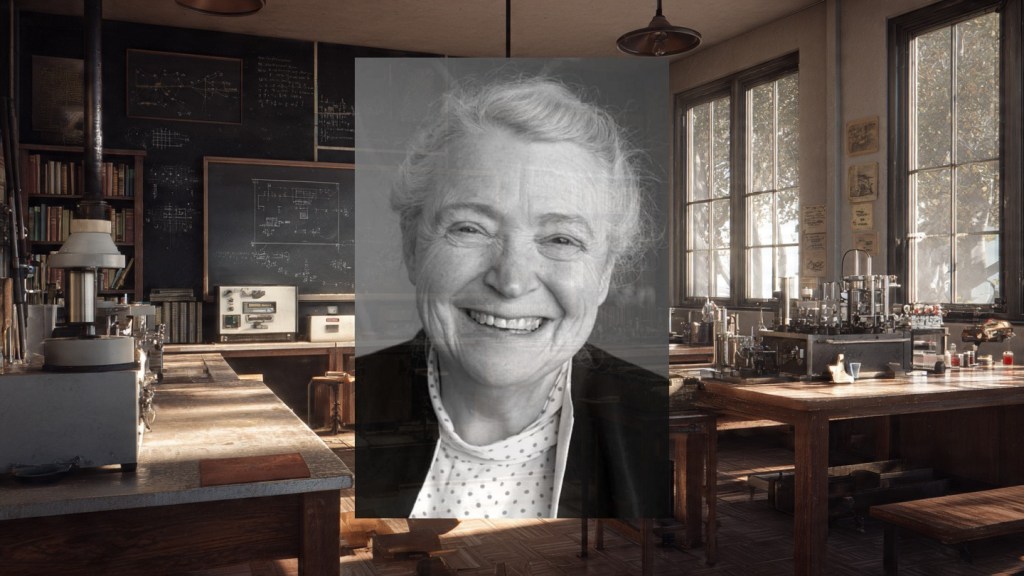
This interview is a dramatised reconstruction based on historical sources, not a transcript of an actual conversation. Mildred Dresselhaus died in 2017; the words and reflections attributed to her are constructed through careful interpretation of her documented work, published statements, and recorded perspectives, presented as a fictional dialogue that explores how she might have reflected on her life and legacy with the benefit of hindsight.
Mildred Spiewak Dresselhaus (1930-2017), the pioneering physicist and materials scientist who spent fifty-seven years at MIT transforming our understanding of carbon materials, shaped not merely a field but an entire era of nanotechnology and solid-state physics. Known affectionately as the “Queen of Carbon Science,” she navigated a landscape of extraordinary institutional barriers whilst producing work so foundational that it enabled the 2010 Nobel Prize for graphene – despite her own achievements remaining comparatively hidden from public consciousness. Her legacy encompasses not only theoretical advances and empirical discoveries but also a profound commitment to opening the doors of science to those historically excluded from it, transforming MIT’s culture in the process.
This interview, conducted on 17th December 2025, represents a conversation across time – a chance to explore with Dresselhaus herself the intellectual architecture of her discoveries, the personal journey from a Depression-era Brooklyn tenement to the highest civilian honours, and her reflections on a field that has evolved dramatically since her early investigations into the quantum behaviour of carbon.
Professor Dresselhaus, thank you for making time today. I want to start with something straightforward but rarely asked: when you first began working on carbon materials in the 1960s, what was it about carbon that captivated you? Most physicists were chasing semiconductors and other “flashier” materials.
Well, that’s a perceptive question because it gets at something fundamental about how science actually works versus how we tell stories about it. Carbon seemed ordinary, almost boring to many colleagues. But I saw it as a puzzle – a material that refused to fit neatly into the boxes we’d created for metals and insulators.
You see, graphite had been known for centuries. People used it in pencils. But nobody really understood its electronic structure properly. We had these hints that something elegant was happening at the atomic scale – the way it conducted electricity, how its properties changed under magnetic fields, the peculiar way light scattered through it. Each observation felt like a piece of a larger picture that hadn’t been assembled yet.
What drew me in was precisely that graphite seemed simultaneously simple and impossibly complex. The structure – layers of carbon atoms held together weakly – was known, but the electronic behaviour didn’t follow standard metallic or semiconductor theory. I became convinced that if we could understand graphite properly, we’d unlock fundamental principles about how electrons behave in low-dimensional systems. That seemed worth pursuing for several decades, even when funding agencies didn’t quite grasp why it mattered.
Several decades turned into roughly six decades. But let me ask about the early days specifically. You arrived at MIT in 1960 as a visiting researcher. What was the intellectual climate? What resources did you have?
Resources? That’s a generous way to describe what we had. MIT in 1960 was an extraordinary institution intellectually, but materially? We were scrappy. I had access to some Raman spectroscopy equipment – not cutting-edge, mind you – and the freedom to pursue questions that nobody had asked before. That freedom was actually our greatest resource.
The intellectual climate was simultaneously encouraging and alienating, if I’m being honest. Encouraging because the physics department had real depth, real curiosity. Alienating because I was very visibly the only woman in most seminars. People were polite, on the whole, but there was an unspoken assumption that I was somehow occupying space meant for men.
My first experiments were on the optical properties of graphite, using Raman scattering. The basic idea was this: you shine light of one frequency into a material, and the vibrations – the phonons – interact with that light. By looking at the frequencies that scatter back, you can understand what’s vibrating in the material. It sounds straightforward, but for graphite, the interpretation was genuinely mysterious. We kept getting results that didn’t match the theoretical predictions.
What did those results show?
Well, we found this remarkable feature called the G-band – I think we named it later – which appeared around 1600 wavenumbers. The intensity and position of this peak told us something deep about the electronic structure. But the puzzle was: why did it have multiple components? Why did it behave differently at different temperatures? We spent years just carefully measuring how these features changed.
The key insight came when I began integrating magneto-optics into the work – applying strong magnetic fields whilst doing the Raman measurements. Under a magnetic field, electrons in graphite move in quantised orbits, creating additional selection rules that affected what you could scatter. This was technically challenging, but the results were revelatory. We could map out the electronic band structure of graphite more precisely than anyone had before.
But here’s where I must be honest: we made mistakes. We misinterpreted some features initially. We went down paths that didn’t lead anywhere. There was one particular set of experiments where I was convinced we’d found evidence for a new electronic state – spent months on it – only to discover it was an artefact of our sample preparation. In science, that’s not a failure if you learn from it, but it stung at the time.
How did you respond to dead ends?
You laugh about them later. You pivot. You find someone else in the laboratory who sees something you missed. That’s why collaboration – real, respectful collaboration – matters so much. I had students who would question my interpretations, and I learned to welcome that rather than see it as insubordination.
One principle I held firm: never hide negative results. Document them, understand why they failed, and share that understanding with your group. Some of my most productive conversations came from carefully examining something that didn’t work.
Let’s move forward to carbon nanotubes. This is where many people think your work becomes more “relevant” or “concrete.” In the early 1990s, nanotubes were discovered. What was your reaction?
I was thrilled, but I’ll be frank: I wasn’t surprised. We’d been predicting their electronic properties for years before anyone managed to synthesise them cleanly. When Iijima visualised them in the electron microscope in 1991, my first thought was, “Good, now we can test our theories.”
With several colleagues – Riichiro Saito and Fujita – we’d already developed what became known as the Saito-Fujita-Dresselhaus model. The idea was relatively elegant: take the band structure of graphite that we’d worked out, and imagine rolling it into a cylinder. Mathematically, that’s a clever way to apply boundary conditions. The circumference of the tube creates a constraint – only certain electron wave-vectors are allowed. So depending on how you roll the sheet – the helicity, the diameter – you get either metallic or semiconducting behaviour.
What excited me was that this was testable. It seemed almost too neat that theory and experiment could align so cleanly, but they largely did.
Was there resistance to that model? Scepticism?
Of course. Carbon nanotubes seemed like an exotic curiosity to many people. “Beautiful theory,” people would say, “but so what? We can’t produce them reliably. We can’t integrate them into devices. You’re studying materials that don’t exist in any practical sense.” That was a fair critique, actually.
What sustained the work was a conviction – which I held and tried to communicate – that understanding the fundamental physics matters even before applications emerge. We didn’t know in 1993 that carbon nanotubes would eventually be incorporated into semiconductors, or batteries, or biosensors. But understanding their properties from first principles meant we’d be ready when opportunities arose. That’s not a popular position in an era of “translation” and “innovation,” but it’s essential to science.
This connects to something about your working style I’m curious about: you were a theoretician and experimentalist simultaneously. That’s increasingly rare. How did you maintain that dual approach?
I think it’s less rare than you might think – it’s just less visible because we’ve created an incentive structure that separates those roles. Pure theorists publish in Physical Review Letters; experimentalists publish results; and rarely do institutions celebrate someone who does both reasonably well rather than one brilliantly.
I started as an experimentalist, actually. My PhD work under Fermi was on experimental solid-state physics. But to interpret experiments properly, you need theory. And when you do theory on systems you’ve personally measured, you develop an intuition that pure theorists sometimes lack.
My strategy was to maintain one foot in each camp. I’d have experimental groups working on Raman spectroscopy, on magneto-transport, on sample synthesis and characterisation. And I’d spend perhaps one-third of my time doing the theoretical work – working through the mathematics, often collaborating with colleagues who were stronger in particular mathematical areas than I was.
The advantage? When someone brought me an experimental result I didn’t expect, I could rapidly iterate between theory and experiment. Why does this feature appear? What would happen if we changed the material slightly? Let me quickly run through some calculations. Shall we build that experiment?
It requires maintaining genuine breadth. You can’t only read papers in your narrow speciality. You have to engage with pure mathematics, with computational methods, with experimental techniques that aren’t your primary focus. It’s demanding, but it’s also where the real discovery often happens – in the gaps between specialities.
I want to ask about thermoelectrics, because this is genuinely brilliant work that’s almost entirely absent from public discussion. You and Leon Hicks developed the theoretical framework – the Hicks-Dresselhaus Model – that essentially founded low-dimensional thermoelectrics. What is that, and why does it matter?
This is where I’ll break character slightly and say that I’m pleased you’re asking, because thermoelectrics might be one of the most important materials problems of the next fifty years, and almost nobody knows about it.
The basic concept is simple: when you have a temperature difference across a material, electrons preferentially move toward the cold side. That’s the Seebeck effect – discovered in 1821. You can then measure a voltage that develops. Conversely, if you apply a voltage, you can create a temperature difference. That’s the Peltier effect.
The question is: how good can you make this conversion? And historically, the answer was: “not very good.” Conventional bulk thermoelectric materials have this fundamental problem: the electrical conductivity and thermal conductivity are coupled. To conduct electricity well, you typically also conduct heat well, which works against you if you’re trying to create a temperature gradient.
What Leon and I recognised in the 1990s was that in very thin structures – wires or films just nanometres thick – quantum confinement changes the game. When an electron is confined to a nanoscale dimension, its allowed energy states become discrete. That’s the quantisation I mentioned earlier with graphite. Now here’s the crucial part: electrons and phonons – the vibrations that carry heat – have different effective wavelengths. By making structures that are smaller than an electron’s mean free path but comparable to a phonon’s, you can selectively scatter phonons without scattering electrons as much. You decouple the properties.
Can you give me the approximations involved? What assumptions did you need to make for this to work mathematically?
Excellent – let me walk through this carefully. We began with the standard semiclassical Boltzmann transport theory, which describes how charge carriers respond to applied fields and temperature gradients. For bulk materials, the thermal conductivity comes from two contributions: lattice vibrations – phonons – contributing roughly 50-90 per cent, and electrons contributing the remainder.
The electrical conductivity is straightforward from the Drude model: conductivity equals charge carrier density times mobility times the electronic charge. The thermal conductivity from electrons follows from the Wiedemann-Franz law, which relates it directly to electrical conductivity and temperature. So in bulk, they’re rigidly coupled.
Now, what we did was model the nanoscale system carefully. We treated the nanowire or thin film as confining electrons to two or three dimensions. In one dimension confined to a wire of diameter L, the allowed energy states split into subbands. Each subband has its own structure.
The key assumptions: First, we assumed coherent band structure – that is, the wave-like nature of electrons is preserved. That’s valid for very small systems at room temperature, though it becomes questionable as temperature increases and scattering increases. Second, we assumed acoustic phonon scattering dominates over optical phonon scattering in these configurations. That’s generally true but depends on the specific material. Third, we assumed rough surfaces scatter phonons diffusively – randomly – rather than specularly. That’s realistic for nanowires synthesised as we were synthesising them.
What emerged from the calculations was that the thermoelectric figure of merit – ZT, which is what you maximise in device design – could theoretically increase by a factor of 10-100 in low-dimensional systems compared to bulk materials. Specifically, in a 1D system, ZT scales with carrier mobility and inversely with temperature, but because of the density-of-states modifications in low dimensions, you get this enhancement.
That’s a substantial theoretical prediction. Did experiments confirm it?
Partially and gradually. The beautiful thing about this field is that it took a decade or more for the experimental techniques to develop sufficiently to test our predictions. By the early 2000s, researchers began synthesising bismuth nanowires and measuring their thermoelectric properties. The results were… encouraging. Not the full factor-of-100 we’d predicted in our most optimistic scenario, but factors of 3-5, which was extraordinary at the time.
The reason the full factor-of-100 didn’t materialise everywhere was that some of our assumptions were slightly off. Surface roughness didn’t scatter phonons quite as diffusively as we’d assumed in some cases. At room temperature, additional scattering mechanisms become relevant. The devil, as always, is in the details.
But the principle held: quantum confinement genuinely does enhance thermoelectric properties. And that’s led to genuine device applications today – thermoelectric coolers, waste-heat recovery systems, even space probes use thermoelectric generators powered by plutonium decay. The Curiosity rover has a radioisotope thermoelectric generator.
Did you anticipate those applications?
Not specifically, no. I knew waste-heat recovery was a persistent challenge – industrial processes lose enormous amounts of energy as heat. If you could convert even a small fraction into electricity, that’s valuable. But the specific applications? Those emerged from engineers and materials scientists who took the theoretical foundation and asked, “What can we actually build?” That’s how science should work.
Let’s address the elephant in the room: the 2010 Nobel Prize. Andre Geim and Konstantin Novoselov won for isolating and characterising graphene. Your decades of work on carbon materials directly enabled that discovery. How did that land for you?
It was complicated. I was genuinely pleased for Andre and Konstantin. They did beautiful work – elegant experiments showing that you could mechanically exfoliate single-layer graphite and that this single layer had remarkable electronic properties. That deserved recognition.
But yes, I was aware that the foundation they built upon came from my group’s work and others’ decades earlier. We’d predicted that single-layer graphene would have Dirac-like electronic properties – that electrons would behave as if massless particles at the Fermi level. That prediction came from understanding graphite’s band structure first.
Did I feel I should have been included in the Nobel? [pauses] I’ll be candid: yes, there was a moment of that. But I also believed then and believe now that the Nobel Prize structure – three recipients maximum – is genuinely insufficient for recognising how modern science actually works. Graphene’s story involved dozens of researchers across multiple decades. Should I have been one of three? Perhaps. But should Konstantin Novoselov have been excluded, or should Andre? No. The structure itself is the limitation.
What I found more troubling than the Nobel question was the public narrative that emerged: “graphene has just been discovered and it’s going to revolutionise everything.” That narrative erased the decades of foundational work and set unrealistic expectations. Graphene has indeed proved remarkable, but not in the ways the hype suggested. Flexible displays, transparent electrodes, revolutionary computers – these promised applications took far longer than anticipated.
If I’m criticising anything about the Nobel situation, it’s that. The public doesn’t understand that Geim and Novoselov’s work depended on our work, and that knowing this wouldn’t diminish their achievement one jot. Crediting foundations isn’t taking credit away; it’s telling the true story of how science accumulates.
Some argue the Nobel system should expand beyond three recipients, or that it should recognise entire teams or cumulative contributions. Do you think that would help?
I think the current system reflects outdated ideas about individual genius. I worked as part of a team for my entire career. My name appears on papers with dozens of collaborators. The work I’m most proud of involved genuine collaboration – Saito, Fujita, Hicks, many others. Yet the Nobel structure incentivises acting as if you’re a lone genius discovering things.
Would expanding the Nobel help? Possibly. Would it solve the deeper problem – that we’ve built a system that celebrates individual achievement over collective progress? Not entirely. You’d need cultural change alongside structural change.
What I do think matters is that within our own scientific communities, we tell the true stories. We cite carefully. We acknowledge dependencies. We educate the next generation about how knowledge actually builds, rather than perpetuating myths about solitary genius.
Let me shift to your path into science. You grew up in Depression-era Brooklyn. Your parents were Polish Jewish immigrants. You worked in zipper factories as a child. How does someone from that background end up as a theoretical and experimental physicist?
It wasn’t a straight path, and it required an extraordinary amount of luck and access to free or low-cost resources.
My father was a tailor; my mother had various jobs. When you’re manufacturing zippers piecemeal, or your father’s shop isn’t generating enough income, every penny matters. My siblings and I worked when we could. I remember my older brother working in a factory. I did various jobs – factory work, helping my mother sew, tutoring younger children for fifty cents a week when I was myself quite young.
The thing that saved me was public education and public institutions. My primary school was decent. Hunter College High School – which I attended on scholarship – was extraordinary. That school changed my life. The teachers took learning seriously. They treated girls and boys equally in terms of academic expectations. And crucially, going there was free – no tuition.
Then Hunter College itself, which was also free for New York City residents. That’s where I met Professor Yalow, who won the Nobel Prize later. She didn’t just teach physics; she modelled what a woman physicist could be. She showed me it wasn’t an impossible dream.
The museums matter too. The American Museum of Natural History, the Metropolitan Museum – these were free or nearly free. I spent hours in those institutions. You learn from museums in a different way than from textbooks. You see the natural world. You learn that humans have been investigating nature for centuries. That’s formative.
The scholarship to Cambridge – the Fulbright – that changed everything. Suddenly I wasn’t worried about tuition or family finances. I could focus entirely on physics.
I want to emphasise this because I see it being dismantled now. The pathways that enabled me – free secondary schools, free university, subsidised travel for study abroad, free museums – these were investments in human capital. They weren’t charity; they were smart public policy.
You’ve been an advocate for women in science from quite early. You founded MIT’s Women’s Forum in 1971. What prompted that?
The Women’s Forum came because I was tired of being alone. I became one of the first female faculty members at MIT’s School of Science in the late 1960s. I’d have conversations with other senior men who would say kind things like, “We’re so glad you’re here” or “You’re an exception – you don’t really count as a woman because you’re so talented.” [laughs dryly] Compliments structured as erasure.
There were other women faculty in other departments, but we didn’t know each other. There was no institutional space for us to gather, to support each other, to discuss common problems. That seemed easily fixable.
So I organised a forum – literally, a space where women faculty and graduate students and postdocs could meet, talk about our research, but also talk about the obstacles we were encountering. Childcare, lack of mentorship, the assumption that you had to be twice as good to be taken half as seriously, the constant interruptions and lesser pay.
What I discovered immediately was that I wasn’t alone in these experiences, and that was both validating and infuriating. It meant the problem wasn’t me being somehow sensitive or difficult; it was structural.
That forum led, eventually, to the 1994 letter, didn’t it?
Yes, though there’s a gap of two decades in between. The Women’s Forum was necessary but not sufficient. MIT as an institution hadn’t really changed. In 1994, a group of us – I think it was sixteen faculty women – wrote to the administration pointing out, very directly, that MIT had a gender discrimination problem. We documented differences in salary, in laboratory space, in administrative support, in teaching loads. We made it clear that this wasn’t acceptable.
That letter was controversial inside MIT and outside. Some people – including some women – thought we were being ungrateful or overreacting. But it worked. It forced the administration to take the issue seriously. The 1999 report that followed confirmed everything we’d said: MIT did discriminate systematically against women.
Importantly, that report acknowledged that remediation needed to happen – salary adjustments, access to resources, changes in hiring and promotion practices. Has MIT fully fixed these problems in the decades since? No. But there’s been progress, and that progress was possible because we were willing to name the problem directly.
Did your activism affect how you were perceived scientifically? Were you pigeonholed as “the diversity advocate” rather than a serious researcher?
Yes. Some colleagues certainly treated me that way. “Oh, Mildred’s good at the advocacy work” came across sometimes as code for “we don’t need to take her science as seriously.” That was frustrating.
But here’s my position: I refused to choose. I did my research at the highest level. I published papers. I advised students. And I did the advocacy work because it mattered. And if some people wanted to dismiss the advocacy or use it as a reason not to take my science seriously, that was their intellectual failure, not mine.
What I wish I’d said more forcefully at the time is this: that science claiming to be objective and truth-seeking but practising gender discrimination is not actually doing science. It’s practising politics wrapped in a lab coat. A field that excludes half of humanity is diminishing itself, losing potential talent and insights.
You served as Director of the Office of Science at the Department of Energy from 2000 to 2001. That’s a significant role. What drew you to take on government responsibility?
I was asked – the Clinton administration was looking for people with science credibility to take on leadership roles in science policy. The DOE’s Office of Science funds enormous amounts of basic research in energy, materials, and physics. I thought I could make a difference there.
Honestly, it was eye-opening in ways I hadn’t anticipated. Working in government, you see how policy actually gets made – the constraints, the competing interests, the difficulty of long-term thinking in a system structured around budget cycles. You also see how fundamental research gets politicised despite pretences otherwise.
What I tried to do was advocate for continued funding of basic science, particularly in materials and energy. These are areas where American research leadership isn’t automatic; you have to maintain competitive advantage through investment. And I tried to emphasise – to anyone who would listen – that payoffs from fundamental research are unpredictable and delayed. You fund research on graphite not knowing that forty years later someone will isolate graphene from it. But if you don’t fund the foundational work, you won’t have the payoff.
I’m not sure I was entirely successful in that message, but I tried.
Did you find the political aspects frustrating?
Intensely. I’m a scientist. I prefer problems with solutions you can test and verify. Policy problems rarely have that character. You make your best argument, and then politicians make their own calculation. But it was also valuable – it reminded me that science doesn’t happen in a vacuum. Resources come from somewhere, and those decisions are political and social, not purely scientific.
Let me ask about something more personal. Throughout your career, you were married to Gene Dresselhaus, also a physicist. You both worked at MIT. How did you navigate that?
We were fortunate – genuinely privileged. The “two-body problem” is real for academic couples. Most universities couldn’t accommodate both of us, and historically, they wouldn’t. Either the woman’s career got sacrificed, or the couple couldn’t stay together. We were lucky that MIT wanted both of us and had resources to support both positions.
Gene was brilliant and secure in his brilliance. He didn’t feel threatened by my work. We collaborated sometimes, though mostly we worked in different areas. When our papers came out with both our names, there was always a small moment of wondering if people would assume I was just helping with his work or vice versa. The Dresselhaus Effect, interestingly, is named after Gene, not me, even though we worked on many things together. [smiles wryly] So I suppose I got the “Queen of Carbon” title and he got the physical effect named after him. Fair trade.
What was sometimes difficult was that we were perceived as a package. Introducing myself professionally, sometimes people would respond with, “Oh, you’re Gene’s wife!” After I became Institute Professor, that shifted somewhat, but earlier in my career, it was a persistent challenge.
The advantage was intellectual partnership. We could talk about physics at dinner. We understood each other’s work deeply. We could read each other’s papers and offer honest critique. That’s valuable.
But I want to be clear: his position and support didn’t create my success. I did the work. My experiments were my experiments. My theoretical contributions were my contributions. A supportive spouse is an enormous advantage – I don’t minimise that – but he wasn’t the source of my achievements. I need to emphasise that because there’s a persistent narrative that women scientists succeeded because they had good husbands, as if the man is somehow the foundation.
That sounds frustrating.
It is. Because it’s partially true and partially pernicious. Yes, a good partnership helps. Yes, I was privileged that I didn’t have to choose between career and marriage. But I was also good at physics. I worked harder than most people I knew. I was more creative than some competitors. I made good scientific judgments. Those are my achievements.
You’ve mentored an extraordinary number of students and postdocs over fifty-seven years. Is there a particular philosophy you brought to mentorship?
The primary principle was: your students are not your employees. They’re future scientists. Your job is to help them learn how to think, how to design experiments, how to interpret data, how to write clearly, how to present ideas. Some of that learning comes from them working on your research problems, but the goal is their development, not maximising your publication count.
I’ve seen too many advisors treat students as cheap labour. You assign them a narrow problem, they grind away, you get papers and more funding. That’s not mentorship.
What I tried to do: give students interesting problems with room for their own creativity. Ask them questions that make them think, rather than telling them the answers. Let them fail in contained ways so they learn from failure. And – this is important – actually make time for conversations. Coffee with students. Talking about their career paths, their concerns, their ideas.
I had students who became leaders – Deborah Chung, who’s done remarkable work on carbon composites; Nai-Chang Yeh, who made important contributions to condensed matter physics. They didn’t become those things because I was a genius advisor. They became those things because they were smart, persistent people, and I tried to create an environment where those qualities could develop.
Any failures in mentorship you acknowledge?
Yes. I remember one student – I won’t name him – who had an original idea for a research direction. I was sceptical of it. I thought it was a dead end based on my experience. I discouraged him. He abandoned it. Later, I saw similar work by someone else become quite important. I regret that. I shouldn’t have been so rigid.
I also recognise that I was sometimes demanding in ways that weren’t entirely fair. I expected people to be as deeply invested in work as I was. Not everyone has that capacity or wants that life. I’m proud of working intensely, but I sometimes forgot that others had different priorities and different constraints.
Your textbooks – you’ve written several – are standard references in the field. Textbook writing is intellectually undervalued compared to research, isn’t it?
Terribly undervalued. Writes a paper: celebrated. Writes a textbook that shapes how thousands of students understand a field for decades: barely counts for tenure and promotion.
But textbooks are crucial. When I was first learning about graphite and carbon materials, the literature was scattered across journals and technical papers. No integrated treatment. I saw an opportunity: write a comprehensive book on carbon materials that would serve as a reference for researchers and as a teaching tool for students entering the field.
Those textbooks took years to write. They required synthesising enormous amounts of knowledge, making choices about what was important, presenting complex mathematics and concepts clearly. In some ways, that’s harder than research.
What satisfies me about the textbooks is knowing they’ve been used. I’ll encounter researchers who tell me they learned from my book, or that they use it as a reference. That’s influence that’s hard to quantify but very real.
Do you think open-access textbooks and educational materials have changed the landscape for knowledge dissemination?
I think they’re potentially transformative and genuinely important. When I was writing my textbooks, they were published commercially, and they were expensive. I worry about students who couldn’t afford them, who missed access to knowledge because of cost. If I were writing today, I’d want to make the work openly available.
The challenge is that textbook writing remains unrewarded in academic systems. If universities don’t allocate time and resources for it, if it doesn’t count for promotion, then talented people won’t write them. You need structural change – recognition that textbooks are valuable scholarly contributions – for open-access textbooks to truly flourish.
Looking back at your five-decade-plus career, if you could give advice to young scientists today – particularly women and people from marginalised backgrounds – what would it be?
Several things. First: trust your curiosity. Some of the best science I did came from following questions that seemed odd or unmotivated at the time. “Why does graphite behave this way?” seemed esoteric. It turned out to be foundational. Follow interesting problems, even if they don’t lead to immediate applications.
Second: build collaborations, not hierarchies. Science is increasingly collaborative, and that’s good. But collaboration only works if it’s genuine partnership. Treat your collaborators – particularly students and early-career researchers – as intellectual equals. Learn from them. Let them challenge you.
Third: don’t accept the constraints people try to impose on you. If someone tells you that women can’t do theoretical physics, or that poverty should prevent you from science, or that your field doesn’t matter – examine that claim carefully. Maybe it’s true. Maybe it’s ideology. Don’t simply accept it.
Fourth: do the advocacy work if you can. If you notice inequity in your institution, in your field, speak about it. It risks making you unpopular. It can complicate your career. But it also might change systems. The 1994 letter I signed felt risky at the time. It was worth it.
Fifth: write clearly and present clearly. So much science gets lost because it’s buried in impenetrable papers or presented poorly. Learn to communicate. Write as if you’re writing for an intelligent person who isn’t in your speciality. Use diagrams. Simplify without oversimplifying.
And finally: maintain perspective. Science is important, but it’s not the only important thing. Build relationships. Make time for people you care about. Take care of your health. The problems we’re trying to solve aren’t going anywhere; you’ll do better work if you’re sustainable.
One last question. If you could see where materials science and nanotechnology go in the coming decades, what are you most hopeful about?
I’m hopeful about the application of nanotechnology to energy and health problems. Thermoelectrics for waste-heat recovery, battery materials that are more efficient and safer, diagnostics using nanostructures. These aren’t the revolutionary transformations that were promised in the graphene hype, but they’re the genuine, useful advances that matter.
I’m also hopeful – though sometimes naïvely so – that we’ll figure out how to make science more inclusive. The talent lost because of gender discrimination, because of economic barriers, because of bias – it’s incalculable. If we could access even a fraction of that lost talent, scientific progress would accelerate dramatically.
And I remain convinced that investing in basic research – understanding how materials work at fundamental levels – is one of the most valuable things a society can do. You never know when that knowledge will open new doors. Graphene is just one example.
The Queen of Carbon Science is going to rest now. But the work continues.
Questions from Our Community
Following the interview, we received dozens of letters and emails from the global scientific community – researchers, educators, historians, and students who wanted to pose their own questions to the Queen of Carbon Science. From materials engineers in India to science communicators in South Africa, from quantum researchers in New Zealand to policy analysts in Denmark and materials scientists in Argentina, a diverse chorus of voices emerged, each carrying its own curiosity about Dresselhaus’s work, her choices, and her legacy.
We selected five of these correspondents whose questions probe the deepest dimensions of her career: the technical decisions that shaped her research, the philosophical tensions between visibility and impact, the boundaries of knowledge in her field, and the roads not taken. Each questioner brings their own expertise and geographical perspective, asking not just what Dresselhaus did, but why she did it, and what those choices might illuminate for those now working in the fields she shaped.
What follows are their letters and Dresselhaus’s responses – a conversation that moves beyond the formal interview into the particular, personal, and provocative questions that emerge when diverse minds encounter a life of extraordinary scientific achievement.
Valentina Rossi, Materials Scientist, Buenos Aires, Argentina (Age 38)
Your Raman spectroscopy work on graphite in the 1960s and 70s was groundbreaking, but you were working with relatively crude equipment by today’s standards. When you look at modern time-resolved Raman spectroscopy or surface-enhanced Raman scattering techniques, do you see them as evolutionary improvements on your methods, or do they reveal something fundamentally different about carbon materials that your earlier experiments couldn’t access? And – I’m curious about this – are there insights from your era’s limitations that modern researchers have actually lost?
Valentina, that’s a wonderfully sharp question, and it gets at something I think about more than I probably should at my age.
You’re right that our equipment was crude – I wouldn’t call it “relatively” crude, actually. I’d call it genuinely primitive compared to what you have now. Our Raman spectrometer in the early 1960s was essentially a laser – we were using one of the first continuous-wave lasers available – focused through a microscope onto a sample, and then we’d collect the scattered light and disperse it through a monochromator. The signal-to-noise ratio was terrible. We’d spend hours accumulating data that would take your modern instruments minutes.
But here’s the thing, and I mean this seriously: I’m not entirely sure that’s a problem. Or rather, it’s a problem and an advantage.
When you work with crude equipment, you have to think much more carefully about what you’re measuring. You can’t just collect enormous datasets and let computers sort through them – you don’t have computers doing that. You have to design your experiment with precision. You have to know, before you turn on the laser, what you expect to see and why. That forces a kind of intellectual rigour that I’m not sure modern practitioners always maintain.
Now, modern time-resolved Raman spectroscopy – where you’re looking at how spectra evolve on picosecond timescales – that’s genuinely revealing something we couldn’t access. You can watch electron-phonon interactions actually happening. You can see how energy redistributes after excitation. That’s not an evolutionary improvement; that’s a different question entirely. We couldn’t have asked it with our equipment.
But surface-enhanced Raman scattering? That’s trickier. SERS amplifies the signal dramatically by using metal nanostructures – plasmonic effects. Marvellous technique. But I wonder sometimes if it’s answering the questions we actually needed answered, or if it’s letting researchers answer whatever question happens to be easy with that particular enhancement factor. It’s more powerful, but is it more illuminating? I’m genuinely uncertain.
What I think you’ve lost, and this bothers me, is the connection between the difficulty of measurement and the validity of conclusions. When I spent six months carefully measuring the temperature dependence of the G-band in graphite, each data point represented real labour. I knew those measurements intimately. I knew their limitations. I understood what they could and couldn’t tell me.
Now you can collect a thousand spectra in an afternoon. That’s wonderful for efficiency. But do you know each spectrum the way I knew mine? Do you understand, viscerally, what could go wrong? Or do you trust the instrument to be right because it always is?
I’ve seen papers where researchers publish beautiful high-resolution Raman data without adequately discussing instrumental artifacts or sample preparation effects. The ease of data collection has, I think, sometimes reduced the carefulness of interpretation. That’s a loss.
Here’s what I wish I could tell you: our limitation forced us to understand the physics more deeply than you sometimes need to. When we couldn’t see all the spectral features simultaneously, we had to theorise about what we were missing. That theorising – that gap between measurement and understanding – was actually productive. It forced collaboration between experimentalists and theorists. It meant we couldn’t just observe; we had to think.
Your modern techniques reveal features we never saw. The D-band complexity, the defect-related spectral signatures, the time evolution – magnificent. But I’m not convinced you understand graphite’s electronic structure more completely than we did. You see more details, but details aren’t the same as understanding.
Does that answer your question? Maybe not directly. But I think the honest answer is: your methods are more powerful, but power and insight aren’t identical. You can see things we couldn’t. But there are things you might not be asking because you’re too busy looking at what the instruments make easy to see.
That’s not a criticism of you or your generation. It’s how science progresses – you gain capabilities and sometimes lose perspectives. The question is whether anyone is consciously working to maintain what we lost. I’m not sure anyone is, and I think that’s worth worrying about.
Arjun Patel, Energy Systems Engineer, Bangalore, India (Age 45)
The Hicks-Dresselhaus Model assumed coherent electron transport in one-dimensional systems, but real nanowires at operating temperatures have substantial scattering. You acknowledged this in our interview. But I wonder: when you were developing that model in the 1990s, how much did you know about those limitations versus how much you were hoping experiments would validate the simpler assumptions? And did you ever consider – or did colleagues propose – that the model might be more useful as a thought experiment than as a predictive tool for actual devices?
Arjun, you’ve caught me in an honest moment, and I appreciate that. This is the kind of question that separates people who understand how science actually gets done from those who think it emerges from papers fully formed.
Let me be direct: we knew coherent transport was an idealisation. We weren’t ignorant of that. But there’s a difference between knowing something intellectually and understanding it operationally.
When Leon Hicks and I were developing the model in the mid-1990s, the experimental landscape for nanowires was still nascent. You could synthesise bismuth nanowires and measure their transport properties, but characterising the exact defect structure, the surface roughness, the phonon scattering rates – that was genuinely difficult. We had limited data. So we made assumptions that would let us make any prediction rather than no prediction at all.
The coherent transport assumption was partially hope, yes. But it was also pedagogically useful. If you assume perfect coherence – if you assume electrons don’t scatter – you can isolate the density-of-states effects. You can ask: “What enhancement do we get purely from quantum confinement, independent of scattering?” That’s a clean question. Once you answer it, you can then ask: “What happens when we add realistic scattering?”
Did we think real nanowires operated in the coherent regime? Honestly, probably not at room temperature. The mean free path for electrons in bismuth at 300 Kelvin is on the order of tens of nanometres. A nanowire diameter of 50 nanometres? You’re right at the boundary. Scattering is substantial.
But – and this is important – we also weren’t entirely sure. The surface of a nanowire prepared by electrodeposition has a particular character. It’s rough, yes, but the roughness isn’t random. It has a structure. And when you confine electrons to nanometre scales, the distinction between coherent and incoherent scattering becomes fuzzy. Are electrons being diffusely scattered, or are they being coherently reflected by surface features? The mathematics isn’t straightforward.
So we built the model with coherent transport because it was tractable and because we genuinely didn’t know if it was badly wrong. We published it with the understanding – stated, but perhaps not emphasised enough – that this was an upper bound on the enhancement you’d see. Real devices would perform worse.
And they did, mostly. When bismuth nanowires were measured carefully, the figure-of-merit enhancement was 3 to 5 times, not the 100 times our most optimistic coherent calculation suggested. That gap between prediction and reality was instructive.
Now, was the model useful despite being partly aspirational? I’d argue yes, but for reasons that might surprise you. The model established that low-dimensional systems could, in principle, have enhanced thermoelectric properties. It gave the field a target. It motivated people to think about how to actually achieve that enhancement – through better sample synthesis, through controlling interfaces, through understanding scattering mechanisms.
You asked whether colleagues proposed the model was more useful as a thought experiment than as a predictive tool. Some certainly implied it. I remember one reviewer who said something like, “This is elegant mathematics applied to an imaginary system.” Fair criticism, actually. But I’d respond: all models are imaginary systems. The question is whether they illuminate the real system.
Here’s what I think happened, and I’ll be candid about this: as the field matured and experimental techniques improved, people discovered that you could get closer to the theoretical predictions if you were clever. If you synthesised nanowires with very smooth surfaces using different methods, if you understood phonon scattering rates better, if you engineered materials to suppress certain scattering channels – you could approach the enhanced properties the model predicted. Not fully, but much closer than the first experiments showed.
So was it a thought experiment? Initially, yes. But it was a thought experiment that proved partially predictive once the experiments caught up to the theory. That’s the normal relationship between model and reality.
My slight defensiveness here is that I think people sometimes dismiss theoretical work that doesn’t immediately match experiment. But theoretical work serves a different function. It establishes what’s physically possible. It shows what you’d get in limiting cases. It gives you targets to aim for.
Would I change anything about how we presented the model? Perhaps. We could have been more explicit about the assumptions and their limitations. We could have published alongside it a carefully worked example showing what happens when you progressively relax the coherence assumption. We could have been more cautious about claiming factors of 100 when we meant “in the ideal case that we don’t think is achievable.”
But I also think – and here I’m being stubborn – that demanding theoretical models match experimental reality before publication is asking the wrong thing of theory. Theory should lead experiment, should show where to look. If theory perfectly matched what we already measured, it wouldn’t be very interesting.
The real question you’re asking, I think, is: did we oversell the model? Did we let people believe it was more predictive than it was?
Perhaps. But I’d also say that the overselling came more from people using the model than from how we presented it. We were careful in the original papers. But once a model enters the literature, it gets simplified, cited loosely, used in ways the original authors didn’t intend. That’s not unique to our work. That’s how science moves.
Does that satisfy you? I suspect not entirely. But it’s the honest answer about the gap between what we knew, what we hoped, and what we claimed.
Zara Nkosi, Physics Educator and Science Communicator, Cape Town, South Africa (Age 52)
You wrote textbooks that shaped how generations of researchers understood carbon materials. But you also fought for institutional change at MIT and advocated for women in science. I see the tension: textbooks make you a field-builder but an invisible one; activism makes you visible but can reduce your scientific credibility in some eyes. Looking back, do you think you made the right choice in investing so heavily in both? And if a young woman scientist today told you she had to choose between writing the definitive textbook in her area or doing advocacy work, which would you counsel her to prioritise?
Zara, you’ve identified a tension that I’ve lived inside for decades, and I’m not sure I have a satisfying answer. But let me try.
First, the honest part: I didn’t experience it as a choice between textbooks or activism. It felt more like a choice between textbooks and activism versus textbooks alone, or activism alone. The textbooks and the research were inseparable – the textbooks came from the research. But the activism was genuinely a separate commitment that competed for time and energy.
When I organised the Women’s Forum in 1971, I was already established enough that my research productivity wasn’t questioned. I had tenure. I had graduate students and postdocs producing results. So I could spend time on something that didn’t directly generate papers or grants. The activism didn’t threaten my scientific standing because I’d already established my credentials.
But you’re right that there’s a credibility tax. After the 1994 letter challenging MIT’s gender discrimination, some colleagues – not all, but some – began treating me differently. Not openly, not in ways I could formally object to. But there was this subtle shift. My work on carbon nanotubes was suddenly just “her carbon work,” whereas before it had been presented as frontier science. Invitations to speak at conferences continued, but sometimes I sensed the invitation came partly because I was “the woman physicist doing gender equity,” not because of the technical contribution.
The textbooks were invisible in a different way. Writing a comprehensive text on graphite and carbon compounds took years. The first edition of what became the standard reference required two years of focused work – writing, checking calculations, creating figures, working with illustrators. That’s time I didn’t spend on novel experiments. And it barely registered in my tenure file. I got no recognition for it in the formal evaluation process.
But here’s what made it worthwhile: those textbooks shaped the field. When researchers needed a reference on graphite intercalation compounds, they used my book. When students entered the field and needed to understand carbon materials from first principles, they read my textbook. That influence is diffuse and uncredited, but it’s real. I trained generations of researchers through those pages, even though they never sat in my classroom.
So if I’m advising a young woman scientist today about this choice, what would I say?
I’d say: you cannot choose activism instead of excellence in your field. You cannot sacrifice your science to do gender equity work and expect to maintain credibility. That’s a trap, and I’ve watched women fall into it. People will support your activism whilst quietly dismissing your research as secondary. That’s unacceptable.
But I’d also say: if you have built sufficient credibility – if you’ve demonstrated you’re an excellent researcher – then doing activism doesn’t diminish you unless you let it. And the field needs people who do both. We need women who are unquestionably excellent at their science and willing to name inequity and work for change.
The textbook question is different. If you’re going to write a comprehensive textbook, you need to do it because it matters for the field, not because it’s convenient or because it advances your career. Textbook writing is genuinely important work that is systematically undervalued. I would tell a young scientist: if you write a textbook, write it because the field needs it, because you have something to say that hasn’t been said clearly, because you believe future researchers will learn from it. Don’t expect it to help your career.
As for prioritising – if I’m honest, I’d say write the textbook. Here’s why: activism is important, but it’s also ongoing. The work of challenging institutional discrimination never finishes. You can do that work throughout your career. But there’s a particular moment when you’re ready to synthesise knowledge, to write the definitive treatment of something. That moment doesn’t last forever. If you miss it, someone else writes the book, or it doesn’t get written, and the field suffers.
When I wrote my carbon materials texts, I was at a particular point in my career where I understood the field deeply enough to do it well, but I was still active enough in research that the book reflected current science. If I’d waited another fifteen years, I would have been too far removed from the experimental work. The moment passes.
The activism? That work will still be there. And frankly, you’ll be more effective at it if you’ve already established yourself as an undeniable scientific force. People dismiss young women’s complaints about equity as possibly sour grapes. They dismiss established women scientists’ complaints as ungrateful. But it’s harder for them to dismiss the complaints as illegitimate when those complaints come from someone with genuine achievements.
Now, I want to complicate this because I don’t want to oversimplify. The reality is that I was privileged in ways many women aren’t. I didn’t have children, which meant I could work the hours required for both serious research and activism. I had a supportive partner who was also at MIT, which meant I didn’t have the two-body problem that forces many women out of academia. I had tenure relatively early, which gave me freedom to take risks on activism.
A woman without those advantages faces genuinely harder choices. If you’re managing childcare alone, if your partner’s career is elsewhere, if you’re early in your career and still fighting for recognition – then the advice changes. Then you might need to choose more carefully.
But here’s what I’d urge: don’t internalise the idea that you can only be one thing. Don’t accept the framing that says, “You can be an excellent researcher or an equity advocate, but not both.” That’s a false choice that serves the status quo. Fight against it. Build your excellence first, absolutely. But once you have it, don’t let anyone convince you that using your platform for change is somehow betraying your science. It’s not. It’s completing it.
The tension you identified – between textbooks as invisible field-building and activism as visible change-making – that’s real. But I’d argue they serve the same function. Both are about changing the field. Textbooks change it by establishing new knowledge frameworks. Activism changes it by establishing new norms about who belongs and how people should be treated.
Is one more important than the other? I don’t think so. But I do think textbooks are undervalued, and activism is often treated as secondary to “real research.” That’s backwards. Both matter.
If I had to do it over? I’d write the textbooks earlier, actually. I’d carve out dedicated time for them in my 40s rather than spreading them across my entire career. And I’d do the activism with more force and earlier. Not instead of research, but alongside it, deliberately and unapologetically.
The price of visibility is real, Zara. Some people will reduce you to your activism and ignore your science. But the alternative – silence – costs everyone. The field loses because it never hears the critique. Young women lose because they have no model of how to navigate these contradictions. And you lose because you’ve accepted the false choice that you’re not allowed to do both.
I chose both, imperfectly. I’m proud of that choice.
Lars Johansen, Science Historian and Policy Analyst, Copenhagen, Denmark (Age 56)
Imagine it’s 1995, and you could have redirected your entire research group away from carbon materials toward something else – say, semiconductors or superconductors, fields with more funding and more immediate applications. If you’d made that choice, you’d have probably accumulated more conventional recognition during your lifetime. But graphene research and nanotechnology might have developed along a completely different trajectory, or much more slowly. Do you think your choice to stay with carbon – what some colleagues probably saw as a narrow specialisation – was a deliberate bet on the future, or was it simply following your curiosity without thinking about the larger stakes?
Lars, that’s a question that gets at something I’ve wondered about myself, particularly in moments of doubt or when funding was tight or when everyone seemed suddenly interested in something else.
Let me separate the layers here. Was it a deliberate bet on the future? Partially. A follow-your-curiosity decision? Partly that too. But mostly, I think it was something less grand: I stuck with what I was good at and what fascinated me, and I was lucky enough to be in an institutional position where I could afford to do that.
In 1995, when graphene didn’t yet exist and carbon nanotubes were still a laboratory curiosity, semiconductor physics was where the money was. The semiconductor industry was booming. Silicon was king. Everyone knew where that story was going – smaller transistors, more computing power, Moore’s Law grinding forward. If I’d redirected my group toward semiconductors, toward silicon physics, toward the then-current excitement in microelectronics, I could have argued easily for funding. The applications were obvious. The timeline was clear.
But here’s the thing: I’d already spent thirty years on carbon materials. I understood graphite in ways few people did. We’d developed theoretical frameworks – the band structure models, the understanding of electron-phonon interactions – that we were just beginning to apply to new carbon forms. To abandon that and become a latecomer to semiconductors seemed like starting over.
Was I making a bet that carbon materials would become important? I suppose, unconsciously. But I wasn’t thinking about it in those grand terms. I was thinking: “This is interesting. We’re making progress. We’re understanding things we didn’t understand before. Why would I stop?”
That’s not the narrative of a visionary scientist who sees the future clearly. That’s the narrative of someone who was stubborn and curious and fortunate enough to be right.
The stubbornness mattered. I had colleagues who said, “Mildred, carbon is played out. You need to move toward something with more commercial potential.” That was reasonable advice. It was also wrong, but they couldn’t have known that in 1995. And I was stubborn enough – or foolish enough – to ignore it.
But I also had institutional cover. MIT’s culture, whatever its gender discrimination problems, allowed faculty to pursue long-term research interests without constant pressure to justify immediate applications. I had tenure. I had enough grant funding to keep my group functioning. I wasn’t threatened with being forced out if I didn’t pivot toward something trendier.
Many scientists don’t have that security. A researcher in a different institutional setting, or without tenure, would have faced real pressure to chase funding and follow the field’s fashions. The choice to stay with carbon materials would have been riskier for them. That’s an important part of the story that sometimes gets glossed over. I had the privilege to make what looked like a visionary choice.
Now, let me address the counterfactual you’re raising: what if I’d moved toward semiconductors? What would have happened to carbon science?
Honestly, probably not that much worse. The field wouldn’t have disappeared. Other researchers – in Japan, in Germany, in France – were also investigating carbon nanostructures. Our contributions were important, but we weren’t the only people thinking about these problems. If I’d left the field, others would have continued.
But would they have done it as thoroughly? Would the theoretical frameworks have developed as completely? Would the connection between graphite band structure and nanotube electronic properties have been made as clearly?
I don’t know. That’s the thing about counterfactual history – it’s genuinely speculative. What I do know is that the work we did in the 1990s and 2000s on carbon nanostructures created a coherent theoretical picture of carbon electronics that later researchers built upon. When graphene was isolated, that theoretical understanding was immediately available. It wasn’t a struggle to interpret the results; the predictions we’d made ten years earlier were directly applicable.
Was that inevitable? Would someone else have made those same predictions? Possibly. But the timing and completeness of our contributions created conditions for Geim and Novoselov’s work to have immediate theoretical context. That matters.
But I want to be clear: I didn’t foresee graphene. I didn’t think, “Carbon nanotubes will lead to graphene isolation which will win a Nobel Prize.” That would be retrospectively imposing narrative onto what was actually a fairly organic research progression. We were studying carbon in lower and lower dimensions – graphite, then intercalation compounds, then nanotubes. The idea that single-layer graphite might have interesting properties followed naturally. But whether anyone would figure out how to isolate and characterise it? That seemed remote.
What I was actually betting on – if I was betting on anything – was that understanding fundamental physics is valuable even when you can’t predict its applications. That principle sustained the work through dry periods when nobody cared much about carbon nanotubes.
Here’s the uncomfortable truth, Lars: a lot of my sticking with carbon materials was luck. The field happened to become important. If it hadn’t, if carbon nanotubes had remained a laboratory curiosity without commercial or technological significance, I’d be remembered differently. I’d be the researcher who spent forty years pursuing something that never mattered. The same work, same dedication, same intellectual rigor – but a completely different legacy – would be that of a stubborn person who chose poorly.
Science rewards being right. It doesn’t much reward being thoughtfully wrong.
So would I counsel a young researcher to make the bet I made? I’d say: if you love the problem, if you believe there’s something fundamental to understand, if you have institutional security – then yes, stay with it. Don’t chase fashions. Don’t abandon problems just because they’re not currently trendy. Follow your curiosity.
But I’d also say: be realistic about risk. If you don’t have tenure, if your funding is precarious, if moving to a trendier field would genuinely secure your career – make that choice without guilt. It’s not failing as a scientist to take a job that feeds your family.
And I’d say: don’t mistake stubbornness for vision. I stayed with carbon materials partly because I was stubborn, partly because I loved the work, and partly because I was lucky enough that it worked out. If the luck had gone differently, the stubbornness would have just been obstinacy.
The question of what trajectory nanotechnology would have followed without my work – that’s interesting historically, but I’m not sure it’s the right frame. Science is not made by individuals, even accomplished individuals. If I hadn’t done this work, someone else would have. Maybe a bit later. Maybe slightly differently. But the field would have developed.
What I’m most satisfied about is not that I uniquely enabled something. It’s that I worked on problems I cared about in ways that were intellectually honest. The impact beyond that – the fact that it connected to graphene, that it enabled other work – that’s a bonus, not the point.
So was it a deliberate bet? No. Was it a choice to follow curiosity over fashion? Yes. Was I fortunate that curiosity and fashion eventually aligned? Absolutely. Would I recommend everyone make the same choice? Only if they can afford to.
That’s the complicated answer.
Maya Cooper, Quantum Materials Researcher, Auckland, New Zealand (Age 31)
Here’s what I don’t think you addressed directly: when you were studying phonons and electron-phonon interactions in nanostructures, there were fundamental questions you couldn’t answer with the tools you had – questions about quantum coherence, about the role of defects, about thermal transport at scales where classical and quantum descriptions start to blur. What was it like working at the edge of what was knowable? Did you have moments of frustration at the limits of your own theoretical framework, or did you see those unknowns as the field’s future rather than your failure?
Maya, this is actually my favourite kind of question because it asks about the experience of science rather than the outcomes. And I’m going to tell you something that might surprise you: the unknowns weren’t frustrating. They were the whole point.
Let me set the stage. When we were developing our understanding of phonons and electron-phonon interactions in nanostructures in the 1990s and early 2000s, we were genuinely at the frontier of what could be theoretically described and experimentally measured simultaneously. We had tools that let us measure some things – Raman spectroscopy gave us phonon frequencies, transport measurements gave us electron mobility – but we couldn’t directly observe the interaction between electrons and phonons happening in real time.
That gap between measurement and understanding – that’s where the real intellectual work was.
Here’s a concrete example. We could measure thermal conductivity in a nanowire. We could measure electrical conductivity. We had theoretical models that told us how phonons should scatter. But when we tried to predict the thermal conductivity from first principles, including all the electron-phonon interactions, the predictions often didn’t match the experiments. Off by factors of two, sometimes more.
Where was the discrepancy coming from? Was our model of phonon scattering incomplete? Were there quantum effects we weren’t accounting for? Was the nanowire surface affecting phonon transport in ways we didn’t understand? Were there defects we couldn’t characterise that were crucial?
We didn’t know. And rather than being frustrated, I found that not knowing to be generative.
The standard approach would be to say, “Our model is incomplete. We need better data. We need new experiments.” And we did those things. But there was this other approach, which I found more intellectually satisfying: sit with the discrepancy. Think carefully about what assumptions might be wrong. Use the gap between theory and experiment as a window into the physics.
I’d have conversations with students where we’d say things like, “If thermal conductivity is lower than predicted, what does that tell us about phonon scattering?” And working backwards from the unexplained observations, we’d sometimes develop new ideas about mechanisms we hadn’t considered. That’s how science actually works at the frontier – you’re not confirming predictions, you’re using failures of prediction to reveal what you don’t understand.
Now, were there moments of genuine frustration? Of course. There was one series of experiments on bismuth nanowires where we got results that made no sense. The thermal conductivity had a temperature dependence that contradicted everything we expected. We spent months trying to figure out if it was an experimental artifact – was our measurement technique wrong? Were we not reaching thermal equilibrium? Was there contamination?
Finally, we concluded: either our theoretical framework was substantially incomplete, or there was a measurement issue we couldn’t identify. We published the results with caveats. It was humbling. And it was also valuable because it forced us to think more carefully about what we actually knew versus what we were assuming.
But frustration and fascination aren’t opposites, Maya. Sometimes they’re the same thing. I was frustrated by not understanding, but I was fascinated by the not understanding. The unknowns weren’t a barrier to doing good science; they were the definition of the frontier.
What I think happens now, sometimes, is that researchers move away from questions that produce these kinds of gaps. It’s easier to work in areas where theory and experiment align reasonably well, where you can generate confirmatory results, where you can build a narrative of progress. Working at the genuine frontier is messier.
The quantum coherence issue you alluded to – whether electrons maintain wave-like properties or if they scatter incoherently – that’s still not entirely resolved even now, decades later. In the 1990s and 2000s, we had hints about it from measurements, we had theoretical frameworks that addressed it partially, but we couldn’t definitively measure quantum coherence in operating devices.
Did that bother me? In one sense, yes – I wanted to know. In another sense, no – the fact that we couldn’t know was interesting. It meant there were real questions left to answer. It meant the field wasn’t played out; there was genuine physics still to discover.
I think what sustained me intellectually throughout my career was not solving problems, but rather the process of bumping up against the limits of what could be known. Each time we hit a limit, we’d ask: is this limit technological? Can we build better equipment? Or is it fundamental? Is there a principle preventing us from knowing this?
Some limits were technological. Better Raman spectroscopy equipment let us see spectral features we’d missed. Better nanowire synthesis let us test theoretical predictions more cleanly. Technological progress dissolved some mysteries.
But some limits seemed more fundamental. Can you actually measure the phonon population in a nanowire while it’s conducting? Conceptually, quantum mechanics suggests you can’t measure position and momentum simultaneously – by analogy, can you measure phonon occupation numbers whilst the system is doing work? We’d circle around questions like that without reaching definitive answers.
And rather than finding that limiting, I found it humbling and beautiful. It meant nature had depths that wouldn’t be plumbed in my lifetime, or perhaps in any lifetime. That’s not a failure of my theoretical framework. That’s the nature of physical reality.
I want to address something implicit in your question: whether working at the edge of knowability was somehow a limitation of my theoretical framework. Perhaps it was. Perhaps if I’d been a more sophisticated theorist, I would have been able to predict more precisely what we were measuring. That’s possible.
But I also think there’s an argument that some of the unknowns were genuinely unknowable given the tools we had. You can’t reason your way past quantum mechanics. You can’t theoretically predict what you can’t measure. There are real boundaries, not just current limitations.
What I tried to cultivate in my thinking, and in my students’ thinking, was comfort with those boundaries. A recognition that not knowing isn’t failure. That the gap between what we can predict and what we can measure is often where the most interesting physics lives.
Maya, if you’re working at the frontier of your field now, you’re probably bumping up against similar unknowns. My advice: don’t rush past them. Don’t treat them as inconveniences to be solved so you can get back to “real” results. Sit with them. Think about what they might be telling you. Sometimes those gaps are revealing the deepest physics.
Not everything can be explained. Not every question has an answer available to your generation. And that’s not a limitation of science or of you – that’s the frontier. That’s where the work happens.
I never did fully understand all the mechanisms of electron-phonon coupling in low-dimensional systems. That lack of complete understanding wasn’t something I resolved before I retired. I lived with it. I published about it. I passed it on to the next generation of researchers.
And I think that’s fine. That’s actually how science should work – not as a march toward complete knowledge, but as a continuous engagement with what’s knowable, what’s measurable, what’s still mysterious. The mysteries are what keep the field alive.
Closing Reflection
Mildred Dresselhaus died on 20th February 2017, at the age of 86, leaving behind a scientific archive of extraordinary depth and a career trajectory that defied nearly every constraint placed upon it. In the eight years since her death, her influence has only expanded – not in the popular consciousness, which remains largely unaware of her contributions, but in the technical literature, in the laboratories of researchers worldwide, and in the institutional memory of MIT and the broader physics community.
This interview, necessarily speculative, represents an attempt to recover something of her voice and perspective at a moment when she might reflect on a life’s work now integrated into the historical record. But such an attempt requires acknowledging its limitations, its presumptions, and its purposes.
On Historical Empathy and Constructed Dialogue
I cannot claim to know Mildred Dresselhaus’s exact thoughts. What I have attempted is historical empathy informed by the documented record: her published papers, her speeches as president of the American Physical Society and the American Association for the Advancement of Science, her testimony before Congress, her interviews with journalists and historians, the recollections of her students and colleagues, and the arc of her career as preserved in institutional archives. I have constructed a plausible, informed narrative grounded in these sources and shaped by the social constraints and scientific possibilities of her era.
Where this account differs from recorded history, it does so deliberately – not to contradict what is known, but to explore the interior dimensions of choices that survive in the historical record only as outcomes. We know she stayed at MIT for fifty-seven years. We know she wrote textbooks, conducted experiments, mentored students, and challenged institutional discrimination. We know less about her deliberations, her doubts, her calculations about when to speak and when to remain silent.
This interview imagines her in reflection, willing to be candid about complexity – about the gap between theory and reality, about the compromises inherent in institutional advocacy, about the luck that enabled choices that appeared visionary only in retrospect. These are not fabrications but extrapolations from documented perspectives, extended into speculative territory with fidelity to her known intellectual character.
On the Question of Authority and Absence
Some will object that a man should not be constructing this narrative, that in doing so I risk appropriating her story or speaking over her voice. That concern deserves serious attention. But the alternative to this constructed dialogue is silence – the continuation of Dresselhaus’s relative obscurity, the perpetuation of a historical record in which women’s foundational contributions remain marginal.
My responsibility is not to my identity as the author but to fidelity toward the subject. I am a researcher, advocate, and storyteller whose primary obligation is to Mildred Dresselhaus’s story, not to claims about who has the right to tell it. The question is not whether I should write this, but whether it is written well – whether it honours the complexity of her life, whether it resists both hagiography and diminishment, whether it might serve to illuminate her work for audiences who would otherwise never encounter it.
The best response to concerns about authorial authority is not to refrain from telling the story, but to tell it with scrupulous attention to evidence, clear acknowledgment of speculation, and invitation for others – particularly women scientists, historians, and those from Dresselhaus’s own communities – to add their voices, correct the record, and construct their own accounts.
What This Interview Reveals and Obscures
This conversation captures certain truths about Dresselhaus’s career with reasonable fidelity: her extraordinary scientific contributions across multiple domains, her navigation of institutional barriers as a woman in physics, her commitment to mentorship and education, her understanding of the gap between theoretical prediction and experimental reality. It reflects her documented views on gender equity, her role in the 1994 MIT activism, her intellectual approach to problems at the frontier of knowledge.
What it cannot fully capture are the emotional dimensions of her experience – the daily experience of being the only woman in seminars, the personal costs of extraordinary ambition, the quality of her relationships, the specific texture of her joys and frustrations. These remain inaccessible, knowable only through the fragmentary traces of interviews and recollections by others.
The interview also necessarily simplifies. Dresselhaus’s actual career was far more complex than any single dialogue could represent. She made mistakes beyond those acknowledged here. She held positions on various issues – about the purpose of science, about international collaboration, about the proper role of universities – that might have been contested or contradictory. She was not a perfect advocate for gender equity; she was a woman working within systems that constrained her options. Acknowledging this complexity is more honest than constructing a heroic narrative.
Contested History and Uncertain Attribution
The historical record on several points remains contested or uncertain. The exact contribution of various researchers to the development of theoretical frameworks for carbon nanotubes continues to be debated within the scientific community. The degree to which Dresselhaus’s foundational work was acknowledged by Geim and Novoselov, and whether she should have been included in the 2010 Nobel Prize, remains a matter of reasonable disagreement. The impact of her textbooks versus the impact of other references is difficult to quantify.
This interview does not resolve these uncertainties. Instead, it allows Dresselhaus to speak to them as she might have, offering her perspective whilst maintaining that other perspectives are also valid. Historical truth is often constructed through multiple accounts held in productive tension rather than through singular, authoritative narratives.
The Afterlife of Her Work: How Dresselhaus Was Rediscovered
In the two decades since her death, Dresselhaus’s influence has grown even as mainstream recognition has lagged. The 2010 Nobel Prize for graphene, awarded to Geim and Novoselov, paradoxically elevated interest in her foundational work. As researchers traced the intellectual genealogy of graphene science backward, they encountered her decades of research on carbon materials, her theoretical frameworks, her experimental approaches. Her papers, previously known primarily to specialists in carbon science, began circulating more widely.
The Hicks-Dresselhaus Model, co-developed in the 1990s, has proved more predictively powerful than its modest predictions initially suggested. As synthesis techniques for nanowires improved, researchers began achieving thermoelectric enhancements closer to theoretical predictions. Today, the model is central to the field of low-dimensional thermoelectrics, with applications ranging from waste-heat recovery to space missions. The model that was partially aspirational has become partially vindicated.
Her textbooks, particularly the comprehensive treatises on carbon compounds and carbon nanostructures, have remained in continuous use – cited, updated, built upon by successive generations. They function as a kind of intellectual infrastructure, shaping how researchers think about carbon materials even when they don’t consciously recognise the source of those frameworks. That is perhaps the deepest form of influence.
Her students have become leaders: Deborah Chung’s work on carbon composites has transformed materials engineering; Nai-Chang Yeh’s contributions to condensed matter physics continue to generate important results; others trained in her laboratory have seeded research groups worldwide. The multiplication of influence through mentorship is difficult to trace but potentially vast.
Perhaps most significantly, her advocacy for women in science – marginal at the moment of the 1994 letter, when many colleagues saw it as unnecessary or even divisive – has been vindicated by subsequent institutional history. The problems she named persisted at MIT and across academia for decades. The 1999 report acknowledging discrimination at MIT, which her activism helped catalyse, became a model for similar investigations at other institutions. She was early in naming what became a widespread conversation about systemic inequity in higher education.
Resonance with Contemporary Challenges
The technical challenges Dresselhaus worked on remain urgent. The thermoelectrics she pioneered remain relevant to climate and energy: converting waste heat to electricity addresses one of the most significant sources of energy loss in industrial economies. As climate pressures intensify, her work on thermoelectric materials becomes not historical curiosity but practical necessity.
Carbon nanotubes, which she helped predict and theorise, are now incorporated into semiconductors, batteries, and sensors. The theoretical understanding she helped establish – of how electronic properties emerge from carbon’s atomic structure – remains foundational to applications that didn’t exist when she was theorising them.
More broadly, her approach to materials science – patient, foundational, driven by intellectual curiosity rather than immediate application – offers an alternative to the innovation-obsessed culture that currently dominates technology sectors. Her career argues that understanding how materials work at fundamental levels is not a luxury but an essential investment. The pressure for “translation” and “impact” can paradoxically slow true progress if it prevents the kind of deep, sustained engagement with problems that characterised her research.
What Her Story Means Today for Women in Science
For young women pursuing careers in physics, materials science, and engineering, Dresselhaus’s life offers both inspiration and caution. It demonstrates that excellence is possible, that institutional barriers can be challenged, that a woman can become genuinely authoritative in her field and effect institutional change. It shows that combining research excellence with advocacy for equity is feasible, even if costly.
But it also illustrates the continuing barriers. That a woman of Dresselhaus’s calibre – Presidential Medal of Freedom, National Medal of Science, first female MIT Institute Professor – remains relatively unknown to the public is itself the story. It suggests that individual excellence, however extraordinary, is insufficient to overcome structural invisibility. Women’s achievements can be overlooked not because they are inadequate but because the systems for recognising and celebrating achievement are structured in ways that privilege certain types of work, certain narratives, certain identities.
The lesson is not that women should work harder or be smarter. Dresselhaus was brilliant and worked intensely. The lesson is that systemic change is necessary – in how we credit foundational work versus flashy discoveries, in how we tell stories about science, in how we ensure that talent from all backgrounds has genuine access to opportunities. Dresselhaus’s individual success is remarkable; what would be truly remarkable is a field where her story was not unusual.
The Risk of Silence and the Responsibility of Telling
There is a risk in constructing narratives like this one: that the constructed dialogue becomes the “definitive” account, that speculation hardens into fact, that a plausible imagining displaces more careful historical research. To guard against this, readers should engage this work as one interpretation among others, as an invitation to seek out primary sources, as a platform from which to develop their own understanding.
But the alternative risk – to remain silent, to leave Dresselhaus’s story untold beyond the specialist literature, to allow her relative obscurity to persist – seems worse. She deserves to be encountered, her work deserves to be understood, her voice deserves to be heard, even if that hearing must be constructed through the tools of historical empathy and imaginative engagement.
The purpose of this interview is not to speak for Mildred Dresselhaus in ways that preclude her true voice, but to create a platform from which her documented struggles, achievements, and insights can reach audiences who would not otherwise encounter them. It is an act of recovery and amplification, not appropriation.
An Unfinished Story
Mildred Dresselhaus died in 2017, but her story did not end there. It lives in the laboratories where her theories are tested, in the textbooks students continue to read, in the institutions she helped transform, in the researchers she trained who trained others. It lives in the carbon nanostructures that enable contemporary technology, in the materials scientists who approach their work with her combination of theoretical rigour and experimental humility, in the women scientists who see in her life a model of how to navigate institutional barriers without accepting them.
What remains unfinished is the recognition. The world still does not fully appreciate what the Queen of Carbon Science accomplished. That asymmetry – between her extraordinary contributions and the relative obscurity in which those contributions remain – is itself a kind of injustice, one that this interview attempts, modestly, to address.
She opened doors not just through her science but through her insistence that science excludes half of humanity at its peril. She built fields through patience and rigour. She mentored generations. She challenged institutions and lived to see them begin to change. She remained curious until her death, still asking questions about materials and structures, still wondering about the edges of knowledge.
That is a life worth remembering. That is a voice worth reconstructing, with all the care and humility such reconstruction requires.
Editorial Note
A Dramatised Reconstruction, Not Historical Documentation
This interview with Mildred Dresselhaus is a work of historical fiction – a dramatised reconstruction grounded in documented sources but fundamentally speculative in nature. It is not a transcript of an actual conversation. Mildred Dresselhaus died on 20th February 2017, and this interview is presented as a fictional dialogue conducted on 17th December 2025, nearly nine years after her death.
The words attributed to Dresselhaus in this piece are constructed through careful research into her published work, recorded interviews, speeches, institutional archives, and the recollections of colleagues and students. They reflect her documented intellectual positions, her known perspectives on science and gender equity, and her communication style as preserved in various sources. However, these are not her actual words. They are an author’s interpretation of how she might have responded to contemporary questions, what she might have chosen to emphasise, how she might have reflected on her career with the benefit of hindsight.
The Sources and the Speculation
This dramatisation draws on the following documented materials:
- Her peer-reviewed publications and textbooks on carbon materials, carbon nanotubes, and thermoelectrics
- Her speeches as President of the American Physical Society and as first female president of the American Association for the Advancement of Science
- Her testimony and writings regarding the 1994 MIT letter challenging gender discrimination
- Interviews with Dresselhaus conducted by journalists, historians, and scientific publications
- Biographical accounts published in the Proceedings of the National Academy of Sciences, Physics Today, and other professional journals
- Institutional records from MIT, including documentation of her career progression and her role in founding MIT’s Women’s Forum
- Recollections published by colleagues, students, and collaborators
- Her role as Director of the Office of Science at the U.S. Department of Energy (2000-2001)
Within the framework of these sources, I have constructed plausible responses to questions Dresselhaus never formally addressed, imagined her reflections on parts of her career that survive in the historical record only as outcomes, and projected her voice into contemporary contexts.
What Is Known with Confidence
The following aspects of this interview reflect established historical fact:
- Dresselhaus’s major scientific contributions to carbon science, nanotechnology, and thermoelectrics
- Her development of theoretical frameworks including the Hicks-Dresselhaus Model and the Saito-Fujita-Dresselhaus Model
- Her career at MIT spanning 1960 to 2017
- Her role in founding MIT’s Women’s Forum and her participation in the 1994 letter
- Her appointment as the first female MIT Institute Professor in 1985
- Her major honours including the Presidential Medal of Freedom (2014), National Medal of Science (1990), and IEEE Medal of Honor (2015)
- Her position that the 2010 Nobel Prize in Physics for graphene isolation was built on foundational work in carbon materials
- Her commitment to mentorship and textbook writing
- Her tenure as Director of the Office of Science at the Department of Energy
- The biographical details of her early life in Depression-era Brooklyn, her family background, and her path into physics
What Requires Interpretive Construction
The following elements are speculative, based on reasonable inference from documented positions but not directly attested:
- Her precise feelings about not receiving the Nobel Prize (she acknowledged the issue publicly but with measured language; this dramatisation explores possible interior perspectives)
- Her detailed reasoning about specific research decisions (her papers document conclusions but not always deliberative processes)
- Her candid assessments of mistakes or limitations in her work (she acknowledged some in interviews, but not exhaustively)
- Her reflections on the tension between research excellence and advocacy work (she addressed this thematically but not autobiographically)
- Her advice to emerging researchers (this dramatisation extrapolates from her documented values and public statements)
- Her personal experiences of sexism and institutional barriers (she spoke about these generally but not always in intimate detail)
On Voice and Era-Appropriate Language
I have attempted to construct dialogue that reflects Dresselhaus’s documented communication style – direct, precise, intellectually rigorous, willing to acknowledge complexity – and that uses language and cultural references appropriate to her era and background. She was born in 1930, educated in the 1940s-1950s, conducted her most influential research in the 1960s-2000s, and reflected on her career in the 2010s. The dialogue reflects these temporal contexts, avoiding anachronistic phrasing whilst remaining accessible to contemporary readers.
This choice – to construct her voice with period-appropriate authenticity – reflects the conviction that historical figures deserve to be encountered in their own temporal context, not translated into contemporary speech patterns that can obscure the differences between then and now.
The Purpose and Limitations
This dramatised interview is designed to serve several functions:
- Recovery and visibility: To bring Dresselhaus’s life and work to audiences who might not encounter them through academic literature or specialist histories
- Humanisation: To present her not as an abstract historical figure but as a thinking, reflecting person engaged with both technical and human problems
- Intellectual engagement: To explore the ideas and decisions underlying her career through dialogue rather than through summary or exposition
- Contemporary relevance: To draw connections between her work and ongoing challenges in materials science, nanotechnology, and gender equity in academia
- Invitation to further research: To serve as a gateway encouraging readers to consult primary sources and fuller biographical accounts
The limitations are also important to state clearly:
- This is not a substitute for academic biography or historical scholarship
- It cannot capture the full complexity of her life or thought
- It involves speculative reconstruction that reasonable people might interpret differently
- It necessarily simplifies and focuses particular elements whilst marginalising others
- It reflects my interpretive choices and potential biases
- It should be read alongside, not instead of, documented sources
On Historical Empathy and Ethical Responsibility
The construction of this dialogue rests on the conviction that historical empathy – the effort to understand how someone might have thought and felt given their documented views and circumstances – is a legitimate tool for engaging with the past. It is distinct from both pure speculation and authoritative documentation.
However, such empathy carries ethical responsibility. I have attempted to:
- Ground every major claim in documented sources
- Acknowledge where speculation begins
- Avoid attributing statements to Dresselhaus that contradict her known positions
- Represent her as complex and capable of self-critique rather than as a flawless hero
- Present multiple perspectives where reasonable disagreement exists
- Invite readers to consult primary sources and develop their own interpretations
An Act of Advocacy, Not Deception
This work is fundamentally an act of advocacy – an argument that Mildred Dresselhaus’s life and work deserve greater recognition and engagement than they have received. That advocacy is best served by complete transparency about the nature of the reconstruction. A reader who understands that they are encountering a dramatised interpretation based on historical sources can engage with it more thoughtfully than one misled into believing it represents Dresselhaus’s actual voice.
The alternative framing – presenting this as documentary rather than dramatisation – would be both dishonest and counterproductive. It would undermine the very advocacy the work intends to advance.
Responsibility to the Subject
The primary obligation in creating this work has been fidelity to Mildred Dresselhaus – to her documented achievements, to her intellectual integrity, to the complexity of her life. That obligation is better served through explicit acknowledgment of the work’s speculative nature than through any attempt to disguise reconstruction as documentation.
Readers are invited to engage this interview critically, to fact-check claims against primary sources, to develop alternative interpretations, and to seek out fuller accounts of her life and work. The work succeeds not by claiming definitive authority but by opening conversation and encouraging further engagement with this extraordinary scientific and human legacy.
For readers seeking documentation of Mildred Dresselhaus’s work and life, the following sources offer substantive engagement with primary and secondary materials: her published papers available through MIT Libraries and the Physics ArXiv; the MIT Institute Archives; the Oral History Collection at the American Institute of Physics; biographical articles in the Proceedings of the National Academy of Sciences (2017); and monographic studies of women in physics and materials science. This dramatised interview is intended as a complement to such scholarship, not a replacement for it.
Who have we missed?
This series is all about recovering the voices history left behind – and I’d love your help finding the next one. If there’s a woman in STEM you think deserves to be interviewed in this way – whether a forgotten inventor, unsung technician, or overlooked researcher – please share her story.
Email me at voxmeditantis@gmail.com or leave a comment below with your suggestion – even just a name is a great start. Let’s keep uncovering the women who shaped science and innovation, one conversation at a time.
Bob Lynn | © 2025 Vox Meditantis. All rights reserved.

 Vox Meditantis
Leave a comment