What skills or lessons have you learned recently?
Friday, 16th December, 1949
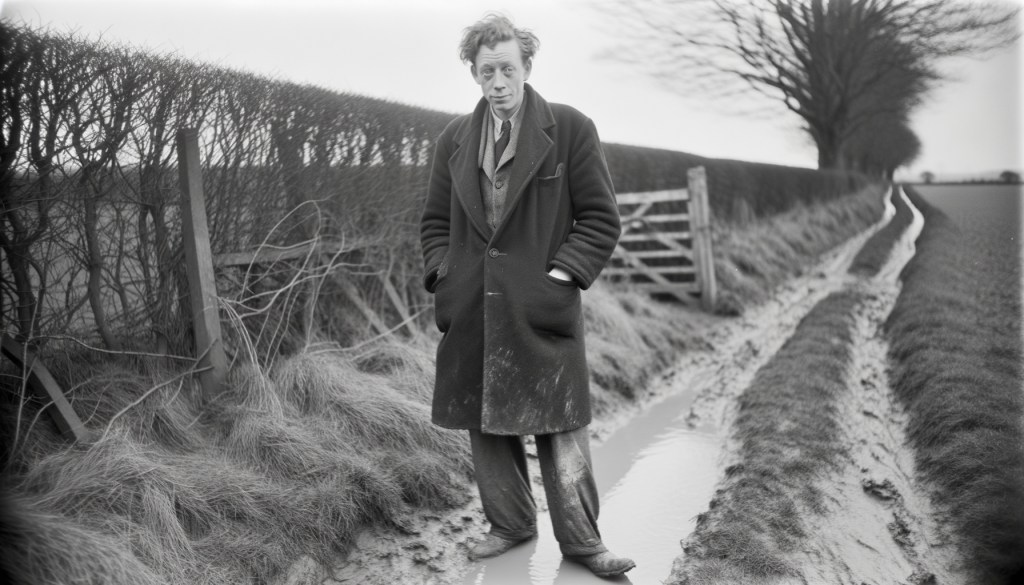
You will forgive me if I address you plainly. We are, after all, walking the same road – whether you know it or not – and there is little use in ceremony when one’s boots are caked in mud and the day is dying early, as December days will.
I have been on this path three days now. The old shrine at Walsingham lies ahead, though I cannot say with certainty that I shall reach it. One learns, in time, that destinations matter rather less than the telling of one’s intentions. A man may declare himself bound for holy ground and gain a night’s lodging on the strength of it, a bowl of broth, a place by the fire. The innkeeper’s wife this morning – decent woman, rough hands, the sort who has worked through rationing and come out the other side with her charity intact – she asked me where I was bound and why. I told her I sought answers. She believed me. They always do.
That is the door, you see. Not the oak one in the church porch, not the lych-gate with its worn boards and rusted hinges. The door is in the believing. You present yourself as a certain kind of man – troubled, seeking, touched perhaps by something larger than yourself – and they open the way. I have walked pilgrim routes from Cornwall to the Welsh borders, and I know this much: a vision costs nothing to describe, but it purchases a great deal.
Class enters into it, naturally. A gentleman may travel for enlightenment; a labourer travels because he has sinned or because someone has died. I am neither, quite – educated enough to speak properly when it serves, coarse enough to pass among working men when that door proves more useful. During the war I learned to shift my voice as one shifts gears in a motor-lorry, though I drove precious few of those. Mostly I observed. I watched officers and privates, clergy and black-marketeers, and I learned which mask to wear and when to wear it. That is what you asked, is it not? What skills have I learned recently? Deception, if we are honest. The careful pruning of truth until only the serviceable portion remains.
I learned it during the war, perfected it after. A man who can read the room, who can sense what his listener wishes to hear – that man will not go cold or hungry, not if he keeps his wits about him. In ’46 I claimed to have seen an omen above a ruined church in Kent. Pure invention, but it bought me three weeks’ work and board with a vicar who believed in signs. Last spring I told a widow in Lincolnshire that her late husband had appeared to me in a dream, urging her to sell the back field. She sold it. I arranged the sale. We both profited, though I rather more than she.
You think me wicked. Perhaps I am. But I have seen too much to believe the righteous are rewarded or the honest fed. The war taught us that, if it taught us nothing else. Good men went into the ground by the thousand; clever men, deceitful men – men like me – we endured. We learned to navigate the bombed streets and the new bureaucracies, the ration books and the forged papers and the endless, grinding need. You call it sin. I call it survival.
Still, there are moments – and this is why I walk, I suppose – when the weight of it presses close. Not guilt, precisely. I am too old and too tired for that particular luxury. But a weariness, a sense of doors closing rather than opening, of paths narrowing until one day there will be no room left to manoeuvre. The shrine at Walsingham has stood for centuries. Pilgrims have walked this way since long before the Reformation, before the wars, before men like me learned to profit from other men’s faith. I wonder, in my weaker moments, whether there is something there that might… not forgive, that is not what I seek. But perhaps something that might simply know. See me plain, see the lies and the half-truths and the careful performances, and not flinch.
I do not expect you to understand. You, reading this – if you are comfortable, if you are secure in your place and your prospects – you cannot know what it is to be always calculating, always weighing whether the vicar’s household offers better shelter than the farmer’s barn, whether the working men in the public house will accept your accent or challenge it. Class is a door you cannot see until you push against it and find it locked. I have pushed against a great many doors in my time. Some I have opened through cunning; some I have opened through lies. None have opened through honesty.
The light is fading now. There will be another village before dark, another opportunity to present myself, to gauge the household and adjust my story accordingly. Tomorrow I may reach Walsingham, or I may turn aside to some other destination entirely. The route matters less than the walking, and the walking matters less than the impression one leaves behind: the troubled pilgrim, the visionary, the man touched by something he cannot quite name.
That, too, is a kind of truth. I am touched by something, though whether it is divine or damnable I cannot say. I see patterns where others see chaos; I sense what people wish to hear before they know it themselves. Is that vision or merely observation sharpened by need? I could not tell you. I have been lying for so long that I scarcely know where the performance ends and the man begins.
But I walk. And you – you listen, or read, or judge, as you see fit. We are all on paths of one sort or another, and some of us have simply learned to walk them with lighter feet and fewer scruples. The doors will open or they will not. The shrine will offer answers or it will not. And I will continue, because a man in motion is harder to pin down than a man at rest, and because the alternative – to stop, to settle, to be seen clearly for what I am – is more than I can bear.
The road darkens. I must find shelter before the night turns bitter.
Bob Lynn | © 2025 Vox Meditantis. All rights reserved.

 Vox Meditantis
Leave a comment