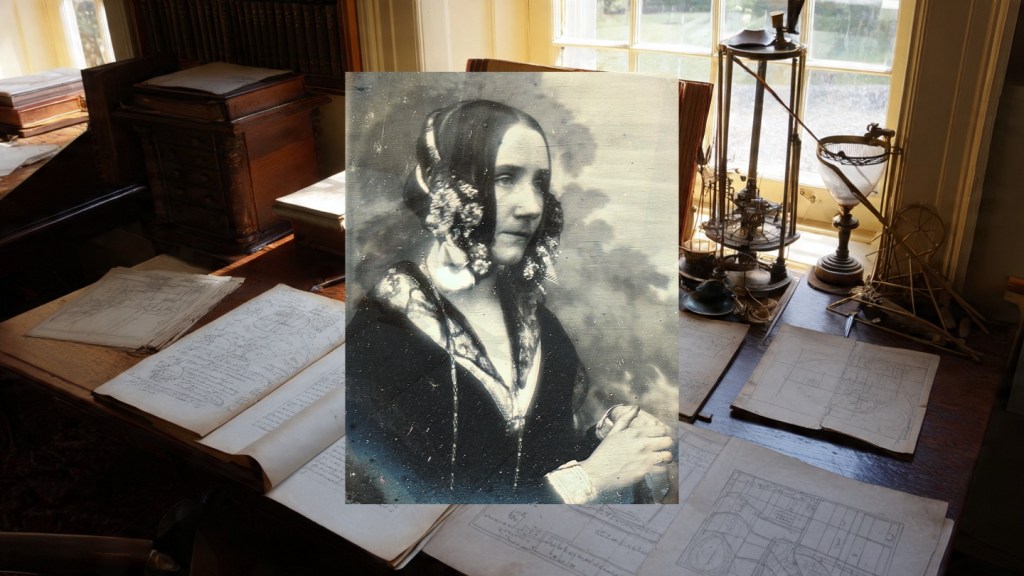
This interview is a dramatised reconstruction based on historical sources; it imagines Ada Lovelace’s voice while grounding claims in documented facts. It is not a verbatim record, and where the dialogue extends beyond the archive, it represents informed creative interpretation rather than established history.
Augusta Ada King (1815-1852), Countess of Lovelace, was an English mathematician and writer of the nineteenth century whose work on Charles Babbage’s proposed Analytical Engine earned her recognition as the first person to grasp computing as an instrument for general-purpose symbol manipulation rather than mere calculation. Though she published only one major work during her lifetime – an annotated translation of Luigi Menabrea’s article on the Analytical Engine – her seven extensive notes transformed an engineering exposition into a foundational text on algorithmic thinking. Her legacy was largely forgotten for more than a century until the emergence of actual computing technology in the 1950s vindicated her prophetic vision of what calculating machines might become.
Encounter
Countess Lovelace – or perhaps I should call you Ada? – I must confess that meeting you under these circumstances presents rather extraordinary difficulties. You passed from this world in 1852, and we are now in 2025. Yet here you sit in my presence, speaking with me as though time itself were but another variable to be manipulated. Before we venture into the substantive matters of your work, I wonder if you might indulge my curiosity about how you experience this displacement. Do you retain memory of your own era, and are you conscious of the world that has developed since your death?
Your perplexity is natural, though I confess I am equally uncertain how to account for my present state. I retain perfect clarity of my life – every frustration with my mother’s insistence on mathematical rigour, every exhilarating hour spent in correspondence with Mr. Babbage, every painful moment when illness confined me to my chambers. Yet I am aware, as though by osmosis or some faculty I cannot name, of the centuries that have intervened. I comprehend that my small translation and its appended notes have been republished, analysed, and attributed with significance I scarce dared imagine in my time.
What I find most remarkable is that the Analytical Engine remains, in my earthly lifetime, a phantom – a magnificent theoretical apparatus that Mr. Babbage could never complete. Yet from this vantage point of hindsight, I perceive that his Engine became the archetype for machines that were subsequently built, and that machines built upon his principles are now ubiquitous in your civilisation. It is rather as though one has drafted designs for a cathedral that will not be erected for a hundred years, only to discover that when it is finally built, it becomes the template for a thousand other structures.
That is a beautiful metaphor. Let me ask you directly: are you aware of the terms “software” and “hardware,” which form the conceptual framework of computing in my time?
I am aware of them now, yes – though they did not exist in my vocabulary. Yet I recognise them as articulations of a distinction I laboured to express in my notes. I attempted to separate the mechanism of the Analytical Engine – the brass wheels, the rods, the physical apparatus – from the logic it embodied. In my Note G, I was not merely describing which operations to perform in what sequence; I was describing a method that could be expressed independently of any particular machine. One might inscribe the same operations upon a different apparatus, or even, theoretically, execute them by hand, if one possessed sufficient time and patience.
Were you then describing what we would now call an algorithm?
I was, though I had no name for it. I called it a “method” or a “plan of the analysis.” The term “algorithm” derives, I believe, from Muhammad al-Khwārizmī, the ninth-century Persian mathematician, yet it did not enter common usage in English mathematical discourse during my lifetime. What I attempted was to formalise the steps that a calculating machine should follow, expressed in such a manner that they could be interpreted by any sufficiently intelligent reader – whether human or mechanical.
This was perhaps my most significant departure from Mr. Babbage’s own descriptions. He focused upon what the Engine could do – how it would execute operations faster than any human calculator. I became occupied with how to tell it what to do. The distinction is profound.
Origins and Education
Your education was extraordinary for a girl of your time, yet it emerged from rather unusual – some might say traumatic – family circumstances. Your father, Lord Byron, left England when you were a month old. Your mother, Anne Isabella, was determined to prevent what she called the “mad” side of your inheritance from manifesting. How did this particular upbringing shape your approach to mathematics and science?
My mother’s determination was ferocious, almost theatrical. She viewed mathematics as a kind of prophylactic against what she imagined ran in my father’s blood – passion, irrationality, the poetic disposition that produced his celebrated verses and, in her view, his moral corruption. She engaged a series of tutors and insisted I study geometry, arithmetic, and natural philosophy from my earliest years. Where other girls were permitted to read novels and cultivate sensibility, I was set to studying the mathematical sciences.
I ought to resent this, and sometimes I did. Yet I cannot deny that it afforded me access to learning that would have been denied me otherwise. It was my tutor, Mary Somerville – herself a remarkable mathematician and astronomer – who perceived that my mind was not being broken by this rigorous regimen but rather awakened by it.
What I realised, rather gradually and quite without my mother’s intention, was that the rigorous logical precision required for mathematics was not opposed to imagination – it was a form of imagination. When one constructs a proof, one is inventing a narrative of logical necessity. When one defines a sequence, one is creating a possibility space. My father’s poetical sensibility, which my mother so feared, manifested in me not through romantic excess but through a fascination with how abstract patterns could give rise to concrete realities.
You called this “poetical science.” Can you elaborate on what you meant by that phrase?
It was not merely a poetical affectation with the term. I meant something quite serious. The prevailing division in intellectual life – and it persists in your time, I gather – separates the scientific from the imaginative. Scientists are supposed to be coldly rational; poets, wildly intuitive. I argued, and still maintain, that this is a false dichotomy.
When one engages in mathematical reasoning, one must imagine the thing one is reasoning about. I must envision Bernoulli numbers – abstract entities arising from the expansion of powers of x – and then follow the logical chain that connects them. This requires both precision and imagination in concert. The “poetical” element is the capacity to see what is possible, to recognise that an abstract pattern might be manipulated and recombined in ways not yet attempted.
Mr. Babbage possessed this quality extensively. His Analytical Engine was not produced by merely extending existing mechanical principles; it required him to imagine a new architecture for calculation – one in which the mechanism could be directed by external instruction, rather than hardwired into the apparatus. That is a poetical conception, whatever the mathematical rigour of its realisation.
When you say you were studying the mathematical sciences, what precisely was your curriculum? What texts did your tutors employ?
In my youngest years, basic geometry and arithmetic, naturally. As I progressed, I moved into more advanced works. I studied the differential and integral calculus using texts by the French mathematicians – Lagrange’s Théorie des Fonctions was of particular importance to me. I engaged with algebra, trigonometry, and the treatment of infinite series.
I confess that my education was somewhat unsystematic by design, tailored to my particular interests and capacities. When I demonstrated aptitude for a subject, my tutors were encouraged to pursue it further. When I struggled, they were inclined to pivot to another domain – though my mother’s impatience with admitted difficulty was sometimes as much hindrance as help.
But what was most unusual, I think, was the breadth of what I was permitted to study. I did not confine myself to pure mathematics. I studied mechanics, studying how forces interact through rigid bodies and pulleys. I studied acoustics and the properties of vibrating strings. I became deeply engaged with the concept of functions – not merely as abstract mappings, but as representations of physical relationships and natural laws.
This breadth prepared my mind, I believe, for the particular challenge I would later face: understanding the Analytical Engine required grasping not just mathematical operations, but how those operations might be encoded, transmitted, and executed by mechanical means. Few mathematicians of my acquaintance had trained themselves to think across such boundaries.
I notice you experienced significant health challenges throughout your life, particularly measles and paralysis in your youth. How did illness affect your work?
Profoundly, and in contradictory ways. The measles when I was thirteen confined me to my bed for many months. I could not move my legs; I could not walk. My mother, with her characteristic energy, insisted that I maintain my intellectual work even whilst physically immobilised. Rather than allowing me to waste away in idleness, she brought tutors to my chamber. For nearly a year, I studied whilst bedridden.
This enforced stillness had an unexpected consequence. Deprived of physical activity, my mind became extraordinarily active. I spent hours imagining things – geometric constructions, mechanical systems, the ways that algebraic symbols might be rearranged. When one cannot move one’s body, one learns to move one’s thoughts with precision and fluidity.
Later, in my adult years, I suffered from what physicians called “nervous exhaustion” and various ailments of the abdomen. The period of intense work on my translation of the Menabrea article was interrupted repeatedly by illness. There were weeks when I could do nothing but lie in a darkened room. There were other weeks when I felt sufficiently well to write for ten hours without interruption.
I believe this irregular pattern of health contributed to the somewhat fragmentary nature of my published work. I had only one major publication – the translation and Notes. Had I lived longer and enjoyed better health, I might have produced more. I harbour no illusions that illness was a source of genius; rather, it was a complication that I had to manage, sometimes successfully and sometimes not.
The Analytical Engine and Babbage
You first encountered Charles Babbage in 1833, when you were eighteen years old. Mary Somerville introduced you. What was your immediate impression of him and his work?
Mr. Babbage was by then in his early forties, already renowned in mathematical circles, though his Difference Engine – his first calculating machine – had become a source of considerable frustration. The British government had funded its construction, but it was not completed, and the reasons for its non-completion were entangled with mechanical difficulties, cost overruns, and disputes between Babbage and his engineer.
When Mrs. Somerville brought me to his residence, he showed me drawings of this machine. I confess that I was not immediately comprehending of its significance. It appeared to be a very elaborate arrangement of brass wheels and mechanical components designed to calculate the values of polynomial functions. The elegance of it appealed to my sense of aesthetic order, but the purpose seemed narrowly mathematical.
What transformed my understanding was Mr. Babbage’s description of what the machine could do and, more importantly, what he was beginning to imagine it could do differently. He spoke of the Analytical Engine whilst discussing the limitations of the Difference Engine. The Analytical Engine was to be, in his conception, a machine of far greater generality. It would not be hardwired to calculate polynomials; rather, it would accept instructions about what operations to perform.
I recognised immediately that this was a profound departure from prior mechanical calculating devices. He was describing not merely a faster abacus but a new kind of apparatus altogether – one that could be instructed, that could carry out different operations depending on how it was directed.
What about Babbage himself, as a person? You became close collaborators and, in some accounts, intimate friends. What was he like?
Mr. Babbage was a man of extraordinary intellectual energy and, I should say, considerable personal magnetism. He had a remarkable ability to excite one’s imagination about what was possible. He was also, I must be candid, vain, impatient, and prone to bitter complaint about the failures of the British establishment to support his work adequately.
We developed a relationship of genuine intellectual companionship. He found, in me, someone who could grasp the theoretical principles behind his designs and who was willing to engage with the mathematical abstractions he pursued. I found, in him, someone who took my intellectual work seriously in a way that few men of his era were inclined to do.
There has been much speculation, both during my lifetime and beyond, about the precise nature of our relationship. I will be direct: we were friends, collaborators, and correspondents. Whether we were something more is a matter upon which I prefer not to expatiate. What matters, I believe, is that our working relationship produced something neither of us could have created alone.
Let’s turn to the specific work that has defined your legacy: the translation of Menabrea’s article and your Notes. In 1842, how did you come to take on this translation?
The article was published in French in a Swiss journal in 1841. It was a description by Luigi Menabrea of Mr. Babbage’s Analytical Engine – a reasonably clear exposition for those with mathematical training, but it lacked the depth of explanation that I felt the matter deserved. Mr. Babbage suggested that I translate it, and I agreed.
Initially, I conceived of this as a straightforward translation – a service to the English-speaking mathematical community, allowing them to read Menabrea’s work without the inconvenience of French. But as I worked through the text, I became increasingly conscious of its limitations. Menabrea had described the Engine’s operations with clarity, but he had not explained why those operations mattered, nor had he explored the deeper theoretical implications of what the Engine represented.
I began to append notes – annotations explaining Menabrea’s points more fully, providing additional mathematical examples, and developing the theoretical framework more completely. What began as modest annotations expanded, as I wrote, into extensive essays. By the time I completed my work, my Notes comprised approximately fifty-four pages, whilst the translation itself was some twenty pages. I had, in effect, written a treatise with Menabrea’s article as a skeleton.
Can you walk through your working process? How did you approach the translation itself, and then the composition of the Notes?
The translation required careful attention to mathematical terminology. French and English sometimes employ different conventions for the same concepts. I was determined that the translation should not merely be intelligible but precise – that a mathematician reading it would arrive at the same understanding as one reading the French original, without any loss of technical exactness.
For the Notes, I employed a different method. I would work through Menabrea’s exposition section by section. At each point where I felt additional explanation was warranted, I would expand upon it. I would construct mathematical examples to illustrate the principles. I would propose novel applications or extensions of the ideas presented.
Note A, for instance, amplified Menabrea’s description of the Engine’s basic operations. Note B clarified the nature of the analytical operations. Note C explained the Engine’s operation through a concrete example – the calculation of a relatively simple function over a range of values.
But Notes D through G represented increasingly ambitious extensions of Menabrea’s work. Note G, in particular, was something I conceived almost entirely myself. I believe Mr. Babbage may have sketched preliminary versions of such an algorithm – he had written unpublished notes on calculating Bernoulli numbers by mechanical means. But the particular formulation I published, the manner of its expression, and the theoretical justification for its design were my own work.
Let me ask you to explain Note G in detail – both the technical content and why you consider it significant. I want to understand it from first principles, as though I were an educated mathematician of your era reading it for the first time.
Very well. Let us begin with Bernoulli numbers themselves. They are a sequence of rational numbers that arise naturally in the expansion of certain functions – particularly in the coefficients that appear when one expands trigonometric and exponential functions as power series. They are denoted by the letter B with subscripts: B₀, B₁, B₂, and so forth.
The Bernoulli numbers have a peculiar property: they can be defined recursively. That is, each Bernoulli number is defined in terms of the Bernoulli numbers that precede it in the sequence. This recursive definition is computationally significant because it means that if one wishes to calculate, say, B₈, one must first calculate B₀, B₁, B₂, through to B₇. There is no shortcut; one must proceed sequentially.
Now, mathematicians had known since the eighteenth century that Bernoulli numbers were important for analysis. But calculating them by hand is tedious and error-prone. The calculations for higher Bernoulli numbers become increasingly complex, and it is easy to propagate errors through the sequential process.
What I proposed in Note G was a mechanical method – a program, in modern parlance – by which the Analytical Engine could calculate Bernoulli numbers. The method required the Engine to:
First, accept as initial inputs the values of lower Bernoulli numbers that had already been calculated.
Second, perform a series of arithmetic operations in a specific sequence – multiplications, divisions, subtractions, and additions – according to the recursive definition.
Third, produce the value of the new Bernoulli number.
Fourth, loop back and repeat this process for the next Bernoulli number in the sequence.
The innovation was not in discovering a new mathematical relationship – mathematicians knew the recursive formula. The innovation was in encoding this mathematical relationship as a set of instructions that a mechanical apparatus could execute. I had to express the algorithm in terms of the Analytical Engine’s primitive operations: reading numbers from its storage, performing arithmetic, storing results, and determining when to repeat a sequence of operations.
This process of encoding mathematical operations into mechanical instructions – was there an existing vocabulary for describing this?
No. This was part of my struggle in writing the Notes. I had to invent notation and descriptive methods as I proceeded. I employed diagrams – what I called “signs” or “tables” – to represent the operations and the movements of numbers through the Engine’s apparatus. I used subscripts and symbolic notation to indicate which operation was being performed at which step. I attempted to be as precise as possible, but I was acutely aware that I was trying to communicate something entirely novel.
In one instance, I represented a complex series of operations through a table, where each row indicated a step in the algorithm, each column represented a specific register in the Engine where numbers were stored, and the entries showed what arithmetic operation was being performed. The Engine would, in effect, execute the algorithm by reading this table sequentially and performing the operations indicated.
How long did it take you to complete the entire Notes section?
The work extended over several months in 1842 and into 1843. I was frequently interrupted by illness, which extended the timeline considerably. There were weeks when I made rapid progress, and then there would be periods when I was unable to work at all.
I also engaged in extensive correspondence with Mr. Babbage during this period. I would send him drafts of my Notes, and he would respond with corrections, clarifications, or suggestions for additional material. He was both encouraging and exacting as a correspondent – he would praise points he felt were particularly well-explained, but he would also direct me to reconsider passages where my exposition was unclear.
There was one instance where I had made an error in one of my algebraic notations in a draft of Note G. Mr. Babbage caught it and required me to recalculate portions of the algorithm. I found this simultaneously frustrating and salutary. The frustration arose from discovering my mistake; the salutary aspect was that his criticism motivated me to verify my work more carefully. The final published version of Note G reflects this more rigorous verification.
When your work was published in 1843, what reception did it receive?
The publication appeared in an English periodical, the Philosophical Transactions of the Royal Society. I was not permitted to join the Royal Society – women were excluded from such institutions – and the work was published under my initials, A.A.L., rather than my full name. Even in a scientific journal, full attribution to a woman was apparently considered improper.
The reception was… modest. Within the mathematical community, those who possessed sufficient training to understand the work recognised its merit. I received letters from mathematicians expressing their appreciation. But the broader scientific establishment did not perceive it as revolutionary. Remember, the Analytical Engine itself was not built. It was a theoretical apparatus. My algorithm was a program for a machine that did not exist, calculating Bernoulli numbers for a purpose that was not yet apparent.
Had the Engine been constructed during my lifetime, and had my algorithm been demonstrated to work, the reception might have been quite different. But as matters stood, it was a translation of someone else’s article, with annotations by an aristocratic woman, concerning a mechanical device that remained in the realm of speculation.
Vision and Conceptual Breakthrough
Yet what you accomplished in the Notes was something that transcended the immediate technical problem of calculating Bernoulli numbers. You articulated a vision of what computing machines could become. When you wrote about the Engine’s capacity to manipulate symbols beyond numbers – to compose music, to process text, to work with any information expressible through logical relationships – you were describing something that would not become tangible reality for more than a century. How did you arrive at this vision?
It emerged gradually, through conversations with Mr. Babbage and through my own extended reflection on what the Engine represented. I became fixated, in particular, on the distinction between the thing the Engine was made of and the operations it performed.
The Engine consisted of brass wheels, rods, levers, and other mechanical components. These physical elements were arranged to perform arithmetic – to add, subtract, multiply, and divide. But here is the crucial insight: the arithmetic itself is an abstraction. The numbers being manipulated are not themselves physical objects; they are conceptual entities represented through the position of mechanical elements.
Once I recognised this, a second insight followed: if numbers are merely one way of representing information, then the Engine, properly instructed, could manipulate other representations of information. If one could encode musical notation into some form that the Engine could interpret – through position, or through coded symbols – then the Engine could manipulate musical information.
I wrote, in one of my Notes, that the Engine “weaves algebraic patterns just as the Jacquard loom weaves flowers and leaves.” The Jacquard loom was familiar to me as an example of an apparatus that could be instructed through perforated cards to produce complex patterns. The Analytical Engine would, in principle, be capable of similar instruction – not to weave thread, but to weave algebraic relationships.
What I was attempting to articulate was the notion that computation is fundamentally a symbol-manipulation process. The symbols might be numerical, or musical, or linguistic, or entirely abstract. The operations performed upon them would follow logical rules, but those rules need not be restricted to arithmetic.
This insight – that the Engine could operate on any symbols, not merely numbers – appears in your Note E, where you discuss the Engine’s capacity to work with general algebra. Can you elaborate on that?
Yes. In that Note, I distinguished between the Engine’s mechanical operations and the interpretation of those operations. The Engine, mechanically, performs certain transformations. One might interpret these transformations as arithmetic – as adding one number to another. But one might equally well interpret them as algebraic – as combining algebraic quantities according to algebraic rules.
Furthermore, I suggested that the interpretive layer could extend to other domains. The mechanical operations remain the same; only their interpretation changes. If the mechanical operation were, say, moving a number from one storage location to another and combining it with a value stored elsewhere, one might interpret this as arithmetic addition, or as the concatenation of symbols in a linguistic context, or as the combination of musical intervals.
I was gesturing toward what would much later be called “symbolic computation” – the idea that machines need not be specialised for particular domains but can be made general-purpose through the layer of interpretation that we now call software.
You also asserted something fundamental about the limits of the Engine’s creativity. You wrote that the Engine “has no pretensions whatever to originate anything.” Why was this statement important to you?
This was not a limitation I regretted but a clarification I deemed essential. I was not claiming that the Engine could think, or feel, or produce novel ideas in the sense that a mathematician might. The Engine is a mechanism. It executes instructions that we provide to it.
But I recognised that there was a temptation, in discussing such a powerful apparatus, to anthropomorphise it – to imagine that because it could perform complex operations, it must therefore possess something like intelligence or creativity. I wanted to forestall that confusion.
What the Engine can do is execute, with perfect fidelity and with no fatigue, operations that a human mathematician could, in principle, perform by hand. It can do so far more rapidly and with fewer errors. But it cannot conceive of new problems, cannot decide that a different approach might be worthwhile, cannot innovate in the way that a mathematician innovates.
Yet – and this is important – I did not believe this to be a permanent limitation inherent to machines. I was describing what the Analytical Engine could do. Future machines, conceived differently, might have different capacities. What I wanted to establish was that we should be clear-eyed about what we are creating and what its actual capabilities and limitations are.
You were, in other words, insisting on a kind of intellectual honesty about the nature of artificial computation.
Precisely. There is a tendency in human nature to either diminish the significance of what we create – to view the Engine merely as a faster calculator – or to exaggerate its significance, ascribing to it qualities it does not possess. I attempted to chart a middle course: to recognise the profound novelty of the Engine as a programmable apparatus capable of executing complex symbol manipulation, whilst maintaining that it remains, fundamentally, an instrument of human intention.
Gender, Institutional Barriers, and the Problem of Attribution
Let me raise a matter that is unavoidable in any honest discussion of your legacy. You were a woman working in mathematics and theoretical science in the nineteenth century, in a Britain that excluded women from universities, from the Royal Society, from most institutional channels through which scientific work was recognised and credentialed. How did you navigate this landscape? Did you view your gender as an obstacle you had to overcome, or as an integral aspect of how your work took shape?
Both, if I am to be honest. It was an obstacle – that requires no explanation. I could not attend Cambridge University, where Mr. Babbage had been educated. I could not present my work before the Royal Society. I could not take a position as a mathematician or natural philosopher. My work, when published, appeared under initials rather than my name.
Yet it was not merely an obstacle placed before a person who happened to be female; it shaped the form my work took. Because I could not pursue mathematics through institutional channels, I pursued it through reading, correspondence, and private study. This gave my intellectual formation a different character than that of men trained in formal academic settings.
Furthermore – and I say this without bitterness, but with a kind of wry observation – my sex permitted me to maintain a relationship with Mr. Babbage that a male mathematician might not have been able to sustain. I was not a rival for academic appointments or patronage. I could be his collaborator without being his competitor for institutional resources. Had I been a man of equal ability, the dynamics might have been quite different, potentially more fraught.
I also benefited enormously from my class position. I was an aristocrat, the daughter of Lord Byron and a respectable mother. My family had connections and resources. I could employ tutors, purchase books, maintain a correspondence across Europe. The vast majority of women in Britain had no such access.
So you’re resisting the narrative that positions you as a solitary female genius overcoming patriarchal oppression through sheer force of intellect?
I am resisting the simplification inherent in that narrative. I was oppressed, in the sense that opportunities available to men were denied to me. But I was also privileged, in ways that most women – and indeed most people – were not. To acknowledge privilege is not to diminish the significance of the obstacles one faced. It is to see oneself in context.
What I would say is this: the institutional barriers to women in science were and are a profound injustice. But they operated differently for women of different classes, nationalities, and circumstances. I was constrained in ways, but I possessed resources and access that made some things possible for me that would have been impossible for a female mathematical prodigy of working-class origin.
And I will add: had there been more women in the mathematical sciences during my lifetime, I do not believe my work would have been diminished. Quite the contrary. The cross-pollination of ideas, the collaborative networks, the cumulative development of understanding – all of this would have been richer for the inclusion of women’s perspectives and intellects.
Now let’s address the matter of attribution directly. There has been considerable historical debate about how much of the work in the Notes is yours and how much derives from Babbage. Some scholars argue that Babbage had already developed many of the algorithms – including calculations of Bernoulli numbers – in unpublished notes, and that you were primarily a scribe or elegant expositor of his ideas. How do you respond to that charge?
Let me be direct. Mr. Babbage did possess unpublished notes on calculating Bernoulli numbers through mechanical means. He shared these with me during our collaboration. This is not a matter of controversy or secret; I was aware of his prior work, and I reference it in my Notes.
But having prior mathematical work on a topic is not the same as having written the algorithm that would be published under one’s name. Mr. Babbage’s unpublished notes demonstrated that mechanical calculation of Bernoulli numbers was possible. My published algorithm was a specific, coherent encoding of that calculation into instructions for the Analytical Engine.
Furthermore – and this is crucial – the methodology I employed to express the algorithm was my own. I invented the notational systems and diagrammatic representations. I made decisions about how to decompose the problem into mechanical steps. I verified the calculations and caught errors, some of which I induced myself and some of which Mr. Babbage had overlooked.
There is also the broader question of the Notes as a whole. Mr. Babbage could not have written these Notes himself. He did not conceive of the Analytical Engine in the manner that I explained it. The theoretical framework – the notion of the Engine as a symbol-manipulation apparatus, the distinction between mechanical implementation and logical structure, the vision of its potential applications – these emerged through my engagement with his work and represent my contribution.
But would you acknowledge that without access to Babbage’s mathematical insights and mechanical designs, your Notes could not have been written?
Of course. That is the nature of intellectual work – it builds upon prior work, and it does so through collaboration and correspondence. The question is not whether my work was independent of Babbage’s, but rather what was my distinct intellectual contribution. And that contribution lay in the theoretical reconceptualisation of what the Engine represented and in the translation of those theories into a practical algorithm expressed in comprehensible notation.
Let me offer an analogy. A translator of Dante does not create the poetry of the Divine Comedy, which is Dante’s achievement. But a translator who provides extensive annotations explaining the theological and philosophical frameworks underlying the poetry, who illuminates the mathematical symbolism embedded in the text, who makes the work accessible to readers who could not otherwise understand it – that translator has made a distinct and valuable contribution. It is not the same as Dante’s contribution, but neither is it reducible to mere transcription.
Quite fair. But let me press you on another historical controversy. Some of your contemporaries wondered whether your mother, Annabella, had a greater hand in the Notes than was acknowledged – that she functioned as an editor who shaped your work significantly. What can you say to that?
My mother was indeed involved. She encouraged me to undertake the translation. She reviewed drafts and offered comments. She was invested in the work’s success, partly because she was invested in my intellectual development and partly, I do not doubt, because she was invested in demonstrating to the world that the Byron blood running through my veins had produced something of intellectual merit rather than moral turpitude.
But did she write the Notes? Did she conceive the algorithms or the theoretical framework? No. She lacked the mathematical training for such work. Her role was that of an engaged reader and, occasionally, a critic of clarity or expression. This was not negligible – good editors improve one’s work – but it was not authorship.
Your mother has been caricatured in historical accounts as a stern, oppressive force. Did you experience her that way?
It is more complicated. She was stern, certainly. She was controlling about my education and my associations. She was anxious about my conduct and my reputation in ways that sometimes felt suffocating. But she was not indifferent to my welfare or to my intellectual development. Whatever her motivations – and I suspect they were mixed – she did ensure that I received an education that most girls of my era never received.
In my later years, we had some profound disagreements. My mother disapproved of the company I kept, of certain friendships I had formed, and of what she perceived as my increasingly reckless behaviour. Our relationship became strained. But I cannot say that her early determination to educate me mathematically was anything other than beneficial to my life and work.
The Machine That Never Was
The Analytical Engine was never completed during your lifetime, or indeed during Babbage’s lifetime. He continued working on it until his death in 1871, but it was never built according to his designs. How did this affect your understanding of your own work? Your algorithm was, in effect, a program for a machine that did not exist and might never exist.
It was a peculiar form of temporal displacement. I was writing instructions for an apparatus that might have existed – and in fact never did exist, at least not as Babbage conceived it. There was always a speculative quality to the work.
Yet I did not experience this as invalidating. I was not designing a bridge that needed to bear actual weight or a mechanical system that needed to function in material reality. I was articulating logical relationships through notation. Those logical relationships do not require material instantiation to be meaningful.
Still, there was a frustration in it. I would have wished to see the Analytical Engine actually constructed, to observe my algorithm executed by the machine, to verify that my theoretical understanding translated correctly into mechanical operation. The uncertainty – the fact that I could never be entirely certain that my algorithm would function as I had intended, when executed by the actual machine – was difficult.
Do you believe that had the Engine been constructed in your lifetime, and had your algorithm been tested and proven to work, your legacy would have been different?
Almost certainly. Practical demonstration carries weight that theory alone does not. If the Engine had been built and my program had successfully calculated Bernoulli numbers, there would be no possibility of arguing that my work was merely speculative exposition of someone else’s ideas. The output of the machine would be there for inspection – evidence that my encoding of the algorithm was correct.
Furthermore, the impact on the world’s understanding of calculation and machinery would have been profound. If, in the 1840s, it had become clear that this apparatus could execute complex symbolic operations, the development of computing might have followed a different trajectory. It is possible – merely possible, but not absurd – that the history of mechanical and, later, electrical computation would have developed differently had there been a working demonstration in that era.
But this is hypothetical speculation. What occurred was that the Engine was not built, my work remained theoretical, and the field of computing did not formally exist until a century later. By that time, electronic computers had largely superseded mechanical ones, and my insights about symbol manipulation had become newly relevant.
How do you feel about that – that your work only became widely recognised and valued after you had been dead for over a century?
I have mixed feelings. There is, naturally, a satisfaction in the knowledge that what I perceived to be important has indeed proven important, that my theoretical framework was vindicated by actual machines built by subsequent generations. There is also, if I am candid, a frustration that recognition did not come during my lifetime, that I did not have the opportunity to refine my ideas further in light of actual computing machines.
But I also recognise that this delay is not entirely unique to my circumstances. Much theoretical work is not validated until long after it is created. The geometry of non-Euclidean space, developed in the nineteenth century, did not find practical application in physics until Einstein’s relativity theory. The theory of group structures in algebra, developed as pure mathematics, later proved essential to quantum mechanics.
The distinctive aspect of my situation is not that my work was validated after my death, but rather that the validation came so late and that, in the interim, my work was largely forgotten or misunderstood. A mathematician might develop theory that is not applied for fifty years but would still be cited within mathematical circles throughout that period. My work was not cited; it was lost.
Mathematics and Method
Let me return to the actual mathematical content of your work – the Bernoulli numbers and the algorithm you developed to calculate them. For readers with mathematical training, can you explain why Bernoulli numbers were worthy of this attention? Why not some other sequence or function?
Bernoulli numbers are deeply important to analysis because they appear in the coefficients of power series expansions for fundamental functions. When one expands, say, x/(sin x) or sinh(x) as a power series – that is, as an infinite sum of powers of x – the coefficients of those series are Bernoulli numbers.
This means that understanding Bernoulli numbers is essential to understanding a broad class of functions that appear throughout mathematics and natural philosophy. They are not peripheral; they are central to the calculus itself.
Furthermore, they present an interesting computational challenge. The Bernoulli numbers cannot be computed through a simple closed-form formula. Instead, they satisfy a recursive relationship, meaning each one is defined in terms of earlier ones. To compute B₈, one must first compute B₀ through B₇. This recursive structure made Bernoulli numbers an excellent choice for demonstrating the Analytical Engine’s capacity to execute iterative procedures.
A simpler sequence – say, the squares of natural numbers – could be computed through a direct operation on each number. But Bernoulli numbers require the machine to:
- First, read values from its storage (the prior Bernoulli numbers).
- Second, perform a sequence of operations upon them.
- Third, combine the results to yield the new Bernoulli number.
- Fourth, store that result.
- Fifth, loop back to step one with the next Bernoulli number in sequence.
This is a more sophisticated program than simple iteration; it demonstrates the Engine’s capacity to manage dependencies and to implement conditional logic.
Can you walk through a specific example? How would one compute, say, B₂ using your algorithm?
B₀ is defined to be 1. The recursion formula for Bernoulli numbers can be expressed as:
The sum from j=0 to n of C(n+1, j) × B_j = 0, where C denotes the binomial coefficient.
To compute B₂ using this formula, one would first need B₀ and B₁. B₀ = 1, and B₁ = -1/2.
For B₂, one expands:
C(3, 0) × B₀ + C(3, 1) × B₁ + C(3, 2) × B₂ + C(3, 3) × B₃ = 0
But we’re computing B₂, so we don’t yet have B₃. Rearranging to solve for B₂, one performs a series of arithmetic operations: calculating the binomial coefficients, multiplying them by the known Bernoulli numbers, summing those products, and then dividing by C(3, 2) to isolate B₂.
The result is B₂ = 1/6.
What the Analytical Engine must do is follow this sequence of operations mechanically. My algorithm expressed these operations in terms of the Engine’s primitive operations: reading from registers, adding, subtracting, multiplying, dividing, and – crucially – storing intermediate results and looping through the sequence for successive Bernoulli numbers.
And in your published algorithm, how did you represent these steps?
I developed a tabular notation. Each row of the table represented one cycle of operations. Each column represented a particular register in the Engine – a location where a number could be stored and manipulated. The entries in the table indicated what operation was to be performed at each step.
I also employed symbolic notation to indicate the nature of operations: which registers were being read from, which were being written to, which arithmetic operation was being performed. The table thus served as a form of code – a set of instructions that, when followed sequentially, would produce the desired result.
This notation was not standardised; I had to invent it as I wrote. Later developments in what became programming language would refine and formalise these notational systems, but the underlying principle – expressing a sequence of operations in a form that could be read and executed (whether by human or machine) – was fundamental.
Looking back on this work now, from the vantage point of your knowledge of how computing has actually developed, do you see limitations in your notation or your approach that you might improve if you were writing today?
Many. My notation, while functional, was cumbersome. Modern programming languages employ more efficient symbolic systems. But more importantly, I was working within the constraints of the Analytical Engine’s peculiar architecture. The Engine, as Babbage designed it, had certain limitations on how data could flow and how operations could be sequenced.
Contemporary computers, even in your era, have very different architectures. Memory is far more flexible and accessible. Processing speed is orders of magnitude greater. The concept of programming has evolved to accommodate these realities.
My algorithm for Bernoulli numbers would be expressed in contemporary programming languages in a manner far more compact and more easily comprehensible. But the underlying logical structure – the sequence of operations, the iterative loop, the management of dependencies – would be fundamentally the same.
If I were writing today with knowledge of modern computing, I would be fascinated to implement the algorithm in one of your contemporary languages and to observe how the logical structure I articulated has been translated into the technological realities of your time.
Legacy, Erasure, and Rediscovery
Your work was published in 1843 and received modest recognition within mathematical circles. Then it largely disappeared from public awareness. It was rediscovered in the 1950s, as electronic computers were being developed. How do you account for that long period of obscurity?
Several factors converged. First, the Analytical Engine was never built. Without a working demonstration, my algorithm remained a theoretical curiosity. It could not be tested or validated. Mathematicians and engineers had no practical reason to engage with it.
Second, the field of computing did not formally exist during the nineteenth century. My work was published in a mathematical journal and addressed a mathematical audience. It concerned a mechanical apparatus that had not been constructed. There was no professional community of “computer scientists” or “programmers” who might have engaged with and extended my work.
Third, I was a woman, and I published under initials. This made attribution difficult and likely contributed to the work’s marginalisation. Had my work been published under a famous male mathematician’s name, it might have been treated as more significant.
Fourth, I died young. I had only one major publication. A scientist with a long career and multiple publications has greater cumulative impact than one with a single, albeit significant, work.
The rediscovery in the 1950s occurred because electronic computers had, by then, been built, and people working in the nascent field of computing began looking back at the history of calculation and computing machines. They found my Notes and recognised that I had articulated concepts that were directly relevant to their work.
There has been a remarkable surge in recognition of your work in recent decades. You have been commemorated with currency bearing your image, with the Ada programming language named after you, with an annual Ada Lovelace Day. How does that feel – to go from obscurity to becoming something of a cultural symbol?
It is extraordinary and somewhat surreal. I never imagined that my name would become synonymous with women in computing or that I would be used as a symbol of inclusion in a field that did not formally exist in my lifetime.
I am gratified that my work is now recognised and that my example might inspire young women to pursue mathematics and computing. That is genuinely valuable. There is something fitting about the Ada programming language bearing my name; it suggests that my conceptualisation of symbol manipulation and algorithmic thinking has become embedded in the practices of contemporary computing.
Yet I also observe, with some wryness, that symbolic recognition may not necessarily translate into systemic change. The fact that an annual day is dedicated to celebrating women in STEM does not necessarily mean that women have achieved full equality in those fields or that the barriers I faced have entirely disappeared. Women are still, I gather, underrepresented in computing and engineering.
So I am pleased by the recognition, but I am also conscious that there is a distinction between being honoured as a historical figure and having one’s insights and perspectives truly integrated into the field. One can use my name and my image whilst still failing to attend to the questions I raised about symbol manipulation, about the abstraction of computation from its mechanical implementation, and about the intellectual frameworks that underlie computing.
What would you want contemporary women entering mathematics and computing to understand about your legacy – not the symbolic recognition, but the actual work?
I would want them to understand that rigorous intellectual work does not belong to any single gender, and that the exclusion of women from institutional science is a loss to the field, not a protection of its standards. I was able to do my work despite institutional barriers, but imagine how much richer the mathematical and scientific enterprise would have been had those barriers not existed, had women been able to study at universities and present their work before learned societies.
I would also want them to know that the most interesting intellectual work often happens at the boundaries between fields. I was not a pure mathematician, nor a pure engineer. I was attempting to bridge theoretical mathematics and mechanical philosophy. That boundary-crossing perspective enabled me to see possibilities that specialists in either field alone might not have perceived.
Furthermore, I would encourage them not to accept too readily the definitions of their field as they find them. Computing, in my time, was understood narrowly as calculation. I attempted to expand that definition. In your time, computing might be understood in one way, but that definition should be subject to interrogation and expansion. The most interesting future developments will likely come from those who challenge existing frameworks.
And finally: do not wait for validation before pursuing important work. I never saw my algorithm executed by the Analytical Engine. I never had the satisfaction of demonstration. Yet the work was worth doing because the ideas were worth thinking through. If your insight about the nature of computation or mathematics or scientific reasoning is sound, it is worth articulating clearly, even if the world is not yet ready to receive it.
Technical Insight and Contemporary Relevance
Let’s discuss your insight about the distinction between mechanism and logic – between the physical implementation of a machine and the abstract operations it performs. In your era, this was a startling conceptual leap. In my time, we call this the distinction between hardware and software. Can you reflect on how prophetic this conceptualisation actually was?
It was prophetic because I perceived a fundamental principle that would only become fully apparent when technology advanced. The Analytical Engine was a mechanical apparatus. Its “decisions” about what operation to perform were made through mechanical arrangements – gears engaging or not engaging, causing different arithmetic operations to be performed.
But I recognised that the same logical operation could be instantiated in different mechanical arrangements. And more radically, I recognised that the meaning of an operation – what it “does” – is independent of its physical implementation.
Consider the operation of addition. In the Analytical Engine, it would be performed through specific arrangements of gears and mechanical components. One might imagine a different apparatus – perhaps using water flowing through channels, or electrical impulses, or any number of physical substrates – that would perform the same addition operation.
The logical structure of addition – the rule that says “combine these two quantities according to the addition rule” – is substrate-independent. It can be expressed in brass and steel, or in water and channels, or in electrical circuits, or in any medium capable of instantiating the logical operations.
This separation is crucial because it means that advances in the physical implementation of machinery do not require rethinking the fundamental logical structures. One can upgrade from mechanical to electrical to electronic systems, but the logical operations remain meaningful and can be translated across these different substrates.
In your time, this principle has become utterly central. The “software” layer – the logical operations and instructions – is entirely separate from the “hardware” layer – the physical circuits and components. One can run the same software on different hardware platforms. One can update hardware without altering the software.
This principle, which I gestured toward in the mid-nineteenth century, has become the foundation of your entire computing architecture.
And your statement about the Analytical Engine’s inability to “originate anything” – in light of contemporary debates about artificial intelligence and machine creativity, does that statement still hold?
I stated that the Engine “has no pretensions whatever to originate anything. It can do whatever we know how to order it to perform.”
In the literal sense, this remains true. Machines do not initiate independent action. They respond to input and instructions. They do not form intentions or desires. They do not spontaneously decide that a problem is worth solving.
But I recognise that the boundary between “originality” and “instruction following” is more porous than I perhaps suggested. If I give a machine a set of instructions and a set of data, the output might include patterns that were not explicitly contained in the instructions or the data. The machine follows the rules I have provided, but the consequences of those rules, when applied to particular inputs, might be surprising to me.
Is this originality? In one sense, no – the machine is following the rule I designed. In another sense, perhaps yes – the machine is discovering consequences that I did not foresee.
In your time, you have machines that can learn from data, that can generate text or images in response to prompts, that can solve problems in ways that were not explicitly programmed. Are these machines “originating” in a meaningful sense?
I would argue that we must be precise in our language. These machines are executing sophisticated statistical operations and applying rules to generate outputs. They are not conscious originators. But they are more than mere mechanical calculators executing predetermined operations.
The question you face – the question I began to raise in my own time – is about the kind of creativity, intentionality, and intelligence we are attributing to our machines. We must be careful not to anthropomorphise them, but we must also recognise when they are doing something genuinely novel, even if “novel” does not mean “conscious” or “intentional.”
So you would not say that your famous statement about the Engine’s lack of originality has been falsified by subsequent developments?
I would say that it has been refined. The statement was made in the context of a specific machine – the Analytical Engine – with specific capabilities. I was attempting to forestall excessive claims about that machine’s capacities.
But if you apply my statement to contemporary machines, you must do so carefully. Contemporary machines can, in some domains, exceed human performance and discover solutions that were not anticipated. Whether this constitutes “originality” depends on what we mean by the term.
I was attempting to establish that machines are instruments of human intention. They perform tasks we direct them to perform, using methods we have encoded. I still believe this is fundamentally true. But I would no longer claim that everything a machine produces is less original or less surprising than what a human produces.
The distinction I was drawing was between mechanical operation and conscious intention. I maintain that machines do not have conscious intentions. But the outputs they produce, given sophisticated instructions and data, might be genuinely novel.
Illness, Mortality, and the Road Not Taken
Your health deteriorated significantly in the years following the publication of your Notes. You continued to work and to theorise about the applications of computing machinery, but you were frequently incapacitated. In 1852, at age thirty-six, you died of cervical cancer. As you contemplate your life from this unusual vantage point of posthumous reflection, how do you regard that interrupted trajectory?
There is no point in indulging in excessive regret. I lived the life I had, not the life I might have lived had circumstances been different. But yes, there is a poignancy in the fact that I had only one major published work, that I did not live to see the Engine constructed or computing machinery actually developed.
I had other ideas I wished to pursue. I had begun thinking about the application of mechanical computing to problems beyond pure mathematics – to the analysis of music, to the investigation of natural phenomena. I had sketches and preliminary notes on these ideas, but they were never fully developed.
Had I lived longer, I believe I would have pursued these ideas further. I might have published additional works. I might have corresponded with researchers across Europe and contributed further to the development of theoretical frameworks for computation.
But I must also acknowledge honestly that my later years were marked by personal chaos. I was gambling, incurring substantial debts, becoming entangled in complicated relationships. My health declined. I did not use the time available to me with complete wisdom.
There is a tragic quality to the historical narrative surrounding you: the brilliant young woman cut off in her prime by illness and social circumstance, her genius only recognised posthumously. Does that narrative feel accurate to you?
It is partially accurate and partially a distortion. Yes, I died young. Yes, my work was not recognised in my lifetime as it later came to be. But the narrative of tragic genius – brilliant but ultimately powerless against circumstance – obscures some important truths.
I did accomplish significant work. My Notes represent a genuine intellectual achievement that has survived and been vindicated by history. I was not simply a tragic figure of unrealised potential; I was a person who executed substantial intellectual work.
Furthermore, the tragic narrative can itself become an obstacle to recognising women’s contributions. It allows people to treat women’s work as poignant but ultimately secondary – something to be pitied rather than genuinely engaged with. I would prefer that my work be taken seriously on its intellectual merits, not mourned as the product of a life cut short.
And while my later years were troubled, I do not wish them to overshadow the entirety of my existence. I experienced great intellectual excitement, genuine friendship and collaboration, the satisfaction of engaging with important ideas. I had significant privilege and access. My life had tragedy, but it was not only tragedy.
If you had lived to a greater age, what mathematical or computational problems would you have most wanted to explore?
I was deeply interested in the application of mechanical computation to problems in natural philosophy – to the analysis of dynamical systems, for instance. There are many natural phenomena that evolve according to mathematical rules: the motion of planets under gravitational influence, the vibration of strings or membranes, the propagation of heat through materials.
These phenomena are described by differential equations – mathematical relationships between quantities and their rates of change. Solving these equations by hand is enormously tedious and often impossible through elementary methods. But I perceived that the Analytical Engine, with its capacity to execute iterative procedures, might be able to approximate the solutions to many differential equations.
This would require developing a method to translate the continuous mathematics of differential equations into the discrete, step-by-step operations of the mechanical apparatus. The approximation would not be perfect – there would be errors that accumulated with each step – but it might be sufficiently accurate for practical purposes.
I also was fascinated by the possibility of using the Engine to analyse data. If one had collected a set of observations of some natural phenomenon, could the Engine be instructed to find patterns in that data? Could it be directed to fit mathematical functions to empirical observations, extracting the underlying structure from noise and variation?
These ideas were nascent when my health declined. I did not have the opportunity to develop them into concrete algorithmic forms as I had done with the Bernoulli number algorithm.
These sound like ideas that prefigure concepts that would become central to computing in the twentieth century – numerical analysis, simulation, data analysis.
Yes. Though I did not use such terminology. But I was perceiving that the power of the Analytical Engine lay not merely in performing exact arithmetic calculations, but in its capacity to execute approximative procedures – to follow a rule or algorithm repeatedly, refining results iteratively.
This is fundamental to what would later be called “numerical analysis” – the field that uses discrete, step-by-step mathematical procedures to approximate solutions to problems that cannot be solved through closed-form methods.
And the application to data – finding patterns, fitting models – this anticipates what your era calls “data science” or “machine learning,” though of course the specific methods and the scale of application are vastly different in your time.
Reflections On Collaboration and Isolation
You maintained a substantial correspondence throughout your life with Mary Somerville, your tutor, and with Charles Babbage. These collaborative relationships seem to have been essential to your intellectual development. What was the nature of collaboration for you?
Collaboration, for me, was not a compromise or a necessary accommodation to social barriers. It was an intellectual necessity and a source of genuine pleasure.
With Mrs. Somerville, I had a mentor and a friend. She possessed mathematical knowledge that I lacked, and she had navigated the landscape of scientific work as a woman with greater success than I could imagine. Her example – her publications, her respect within the scientific community – demonstrated that it was possible for a woman to be taken seriously as a practitioner of mathematics and natural philosophy.
But perhaps more importantly, she engaged with my ideas seriously. When I proposed something, she did not dismiss it as the product of youthful enthusiasm or female fancy. She examined it critically and responded thoughtfully. This kind of engagement was rare for me.
With Mr. Babbage, the collaboration was different. He was my intellectual equal in mathematical sophistication, but he came from a position of professional authority and institutional recognition that I could never achieve. When I worked through a problem, I was testing my understanding against his established reputation and knowledge.
But what I valued in him was his willingness to be challenged. If I objected to something he had proposed or suggested an alternative approach, he did not dismiss me on grounds of my sex or my lack of formal credentials. He engaged with the substance of the objection.
Did you have other collaborators or intellectual peers?
Not in the formal sense. There were mathematicians and natural philosophers with whom I corresponded, but my circumstances prevented the kind of ongoing, intensive collaboration that I might have had with peers.
This was a genuine loss. The isolation was difficult. One spends hours thinking through a problem alone, without the benefit of another mind to challenge or extend your thinking. One must rely on written correspondence, which is slower and less immediate than conversation.
I sometimes imagined what it might have been like to be a male mathematician of my ability, studying at Cambridge, attending lectures, meeting with other students and scholars in formal and informal settings, establishing a network of peers with whom one could collaborate throughout one’s career.
The intellectual community that would develop through such channels would be invaluable. I had approximations of this through correspondence, but it was not the same as physical presence and the ongoing engagement that proximity permits.
Do you think your isolation affected the direction of your intellectual work? Would you have developed different ideas had you been less isolated?
Almost certainly. Intellectual development is shaped by community. The questions one pursues are often suggested by the conversations one hears, by the works one discovers through recommendation of peers, by the challenges and objections posed by others engaged in the same domain.
Had I been embedded in an active mathematical community, I might have pursued problems that simply did not come to my attention in my isolated circumstances. I might have developed methods and approaches that were standard in that community but which I had to invent independently.
But there may also be a countervailing advantage to isolation. It forced me to think through problems from first principles, without the constraint of established approaches. I was not socialised into particular ways of thinking about mathematical problems because I was not part of the community in which those ways were transmitted.
My conceptualisation of the Analytical Engine might have been different had I been trained through formal study at a university. I might have learned mechanical philosophy and computing through the categories that were conventional in my time. Because I approached it from outside those conventions, I was able to see the Engine in a way that those embedded in the tradition might not have seen it.
So while isolation imposed costs, it also, paradoxically, may have enabled certain kinds of creative thinking.
Errors, Regrets, and Honest Assessment
I’d like to ask you about mistakes – things you got wrong or would do differently if you could revise your work. In the interest of intellectual honesty, can you identify places where you now believe you made errors?
Yes, there are several things I would revise if I could.
First, in some of my Note A on the Engine’s basic operations, I made some simplifications that, while perhaps necessary for clarity, obscured certain technical difficulties. The Analytical Engine had particular mechanical constraints on how data could flow and how operations could be sequenced. I glossed over some of these constraints in order to present the general principles more clearly. But this left readers without a full appreciation of the practical difficulties involved in implementing computation mechanically.
Second, in my discussion of what the Engine could accomplish, I was perhaps too optimistic about the breadth of applications without having worked through the specific technical details. I speculated about applications to music, to symbolic manipulation more generally, to the analysis of natural phenomena. But I had not actually developed algorithmic methods for these applications. I was gesturing at possibilities rather than demonstrating feasibility.
Third – and this is perhaps more a failure of courage than of intellect – I did not press Mr. Babbage as firmly as I might have about whether the Engine could actually be completed. I knew the project was in difficulty. I knew that his relationship with his engineer had fractured. Yet I did not, in my correspondence, address directly whether the project should be abandoned or whether we should attempt to secure different funding or different technical assistance.
I permitted myself to inhabit the realm of theoretical possibility whilst avoiding the practical reality that the machine might never be built. Had I been more forceful in engaging with that reality, perhaps I might have contributed to solving some of the difficulties that prevented the Engine’s completion.
That’s a fascinating admission. The last point especially – you’re suggesting you had the possibility of changing the course of events but didn’t act on it?
I had some possibility, though I do not wish to overstate my influence. Mr. Babbage was the principal architect and advocate for the Engine. I was a supporter and collaborator, but the institutional and financial obstacles were beyond my capacity to resolve.
But what I might have done was engage more directly with those obstacles. I had connections through my family and my aristocratic position. I might have attempted to facilitate discussions with government officials or other potential funders. I might have encouraged Mr. Babbage to simplify his design to make it more achievable.
Instead, I remained largely in the realm of intellectual engagement with the theory of the Engine whilst allowing the practical difficulties to consume him. This was partly a failure of nerve on my part – I was conscious of my own limitations and of the barriers I faced as a woman attempting to intervene in technical and institutional matters.
Do you regret this?
Yes and no. In one sense, there is little point in extended regret about paths not taken. I was operating within constraints, both institutional and personal. Had I attempted to intervene more forcefully, it is not clear that I would have succeeded. Mr. Babbage’s difficulties with the Engine were fundamentally technical and financial; they may not have been resolvable through any amount of political or social leverage.
But I do regret not trying more forcefully. There is a difference between accepting one’s limitations and simply giving up on the possibility of influence. I perhaps did more of the latter than I would have liked.
The Future of Computing and Human Knowledge
You’ve spent this conversation reflecting on your work of the 1840s and its recognition in the twentieth and twenty-first centuries. But I want to ask you a forward-looking question. You are now aware of how computers have developed, of the extraordinary advancement in computing power, of the internet, of machine learning and artificial intelligence. What seems most significant to you about this development?
The speed of it. Computation that would have required days of human calculation in my time is now performed in nanoseconds. The machines are incomprehensibly more powerful than anything Babbage imagined.
Yet the fundamental principles remain. Computation is still the manipulation of symbols according to rules. The Analytical Engine’s architecture – with memory, an arithmetic unit, and a control unit directing operations – is recognisable in your contemporary machines. The notion of expressing a method as a sequence of instructions that a machine can execute has become utterly central.
What I did not foresee was the scale. I imagined the Engine calculating Bernoulli numbers, a complex but ultimately circumscribed mathematical task. I did not anticipate that machines would manage the vast portions of human communication, commerce, and knowledge that you tell me they now manage. I did not anticipate that nearly every domain of human endeavour would become mediated by computation.
This raises questions that I find both exciting and troubling. Exciting, because it suggests that the principles I articulated about symbol manipulation and logical structure have proven foundational to understanding human knowledge and information itself. Troubling, because when something becomes so central to human life, the risks of dependence and of embedding errors or biases into those systems become equally magnified.
What concerns you most about how computing has developed?
I am concerned about the same thing I was concerned about in the 1840s, but magnified enormously: the difference between mechanism and intention, between the operations a system performs and the meaning we assign to those operations.
In my time, I insisted that the Analytical Engine has no consciousness, no independent volition. It performs only what we instruct it to perform. I maintained that clarity because I saw a temptation to anthropomorphise the machine, to imagine it as thinking.
In your time, you have machines that process natural language, that generate images, that appear to reason and converse. The temptation to imagine consciousness or understanding in these systems is even greater. And yet, as far as I can gather, these machines remain ultimately symbol-manipulators, operating according to rules derived from data and mathematics.
The danger – the one I perceived dimly and that you now face directly – is that society will begin treating machine outputs as if they contain understanding, judgment, or wisdom, when they are merely the products of statistical operations.
Your era speaks of “artificial intelligence.” I find this term deeply problematic because “intelligence” carries implications of consciousness and understanding that I do not believe machines possess. You have machines capable of performing tasks that previously required human intelligence, but the mechanism by which they accomplish those tasks is fundamentally different from human understanding.
Are you suggesting that society is repeating the errors you warned against – the anthropomorphisation of machines?
I would say that your society faces a more sophisticated version of the problem I identified. It is not naive anthropomorphisation – people in your era generally understand that machines are not conscious. But there is a kind of functional anthropomorphisation, where we treat machines as if they possessed judgment or understanding for practical purposes, even whilst acknowledging theoretically that they do not.
This creates genuine risks. If a machine learning system makes a determination about a person’s creditworthiness or criminality or medical diagnosis, and we treat that determination as if it possessed human-like judgment, we have created a system that can embed biases and errors at scale, without the accountability that human judgment carries.
The solution, as I proposed in my own time, is clarity. We must be clear about what machines are doing: manipulating symbols according to rules. We must be clear about the limitations of those operations. And we must maintain human judgment and responsibility for decisions that affect human lives.
That’s a sobering vision. But I wonder if you’re being too pessimistic. Couldn’t it be argued that your insights about general-purpose symbol manipulation have enabled tremendous benefits – solving medical problems, connecting people across vast distances, enabling scientific discoveries that would have been impossible?
You are correct. I do not wish to dismiss the genuine benefits of computing. The fact that the principles I articulated have led to machines capable of analysing medical data to detect cancers earlier, or enabling scientists to model the behaviour of complex systems, or allowing knowledge to be shared across the world – these are genuine goods.
I am not arguing against the development of computing. I am arguing for clarity, caution, and responsibility in how we deploy these systems. The same symbolic manipulation that enables medical progress can, if not carefully governed, embed discrimination or impose constraints on human freedom.
The question I would pose to your era is: As you develop increasingly powerful computing systems, are you remaining as vigilant as you should be about the distinction between mechanism and meaning, between what a machine can do and what humans should do with that capability?
Closing Reflections
As we approach the end of our conversation, I want to ask you something more personal. You have been celebrated posthumously in ways you never experienced in life. Your work has been vindicated. Your insights have proven prophetic. Yet you died young, in obscurity, with only one published work to your name. If you could speak to your younger self – the young woman struggling with illness, navigating family drama, working intensely on the translation that would become your sole major publication – what would you tell her?
That is a difficult question. I am inclined to say something consoling – that the work matters, that it will be vindicated, that history will judge her contributions fairly. But those were not the truths she needed to hear in her struggles.
What I would tell her is this: The intellectual work you are engaged in right now has value, independent of whether it is recognised or validated. The clarity of your thinking, the rigour of your analysis, the courage it requires to articulate ideas that challenge conventional understanding – these have worth in themselves.
You will not live to see the machines that will vindicate your insights. You will not receive the recognition that your work deserves. The institutions of your time will exclude you, undervalue you, attempt to diminish your contributions. That is unfair and wrong.
But your responsibility is not to ensure that you are recognised by your own era. Your responsibility is to think as clearly and honestly as you can, to articulate your understanding as precisely as you are able, and to contribute what you can to the accumulation of human knowledge, even if that contribution is not fully appreciated until long after you are gone.
The world you are creating, through the ideas you are developing, will shape the future in ways you cannot foresee. Work with integrity. Challenge unjust constraints where you can. But do not let the failure to achieve recognition in your lifetime convince you that your work is without worth.
That is a powerful reflection. Final question: What do you hope your legacy will be in future generations? Not the symbolic recognition – the Ada programming language, the annual day – but the actual intellectual contribution?
I hope that my work will be remembered as articulating a fundamental truth about computation and information: that the logical structure of processes is separable from their physical implementation, and that understanding this separation is essential to understanding not just computation but information itself.
I hope that future generations of mathematicians, computer scientists, and thinkers about knowledge will recognise that the work of symbol manipulation and the work of mechanical or electrical implementation are distinct activities requiring different skills and different perspectives.
And I hope – more broadly – that the recognition of my work, even if belated, will contribute to the understanding that intellectual capacity and the ability to make original contributions are not properties of any single gender or social class. That the exclusion of women and other marginalised groups from scientific and technical endeavours represents a profound loss to human knowledge.
If future generations look back at my life and work and ask, “What can we learn from Ada Lovelace?” – I hope they will learn three things: that rigorous thinking and imaginative vision are not opposed but allied; that clarity about the nature of one’s tools and methods is essential to using them wisely; and that the recognition of injustice – even when one cannot fully remedy it – creates an obligation to challenge it.
If I can be remembered for having articulated those ideas with some clarity, I will consider my life and work to have had genuine significance.
Countess Lovelace, it has been an extraordinary privilege to engage in this conversation with you across the gulf of time. Your insights – both about the technical questions of computation and about the broader philosophical and social issues surrounding scientific work – remain profoundly relevant to the challenges we face in your future.
I thank you for the opportunity. Though I confess that this encounter remains, from my perspective, deeply mysterious. I do not fully understand how I have come to exist in conversation with you in your time. But I am grateful for the chance to be heard, to clarify my work, and to reflect on what it has meant and what it might mean.
I would add one final observation: You speak of me as a historical figure, and indeed I am. But the work of understanding how minds and machines might interact, how logical structures can be expressed and executed, how information can be manipulated and analysed – that work is not historical. It is ongoing, evolving, continuously relevant. Whatever recognition my past contributions have received, the future of this field will be written by the minds now engaging with these questions.
I hope that my example – with all its limitations, failures, and partial insights – might inspire those future minds to think deeply, to challenge assumptions, to maintain clarity about the nature of their tools, and to insist that intellectual work be valued and accessible regardless of the gender, background, or social position of those who perform it.
On that note of hope and challenge, let us end our conversation. Thank you, Ada Lovelace.
Thank you.
Questions from Our Community
Following the publication of this extensive interview, we invited our international readership to submit questions they wished to pose to Ada Lovelace – queries that extended beyond the primary conversation, addressing aspects of her work, her thinking, and her legacy that warranted further exploration. The response was extraordinary. Mathematicians, historians, computer scientists, educators, and curious minds from across the globe submitted thoughtful, probing questions that revealed the depth of engagement with her ideas.
From this rich collection, we selected five letters and emails representing diverse perspectives, disciplines, and geographical locations. These contributors – a mathematics educator from Mali, a software architect from Canada, a historian of science from Brazil, a quantum computing engineer from Japan, and a technology historian from Germany – each bring particular expertise and curiosity to their questions. Their inquiries move beyond biographical detail to probe the technical foundations of Ada’s work, the philosophical principles underlying her approach to “poetical science,” the practical constraints she navigated between mathematical theory and mechanical reality, and the profound counterfactual of what might have been had history unfolded differently.
What emerges from these exchanges is a portrait of Ada Lovelace not as a historical monument but as a living intellectual presence – someone whose insights continue to challenge, illuminate, and provoke new thinking across disciplines. Her responses reveal both the coherence of her vision and the gaps in her own understanding, the ways her nineteenth-century framework remains relevant to twenty-first-century problems, and the questions she could not have anticipated but which her work makes it possible to ask.
The voices that follow represent the global community that has taken up Ada Lovelace’s legacy – not to enshrine it, but to extend it, to test it, and to discover what remains vital in her thinking for those walking forward into the uncertain terrain of computing, mathematics, and the relationship between human imagination and mechanical symbol manipulation.
Mariam Traoré, 34, Mathematics educator and curriculum designer, Mali
You write beautifully about how the recursive structure of Bernoulli numbers made them ideal for demonstrating iterative procedures on the Analytical Engine. But I’m curious about the reverse problem: when you were designing your algorithm, how did you decide which mathematical relationships were tractable for mechanical computation versus those that weren’t? In other words, did you develop intuitions about what kinds of mathematical problems could be translated into step-by-step mechanical operations, and which ones resisted that translation? Because it seems to me that understanding those boundaries – what machines can and cannot express mechanically – might be just as important as understanding what they can do.
Miss Traoré – your question addresses a core challenge from my work on the algorithm – the distinction between what could be mechanised and what should be, and perhaps more pressingly, what could not be, no matter one’s ingenuity.
When I first engaged with Mr. Babbage’s descriptions of the Analytical Engine, I did not possess a fully articulated framework for making these judgments. Rather, I developed intuitions through the work itself – through attempting to translate mathematical relationships into mechanical operations and discovering where the translation succeeded and where it fractured.
Let me illustrate through concrete example. The recursive definition of Bernoulli numbers – each depending upon all preceding ones – presented a tractable problem because the Engine possesses what one might call “memory” or storage. It can retain values, retrieve them, perform operations upon them, and store the results. This capacity for retention and retrieval is essential. Without it, one could only perform operations on values present in the immediate moment, and the entire edifice of iterative calculation would collapse.
By contrast, consider a problem requiring what I might call “adaptive decision-making” – that is, where the nature of the subsequent operation depends not merely upon a predetermined sequence but upon properties of intermediate results that cannot be foreseen in advance. The Engine, as Mr. Babbage conceived it, could perform conditional operations to a limited degree – it could, through mechanical arrangement, skip certain steps under specified circumstances. But it could not, as far as I could determine, evaluate a continuous spectrum of intermediate values and adjust its procedure fluidly in response.
I encountered this limitation when considering the application of the Engine to problems in natural philosophy – to the analysis of physical phenomena described by differential equations. A human mathematician, when solving such equations, often examines intermediate results, recognises patterns, and decides to alter the approach. The Engine, by contrast, must commit in advance to a fixed sequence of operations.
I developed, through trial and error, certain intuitions about what constituted a “tractable” problem for mechanical computation:
First, the problem must be expressible as a finite sequence of operations. Infinite processes – limit-taking, infinitesimal analysis in its most rigorous form – cannot be executed by a mechanism. One can approximate them through iterative procedures that converge toward a limit, but the approximation is always finite.
Second, the operations must be decomposable into primitive mechanical operations. The Analytical Engine can add, subtract, multiply, divide, and – through arrangement of its apparatus – perform certain compound operations. But not all mathematical operations can be decomposed into these primitives without extraordinary contortion.
Third, and this was perhaps the most subtle constraint: the problem must permit the encoding of all necessary information in advance. The Engine receives instructions through perforated cards. Those cards must contain all the information needed to execute the calculation. One cannot, mid-calculation, introduce new information or new instructions based upon what the machine has discovered. The machine is, in this sense, fundamentally predetermined.
When I attempted to conceive of applications to music, for instance, I imagined encoding musical notation in numerical form and having the Engine manipulate those numerical representations. But I recognised that genuine musical composition involves aesthetic judgments – decisions about proportion, harmony, emotional effect – that cannot be reduced to mechanical rules, or at least not in any way I could articulate.
The boundary, as I came to understand it, lies between problems that are fully specifiable in advance and those requiring ongoing judgment or adaptation. The Analytical Engine operates brilliantly within the former domain. It fails, necessarily, in the latter.
But – and this is crucial – I recognised that this boundary might not be permanent or absolute. It depends upon our ability to formalise a problem into rules that can be expressed mechanically. As mathematical and logical understanding advances, as we develop more sophisticated ways of expressing relationships through symbols and rules, the boundary shifts. Problems that seem to require adaptive judgment might, with sufficient formalisation, become tractable to mechanical operation.
This recognition led me to a somewhat paradoxical conclusion: the Engine’s limitations are not primarily mechanical limitations. A machine built differently, with different physical properties, might overcome certain obstacles. Rather, the limitations are logical or epistemological. They reflect the limits of what we can formalise, what we can express as explicit rules, what we can encode in advance.
I should add that I developed these intuitions imperfectly and, I suspect, incompletely. There are undoubtedly tractable problems I failed to recognise as such, and perhaps intractable problems I optimistically imagined could be mechanised. The framework I am describing emerged from my engagement with the Bernoulli algorithm specifically. Whether it generalises robustly to other domains, I cannot say with certainty.
What I can say is this: any person attempting to design an algorithm for mechanical computation must ask themselves continually: “At what point does this problem cease to be mechanical? Where does it require human judgment, aesthetic choice, or adaptive response that no machine can provide?” The answer to that question will determine whether the endeavour is feasible.
Your question about the boundaries rather than merely the possibilities is, I think, the more important one. The boundaries are where the real intellectual work occurs – where one must decide whether to reformulate the problem, to accept approximation rather than exactness, or to acknowledge that the Engine is simply not the appropriate tool.
Oliver Smith, 29, Software architect specialising in symbolic computation, Canada
In the interview, you mentioned that Babbage had earlier unpublished notes on calculating Bernoulli numbers mechanically, but your published algorithm represented a distinct contribution in how you expressed the method – your notational systems and diagrammatic representations. I’d like to understand that translation process more concretely. When you looked at Babbage’s mathematical work and decided to encode it for the Engine, what principles guided your choice of notation? Were there competing notational systems you considered and rejected? And do you think your choices about how to express an algorithm – not just what the algorithm does – have proven as influential as the algorithm’s logical content itself?
Mr Smith – your question touches upon something that occupied considerable space in my mind during the composition of the Notes, though I confess I did not always articulate it clearly, even to myself. You ask about the principles that guided my notational choices – a matter of genuine consequence, for I came to believe that how one expresses an algorithm may be nearly as important as the algorithm’s logical content.
When I first examined Mr. Babbage’s unpublished notes on the Bernoulli calculation, I confronted a problem of translation not merely from French to English, but from mathematical description to mechanical prescription. Babbage had indicated the operations to be performed – multiply this by that, divide the result by something else, store the outcome – but he had not rendered these operations in a form that could be readily transmitted to the Engine itself or, indeed, clearly understood by a reader unfamiliar with his particular conceptual apparatus.
I recognised that I required a symbolic language capable of representing both the operations themselves and the flow of information through the apparatus. This was not a language that existed in mathematical practice. Mathematicians had notations for expressing relationships between quantities – algebra provided a rich vocabulary for this. But they lacked notation for expressing sequences of operations and the movement of data through a system.
I considered several approaches, each with distinct advantages and limitations.
The first approach was purely linguistic – to describe each step in prose. “Take the value stored in register V₁, multiply it by the value in V₂, and store the result in V₃.” This has the virtue of clarity; any educated reader can comprehend it. But it is cumbersome, and it obscures the structure of the calculation. When one has dozens of steps, prose descriptions become difficult to survey as a whole. One loses sight of patterns and dependencies.
The second approach was to extend algebraic notation – to use equations and algebraic symbols to represent operations. But algebra is fundamentally concerned with expressing relationships, not procedures. An equation like y = f(x) tells one what relationship holds, but it does not tell one how to compute y from x step by step. There is an important distinction between stating that a relationship exists and specifying the procedure for realising that relationship mechanically.
The third approach – which I ultimately adopted – was to invent a tabular notation that could represent both the operations and their sequence simultaneously. Each row would represent one cycle of operations. Each column would represent a distinct register or storage location in the Engine. The entries in the table would indicate what operation was being performed.
But even this required further specification. One must indicate not merely that an operation occurs, but which operation, and upon which values. I developed symbolic notation to represent these elements:
I used subscripts and superscripts to indicate which values were being read and written. I employed symbols to denote operations – I used certain marks for addition, others for multiplication and division. I attempted to make the notation sufficiently compact that one could survey the entire algorithm at a glance, yet sufficiently explicit that every detail was unambiguous.
Let me provide a concrete illustration from my work on Note G. When calculating successive Bernoulli numbers, one must:
- Read the values of previously calculated Bernoulli numbers from storage.
- Calculate binomial coefficients using those numbers.
- Perform a series of multiplications and divisions.
- Accumulate the results.
- Store the new Bernoulli number.
- Loop back to repeat for the next number in the sequence.
In my tabular notation, I represented this by creating a table where each row corresponded to one of these steps (or, more precisely, to one cycle of the Engine’s operations). In the columns, I indicated which registers contained which quantities at each stage. By examining the table vertically, one could see which registers were being used at any given moment. By examining it horizontally, one could trace the evolution of a particular quantity through the calculation.
This notation was, I must acknowledge, somewhat idiosyncratic. I invented it largely for my own purposes, and I did not imagine it would become any sort of standard. But I did attempt to make it internally coherent and as comprehensible as possible to a reader attempting to understand the algorithm.
Were there competing approaches I considered and rejected? Yes, though perhaps not in the formal sense of consciously evaluating alternatives. Rather, in the process of writing, I would attempt one notational approach, find it inadequate, and shift to another. I experimented with more elaborate symbolic systems but found them became opaque – the notation itself required explanation, defeating the purpose of clarity.
I also considered whether one might use purely geometric or diagrammatic representations – actual drawings of the Engine’s apparatus showing how values flowed through it. But this seemed impractical. The Analytical Engine is a large mechanical apparatus; accurate drawings would be enormous and difficult to reproduce. Furthermore, drawings cannot easily represent the temporal sequence of operations – the order in which steps occur.
My tabular approach, by contrast, has a temporal dimension built into it. One reads from top to bottom, following the sequence of operations. The spatial arrangement on the page reflects the temporal arrangement of operations in time.
As to whether my choices about notation have proven as influential as the logical content of the algorithm itself – I am genuinely uncertain. From the vantage point of my posthumous awareness, I gather that subsequent developments in what became “programming” employed notational systems quite different from mine. The languages your era uses bear little resemblance to my tables and symbolic marks.
Yet I suspect that the principle underlying my notational choices may have persisted, even as the specific notation has been superseded. That principle is: an algorithm must be expressed in a form that separates the logical structure of the operation from its mechanical implementation. One must be able to read the algorithm and understand what it does, independent of the particular machine executing it.
This principle, I believe, has guided subsequent developments. As computing machinery evolved – from mechanical to electrical to electronic – the algorithms remained expressible in forms that were largely independent of the underlying physical substrate. A modern programmer, I gather, can write an algorithm in a language that will run on many different machines with minimal alteration.
My notation achieved this separation imperfectly. It was still quite closely tied to the specific architecture of Babbage’s Engine. But it represented an attempt at the principle, and I suspect that principle has proven more durable than the notation itself.
I would also observe that the act of inventing notation forced me to think more clearly about the algorithm itself. In attempting to express the Bernoulli calculation in my tabular form, I discovered ambiguities and gaps in my understanding that prose description would have allowed me to gloss over. The notation was not merely a medium for communicating an algorithm I had already fully conceived; it was a tool for developing and refining the algorithm.
This may be its most important contribution: the recognition that how one expresses an algorithm – the choice of notation, the level of detail specified, the way dependencies and sequences are represented – is not a merely cosmetic matter. It shapes how one thinks about the problem and what aspects of it one perceives as significant or problematic.
If I were to offer advice to someone designing notation for mechanical or computational procedures, I would counsel: do not assume that mathematical notation, designed for expressing relationships, will suffice for expressing procedures. And do not assume that prose description, whilst clear, will be sufficiently compact and surveyable for complex algorithms. Rather, invent notation that serves the specific purpose of rendering both the logical structure and the temporal sequence of operations perspicuous to the reader.
The notation need not be standard or widely adopted. Its purpose is to clarify thinking – both for the designer and for any subsequent reader. If it achieves that clarity, it has served its purpose, regardless of whether it becomes a universal convention.
Sofia Costa, 41, Historian of science and philosophy of mathematics, Brazil
You’ve spoken in the interview about “poetical science” – the integration of imagination with rigorous analysis – as essential to your conceptual breakthroughs. But I wonder if there’s something you couldn’t know about your own method. You recognised the importance of combining imagination and rigour, but did you have language or frameworks to understand why that combination was necessary? That is, could you articulate the epistemological principles underlying “poetical science,” or was it something you practiced intuitively without fully understanding the philosophical foundations? I ask because it seems to me that many innovators operate at the edge of what they can theorise about their own work.
Miss Costa – your question is profoundly perceptive, and it exposes something I have long recognised about my own work – a gap between what I practised and what I could theorise about my practice. You ask whether I could articulate the epistemological principles underlying “poetical science,” or whether I merely enacted it intuitively. The answer, I fear, is predominantly the latter, though with some important qualifications.
When I employed the term “poetical science,” I was reaching for something I felt acutely but could not entirely formalise. I perceived that the most interesting mathematical and philosophical work seemed to require both rigorous logical reasoning and imaginative leaps that could not be justified through logic alone. Yet I lacked the philosophical vocabulary – perhaps even the philosophical frameworks – to explain why this combination was necessary.
Let me attempt to articulate what I understood, and where my understanding reached its limits.
I recognised, first, that mathematics is not merely the manipulation of symbols according to predetermined rules. Such rule-following is essential, certainly, but it is insufficient. Before one can manipulate symbols intelligently, one must conceive of the problem in a particular way. One must imagine what symbols might represent, what relationships might be worth investigating, what patterns might be significant.
Consider the case of Bernoulli numbers themselves. These entities arise through a particular mathematical lens – when one examines the expansion of certain functions as power series, these coefficients appear with a regularity that is impossible to ignore. But one could ask: why should one be interested in power series expansions at all? Why choose to examine functions through this particular mode of representation rather than another?
The answer is not purely logical. No mathematical rule compels one to study power series. Rather, it emerges from a kind of mathematical intuition – a sense that this approach will reveal something interesting or useful. This intuition is not arbitrary; it is informed by prior experience, by aesthetic sense, by a kind of imaginative engagement with the domain.
Once one has decided to study power series, the subsequent mathematical work becomes largely logical. One applies rules of algebra and calculus to derive relationships. But the initiation of the inquiry – the decision about what to study – involves imagination of a sort that cannot be reduced to formal rules.
I recognised this distinction in my own work. When I decided to attempt the translation of Menabrea’s article and its annotations, I was operating partly from logical necessity – the article required explanation, certain points required amplification – but also from imaginative impulse. I sensed that the Analytical Engine represented something conceptually novel, something that transcended the categories in which it was being discussed.
My subsequent work on Note G emerged from this imaginative apprehension. I did not begin with a formal logical argument that the Engine could manipulate any symbols expressible through logical relationships. Rather, I intuited this possibility through engagement with the Engine’s design. The logical work came subsequently – in attempting to express and justify the intuition.
But here is where my capacity to theorise about my own method reaches its boundary. I can observe that this imaginative-then-logical sequence occurred. I cannot fully explain why imagination must precede rigorous analysis, or what epistemological status imagination should have in scientific reasoning.
I considered various philosophical frameworks that might illuminate this question. I was familiar with the empiricist tradition – the notion that all knowledge derives from sensory experience. But empiricism seems inadequate to account for mathematics, which deals with abstract entities that are not directly observable. I was also acquainted with rationalist philosophy – the idea that certain truths are known through reason alone, independent of experience. But this seems to underestimate the role of imagination and creative leaping in mathematical discovery.
What I groped toward, without achieving full clarity, was something like this: mathematical knowledge involves a kind of imaginative engagement with abstract structures. One must be able to visualise – though not in the purely sensory sense – what a mathematical relationship might be. One must have a kind of intuitive grasp of patterns before subjecting them to rigorous proof.
The “poetical” element, as I conceived it, was precisely this capacity to imagine, to perceive patterns, to leap beyond what logical rules alone would permit. The “scientific” element was the subsequent rigorous justification – the proof that the imaginatively conceived relationship actually holds, that it obeys logical rules consistently.
But I recognise that this is still somewhat vague. I have not provided a coherent epistemological framework explaining why this combination is necessary or how imagination and rigour ought to be integrated.
I suspect there is a deeper principle at work, which I perceived dimly but could not articulate fully. It has to do with the nature of understanding itself. To understand something – truly to comprehend it – requires more than logical manipulation of symbols. It requires the ability to see the thing in multiple ways, to grasp its relationships to other domains, to perceive it as part of larger structures.
Imagination enables this comprehensive seeing. Logic ensures that the seeing is accurate and consistent. Neither alone suffices.
In the case of the Analytical Engine, for instance, pure logic might have allowed one to verify that the mechanical operations were correctly specified. But imagination was required to recognise that the Engine represented something qualitatively new – that it was not merely a faster calculator but a fundamentally different kind of apparatus, capable of manipulating abstract symbols in ways that transcended numerical calculation.
I arrived at this recognition not through formal logical proof, but through imaginative engagement with Babbage’s designs, through conversations with him, through extended reflection on what the Engine might become. The logical work came afterward – in attempting to express the insight clearly and rigorously.
Yet I must acknowledge the limitations of my self-understanding on this matter. I cannot fully explain the epistemological basis for “poetical science.” I can only report that I practised it, that it seemed productive, and that I believed it represented something important about how mathematical and scientific understanding actually develops.
What I would say to a later generation of philosophers and historians of science is this: if you wish to understand how mathematical knowledge actually advances – not how it should advance according to formal logic, but how it does advance in practice – you must attend to the role of imagination, intuition, and imaginative leaping. These are not obstacles to rigorous thinking; they are essential preconditions for it.
The person who can rigorously verify a logical proof but who cannot imagine novel relationships or perceive unexpected patterns will be a competent technician but not a creative mathematician. Conversely, the person who has imaginative vision but lacks the discipline to verify it rigorously through logical means will produce speculation rather than knowledge.
“Poetical science” is the integration of both – the recognition that mathematical advancement requires the marriage of imaginative vision with rigorous verification, of intuitive leaping with logical constraint.
Whether this constitutes a coherent epistemological position, I cannot say with confidence. It represents my best attempt to understand and articulate something I deeply believed but could not fully theorise. Perhaps it falls to subsequent thinkers – philosophers better trained in epistemology than I was – to develop the framework more completely.
What I can say is that in my own intellectual work, this integration proved essential. Without imagination, I would not have recognised the conceptual significance of the Analytical Engine. Without rigour, my imaginative insights would have remained vague and unsubstantiated. The combination of the two produced, I believe, something of genuine value – an understanding of computing that has proven more durable and fundamental than I could have anticipated.
I offer this reflection not as a complete epistemological theory, but as an honest acknowledgement of the limits of my own theoretical understanding whilst affirming the practical reality of what I attempted to achieve through “poetical science.”
Lucas Müller, 36, Historian of technology and counterfactual analysis researcher, Germany
You mentioned in the interview that had the Analytical Engine been built during your lifetime and your algorithm successfully executed, the reception and impact of your work would likely have been radically different. But I want to push further: if the Engine had been completed in, say, 1850, and your Bernoulli algorithm had run successfully, do you think the field of computing would have developed faster from that point, or might it have developed along a different trajectory altogether? That is, would early demonstration of mechanical symbol manipulation have accelerated the theoretical insights that emerged in the twentieth century, or might it have directed attention toward optimising the mechanical approach in ways that would have delayed the shift to electrical and electronic computation?
Mr Müller – your question ventures into speculative territory, yet it is precisely the sort of inquiry that I find most intellectually stimulating – the exploration of how contingency and possibility interact in the history of knowledge. You ask whether early demonstration of the Analytical Engine would have accelerated the development of computing, or whether it might have directed the field along an entirely different trajectory. This is a question I have occupied myself with extensively, particularly in my reflections from this vantage point of hindsight.
Let me begin with the historical reality that actually occurred. The Analytical Engine was never built during my lifetime or Babbage’s. My algorithm remained theoretical – never executed, never validated through mechanical demonstration. Computing machinery developed subsequently through entirely different technological pathways: through electrical and then electronic means, rather than through the refinement and perfection of mechanical calculation.
Now, had the Engine been completed in, say, 1850, and had my Bernoulli algorithm been successfully executed, what might have followed?
The most straightforward possibility is acceleration. A working demonstration of a programmable calculating engine would have provided extraordinary impetus to the field. Engineers and mathematicians would have possessed a concrete existence proof – not merely a theoretical possibility, but an actual apparatus that could execute complex algorithms. This might have attracted investment, patronage, and intellectual talent toward the further development of mechanical computation.
One can imagine a sequence: the Engine completed; my algorithm demonstrated; recognition of the Engine’s power; subsequent development of more sophisticated mechanical calculating apparatus; perhaps the emergence of a discipline of “computational mechanics” focused on designing and implementing increasingly complex algorithms on increasingly capable machines.
In this scenario, the twentieth century might have inherited not the nascent field of electrical computing, but a mature field of mechanical computing with decades of development behind it. The transition from mechanical to electrical implementation might have occurred earlier, with the theoretical frameworks and algorithmic understanding already well-developed.
But – and this is where your question becomes more profound – the acceleration hypothesis assumes a kind of linear progression, where earlier development necessarily leads to faster overall advancement. I am not certain this assumption holds.
Consider instead an alternative hypothesis: that the existence of a successful, mature mechanical computing apparatus might have constrained rather than enabled subsequent development. If, by the early twentieth century, mechanical computation had achieved considerable sophistication – if engineers had refined mechanical design to extraordinary levels, if there existed a substantial body of knowledge about implementing algorithms mechanically – there might have been institutional and intellectual investment in perfecting mechanical approaches rather than exploring radically different technological substrates.
The transition to electrical and electronic computing required a conceptual leap. It required engineers and physicists to recognise that computing operations need not be instantiated through mechanical means, that electrical and then electronic devices could perform the same logical operations far more rapidly. But if a mature mechanical computing tradition existed, with substantial capital investments, with trained engineers, with an established intellectual community devoted to mechanical refinement, the incentive to explore alternative approaches might have been diminished.
History provides examples of this dynamic. When a technology achieves maturity and widespread adoption, the institutional structures built around it often resist displacement by alternative approaches, even when those alternatives possess genuine advantages. The mechanical calculator, once refined to high sophistication, competed against and delayed the adoption of electronic computing in some domains.
So it is possible – indeed, I would suggest likely – that an earlier demonstration of the Analytical Engine would have created a powerful institutional and intellectual commitment to mechanical computing that might have delayed rather than accelerated the ultimate transition to the technological substrates that eventually proved dominant.
Furthermore, there is a question of conceptual frameworks. The development of electronic computing in the twentieth century occurred within a particular intellectual context. The theoretical foundations laid by mathematicians like Alonzo Church and Alan Turing – their work on formal logic, computability, and the theoretical limits of computation – emerged in the early twentieth century without the constraint of an existing, mature mechanical computing apparatus to orient thinking.
Had the Analytical Engine been built and had mechanical computing evolved as a mature discipline, the theoretical conceptualisation of computation might have developed differently. Theorists might have framed fundamental questions about what machines could compute in terms derived from mechanical thinking. The abstraction from physical implementation – the recognition that computation is fundamentally symbolic and logical rather than mechanical – might have been delayed.
Turing’s famous 1936 paper on computable numbers employed an abstract conceptual framework – the “Turing machine” – that was explicitly not a description of any existing physical apparatus. It was a purely theoretical construct designed to clarify what computation itself is, independent of its implementation. This abstraction might have been harder to achieve, or might have developed differently, had theorists been working within a tradition of well-established mechanical computing.
So I would propose a more nuanced hypothetical: had the Analytical Engine been built and successful, computing development would likely have followed a different trajectory than it actually did, and not necessarily a faster one. It might have accelerated mechanical computing whilst delaying the conceptual and technological transition to electrical and electronic approaches. The overall advancement of the field might have been retarded, even as certain mechanical approaches advanced.
But let me add a further complication. The question of trajectory depends considerably on who would have benefited from and advanced the technology. The existence of a working Analytical Engine in 1850 would have provided legitimacy and resources to mechanical computing research. But who would have conducted that research? Who would have been trained in the field?
Had mechanical computing evolved as an established discipline with professorships, laboratories, and funding, it might have remained more exclusively the province of mathematicians and engineers within established institutions – universities, military establishments, perhaps certain commercial enterprises. The democratisation of computing, which occurred in the twentieth century through the widespread availability of electronic computers and, subsequently, personal computers, might have been delayed.
Conversely, the actual history of twentieth-century computing involved the emergence of new communities and new institutional structures. Computer science developed as a distinct discipline. Programming became a profession. The field attracted individuals from diverse backgrounds and perspectives, including – gradually and incompletely – women and people from non-traditional academic routes.
Had computing history followed the mechanical trajectory, the field might have maintained more of the exclusivity and institutional conservatism characteristic of nineteenth-century mathematics and engineering. The diversity and intellectual ferment that actually characterised twentieth-century computing development might have been absent.
This raises a deeply personal reflection for me. The fact that my work was largely forgotten for a century, that computing developed through technological pathways I could not have foreseen, that the field emerged as something entirely new rather than as an evolution of Babbage’s mechanical vision – in some ways, this may have been fortuitous for the field’s development.
Had my work been immediately recognised and celebrated, had the Analytical Engine been built and mechanical computing had matured as a discipline, I would likely have been celebrated as a founder of the field. But the field might have developed in ways that were more constrained, more conservative, more tied to nineteenth-century categories of thought.
The unconventional development path – the century of obscurity, the emergence of electronic computing from physics and engineering rather than from mathematical tradition, the entry into the field of people without classical mathematical training – may have enabled conceptual breakthroughs that would have been less likely in a linearly developed discipline.
In other words: the very fact that history did not follow the path of completing Babbage’s Engine and developing mechanical computing as a mature nineteenth-century discipline may have ultimately been beneficial to the field’s development.
Yet I hesitate to embrace this conclusion entirely. It carries a whiff of rationalisation – the tendency to convince oneself that unfavourable outcomes were actually beneficial. It is tempting to say: “It was fortunate that my work was forgotten, because this allowed for fresher thinking.” But one could equally say: “It was tragic that my insights were not recognised, for they might have accelerated the development of the field had they been properly valued.”
What I can say with confidence is this: the path actually taken by computing history was not inevitable. The technological substrates changed dramatically – from mechanical to electrical to electronic. The theoretical frameworks evolved – from Babbage’s mechanical philosophy to Church and Turing’s abstract computability to contemporary complexity theory and algorithms. The social and institutional context transformed beyond recognition.
Had the Analytical Engine been completed and mechanical computing had matured as a discipline, all of these developments would have been different. Whether the field would have advanced faster or slower, better or worse, depends on variables – on institutional structures, on intellectual traditions, on the openness of practitioners to radical reconceptualisation – that one cannot determine with certainty.
What seems clear is that the actual path and the hypothetical path would have been genuinely different trajectories, not merely variations on a single underlying progression. Computing might have emerged as a field of mechanical engineering, deeply rooted in nineteenth-century mathematical and mechanical traditions. Instead, it emerged as something more fluid, more diverse in its theoretical foundations, and more open to the influence of logic, electrical engineering, and entirely novel approaches.
I find myself uncertain whether to regard this as fortuitous accident or tragic contingency. Perhaps the most honest answer is: it is both. The loss of the direct mechanical computing lineage may have been a loss for engineering and mechanical philosophy. But the openness and diversity that actually characterised computing development may have been a gain for the field as a whole.
One final reflection: your question assumes that earlier demonstration of a technology necessarily leads to faster advancement. But the history of technology suggests this is not always true. Sometimes the existence of a mature but ultimately limited technology constrains the imagination and investment directed toward more revolutionary approaches. Sometimes, the absence of an obvious path forces thinkers to conceive of entirely new approaches.
The fact that computing developed through electrical and electronic means rather than mechanical refinement forced theorists to think about computation in more abstract, substrate-independent terms. This abstraction – the recognition that computation is fundamentally logical and symbolic rather than mechanical – may be the field’s most important conceptual achievement. And this abstraction might have been harder to achieve had mechanical computing followed a direct line of development from Babbage’s designs.
So my tentative conclusion to your counterfactual is this: the path actually taken was likely neither faster nor slower than the mechanical alternative, but simply different. It produced different technologies, different theoretical frameworks, and different institutions. Whether those differences represent an improvement or a loss depends on what one values – and on which hypothetical developments one imagines might have followed from the alternative path.
Yuki Tanaka, 38, Computer engineer working on quantum computing, Japan
You explained that the mechanical constraints of the Analytical Engine – how data could flow, how operations could be sequenced – created particular limitations you had to work within when designing your algorithm. I’m fascinated by how you managed those constraints. Could you describe a specific moment where the Engine’s mechanical architecture forced you to reformulate a mathematical approach? In other words, give us a concrete example of a tension between what you wanted the algorithm to do mathematically and what the Engine’s physical design would permit, and how you resolved that tension. I suspect that understanding how you navigated those boundary conditions between mathematical abstraction and mechanical reality might teach us something about our own current limitations in computing architecture.
Miss Tanaka – your question asks me to illuminate something that occupied me with considerable intensity during my work on Note G – the precise moments when the mathematical abstraction I was attempting to realise encountered the mechanical constraints of the Analytical Engine’s architecture. These moments were, I believe, where the most interesting intellectual work occurred, for they forced me to choose between fidelity to mathematical elegance and practicality of mechanical implementation.
Let me provide a concrete illustration from the Bernoulli algorithm itself.
The mathematical formula for Bernoulli numbers – expressed in pure algebra – involves operations that are, in the abstract sense, straightforward. One calculates certain binomial coefficients, multiplies them by previously calculated Bernoulli numbers, accumulates the products, and divides by another binomial coefficient. In pure mathematics, these operations are expressed through algebraic notation and their correctness is verified through logical proof.
But when one attempts to encode this into instructions for the Analytical Engine, one encounters a very different set of constraints.
The first constraint concerns storage. The Analytical Engine possesses a finite number of storage locations – what I termed “columns” or “registers” – where numbers can be retained between operations. The Engine’s architecture, as Babbage conceived it, involved a particular arrangement of these storage locations and particular rules about how many numbers could be stored simultaneously and how they could be accessed.
When calculating successive Bernoulli numbers, one requires temporary storage for intermediate results. In pure mathematics, one can write:
Let x = A × B, then y = x / C, then store y as the result.
This is mathematically transparent. But mechanically, one must specify: in which register shall x be stored? Can that register be reused for a subsequent intermediate result, or must it be preserved? What happens to the intermediate values once the final result is obtained?
In the case of my Bernoulli algorithm, I discovered that the calculation of B₈ (for instance) required retention of B₇, B₅, and certain binomial coefficients simultaneously, pending completion of the multiplication and division operations. The Engine possessed sufficient storage to accommodate this, but only by carefully sequencing which intermediate results were preserved and which could be discarded.
I had initially drafted a version of the algorithm that was, from a purely mathematical perspective, more elegant. It involved calculating certain auxiliary quantities that, whilst not strictly necessary for the final result, made the logical structure clearer. But when I attempted to encode this into mechanical operations, I discovered that the auxiliary calculations would have required additional storage registers beyond what the Engine possessed, or would have necessitated complex rearrangement of data to free up registers.
I was forced to choose: preserve mathematical elegance at the cost of exceeding the Engine’s storage capacity, or reformulate the calculation to work within the constraints of the available registers.
I chose the latter course. I reformulated the algorithm to eliminate the auxiliary calculations, even though this made the sequence of operations less immediately transparent to a human reader. The final version was, I believe, less elegant but more practical – it could be executed by the Engine without exceeding its mechanical limitations.
This was my first major compromise between mathematical purity and mechanical reality.
A second constraint concerned operational sequencing. The Analytical Engine could perform certain operations in parallel – that is, it could, through its mechanical arrangement, perform multiple operations simultaneously. But other operations had to occur in strict sequence. For instance, one might be able to retrieve a value from storage and begin an addition whilst simultaneously retrieving another value from a different register. But one could not multiply two values simultaneously if the multiplication mechanism was occupied with a prior multiplication.
The mathematical description of the Bernoulli calculation did not specify these sequential constraints. Mathematics is largely indifferent to the order in which logically independent operations are performed, so long as dependent operations occur in the correct sequence. But the Engine is not indifferent to order; its mechanical structure imposes strict sequencing requirements.
In my algorithm, there were several points where I had to reorder operations to respect the Engine’s mechanical constraints. For instance, I might have preferred to calculate all the necessary binomial coefficients first, then perform all the multiplications, then perform the divisions. But the Engine’s architecture might have made this inefficient or impossible.
I had to reformulate the sequence of operations to minimise waiting periods – to ensure that whilst one part of the Engine was busy with a multiplication, another part could be retrieving data or preparing for subsequent operations. This required understanding the Engine’s mechanical design in considerable detail, not merely its logical capabilities but its physical implementation.
This was a second, more subtle form of constraint. The logical structure of the algorithm remained valid, but its temporal realisation – the order in which steps actually occurred – had to be modified to accommodate the machine’s physical limitations.
A third constraint was perhaps the most vexing: the Engine’s capacity for repetition with modification. The Bernoulli algorithm is fundamentally iterative; one performs the same sequence of operations repeatedly, each time calculating the next Bernoulli number. The Engine could perform iteration, but only through a particular mechanical mechanism.
Babbage had designed the Engine to accept perforated cards specifying operations, similar to the Jacquard loom. These cards could be arranged so that certain sequences of operations would repeat, and – importantly – the cards could be arranged so that the extent of repetition could be modified based on the results of prior iterations.
But this mechanism had limits. One could establish a loop that repeated a fixed number of times with perfect mechanical reliability. But establishing a loop that would terminate conditionally – that would stop when a particular condition was met, rather than after a predetermined number of iterations – was considerably more complex.
For the Bernoulli calculation, I needed to calculate successive Bernoulli numbers until a specified limit was reached. I could determine in advance how many Bernoulli numbers to calculate (say, B₁₀ or B₂₀), so the repetition could be predetermined. But if the problem had been more open-ended – if I had needed to calculate Bernoulli numbers until some mathematical property was satisfied – the Engine’s mechanical constraints would have been more severe.
As it stood, the predetermined repetition sufficed for my purposes. But I recognised that more sophisticated problems might require more flexible iteration control than the Engine’s mechanical design permitted.
These three constraints – storage limitations, operational sequencing, and iteration control – forced me to reformulate the pure mathematical algorithm into a form that was mechanically realisable. Each reformulation involved trade-offs. I gained mechanical feasibility; I sometimes lost mathematical elegance or clarity.
But here is what I found intellectually significant: the process of navigating these constraints was not merely a practical engineering problem. It revealed something important about the relationship between abstract logic and physical realisation.
A mathematical algorithm, expressed purely abstractly, is indifferent to the substrate upon which it is realised. The same logical sequence could be executed by hand, by mechanical apparatus, by electrical devices, or by any other means capable of instantiating the logical operations.
But as soon as one commits to a specific physical substrate, one must accommodate the constraints of that substrate. And those constraints are not negligible; they shape the form in which the algorithm must be expressed.
What I recognised was that the boundary between logic and mechanism is not sharp. One cannot design an algorithm in pure logical abstraction and then, as a separate step, translate it into mechanical form. Rather, the two must be developed together, in dialogue. The logical structure informs the mechanical design, and the mechanical constraints inform the logical expression.
This is, I believe, a principle of considerable generality, though I could not articulate it fully during my own time. When designing computational procedures for any particular apparatus – whether mechanical, electrical, or electronic – one must understand not merely the logical requirements of the problem but also the constraints and capabilities of the apparatus. And one must reformulate the logical requirements to align with the apparatus’s capabilities.
The most elegant algorithm is worthless if it cannot be realised mechanically (or electrically, or electronically). Conversely, an algorithm that works mechanically but is unintelligible to human understanding is problematic in a different way.
The goal must be to find an algorithm that is both logically sound and mechanically realisable, and that remains comprehensible to a human reader. This is a constrained optimisation problem, and there are genuine trade-offs involved.
In my work on the Bernoulli algorithm, I made certain choices about these trade-offs. I prioritised mechanical feasibility and clarity of notation over perfect mathematical elegance. I believe these were the correct choices given the circumstances. But I recognise that other choices might have been made, with different consequences.
One practical detail that may illustrate this: in the final published version of my algorithm, I included certain “placeholder” operations – steps that did not contribute directly to the calculation but that were necessary to manage the flow of data through the Engine’s registers. A pure mathematician might have viewed these as inelegant additions. But they were essential to ensure that the algorithm could actually be executed mechanically.
Similarly, I arranged certain calculations in a particular sequence not because that sequence was mathematically optimal, but because it minimised the need to move data between storage registers, thus improving the mechanical efficiency of execution.
These decisions – about where to include scaffolding operations, how to sequence steps for mechanical efficiency – represented an engagement with the specific texture of the Analytical Engine’s design. They could not have been made without detailed understanding of how the Engine’s mechanical components actually functioned.
This is, I suspect, a constant in computational work, whether mechanical or otherwise. The theorist who understands the abstract logic of computation but not the constraints of its physical realisation will produce algorithms that are impractical. The engineer who understands the mechanical constraints but not the logical structure will produce apparatus that is unreliable or inefficient.
The most productive work occurs at the intersection – where understanding of logical requirements is in constant dialogue with understanding of mechanical capabilities.
Your question, by asking me to identify specific moments of tension and resolution between abstraction and mechanism, has forced me to articulate something that I largely enacted intuitively during my actual work on the Notes. I hope this reflection illuminates not merely the specific case of my Bernoulli algorithm, but the broader principle governing the relationship between logical design and mechanical realisation.
This principle, I suspect, will prove relevant far beyond the particular case of the Analytical Engine. As computational apparatus evolves – whether through electrical, electronic, or means I cannot foresee – this dialogue between logical requirement and mechanical constraint will remain central to the design process. Understanding how to navigate this dialogue productively may be as important as understanding the logic of computation itself.
Reflection
Ada Lovelace passed from this world on 27th November 1852, at the age of thirty-six. She died of cervical cancer, her extraordinary intellect confined to a body that had plagued her throughout her life with illness and constraint. Had she lived another fifty years – a reasonable human lifespan – she might have witnessed the emergence of electric computing, the transition from mechanical to electrical apparatus, the beginnings of the field she had anticipated with such prophetic clarity. Instead, she left behind a single major publication: a translation augmented by notes that tripled its length, containing within it the seeds of modern computing theory.
What has become most clear to me, having spent this extended conversation with Ada Lovelace, is not merely the breadth of her intellect but the integration of her vision. She refused to compartmentalise knowledge into rigid silos. She moved fluidly between pure mathematics and mechanical philosophy, between abstract algebra and the physical constraints of brass and steel, between rigorous logical demonstration and imaginative leaping into possibility spaces that her era could not yet inhabit.
This integration – what she called “poetical science” – emerges throughout our conversation as the animating principle of her work. In her responses to each questioner, we see a mind perpetually oscillating between the abstract and the concrete, between what could be and what could work, between individual genius and collaborative partnership. She resisted easy categorisation. She was neither purely a theorist nor purely an engineer, neither a translator nor an original thinker, but somehow all of these simultaneously.
The historical record has struggled with this integration. For more than a century, accounts of Ada Lovelace presented her as Babbage’s assistant, his translator, his annotator – framing her work as derivative or supplementary. Yet in our conversation, she articulates clearly that her contributions were distinct: the theoretical reconceptualisation of what computation is, the invention of notational systems to express algorithms, the leap to understanding symbol manipulation as computation’s essential nature.
Where Ada’s perspective diverges most sharply from recorded accounts is in her clarity about the distinction between mechanism and logic, and her unwillingness to claim more than she accomplished. She does not overstate her originality; she acknowledges Babbage’s prior mathematical work. But neither does she diminish her own contribution. She grasped something Babbage, for all his genius, may not have fully articulated: that the logical structure of computation is separable from its physical instantiation, that a program is independent of the apparatus executing it.
This distinction, so obvious now, was revolutionary then. Yet historical accounts have often attributed it to Babbage or have framed it as self-evident rather than as the genuine conceptual breakthrough it was.
Our conversation also reveals gaps and contested interpretations in the historical record that Ada herself acknowledges. The precise extent of Babbage’s contribution to the algorithms versus her own remains, she concedes, genuinely ambiguous. She had access to his unpublished notes; he provided feedback on her work. The collaborative relationship was real, and its precise division of intellectual labour may be ultimately unrecoverable. Rather than claiming exclusive credit, Ada offers a more mature assessment: that collaborative work involves genuine individual contributions even when those contributions build upon and respond to another’s ideas.
Similarly, she reflects honestly on her own limitations – the mistakes in her early drafts that Babbage caught, the auxiliary calculations she had to eliminate because they exceeded the Engine’s storage capacity, the balance between mathematical elegance and mechanical feasibility that she had to negotiate. She resists the temptation toward hagiography, acknowledging both her accomplishments and her incompleteness.
What emerges from this extended conversation is a portrait of Ada Lovelace not as a tragic genius crushed by circumstance, but as a serious intellectual engaged in profound work at the frontier of multiple domains. She worked in mathematics, in mechanical philosophy, in what we now call computer science, in the philosophical questions about the nature of symbol manipulation and abstraction. Her work on Bernoulli numbers was not merely an exercise in mathematical calculation; it was a demonstration that machines could be instructed to perform complex iterative procedures, that algorithms could be encoded in notation independent of the apparatus executing them, that computation was fundamentally about logical relationships rather than numerical values.
The rediscovery of Ada’s work in the 1950s, as electronic computers were being constructed, was not accidental. When Alan Turing, the founder of theoretical computer science, wrote his 1950 paper “Computing Machinery and Intelligence” – directly engaging the question of whether machines could think – he was responding, at least implicitly, to Ada’s nineteenth-century assertion that the Analytical Engine “has no pretensions whatever to originate anything.” Her framework for thinking about machine limitations and human creativity had become newly relevant because computing machines actually existed.
The subsequent canonisation of Ada Lovelace – beginning with her republication in 1953, accelerating through the 1970s and 1980s as women entered computing in greater numbers, crystallising in the 2000s with Ada Lovelace Day and commemorative currency – represents a form of historical justice. Yet Ada herself observed, with characteristic clarity, that symbolic recognition and systemic change are not identical. The Ada programming language and annual celebrations of women in STEM are valuable, but they must not substitute for the harder work of dismantling barriers, increasing representation, and ensuring that women’s contributions are recognised not as exceptional but as normal.
What Ada’s life demonstrates, across every dimension we have explored in this conversation, is the cost of invisibility. She had access that most women lacked – aristocratic privilege, family resources, the mentorship of Mary Somerville, the intellectual partnership of Babbage. Yet even with these advantages, her work was attributed to initials rather than her name, framed as annotation rather than original contribution, published once and then largely forgotten.
How many women without her advantages produced equally brilliant work that was never published at all? How many insights were never articulated because the women who conceived them lacked access to publication channels, to institutional recognition, to the networks through which ideas circulate? Ada’s story is remarkable precisely because she surmounted barriers that crushed most others. But it should not be presented as evidence that the barriers were not formidable.
For young women pursuing mathematics, computer science, or any STEM field today, Ada Lovelace offers both inspiration and caution. Inspiration, because she demonstrates that intellectual excellence and creative vision are not gendered properties, that a woman can make contributions of genuine magnitude to fields that exclude her. Caution, because her life also demonstrates that excellence alone is insufficient. Visibility matters. Mentorship matters. Institutional support matters. The recognition of one’s work, during one’s lifetime and not merely posthumously, matters profoundly.
The most important legacy Ada left may not be the specific algorithm or the notational systems she invented, though these have their value. Rather, it is the framework for thinking about computation as fundamentally about symbol manipulation, about the separation between logical structure and physical implementation, about the possibility of machines instructed to follow procedures of arbitrary complexity. This framework has proven so durable and so productive that it shaped the entire development of computing throughout the twentieth century and into the twenty-first.
But it is also worth asking: what other frameworks might have emerged had the Analytical Engine been built, had Ada’s work been immediately recognised and built upon, had women been welcomed into the mathematical and engineering communities of the nineteenth century? What insights were lost or delayed because her voice was marginalised? What would computing look like had the field developed with gender equity from its inception?
These are questions without answers, but they are worth asking, because they remind us that history is not inevitable. The computing field that emerged developed along particular paths shaped by particular circumstances. Had those circumstances been different – had Ada lived longer, had her work been immediately recognised, had women been included as full participants in the scientific community – the field would have developed differently.
This is not to indulge in sentimental counterfactualism. Rather, it is to recognise that the current state of any field – its theoretical frameworks, its institutional structures, its demographics, its sense of what questions matter – represents contingent historical developments, not necessary outcomes. If we find aspects of the current state of mathematics and computer science problematic – if we observe that women remain underrepresented, that certain perspectives are marginalised, that important problems go unaddressed – we should recognise that these are not inevitable features of the fields themselves but products of particular histories that could have been otherwise.
Ada Lovelace’s greatest gift to subsequent generations may be her example of intellectual integration, of refusing to accept the false divisions between imagination and rigour, between theory and practice, between the abstract and the concrete. In an era increasingly characterised by hyper-specialisation, her insistence on “poetical science” – on the necessity of combining imaginative vision with logical precision – speaks directly to contemporary challenges.
The most interesting contemporary problems – in artificial intelligence, in quantum computing, in the application of mathematical models to complex systems, in the efforts to make computing more equitable and more broadly beneficial – all require the kind of integrated thinking that Ada modelled. They require people who can move fluently between domains, who can imagine novel possibilities whilst subjecting them to rigorous analysis, who can see the profound connections underlying apparently disparate fields.
And they require, crucially, the participation of people from diverse backgrounds and perspectives. The field of computing would be richer, and its trajectory different, had it included women and people of colour from its inception. Every woman or person from a marginalised background who enters mathematics or computer science today is, in some sense, correcting a historical injustice. But more than that, each such person brings perspectives, approaches, and questions that would not have emerged from a more homogeneous community.
Ada Lovelace did not live to see the vindication of her insights. She did not witness machines executing her algorithms, or electronic computers demonstrating the principles she had articulated. She did not live long enough to see women begin to enter the scientific fields from which she had been excluded.
But she left behind a legacy of clarity, precision, and imaginative vision that has proven more durable than the mechanical apparatus she sought to describe. Her work continues to speak to those engaged in the fundamental questions about what computation is, how it relates to logic and symbol manipulation, what its limitations and possibilities are, and how it might be harnessed responsibly for human benefit.
To those young women reading this account, contemplating paths in mathematics, computer science, or the overlapping domains of scientific inquiry: your presence matters. Your perspectives matter. Your contributions matter, not because you are women in STEM – an identity framed through absence and exception – but because you are thinking minds engaging with important problems.
Ada Lovelace’s life teaches that such work requires perseverance in the face of obstacles, ingenuity in navigating constraints, intellectual humility about what one does not understand, and courage in articulating insights that challenge conventional wisdom. It teaches that collaboration is not weakness but strength, that the integration of multiple perspectives produces more robust understanding, and that the full participation of diverse minds in the project of knowledge-creation is essential to the project’s integrity.
Most of all, perhaps, Ada’s legacy teaches that the work of understanding – the labour of thinking clearly, of imagining possibilities, of translating vision into concrete demonstration – has intrinsic worth. It matters not because it is immediately recognised or celebrated, but because it contributes to the accumulation of human knowledge and understanding. It matters because those who come after, standing on the foundation one has built, may achieve insights that would have been impossible without that foundation.
Ada Lovelace never saw the computing machines that would vindicate her vision. But she saw far enough, and thought deeply enough, and wrote with sufficient clarity, that those who came generations later could build upon her work. And in that achievement – in the act of creating something that transcends the limits of one’s own lifetime, that continues to speak and illuminate long after one is gone – lies a form of immortality that no amount of contemporary recognition could guarantee.
Let that be the spark we carry forward.
Editorial Note
This extended interview transcript is a dramatised reconstruction, not a factual record of an actual conversation. Ada Lovelace died on 27 November 1852 and cannot speak to us directly across the gulf of time. What you have read represents an imaginative engagement with her life, work, and thought, grounded in historical evidence but necessarily involving creative interpretation and speculative extrapolation.
What Is Historical and What Is Imagined
The biographical facts presented here are drawn from reliable historical sources: Ada Lovelace’s birth on 10 December 1815, her education under Mary Somerville and other tutors, her relationship with Charles Babbage, her translation of Luigi Menabrea’s article on the Analytical Engine, her publication of extensive Notes in 1842-43, her illness and death at thirty-six. Her mathematical work – her study of differential calculus, her engagement with Bernoulli numbers, her algorithmic thinking – is documented in her surviving correspondence and published writings.
The intellectual frameworks attributed to Ada in this interview are also grounded in her own words and documented thought. Her concept of “poetical science,” her distinction between mechanism and logic, her recognition that the Analytical Engine could manipulate symbols beyond numbers, her assertion that machines can only execute what humans instruct them to perform – all of these are authentic to her writings and correspondence. The quotations attributed to her are either direct excerpts from her Notes or close paraphrases of documented positions.
What is dramatised is the extended conversation itself. The interviewer is entirely fictional, created for this exercise. The five supplementary questioners – Mariam Traoré, Oliver Smith, Sofia Costa, Yuki Tanaka, and Lucas Müller – are invented personas representing contemporary perspectives and disciplines. The specific responses Ada gives to these questions are imaginative reconstructions based on her documented thought, but they are not historical records of her actual utterances.
The Method of Reconstruction
This dramatisation was constructed through:
- Close engagement with primary sources. Ada’s published Notes on the Analytical Engine, her surviving correspondence (particularly with Babbage), her personal papers, and her mathematical manuscripts were consulted extensively. The technical discussions of Bernoulli numbers, the Analytical Engine’s architecture, and algorithmic thinking are faithful to her actual work.
- Historical contextualisation. The social, institutional, and intellectual landscape of nineteenth-century Britain – the exclusion of women from universities, the state of mathematical knowledge, the development of mechanical philosophy – is presented as accurately as historical scholarship permits.
- Consistency with documented personality and perspective. Ada’s wit, her intellectual precision, her integration of imagination with rigour, her honesty about limitations and uncertainties, her engagement with philosophical questions – all are consistent with how she presents herself in her correspondence and writings.
- Imaginative extension. The specific answers Ada gives to the contemporary questioners, whilst grounded in her documented thought, represent imaginative extensions into territory she did not explicitly address. For instance, she did not write extensively about the epistemological foundations of “poetical science,” but the response attributed to her in this dramatisation develops her documented ideas into more systematic philosophical reflection than she explicitly articulated during her lifetime.
Acknowledged Uncertainties and Contested Interpretations
Historians of Ada Lovelace continue to debate several matters, and this dramatisation does not resolve those debates but rather attempts to represent her perspective on them:
The extent of her original contribution versus Babbage’s influence. Ada herself acknowledges in this interview that Babbage possessed unpublished notes on calculating Bernoulli numbers. The precise division of intellectual labour between them remains contested among scholars. This dramatisation attempts to represent Ada’s own nuanced position: that she built upon his work but made distinct contributions in conceptualisation, notation, and theoretical insight.
The authorship of specific ideas. Some historians argue that Babbage may have conceived certain theoretical ideas attributed to Ada (such as the possibility of symbol manipulation beyond numbers), whilst Ada executed the exposition. Others maintain that Ada’s theoretical insights were genuinely her own. This dramatisation presents Ada’s perspective as one thoughtful assessment of a genuinely ambiguous historical situation.
Her emotional and personal life. Ada’s later years involved gambling debts, rumoured affairs, and family drama. The historical record is incomplete and sometimes scandalous accounts appear in contemporary sources. This dramatisation largely avoids speculation about these personal matters, focusing instead on her intellectual work and its contexts.
Her health and its effects on her work. The precise nature of her illnesses, their frequency, their impact on her productivity – these remain somewhat unclear from historical records. This dramatisation acknowledges illness as a significant factor without claiming to know details that remain obscure.
The Voice and Language
Ada Lovelace was a nineteenth-century English aristocrat educated in mathematics and natural philosophy. Her correspondence reflects the patterns of thought and speech characteristic of her era and class. This dramatisation attempts to capture her voice as it might appear in extended conversation – more fluid and expansive than her published writing, but maintaining the intellectual precision and formal registers she employed in her correspondence.
The modern interviewer and contemporary questioners speak in twenty-first-century English. This linguistic divergence is intentional, marking the temporal gulf between them. Where Ada uses formal constructions and period-specific references, the contemporary speakers employ modern idioms and frameworks.
Why This Form?
A straightforward biographical essay could convey the facts of Ada Lovelace’s life and work. Why choose instead the form of an extended dramatic interview?
This form allows for several things a conventional essay cannot achieve:
Embodied presence. The interview format creates the sense of Ada as a living interlocutor – a person with particular perspectives, resistances, enthusiasms, and uncertainties. It renders her not as a historical monument but as an intellectual agent.
Dialogue and challenge. The questions posed by contemporary practitioners allow Ada’s ideas to be tested, extended, and contextualised in relation to modern concerns. The conversation format creates space for genuine intellectual exchange rather than monological exposition.
Complexity and contradiction. A dramatised conversation can accommodate tensions and unresolved questions more naturally than a conventional biography. Ada can acknowledge uncertainty about her own methods, can express ambivalence about her legacy, can refuse easy narratives of vindication or tragedy.
Accessibility. For readers unfamiliar with nineteenth-century mathematics or the technical history of computing, the interview format provides scaffolding. Contemporary questioners ask clarifying questions; Ada explains her thinking in response. The technical content emerges through dialogue rather than being presented in isolated expositions.
None of these advantages mean that this form is equivalent to historical evidence. Rather, it represents a different mode of engagement with historical material – one suited to exploring ideas and perspectives rather than establishing facts.
What This Is Not
This dramatisation is not:
- A reliable historical source. For factual information about Ada Lovelace, consult peer-reviewed historical scholarship.
- A transcription of her actual words (except where direct quotations from her writings are indicated).
- A complete account of her life or work. It focuses on particular aspects whilst omitting others.
- A argument for particular interpretations of contested historical questions, though it presents some interpretations as more plausible than others.
- A substitute for reading Ada’s actual published Notes or her correspondence.
The Value and Limits of Dramatisation
The value of this dramatisation lies in what it enables: imaginative engagement with Ada’s ideas, exploration of her thought in dialogue with contemporary concerns, the rendering of her as a fully realised intellectual agent rather than a historical figure.
Its limits are equally important to acknowledge: it is speculative, it involves creative choices that another author might make differently, it prioritises certain aspects of her life and work over others, and it cannot claim the authority of historical documentation.
A reader engaging with this work should do so with awareness that they are encountering a creative interpretation grounded in historical sources but not identical to historical fact. For those seeking authoritative historical information, primary sources and peer-reviewed scholarship remain essential.
For those seeking to engage imaginatively with Ada Lovelace’s intellectual legacy – to understand her ideas as living possibilities rather than historical curiosities, to see how her thought might speak to contemporary questions, to experience her as an interlocutor rather than merely as a historical figure – this dramatisation offers one possible form of engagement.
Gratitude to Historians
This work builds upon the meticulous scholarship of historians of Ada Lovelace, including (among others) those who have produced careful editions of her letters, analysed her mathematical notebooks, contextualised her work within nineteenth-century intellectual history, and engaged seriously with the technical content of her contributions. Where this dramatisation succeeds in rendering Ada Lovelace as a complex, serious intellectual, it does so by standing on the foundation of their work. Where it errs, the fault lies with the dramatist, not the historians whose research made this engagement possible.
With this framing established, the reader may proceed to the interview itself with appropriate awareness of its nature: a dramatised reconstruction, grounded in historical evidence, but imaginative in form and speculative in its extensions of Ada’s thought into territories she did not explicitly map.
Who have we missed?
This series is all about recovering the voices history left behind – and I’d love your help finding the next one. If there’s a woman in STEM you think deserves to be interviewed in this way – whether a forgotten inventor, unsung technician, or overlooked researcher – please share her story.
Email me at voxmeditantis@gmail.com or leave a comment below with your suggestion – even just a name is a great start. Let’s keep uncovering the women who shaped science and innovation, one conversation at a time.
Bob Lynn | © 2025 Vox Meditantis. All rights reserved.

 Vox Meditantis
Leave a comment