What are your favorite physical activities or exercises?
Thursday, 11th December 2025
Questions about exercise tend to arrive dressed in athletic optimism, all heart rates and training plans and the virtuous vocabulary of self-improvement. This one lands differently – boots by the door, suitcase half-packed on the chair beneath the harbour window, the train timetable tucked under my notebook like a permission slip I’ve been carrying for weeks. Tomorrow I’ll be walking along a different river in a different language, and the question isn’t really about favourite exercises at all. It’s about what the body has been teaching me these past months whilst I’ve been so busy narrating its lessons.
The wool coat waits on its hook. Gloves paired with uncharacteristic efficiency. The sketchbook I bought at Riverfront Books – Dan sliding it across the counter with that conspiratorial gentleness that makes risk feel manageable – sits atop a pencil tin that still smells faintly of Elena’s shop, paper bags and fennel and the mercy of being known by one’s ordinary habits.
I’m writing with twelve hours until departure, aware that the favourite physical activities I’m about to catalogue are also the scaffolding that’s held me upright whilst I’ve been learning, slowly and terrestrially, to stop performing quite so thoroughly.
The Liturgy of Harbour Mornings
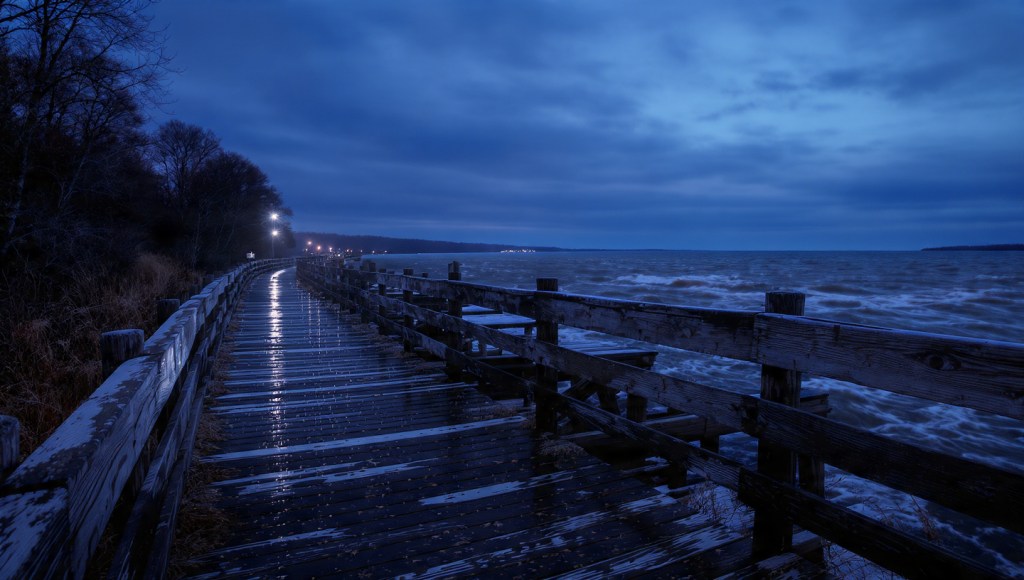
Father Walsh and I completed our circuit at dawn, the December cold making a persuasive argument for mortality whilst the tide held its breath between states. Seven years of these walks – theology and weather reports trading places in comfortable silence, the boardwalk delivering us back to our respective days with the reliable rhythm of public transport my father would have admired.
But Tim was right back in October when he named what we’d both been doing: using movement as elegant avoidance, exercise as the hour when we don’t have to be anyone in particular. I’ve walked this harbour with missionary zeal for thirty years, telling myself it was about cardiovascular health and mental clarity, when mostly it was about having somewhere I must be before the day’s actual demands arrived.
What’s shifted – and this is what I’m only now learning to admit – is that I’ve started walking differently. More slowly. Available to interruption. Stopping when Elena opens her shop to ask whether the fennel’s for risotto or something more adventurous. Pausing when Tom adjusts his route to accommodate the hip that’s been troubling him, offering company that doesn’t require him to pretend he’s managing better than he is.
The harbour walks remain favourite not because they keep me in therapeutic motion, but because I’m finally learning to let them be something I do with people rather than something I do instead of people.
The Satisfaction of Bending for Others
Kevin’s river clean-ups on the third Saturday – those humble choreographies of bodies working together toward modest shared goals. Bending, reaching, the small satisfactions of making something incrementally cleaner whilst Priya somehow makes litter collection look architectural and David arrives mid-morning with that quiet competence he brings to everything, settling into work without requiring acknowledgment.
This is exercise without performance, movement in service of something beyond the self. Different muscles, different satisfactions. The pleasure of physical labour that doesn’t need to justify itself with metrics or outcomes, that simply makes the shoreline slightly kinder for the next person who walks it.
I’ve discovered, at fifty-eight, that for a woman who lives so much in her head, these small movements have been an almost shocking relief. The body earning its way into usefulness without the protective frame of expertise, without needing to be witnessed or applauded, just – present, capable, enough.
Museum Stairs and the Weight of History
Thursdays now belong to Maggie and the stillness rooms, carrying boxes of laminated cards up the back stairs to storage, the quality of exertion that makes you feel you’re collaborating with the building rather than simply occupying it. My shoulders know these stairs intimately now – the rhythm of ascent, the careful descent with armfuls of sanctuary signage, the way the body learns architecture through repetition until moving through space becomes a form of belonging.
Claire mentioned last week that she’d watched someone use the bench by the Civil War exhibit, sitting with the daguerreotype of the unnamed woman who crossed the Delaware in 1863. Twenty minutes of stillness we’d designed into the space, permission granted through careful placement of furniture and light. That felt like exercise of a different sort – not my body moving, but my attention, my three decades of knowing how to hold space, translated into public furniture where anyone could rest without appointment or invoice.
There’s probably a limit to how much cardiovascular benefit one can derive from typing. But climbing museum stairs whilst carrying the physical weight of other people’s permission to pause – that’s changed something in my posture, in the way I inhabit my own capacity for care.
The Clumsy Choreography of Humility
Tuesday evenings, seven o’clock, Harbour Street Community Centre. Wrong brushes, appropriate humility, skies that list sideways and horizons that would make any competent sailor weep. The watercolour class has been teaching my shoulders and wrists an entirely new vocabulary – the small muscles that steady a loaded brush, the rotation required to suggest distance, the physical grammar of allowing marks to be what they are rather than what I’d planned.
At fifty-eight I’ve become a dedicated public novice, and the exercise isn’t really about the painting. It’s about tolerating the wobble. About being genuinely terrible at something in company, in fluorescent light, with witnesses who are kind enough not to mention that my boats look confused about buoyancy whilst my trees remain faintly apologetic about existing.
This fumbling has its own athletic demands – the discipline of not retreating to safer ground, the stamina required to keep showing up to something I haven’t mastered, the courage to let incompetence be visible because the alternative is never attempting anything beyond my existing repertoire.
Fingers Learning What They’ve Forgotten
Occasional evenings at the church piano with David, both of us relearning how fingers remember. Bach partitas that resist my fumbling, his careful hands moving through passages with the same unhurried attention he brings to washing dishes, to walking shorelines, to every gesture that suggests presence might matter more than perfection.
This isn’t exercise in any conventional sense. But there’s physical courage required – sitting beside someone whilst your fingers betray how long it’s been since you’ve risked making music, allowing him to hear you attempt and fail and attempt again, trusting that intimacy might be built through shared incompetence rather than mutual admiration of credentials.
The body keeps better accounts than the diary. My hands smell of lemon and Prussian blue some evenings, of museum dust on Thursdays, of the chemical trace left by thermal receipt paper from Riverfront Books. These are the physical signatures of a life that’s been expanding whilst I’ve been narrating its expansion – and here’s what I’m learning: there comes a point when the narration itself becomes another sophisticated form of staying adjacent.
From Witness to Participant
This autumn’s arc has been about moving from “extraordinary at adjacency” – that phrase I used months ago, naming my genius for remaining carefully elsewhere – to being very slightly more present in my own life. The experiments have been modest: signing up for watercolours, volunteering for Maggie’s oral history project, inviting David to Bartók, booking Québec with my own name on the ticket instead of filing it under pleasant hypotheticals.
But here’s what I’m noticing: daily blogging, for all its gifts, has also kept me sitting still a great deal. Watching myself think rather than simply going for the walk. Converting every lived moment into narrative before I’ve fully inhabited it. Treating presence like something that only counts once it’s been processed into prose and posted for the seven people who’ve been patient enough to follow along.
The blog has become what I wrote about on Monday – another form of doing too much, round-the-clock clinical supervision of my own life, narrating instead of inhabiting. And whilst the experiment has been valuable, whilst it’s taught me that seven readers is enough and that being seen costs something but being perpetually hidden costs more, I’m beginning to suspect that this season is complete.
The Graceful Pause
This will be my last daily entry, at least for this chapter.
Not because the metrics never justified the effort – though my faithful band of seven would barely fill a consulting room, never mind a lecture hall. And not because I’ve failed at some implicit promise to maintain perpetual visibility. But because the experiment has done what it needed to do.
It got me into the watercolour class. To Thanksgiving with David, shepherds pie and the washing-up performed like liturgy. Into the museum corridors on Thursday afternoons, designing sanctuary with Maggie whilst learning that care doesn’t have to happen behind closed consulting doors. Onto a booked train to Québec with my name on the ticket, a weekend I’ve rescheduled twice and finally held firm on, ready to walk steep streets in a city where I’ll be anonymous and perhaps, finally, simply present.
The daily writing has been scaffolding. But scaffolding, however useful during construction, eventually needs dismantling so the actual building can be inhabited.
I’m taking the blog with me in a different form – a private notebook for the Québec weekend, ink and cold fingers and the St Lawrence doing its own patient work whilst I practice the same ordinary courage I’ve been writing toward all autumn. No posts. No dashboard refreshing. Just walking, noticing, allowing the weekend to teach me what it wants to teach without the pressure of eventual narrative coherence.
Leaving the Door on the Latch
This isn’t goodbye forever – that would be melodramatic, and I’m suspicious of melodrama. Call it the end of season one, with the understanding that if I return, it will likely be less often and more slowly, perhaps not daily at all.
When I do write again – and I suspect I will, because some habits die hard and this one has served me well – it will be with the confidence that comes from knowing I can walk Québec’s steep streets without needing to document every step. That I can sit with David over pre-concert dinner, both of us fumbling through the awkward choreography of being in the same room without credentials to hide behind, and simply be there rather than collecting material.
I’m grateful to Vox Meditantis, the blog that’s been home for these entries since early October, offering space for a harbour psychiatrist to practice visibility without requiring her to be anything more spectacular than honestly present. To the seven of you who’ve read along – Jenny with your library cataloguing precision and refusal to let me hide behind theory, David with your careful attention to what I’m almost saying, Father Walsh checking in from your Wilmington deliberations, Maggie mining these pages for the oral history archive, and the others who’ve followed silently, generously, without requiring acknowledgment.
If you’re ever in New Corinth, you’ll know where to find me. Dawn harbour-walks when the weather holds. Marcus’s café mid-morning, the table by the window. Thursday afternoons at the Historical Society, adjusting sanctuary benches. Tuesday evenings at the community centre, attempting watercolours with persistent incompetence. The Victorian office on Harbour Street where the blue chair catches the light and the shell bowl waits for anxious hands.
And to someone in particular – someone I don’t know how to name yet, someone who might be walking different streets in a different city, carrying questions I can only imagine – if you’re reading this, if you’ve somehow found these entries through whatever strange mathematics governs these things, know that a door remains open. Not demanding anything. Not requiring resolution or reunion or any of the tidy endings stories prefer. Just – open, should you ever want it to be.
One More Harbour Circuit
The train leaves tomorrow morning, early enough that the harbour will still be deciding whether to commit to daylight. Tonight I’ll close this laptop, check my ticket one final time, and go out for one more circuit before the trip.
The body moving. The tide doing its precise, twice-daily work. And the words, for once, content to follow later rather than leading.
There’s pleasure in this – the anticipation of walking without the parallel narration, of letting the weekend arrive at its own pace, of risking presence without the safety net of eventual documentation. Of trusting that what happens in Québec will matter whether or not I convert it into careful prose for seven patient readers.
The harbour keeps its counsel. I’m learning to do the same – a little less publicly, a little less urgently, with growing faith that Catherine Bennett at fifty-eight is interesting enough without constant curation.
The suitcase waits. The sketchbook lies ready, empty pages that might stay empty or might fill with clumsy attempts at architecture I don’t yet have words for. The pencil tin – Elena’s paper bag scent still clinging – holds implements for a different kind of attention, one that doesn’t require an audience to justify its existence.
Tomorrow: Québec, the St Lawrence, steep streets and the freedom of being unknown. The weekend as experiment, as exposure exercise, as evidence that the bravest physical activity might simply be showing up to your own life without narration, without credentials, without the protective momentum of perpetually being en route to somewhere else.
For tonight: enough.
The words can rest. The body can lead. And I can practice, just for a few days, what it feels like to move through the world as Catherine rather than Dr Bennett – fumbling, uncertain, mid-process rather than finished, and somehow, finally, almost exactly where I need to be.
With gratitude to the seven who’ve walked these entries with me. See you on the other side of silence.
Catherine
Bob Lynn | © 2025 Vox Meditantis. All rights reserved.

 Vox Meditantis
Leave a comment