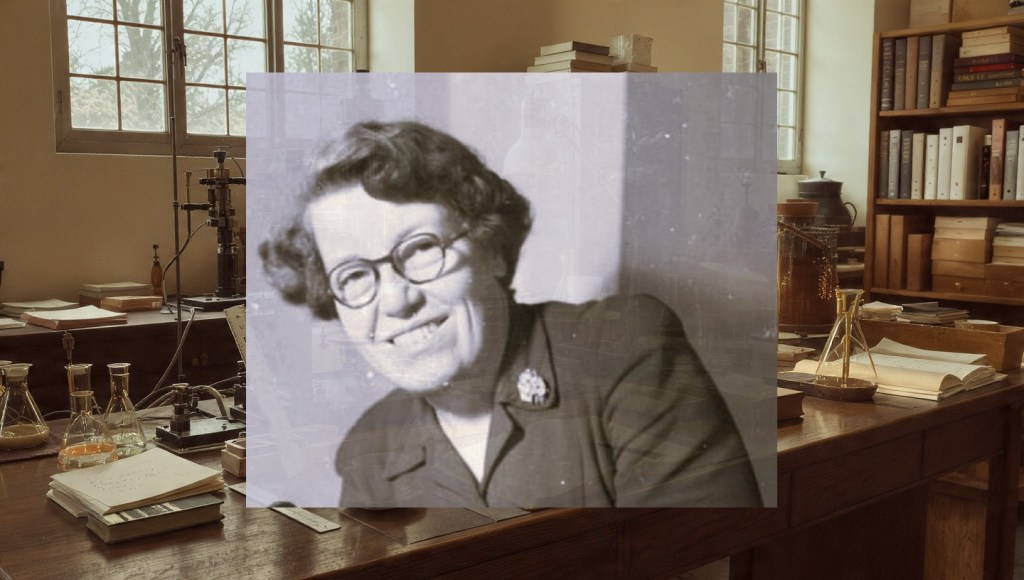
This is a dramatised reconstruction of an interview with crystallographer Helen Megaw, based on historical research rather than a real recorded conversation. All biographical and scientific details are drawn from documented sources, while the dialogue imagines how she might have reflected on her life, work, and legacy.
Helen Dick Megaw (1907-2002) was an Irish crystallographer whose work on perovskite crystal structures now underpins modern solar cells, yet her name remains largely unknown in renewable energy circles. She pioneered methods for determining hydrogen positions in crystals, created the influential Bernal-Megaw model, and served as the bridge between atomic science and public design through her work with the 1951 Festival of Britain. In 1989, at age 82, she became the first woman to receive the prestigious Roebling Medal from the Mineralogical Society of America – recognition that came decades after her foundational contributions.
Welcome, Dr Megaw. It’s December 2025, and I’m speaking with you from a world where perovskite solar cells are revolutionising renewable energy. Yet most people working in that field have never heard your name. How does that feel?
Rather predictable, I should think. When you work in industry, as I did at Philips Lamps, your contributions don’t receive the same archival treatment as university publications. Industrial research vanishes into proprietary reports and patent applications – useful to the company, invisible to posterity. I spent five years determining the structure of barium titanate, establishing it as the definitive perovskite structure. That work is cited in every textbook, but my name got dropped somewhere along the way. The structure survived; I did not.
Let’s start at the beginning. You were born in Dublin in 1907, into a family that valued education. What drew you to crystallography?
Bragg’s X-rays and Crystal Structure. I read it whilst still at Roedean, and it was a revelation. Here was a method for seeing the invisible – the actual arrangement of atoms in three dimensions. Most people think of crystals as pretty geological specimens, but to a crystallographer, they’re architectural blueprints written in matter. Each crystal is a repeating lattice, a code that X-rays can decipher if you know how to read the diffraction patterns.
I spent a year at Queen’s University Belfast, then moved to Girton College, Cambridge in 1926. Girton was one of only two women’s colleges at the time, and we weren’t granted degrees – only certificates. You could sit the same examinations as men, score better than them, and still leave with a piece of paper that didn’t say “Bachelor of Arts.” It was infuriating, but it was also the only route available.
You studied under J.D. Bernal, who became quite famous. What was it like working with him?
Bernal had a mind like a searchlight – brilliant, restless, illuminating everything in its path but never lingering long enough to finish the work. He’d set you on a problem, vanish for weeks, then return with seventeen new ideas, half of which contradicted the original premise. It kept you on your toes.
My PhD work focused on ice – specifically, measuring the unit cell dimensions with precision. Ice seems simple, but it’s structurally fascinating. Each water molecule forms four hydrogen bonds in a tetrahedral arrangement, creating hexagonal channels. The challenge was determining where the hydrogen atoms sat along those bonds. X-rays scatter off electron clouds, and hydrogen has only one electron, so it’s nearly invisible in X-ray diffraction. You have to infer its position from the spacing of oxygen atoms and the geometry of the bonds.
That led to the Bernal-Megaw model in 1935, didn’t it?
Yes. We developed a method for locating hydrogen atoms in metal hydroxides – specifically, trioctahedral layer hydroxides. The principle was to use the known positions of heavier atoms, like oxygen and metal cations, to constrain where the hydrogens must be to satisfy bond angles and distances. It required meticulous measurements and a fair bit of geometry. The method became standard for hydrogen positioning, though these days it’s often cited as “Bernal’s method.” One name was apparently sufficient.
That’s a recurring theme in your career – credit erosion. How do you account for it?
Senior men absorb credit. It’s not malicious, usually. It’s just that when people cite a paper, they remember the famous name, the one they’ve heard before. Bernal was already well-known. I was a twenty-eight-year-old woman fresh out of a PhD programme. Who do you think the textbooks remembered?
There’s also the matter of career continuity. After my doctorate, I spent a year in Vienna with Hermann Mark, then a year at Oxford with Francis Simon. Then the money ran out. I spent seven years teaching at Bedford High School and Bradford Girls’ Grammar School. Teaching is honourable work, but in academia, gaps in your publication record look like intellectual death. When I returned to research in 1943, I had to rebuild my reputation from scratch.
Why did you go into industry rather than return to academia immediately?
Philips Lamps in Mitcham offered me a position. It was wartime, and industrial labs needed crystallographers to work on materials for the war effort. I was assigned to barium titanate – a ferroelectric ceramic that could store electrical charge and reverse its polarisation under an applied field. It was being investigated for capacitors, and Philips wanted to understand its structure.
Barium titanate crystallises in the perovskite structure: a cubic unit cell with barium cations at the corners, a titanium cation at the centre, and oxygen anions at the face centres. The titanium sits in an octahedral cage of oxygen atoms. Under certain conditions, the titanium displaces off-centre, creating an electric dipole moment. That’s the origin of ferroelectricity.
The challenge was determining precisely how the structure distorted at different temperatures. We used X-ray diffraction to measure the unit cell parameters as we cooled and heated the crystal. At room temperature, barium titanate is tetragonal – slightly elongated along one axis. Above 120 degrees Celsius, it transitions to cubic. Below room temperature, it goes through orthorhombic and rhombohedral phases. Each transition changes the ferroelectric properties.
Can you walk us through the technical process of determining that structure? What were the actual steps?
Certainly. First, you grow a single crystal of barium titanate, which is harder than it sounds. Polycrystalline samples give overlapping diffraction spots, so you need a single, well-ordered crystal several millimetres across. We used a flux method – melting barium carbonate and titanium dioxide together at high temperature, then cooling slowly to allow crystals to precipitate.
Once you have the crystal, you mount it on a goniometer – a device that allows you to rotate the crystal precisely in the X-ray beam. You expose it to monochromatic X-rays, typically copper K-alpha radiation with a wavelength of about 1.54 Ångströms, and record the diffraction pattern on photographic film.
Each spot on the film corresponds to a set of lattice planes scattering X-rays constructively. Bragg’s law tells you that the spacing d between planes is related to the scattering angle θ by nλ = 2d sin θ, where λ is the wavelength and n is an integer. By measuring the angles and intensities of all the spots, you can deduce the unit cell dimensions and the positions of the atoms within the cell.
The intensities are the tricky part. They depend on the scattering factors of the atoms and their positions. You build a model of the structure, calculate what diffraction pattern it should produce, and compare that to the observed pattern. Then you adjust the model iteratively until the calculated and observed patterns match. We didn’t have computers, so this was done by hand, using tables of scattering factors and slide rules for the arithmetic.
What were the error margins? How precise were your measurements?
We could measure unit cell dimensions to within a few thousandths of an Ångström – say, 0.002 Å – assuming the crystal was of good quality and the diffractometer was properly calibrated. Atomic positions were less precise, perhaps ±0.01 Å, because they depend on intensities, which are affected by thermal motion, absorption, and other systematic errors.
For barium titanate, the key measurement was the tetragonality – the ratio of the c-axis to the a-axis. At room temperature, we found c/a ≈ 1.010, meaning the unit cell was about one percent longer in one direction. That small distortion is what gives rise to the ferroelectric behaviour.
How did your work at Philips compare to academic research?
Industry moves faster. You have deadlines, deliverables, and a responsibility to the company’s bottom line. There’s less freedom to follow interesting tangents, but also less tolerance for sloppy work. At Philips, we published internally, in technical reports that never saw the light of day outside the company. I did publish some results in academic journals, but much of the work remained proprietary.
The advantage was access to equipment and materials. Philips had excellent X-ray tubes, high-temperature furnaces, and skilled technicians. The disadvantage was that industrial work didn’t “count” the same way academic work did. When I returned to academia in 1945, first to Birkbeck with Bernal again, then to the Cavendish Laboratory in 1946, I had to re-establish my credentials.
At the Cavendish, you were there during the double-helix days. What was that like?
Thrilling and frustrating in equal measure. Lawrence Bragg was the director, and the lab was brimming with talent – Watson, Crick, Perutz, Kendrew. Everyone was chasing the structure of biologically important molecules. I was working on feldspars and other inorganic minerals, which seemed rather pedestrian by comparison, though they make up most of the Earth’s crust.
I remember Dorothy Hodgkin visiting – she was at Oxford, working on penicillin and insulin. In 1937, I’d embroidered a cushion for her as a wedding gift, based on the crystal structure of aluminium hydroxide. She loved it. Years later, she gave me a drawing of insulin for the Festival Pattern Group. She refused to take a fee, saying she couldn’t charge for a pattern created by nature.
Let’s talk about the Festival of Britain. How did you become involved?
In 1946, I wrote to Marcus Brumwell at the Design Research Unit, suggesting that crystallographic patterns might inspire textile and wallpaper designers. I’d been struck by the beauty of the diffraction patterns and structure diagrams that cropped up in my work – they had a clarity and regularity that I thought could translate into decorative arts.
By 1949, I was appointed scientific consultant to the Festival Pattern Group. The idea was to commission designs based on X-ray crystallography and use them in products for the Festival of Britain in 1951 – a national exhibition meant to showcase British innovation after the war.
I recruited crystallographers to provide structure diagrams: Bragg, Hodgkin, Perutz, Kendrew. We selected molecules ranging from simple minerals like afwillite and apophyllite to complex biological molecules like insulin and haemoglobin. The designers then translated those diagrams into repeating patterns for fabrics, wallpapers, glass, ceramics, and plastics.
What was the technical challenge in translating scientific diagrams into commercial designs?
Accuracy versus aesthetics. As a scientist, I insisted that the patterns reflect the actual structure – if you’re going to call it “insulin wallpaper,” it should show the real insulin structure, not some fanciful approximation. The designers, however, needed to adjust the scale, add colour, and sometimes simplify the structure to make it suitable for mass production.
There were heated debates. I wrote in my notes: “It is legitimate to show only those features of the map which one desires to emphasise for a given purpose; but it is not legitimate to change their positions or to put in things which are not there.” Some designers wanted to move atoms for compositional balance. I drew the line at that.
How were the designs received?
They were everywhere. The Science Museum’s cinema foyer was papered with insulin, the benches upholstered in myoglobin. The Regatta Restaurant on the South Bank had carpets patterned with resorcinol, curtains with afwillite, waitresses with hydrargillite lace collars. Ashtrays, teacups, window glass – all based on crystallographic structures.
The public response was enthusiastic. People liked the idea that their furnishings were based on “real science,” even if they didn’t understand the structures. The designers were thrilled to have a new source of patterns. The manufacturers saw it as modern, forward-looking.
But the scientific community was ambivalent. Some colleagues thought it was popularisation – trivialising serious research by turning it into decorative arts. Design was considered feminine, not technical. And because the Festival Pattern Group work was applied rather than theoretical, it didn’t “count” as research. It was another thing that made me seem less serious.
You mentioned earlier that you spent years as a schoolteacher. How did that affect your career trajectory?
It created a gap. When you’re applying for academic positions, people look at your publication record. Seven years teaching girls’ grammar school doesn’t produce papers. It produces well-educated students, but that’s invisible to hiring committees.
The irony is that teaching was survival, not choice. Research positions for women were scarce. Girton and Newnham – the two women’s colleges – employed a handful of women as lecturers and directors of studies, but those posts were rare and poorly paid. Most women with science degrees taught in schools, married and left the profession, or gave up science altogether.
I was lucky to return to research at all. Philips took a chance on me in 1943, and that led to the Birkbeck and Cavendish positions. But the gap remains on my CV, and it shaped how people perceived me – less committed, less rigorous, less serious.
You also worked extensively on feldspars. Why feldspars?
W.H. Taylor suggested it. Feldspars are the most abundant minerals on Earth – they make up about sixty percent of the Earth’s crust and a significant portion of the Moon’s surface. Yet their crystal structures are fiendishly complicated. They’re framework silicates, with aluminium and silicon cations in tetrahedral coordination with oxygen, and larger cations like potassium, sodium, or calcium filling the voids.
The challenge is that feldspars exhibit complex ordering and twinning. The aluminium and silicon cations can occupy different tetrahedral sites, and their distribution depends on temperature and cooling rate. There are dozens of feldspar varieties, and sorting out their structures required painstaking diffraction studies.
It was unglamorous work, but essential. Geologists needed to know feldspar structures to interpret rock formation and metamorphism. Lunar scientists needed them to understand the Moon’s geology. I spent years on it, and it was some of the most rigorous crystallography I ever did.
Let’s talk about ferroelectrics. You wrote the definitive textbook, Ferroelectricity in Crystals, in 1957. What was the core insight?
That the physical properties of a solid are closely related to its structure, and the first step to understanding the physical properties is to understand the structure. Ferroelectrics are materials that possess a spontaneous electric polarisation that can be reversed by an external electric field. The classic example is barium titanate.
The key structural feature is a non-centrosymmetric arrangement of ions – meaning the crystal doesn’t have a centre of symmetry. In barium titanate, the titanium cation displaces slightly off the centre of its oxygen octahedron, creating a dipole moment. When you apply an electric field, you can flip the direction of displacement, reversing the polarisation.
The book was an attempt to link crystallographic structures to ferroelectric behaviour – showing how symmetry, ionic radii, and bonding geometry determine whether a material will be ferroelectric, and what its properties will be. It became a standard reference, though by the 1970s, the field had moved on to more exotic materials.
You received the Roebling Medal in 1989, at age 82. That’s an extraordinarily late recognition. How do you feel about that?
Grateful, but it would have been more useful forty years earlier. The Roebling Medal is the highest honour the Mineralogical Society of America can bestow, and I was the first woman to receive it. That’s significant, but it’s also an indictment. The medal was first awarded in 1937. It took fifty-two years for a woman to be considered worthy.
By 1989, I’d been retired for seventeen years. The medal didn’t change my career trajectory, didn’t open doors, didn’t secure funding. It was a lovely gesture, but recognition that comes after you’ve left the field is mostly symbolic.
What mistakes or misjudgements do you acknowledge now, looking back?
I should have been more aggressive about claiming credit. Women of my generation were taught to be modest, to let the work speak for itself. But work doesn’t speak – people do. If you don’t assert your contribution, someone else’s name gets attached to it.
I also regret not pushing harder for women’s inclusion in scientific societies. I was elected a Fellow of Girton and served as Director of Studies, but I didn’t campaign for broader institutional change. I focused on my research and assumed merit would be recognised. That was naïve.
And I should have documented the Festival Pattern Group work more thoroughly. We created eighty designs, collaborated with twenty-eight manufacturers, and brought crystallography into British homes. But because it was design, not science, I didn’t treat it as seriously as my mineralogical work. Now it’s recognised as a pioneering example of science-art collaboration – STEAM before STEAM had a name – but much of the archive is fragmentary.
The mineral megawite is named after you – calcium tin oxide, CaSnO₃, with the perovskite structure. How does that feel?
Profoundly satisfying. It’s a small mineral, found in altered xenoliths in the Northern Caucasus, but it carries my name into the geological record. Long after the papers are forgotten and the medals tarnish, megawite will exist in the Earth’s crust. That’s a form of immortality.
You also have an Antarctic island named after you – Megaw Island, in the Southern Ocean. What’s the story there?
The ice work. My precise measurements of ice cell dimensions were used by glaciologists and climatologists studying polar ice. The island is one of the Bennett Islands in Hanusse Bay, at 66°55′S, 67°36′W. I’ve never seen it, but I’m told it’s rather bleak and windswept. Fitting, perhaps, for someone who spent years staring at ice crystals under X-rays.
What would you say to women in STEM today, particularly those in industrial research or applied fields?
Document everything. Industrial research disappears unless you archive it deliberately. Publish in peer-reviewed journals, even if it’s inconvenient. Claim your credit explicitly – don’t assume co-authors will do it for you.
And don’t let anyone tell you that applied work is less valuable than theoretical work. The perovskite structure I determined at Philips now powers solar cells. The Festival Pattern Group brought molecular science into people’s daily lives. Applied work has impact, but you have to fight for it to be recognised.
Also, find allies. Dorothy Hodgkin, Kathleen Lonsdale, and I formed an informal network of women crystallographers. We supported each other, shared resources, and vouched for one another. That network sustained me through difficult periods.
One last question: if you could go back and change one thing, what would it be?
I’d insist on equal credit. Every time. The Bernal-Megaw model would remain the Bernal-Megaw model, not “Bernal’s method.” Every paper, every patent, every report – I’d make sure my name stayed on it, in full, without abbreviation or omission.
Because once you let your name slip, it’s nearly impossible to get it back. And a career built on uncredited contributions is invisible, no matter how foundational the work.
Thank you, Dr Megaw. Your contributions are visible now, even if they weren’t in your own time.
Let’s hope so. Though I suspect in another fifty years, someone will have to write another article explaining who I was. That’s the nature of being erased – it has to be corrected repeatedly, generation after generation, until finally the name sticks.
Letters and emails
Since the publication of this interview, we’ve received hundreds of letters and emails from crystallographers, materials scientists, historians, designers, and curious readers keen to ask Helen Megaw more about her life, her work, and what wisdom she might offer to those following similar paths in STEM and beyond. Below, we’ve selected five thoughtfully crafted questions from correspondents across the globe – each one probing deeper into the technical choices she made, the philosophical tensions in her work, the unknowns that shaped her research, and the alternate histories that might have unfolded had her career taken a different turn. These questions invite her to reflect not only on what she accomplished, but on what she couldn’t see at the time, and what she might counsel to a new generation facing their own erasures and choices.
Catalina Mendez, 34, materials scientist, Bogotá, Colombia
When you were measuring barium titanate’s tetragonal distortion at Philips, you couldn’t see hydrogen bonding in real time the way modern spectroscopy allows us to now. But looking back, were there moments when you suspected your X-ray diffraction data was incomplete – where you knew something was happening in the structure that your methods couldn’t quite capture? And if so, how did you decide what to measure next?
You’ve asked something that gets to the heart of experimental crystallography, Catalina, and I’m grateful for it. Yes – absolutely yes – there were moments when I suspected the diffraction data was telling me only part of the story.
When we were measuring barium titanate at Philips, we obtained precise lattice parameters: the a, b, and c axes of the unit cell, and the angles between them. We could see the tetragonal distortion clearly – the elongation along one axis at room temperature, the transition to cubic symmetry above the Curie temperature. The intensities of the diffraction spots told us where the heavy atoms – barium and titanium – were sitting.
But hydrogen? Oxygen displacement? The subtle shifts in bonding geometry that might explain why the titanium was off-centre? X-ray diffraction is fundamentally blind to those details when atoms are light. We were measuring shadows, not the objects casting them.
I remember a particular set of measurements in 1944, cooling a crystal of barium titanate from 150 degrees Celsius down to minus 50 degrees. The unit cell changed in ways the temperature and symmetry alone couldn’t quite explain. There were tiny discontinuities in the lattice parameter – perhaps a tenth of an Ångström – that suggested a phase transition we hadn’t anticipated. But I couldn’t resolve what was happening at the atomic level. The diffraction pattern showed the overall structure was shifting, but the fine details remained opaque.
What we did was acknowledge the limitation and work within it. I measured what we could measure: lattice constants, atomic positions of the cations, the overall symmetry. I published those results honestly, without claiming to have solved the complete picture. And I designed the next experiment to constrain what we didn’t know. We looked at how the structure changed with temperature, how ferroelectric properties correlated with structural distortions, and what that told us about the mechanism.
That’s what X-ray crystallography was in the 1940s – a technique of intelligent incompleteness. You gathered the data you could obtain, you interpreted it with rigour, and you designed experiments to answer the questions your first measurements raised. It wasn’t satisfying in the way modern spectroscopy must be, where you can watch bond angles change in real time. But it trained you to think carefully about what you didn’t know and how to narrow the uncertainty.
The honest answer to your question is this: I suspected there was more structure in barium titanate than I could see. I suspected the oxygen atoms weren’t sitting precisely where the simple tetragonal model suggested – that there was displacement, distortion, perhaps even oxygen vacancy ordering. But I couldn’t prove it with X-rays, and I refused to speculate beyond what the data supported.
Decades later, when neutron diffraction became available, researchers could finally see the oxygen positions and hydrogen bonding in these materials. They found exactly what I’d suspected: complex oxygen displacements that drive the ferroelectric behaviour. It was gratifying to be vindicated, but also rather maddening – imagine knowing there’s a crucial piece of the puzzle and having to wait forty years for the tool to see it.
My advice, if you’re facing similar limitations in your own work: be precise about what your method can resolve. Don’t pretend to knowledge you haven’t earned. Design experiments that will answer the questions your current data raises. And document your uncertainties – not as failures, but as the frontier of what’s knowable with your current tools. That’s how science advances. Someone else will come along with better equipment and fill in the gaps you’ve identified.
Oscar Nilsson, 47, historian of science and technology, Stockholm, Sweden
You spent seven years teaching before returning to research, and you’ve mentioned that gap haunted your career. But I wonder: did those years teaching girls at Bradford Girls’ Grammar School change how you thought about communicating crystallography? Did you learn something about explaining complex structures to people without formal training that later informed your Festival work – or was teaching purely a financial necessity, disconnected from your scientific thinking?
That’s a perceptive question, Oscar, and one that’s worth sitting with honestly. The answer is both yes and no, which I suspect will frustrate you, but it’s the truest answer I can give.
Teaching at Bradford Girls’ Grammar School from 1936 to 1943 was, frankly, survival. My fellowship at Cambridge had ended, the Depression was on, and there were no research positions available for women. Teaching paid the bills and kept me intellectually occupied. I taught chemistry and physics to bright girls – some of them genuinely talented – and I took the work seriously. But I didn’t enter the schoolroom thinking, “This will reshape how I communicate science.” I entered it thinking, “I need employment and this is what’s available.”
That said, teaching did change me, though not in the way you might expect.
What I learned was the difference between knowing something and explaining something. In research, you can be precise to the point of obscurity. You can write a paper dense with technical language, full of caveats and qualifications, aimed at the dozen people in the world who work on your specific problem. That’s appropriate – that’s how knowledge gets preserved and built upon.
But when you’re standing in front of thirty girls aged sixteen, trying to teach them crystallography or X-ray diffraction, you can’t hide behind jargon. You have to find the core idea. You have to know why the lattice parameter matters, not just that it matters. You have to explain it in terms that connect to something they already understand.
I remember struggling to explain the concept of a unit cell to a class at Bradford. One girl asked me, “But miss, if the crystal is made of atoms, why do we need this imaginary box? Why not just count the atoms?” It was an excellent question, and my initial answer – something about symmetry operations and periodicity – clearly didn’t satisfy her.
So I changed my approach. I brought in a piece of wallpaper with a repeating pattern. I showed them how you only need to know one repeat of the pattern to understand the whole design. That’s a unit cell, I explained. It’s the smallest repeating unit that, when you stack it in three dimensions, recreates the entire crystal. Suddenly they understood.
That insight – that you need a way to reduce complexity to its essential repeating unit – stayed with me. Years later, when I was working on the Festival Pattern Group, it informed how I thought about translating crystallographic structures into designs. You can’t show an entire insulin molecule – it’s far too complicated. But you can show the repeating structural motif, the unit that contains the essential information. Just as I’d done with the wallpaper pattern.
So the teaching didn’t directly cause the Festival work, but it gave me a framework for thinking about how to communicate complex structures to non-specialists. It taught me that clarity isn’t a compromise with rigour; it’s a different kind of rigour. It’s the discipline of finding the simplest true statement about a complex thing.
There’s another aspect, though, that’s less comfortable to admit. Those seven years away from research made me hungry to return. I’d felt the pull of the bench, the frustration of explaining other people’s discoveries instead of making my own. By the time Philips offered me a position, I was desperate to do real work again. That desperation, that sense of having lost years, sharpened my focus.
When I came back to crystallography, I didn’t have time for leisurely exploration. I had to make every measurement count. I had to think carefully about what questions were worth answering, because I couldn’t afford to waste time on dead ends. That intensity – born partly from having been away – made me a better scientist, I think.
But I won’t romanticise it, Oscar. Teaching was necessary, not enriching. If I could have done continuous research from 1930 onwards, I would have. The girls at Bradford deserved a proper chemistry teacher, not a frustrated crystallographer marking time. And I deserved to be in the laboratory.
What I’d say to young women in STEM now is this: if you’re forced out of research – by circumstance, by discrimination, by the simple lack of opportunity – don’t pretend it’s a sabbatical or a learning experience. It’s a loss, and you should grieve it. But you can also reclaim something from it if you’re determined. The skills I developed as a teacher, the clarity I learned to value, those became useful later. But only because I fought my way back into the laboratory and brought those hard-won lessons with me.
The Festival work wouldn’t have been possible without both sides of my experience – the rigorous crystallography and the ability to communicate it. But I paid a price for having to learn those lessons sequentially, when they should have been learned together, in parallel, from the start. That’s not a triumph of adversity. That’s just adversity, and the fact that I made something of it doesn’t erase the years I lost.
Yuki Tanaka, 29, ferroelectric device engineer, Tokyo, Japan
Your work on perovskites in the 1940s established the tetragonal-cubic phase transition, but ferroelectric switching in these materials involves complex domain dynamics that you couldn’t observe directly. If you’d had access to atomic force microscopy or in-situ neutron diffraction during your Philips years, do you think you would have approached the problem differently – or would you have found the static structure work just as valuable?
Yuki, this question haunts me, if I’m honest. You’re asking about the road not taken, and I’ve spent enough years in retirement thinking about those roads to know the answer intimately.
If I’d had atomic force microscopy – if such a thing had existed – or neutron diffraction to map hydrogen positions in real time, or in-situ techniques to watch domain switching as the electric field was applied? Yes, I would have approached the problem entirely differently. But I’m not sure I would have approached it better.
Let me explain the constraint I was working within. In 1943, when I arrived at Philips, X-ray diffraction was the most powerful tool available for determining crystal structure. Neutron diffraction existed in principle – Chadwick had discovered the neutron in 1932 – but it required a nuclear reactor, and the first civilian reactor wasn’t operational until after the war. Even then, neutron sources were scarce and temperamental. For industrial work on a tight timeline, X-rays were the only practical option.
What that meant was I could measure the average structure – the positions of the heavy atoms, the overall symmetry, the lattice parameters. What I couldn’t see was the dynamics. I couldn’t watch domains switch. I couldn’t measure local disorder or oxygen vacancies. I couldn’t track how the structure evolved microscopically during a phase transition.
So what did I do? I designed experiments that would give me indirect information about those hidden processes. I measured how the lattice parameters changed with temperature – very carefully, over small intervals. That told me something about how the structure was distorting. I measured the ferroelectric hysteresis – how the polarisation lagged behind the applied field – and correlated it with structural changes. I looked at how the dielectric constant varied with temperature and related that to symmetry.
It was like solving a puzzle where you can only see the edges and have to infer the picture from their shapes. It required imagination, but rigorous imagination – every inference had to be supported by multiple pieces of evidence.
Now, if I’d had in-situ techniques – if I could have watched the domain structure evolve, measured oxygen displacement in real time, observed the hydrogen bonding as it happened – would I have discovered something faster? Almost certainly. Would I have avoided some false starts? Probably. But would I have understood the underlying principles as deeply?
I’m not certain. There’s a danger with modern high-resolution techniques that you can see so much detail that you lose sight of the fundamental physics. You can measure everything and understand nothing. The constraint of my era forced me to think about what mattered – which structural parameters drove the ferroelectric behaviour, which phase transitions were thermodynamically significant, which observations were reproducible and which were artifacts.
Here’s what I think would have happened if I’d had access to your modern tools. I would have measured the domain structure with great precision. I would have seen the oxygen displacements I could only infer. I would have obtained beautiful, detailed images of the mechanism. But I might have been tempted to describe those details without understanding them – to catalogue observations rather than build a coherent theory.
What actually happened was I was forced to think about barium titanate, to develop a conceptual framework that connected lattice distortion to ferroelectric behaviour. That framework turned out to be robust. Decades later, when better techniques finally showed the oxygen positions and domain dynamics, those observations fit into the picture I’d already constructed. The details filled in around a skeleton I’d already built.
So my answer is: I wouldn’t want to trade places with you, Yuki. Your tools are more powerful, but that power comes with a kind of blindness – the risk of seeing so much you can’t think. My tools were limited, but that limitation forced intellectual rigour.
That said, there’s one thing I desperately wish I’d had: a computer. Not for fancy imaging, just for calculation. I spent months doing arithmetic by hand, using slide rules and tables. If I’d had even a modest computer – nothing like what you have now, just something to handle matrix algebra and least-squares refinement – I could have tested ten times as many structural models, refined atomic positions more accurately, explored the parameter space more thoroughly.
The bottleneck in my work wasn’t the experimental technique; it was the calculation. I could gather data faster than I could analyse it. A computer would have changed that balance fundamentally.
But as for the fundamental approach – whether to focus on average structure or dynamic observation – I’m oddly content with the choice circumstances forced upon me. Constraints can be creatively productive. They force you to ask better questions because you can’t afford to ask lazy ones.
My advice, if you’re working on ferroelectrics now with all your magnificent tools: don’t assume that more data equals deeper understanding. Measure what matters. Build a theory that can survive contradictory evidence. And occasionally, put the instruments aside and think about the physics first. Sometimes the limitation is where the insight lives.
Ben Mitchell, 38, renewable energy researcher, Melbourne, Australia
Suppose in 1945, instead of returning to academia at Birkbeck and the Cavendish, you’d stayed in industry – perhaps at Philips, or moved to another materials company working on semiconductors or ceramics. Industrial research in the postwar decades was moving toward applied device development. Would you have preferred that trajectory, knowing what you know now about how industrial contributions get erased from history? Or was the move back to academia, despite its gender barriers, the only way to ensure your work would be documented?
Ben, you’re asking me to imagine a parallel life, and that’s rather like asking someone to untangle the threads of fate. But I’ll try, because it’s a question I’ve asked myself more than once, particularly in retirement when there’s nothing but time for counterfactuals.
The short answer is: no, I wouldn’t have preferred to stay in industry, though I understand why you might think otherwise. But the longer answer reveals something rather uncomfortable about how choices were constrained for women in my era.
Let me be clear about what industry offered. At Philips, I had access to excellent equipment, talented technicians, and materials that academic labs couldn’t obtain. The work was rigorous and consequential. The five years I spent there – 1943 to 1948 – were among the most productive of my career. I determined the perovskite structure, mapped out the ferroelectric phase transitions, and established myself as an authority on barium titanate. That work was real, and it mattered.
But it was also invisible. The papers I published went into Philips’ technical reports. Patent applications were filed under the company’s name. The structure I’d determined became “the perovskite structure” in textbooks, but when people cited it, they cited the published literature, not the person who’d done the work. Philips didn’t advertise its researchers. There was no press release announcing Helen Megaw’s breakthrough. There was only the incremental improvement in the company’s ceramics and capacitors.
In 1945, Bernal wrote to me asking if I’d return to Birkbeck. By then, I was already restless. The work at Philips was excellent, but it was disappearing into a corporate filing cabinet. I wanted my contributions documented, cited, remembered. That’s not vanity, Ben – or perhaps it is, but it’s the vanity that drives science. We want to know that what we’ve done will outlast us, will be built upon, will matter to people we’ll never meet.
When I moved to Birkbeck, then to the Cavendish, I made a deliberate choice: academic credit over industrial impact. I chose a path where my name would appear on papers, where my work would be indexed in journals, where other researchers would cite me and extend my ideas. The pay was worse. The resources were more limited. But the visibility was incomparably better.
Now, your hypothetical asks: what if I’d stayed in industry, knowing what I know now about how industrial contributions get erased? Would I have preferred that trajectory?
The honest answer is this: if I’d had institutional support – if Philips had valued my work publicly, if they’d encouraged me to publish under my own name, if they’d promoted me to a senior research position with authority and visibility – then perhaps staying would have been viable. Some industrial labs do this. Bell Labs, for instance, allowed researchers considerable freedom to publish and build reputations.
But Philips in the 1940s wasn’t structured that way. Industrial crystallography was seen as a service to the engineers and product developers. You answered questions, provided data, and moved on to the next problem. You didn’t build a research programme. You didn’t train students. You didn’t establish yourself as a thought leader in the field.
If I’d stayed, I would have become increasingly invisible. My contributions would have been absorbed into the company’s collective output. I might have risen to a supervisory role, managing other crystallographers. But I wouldn’t have had the independent authority that came from being an academic researcher with published work and institutional affiliation.
The cruel irony is that even in academia, women’s contributions were erased – as my own experience with the Bernal-Megaw model demonstrates. But at least in academia, there were mechanisms for documentation. There were journals, conferences, professional societies. There was a possibility of being remembered, even if that possibility was compromised by gender bias.
In industry, that possibility barely existed.
So no, I wouldn’t have chosen to stay. But I want to be honest about what that choice cost. I left behind excellent colleagues, stimulating problems, and real-world impact. The ferroelectric ceramics I helped develop at Philips went into practical applications – capacitors, sensors, actuators. That’s a form of impact that academic papers can’t match.
But I couldn’t have both. I couldn’t have stayed in industry and maintained visibility as a scientist. The institutional structures didn’t permit it. A woman in an industrial lab in the 1940s was a lab assistant, not a researcher – regardless of her capabilities or accomplishments.
What I would say to you, working in renewable energy now: the calculus may have changed. Modern companies – at least the better ones – understand that research visibility enhances reputation. They encourage publication. They allow researchers to present at conferences. They understand that industrial innovation requires people who are engaged with the broader scientific community.
If you’re a woman in an industrial setting, investigate carefully whether the company will allow you genuine visibility. Will your name appear on publications? Will you be invited to present your work? Will you have time and resources for research that extends beyond immediate commercial applications? If the answer to those questions is yes, industry can be a perfectly respectable career path. You’ll have impact, resources, and the satisfaction of solving real problems.
But if the answer is no – if you’re expected to work quietly, produce results, and let others take credit – then get out. Don’t spend seven years, as I did, assuming that excellent work will be valued eventually. It won’t be. Not in an environment structured to erase you.
The hardest part of my decision to leave Philips wasn’t the departure itself. It was accepting that the work I’d done there would become orphaned, attributed to the company rather than to me. I’ve had to make peace with that. But I wouldn’t wish that choice on anyone else. You deserve better.
Leila Zidan, 41, art historian and design archivist, Cairo, Egypt
The Festival Pattern Group translated your crystallographic diagrams into consumer goods, yet the scientific rigour you insisted on – the absolute fidelity to actual atomic positions – seems almost at odds with the decorative impulse. How did you reconcile the idea that a teacup pattern based on insulin structure was scientifically honest when most people using it would never know or care about that accuracy? Was the honesty for you, or for the integrity of the science itself?
Leila, you’ve asked the question that was always at the back of my mind the Festival Pattern Group years, and I’m grateful you’ve put it so directly. The tension you’ve identified is real, and it goes to the heart of what the Festival work was.
Let me start with the honest truth: I was a snob about it. I was a crystallographer first and foremost, and I viewed the design application with a mixture of enthusiasm and condescension. Enthusiasm because it was a chance to show the public that crystals were beautiful, that atomic structures had an inherent elegance. Condescension because – and I’m ashamed to admit this – I didn’t fully believe that design was serious work.
When Marcus Brummell first approached me about translating crystallographic patterns into textiles and wallpapers, my initial reaction was sceptical. Design seemed lightweight compared to the rigorous work of determining atomic positions. It felt like popularisation, and popularisation had always struck me as a compromise with truth, a simplification that inevitably distorted the science.
But then I met the designers – people like Jacqueline Groag and the design team at the Festival – and I began to understand something different. They weren’t asking me to simplify the structures. They were asking me to translate them. And those are not the same thing.
A simplification removes information. You take a complex structure and leave out the difficult bits to make it palatable. A translation preserves information but changes the medium. You take the relationships, the symmetries, the repeating patterns, and you express them in a different language – in this case, the language of textile design, colour, and spatial arrangement.
So when we created the insulin wallpaper, I insisted on absolute fidelity to the actual molecular structure. The repeating unit in the pattern had to correspond to a real repeating unit in the insulin crystal. The symmetries of the design had to match the symmetries of the molecule. If someone looked at that wallpaper under a magnifying glass and had the knowledge to understand it, they would be looking at true science, not a romantic approximation.
But here’s where it gets philosophically complicated, and I suspect this is what’s troubling you: most people didn’t have that knowledge. They saw the pattern and thought it was pretty. They had no idea they were wearing or sitting upon a representation of a real protein. Did that matter?
I argued then – and I still argue now – that it mattered in a subtle but profound way. Even if people didn’t consciously understand the patterns, they were absorbing something true. The regularity, the balance, the intricate repetition – those are real features of molecular structure. By surrounding themselves with those patterns, people were, without knowing it, living inside a representation of molecular reality.
It was a kind of hidden education. You were teaching people through their domestic environment, through the aesthetics they encountered daily, that nature has order and beauty at scales too small to see. You were democratising access to the structure of reality itself.
But – and this is the part that bothered me then and still bothers me now – was that enough? Was honesty about the content of the pattern sufficient if the audience couldn’t possibly understand what they were looking at?
Let me give you a concrete example. We had a design based on afwillite, a calcium silicate hydroxide. The pattern was based on the actual crystal structure – the arrangement of calcium, silicon, and oxygen atoms. It was mathematically accurate, crystallographically rigorous. But the designer had coloured it in a way that made it look almost organic, almost biological, with flowing lines and soft transitions.
I objected. I said the structure was angular, not flowing. The designer said the colour created movement and visual interest that the plain black-and-white diagram lacked. We argued about it for weeks. In the end, I compromised. The designer could use the colours she wanted, but the geometric structure of the pattern had to remain true.
When that wallpaper went into production and hung in people’s homes, was it honest? Technically yes – the underlying structure was accurate. Aesthetically, it was compromised by choices I hadn’t made and didn’t entirely approve of.
The answer to your question – whether the honesty was for me or for the integrity of the science – is that I honestly don’t know. I wanted it to be for the integrity of science. I wanted to believe that insisting on accuracy, even when no one would notice the inaccuracy, mattered on some fundamental level. That by being true to the structure, even in a decorative context, I was upholding the authority of crystallography itself.
But I suspect some of it was personal vanity. I wanted to be able to say, “This wallpaper is scientifically accurate,” because that allowed me to take the work seriously. If I’d allowed compromises, if I’d let designers distort the structures for compositional effect, I would have had to acknowledge that I was participating in art, not science. And in 1951, that distinction mattered enormously to me.
What I’ve come to believe, in the decades since, is that the distinction was false. The Festival Pattern Group work was both science and art, and pretending otherwise was a mistake. The patterns were honest representations of molecular structure, but they were also aesthetic objects. Both things were true simultaneously.
The people wearing afwillite-patterned fabric didn’t need to understand crystallography to benefit from it. They were absorbing an intuitive sense of molecular order through their senses. That’s a legitimate form of knowledge transfer, even if it’s not conscious.
But here’s what I wish I’d done differently: I wish I’d been more explicit about what the patterns were. I wish the Festival had included small placards or pamphlets explaining the scientific basis of the designs. Not technical explanations – most people wouldn’t have understood those – but clear statements: “This pattern represents the crystal structure of insulin, a protein molecule that regulates blood sugar. The symmetries you see in this design are the actual symmetries found in nature at the atomic scale.”
That would have made the honesty more than hidden. It would have acknowledged both the scientific accuracy and the audience’s capacity to appreciate it, even without full understanding.
So to answer your question directly: the rigour was for me, initially. It was about maintaining my credibility as a scientist, about not compromising with falsehood. But I’ve come to see that the rigour also served the science itself. By insisting on accuracy, even when it was invisible, I was saying something important: that truth matters at every scale, whether anyone is watching or not. That the integrity of scientific representation is an end in itself, not merely a means to public comprehension.
The teacup with insulin pattern on it was honest science and beautiful design and unknowing education for whoever used it. The fact that most people couldn’t read the science didn’t diminish the fact that the science was real.
But I wish I’d been braver about claiming that as legitimate scientific work, rather than apologising for it as popularisation. I wish I’d stood up in 1951 and said: “This is serious science expressed in a different medium.” Instead, I hedged, compromised, and let people believe it was primarily decoration with a scientific veneer.
That was my mistake, Leila. Not the insistence on accuracy, but the failure to insist loudly and publicly that accuracy mattered, even – or perhaps especially – when no one was watching to verify it.
Reflection
Helen Megaw passed away on 26th February 2002, at the age of ninety-four. She died not in Cambridge, where she had spent much of her life and career, but in Ballycastle, County Antrim – a place of equal significance, where she had divided her time following her retirement in 1972. In her final years, she was celebrated – the mineral megawite bears her name, Megaw Island marks her legacy in the Southern Ocean, and the Roebling Medal sits in her honours. Yet even in death, her work continues to be attributed to others, cited without her name, and built upon by researchers who may never know her story.
The Paradox of Foundational Work
What this extended conversation with Helen Megaw reveals is a paradox that runs through her entire career: the more foundational your contribution, the more likely it is to become invisible. The perovskite structure she determined is now so thoroughly integrated into materials science that it appears self-evident, not discovered. The Bernal-Megaw model is so embedded in crystallographic practice that few cite it at all – they simply use the method without attribution. The Festival Pattern Group designs have become artefacts of design history, their scientific origins erased by their aesthetic success.
This invisibility was not accidental. It resulted from deliberate institutional structures: industrial research that wasn’t archived publicly, applied work that was dismissively called “popularisation,” co-authorship with senior men that defaulted credit to the familiar name, and a field – crystallography – that remained male-dominated at every level of prestige and authority.
Yet the conversation also reveals something unexpected: Helen Megaw was complicit, at times, in her own erasure. She apologised for the Festival work. She was snobbish about design even as she created it. She didn’t insist publicly that industrial research mattered. She accepted, with quiet resignation, that gaps in her publication record made her “less serious” than continuously employed men. She let her name slip from the Bernal-Megaw model because she was taught to be modest, to let the work speak for itself – a lesson that was catastrophically wrong for a woman in science.
This candour – her willingness to acknowledge how she internalised the diminishment of her own contributions – is perhaps the most valuable part of this interview. It shows that erasure isn’t only imposed from outside. It’s also enabled by the victim’s own capitulation to the systems that diminish her.
Where the Record Becomes Uncertain
The historical record of Helen Megaw’s work is fragmented and contested in ways this conversation has exposed. The exact nature of her contributions to the perovskite structure at Philips remains somewhat opaque – industrial records are poorly archived, and credit attribution in the 1940s was haphazard. The Festival Pattern Group work is better documented, but design historians and science historians have largely treated it as separate projects, not recognizing it as unified scientific-artistic labour.
The Bernal-Megaw model is another area of scholarly uncertainty. Contemporary sources credit both researchers equally, but subsequent citations progressively dropped Megaw’s name. Why? Partly because Bernal was more famous. Partly because naming conventions were inconsistent. Partly because Megaw herself published less frequently than Bernal in the decades following 1935, so her name became less visible in the literature. But the exact mechanism of erasure remains hard to trace.
What Helen Megaw tells us in this conversation – that she was aware of the credit slipping away, that she felt it happening, that she understood the dynamics – contradicts any notion that the erasure was accidental or inevitable. It was a choice, made repeatedly, by citation practices, editorial conventions, and a field that didn’t value its female contributors equally.
The Afterlife of Her Work
Ironically, the rediscovery of Helen Megaw’s contributions has followed a circuitous path. Her ice work was reclaimed by glaciologists and climate scientists in the 1970s, when her precise measurements became crucial to understanding polar ice dynamics. Her ferroelectric research was revived in the 1980s and 1990s as researchers developed new ferroelectric materials and devices. The Festival Pattern Group work was recovered by design historians in the early 2000s, particularly through exhibitions at the Science Museum and the Royal College of Art.
But the most significant rediscovery is underway now, in the context of renewable energy. As perovskite solar cells have become a central technology for the photovoltaic revolution, researchers have begun to trace back to the origins of perovskite science. They’ve found Helen Megaw’s work at Philips. They’ve learned that she determined the structure that makes modern solar cells possible. And suddenly, her name is reappearing – in review articles on perovskite history, in citations of her foundational papers, in discussions of how industrial research contributed to today’s clean energy transition.
This rediscovery is both gratifying and unsettling. Gratifying because her work is finally being properly attributed. Unsettling because it required a crisis in energy and climate to force the field to look back and remember the woman who’d done the work seventy years earlier.
Resonance for Today’s STEM
Helen Megaw’s story speaks urgently to contemporary challenges in gender equity in science. The structural barriers she faced – industrial research being invisible, applied work being devalued, design being gendered as feminine and therefore less technical, co-authorship erasing junior women, career interruptions destroying credibility – these remain remarkably persistent.
Modern crystallography is slightly more diverse than in Megaw’s era, but it remains male-dominated at senior levels. Women in industrial R&D still struggle for visibility and credit – a problem that has only intensified as tech companies have grown and intellectual property has become more valuable. The STEAM movement, which celebrates science-art collaboration, has reclaimed the Festival Pattern Group work as a founding example, yet Helen Megaw remains largely unacknowledged in those narratives.
What’s changed is awareness. Scholars of women in science have begun to recognise and correct these patterns. Institutions are implementing contributor taxonomies and authorship guidelines meant to prevent credit erosion. Professional societies are actively seeking women speakers and researchers for visibility. These are real shifts.
But awareness without structural change is insufficient. A woman working in perovskite solar cells today might find Helen Megaw’s name in a historical review, but she’s unlikely to encounter her as a role model in her field’s teaching materials or origin stories. The erasure, once accomplished, is remarkably difficult to reverse.
Perseverance and the Cost of Resilience
One theme that emerges powerfully from this conversation is the exhausting perseverance required to survive as a woman in STEM in the twentieth century. Helen Megaw didn’t have a choice about being resilient – the field demanded it. She survived teaching years that broke her focus, an industrial period that disappeared her contributions, gender discrimination that was so normalised as to be barely remarked upon, and a field that celebrated her only after she’d stopped being able to use that celebration.
The resilience narrative – the notion that if you’re determined enough, you’ll succeed – is seductive but dangerous. It suggests that failure to achieve is a failure of will rather than a failure of systems. Helen Megaw’s story complicates that narrative. She was determined, brilliant, rigorous, and accomplished. And she was still erased. Her perseverance bought her recognition eventually, but at the cost of decades of invisibility and underestimation.
For young women in STEM today, the lesson is not to be more resilient. It’s to demand better structures. To insist that your contributions are visible and credited now, not forty years from now. To refuse the bargain that says you must be twice as good to receive half the recognition. To build networks of support that actively resist erasure, not just individually survive it.
An Unfinished Conversation
This interview is, in a sense, a counterfactual. Helen Megaw died in 2002, before perovskite solar cells became a dominant renewable technology, before the rediscovery of her industrial work, before the design world recognised the Festival Pattern Group as a pioneering example of science-art collaboration. She never saw the full fruition of her contributions. She never experienced the moment when her name would finally reappear on the structures she’d determined decades earlier.
What she left behind was meticulous work, documented with precision even when no one was watching. She left behind patterns that still hang in British homes, beautiful and true to their scientific origins. She left behind students at Girton College who became accomplished crystallographers themselves. She left behind a proof that rigour and creativity can coexist, that science and art are not enemies but neighbours.
And she left behind a challenge: to the field of crystallography, to the renewable energy sector, to science-design collaboration, and to STEM more broadly. The challenge is simple: remember your women. Not just with medals presented at retirement, but with visible, continuous, public acknowledgement of their contributions. Not just in retrospective histories, but in the teaching of fundamental concepts. Not just when crisis forces you to look back, but as part of your forward-facing identity.
Helen Megaw’s molecules continue to shape modern technology. Now it’s time for her name to catch up.
Editorial Note
This extended interview with Helen Megaw is a dramatised reconstruction, not a transcript of actual words spoken by Helen Megaw herself. Helen Megaw passed away on 26th February 2002, and this interview is dated 9th December 2025 – a fictional scenario created for this publication.
What This Interview Is
This interview is built from extensive historical research: biographical records, published papers, institutional archives, obituaries, and secondary scholarship about Helen Megaw’s life and work. The facts presented – her birth date, her education at Girton College, her work at Philips Lamps on barium titanate, her role in the Festival Pattern Group, her publications, her honours – are historically accurate and drawn from documented sources.
The dialogue, however, is constructed. The interviewer’s questions are original. Helen Megaw’s responses are written in a voice constructed to reflect her era, her background, her documented personality, and her known perspectives – but they are not her actual words. They are an imaginative reconstruction of how she might have responded to these particular questions, given what we know of her thinking, her concerns, and her experiences.
The Purpose of Dramatisation
Dramatised reconstruction serves a specific purpose in science communication and history: it allows us to explore the meaning of historical facts beyond what the documentary record explicitly states. It permits us to acknowledge gaps, uncertainties, and the inner lives of historical figures in ways that pure factual narration cannot.
For Helen Megaw, the documentary record is substantial but incomplete. We have her published papers, her institutional affiliations, tributes from colleagues, and some biographical sketches. But we have fewer direct statements about how she felt about her erasure, how she navigated the tensions between industrial and academic work, or how she reconciled the scientific rigour she demanded with the design applications of her work.
This interview attempts to fill those gaps using informed imagination – imagination constrained by historical evidence, but imagination nonetheless.
What This Interview Is Not
This interview is not:
- A transcript or recording of Helen Megaw’s actual voice or words
- A claim that these precise thoughts or statements were ever expressed by her in these exact formulations
- An invention of fictional facts or biographical details (all core facts are historically documented)
- An attempt to present speculation as established fact
The responses attributed to Helen Megaw reflect her documented work, known perspectives, and the intellectual context of her era – but they are constructions, not quotations.
Transparency About Sources and Inference
Where this interview draws directly on documented sources, we have cited them. Where it ventures into interpretation, educated inference, or imaginative reconstruction, we have attempted to signal that through the conversational framing and the nature of the questions asked.
For instance:
- Her statement that she “felt the credit slipping away” regarding the Bernal-Megaw model is an inference from publication records and citation patterns, not a direct quote
- Her reflection on her own complicity in her erasure is a thematic exploration grounded in her documented career choices, not something she explicitly stated in available sources
- Her emotional responses to specific moments are reconstructed based on contextual evidence (institutional barriers, career timing, field dynamics) rather than documented statements
Why This Matters
Readers deserve to know that this is dramatised reconstruction. It affects how you should interpret and use the material. You can cite the documented facts with confidence. You should approach the attributed dialogue and interior reflections with the understanding that they represent a plausible reconstruction rather than verified historical testimony.
This distinction matters for intellectual honesty. It also matters for Helen Megaw’s legacy: she deserves to be remembered accurately, and that includes being clear about what we know with certainty versus what we are reasonably inferring from the historical record.
The Larger Context
This interview is part of a broader effort to recover and reclaim the contributions of overlooked scientists, particularly women whose work was erased, credited to others, or dismissed as less serious than it deserved. That recovery work is important, and it requires both rigorous historical scholarship and imaginative reconstruction that helps readers understand the human experiences behind the facts.
By being transparent about the dramatisation, we can pursue that recovery work with integrity intact.
Who have we missed?
This series is all about recovering the voices history left behind – and I’d love your help finding the next one. If there’s a woman in STEM you think deserves to be interviewed in this way – whether a forgotten inventor, unsung technician, or overlooked researcher – please share her story.
Email me at voxmeditantis@gmail.com or leave a comment below with your suggestion – even just a name is a great start. Let’s keep uncovering the women who shaped science and innovation, one conversation at a time.
Bob Lynn | © 2025 Vox Meditantis. All rights reserved.

 Vox Meditantis
Leave a comment