What could you do less of?
Monday, 8th December 1997
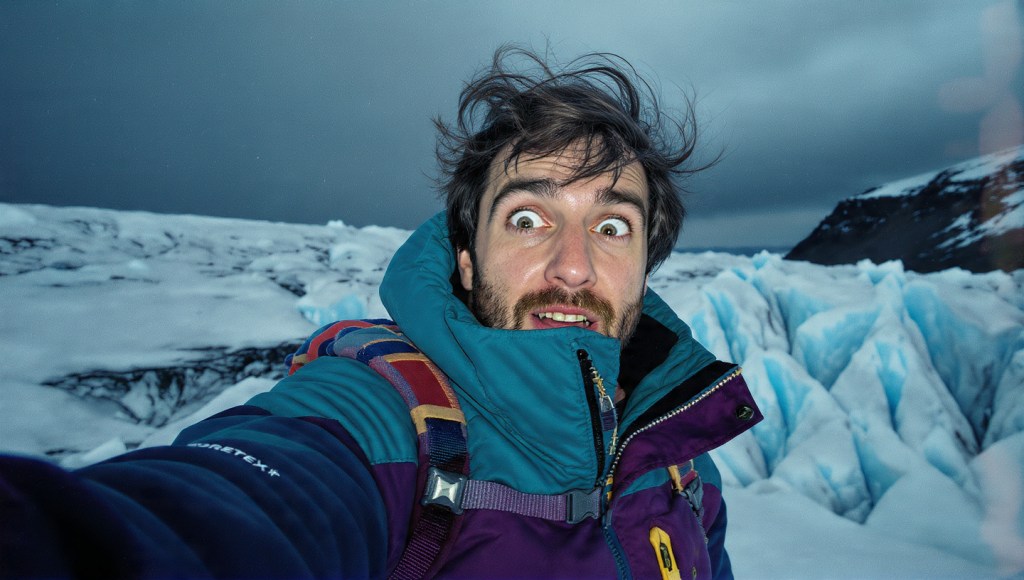
Well now, here’s a peculiar thing – standing at the edge of the world, or near enough to it, on a Monday morning in December. The eighth, to be precise. 1997, if you’re keeping track, which I suppose someone ought to be. The ice beneath my boots groans like an old man’s knees, and I can’t help but laugh, because what else does one do when one’s heart is hammering away like it’s trying to tunnel straight through one’s ribcage and make a run for it?
Heights, you see. Heights are my particular nightmare. Always have been. Even as a boy I couldn’t climb the apple tree in our garden without my mother having to coax me down with promises of chocolate digestives. And here I am, decades later, perched on the lip of a glacier somewhere in Iceland, staring down at crevasses that look like the earth’s opened her mouth to swallow me whole. Marvellous, really. Absolutely marvellous.
The wind’s picking up now – you can hear it coming across the ice field like a freight train, all howl and fury. There’s a storm building to the north, great clouds the colour of old bruises stacking themselves up like they’re planning something vindictive. Which, I must confess, is rather appropriate. Vindictive. That’s the word my ex-wife used, wasn’t it? “You’re vindictive, Martin,” she said, though she never called me Martin, always something else, something sharper. But vindictive will do. It fits like a good pair of gloves.
I’ve been thinking about what I could do less of. Less of the keeping score, perhaps. Less of the mental ledger I maintain, where every slight, every perceived injustice gets tallied up with beautiful precision. Jeremy borrowed my Gore-Tex jacket in ’93 and returned it with a torn pocket – still noted. Susan from accounts made that comment about my presentation style in ’95 – logged and filed. It’s exhausting, actually, this constant arithmetic of grievance. What could I do less of? I could do less of remembering. Less of plotting those small, petty revenges that never quite materialise but live so vividly in my imagination that they might as well be real.
The guilt comes in waves, you see, much like the wind across this forsaken plain of ice. It builds and builds until you think you might be buried under it, and then it recedes, and you can breathe again. Atonement’s a funny old concept when you think about it. The Catholics have it sorted – confession, Hail Marys, slate wiped clean. The rest of us just have to muddle through, don’t we? Carry our transgressions around like so much luggage, hoping we’ll find somewhere to set them down.
I came here to face the fear, or so I told myself. Thought perhaps if I stood at the edge of something truly terrifying, the everyday terrors might shrink down to size. Thought perhaps the cold might freeze out some of the anger I’ve been nursing along like a careful flame. The ice doesn’t care about my grievances, though. The glacier doesn’t keep score. It simply is – grinding forward by inches each year, carrying whatever falls onto it down towards the sea, pulverising everything into dust so fine you’d never know what it once was.
There’s something cleansing in that, I think. Something that speaks to atonement without all the religious baggage. Just the pure, mechanical fact of time and pressure reducing everything to nothing. My petty revenges, my careful catalogues of slights – what are they against this? What are they when the storm breaks and the wind screams across the ice and I’m just a small, frightened man trying not to think about the drop beneath his feet?
The whimsical part – the part that finds this all rather amusing – is that I paid good money to be terrified. Chartered a flight, hired a guide, bought all the proper gear. Spent what I’d been saving for that holiday in Provence to come and stand here, shaking like a leaf, staring into the abyss and having deep thoughts about my character defects. The travel agent must have thought I was mad. “Iceland in December?” she said, raising one perfectly plucked eyebrow. “Bit grim, isn’t it?”
But that was rather the point, wasn’t it? The grimness. The facing of things.
The storm’s closer now. I can taste it on the air, that peculiar electric quality that presages snow. I should be heading back to the hut, back to safety and warmth and a cup of something hot with a generous slug of Brennivín in it. But I’m holding here, just a moment longer, at this edge, with the wind trying to peel me off like old wallpaper and my phobia singing in my blood like a song I’ve always known.
What could I do less of? I could do less of this – less of the running from what frightens me, less of the compensating for fear with spite. I could do less of holding onto things that ought to have blown away years ago, like ash from a fire long since dead.
The ice creaks again, a sound like the world settling its bones, and I step back. Not because I’m done, not because I’ve achieved some great revelation or inner peace. But because the storm’s coming, and even vindictive, phobic men have enough sense to get out of the weather when the weather means business.
Atonement, I think, isn’t a single grand gesture. It’s a series of small retreats from the edge – from the edge of cruelty, the edge of pettiness, the edge of the glacier. It’s choosing, again and again, to step back into warmth rather than letting the cold claim you entirely.
Mind you, I’m still terrified. The walk back to the hut will be just as frightening as the walk out here. But I’m laughing again, because what else is there to do? What else but laugh at the absurdity of it – Martin, afraid of heights, seeking atonement on a glacier. Martin, who keeps such careful accounts, trying to balance books that were never meant to balance.
The first flakes are falling now, swirling in the wind like ashes. Like everything, in the end, returning to dust.
Bob Lynn | © 2025 Vox Meditantis. All rights reserved.

 Vox Meditantis
Leave a comment