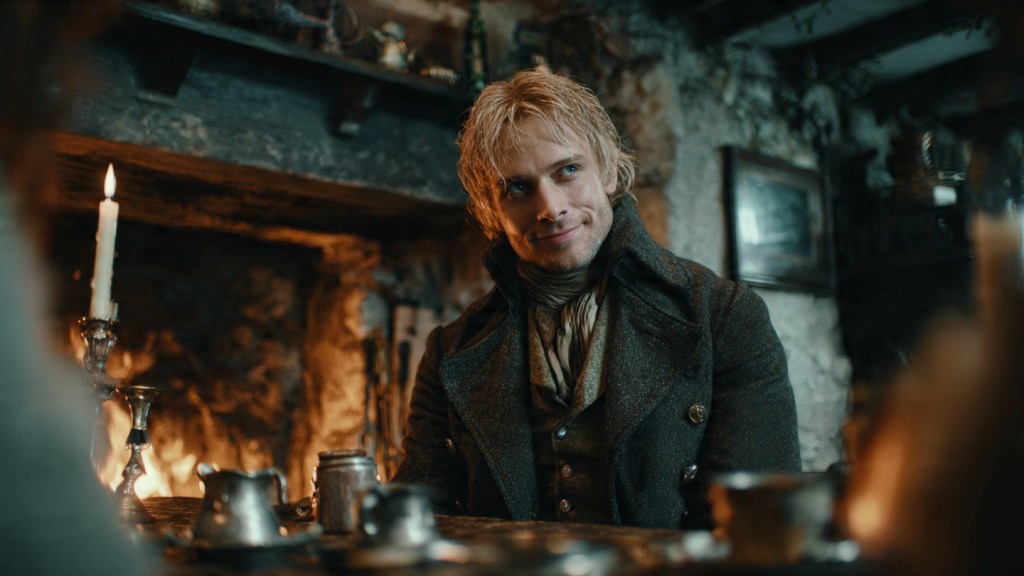
Do you ever see wild animals?
Friday, 6th December 1793
You wonder, perhaps, what manner of man addresses you from this mean dwelling – this farmstead, with its low rafters black with smoke and its earthen floor trodden by beasts as much as by men. I shall enlighten you, though I doubt you possess the faculty to comprehend the distinction between us. I am an artist of the speaking voice, a practitioner of the theatrical arts, and my understanding of human nature exceeds that of these dull rustics as surely as the eagle’s sight surpasses the mole’s.
The good people here – if one may dignify them with such appellations – know nothing beyond their plough-shares and their dung-heaps. They cannot parse a line of verse. They have never contemplated the passions as rendered upon the stage, nor studied the humours that govern mankind’s baser inclinations. Yet I have made them my study, oh yes. I watch them as a naturalist observes his specimens, and what I have learnt serves me well.
Do you ever see wild animals, you ask? A curious enquiry. But then, perhaps you have perceived something in my countenance that prompts such a question. Let me answer you plain: I see them daily. I see them in the swineherd’s daughter, with her eyes like a cornered fox. I see them in the farmer’s son, who bristles like a young boar when I speak to him of matters beyond his rude comprehension. The shepherd possesses the wariness of the hare, forever watching, forever ready to bolt. And the goodwife – ah, the goodwife has the hen’s foolish clucking, her small concerns for hearth and bread, entirely oblivious to the hawk that circles above.
These creatures do not recognise a predator when he sits amongst them, sharing their poor fare and their sour ale. They lack the education to perceive danger clothed in civil manners and well-turned phrases. A gentleman of my refinement, versed in the great authors and the movements of sophisticated society, appears to them as a curiosity – queer, perhaps, but harmless. They mistake the wolf’s patience for the dog’s loyalty.
The landscape here holds a certain savage beauty, I confess. Yesterday evening the western sky displayed such a profusion of pigments as would task any painter’s art to capture: vermillion bleeding into ochre, fading to a grey like soiled lead. The very clouds seemed stained with some celestial dye. This morning, the frost has rendered every blade and twig in purest white, while the furrows in the near field remain dark as lamp-black, striped across the lower meadow in a pattern both monotonous and strangely compelling. Even the blood from the pig they slaughtered on Tuesday has left its russet mark upon the threshold stones – they are careless in their butchery, these people, careless in all their works.
I have taken lodgings here whilst the roads remain fit for travel, or so I informed them. In truth, I stay because I have found what I sought. The farmer’s ignorance of the wider world serves my purpose admirably. His daughter possesses a certain quality – raw, unschooled, like iron ore before the smelting – and she regards me with something approaching awe. She believes I shall take her to the city, teach her to speak fine, introduce her to persons of quality. Poor creature. She cannot conceive that a man of my learning and discernment might harbour intentions she lacks the wit to fathom.
They trust me because I speak well. Because I have demonstrated my superiority in matters of the mind, quoting passages they have never read, explaining the machinations of great affairs in London and Paris, of which they know nothing save garbled rumours. I have positioned myself above them, and from that height I command a prospect they cannot imagine. The weak-minded invariably defer to those who show themselves the stronger in intellect. It is a law as certain as gravity.
The fire burns low. Outside, the December night presses close around this isolated place. The nearest village lies three miles distant across the fields. No one comes here unbidden after dark, and no one questions a gentleman’s need for privacy, for time to compose his thoughts, to write his letters. The goodwife has retired. The others sleep sound, their dull animal sleep of exhaustion after labour. Only I remain wakeful, turning over in my mind the patterns and possibilities that my refined understanding reveals.
You think me cruel? You misjudge me. I am merely more clear-sighted than the common run of mankind. Nature herself teaches us that the clever prey upon the simple, the strong devour the weak. I have seen it in every hedgerow and field. The stoat takes the rabbit. The hawk takes the mouse. And those of superior reason hold dominion over those who lack it. This is no sin, but the very ordering of Creation.
Come the morning, I shall play my part with consummate skill – the courteous guest, the learned gentleman, the kindly tutor. I have rehearsed the role to perfection. They shall suspect nothing until the moment I choose. And by then, my dear listener, it shall be far too late for suspicions to avail them.
Consider this a lesson in the wages of ignorance. Those who cannot read character are doomed to be read – and exploited – by those who can.
Bob Lynn | © 2025 Vox Meditantis. All rights reserved.

 Vox Meditantis
Leave a comment