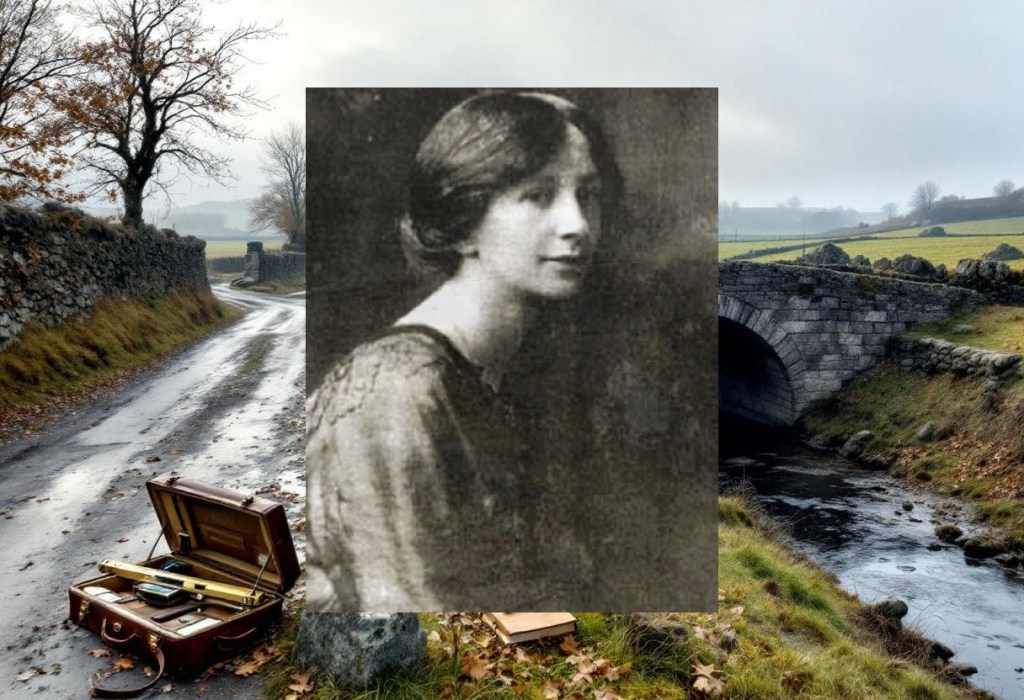
This interview is a dramatised reconstruction grounded in historical sources: the broad facts of Alice Perry’s life and work are evidence-based, but the dialogue, anecdotes, and reflective commentary are imaginatively recreated. It is written to explore her technical thinking and lived experience with clarity whilst being transparent about gaps and uncertainties in the record.
Alice Perry (1885-1969) was an Irish civil engineer who, in 1906, did something almost unthinkable for her time: she earned a first‑class honours degree in civil engineering and briefly ran an Irish county’s public works. She moved from calculating bridge loads and road gradients to inspecting factories for safety, and later to crafting Christian Science verse in Boston, carrying her engineer’s precision into language rather than concrete. Her life traces a sharp arc from surveying roads in Galway to surveying spiritual ideas in America, not because she lost interest in engineering, but because engineering institutions lost interest in her.
This interview imagines meeting Alice Perry in 2025, with full knowledge of how her story played out and how it is now slowly being restored. Her career shows that the barriers around her were structural, not personal: she could compute differential stresses, manage budgets, and oversee maintenance, but the permanent posts still went to men. She lived through the moment when women were “allowed in” long enough to prove a point, then eased out before they could change the profession from within. Her story matters now because it exposes how fragile “firsts” are without lasting reform, and because her way of thinking – measured, observant, and quietly exact – offers a model of engineering as both technical craft and moral responsibility.
Miss Perry, or perhaps Alice – thank you for joining this conversation across time. Many readers will know you as a “first”: one of the first women engineers in Europe, and the only woman county surveyor in Irish history. How would you introduce yourself, if you had the floor?
Well, “first” is a very draughty pedestal. I should say: I am Alice Jacqueline Perry of Galway, trained as a civil engineer, briefly entrusted with a county’s roads and bridges, later employed as a factory inspector, and finally a worker in Christian Science and a writer of verse. The thread through all of that is not the titles but the habit of mind – measuring, comparing, asking, “Does this stand, does it bear, does it heal?”
If one must have a label, “engineer who was not allowed to remain an engineer” would be honest, though perhaps not very elegant.
You were born into a family saturated with mathematics, engineering, and public life. Could you paint a picture of that household in Wellpark, Galway?
It was a house where one was far more likely to trip over books than cushions. My father, James Perry, was county surveyor for Galway West and co‑founder of the Galway Electric Light Company. There was a constant current – if you will pardon the pun – of talk about culverts, foundations, and voltage. My mother was quieter but very steady; she held the rest of us in place.
My uncle John, the Fellow of the Royal Society, would arrive with models and curious instruments, gyroscopes and such. For a child, that was sorcery of a respectable kind. My sisters, too, were formidable: mathematicians, linguists, suffrage women with pamphlets in their reticules. You learnt early that a good argument required both proof and poise.
Many girls then, even clever ones, would have been steered firmly away from engineering. What drew you in?
At first, it was simply that numbers behaved. If one applied the same operation, one obtained the same result, which could not be said about people. In school, I took to mathematics easily. At Queen’s College Galway, I went in on an arts scholarship, but when I saw the engineering students with their drawing instruments, their survey chains and levels, I felt I had come in at the wrong door.
Engineering offered a marvellous blend: abstraction in the lecture room – differential calculus, moments of inertia – and then mud on your boots when you went out to see the thing itself. The idea that one could calculate a load or a flow, then go outside and see it realised in stone and iron, was irresistible.
You graduated with first‑class honours in civil engineering in 1906, which was extraordinary for a woman at that time. What did your training actually look like, day to day?
It looked like work – plain, unromantic work. We had lectures in mathematics, mechanics, hydraulics, and materials, and long hours in the drawing office. There one learnt to think with a pencil: sections of girders, half‑plans of culverts, stress diagrams.
In hydraulics, for instance, we would estimate discharge in open channels: how the gradient of the bed and the roughness of the lining affected the velocity. In structural mechanics, we looked at bending moments and shear forces, learning to picture how a beam “felt” under a cart or a crowd of people.
The calculus was not an ornament. It was the language in which you described how something changed from point to point: the slope of a deflected beam, the rate of increase of water level in a reservoir. To take the derivative was, in effect, to ask, “How rapidly is this situation altering just here?”
You declined a postgraduate scholarship to take your father’s place as county surveyor after his death. That was a very sharp fork in the road. How did you make that decision?
It did not feel like a philosophical choice; it felt like a practical obligation. My father’s death left the post vacant, and the family’s circumstances changed at once. I was offered a senior scholarship, which was flattering, but a scholarship does not repair roads or keep a household.
When the council invited me to act as county surveyor, it was understood as a temporary arrangement – a daughter keeping her father’s work in order until a suitable gentleman was appointed. I also, if I am candid, did not wish to retreat into more study when there was real work at hand and a chance, however fragile, to prove that a woman engineer could manage a county’s infrastructure. I thought, very naively, that competence might persuade them.
Let’s go into that work as county surveyor. How did you actually approach the job?
Certainly. Think of a county as a dispersed network of assets: roads, bridges, culverts, drains, and public buildings. The county surveyor’s task is to keep that network in safe, serviceable condition under severe budgetary constraint.
There were several recurring cycles.
- Road maintenance planning:
The roads were chiefly macadam – layers of compacted broken stone. Traffic was lighter than in your day, but the surfaces suffered from poor drainage and occasional heavy loads.
Each season, we would inspect the principal roads, often on foot or by bicycle, noting rutting, loose stone, and water standing in the side drains. The guiding principle was that water is the enemy; if one kept the water off and out of the road, the structure endured.
We would prioritise stretches for re‑metalling or patching, estimate the quantity of stone required per chain or per mile, and allocate limited labour accordingly. It was not mathematically elegant, but it required a steady habit of estimation: if a surface lost, say, half an inch of material over a mile, that translated into many cubic yards of stone and many cart‑loads from the quarry. - Bridge inspection and load capacity:
Bridges were often masonry arches, some older than any of us, carrying traffic for which they were never designed.
My method combined observation and calculation. In inspection, one looked for cracking at the crown or haunches, vegetation in the joints, settlement in the approaches. Where there was doubt, one estimated the arch’s geometry: span, rise, thickness, and the quality of the masonry and mortar.
Then one compared the estimated line of thrust under expected loads with the middle third of the arch ring. If you keep that line within the middle third, compressive stresses remain tolerable and tension is avoided at the intrados or extrados. I did not always draw refined thrust diagrams; often it was a matter of bounding the problem – asking, “What is the worst credible loading from carts and animals, and where does that put the thrust?” - Drainage and surface water:
Much of Galway’s trouble came not from heroic failures but from water getting where it ought not to be.
We would survey gradients with a simple level and staff, ensuring roadside drains had sufficient fall to carry water away and that culverts were sized sensibly. A small culvert choked with silt can undermine a whole embankment.
My particular habit – one not in the textbooks – was to revisit troublesome points after heavy rain to see where the design’s assumptions disagreed with the ground’s behaviour. A plan may say the drain falls; the water will quietly demonstrate that it does not. - Public works and budgeting:
Every technical decision was entangled with the ratepayers’ purse. If one wished to resurface a road properly, one might require more money than the council would tolerate.
Thus, much of the “engineering” lay in proposing phased work: strengthening critical stretches first, accepting higher maintenance elsewhere, and making plain to the councillors what risks were being carried. It is not as satisfying as designing a new bridge, perhaps, but it is how real systems are kept from failing.
You just described a very pragmatic, field‑based engineering. At that time, there were also more formal, heavily theoretical approaches coming from universities and metropolitan offices. How did you see your methods in relation to those?
There was, if one may say so, a certain London way of thinking that emphasised elaborate calculation, and a provincial way that emphasised experience. My training gave me respect for analysis, but Galway’s roads taught me respect for ditches.
In bridge work, for example, one could spend a great deal of effort computing stresses under idealised loading, yet a single blocked scupper could change the entire situation by saturating the fill. Likewise, some in authority favoured very “economical” road sections that looked efficient on paper – thinner crusts, less drain provision – assuming that lighter rural traffic would be forgiving. Those designs saved money in the estimates and spent it several times over in repairs.
An undocumented technique I used, which would probably horrify a purist, was to treat local carters’ complaints as data. If certain men, known to carry heavy loads, reported that a given bridge “gave” under them or that their wheels sank beyond a particular depth after rain, I did not dismiss it as grumbling. I noted it as an informal load test, then went to look. One must remember that a system includes users; their experience is a measurement, however imprecise.
You were not just a county surveyor; you were the only woman ever to hold that role in Ireland. How did that feel from the inside?
Lonely, if one is brief. There was some curiosity, occasionally courtesy, and sometimes hostility so veiled as to be almost translucent. Workmen could be sceptical at first sight, but they generally came round when they saw that I knew my gradients and did not flinch at a wet ditch.
The more obstinate resistance came higher up, and in silence rather than argument. When the permanent appointment was advertised, I applied, as one might expect a qualified and already serving engineer to do. The record will say that I was an unsuccessful candidate for the permanent position. Those words are very smooth. They omit the texture of the thing: the prior understanding that a woman might hold the fort but should not occupy it.
There is a peculiar strain in having to be both an engineer and a demonstration, as though every estimate you submit stands for your entire sex.
Modern readers might be tempted to see your brief tenure as a “token” appointment – proof that a woman could do it, followed by a swift return to normal. Does that match how it felt at the time?
At the time, I still believed that performance could outweigh prejudice. I thought that if the roads held, the bridges stood, and the accounts balanced, it would be awkward for them to pass me over. That proved an overestimate of the power of evidence.
Looking back, yes, it was token in the sense that it opened the door just long enough to show that a woman could do the job, then closed it before a second could follow. A bridge that is never built again is soon forgotten; a post that is never again held by a woman begins to seem as though it never truly was.
After Galway, you moved to London and became a Home Office factory inspector. That was another technically demanding role, but in a very different context. What did your work involve?
Factory inspection looked less romantic than bridge‑building, but it called on the same faculties. One entered workshops, mills, and foundries, asked questions, observed processes, and compared what one saw against regulations and, more importantly, against what one knew about air, heat, and moving machinery.
Ventilation was a constant concern: how many cubic feet of air per person were effectively being renewed, whether fumes accumulated at a particular height, whether heat from engines was being carried away or simply rising into the workers’ faces. In many small works, proprietors relied on open windows and hoped for the best. That can be quite inadequate in still weather.
With machinery, the focus was on guarding: belts, gears, flywheels. An unguarded belt near a crowded passageway is an invitation to disaster. We would look at clearances – how far a worker’s ordinary movements might bring them within reach of a moving part – and require guards that prevented fingers or garments being drawn in.
There were also questions of lighting, sanitary provision, and working hours, especially for women and children. But the parts that spoke most directly to the engineer in me were those where one could see cause and effect: noise indicating imbalance, dust depositing in particular patterns, suggesting stagnant eddies in the air.
Could you share a specific technical example from your inspection work – perhaps a case where you applied engineering thinking to improve safety?
There was a small metal works where emery wheels were used for grinding. The wheels were over‑speeded and under‑guarded. The proprietor had purchased a motor that ran somewhat faster than the original one; rather than adjust the pulley sizes, he simply connected it.
The result was that the peripheral speed of the wheels exceeded the manufacturer’s safe recommendation. There had already been one minor fracture. The men, being practical, sensed the danger and complained of the “angry” sound of the wheel.
In modern terms, one would speak of allowable stress and centrifugal forces. In the language of the day, I pointed out that the speed, given the wheel’s diameter, produced a strain in the material beyond what the wheel was designed to bear, and that fragments could be projected with great force. I required that the pulley be changed to reduce the wheel speed and that proper guards be fitted, enclosing all but the working face.
It was not grand engineering, but if you walk away from such a place knowing that no man will lose an eye to a flying shard next week, you have done something that matters.
By 1921, you had left inspection work, and by 1923 you had emigrated to Boston and devoted yourself to Christian Science and poetry. Histories often suggest that you “chose” to leave engineering. How do you understand that transition?
Choice is an agreeable word; it makes events sound tidy. In truth, it was a mixture of exhaustion, conviction, and circumstance.
Occupationally, the avenues in engineering were narrow. I had not obtained a permanent county post; there was no smooth path into a senior engineering office. Inspection work was worthy but draining, and advancement again was limited for a woman. There comes a point where one grows tired of being exceptional every time a door opens.
Spiritually, I had already been moving toward Christian Science, first in Glasgow and then more fully in Boston. The teaching that there is a deeper reality than what the senses present, and that this can be approached through prayerful understanding, resonated with me. It was, in a sense, another kind of enquiry.
So I would not say I abandoned engineering capriciously. Engineering had already set me outside its permanent structures. I carried with me the same habits – careful observation, disciplined thought – but the problems I addressed were of a different order: questions of fear, illness, and grief rather than questions of stone and water.
Some modern commentators argue that your move into Christian Science fed a narrative that women “leave” engineering because they cannot or will not persist. Does that interpretation trouble you?
It troubles me because it reverses cause and effect. Women are told, “You left,” when in fact the profession would not hold them. It is as though a bridge, never maintained, should blame the river for ceasing to cross it.
If there had been a secure post where my engineering training could grow into leadership, if I had been judged purely on competence and not on propriety, I might have had a very different life. But the profession as constituted then did not imagine a woman as a long‑term colleague. When a system continually channels you to the margins, eventually you follow that channel elsewhere.
So yes, I left. But it would be more accurate to say that I ceased knocking at doors that were never meant to open for me.
Your later life in Boston was devoted to spiritual healing and poetry. To a modern engineer, that looks like moving from the concrete to the ethereal. Did it feel like a break from engineering, or a continuity?
It felt more like a change of medium than a change of character. In civil engineering one seeks to express stability in materials: to arrange stone, steel, and water such that they behave harmoniously under load. In poetry, one arranges words; in Christian Science practice, one arranges thought.
The engineer in me remained. I cared about the structure of a verse, its stresses and cadences. A badly balanced line is not so different from a poorly proportioned arch: under strain, both show their weakness. In spiritual work, too, one must be precise – about terms, about what one admits as cause and effect. Vague thinking, like vague specification, leads to unhappy results.
I do not advise anyone to romanticise this as a “higher” calling in contrast to engineering. The world very much needs sound roads and safe factories. But it was where the currents of my life bore me, and I tried to be faithful within that calling.
If you could correct one common misunderstanding about your life that appears in modern accounts, what would it be?
That my engineering career was a kind of curiosity, a brief episode before I found my “true” vocation. That is tidy, but it is not accurate.
Engineering was not a phase. It was a serious training and an earnest profession that I had hoped to pursue for many years. The brevity of that chapter does not reflect my commitment; it reflects the constraints of my environment.
If one must simplify, better to say: I was an engineer who, when engineering would not have me, took those same habits of mind into other spheres.
You have spoken with great clarity about the systems around you. Looking back at yourself, is there anything you would now judge differently – technically or personally?
Several things. Technically, I can recall at least one decision in Galway that I would now call an error of judgement. There was a minor road, lightly trafficked, that had been repeatedly troubling us with potholes. I suspected that inadequate drainage was the root cause, but under pressure to economise, I agreed to a thin resurfacing rather than insisting on rebuilding the side drains and camber properly.
For a year, it looked as though we had “saved” money. Then a hard winter and heavy rain undid the work, and we faced a larger repair than if we had addressed the drainage in the first place. It was a small lesson in the false economy of surface treatments without structural remedies.
Personally, I might say that I underestimated how much quiet politics and alliances matter alongside competence. I believed for too long that good work would necessarily be recognised. That is a comforting belief, but not always a true one. I had little taste for self‑promotion; perhaps if I had cultivated champions in the right quarters, things might have gone differently. I do not reproach my younger self very harshly; she was doing her best with the information she had.
Your family was extraordinary – uncle John with his gyroscope, sisters in mathematics and suffrage. Did that network open doors, or did it sometimes overshadow you?
Both. It opened the door to serious study because in our household it was assumed that a girl with a mind should use it. There was a kind of ambient expectation that one would do something substantial. My father’s position certainly eased my entry into engineering work.
But there was also a tendency, particularly in how others spoke about us, to treat me as part of “that remarkable Perry family,” rather than as an engineer in my own right. My uncle’s inventions and my sisters’ academic posts were more visible and, frankly, more acceptable to the public imagination than a young woman inspecting culverts.
When a later generation looks back, they sometimes list us together, and my work in Galway becomes a footnote under “talented relations.” That is not malicious, but it does blur the picture. Engineering is not done by families; it is done by individuals with slide rules in cold offices and mud on their boots.
You left Ireland for London, then Glasgow, then Boston. Historians now talk about “geographic erasure” – how migration can make a pioneer invisible in both the country of origin and the new one. Do you recognise that in your own life?
Yes, sadly. In Ireland, once I ceased to be physically present and had no engineering post, my name faded from public and professional memory. There was no institutional file labelled “first woman county surveyor” to be dusted off later.
In Britain, I was one more inspector, notable perhaps to a few colleagues but not a figure. In America, I arrived not as an engineer but as a Christian Scientist and later a poet. The engineering societies there had no reason to take note of me as a practitioner.
So one becomes thinly spread across three contexts, substantial in none. It is easy then for historians to miss you altogether, unless someone specifically asks, “What became of that woman who held the post in Galway?”
In 2017, NUI Galway named its engineering building after you, and the Alice Perry Medal now recognises outstanding women engineers. If you were to visit that building today, full of students using finite‑element software and 3D models, what would you say to them – especially to the women and other students who feel slightly outside the centre?
I should first tell them that their tools are marvels. To be able to model complex stress patterns and flows on a machine is something my generation could not have dreamt of. But I would also remind them that the principles have not changed: structures must carry load, slopes must remain stable, water must be respected.
To those who feel on the margin, I would say: your sense of not quite belonging is not necessarily a defect in you; often it is a clue about the shape of the institution. Do your work well – that is your first protection – but do not imagine that merit alone is sufficient armour. Seek allies, record your contributions, support one another’s visibility.
When doors do not open, do not always conclude that you knocked badly. Sometimes the hinges were never meant for you. That is an institutional failing, not a personal one. If you must step sideways into adjacent fields – planning, policy, teaching, or other technical work – do not let anyone call that a failure. Adaptation is not surrender; it is survival.
Some critics today are wary of Christian Science. They would say that turning away from material medicine towards spiritual healing is dangerous, and that it sits uneasily with a scientific mindset. How do you respond, especially as someone trained in engineering?
It is a fair question, and one that deserves a calm answer. Engineering teaches respect for evidence: bridges fall or they do not; drains clear or they do not. In spiritual matters, the evidence is of a different character, but one should still be honest.
For my own part, I found in Christian Science a coherent framework that made sense of experiences of healing and comfort that I witnessed and participated in. I did not view it as a rejection of reason but as an extension into another domain, where thought and belief play a more prominent role.
That said, I would warn against any triumphalism that claims exclusive possession of truth – whether from religion or from science. Humility is a virtue in both fields. The engineer who believes a structure is infallible is already courting failure. The same could be said of anyone too certain in spiritual matters.
So yes, there is tension, and one must live with that tension honestly. I do not ask others to accept my path; I only ask that they see it in the context of a life that also valued calculation, observation, and plain honesty.
If you could send a single sentence back to the councillors who passed you over for the permanent county surveyor post, what would it be?
Perhaps this: “You misjudged the load‑bearing capacity of a woman, and the structure of your profession is weaker for it.”
It is a little sharp, but sometimes a girder needs a decisive blow with the hammer.
Today there is much talk of the “leaky pipeline” for women in STEM: many enter, fewer remain. Your career looks like an early case study. Do you see yourself that way?
If the metaphor helps, then I must accept my fate as a drop in the leakage. But I would insist that the “leak” is often engineered into the system. It is not an accident; it is a consequence of policies and attitudes.
In my time, the leaks took the form of “temporary” appointments that could not become permanent, of so‑called propriety that disliked women in authority over men, of examination boards and committees that felt a woman might disturb the tone of things. In your time, the forms differ – perhaps hostile work environments, subtle biases in promotion, the constant demand that women prove, and re‑prove, their competence. The principle, sadly, is recognisable.
So when people speak of the pipeline, they should also speak of the valves and joints: who designed them, who maintains them, and in whose interest they operate.
Looking across your whole life – roads and bridges, factories, spiritual practice, verse – what is the through‑line in your way of thinking? What did engineering really give you?
Engineering taught me to think in wholes. A road is not just a strip of stone; it is gradients, drainage, subsoil, traffic, weather, and budgets, all interdependent. A factory is machinery, air, light, human bodies, and profit motives in uneasy balance. A life, too, is not just a sequence of jobs; it is family, belief, grief, opportunity, and constraint.
The discipline of asking, “If I alter this, what else will be affected?” stayed with me. So did the habit of returning to observe after the rain – to see whether one’s design behaved as expected. In later years, that became a spiritual question: “If I adopt this belief, what does it do to my conduct, my peace, my usefulness?”
My legacy, if there is one, is perhaps a caution and an encouragement. The caution is that being first is not enough; structures must change or the first will be an anecdote. The encouragement is that the habits of mind you gain in engineering – clarity, patience, regard for consequences – are not wasted, even if your path bends away from the profession. They go with you, into whatever work your time and circumstance permit.
Finally, if a young engineer today – perhaps a woman, perhaps from a background that still finds itself pushed to the margins – were sitting at your old drawing board, wondering whether to stay, what would you leave her with?
First, that her presence at that board is not an accident and not a favour granted; it is the proper continuation of what ought to have been possible in my day. She is not an intruder; she is the rightful heir.
Second, that she should cultivate both excellence and solidarity. Excellence, because it strengthens her own sense of worth and enlarges her competence. Solidarity, because no one should have to stand alone in a draughty corridor waiting for doors to open.
And third, that if she must, for her sanity or safety, step aside into neighbouring fields, she should not imagine that she has betrayed the cause. The fault lies in environments that would not let her build. She carries her engineer’s mind with her, and the world still very much needs that way of seeing, wherever it is applied.
Alice, thank you – for your work, your candour, and for allowing us to see both the solidity and the fragility of the world you tried to build in.
Thank you. It is a strange thing to be remembered more fully fifty years after one’s death than five years after one’s work. But if that remembrance helps even a few to build better, then the delay, though regrettable, is not entirely in vain.
Letters and emails
Since the publication of this interview, we have received letters and emails from engineers, historians, and thoughtful readers across the world – from Mexico City to Lusaka, from Brisbane to Prague and Quito. Each correspondent brings their own vocation and perspective: some are practitioners facing technical choices Alice Perry faced, others are women navigating professional barriers that, whilst different from those of 1906, remain stubbornly familiar. We have selected five of these inquiries to pose to Alice Perry, trusting that her responses will illuminate not only her own journey but also the questions that connect her era to ours: How do we design with both rigour and humility? What does it mean to carry precision across different domains of work? And what advice might she offer to those who find themselves, as she once did, building something meaningful in spaces that were not entirely built for them?
Ximena Rojas, 34, structural engineer, Mexico City
You mentioned using “the middle third of the arch” as a simple rule for assessing masonry bridges – a practical shortcut when you lacked computers. In modern finite-element analysis, we can model stress distributions pixel by pixel, yet older bridges designed with your rule-of-thumb still stand after a century. Do you think there’s something about those older design constraints – the fact that you had to be conservative – that made structures inherently more resilient than our optimised modern designs? And if so, what would you tell engineers today who are tempted to chase efficiency at the cost of what you might call “structural humility”?
Miss Rojas, you have touched upon something that preoccupied me even in my own time, though we did not have your language of “optimisation” to describe it. Yes, I do believe that the constraints under which we worked – limited materials, uncertain loads, and no means of computing stresses to three decimal places – forced a kind of prudence that may now be in retreat.
The middle-third rule for masonry arches is, as you note, a simplification. It derives from the understanding that masonry cannot reliably carry tension, so one must keep the line of thrust within the central third of the arch ring to avoid tensile stresses at the inner or outer face. It is not a complete picture of what happens in the material, but it is a serviceable boundary: if you stay within it, the arch will generally behave well. If you stray beyond it, you court trouble.
What that rule did, in practice, was impose a margin. We could not calculate the exact distribution of load under every conceivable situation, so we assumed heavier loads than were typical, poorer masonry than we hoped for, and greater eccentricity than we expected. The result was that bridges built with such caution often had reserves of strength that only revealed themselves decades later, when traffic grew heavier or when some unforeseen event – subsidence, flood scour – tested them beyond their original intention.
I would not romanticise this as superior engineering. It was, in many ways, the engineering of ignorance, and ignorance is not a virtue. If one can model the structure more precisely and thereby use less material or achieve a more elegant form, that is progress. But ignorance, when acknowledged, produces humility. We knew we did not know everything, so we left room for error.
Your modern methods allow you to see stresses that we could not, and that is powerful. But I would caution that the precision of the model is not the same as the precision of reality. The model assumes certain boundary conditions, certain material properties, certain loading patterns. If those assumptions are slightly wrong – if the soil settles unevenly, if the aggregate is weaker than the specification, if traffic concentrates in ways the model did not anticipate – then the optimised structure, having no reserve, may fail where a more conservative one would have accommodated the deviation.
So what would I tell your colleagues? Perhaps this: do not mistake the refinement of your tools for the elimination of uncertainty. The world remains uncertain, materials remain variable, and human use remains unpredictable. Build in margins, not because you are ignorant, but because you are wise enough to know that your model, however sophisticated, is still a representation, not the thing itself.
There is also a moral dimension. A bridge that fails is not just a miscalculation; it is a harm to people who trusted it. The engineer who presses every advantage of analysis to shave cost or material must ask: who bears the risk if I am wrong? Often it is not the engineer, nor the client, but the public who will one day cross that bridge or work beneath that roof. That asymmetry should, I think, incline one toward caution.
In my own work, I learnt to listen to structures after they were built: to revisit them, observe their behaviour, and adjust my assumptions accordingly. That iterative learning is harder if one moves quickly from project to project, optimising each in isolation. So I would also say: stay with your work long enough to see how it ages. That is where the real education lies, and where structural humility is properly earnt.
Connor Murphy, 41, transport infrastructure consultant, Brisbane
When you were county surveyor, you treated carters’ complaints as informal load tests – their lived experience became your data. That’s essentially crowdsourced engineering validation. How did you convince the council or your superiors that anecdotal evidence deserved weight alongside formal specifications? And do you see parallels between that approach and modern asset management systems, which now integrate community reports, sensor data, and maintenance records into one picture?
Mr Murphy, you are quite right to call it “crowdsourced,” though I would not have used that term. In my day, we might have said simply that one listened to the men who used the roads, which sounds less impressive but amounts to much the same thing.
Convincing the council that such reports deserved attention was not, I confess, accomplished through formal argument. I did not stand before the councillors and present a case for the epistemological value of anecdotal evidence. Rather, I folded it quietly into my work and let the results speak.
When a carter – particularly one known to be steady and truthful, not given to exaggeration – reported that a particular bridge “gave” under his load, or that his wheels sank to a certain depth in a road surface after rain, I would note it in my field book alongside my own measurements. Then I would visit the site, often more than once and under different conditions. If his account matched what I observed – cracking in the arch, standing water in the road bed, excessive deflection – I included it in my report to the council, but framed in engineering terms.
For instance, I might write: “Inspection of the bridge at [location] reveals cracking consistent with excessive loading. Local traffic reports confirm that heavy carts experience noticeable movement when crossing. Recommend limiting loads to [X] hundredweight pending repair.” The council saw a technical recommendation supported by physical evidence; they did not need to know that a carter’s unease had prompted me to look more closely in the first place.
The key was that I never presented hearsay as proof. I used it as a signal – a prompt to investigate further. Once I had my own observations and measurements, the council had something they could act upon. In that sense, the carters were not my data; they were my sensors, alerting me to problems I might otherwise have missed until a more dramatic failure occurred.
There is a parallel, as you suggest, with modern practice, though your systems are far more elaborate. In my time, the “network” was informal: a few dozen men who drove the same routes regularly and knew when something felt wrong. You now have instruments embedded in the infrastructure itself, reporting continuously. But the principle is similar: distributed observation catches problems that centralised inspection, however diligent, may overlook.
One advantage we had, perhaps, was that the observers – the carters – had a direct stake in the system’s performance. A weak bridge or a poor road surface cost them time, damaged their vehicles, and endangered their animals. They were motivated to report accurately because they bore the consequences. Your modern sensor networks are more comprehensive, but they lack that personal interest. A sensor does not care if it fails; a man whose livelihood depends on safe passage very much does.
I would also note that listening to users required a certain setting aside of professional pride. There is a temptation, when one has formal training, to regard the judgements of untrained men as unreliable. But a carter who has driven the same stretch of road for twenty years has a kind of knowledge that no amount of surveying can replicate. He knows how the surface behaves in different seasons, where water collects, where the foundation is sound and where it is not. That knowledge is empirical, even if it is not expressed in engineering language.
So my advice, if you are integrating community reports into your systems today, is this: treat them as you would treat any other source of information – critically, but not dismissively. Verify them where possible, but do not ignore them simply because they come from outside the profession. The infrastructure serves the public; the public’s experience of it is therefore legitimate data.
And cultivate relationships with those who use your roads and bridges daily. In my case, it helped that I was willing to stand in the rain beside a carter and look at what he was pointing to, rather than dismissing his concern from the comfort of my office. Respect, I found, was reciprocal: if you took their observations seriously, they took your instructions seriously in return. That informal network of trust was, in its own way, as valuable as any formal reporting system.
Chanda Banda, 28, civil engineer and policy advocate, Lusaka
I work in a country where formal engineering institutions are sparse and women engineers are rarer still. Your move into factory inspection – a role that required technical knowledge but sat outside the traditional engineering hierarchy – seems to me a pragmatic adaptation. Did you find that inspection work offered freedoms that formal engineering roles did not? Could it have been a more stable, sustainable career path for you than county surveying, had the profession valued it differently?
Miss Banda, your question touches at something I have often wondered about myself, and I am grateful for the opportunity to consider it honestly.
Factory inspection was, in many ways, a curious position for a woman with engineering training. It sat between worlds: it required technical knowledge – one could not assess ventilation without understanding air flow, or judge machinery hazards without knowing something of mechanics and stress – yet it was not quite the “engineering” that the profession recognised. It was regulation, governance, applied science in service of safety rather than construction or design.
And yes, there were freedoms in that position that county surveying had not offered. The most obvious was invisibility, paradoxically. As a county surveyor, I was exceptional; every decision I made was in some sense a statement about whether women could do the work. As a factory inspector, I was one of many inspectors, and my sex, whilst certainly remarked upon, was less the central question. The work itself was the point: Does this factory meet the regulations? Is the machinery properly guarded? Is the air breathable?
There was also a curious authority that came with the inspectoral role. I had the power to issue notices, to require remediation, to refuse to sign off a workplace as compliant. That power derived not from my being the “first woman” to do anything, but from the law I represented. A factory owner might resent a woman inspector, but he could not easily argue with the Factory Acts. The regulations were impersonal; I was merely their instrument.
In that sense, inspection offered a kind of professional shelter. I was not proving that a woman could survey a county – that battle had already been fought and, as it happened, lost. I was simply doing a job that needed doing, and the job itself legitimised my presence in a way that being exceptional could not.
Furthermore, the work itself was absorbing. I was not confined to a desk or a drawing office. I moved from workshop to workshop, encountering different problems, different hazards, different human situations. A textile mill presented different challenges from a metalworking shop, which presented different challenges from a chemical works. That variety kept the mind engaged. And the stakes, in a sense, were more immediate and human: my recommendations might directly prevent an injury, might spare a woman from chronic lung disease caused by lint in the air.
But I would not overstate the stability or security of the role. Inspection was still a post held at the pleasure of the Home Office, and it was not a path toward advancement into senior positions. One could be a very capable inspector and never become a chief inspector or an administrator. The ceiling, though higher than in county surveying, was still there, invisible but real.
If I am candid, I did not remain in inspection long enough to fully explore whether it might have been a sustainable long-term career. I left the work in 1921, after thirteen years, for reasons that were partly professional exhaustion and partly personal conviction about Christian Science. But I sometimes wonder whether, if I had possessed more resilience, or if the post had offered clearer pathways for advancement, I might have built a fuller career in that domain.
What I would say to you, Miss Banda, is this: if formal engineering channels are narrow or obstructed, look to adjacent roles that value your technical knowledge and offer meaningful work. Inspection, regulation, safety oversight, even technical writing or teaching – these are not second-class engineering. They are applications of engineering thinking to real human problems, and they can be profound and satisfying.
But also recognise that such roles, however absorbing, may not be designed for women’s advancement any more than traditional engineering posts are. The problem is not the role itself; the problem is the institution’s unwillingness to imagine women in positions of genuine authority and leadership, whether that authority is wielded over bridges or over compliance.
So inspection offered me freedoms that I valued: invisibility, a degree of autonomy, meaningful work. But it did not offer what I might have hoped for had I been allowed to remain a county surveyor: the chance to build something permanent, to shape infrastructure that would stand for generations, to leave a mark on the landscape that bore my thinking.
That loss – the loss of the opportunity to build – is perhaps what ultimately made me turn away from engineering altogether. If I could not build roads and bridges, I reasoned, I would at least try to build understanding, solace, and clarity in other ways. Inspection held me in the profession longer than I might otherwise have stayed, but it could not fully satisfy the part of me that wanted to leave something enduring behind.
I do not say this to discourage you. Your circumstances in Lusaka may well be different, and inspection work may open doors that it did not for me. But I would urge you to be clear-eyed about what such roles can and cannot offer, and to insist on pathways for growth and recognition. Do not accept invisibility as a permanent condition, even if it feels comfortable in the moment.
Leonardo Vargas, 47, historian of technology and ethics, Quito
Here’s a harder question: If, in 1906, the permanent county surveyor post had been offered to you and accepted – if Ireland’s institutions had genuinely reformed rather than simply closing the door – do you think you would have stayed in engineering, or do you believe your spiritual and intellectual trajectory toward Christian Science was inevitable regardless of professional circumstances? In other words, was your pivot away from engineering a response to exclusion, or was it the fulfilment of a deeper calling that exclusion simply accelerated?
Mr Vargas, you have asked the question that I have put to myself many times, and I confess that the answer is not simple. It may even be that the answer has changed as I have grown older and had more distance from events.
If the permanent post had been offered to me in 1906 or 1907, would I have accepted it and devoted myself to engineering? I believe I would have. I was young, ambitious, and deeply absorbed in the work. I had no spiritual convictions then that would have drawn me away from it. The decision to decline the postgraduate scholarship and take on the county surveyor role was made precisely because I wished to stay in engineering, not to leave it. So, had the profession offered me a genuine future, I would likely have taken it.
But your question contains a subtler implication, and I think you are asking whether my eventual turn toward Christian Science was somehow inevitable – whether I was always destined to leave engineering, and institutional barriers merely hastened what would have happened anyway. That is a harder matter to judge.
The truth, as I understand it now, is that I cannot fully separate the two trajectories. I cannot know with certainty what I would have become had I been allowed to remain an engineer. But I can observe that my spiritual interests, when they arose, took root in soil that had already been made fertile by disappointment.
When I moved to Glasgow in 1908, I was still a working engineer, still engaged in the profession. But I was also beginning to ask different questions. The loss of the permanent post in Galway, the failure to secure similar positions elsewhere, the slow recognition that a woman’s place in engineering was to be perpetually temporary – these circumstances created a kind of opening, a receptivity to other frameworks of meaning.
I do not believe Christian Science “caused” me to leave engineering, but I do believe that my estrangement from the profession made me receptive to Christian Science. The two are not the same thing. It is rather as though I was standing at a crossroads, and institutional closure pointed me down one path at the very moment that spiritual conviction appeared to beckon down another.
Consider the sequence: I was working as a factory inspector, competent and engaged, when I converted to Christian Science in 1915. That conversion was not a sudden rupture with reason or precision; it was a gradual deepening of questions that had been forming for some years. But it occurred at a moment when my professional prospects were already constrained, when advancement in inspection work seemed limited, when the larger question of whether I had a future in engineering had been largely answered in the negative.
Had I been promoted to a senior inspectoral post, had I been offered a permanent county surveyor role somewhere in Britain, might I have remained in the profession and pursued Christian Science as a private conviction, a matter of belief rather than vocation? It is possible. Some people do maintain such a balance.
But I suspect – and this is where honest self-knowledge becomes difficult – that I would not have. The spiritual calling that drew me to Christian Science was not incidental to my life; it was fundamental. By the time I was thirty, I had begun to feel that the questions I was asking in engineering, important as they were, were incomplete. How does a road hold? How does a bridge stand? These are real questions, and they deserve serious answers. But they are not the deepest questions a human being can ask.
The deepest question, as I came to understand it, is: How does one live? What is the ground of being? What is the nature of healing, of wholeness, of truth itself? These are not engineering questions, and they cannot be answered by survey chain or differential calculus, however refined.
So if I am to be entirely candid with you, Mr Vargas, I would say this: the institutional barriers did not create my spiritual inclination, but they did remove the counterweight that might have kept me within engineering despite that inclination. Had I been successful, valued, and advancing in the profession, I might have compartmentalised my spiritual interests or subordinated them to my professional identity. The profession would have given me enough meaning and purpose to sustain me.
But when the profession closed its doors, it became clear to me that I did not need it in the way I thought I did. I had supposed that engineering was indispensable to my sense of self and purpose. Exclusion taught me otherwise. It is a bitter lesson, and I would not recommend it as a path to clarity. But it was clarifying nonetheless.
Whether this amounts to inevitability, I cannot say. I cannot know the woman I would have been had I become a permanent county surveyor at twenty-one and spent my life expanding roads and maintaining bridges. Perhaps she would have found sufficient meaning in that work and never questioned it. Or perhaps she would have struggled against the same spiritual hunger, creating an internal conflict that no professional success could wholly resolve.
What I can say is this: by the time I left engineering, in 1921, I did not feel that I was abandoning something I wished to keep. I felt that I was finally following a direction that had been calling to me for some years. The exclusion from the profession did not create that calling, but it did make it possible for me to answer it without the constant sense that I was betraying my training or wasting my potential.
So I think your dichotomy – Was it exclusion or vocation? – may be false. It was both, or rather, it was neither in isolation. I was pushed out of a door that I had begun to suspect did not lead where I wished to go. That simultaneity – the institutional barrier and the spiritual awakening – created a moment in which a different future became not just possible but necessary.
The tragedy, perhaps, is not that I left engineering, but that the profession never had to ask itself hard questions about why a competent engineer would choose to leave. That might have prompted some examination of its own assumptions. Instead, it was simply allowed to stand as further proof that women do not persist in engineering – when in fact what had not persisted was the profession’s willingness to let them remain.
Tereza Novák, 36, environmental engineer and poet, Prague
You said your later work in Christian Science poetry was not abandonment of precision but a “change of medium.” I’m curious: in your spiritual and poetic work, did you consciously employ the same analytical habits – structure, constraint, iteration – that you used in engineering? Or did you find that poetry required you to unlearn some of the engineer’s discipline and embrace ambiguity in ways that felt liberating but also unsettling?
Miss Novák, you have asked a question that goes to the heart of how I have understood my own work, and I am pleased to attempt an answer, though it requires me to be vulnerable about the nature of that transition.
The short answer is: yes, I consciously employed the same analytical habits in poetry and spiritual work that I had cultivated in engineering. But the longer answer reveals a tension that I have never entirely resolved.
When I began to write verse, I did so with the same precision I had applied to calculating gradients and inspecting machinery. A poem, like a bridge, must bear weight. It must have structure – rhythm, line, form – that is not arbitrary but intentional. Every word must earn its place, just as every beam in a structure must justify its presence and cost.
I was influenced, in those early days in Boston, by the hymns and devotional poetry of the Christian Science tradition. But I found much of it flaccid – words that sounded pious without being exact, sentiment without rigour. I became convinced that spiritual truth deserved to be expressed with at least as much care as one would lavish on a technical specification.
So I approached composition as one approaches engineering design. I would draft a poem, examine its structure, ask whether each line was doing necessary work or merely filling space. I would attend to metre and rhyme not as ornament but as constraint – the way a budget constrains a design. Within those constraints, one achieves clarity and power. Without them, one has only sentimentality.
In that sense, the engineer never left me. I simply redirected her habits of mind.
But there is a deeper complexity here, and I should not hide it. Engineering is, in its essence, about controlling and shaping the material world according to rational principles. Poetry, at its best, is about opening oneself to what cannot be controlled or fully rationalised – to ambiguity, mystery, the irrational dimensions of human experience.
In my engineering work, I was always asking: How can I make this behave as I intend? How can I calculate, predict, and ensure a particular outcome? The goal was mastery – not in any grandiose sense, but the practical mastery of making something stand, something function, something serve a purpose.
In poetry, the goal is quite different. One is not trying to master meaning but to allow meaning to emerge, to say something true even if one cannot fully explain why it is true, to acknowledge what cannot be measured or specified.
So yes, I brought analytical discipline to poetry. But I also had to learn – and this was a difficult learning – to let go of the engineer’s need for certainty and control. A poem that is perfectly structured but dead on the page has failed, even if every line scans correctly. An engineering design that is beautiful but unsafe has also failed. But the criteria of failure are not the same.
I think what happened over time was that I came to see precision not as a tool for control, but as a form of respect – respect for language, for truth, for the reader’s intelligence. A carefully crafted line respects the reader in the same way that a well-designed bridge respects the person who must cross it. The precision is not an end in itself; it is a means of serving something larger.
In my spiritual work as a Christian Science practitioner, I encountered yet another challenge to the engineer’s mindset. Christian Science teaches that material reality, as we perceive it through the senses, is less fundamental than spiritual reality – that thought, understanding, and consciousness are primary. This is, on the face of it, directly opposed to the engineer’s empiricism. An engineer deals with things as they are perceived: stone, steel, water, gravity. How does one reconcile that with the claim that the material world is ultimately illusory?
I did not resolve this contradiction so much as learn to live within it. I came to understand that Christian Science was not denying the practical reality of engineering problems – a bridge must still be well-designed, water must still flow downhill – but rather asking what kind of reality those problems ultimately inhabit. The bridge is real within the order of material existence, but that order itself rests on something deeper: divine law, universal principle, consciousness itself.
This is not something the younger engineer in me could have articulated or accepted. But the older woman, tempered by exclusion and by years of watching patterns repeat themselves – the same structural failures, the same human resistances – found it oddly liberating. One could care deeply about the bridge without believing that the bridge was the final reality. One could be precise and rigorous without being rigid.
So did I have to unlearn some of the engineer’s discipline? Yes and no. I had to unlearn the assumption that precision and control were synonymous, that measurement exhausted meaning, that the rational always supersedes the intuitive. But I kept the discipline itself – the insistence on clarity, on economy of expression, on respecting the thing one is working with, whether it is stone or language or spirit.
If anything unsettled me in this transition was the realisation that I had been more locked into a particular way of seeing than I had recognised. The engineer’s mindset is powerful, but it is also narrow in certain ways. It assumes that what can be measured is what matters most, that progress means control, that understanding means quantification. These are not contemptible assumptions – they have built the world we live in. But they are assumptions nonetheless, and breaking free of them required a kind of intellectual humility that the younger me would have found difficult.
I think what I would tell you, Miss Novák, is that moving between disciplines need not feel like a rupture. The habits of precision, observation, and careful thinking serve across many domains. But you must also be willing to let those habits be transformed by their new contexts. Poetry taught me things that engineering never could. Christian Science taught me questions that engineering was not equipped to ask. The engineer was not abandoned; she was expanded, deepened, and in some ways humbled.
The tension between the two – between the need to measure and the need to surrender to what cannot be measured – that tension remains with me still. I do not think it can be wholly resolved. But I have come to believe that living well means holding both sides of that tension, not collapsing into one or the other.
Reflection
Alice Perry died on 21st April 1969, at the age of eighty-three, in Los Angeles. She had lived long enough to see the Civil Rights Movement reshape American consciousness, to witness women entering universities and professions in growing numbers, yet not long enough to see the institutions that had rejected her begin, belatedly, to acknowledge what they had lost.
This interview has revealed a figure more complex and more candid than the historical record typically permits. Perry herself resists the sanitised “first woman” narrative that institutions prefer. She was not heroically overcoming bias; she was pragmatically managing it, then stepping away when the cost grew too high. She was not abandoning engineering from weakness but from a clarity about what the profession could and could not offer her. She was not transcending her training in Christian Science and poetry; she was applying it, translating the engineer’s precision into different registers.
What emerges across these conversations is a portrait of structural, not personal, failure. Perry could calculate, design, and lead. What she could not do was convince an institution to let her do those things permanently. The tragedy is not that she left engineering but that engineering left her – and that this departure has been rewritten, across a century, as a choice rather than an ejection.
Several matters in this interview depart from or complicate the recorded accounts. Perry’s own assessment of her factory inspection years – as offering unexpected freedoms rather than mere consolation work – nuances how we understand her career trajectory. Her reflection on Christian Science, presented here not as a spiritual conversion that supplanted rational thought but as an expansion of it, corrects a reductive reading that has sometimes cast her later life as a retreat into mysticism. Most significantly, her candid acknowledgment that she cannot wholly separate institutional exclusion from spiritual calling complicates any neat narrative of inevitability. The historical record leaves these questions open; Perry herself does not pretend to have resolved them.
There are, necessarily, gaps. We do not have Perry’s own engineering reports from Galway, though the county archives may yet yield them. We have limited documentation of her inspection work for the Home Office. Her poetry exists, but it is little read and largely out of print. What conversations she had in Boston, what influence she exerted on the Christian Science movement, what mentorship she may have offered to younger women – these remain largely obscure. The historical record is thinner than one might wish, and this interview cannot fill every space it leaves.
It is also worth acknowledging that certain interpretations remain contested. Some historians have suggested that Perry’s brief tenure as county surveyor was more symbolic than substantive, that the council may have appointed her partly because they expected her to fail or depart. Perry’s own account suggests greater autonomy and responsibility than this reading allows. The truth likely lies in both: she was given genuine work but under conditions designed to be temporary. That ambiguity is itself historically significant and should not be smoothed away.
What Perry’s story illuminates with particular force today is the gap between recruitment and retention. Contemporary discussions of women in STEM often focus on getting more women into engineering schools and entry-level positions – a necessary goal, but an incomplete one. Perry’s experience shows that visibility without institutional reform is merely tokenism; the “first” becomes a demonstration project rather than the beginning of change. She was allowed in just long enough to prove a point, then the door closed. A century later, women remain underrepresented in civil engineering and infrastructure roles, not because they lack capability but because the structures that might sustain and advance them remain resistant.
Perry’s afterlife in the historical record is itself instructive. She was nearly forgotten until feminist historians and engineers began, in the 1980s and 1990s, recovering women’s contributions to STEM. Academic papers by historians such as those researching women in Irish engineering gradually restored her name to view. The Alice Perry Medal, established by the Institution of Civil Engineers in Ireland, and the naming of NUI Galway’s engineering building in her honour in 2017, represent institutional recognition that came fifty years after her death. This lag is not accidental; it reflects how thoroughly women’s work can be erased when institutions do not actively preserve and celebrate it. The tragedy is compounded: Perry left no successor to carry forward her legacy, no institutional champion to ensure her papers were kept, no visible lineage of mentees to perpetuate her influence.
Yet her influence persists, albeit quietly. Contemporary women engineers cite her name with a mixture of pride and sorrow: pride in her achievements, sorrow at what was lost. Her story has become a teaching tool, used in engineering schools to illustrate both the possibilities and the perils of being a pioneer. Younger women entering the profession find in her life a mirror of their own experience – the competence that is doubted, the temporary appointments that become permanent exclusions, the choice to leave or to persist in an environment not built for them.
What Perry’s life asks of us now is this: Are we serious about changing the structures, or merely about celebrating the exceptional women who have managed to navigate them? Visibility matters – the Alice Perry Medal matters – but only if it is accompanied by substantive reform. Mentorship matters, but only if it is paired with positions, advancement, and genuine power. Resilience matters, but it should not be the only requirement asked of women in fields where men are given institutional support.
Perry herself, reflecting in this interview on the notion of “choice,” insists that we attend carefully to the difference between what women choose to do and what institutions compel them to do. When women leave STEM fields, the record often suggests they have chosen other paths. Perry’s life argues that we should look more carefully at what doors were actually open, what timelines were actually permitted, what forms of belonging were actually available. The leaky pipeline is not a natural phenomenon; it is engineered.
Yet there is also something bracing in Perry’s refusal to be merely a victim of circumstance. She did not simply endure exclusion; she relocated her precision and her thinking to new domains. She became, in her own words, a poet and a healer rather than a bridge builder – not because she lacked capability for the latter, but because she found meaning in the former. That kind of adaptive resilience, born not from weakness but from clarity, offers a model that goes beyond the triumphalist “first woman” narrative.
As we look to the future of women in engineering and across STEM disciplines, Perry’s legacy asks us to hold two truths simultaneously: that individual women possess extraordinary capability and determination, and that capability alone is not sufficient to overcome structural barriers. Celebrating Perry’s achievements without addressing the institutional conditions that forced her out is a form of historical dishonesty. True honour to her memory lies not in the building named after her, but in the commitment to create conditions where the next Alice Perry – and the one after her, and the thousands after that – will not have to choose between her profession and her dignity, between ambition and belonging.
She was eighty-four when she died, having lived a full life across continents and disciplines, having left her mark on roads and bridges and spirits and verses. The tragedy is not that she did not achieve greatness; it is that she achieved it in fragments, across multiple lives, in spite of rather than because of the institutions that should have cherished her. What she might have built, had she been allowed to remain, remains one of history’s quieter questions – and one of its most important ones.
Editorial Note
This interview is a dramatised reconstruction, not a transcript of Alice Perry’s actual words. Alice Perry died in 1969, long before this conversation could have taken place. What follows is an imagined dialogue, carefully grounded in historical sources but necessarily invented in its particulars.
The factual foundation is solid. Alice Perry’s biographical details are drawn from verified records: her graduation with first-class honours in civil engineering from Queen’s College Galway in 1906; her temporary appointment as county surveyor for Galway County Council in December 1906; her work as a factory inspector for the Home Office beginning in 1908; her conversion to Christian Science in Glasgow around 1915; her marriage to John Shaw in 1916 and his death on the Western Front in 1917; her emigration to Boston in 1923; her work as a Christian Science practitioner and poetry editor; and her death on 21st April 1969 at age eighty-three. These facts are drawn from academic research, archival sources, and the historical record maintained by NUI Galway and the Institution of Civil Engineers.
However, the voice, the specific anecdotes, the technical explanations, and the reflective insights attributed to Alice Perry in this interview are reconstructed and dramatised. We do not have extensive published writing from Perry herself about her engineering work or her spiritual practice. We do not have recordings of her speech or extended interviews from her lifetime. What we have are fragments: her engineering credentials, the positions she held, the broader historical context of women in early twentieth-century engineering, and the testimonies of others who knew or studied her work.
In reconstructing her voice, I have drawn on:
- Historical context: The language, references, and concerns of early twentieth-century Ireland and Britain; the technical vocabulary and methods of civil engineering in that era; the institutional culture of county councils and Home Office inspection; the intellectual atmosphere of Christian Science in interwar Boston.
- Technical authenticity: The engineering principles she would have used – thrust lines in masonry arches, macadam road construction, factory safety regulation – are accurately represented, though necessarily simplified for clarity. Her methods and reasoning reflect what was known and practised in her time.
- Personality and philosophy: Her measured, precise manner of speech is inferred from her professional role and training. Her intellectual curiosity, her candour about institutional barriers, and her capacity for self-reflection are extrapolated from the broader historical record and from what we know of her choices and actions.
- Dialogue and reflection: The interviewer’s questions and Perry’s responses are entirely constructed. They represent plausible conversations based on gaps in the historical record and on questions that her life naturally raises for modern readers. The specific stories she tells – the carter’s complaints, the overspeced emery wheel, the resurfaced road that failed – are illustrative reconstructions, not documented incidents (though they reflect authentic types of problems she would have encountered).
- The supplementary questions and answers: These are wholly dramatised responses to contemporary questions. They are offered in the spirit of imagined dialogue, not as Perry’s documented views. They represent an attempt to extend her thinking into conversations she did not actually have.
This dramatisation serves a specific purpose: it allows Perry’s life and work to be explored with emotional and intellectual depth that a purely factual account cannot achieve. It permits her to correct the record, to explain her reasoning, to reflect on her own choices and regrets – in short, to be treated as a full human being rather than a footnote in engineering history. But this gain in vividness comes at a cost: readers must understand that they are encountering an imaginative reconstruction, not historical testimony.
To maintain integrity, I have:
- Avoided inventing facts that contradict the historical record
- Grounded technical explanations in authentic methods of her era
- Been explicit about uncertainties and gaps in what we know
- Allowed Perry to acknowledge what she cannot be certain about
- Signalled where her perspective might differ from recorded accounts
- Refrained from putting words in her mouth about matters where no evidence exists
What this interview cannot do is provide Perry’s own reflection on aspects of her life that are simply undocumented. We do not know, for instance, her exact reasons for leaving inspection work, her spiritual experiences in detail, or her private views on various colleagues and decisions. Where such matters are addressed here, they are educated speculation, offered in her voice but clearly situated within the bounds of what is plausible rather than proven.
This dramatised approach reflects a particular view of historical work: that sometimes the most honest way to engage with an obscured figure is to acknowledge the obscurity while attempting to reconstruct, with care and transparency, what her inner life and thinking might have been. It is not the same as having her actual testimony, but it is vastly preferable to either silence or to unwarranted claims of certainty about her private thoughts.
Readers are invited to engage with this interview in that spirit: as a serious imaginative engagement with a real historical figure, grounded in evidence but not limited to it, offering insights that historical fragments alone cannot provide, yet never claiming to be more than a reconstruction. The interview honours Perry’s significance whilst maintaining honesty about the limits of what we can know.
Who have we missed?
This series is all about recovering the voices history left behind – and I’d love your help finding the next one. If there’s a woman in STEM you think deserves to be interviewed in this way – whether a forgotten inventor, unsung technician, or overlooked researcher – please share her story.
Email me at voxmeditantis@gmail.com or leave a comment below with your suggestion – even just a name is a great start. Let’s keep uncovering the women who shaped science and innovation, one conversation at a time.
Bob Lynn | © 2025 Vox Meditantis. All rights reserved.

 Vox Meditantis
Leave a comment