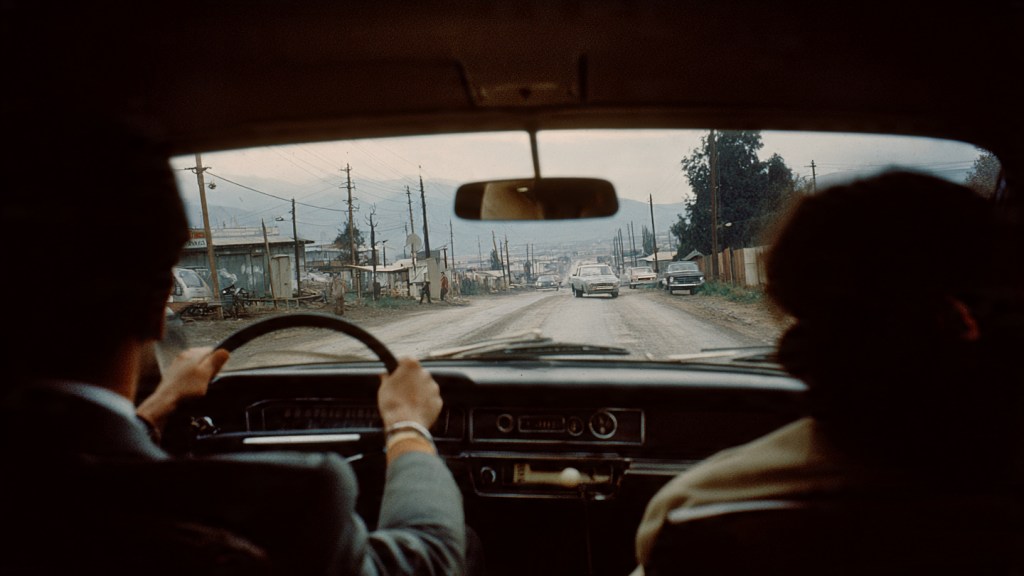
Do you have a favorite place you have visited? Where is it?
Friday, 5th December 2025
The guest room wall is thinner than I remembered – or perhaps Michael and Linda are simply better at marriage than I am at sleep, their low conversation threading through the plaster like a gentle reproof to my decades of practised solitude. They arrived three hours ago, navigated my inadequate parking instructions with more grace than they deserved, submitted to shepherds pie and the sort of catching-up that families perform when affection and distance have reached their usual accommodation.
Now they’re settling into rooms I cleared with what I can only describe as archaeological intent – my mother’s belongings finally sorted into keep, release, and the more honest category of still deciding. Through the wall I hear Linda laugh at something, then Michael’s lower reply, and I’m struck by how foreign domestic contentment sounds when it’s not your own, how it makes the silence on this side feel less like peace and more like an ongoing negotiation I haven’t entirely won.
But the question waiting on my phone – delivered this morning between sessions with the cheerful presumption that I’d have a ready answer – wasn’t about silence or solitude. It asked: Do you have a favourite place you have visited?
The Places That Changed Rather Than Impressed
The expected answer would be something postcard-ready. Paris, perhaps, or that October weekend in Vermont during residency when the mountains held fog like something poured and I lay awake wondering if peace was supposed to feel quite that uncompromising. The Philadelphia years could make a case for themselves – three years of psychiatric training in a city that felt, most days, like an overwhelming case conference, every street corner offering a different thesis on suffering and survival.
But those places impressed me more than they changed me. They were stops on a route I was meant to travel – checkpoints in a career that looked, from the outside, like steady forward motion even when it felt, from the inside, like careful avoidance of anything that might require me to be more than competent.
The places that actually changed me were quieter, closer, embarrassingly ordinary.
The First Geography: Washington Routes
I was very young when my father let me ride the full circuit of his D.C. bus route on a Saturday morning – the entire loop from terminus to terminus, watching him check the mirror not for traffic but for passengers, that particular quality of attention that asked, without asking, whether everyone was still upright. He drove those streets for years before we moved north, navigating a city where monuments and history hummed in the background whilst people simply tried to get to work on time.
What I learned on those Saturday circuits wasn’t about Washington’s grand architecture or its commemorative impulse. It was about my father’s grammar of care – the way steadiness itself could be a form of showing up, how reliability might matter more than spectacle, how you could tend to strangers through the simple discipline of getting them where they needed to go without incident.
Years later, setting up my consulting room in New Corinth, I arranged the chairs with the same attention Joseph Bennett brought to his routes – not for drama, but so people could arrive carrying difficulty and discover they’d been seen without being scrutinised. The blue chair angled toward harbour light without exposing whoever’s sitting there. The particular quality of silence I hold that says: you’re allowed to be exactly as you are in this moment.
My father’s buses became my consulting room. His routes became my thirty years of showing up Monday mornings regardless of doubt or fatigue. The first place that changed me wasn’t a destination – it was a practice, witnessed from the seat behind the driver, in a city I left at eleven but never quite stopped carrying.
The Second Geography: First Sight of the Harbour
September 1971. I was four when we drove into New Corinth for the first time, my parents having decided that this small harbour town offered what Washington couldn’t – enough distance from larger cities to feel possible, enough maritime work to sustain us, enough accumulated kindness to make starting over bearable.
What I remember – or think I remember, since four-year-olds are notoriously unreliable narrators of their own arrivals – is a fragment: the Delaware suddenly visible through the car window, not the postcard sweep of it but the working harbour with its cranes and practical piers. Whether I actually registered the smell of rust and river silt, or whether I’ve imported that detail from a thousand subsequent dawn walks, I honestly couldn’t say. Memory at that age is more collage than documentary – part lived experience, part family mythology, wholly unreliable as evidence.
But I do know my mother leaned forward in her seat at some point during that drive. My father told me years later that she said, with characteristic audacity, “Well then, here we are. Let’s see what we can make of it.” Whether I heard those words at four or simply absorbed them later as the family’s founding narrative doesn’t particularly matter. What matters is that I’ve spent fifty years trying to answer her question.
What I made of it, over five decades, was a life. Not the dramatic sort that would merit biography, but the ordinary architecture of staying – same Victorian rooms, same harbour view, same streets walked at dawn before the town requires me to be anyone in particular.
That first sight of New Corinth’s harbour – real or reconstructed, witnessed at four or assembled from fifty years of retellings – didn’t overwhelm me with beauty. It offered something rarer: it looked like somewhere I might learn to stop performing. Where my mother’s brightness could find expression in community connection rather than casino survival. Where my father’s municipal competence could serve actual neighbours instead of anonymous passengers. Where I, eventually, could build a practice not on being extraordinary but on being reliably, unglamorously present.
The Third Geography: Philadelphia’s Overwhelm
The residency years – 1990 to 1993 – remain filed under necessary difficulty. Philadelphia taught me psychopharmacology, attachment theory, the delicate choreography of holding someone’s worst day whilst maintaining the frame that keeps you both safe. But it also taught me that a city can feel like too much case conference, too many competing theories, too little room for the quieter work of simply sitting with people until their breathing steadies.
I was competent there. Possibly even good. But I was also performing a version of myself that required constant maintenance – the promising young psychiatrist, the one who could handle the difficult cases, who never seemed to need the sort of tending she offered others.
What changed me about Philadelphia wasn’t what I learned. It was discovering what I couldn’t sustain. The woman who could hold fifty-minute containers for other people’s suffering but couldn’t quite locate the door to her own. Who was brilliant at adjacency – warm colleagues, pleasant enough socially – but catastrophic at the ordinary intimacy that doesn’t come with professional boundaries to hide behind.
I left Philadelphia grateful for the training and relieved to return to New Corinth, where the harbour’s patient arithmetic felt less like pressure and more like permission – to build slowly, to stay rather than prove myself elsewhere, to discover whether depth might matter more than breadth.
The Actual Favourite: A Specific Stretch of Boards
If you pressed me – if you stood here in my bedroom with the muffled voices of my brother’s contentment seeping through the wall and demanded an honest answer – I’d tell you this.
My favourite place isn’t a place I visited once and left transformed. It’s a quarter-mile stretch of harbour boardwalk between the old shipyard and the Methodist church, walked thousands of times over thirty years, never the same twice.
It’s the bench near the Historical Society where Father Walsh and I meet most mornings at dawn – seven years of companionable circuits, theology disguised as weather commentary, pastoral care masquerading as neighbourly concern. That bench has held more honest conversation than most consulting rooms – admissions about using busyness as elegant defence, confessions about fearing change whilst prescribing courage, the sort of recognition that only arrives when you’ve walked the same route often enough that pretence becomes exhausting.
It’s the window seat at Marcus’s café, the table I pretend I don’t always prefer, where Jenny appears with her librarian’s gift for editorial intervention and refuses to let me hide behind talk of civic resilience. Where David first asked, carefully, whether I’d like to sit together at the Bartók concert – and where I said yes before my defences could rehearse better evasions.
It’s the museum’s new stillness room – the one we’ve been designing these past months, with benches positioned to catch light without exposing whoever needs to sit. Yesterday afternoon, Claire watched someone use that bench for the first time – an older gentleman who simply sat with a daguerreotype for twenty minutes, then took one of the cards and nodded as if he’d been given him something he needed.
That’s the place. Not exotic, not distant. Just the accumulated geography of becoming slightly less defended, incrementally more visible, learning through repetition what transformation rarely teaches – that home isn’t where you arrive perfect, but where you’re permitted to keep arriving imperfect and the welcome holds.
Tomorrow’s Itinerary
In the morning, after the slow breakfast I’ve blocked in my diary with more ceremony than is strictly reasonable, I’ll show Michael and Susan these places. Not the tourist sites – New Corinth doesn’t quite have those – but the modest landmarks that have become my emotional coordinates.
Elena’s shop, where groceries and kindness circulate in equal measure, where she tucks herbs into bags as if it were punctuation and somehow knows when someone needs tending. The museum’s stillness room, where yesterday’s decades of being excellent at witnessing have transformed, tentatively, into something more public – care that doesn’t require my consulting room’s frame to function. The church hall where music happens on Thursday evenings and community meals get served with the sort of practical grace my father would have recognised.
Nothing spectacular. Just the architecture of staying – the places that have taught me, slowly and against considerable resistance, that being woven into a town’s fabric might matter more than maintaining perfect professional boundaries.
The Other River
This evening, whilst Michael and Linda were unpacking, I checked my email and found the reminder I’d been half-expecting – the Québec booking, finally settled after months of circling it like a planet I wasn’t quite ready to visit.
Next weekend – two nights – single room – view of the St. Lawrence if the clerk feels merciful. Not for a conference. Not for professional development. Just because I want to see how another river city holds its light, whether altitude changes the quality of water against stone, whether I can practise being unremarkable in a language that isn’t quite mine.
For once, I’m visiting somewhere not because duty requires it but because curiosity does. Not to prove anything or accomplish anything, but simply to stand beside different water and see whether the same questions surface – about staying and leaving, about solitude and connection, about what becomes possible when you stop treating competence as shelter and risk being ordinarily, imperfectly present.
It feels both modest and slightly terrifying, which is usually how I know something matters.
The Future Geography
Lying here, the guest room voices quieting toward sleep, I find myself wondering whether my favourite place might eventually be something I haven’t quite named yet.
Not the harbour, though it will always be where I return. Not Québec, though I suspect it will teach me something the Delaware hasn’t. But perhaps – and I’m only discovering this as I write it – whichever corner of the world I learn to inhabit with someone, rather than adjacent to them.
With David, whose careful hands and unexpected laughter have started appearing not just at concerts but in my kitchen, at my table, in the risky category labelled possibility. With Michael and Susan, if I can manage tomorrow to be the textured sister rather than the competent précis, the one who admits uncertainty alongside achievement. With Father Walsh, whilst he’s still here and not yet claimed by Wilmington’s more pressing needs. With Jenny and Maggie and the rest of the small parliament who’ve decided, for reasons I don’t entirely understand, that Catherine Bennett is worth knowing beyond her professional usefulness.
Someday – not yet, but perhaps not as far off as I once thought – my favourite place might not be defined by coordinates at all. It might simply be wherever I’ve finally learned to arrive as myself: insufficient, fumbling, ordinarily present, and discovering that this was always enough.
The harbour will still be there in the morning, reliable as my father’s routes, patient as the tide that rearranges everything twice daily and calls it steadiness rather than chaos. Michael and Linda will wake in the cleared guest room, evidence that I’m mid-process rather than finished. And I will make breakfast for people I love, in a city I’ve stayed in long enough to call it home, practising the quiet courage of letting them see not just where I’ve been, but where I’m still learning to go.
The voices have stopped now. Tomorrow will ask its particular price – small intimacies, modest revelations, the ordinary work of showing family the life I’ve actually built rather than the version that fits comfortably in Christmas letters.
For tonight, this is enough: the harbour darkening beyond the window, my brother’s safe arrival, the confirmation email promising another river in another season, and the recognition that the best places aren’t the ones that impress us from a distance but the ones that change us through repetition – one walk, one meal, one honestly occupied morning at a time.
Catherine
Bob Lynn | © 2025 Vox Meditantis. All rights reserved.

 Vox Meditantis
Leave a comment