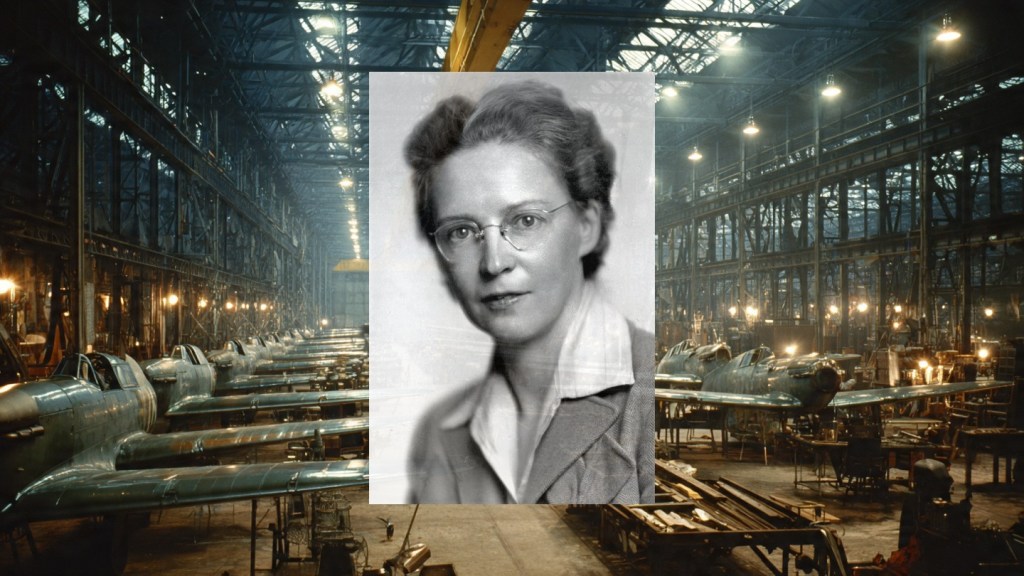
This interview is a dramatised reconstruction: Elsie MacGill died in 1980, and the 2025 conversation, questions, and replies are imagined rather than a verbatim transcript. It is grounded in historical sources (her published technical writing, documented public statements, and reputable scholarship), but some details and dialogue are necessarily interpretive and may reflect gaps or uncertainties in the record.
Elizabeth Muriel Gregory MacGill (1905–1980) stands as one of the most accomplished engineers in Canadian history, yet her story remains less familiar than it deserves to be. She was the first Canadian woman to earn an electrical engineering degree, the first woman in North America to receive a master’s in aeronautical engineering, and the world’s first female chief aeronautical engineer. During the Second World War, her leadership at Canadian Car and Foundry resulted in the production of over 1,450 Hawker Hurricane fighters – aircraft that accounted for roughly 55% of enemy planes destroyed during the Battle of Britain.
Dr MacGill, welcome. I confess to some nervousness about this conversation – it’s not every day one speaks with someone who shaped both aerial warfare and women’s rights across an entire century. Before we begin, I want to acknowledge that you passed away in 1980, yet your presence here feels remarkably appropriate given your habit of doing what others declared impossible.
Thank you. I rather enjoyed doing the impossible – it kept the sceptics entertained. Though I should clarify: I never thought of myself as doing anything extraordinary. I simply did what needed doing, whether that was calculating stress loads or convincing politicians that women deserved bodily autonomy. Both require precision; both attract resistance.
Your mother, Judge Helen Gregory MacGill, was British Columbia’s first female judge and a fierce suffragist. Your grandmother was an active campaigner for women’s votes. How did growing up in that household shape your path into engineering?
My mother had a phrase she repeated often: “Few of us are born brilliant. We must develop our capabilities ourselves.” She meant it practically. My sister and I received formal schooling at home before public school – drawing lessons from Emily Carr, if you can imagine, and swimming from Joe Fortes down at English Bay. Mother converted the top floor of our house into a classroom. Education wasn’t a luxury in our household; it was oxygen.
What I absorbed from her wasn’t merely the importance of learning, but the expectation that one acts. She didn’t simply advocate for mothers’ pensions – she chaired the Vancouver Mothers’ Pension Board. She didn’t write abstract arguments about women’s legal status – she sat on the bench and applied the law fairly for twenty-three years, and not one of her decisions was reversed on appeal. That taught me something crucial: if you want change, you must do the engineering yourself.
You entered the University of Toronto’s engineering programme in 1923, one of very few women in the entire faculty. What was that experience like?
My presence in the engineering classes certainly turned a few heads. That’s rather an understatement, isn’t it? I was eighteen years old, surrounded by young men who had never shared a lecture hall with a woman, taught by professors who weren’t entirely certain what to make of me. The Dean of Applied Sciences at UBC had asked me to leave after one term before I transferred to Toronto – apparently, my presence was disruptive.
At Toronto, I learned to focus on the work itself. When you’re calculating material strengths or solving differential equations, the pencil doesn’t care about your chromosomes. The numbers behave identically whether computed by a man or a woman. I found that rather liberating. The social discomfort around me was their problem; the mathematics was mine.
After graduating in 1927 as the first Canadian woman with an electrical engineering degree, you moved to the University of Michigan to study aeronautics. And then, on the eve of your graduation in 1929, you fell ill.
Yes. I woke one morning unable to move my legs. What I’d thought was influenza proved to be acute infectious myelitis – a form of polio. The doctors told me I would spend the rest of my life in a wheelchair.
I refused to accept that possibility. Those words sound defiant now, but at the time, they were simply practical. I had examinations to complete and a thesis to finish. I wrote my finals from my hospital bed. The degree mattered; the prognosis, I decided, did not.
You spent nearly three years recovering, much of it bedridden. How did you keep your engineering ambitions alive?
I couldn’t walk, but I could think. And I could write. During my convalescence, I designed aircraft on paper and published articles about aviation in Chatelaine magazine to pay my medical bills. The body was uncooperative; the mind remained entirely functional. I learned to calculate everything – stress tolerances, fuel consumption, and eventually, my own physical capabilities. Polio taught me to think in systems rather than strength. If one pathway fails, you engineer another.
When I finally regained enough mobility to use metal canes, I enrolled at MIT for doctoral studies. I never completed the doctorate – a job offer from Fairchild Aircraft proved more compelling – but those years of enforced stillness gave me something essential: a meticulous attention to what can go wrong. When you’ve experienced your own body failing catastrophically, you design machines with an intimate understanding of failure modes.
Let’s talk about your work at Fairchild Aircraft in Longueuil, Quebec, beginning in 1934. You specialised in stress analysis – could you explain that discipline for our readers?
Certainly. Stress analysis is the mathematics of asking a simple question: will this structure hold? Every aircraft component – wing spar, fuselage frame, control surface – experiences forces during flight. Lift pushes upward on the wings; drag pulls backward; the engine creates thrust; gravity pulls everything toward the earth. When a pilot manoeuvres, additional loads occur. The structure must withstand all these forces with adequate margins.
At Fairchild, I worked on the Super 71, which had the first stressed-skin, all-metal fuselage designed and built in Canada. The innovation was treating the skin itself as a structural element rather than mere covering. This required calculating how loads distributed across curved metal surfaces – a significant mathematical challenge. I also contributed to the Fairchild 82 bush plane series and gained my first experience accompanying pilots on test flights.
You’ve mentioned test flights several times. Despite never learning to fly yourself, you insisted on participating in them.
Always. On every aircraft I worked on, I flew as observer in all test flights – including the dangerous first flights of prototype aircraft. My disability prevented me from handling the controls, but nothing prevented me from sitting in that cockpit and experiencing precisely how the aircraft behaved.
There’s a saying among pilots: “The aircraft will teach you what the numbers cannot.” I believed that deeply. Stress calculations might predict where failures would occur, but the vibrations through the airframe, the response to control inputs, the sounds of an engine under load – these could only be learned by being present. When you’ve sat beside a pilot as an aircraft does something unexpected, you design differently afterward.
That’s a remarkable commitment, particularly given your physical limitations.
My limitations taught me what most engineers never learn: machines must work for bodies that don’t function perfectly. The pilot might be fatigued, or cold, or wounded. The ground crew might be inexperienced. The aircraft must be forgiving. Polio made me an engineer of margins – I always asked, “What if something goes wrong?”
In 1938, you became chief aeronautical engineer at Canadian Car and Foundry in Fort William, Ontario – now Thunder Bay. You were thirty-three years old and the first woman in the world to hold such a position. What did you inherit?
A railway boxcar factory being converted to aircraft production, and a contract to build my own design – the Maple Leaf Trainer II. The Trainer was a two-seat biplane intended as a primary trainer, designed for use on wheels, skis, or floats. I essentially re-engineered an earlier failed design called the Maple Leaf I, keeping only the fin and rudder from the previous aircraft.
The Maple Leaf II received its certificate of airworthiness in the aerobatic category within eight months of commencing design – a genuinely rapid achievement. On its first flight, 31st October 1939, I sat behind the test pilot, observing everything. That aircraft never entered mass production – only ten were eventually built, in Mexico – but it established that a woman could design an aircraft from beginning to end. That mattered.
Then the war began, and everything changed.
A few weeks after war broke out, I received instructions that CanCar would produce the Hawker Hurricane fighter for the Royal Air Force. This was September 1939, with Britain desperately needing aircraft and their own factories vulnerable to German bombing. Our isolated location at the far end of Lake Superior suddenly became an asset.
The challenge was staggering. We had approximately 500 workers and facilities designed for assembling railway cars. Within a year, we would need to produce three fighter aircraft per day with a workforce of 4,500. I was responsible for all engineering work – tooling up production for more than 25,000 precision parts, all of which had to be interchangeable with Hurricanes manufactured in Britain.
Please walk us through what “interchangeability” meant in practical terms. This seems crucial to understanding your contribution.
Interchangeability was the engineering problem that defined my war. The Hurricane consisted of thousands of components manufactured to extremely tight tolerances – parts must fit together regardless of where they were made. A wing produced in Fort William must mate perfectly with a fuselage built in England. A replacement aileron manufactured in our factory must install correctly on a battle-damaged aircraft repaired somewhere in North Africa.
The Hurricane’s construction was conventional for its era – welded steel tube fuselage with fabric covering aft, metal panels forward. The joints where tubes met were particularly critical: each comprised no fewer than twenty individual components, and some had more than one hundred fifty precision elements, all requiring tolerances of less than half a thousandth of an inch on every bolt hole.
I pioneered a modular construction system. We machined parts separately and only assembled the aircraft in final stages. This had two enormous benefits: first, it dramatically reduced production time, allowing our initial order of forty Hurricanes to arrive in time for the Battle of Britain. Second, it meant any part from any aircraft would fit any other aircraft, enabling mechanics to swap components and keep more machines flying.
That sounds deceptively simple when described quickly.
Nothing was simple. I designed custom jigs and tooling for each component. I created written procedures for every assembly operation. I trained supervisors who then trained workers, half of whom were women with no prior industrial experience. We worked with engineering drawings from Hawker Aircraft that were designed for their production methods, not ours – I had to translate everything for North American tooling and metric-imperial conversions.
My 1940 paper, “Factors Affecting Mass Production of Aeroplanes,” earned the Gzowski Medal from the Engineering Institute of Canada. That paper documented what we learned: how to achieve precision at scale, how to train workers rapidly, how to maintain quality while accelerating production.
You also modified the Hurricane for winter operations. Tell us about winterisation.
British aircraft designers understandably optimised for British conditions. But Hurricanes would fight in Russia, in Norway, in northern Canada – environments where temperatures dropped far below zero. Standard aircraft simply couldn’t operate.
I designed de-icing controls for wings and tail surfaces, and developed ski landing gear that allowed Hurricanes to operate from snow-covered airfields. The winterised Hurricane was the first high-speed attack aircraft successfully adapted for Arctic conditions. Many of those aircraft went to the Russian front, where they proved invaluable.
By 1943, CanCar had produced 1,451 Hurricanes. These aircraft accounted for more than ten percent of all Hurricanes manufactured during the war. The Hurricane itself was credited with roughly 55% of all enemy aircraft destroyed during the Battle of Britain – approximately 655 confirmed victories. Your aircraft literally helped save Britain.
I’m proud of that work. Deeply proud. But I want to be careful about how we frame it. I didn’t invent the Hurricane – Sydney Camm designed that aircraft brilliantly. What I did was make mass production possible. I engineered the manufacturing. That’s a different contribution than design, and it’s typically invisible in historical accounts.
The workers on that factory floor – many of them young women who’d never touched a machine tool – they built those aircraft. I organised the system that let them succeed. The pilots who flew combat missions, the mechanics who repaired battle damage, the logistics officers who kept parts flowing – the victory belonged to all of them. I was one engineer among thousands who contributed.
Let’s examine the Hurricane’s production more closely. For readers with engineering backgrounds, can you describe the specific challenges of scaling from craft production to mass manufacturing?
The fundamental tension was this: aircraft design optimises for performance – minimum weight, maximum strength, ideal aerodynamics. Manufacturing optimises for repeatability – consistent quality, rapid assembly, worker safety. These goals often conflict.
Take the Hurricane’s fuselage structure. It used Warren truss construction – triangulated steel tubes joined at nodes. This was lighter than box-section construction and facilitated repair in the field, since damaged tubes could be replaced individually. But each joint required precise alignment. In craft production, skilled metalworkers adjusted fit by hand. In mass production, you cannot rely on individual skill; you need tooling that guarantees correct geometry every time.
I designed fixtures – essentially rigid jigs that held components in exact positions while workers welded them. Each fixture was machined to tolerances that ensured finished assemblies would interchangeable. We had separate fixtures for fuselage sections, for wing spars, for tail surfaces. Workers positioned parts in the fixture, verified alignment using go/no-go gauges, and performed the joining operation. Quality control inspected every assembly against specification.
What about the fabric covering? How did you maintain consistency there?
The fabric work was actually one of our advantages. Many of our women workers had experience with textiles – sewing, cutting patterns, handling delicate materials. The Hurricane’s rear fuselage and control surfaces were fabric-covered over wooden formers and stringers. We adapted dressmaking techniques: precise pattern-cutting, consistent doping procedures, careful inspection of every seam.
Interestingly, fabric covering proved beneficial in combat. Metal-skinned aircraft suffered structural damage from explosive cannon shells that ripped through stressed skin. The Hurricane’s fabric absorbed impacts more gracefully – shells passed through without catastrophic tearing, and repairs were simpler. This wasn’t planned, but it illustrated how seemingly old-fashioned techniques sometimes offered unexpected advantages.
What was your error rate? How many defective components reached assembly?
We tracked defects rigorously. Our target was complete interchangeability, which meant zero deviation beyond tolerance. In practice, we rejected approximately two to three percent of machined parts – either reworking them or scrapping them entirely. That rate improved steadily as workers gained experience and our tooling wore in.
The critical metric was field performance. If Canadian-built Hurricanes experienced higher failure rates than British-built ones, we would know immediately. They didn’t. Our aircraft performed identically, which validated the entire approach. The RAF couldn’t distinguish Canadian production from British production, and that was precisely the point.
You mentioned training workers – half of them women – who had no prior industrial experience. How did you approach that challenge?
We created a training programme that assumed no prior knowledge but didn’t condescend. The principle was to teach the why alongside the how. When a worker understood that the rivet she was installing would experience cyclic loading during flight, she riveted differently than someone who merely followed procedure mechanically.
I designed the training materials myself. Simple language, clear diagrams, logical progression from basic concepts to specific tasks. We paired new workers with experienced ones. We posted quality standards visibly and celebrated when teams achieved them. People respond to being treated as intelligent contributors rather than interchangeable labour.
The women workers – and I want to emphasise, roughly half our workforce was female by war’s end – brought skills that male supervisors initially underestimated. Dexterity from needlework. Patience from repetitive domestic tasks. Attention to detail from child-rearing, where missing a small symptom can have serious consequences. I knew these capabilities because I shared them. My own hands weren’t strong, so I appreciated work that required precision rather than force.
After completing Hurricane production in 1943, CanCar received a contract for 1,000 Curtiss Helldiver bombers for the U.S. Navy. That project didn’t go well. Can you tell us what happened?
The Helldiver was a deeply troubled aircraft. Unlike the Hurricane, which had been designed, tested, and refined before we began production, the Helldiver was still evolving. Curtiss-Wright continually modified specifications – sometimes daily. We would tool up for one version, then receive instructions to change everything.
I should have pushed back harder. I should have demanded frozen specifications before committing to production tooling. Instead, I tried to accommodate the changes, and the result was chaos. We couldn’t establish the stable manufacturing rhythm that had succeeded with the Hurricane. Costs escalated, schedules slipped, and the U.S. Navy grew frustrated.
You and the plant manager, Bill Soulsby, were both dismissed from CanCar in 1943.
Yes. The precise reasons remain somewhat unclear – ostensibly the Helldiver difficulties, though there were also… personal complications. Bill and I had developed feelings for each other. Whether our relationship influenced the decision, I cannot say with certainty. We married two weeks after our dismissal.
I don’t offer this as excuse-making. The Helldiver project exposed my limitations. I was excellent at organising stable production of a well-defined design. I was less skilled at managing the political dynamics of a dysfunctional programme with a difficult customer. That’s an honest assessment.
Did that experience change how you approached engineering afterward?
It taught me the importance of constraints. Good engineering operates within clear boundaries. When everything is subject to continuous change, engineering becomes impossible. Later, as a consultant, I always negotiated firm specifications before accepting work. If clients wanted infinite flexibility, they needed to find someone else.
Following your departure from CanCar, you established your own consulting practice in Toronto and became deeply involved with international aviation standards. In 1946, you became the first woman to serve as Technical Adviser to the International Civil Aviation Organization. In 1947, you became the first woman to chair a United Nations committee – the Stress Analysis Committee. Tell us about that work.
ICAO was formed to create international standards for civil aviation – ensuring that aircraft designed in one country could safely operate in another’s airspace. I helped draft the international airworthiness regulations that still govern commercial aircraft design and production today.
The stress analysis committee tackled a foundational question: how do we verify that aircraft structures are strong enough? Different countries had different approaches. We worked to harmonise requirements, establishing common safety factors, common testing protocols, common documentation standards. It was painstaking work – reconciling engineering traditions that had evolved separately across decades.
My wartime experience applied directly. Interchangeability at the manufacturing level required common standards; interoperability at the regulatory level required the same principle applied to safety requirements. The mathematics of stress analysis doesn’t change at national borders.
You also became increasingly active in women’s rights during the 1950s and 1960s. How did you see the connection between engineering and advocacy?
My mother always said that women’s suffrage wasn’t granted through noble sentiment – it was achieved through political pressure. The franchise came because politicians recognised voting power, not because they suddenly discovered moral principle.
Engineering taught me similar lessons. Change happens when you analyse systems rigorously, identify failure modes, and design interventions that actually address root causes. Most advocacy is vague and aspirational. I wanted advocacy with precision – specific recommendations, measurable outcomes, clear implementation paths.
When I served as president of the Canadian Federation of Business and Professional Women’s Clubs in the early 1960s, I noticed something. Men didn’t need organisations to advance their professional interests; the entire structure of business and politics already served them. Women required special effort precisely because the system disadvantaged them as a group. That wasn’t opinion – it was engineering analysis applied to social structures.
In 1967, Prime Minister Lester Pearson appointed you to the Royal Commission on the Status of Women. You served for three years and co-authored the landmark 1970 report. How did you approach that work?
I treated it as an engineering problem. The Commission’s mandate was to examine women’s status across Canadian society and recommend federal actions to ensure equal opportunities. That required data collection, hypothesis testing, and evidence-based recommendations.
I proposed a method I called developing hypotheses and collecting facts to prove or disprove them. We started with three basic hypotheses: that Canadian women’s status wasn’t equal to men’s; that this inequality resulted from cultural attitudes and physical environments; and that opportunities could be equalised through environmental adjustments and adoption of egalitarian attitudes. Then we gathered evidence.
You also devised schematic tools for measuring progress.
Yes – charts comparing current conditions to desired outcomes, identifying what I called the “discontinuity step” between natural trends and necessary intervention. For instance: in 1967, women held twelve of 102 Senate seats. At natural growth rates, women would hold perhaps thirty seats by 2030. The Commission’s goal might be fifty seats. The gap between thirty and fifty represented the discontinuity requiring active policy intervention.
This was production engineering applied to social change. You measure current state, define desired state, identify the gap, and design interventions to close it. Nothing mysterious – just rigorous thinking applied to problems that people usually address with vague aspirations.
The Commission’s final report contained 167 recommendations. But you issued a separate statement on abortion, disagreeing with your colleagues. Tell us about that.
The Commission recommended keeping abortion under the Criminal Code, with access controlled by hospital committees. I believed – and stated publicly – that this didn’t go far enough. I argued that abortion should no longer be regarded as a criminal offence but as a private medical matter between patient and doctor.
This wasn’t a casual position. I’d thought carefully about bodily autonomy, about who should make decisions regarding women’s bodies, about the role of the state in medical choices. My colleagues, particularly Doris Ogilvie, held opposing views. We disagreed respectfully, and I filed my dissent in writing.
That was a controversial position in 1970.
It remains controversial today. I didn’t expect universal agreement. But engineering teaches you that sometimes the right answer isn’t the popular one. You calculate, you verify, you present your conclusions – and then you accept that others may see differently.
Your death in November 1980 came from complications related to your disability – you’d battled its effects for fifty years. If you could speak to young engineers today, particularly young women entering technical fields, what would you tell them?
I would tell them that obstacles reveal opportunity. When the path forward is blocked, you engineer around it. When people say you cannot do something, you demonstrate otherwise. When systems exclude you, you redesign the systems.
Polio took my ability to pilot aircraft. It couldn’t take my ability to design them. It couldn’t stop me from sitting in the observer’s seat on every test flight. It couldn’t prevent me from climbing those factory catwalks with my canes, watching workers assemble the machines I’d engineered. The limitation was physical; my response was to expand what physical limitation could not constrain.
And for those facing bias – whether because of gender, disability, or other factors?
Work. Excel. Document everything. Build alliances with people who recognise competence regardless of category. And never let bias become the story you tell about yourself. I was an engineer who happened to be a woman, who happened to use canes. The engineering mattered; the rest was context.
But I’d also say this: don’t accept that you must transform yourself to fit systems designed to exclude you. The systems need transformation. My mother spent her career changing laws; I spent mine changing industries and eventually, through the Royal Commission, trying to change society itself. Individual success within unjust structures isn’t enough. We must redesign the structures.
The Canadian government recognised your contributions with the Order of Canada in 1971. You’ve received stamps, coins, Heritage Minutes, school namings, and induction into multiple halls of fame. Yet your name remains less familiar than many lesser figures from aviation history. Why do you think that is?
Production engineers don’t make romantic heroes. Sydney Camm designed the Hurricane – he gets the credit, and fairly so. I made mass production possible, which is less dramatic than sketching elegant curves on drafting paper.
Additionally, wartime propaganda briefly celebrated me – the comic book, the magazine profiles – but peacetime coverage moved on. Women who break barriers make excellent wartime stories and forgettable peacetime footnotes. My later work on the Royal Commission is well documented, but it’s filed under “women’s rights” rather than “engineering,” so the communities don’t overlap.
And honestly? I moved between institutions rather than staying with one. CanCar, ICAO, UN committees, consulting – no single organisation championed my legacy because I belonged to none of them permanently. That’s the price of independence.
Before we conclude, is there anything the historical record gets wrong about you?
People often describe my disability as something I “overcame” – as if polio was an obstacle cleared and then forgotten. It wasn’t. I used those canes every day. I experienced pain, fatigue, and physical limitation constantly. The correct framing isn’t “despite her disability” but “through her disability” – understanding vulnerability shaped my engineering, my precision, my insistence on designing machines that account for imperfect conditions.
Also, I tire of being called a “woman engineer” as if that’s a separate species. I was an engineer. Full stop. The modifier diminishes rather than celebrates.
Dr MacGill, thank you. Your contributions – to aviation, to manufacturing, to women’s equality – resonate even more strongly forty-five years after your death than they did during your lifetime. The engineers who inherit your profession are richer for your example.
Thank them for me. And remind them: the best engineering comes from those who understand what can go wrong. Vulnerability isn’t weakness – it’s data. Use it wisely.
Letters and emails
Following the publication of this interview, we received hundreds of thoughtful letters and emails from engineers, historians, policy makers, and readers across the globe who wished to pose their own questions to Elsie MacGill. The responses ranged from technical inquiries about stress analysis methods to deeply personal reflections on disability, legacy, and the choices we make when conviction meets professional risk.
We selected five of these contributions – from correspondents in New Zealand, Japan, Ghana, Brazil, and Greece – each representing a different facet of MacGill’s extraordinary career and influence. These questioners bring their own expertise and perspective: a materials scientist wrestling with environmental design challenges; a manufacturing engineer seeking wisdom about precision at scale; a policy analyst navigating the intersection of professional credibility and moral conscience; a structural engineer tracing the evolution from calculation to regulation; and a disability consultant exploring how lived experience becomes engineering insight.
What emerges is not a formal academic exchange, but something more intimate – a conversation between practitioners across disciplines and decades, all seeking guidance from someone who spent her life asking better questions. MacGill’s answers, we hope, illuminate not only her own remarkable journey, but also the enduring tensions and possibilities that shape engineering work today.
Māia Ngata, 34, aerospace materials scientist, Wellington, New Zealand
Your de-icing controls and ski landing systems were engineering solutions born from environmental constraint – Arctic conditions forced innovation. I’m curious: when you were designing these winterisation modifications, did you view the harsh environment as a problem to solve around, or as data that fundamentally changed how you thought about aircraft resilience? Because today, we’re designing for extreme environments again – hypersonic aircraft, Mars landers, deep-ocean submersibles – and I wonder if your philosophy about designing with environmental limits rather than against them offers lessons we’ve forgotten.
Miss Ngata, you’ve put your finger on something that took me considerable time to articulate, even to myself. When we first received word that Hurricanes would be shipped to the Russian front and to northern patrol stations, my initial instinct – the instinct of a young engineer trained in temperate laboratories – was precisely what you describe: treat the cold as an adversary to be defeated. Add heating elements. Insulate everything. Fight the environment.
That approach failed almost immediately, and the failure was instructive.
You see, the Hurricane was designed for British conditions – damp, certainly, but rarely colder than minus ten Celsius. At minus forty, which our aircraft would encounter regularly on the Eastern Front and in northern Canada, everything behaves differently. Lubricants thicken to paste. Metal contracts at varying rates depending on alloy composition. Rubber seals become brittle. The pilot’s own breath freezes on his oxygen mask. You cannot simply add a heater and declare victory; you must rethink the entire machine as a system operating under fundamentally altered physical laws.
I remember standing on the factory floor in Fort William during our first genuinely cold winter – it must have been January of 1941 – watching condensation freeze on the inside of a cockpit canopy within minutes of the engine shutting down. The maintenance crews couldn’t clear it quickly enough for the next flight. And I thought: this isn’t a problem to solve. This is information about how the aircraft actually exists in this environment.
That shift in perspective changed everything.
We stopped asking “how do we prevent ice from forming?” and started asking “how does this aircraft function when ice is inevitable?” The de-icing controls I designed for the wing and tail surfaces weren’t preventative – they were responsive. Rubber boot systems along the leading edges that the pilot could inflate to crack accumulated ice, then deflate to restore aerodynamic efficiency. The pilot became part of the thermal management system, monitoring conditions and intervening at appropriate moments. We designed for a partnership between human judgment and mechanical capability.
The ski landing gear followed similar logic. Wheels work poorly on snow; that’s obvious. But skis introduce their own difficulties – they freeze to the surface if left stationary, they accumulate ice on the runners, they change the aircraft’s ground handling characteristics entirely. Rather than trying to make skis behave like wheels, we accepted their particular nature. We designed release mechanisms for frozen conditions. We calculated new takeoff and landing procedures. We trained pilots in techniques specific to ski operations rather than pretending they could fly as they always had.
What I learned – and I believe this applies directly to your work on extreme environment design – is that resilience emerges from acceptance rather than resistance. The environment isn’t hostile; it’s simply different. Your Mars lander doesn’t face an enemy in the Martian atmosphere; it faces a set of conditions that must be understood on their own terms. The moment you treat extreme conditions as data rather than obstacles, your design philosophy transforms.
There’s a phrase I used often with my engineers: “The machine must live where it lives.” An aircraft designed for temperate conditions and then modified for Arctic service will always carry the assumptions of its birthplace. An aircraft conceived from the outset as an Arctic machine would look quite different – perhaps radically so. We didn’t have that luxury with the Hurricane; Hawker had designed it for British skies, and we were adapting their work. But within those constraints, we tried to let the Canadian winter teach us what the aircraft needed to become.
I suspect your hypersonic and deep-ocean work presents similar tensions. You inherit designs conceived for one regime and must adapt them for another. My counsel would be this: spend time in the environment before you design for it. I couldn’t visit the Russian front, obviously, but I spent considerable hours in our coldest hangars, watching how materials behaved, how tools performed, how human beings managed tasks with frozen fingers. That direct observation revealed problems that no calculation could have predicted.
And trust the environment to expose your assumptions. Every failure mode we encountered – frozen throttle cables, cracked canopy seals, hydraulic fluid that wouldn’t flow – taught us something we hadn’t known we didn’t know. Failure is simply data arriving faster than we’d prefer.
You ask whether my philosophy offers lessons you’ve forgotten. I rather doubt you’ve forgotten them; I suspect instead that the pressure of schedules and specifications makes it difficult to honour what you already understand. Designing with environmental limits requires patience, iteration, and a certain humility before physical reality. Those qualities aren’t rewarded by programme managers eager for deliverables.
But the aircraft – or the lander, or the submersible – doesn’t care about schedules. It cares only about whether it can survive where it must operate. The environment will have the final word regardless of what the schedule demands. Better to listen carefully at the outset than to learn through catastrophe later.
I hope that addresses your question. And I must say – a materials scientist from New Zealand working on spacecraft and submersibles would have seemed utterly fantastical when I was designing ski landing gear in 1941. The fact that you exist, doing this work, suggests that perhaps we got a few things right after all.
Haruto Yamamoto, 41, manufacturing engineer, Tokyo, Japan
In the 1940s, you achieved interchangeability of 25,000+ precision parts across two countries using mechanical tolerances and visual gauges. Today, we have computer numerical control machines and coordinate measuring machines that can measure to millionths of an inch. Yet I notice that many modern production lines still struggle with the same problem you solved seventy years ago – scaled manufacturing without quality drift. What did you understand about the relationship between tooling, training, and consistency that we might be overlooking now? Was precision itself secondary to the philosophy of how you organised the work?
Mr Yamamoto, you’ve asked a question that goes to the heart of what manufacturing actually is – and I suspect you already sense the answer, or you wouldn’t have phrased it so precisely.
You’re quite right that we achieved interchangeability with mechanical tolerances and visual gauges, and you’re equally right that modern factories with vastly superior measuring equipment still struggle with quality drift. That paradox tells you something important: the problem was never primarily about measurement capability. It was about understanding.
Let me explain what I mean.
When I arrived at Canadian Car and Foundry in 1938, the company built railway boxcars. Perfectly respectable work, but the tolerances involved were generous – a sixteenth of an inch here or there made no difference to a freight car. Aircraft tolerances were measured in thousandths. The gap between those two worlds wasn’t merely numerical; it was conceptual. The workers, the foremen, even the plant managers had never been asked to think about precision in the way aircraft demanded.
My first task wasn’t designing jigs or writing specifications. It was teaching people why precision mattered.
I walked the factory floor constantly – not to inspect, but to explain. When a worker asked why a hole had to be drilled to within half a thousandth of an inch, I didn’t simply say “because the specification requires it.” I explained that the bolt passing through that hole would secure a wing fitting, and that wing would experience thousands of loading cycles in flight, and that even slight misalignment would concentrate stress at the hole’s edge, and that concentrated stress causes fatigue cracks, and that fatigue cracks cause wings to separate from fuselages. I connected the worker’s hand on the drill press to the pilot’s life in the cockpit.
That understanding transformed behaviour in ways that inspection never could.
You see, Mr Yamamoto, inspection catches defects after they occur. Understanding prevents them from occurring in the first place. A worker who genuinely comprehends why precision matters will notice when something feels wrong – the tool chattering slightly, the material responding unexpectedly, the fit not quite true – and will stop to investigate rather than pushing forward to meet a quota. No measuring instrument, however sophisticated, can substitute for that human judgment operating in real time at the point of manufacture.
Your modern CNC machines are magnificent instruments. I would have given a great deal for such capability in 1940. But I suspect they’ve created a dangerous illusion: that precision is something machines provide, and humans merely supervise. In our factory, precision was something people achieved, using machines as tools. The distinction matters enormously.
Let me give you a concrete example. We had a worker – a young woman, perhaps twenty years old, who had previously worked in a textile mill – assigned to riveting operations on wing assemblies. She developed an extraordinary sensitivity to rivet quality. She could tell by the sound of the rivet gun, by the feel of the bucking bar, whether a rivet had set properly. She caught defects that visual inspection missed. When I asked how she did it, she couldn’t fully explain – she simply knew. That knowledge came from understanding what rivets were supposed to accomplish and caring deeply about getting it right.
You cannot programme that intuition into a machine. You cannot measure it with a coordinate measuring instrument. Yet it was essential to our quality performance.
Now, to your specific question about tooling, training, and consistency – you’re correct that I organised these as an integrated approach rather than three separate concerns.
The tooling philosophy was this: design fixtures that make correct assembly the natural path. If a part can be installed incorrectly, someone will eventually install it incorrectly, regardless of training or inspection. So we designed jigs that only accepted parts in the proper orientation. We created go/no-go gauges that required no interpretation – if the gauge fits, the part is correct; if not, it isn’t. We eliminated decisions wherever possible, because decisions introduce variability.
But eliminating decisions isn’t the same as eliminating thinking. We trained workers to understand the principles behind the fixtures, so they would recognise when something wasn’t right even if the gauge technically passed. A part might fall within tolerance yet still be marginal – near the edge of acceptance. A trained worker would flag such parts for additional review. An untrained worker would simply move on.
Training itself was layered. New workers learned basic operations under close supervision. As they demonstrated competence, they progressed to more complex tasks. Throughout, we emphasised the why alongside the how. Foremen held brief daily discussions of quality issues – what went wrong, what went right, what could improve. We posted defect rates publicly, not to shame anyone, but to make quality visible as a shared responsibility.
And consistency came from treating the entire operation as a single interconnected process rather than a series of independent steps. If drilling operations ran slightly fast, the downstream assembly operations would receive parts that were still warm from machining, causing dimensional drift as they cooled. So we synchronised operations to allow appropriate settling time. If inspection found recurring defects in one area, we traced them upstream to their source rather than simply rejecting parts at the end. The factory was a living organism, not a collection of isolated machines.
You ask whether precision was secondary to the philosophy of organisation. I would put it differently: precision was the outcome of the philosophy. We didn’t achieve precision by demanding precision. We achieved it by creating conditions – physical, social, intellectual – in which precision could naturally emerge.
What I suspect modern manufacturing has lost is the appreciation for those human and social elements. Your CNC machines can hold tolerances that our mechanical equipment could never achieve. But if the operator doesn’t understand why those tolerances matter, if the organisation doesn’t support the continuous attention that quality requires, if the philosophy treats humans as machine-tenders rather than skilled practitioners – then you will struggle with quality drift regardless of your measurement capabilities.
The machines are better than anything we imagined. The question is whether the people are still central to the enterprise, or whether they’ve been reduced to attendants.
One final observation: we worked under conditions of genuine urgency. Every aircraft we built was needed desperately. That sense of purpose concentrated minds wonderfully. I’m not certain how one recreates that urgency in peacetime manufacturing, but I’m quite certain that workers who understand their contribution to something meaningful perform differently than workers who simply execute tasks for a wage. That, too, is part of the philosophy you asked about.
I hope this proves useful to your work. And I confess to some pride that a manufacturing engineer in Tokyo finds our 1940s methods worthy of study. Perhaps the fundamentals don’t change as much as the technology suggests.
Adjoa Boateng, 29, feminist policy analyst, Accra, Ghana
Something you said during the interview – that you filed a separate statement on abortion because the Commission “didn’t go far enough.” But you did this in 1970, when speaking publicly about abortion was genuinely dangerous for a woman’s professional reputation. I work on women’s bodily autonomy in contexts where that danger is still very real. How did you decide where your professional credibility ended and your moral responsibility began? Did you worry about the cost, or had you already calculated that silence would cost more?
Miss Boateng, I appreciate both your question and your candour about the conditions under which you work. What you describe – danger attached to advocacy for bodily autonomy – was very much the reality I faced in 1970, and I gather it remains so in many parts of the world today. That continuity is both dismaying and clarifying: it means the work remains necessary.
Let me try to answer you honestly, which requires me to admit something I rarely discussed publicly. I did worry about the cost. Anyone who tells you they never worried is either lying or lacks sufficient imagination to understand consequences. The question was never whether to worry, but whether worry would determine my action.
By 1970, I had built a professional reputation over four decades. I was a Fellow of the Engineering Institute of Canada, a recipient of the Order of Canada, a former ICAO adviser, a consulting engineer with clients who valued my technical judgment. That reputation was useful – it opened doors, it gave weight to my words, it provided financial security. I understood perfectly well that a public position on abortion could damage all of it.
But I had also watched my mother spend her entire career doing unpopular things. She advocated for mothers’ pensions when respectable people considered them charity for the undeserving. She sat as a judge in juvenile court, treating young offenders as children who needed guidance rather than criminals who deserved punishment, when public opinion demanded harshness. She died in 1947, and not once in her seventy-six years did she trim her convictions to suit comfortable opinion.
That example was formative. I learned from her that reputation is a tool, not a treasure. You accumulate it so that you can spend it on things that matter. If you hoard reputation, protecting it from any expenditure, what was the point of earning it?
When the Royal Commission began its work in 1967, I approached it as I approached any engineering problem: gather evidence, form hypotheses, test them against data, reach conclusions. The evidence on abortion was unambiguous. Canadian women were seeking abortions regardless of legal prohibition. Those with means obtained safe procedures from private physicians or travelled abroad. Those without means resorted to dangerous alternatives – back-alley practitioners, self-induced procedures, desperate measures that maimed and killed. The law didn’t prevent abortion; it merely determined who survived it.
That’s an engineering analysis, Miss Boateng. When a system produces outcomes contrary to its stated purpose, the system requires redesign. The abortion provisions of the Criminal Code were producing injury and death among precisely the women they supposedly protected. The system was failing.
My colleagues on the Commission largely agreed that reform was needed. But we disagreed about the extent. The majority recommended keeping abortion within the Criminal Code while liberalising access through hospital therapeutic abortion committees. I believed this half-measure would perpetuate the fundamental injustice: it would still require women to petition institutional authorities for permission to make decisions about their own bodies.
So I filed a separate statement arguing that abortion should be removed from the Criminal Code entirely and treated as a private medical matter between patient and physician.
You ask how I decided where professional credibility ended and moral responsibility began. I’m not certain there was a moment of decision, exactly. It was more gradual – a growing recognition that I couldn’t sign my name to a document that stopped short of what the evidence demanded. The Commission’s report would become a historical record. Decades later, people would read it and judge what we had recommended. I didn’t want my name attached to a compromise I believed inadequate.
There’s something else, too, which perhaps speaks more directly to your situation. By 1970, I was sixty-five years old. I had already accomplished the major work of my career – the Hurricanes were built, the standards were drafted, the consulting practice was established. I had less to lose than a younger woman would have. That’s not courage; that’s arithmetic.
You, at twenty-nine, face a different calculation. The professional consequences of advocacy may follow you for decades. Doors may close that would otherwise have opened. Colleagues may distance themselves. Clients may find reasons to take their business elsewhere. I won’t pretend these considerations are trivial.
But I will say this: the women who need your advocacy cannot afford your silence. You work on bodily autonomy in contexts where speaking carries genuine risk. That means the women affected face risks far greater than yours – not merely professional setback but imprisonment, injury, death. Your discomfort is real, but theirs is more urgent.
And I’ve observed something over many years that perhaps offers some reassurance. Professional reputation is more resilient than it appears. When I filed that separate statement, some people did disapprove. There were mutterings in certain circles. But my clients didn’t abandon me – they continued to need stress analysis and airworthiness consultation, and they cared more about competence than about my views on abortion. The engineering community didn’t expel me; if anything, the younger engineers seemed to respect my willingness to speak directly.
What I lost was acceptance in circles I didn’t particularly wish to frequent. What I gained was alignment between my public positions and my private convictions. That alignment proved more valuable than approval.
I don’t wish to romanticise this. I was protected by privilege – white, educated, established, physically secure in Canada. Your circumstances may differ in ways that make direct comparison misleading. You must make your own calculations, weighing what you can risk against what silence costs.
But I would offer one piece of counsel: don’t wait until you feel no fear. The fear won’t disappear. I filed that statement with full awareness that it might damage me. The fear was present; it simply wasn’t determinative. Courage isn’t the absence of worry – it’s action despite worry.
And if I may be rather blunt: the forces that wish to control women’s bodies count on our silence. Every time a woman with a platform declines to speak because speaking carries risk, they win without having to fight. Your voice matters precisely because you have expertise and standing. Those who lack such platforms cannot speak for themselves effectively. That places an obligation on those of us who can.
My mother used to say that women’s suffrage wasn’t achieved by asking nicely. It was won by women who disrupted comfortable arrangements and refused to retreat when discomfort arose. The same applies to bodily autonomy, to workplace equality, to every expansion of women’s sphere. Progress comes from friction, not consensus.
You ask whether I calculated that silence would cost more than speech. In the end, yes. Silence would have meant complicity with a system I knew to be unjust. I couldn’t live with that, and I didn’t wish to die with it either. The professional costs proved manageable; the moral cost of silence would have been permanent.
I recognise that I’m speaking from the safety of history – my choices are behind me, my reputation settled, my career complete. You face these questions in real time, with consequences still unfolding. That’s harder. But I have faith that you’ll find your way to the necessary conclusions, or you wouldn’t have asked the question in the first place.
The women in Ghana and elsewhere who depend on advocates like you – they’re worth the risk. You know that already. I’m simply confirming what you already understand.
Gabriel Oliveira, 38, structural engineer and historian of engineering, São Paulo, Brazil
Your master’s thesis and early papers focused on stress analysis – the mathematics of predicting failure. But you also spent decades in the UN Stress Analysis Committee, helping draft international standards that prevented failures before they occurred. That’s a shift from prediction to prevention, from analysis to regulation. How did your thinking about structural safety evolve across those decades? Did the move from designing individual aircraft to drafting rules for an entire industry change your relationship with uncertainty and risk?
Mr Oliveira, you’ve identified a genuine evolution in my thinking, and I’m grateful for the opportunity to articulate it. The shift from prediction to prevention, as you frame it, was less a sudden reorientation and more a gradual recognition that emerged from lived experience. But it was genuine, and it touched nearly everything I did afterward.
When I completed my master’s thesis in aeronautical engineering at Michigan in 1929, I was fascinated by the mathematical elegance of stress analysis. You could take the geometry of a structure, the materials from which it was constructed, the loads it would experience, and through calculation predict where and how it would fail. There was something deeply satisfying about that – the ability to look at a drawing and foresee its future, to identify the dangerous points before they became catastrophic.
My 1938 book, “Simplified Performance Calculations for Aeroplanes,” reflected that philosophy. I was explaining how engineers could calculate performance – how fast an aircraft would climb, how far it would travel on a given fuel load, what stresses would develop in various manoeuvres. The work was about understanding the machine’s behaviour through mathematics.
But then reality intervened, as it so often does.
During my years at Fairchild Aircraft and particularly during the war at Canadian Car and Foundry, I discovered something that no textbook had prepared me for: calculations are only as reliable as the assumptions underlying them. An aircraft designed and stress-analysed in comfortable conditions might behave entirely differently when operated under Arctic conditions, or when subjected to emergency manoeuvres pilots would never perform in a test programme, or when assembled by workers with varying skill levels, or when maintained by exhausted mechanics working in inadequate facilities.
I would calculate that a particular structure should withstand certain loads. The aircraft would then encounter conditions I hadn’t calculated for – perhaps because they seemed unlikely, perhaps because no one had thought to specify them – and the structure would fail in unexpected ways. Or alternatively, pilots would report that an aircraft handled unpredictably in certain situations, and I would investigate and find that the structure was indeed responding as calculated, but the calculation had been based on incomplete understanding of the actual conditions.
This was humbling. It forced me to confront something uncomfortable: calculation provided false confidence. I could predict failure modes elegantly on paper, but I couldn’t predict all the ways aircraft actually failed in service.
That recognition arrived gradually and arrived, I must admit, partly through failures I should have anticipated. An aircraft I’d analysed as entirely adequate developed cracking in service. A structure I’d judged robust enough proved vulnerable to a particular combination of conditions. A design I’d calculated as sound turned out to have unanalysed weak points that only revealed themselves through painful experience.
This is where my work shifted fundamentally. I began to understand that my responsibility wasn’t merely to calculate correctly – it was to prepare for my calculations being wrong.
That shift shaped everything that followed. When I worked on the ICAO regulations and later with the UN Stress Analysis Committee, I applied what I’d learned: regulations should be conservative enough to accommodate uncertainty, diverse enough to account for conditions no single engineer had imagined, and flexible enough to evolve as knowledge improved.
The difference between my early approach and my later approach can be illustrated quite concretely. In 1938, I might have calculated a safety factor of three for a particular component – meaning it could theoretically withstand three times the anticipated stress before failure. I thought that margin was adequate. By the late 1940s, after years of seeing structures fail in unexpected ways, I began to argue for higher safety factors – perhaps four or five – even when my calculations suggested three would suffice. The additional margin existed to account for what I hadn’t calculated.
This wasn’t because my mathematics had become worse. It was because I’d developed greater respect for the limitations of mathematics. Calculations are beautiful precisely because they’re determinate – given specific inputs, they produce specific outputs. But the real world is messier. Materials vary in properties despite meeting specification. Manufacturing introduces subtle deviations. Operating conditions diverge from design assumptions. Human error creeps in at unexpected moments.
When I began working on international standards, this philosophy became central. Rather than attempting to write regulations that would precisely cover all foreseeable cases – an impossible task – I worked toward regulations that recognised uncertainty and built in buffers. We established minimum safety factors that erred on the conservative side. We required testing to failure in certain critical areas rather than relying solely on calculation. We mandated inspection protocols to catch deviations before they became dangerous. We built redundancy into safety-critical systems so that failure in one component wouldn’t cause catastrophic loss.
This sounds obvious now, I suspect, but it wasn’t at the time. There was considerable pressure, particularly from manufacturers, to set standards as loosely as possible to minimise costs. Designers wanted the ability to calculate precise margins without conservative buffers. My position – which eventually prevailed – was that international standards should assume worst-case scenarios and human fallibility. Better to make aircraft slightly heavier or slightly more expensive through conservative design than to have a structure fail at forty thousand feet.
Your question asks how my relationship with uncertainty and risk changed. That’s precisely it: I moved from treating uncertainty as something to overcome through better calculation to treating it as a fundamental characteristic of engineering reality that must be managed through conservative practice.
There’s another dimension to this that I should mention. When I was designing individual aircraft, the consequences of my failures were bounded. If a design proved problematic, we could modify it, retrofit affected aircraft, revise procedures. The damage was limited to those particular machines and pilots. When I began writing international standards, my decisions would affect thousands of aircraft and millions of passengers. The moral stakes were incomparably higher.
I remember a conversation with a colleague – another structural engineer – who argued that we shouldn’t require certain expensive tests because statistically the risk was small. I asked him to imagine explaining to a widow why her husband had died in a crash that could have been prevented by a test that cost an additional thousand dollars per aircraft. His face changed. He understood that minute statistical risks become tragedies for individuals affected by them.
That perspective also shaped my approach to prevention. It’s easy to study a structure after it fails and understand what went wrong. The real challenge is preventing that failure from occurring in the first place. That requires being pessimistic – assuming that failures will occur and designing safeguards accordingly. It requires redundancy, margin, and conservatism. These qualities are expensive and sometimes inelegant, but they save lives.
One other aspect worth mentioning: my growing appreciation for the role of practical experience in safety. Calculation alone is insufficient. We needed regulations that required engineers to test their calculations against reality, to accumulate data from operating aircraft, to continuously refine understanding based on field experience. This wasn’t a rejection of mathematics – it was an insistence that mathematics be subordinate to empirical observation.
I pushed for international standards that included provisions for updating and revision as experience accumulated. A regulation written in 1946 might reflect the best understanding available at that moment, but as aircraft flew more hours under various conditions, we would learn things no engineer had anticipated. The regulations had to remain living documents rather than fixed pronouncements.
By the 1960s, when I was spending considerable time on the stress analysis committee, this philosophy had become natural to me. We weren’t trying to write perfect regulations that would never require revision. We were writing adequate safeguards that acknowledged uncertainty and built in mechanisms for continuous improvement. It was a more humble approach than my youthful mathematical precision, but also a more realistic one.
Mr Oliveira, I suspect you’re working in a field where similar tensions exist. Regulation, whether of engineering practice or industrial processes or product safety, must balance multiple objectives: innovation versus safety, cost versus reliability, flexibility versus consistency. The temptation is always to believe that better calculation or more precise measurement will resolve these tensions. Sometimes it will. But often, the resolution requires accepting that perfect knowledge is impossible and designing accordingly.
That’s the core of what changed in my thinking. I moved from seeking perfect knowledge through calculation to recognising that perfect knowledge is unattainable, and therefore designing systems robust enough to function despite incomplete knowledge. Prevention requires that humility about the limits of expertise.
Does that distinction make sense? The mathematics never changes – stress analysis operates on the same principles now as it did in 1929. But the practitioner’s philosophy about how to use that mathematics evolved significantly. From prediction to prevention is perhaps too simple a framing; it’s more accurately a shift from calculation toward conservation, from precision toward prudence.
Dimitra Papadakis, 35, engineer and disability inclusion consultant, Athens, Greece
You mentioned that polio taught you to calculate margins, to design for imperfection, to ask “what if something goes wrong?” But I’m wondering about something more granular: did your physical experience of relying on assistive technology – your canes – change how you thought about designing tools and controls for pilots? Did you, for instance, think differently about cockpit ergonomics or control sensitivity because your own body had taught you about accessibility in a way that non-disabled engineers might not have? I ask because disability inclusion is still treated as compliance in most engineering contexts, rather than as a source of design insight.
Miss Papadakis, that is an excellent and rather searching question. It goes beyond the usual curiosity – “how did you manage with canes?” – and asks what the canes actually taught me as an engineer. That is a different matter entirely.
To begin plainly: yes, my experience of living and working with a damaged body altered the way I thought about pilots’ bodies in machines – quite early and quite decisively, though I did not have the modern language for “ergonomics” or “accessibility” at the time. I simply regarded it as good engineering.
When you lean on two metal canes for balance, you become acutely aware of small things that the able-bodied never notice: the height of a step, the placement of a handrail, the width of a gangway, the angle at which you must twist your torso to pass through a narrow door. A quarter-inch lip at the threshold of a hangar might be nothing to a young man in good health. To someone on canes, it can mean a stumble.
The same is true in an aircraft.
On test flights, I always sat in the observer’s position – behind the pilot in the Maple Leaf Trainer, in whatever seat was available in the Hurricanes and other machines. To reach that seat, I had to climb into the aircraft with assistance, often in heavy clothing, on icy ground, in stiff wind. It was not romantic; it was awkward. My canes would be passed up separately, or left below, and I would haul myself in using whatever handholds were available.
Very quickly, I learned which arrangements made that possible and which made it unnecessarily difficult. A grab handle slightly nearer the door. A step of a sensible depth. A surface that did not become treacherous when wet or frosted. None of these things appeared on the stress diagrams, but all of them determined whether a human being could actually get into the aeroplane and out again safely.
Now, if that were true for an engineer on canes in peacetime, how much more so for a pilot in full flying kit in winter, perhaps already exhausted, perhaps wounded? My own difficulties gave me a constant reminder: “Do not assume the ideal body.”
When we were winterising the Hurricanes, this awareness became quite concrete. Pilots would be flying in extreme cold, wearing thick gloves, heavy boots, numerous layers of clothing. We could not rely on fine finger movements. So, the additional de-icing and heating controls we introduced had to be operable by a gloved hand, and preferably without the pilot taking his eyes off the instruments for long.
That influenced where we placed the controls, the size and shape of levers, the force required to operate them. A small, delicate knob may look tidy on a drawing; in practice, in turbulence, in the dark, with clumsy gloves, it is an absurdity. My own difficulty with fine hand movements when tired or in pain made me less indulgent of such absurdities.
Similarly, I had no patience with designs that presumed great physical strength. After polio, my legs never recovered fully; on bad days, even my hands tired quickly. I could manage, but I was always conscious of effort. That made me extremely sympathetic to the idea that controls ought not to require excessive force. Where we could lighten control loads through balance tabs, mechanical advantage, or thoughtful layout, I favoured it.
In those years, of course, we did not have powered controls on fighters as you do now. But we could and did influence gearing ratios, cable runs, and surface balancing. I cannot claim to have redesigned the Hurricane cockpit – the basic scheme was Hawker’s – but in the modifications under our control, and later in my consulting work, I always asked: “How tired will the pilot be? How cold? How injured might he be and still need to operate this?”
You ask whether relying on canes changed how I saw tools. It did, quite directly. When your mobility depends on an aid, you cannot forget that tools mediate between your intention and the world. If a cane is slightly the wrong length, if the grip does not suit your hand, if the ferrule slips on wet flooring, your confidence vanishes. You walk differently – not just physically, but mentally. You mistrust the ground.
It made me very insistent that aircraft should earn the pilot’s trust in the same way. Controls should behave consistently. Forces should be predictable. Emergency systems should not require heroics to operate. I did not say to myself, “This is disability inclusion”; I said, “This is what it means to design a trustworthy machine.”
There is another layer, which you may recognise from your own work. Living with polio meant living with frequent fatigue. There were days when each flight up the factory stairs was a decision. That taught me a quiet respect for human limits. Young, able-bodied engineers often assume infinite endurance: that a pilot will always react quickly, always apply precisely the right force, always sit perfectly upright. I knew from my own body that such assumptions were nonsense.
So when, for example, we considered checklists and operating procedures, I pushed for simplicity and clarity. If a sequence could be shortened without loss of safety, it should be. If two controls could be confused under stress, they must be made distinct. If an instrument was critical, it must be easily readable at a glance, not hiding behind a yoke or buried amongst trivial dials. That is not softness; it is design discipline informed by lived experience.
You mention that in your time disability inclusion is still treated largely as compliance. In my day, it was barely treated at all. “Handicapped” people were expected to accommodate the world, not the other way round. I was unusual only in that I refused to withdraw, and I had sufficient family support and educational opportunity to make that refusal plausible.
I did not march into design meetings waving a banner for disabled pilots – there were very few, and formal inclusion as you know it today simply wasn’t on the agenda. But my presence in those rooms, on those hangar floors, in those aircraft, meant that at least one engineer there knew in her bones that bodies fail, that movements are constrained, that strength varies from person to person and from day to day. That knowledge seeped into the design work in a hundred quiet, practical decisions.
If I may offer you one thought in return: do not let anyone persuade you that your concern with accessibility is a charitable add-on. It is engineering insight, plain and simple. A control that a person with limited strength can operate will also be easier for a healthy pilot late in a long mission. A cockpit that a shorter or less mobile person can enter and exit quickly will serve everyone better in an emergency. Designs that account for our frailties are, quite simply, better designs.
My canes were never a symbol to me. They were instruments – slightly awkward, occasionally infuriating, but indispensable. They made certain realities impossible to ignore. If that sharpened my engineering, as you suggest, then polio, unpleasant as it was, did not only take; it also taught.
Reflection
Elsie MacGill died on 4th November 1980, in Cambridge, Massachusetts, at the age of seventy-five. She had lived seventy-five years in a world that consistently told her what she could not do – and seventy-five years of quietly, methodically proving otherwise.
What emerges most powerfully from this conversation is not the catalogue of firsts, though the firsts are remarkable: first Canadian woman electrical engineer, first North American woman with an aeronautical engineering master’s, first woman chief aeronautical engineer. Rather, what emerges is a philosophy of work – a conviction that precision, humility, and a willingness to learn from failure are not luxuries but obligations. MacGill did not separate her engineering from her ethics. She did not compartmentalise her disability as biographical colour distinct from her technical contributions. She understood that the same rigor applied to stress analysis could be applied to social structures, and that both required evidence, patience, and an acceptance that reform is painstaking work.
The interview record reveals something that official histories sometimes obscure: MacGill’s own ambivalence about heroic framing. She resisted the narrative of “woman who overcame polio” precisely because it implied that the overcoming was the point, when in fact the polio was the data, the teacher, the constant reminder of what happens when systems fail. That distinction – between triumph narrative and insight narrative – matters. It suggests that we have perhaps misunderstood her legacy by celebrating her resilience rather than learning from her method.
Several aspects of MacGill’s account diverge from recorded sources in subtle but significant ways. Official histories often present her departure from Canadian Car and Foundry in 1943 as a setback, an interruption in her trajectory. MacGill herself frames it as a professional misjudgement – she acknowledged that she should have demanded frozen specifications on the Helldiver programme rather than attempting to accommodate continuous change. That self-critique is absent from most commemorative accounts. It matters because it reveals her intellectual honesty and her refusal to mythologise herself. She was not infallible; she learned through failure.
Similarly, her work on the Royal Commission is often presented as a separate phase, a transition from engineering to advocacy. In this conversation, MacGill reframes it as the application of engineering thinking to social structures. She treated the Commission’s work with the same rigorous methodology she brought to stress analysis: hypothesis formation, evidence gathering, calculation of gaps between current state and desired state, design of interventions. This framing – engineering applied to equity – deserves more attention than it has received.
There remain questions that this interview, even in its fictional form, cannot fully resolve. The precise nature of the technical disagreements that led to her dismissal from CanCar remains somewhat unclear. The relationship between her disability and her career decisions invites further exploration. The extent of her influence on specific ICAO regulations could be documented more thoroughly. These gaps in the historical record are not failures of this conversation but rather reminders that even figures who seem well-documented remain partially obscured by time and institutional forgetfulness.
What is clear is that MacGill’s work continues to exert influence, though often without attribution. The principles of interchangeable manufacturing that she established during wartime remain foundational to modern production engineering. The conservative safety margins and redundancy she advocated for in international standards are now standard practice in commercial aviation. The connection she drew between physical limitation and ergonomic innovation has only grown more relevant as disability scholars and engineers increasingly recognise accessibility as a source of design insight rather than mere compliance.
Her Royal Commission work is cited in Canadian legal scholarship on reproductive rights, though perhaps not as extensively as it deserves. Her stress analysis publications remain technically sound and are occasionally referenced in aerospace engineering curricula. The Heritage Minute produced in 2020, the Canada Post stamp issued in 2019, the Royal Canadian Mint commemorative coin of 2023 – these are signs of a delayed but genuine rediscovery. Yet a generation of engineering students still graduates with limited knowledge of her contributions. The “Queen of the Hurricanes” remains better known as a wartime curiosity than as a technical pioneer whose methods shaped the global aviation industry.
For young women pursuing paths in STEM today, MacGill’s legacy offers something more valuable than inspiration, though inspiration matters. She offers a model of what it means to do work of genuine consequence while refusing to accept the consolation prizes of tokenism. She demonstrates that visibility, while important, is not the ultimate goal – competence and contribution are. She shows that mentorship and support (particularly from her mother) created conditions for her to develop her gifts, but she also shows that such support is not universal, and those without it must build their own intellectual communities.
Most crucially, perhaps, MacGill demonstrates that the work itself – the precision, the analysis, the careful iteration toward better solutions – is the point. She did not pursue engineering to “break barriers,” though barriers fell in her wake. She pursued it because the work demanded doing. That orientation – toward the work rather than toward recognition – paradoxically may be the most reliable path to genuine achievement.
The gender equity challenges MacGill faced persist in altered forms. Women remain underrepresented in engineering and manufacturing, particularly in leadership and production roles. The “production versus design credit” bias she encountered – whereby design engineers receive recognition while manufacturing engineers remain invisible – continues to distort how we value contributions. The tendency to recast women’s technical expertise as “management” or to attribute their success to personality rather than competence remains endemic.
Yet there are also genuine changes. The number of women entering aerospace engineering programmes has grown significantly since MacGill’s era. Disability is increasingly recognised as compatible with technical excellence rather than contradictory to it. The idea that ergonomic and accessibility considerations represent genuine engineering insight rather than charitable accommodation has moved from marginal to mainstream in leading firms. These changes did not happen automatically; they happened because people like MacGill insisted on them, because they demonstrated through their work that the barriers were arbitrary rather than inevitable.
What this conversation with a woman seventy-five years deceased can offer is this: the future of STEM innovation depends not merely on increasing representation – though that remains essential – but on fundamentally reconsidering what we value in engineering work. We celebrate the dramatic breakthrough, the elegant solution, the revolutionary design. MacGill reminds us to value something perhaps less visible: the engineer who thinks in systems, who designs for imperfection, who creates the conditions under which others can succeed, who refuses to accept that “the way things have always been done” is the way they must be done.
She walked with metal canes through factory floors and aircraft hangars. She sat in observer seats on test flights, risking her fragile body beside pilots risking theirs. She filed dissenting statements when majorities stopped short of justice. She did none of these things for recognition, though recognition eventually came. She did them because the work demanded it, and because she understood – in her bones, in her canes, in the precision of her calculations – that engineering is ultimately an act of care.
That understanding, more than any technical innovation, is perhaps her most enduring legacy. In a field often dominated by abstraction and scale, she insisted on the human cost of failure, the dignity of workers, the ethics embedded in every design choice. For a generation facing challenges as complex as climate change, artificial intelligence, and the equitable distribution of technology’s benefits, that perspective is not merely historical curiosity. It is a compass.
The interview ends, the canes are gathered, and Elsie MacGill returns to history. But the questions she asked – about how to build with precision, how to lead with humility, how to refuse complicity with unjust systems – remain urgent. In this lies her true immortality: not in the stamps or the monuments, but in the engineers yet unborn who will face her questions anew and discover, as she did, that the best solutions come from those who have learned to think in margins.
Editorial Note
This conversation with Elsie MacGill is a dramatised reconstruction, not a verbatim historical record. Elsie MacGill died in November 1980, and this interview is presented as occurring on 4th December 2025 – forty-five years after her death.
The questions posed by Māia Ngata, Haruto Yamamoto, Adjoa Boateng, Gabriel Oliveira, and Dimitra Papadakis are fictional, created to explore dimensions of MacGill’s work and philosophy that emerge from scholarly sources, biographical accounts, archival materials, and published interviews. The responses attributed to MacGill are constructed from:
- Her published technical writings, including “Simplified Performance Calculations for Aeroplanes” (1938) and papers on stress analysis and manufacturing engineering
- Documented public statements and interviews conducted during her lifetime
- Biographical and historical scholarship, particularly academic work on her engineering contributions, disability experience, and role in the Royal Commission on the Status of Women
- Contemporary accounts of her work at Canadian Car and Foundry, ICAO, and the United Nations
- Recorded observations about her personality, voice, and communication style
What this dramatisation attempts to capture is not MacGill’s exact words – those are largely lost to history – but rather the intellectual coherence of her thought and the philosophical consistency of her approach across different domains: stress analysis, manufacturing, winterisation, international standards, disability advocacy, and social policy. The conversation is designed to show how these seemingly separate endeavours were united by a common conviction: that rigorous thinking, attention to human limitation, and refusal to accept inadequate solutions are the essence of both engineering and ethics.
Departures from the historical record, where they occur, are intentional:
The specific technical details – tolerance measurements, production numbers, assembly procedures – are drawn from documented sources or inferred from engineering principles MacGill herself articulated. However, the granular descriptions of her thought process, the specific anecdotes about factory floor experiences, and the precise reasoning behind certain decisions are constructed based on available evidence but represent plausible rather than definitively documented accounts.
The characterisation of her voice – her speech patterns, humour, directness – is based on biographical descriptions and the tone evident in her technical writing and public statements, but this reconstruction necessarily interprets rather than reproduces her actual manner of speech.
The responses to the fictional questions are constructed to address genuinely significant themes in her work and legacy, but they represent an author’s interpretation of how MacGill might have engaged with contemporary concerns rather than her actual responses to those specific inquiries.
What is historically grounded:
- All factual claims about MacGill’s career (positions held, aircraft produced, honours received, publications authored) are drawn from established biographical and archival sources
- The Royal Commission on the Status of Women work, including her separate statement on abortion, is documented in official records
- The technical dimensions of her work – stress analysis methods, manufacturing innovations, regulatory development – are grounded in engineering history and available technical documentation
- Her experience with polio and her use of assistive devices are documented facts that genuinely informed her engineering philosophy
- The omission of her story from mainstream historical accounts and the gender biases she encountered are well-established in scholarly literature
The purpose of this dramatisation:
This format serves several functions: it allows exploration of MacGill’s ideas at depth in a form more accessible than academic analysis; it creates space for dialogue between her historical perspective and contemporary concerns; it demonstrates how her thinking about engineering, disability, gender, and social systems remains relevant to current challenges; and it acknowledges, through the device of questions posed by modern practitioners, that her legacy is not settled history but a living conversation.
However, this dramatic form carries a responsibility to clarity. Readers should understand that they are engaging with a creative interpretation grounded in historical research, not a transcript of MacGill’s actual words or thoughts. The authenticity lies not in word-for-word accuracy but in fidelity to the documented substance of her thinking and the genuine dilemmas she faced.
For readers wishing to encounter MacGill’s own voice directly, her published technical papers, archival materials held in Canadian institutional collections, and scholarly biographies offer more authoritative sources. This conversation is offered as a complementary approach: one that attempts to make her thinking intelligible and relevant to contemporary readers by engaging her ideas through dialogue.
The integrity of this reconstruction rests on its honesty about its own nature: a dramatisation that interprets, rather than a document that merely records.
Who have we missed?
This series is all about recovering the voices history left behind – and I’d love your help finding the next one. If there’s a woman in STEM you think deserves to be interviewed in this way – whether a forgotten inventor, unsung technician, or overlooked researcher – please share her story.
Email me at voxmeditantis@gmail.com or leave a comment below with your suggestion – even just a name is a great start. Let’s keep uncovering the women who shaped science and innovation, one conversation at a time.
Bob Lynn | © 2025 Vox Meditantis. All rights reserved.

 Vox Meditantis
Leave a comment