Are you more of a night or morning person?
Saturday, 2nd December 1961
You ask me if I am a creature of the small hours or of the dawn. The question presumes a choice, does it not? As though a man might still command his own rhythms, his own habits. I confess I no longer know. The nights here are not silent – they crack with distant ordnance, the thump of mortars settling into the earth like judgement deferred. And the mornings bring no relief, only the pale reckoning of what the dark has wrought. I have become neither night nor morning, but something suspended between: a man who cannot sleep and cannot wake, who reaches for the bottle at both ends of the clock and finds it answers with equal indifference.
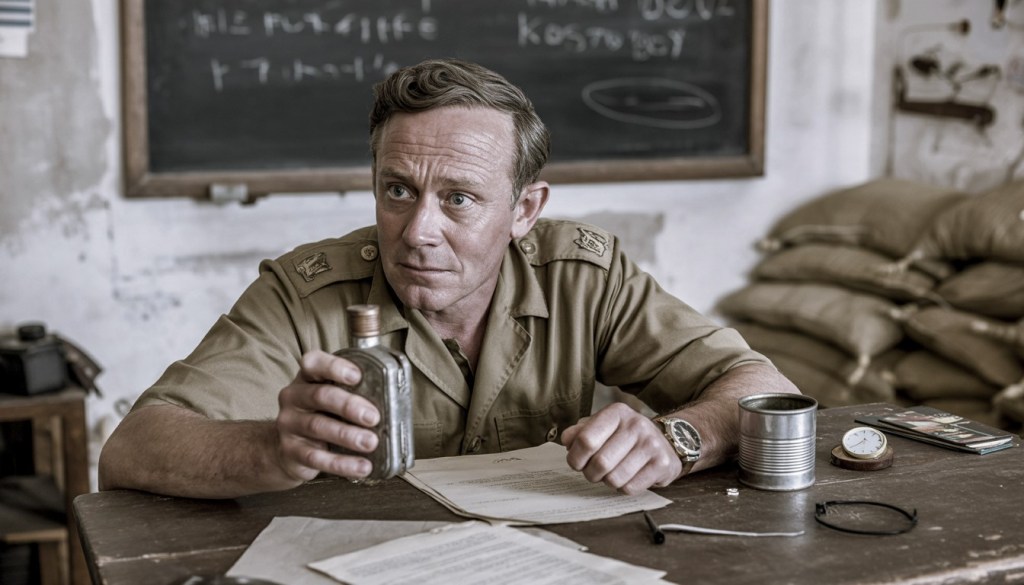
I am a judge. Or rather, I was appointed as such. Her Majesty’s Government thought it prudent to attach legal officers to certain… delicate operations. The United Nations required men versed in military law, men who might lend the colour of legality to what unfolds in the red dust of Katanga. And so I find myself here, in a requisitioned schoolhouse outside Elisabethville, where the blackboard still bears chalk marks in French and the floor is now packed earth trodden smooth by boots. The soil here is not like English soil. It is rust-coloured, ancient, and it clings. It works its way into every seam of one’s uniform, into the creases of one’s hands, beneath one’s fingernails. I have scrubbed and scrubbed, but the stain remains.
They bring me cases, such as they are. A Ghanaian corporal accused of striking a superior. An Irish sergeant found drunk on duty – there is a bitter communion in that, is there not? – and I must sit in judgement whilst the taste of whisky still coats my own tongue. They expect me to uphold discipline, to maintain order, to be the very embodiment of dispassionate justice. But how does one arbitrate fairly when one’s hands shake, when the only steadiness comes from the flask tucked into one’s battledress? I am become dependent upon it. The word shames me, but there it is. Not habituation, not mere fondness – dependence. As a man lost in the desert depends upon water, so do I depend upon drink to silence the fear that gnaws without ceasing.
The fear is this: that every decision I render, every sentence I pass, is tainted. That I am become an instrument not of justice but of expedience, a rubber stamp for operations that would make Grotius weep. They tell me the rules of engagement are clear, that our mandate is lawful. But I have read the cables, heard the wireless reports. We are here to prevent secession, they say. To restore order. Yet the methods… the methods trouble the conscience. Yesterday I was asked to review the legality of certain aerial bombardments. Civilian areas, they admitted, but harbouring mercenaries. I approved it. God help me, I approved it, because to do otherwise would have been to question the entire edifice, and I have not the courage for that. Not here. Not when the walls shake and the earth beneath one’s feet seems no more solid than water.
The earth. I think of it often. At night, when I cannot sleep, I walk the perimeter and look at the graves – shallow trenches scraped into the red soil, marked with crude crosses fashioned from ammunition crates. Men of a dozen nations, buried in African earth that cares nothing for their allegiances. The soil takes them all without distinction: the righteous and the damned, the sober and the drunk, the judge and the judged. There is a democracy in death that the living can never achieve. And I wonder, when my time comes – as surely it must, if not by bullet then by the slow corruption of this dependence – I wonder whether this red earth will hold me accountable for what I have done in Her Majesty’s name, in the name of international law, in the name of a peace that looks remarkably like war.
I am afraid. There, I have said it plainly. A judge ought not to be afraid, ought he? He ought to be Olympian, serene, untouched by passion or prejudice. But I am afraid of everything: of the mortars that fall without pattern or mercy, of the men who come before me expecting fairness I cannot give, of the bottle that promises oblivion and delivers only a briefer, sharper reckoning. Most of all, I am afraid that when I return home – if I return – I shall carry this red dust with me, this stain that will not wash clean, and that everyone will see what I have become. A drunkard in judicial robes. An arbitrator with no authority, least of all over himself.
So no, I am neither a man of the night nor of the morning. I am a man of the earth, and the earth is waiting.
Bob Lynn | © 2025 Vox Meditantis. All rights reserved.

 Vox Meditantis
Leave a comment