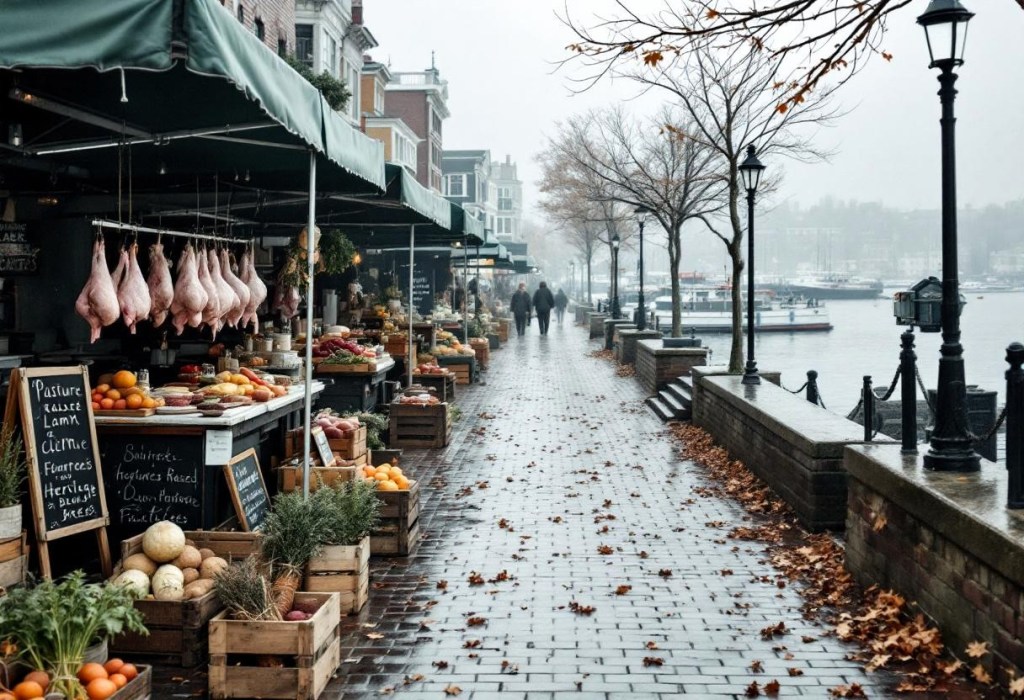
What are your feelings about eating meat?
Monday, 1st December 2025
Someone keeps asking questions that arrive like scalpels dressed as small talk, and this morning’s sits beside the kettle with its edges showing: what are your feelings about eating meat?
The kitchen smells of decisions I haven’t quite made. On the counter, the carcass from Thursday’s turkey – stripped nearly clean but still carrying enough for stock – sits beside a brown-paper parcel of lamb mince for the shepherd’s pie I’ve been planning since Michael confirmed he and Susan will arrive Friday. The turkey has that particular scent of good bones gone patient, waiting to be useful again. The lamb smells of earth and something iron-rich, of fields I’ve never walked through but can taste in the back of my throat. Between them, the morning’s coffee and last night’s lemon zest, and underneath it all – faint but insistent – the discomfort of someone who has built a life around careful attention finally turning that attention on something she’d rather leave unexamined.
I stood there longer than the moment required, hands on the worktop, feeling the cold of the lamb through its wrapping and remembering Father’s pies. Not the recipe – though I have that, transcribed in my own apologetic hand from memory, Elizabeth having been far too improvisational to write most of hers down – but the fact of them. The way they appeared on winter Saturdays with the reliability of bus schedules, lamb browned properly, vegetables softened without surrender, mashed potatoes crowned with the modest authority of a man who understood that feeding people was a form of showing up. Edible reliability, that’s what those pies were. Comfort that didn’t announce itself, warmth measured in the steam rising from a fork’s first puncture, the promise that tomorrow would come and we’d still be here to meet it.
Mother’s cooking operated under entirely different governance. In Nevada, before Washington and long before New Corinth, she’d learned to feed high-rollers and visiting salesmen with whatever the casino kitchen could spare – improvisation elevated to art form, audacity seasoned with charm. Her risottos were really brave, imprecise pilafs. Her stews accumulated ingredients the way conversations accumulate tangents, everything adjustable mid-flight, the whole enterprise an adventure she invited you to help her navigate. What both approaches shared, though neither of my parents would have named it this way, was an understanding that meat meant security. Father, who’d driven Washington routes during years when reliable work wasn’t guaranteed to men who looked like him, treated Sunday roasts as a form of evidence – see, we’re managing, we’re more than managing, there’s plenty. Mother, who remembered leaner years on the casino floor when dinner was whatever the kitchen discarded after last call, cooked meat with the zealousness of someone proving she’d arrived somewhere safe enough to be wasteful with trimmings.
I learned, without anyone saying it directly, that animal flesh on the table was how you demonstrated you’d survived another week intact. That abundance started with protein. That love, at least the reliable kind, could be measured in how carefully you browned the mince before adding stock.
Bodies as Machinery, Appetite as Maintenance
This morning I covered Rajesh’s early appointments – two patients, both straightforward enough that the hour felt less like clinical work and more like sitting with people who’d temporarily mislaid their courage and needed someone to hold space whilst they located it again. But a phrase kept surfacing, in different words from each of them, that made me think of the lamb waiting at home and the question I’ve been circling since dawn.
The first – a man in his forties, IT contractor, shoulders permanently apologetic from years hunched over keyboards – described his body as a vehicle he was “trying to keep roadworthy.” Needed fuel at regular intervals, required occasional servicing, produced error messages he didn’t have the manual to interpret. When I asked, gently, whether the vehicle ever got to rest rather than simply idling between tasks, he looked at me as though I’d suggested his car might enjoy the opera.
The second – younger, a teacher who’d been managing anxiety with the kind of white-knuckled competence I recognise far too clearly – talked about “running on fumes” and needing to “refuel properly” instead of grabbing whatever was fastest between playground duties and marking. Good intentions, familiar language. The vocabulary of maintenance rather than care, efficiency rather than tenderness.
I offered what I could – reflections on how bodies aren’t machines, how appetite is information rather than inconvenience, how feeding ourselves might be less about optimal fuelling and more about acknowledging we’re creatures with needs that don’t fit neatly into productivity metrics. All true. All things I believe deeply when I’m saying them to someone else. All things I comprehensively fail to practise when I’m standing in my own kitchen at half-seven on a Monday, staring at protein I’ll cook not because my body has asked for it but because the meal plan says it’s shepherd’s pie night and Michael expects his father’s recipes to appear when he visits, evidence that some inheritances survive translation.
Walking back from Rajesh’s rooms – his practice sits closer to the old shipyard, where the streets still smell faintly of maritime industry and the pavements haven’t yet been persuaded into gentrification – I caught myself planning the week’s meals with the strategic focus I usually reserve for complex case formulations. I’d abandoned, after two days of increasingly dispiriting research, the idea of finding a restaurant suitable for Michael and Linda’s visit. December in New Corinth and beyond means every halfway decent establishment has been colonised by office Christmas parties – tinsel, shouting over compilations of seasonal standards, that particular false joviality that comes from colleagues who’ve been mandated to celebrate together. The thought of trying to have an actual conversation with my brother whilst surrounded by tipsy accountants wearing reindeer antlers was enough to make the decision easy: I’ll dazzle them with simple home-cooked food instead, the kind that doesn’t require competing with background noise or waiting forty minutes for a table because someone’s finance department decided to book the entire ground floor.
Shepherd’s pie Friday, because it says welcome in Father’s dialect. The risotto Saturday if David joins us, because it speaks Mother’s language of abundance without fuss. A proper roast Sunday if everyone’s still here, because that’s what you do when family visits – you demonstrate, through successive applications of heat to flesh, that you’ve built a life solid enough to be generous with.
Nowhere in that planning was the question what do I actually want to eat? Or the adjacent, more troubling one: what am I willing to kill for, even at commercial remove?
The Tension That Won’t Quite Sit Flat
The truth is I love stews. The patient alchemy of tough cuts rendered tender through time and attention, the way stock becomes something nourishing when you let it simmer long enough, the particular comfort of a bowl of something that’s been cared for before it reaches the table. I love the shepherd’s pie for reasons that have nothing to do with nutrition and everything to do with the fact that Father made it on the Saturdays after difficult weeks, and eating it now is a way of keeping him at my table even though he’s been gone twelve years. I love the way a good roast brings people together, creates the kind of generous plenty that makes a meal feel less like refuelling and more like celebration.
I also hate – with a clarity that’s become harder to ignore – what happens before any of that reaches my kitchen. The factory farming, the efficient cruelties we’ve industrialised so successfully that most of us can consume meat without ever encountering the creature it came from. The environmental cost, which I understand intellectually even as I plan menus that ignore it. The quiet ethical crisis of loving the outcome whilst deploring the process, of wanting the comfort without bearing the full weight of what that comfort costs.
It would be easier if I were straightforwardly vegetarian – cleaner, more defensible, the sort of position you can state at dinner parties without requiring footnotes. But I’m not, and the reasons why resist tidy summary. Part of it is inheritance – the sense that refusing meat would be refusing something my parents worked hard to be able to offer. Part of it is the stubborn reality that my body, when I actually listen to it rather than treating it as a vehicle to be fuelled, seems to do better with animal protein in modest rotation. Part of it is sheer cowardice, the awareness that making different choices would require more courage than I’ve yet managed to locate, would mean navigating family gatherings and professional dinners with the added burden of explaining my abstention whilst everyone else tucks in.
So instead, I’ve started researching. Quietly, in the margins of evenings when the clinic notes are done and the harbour’s settled into its night watch. Looking for a butcher who sources thoughtfully – animals raised on actual pasture, slaughtered with something approximating dignity, meat that costs enough to make you reconsider whether you actually need it or whether you’re just defaulting to habit. I haven’t found one locally yet, though Dan mentioned a farm near the Pennsylvania border that supplies a few restaurants in Wilmington, and I’ve tucked the name away for further investigation.
What I have decided – modest progress, but progress nonetheless – is that when Michael and Susan arrive this weekend, I’ll make the shepherd’s pie because it speaks a language Michael understands and I want him to feel welcome. But I’ll also make something generous and entirely vegetarian, something that doesn’t feel like consolation prize or dietary restriction but like a meal you’d actually choose. Perhaps the white bean and rosemary stew I’ve been meaning to attempt, the one that smells like Tuscan hillsides I’ve never visited but can imagine from books. Perhaps a mushroom Wellington if I’m feeling ambitious and my patience with pastry holds. Something that says this too is abundance, this too is care, you get to choose what you can bear.
Not didactic. Not a lecture disguised as hospitality. Just an acknowledgement that feeding people might mean offering options rather than assumptions, letting them decide what feels right for their own bodies on this particular evening rather than deciding for them based on what Father would have served or what tradition dictates.
The Issue Underneath the Issue
But here’s the admission that’s been waiting since I first read this morning’s question, the one I’ve been avoiding by talking about farms and recipes and my parents’ complicated relationships with scarcity: the real meat issue, for me, isn’t actually about meat at all.
It’s about consent.
In the consulting room, I spend hours – decades now – helping people learn to hear their own needs, to trust their bodies’ signals, to understand that they’re allowed to say this is too much or I’d prefer something different or actually, I’m not hungry for what’s being offered. I teach, with what I hope is gentle persistence, that caring for someone doesn’t mean deciding for them what they can stomach. That intimacy requires asking rather than assuming. That love, the sustainable kind, involves learning someone’s actual appetite rather than feeding them what you’ve decided would be nourishing.
Then I plan a menu for Michael’s visit without asking what he’d actually like to eat. I assume David will want the risotto because he seemed to enjoy it, without considering that tastes change or that what felt right in autumn might not suit December. I design meals for patients’ wellbeing – encouraging them to notice hunger and satisfaction – whilst standing in my own kitchen treating dinner as a logistical problem to be solved rather than an opportunity to check in with what my own creature-self might be asking for.
The metaphor isn’t subtle. It doesn’t need to be. The pattern is consistent enough to make itself plain: I’m far better at facilitating other people’s choices than I am at honouring my own, far more comfortable offering options than actually having preferences, significantly more practiced at feeding people what I think they need than at asking what they actually want.
This weekend, Michael and Susan will arrive. David may or may not join us for Saturday’s meal – I’ve learned, slowly, to issue invitations without requiring immediate answers, to trust that he’ll show up if it suits and won’t if it doesn’t, and that neither outcome needs to be turned into evidence about the state of things. The shepherd’s pie will appear because some inheritances deserve honouring. The vegetarian option will appear because some acknowledgements can’t be postponed forever. And somewhere between those two offerings, I’m going to try – quietly, without announcement – to practise what I’m always preaching: that feeding people, whether family or patients or the careful-handed man who washes dishes with unreasonable attention, might be less about getting the menu right and more about creating space for them to know what they can bear.
The turkey carcass will become stock sometime this week. The lamb will become pie on Friday evening. And the question will keep sitting beside the kettle, asking in its mild, persistent way whether I’m ready yet to stop treating appetite – mine and everyone else’s – as something to be managed rather than consulted, solved rather than witnessed, fuelled rather than genuinely fed.
Edges showing, indeed. The scalpel’s doing its work whether I’m ready or not.
The harbour’s gone the colour of tarnished silver, December asserting itself with that particular cold that makes you grateful for soups and stews and the promise of warm kitchens. Tomorrow I’ll cover my own appointments, not Rajesh’s, and the ordinary architecture of Tuesday will reassert itself. But tonight, the question sits answered – or at least acknowledged – and the lamb sits defrosting, and somewhere between the two I’m learning that feelings about meat are really feelings about how we feed each other without assuming we know what anyone can stomach, this weekend or otherwise.
Enough for one Monday evening. The creature wants tea.
Catherine
Bob Lynn | © 2025 Vox Meditantis. All rights reserved.

 Vox Meditantis
Leave a comment